Skip to comments.
Catholic Caucus: Daily Mass Readings: 09-09-19, M, St. Saint Peter Claver, Priest
USCCB.org/RNAB ^
| 09-09-19
| Revised New American Bible
Posted on 09/08/2019 10:22:01 PM PDT by Salvation
September 9 2019
Memorial of Saint Peter Claver, Priest
Brothers and sisters:
I rejoice in my sufferings for your sake,
and in my flesh I am filling up
what is lacking in the afflictions of Christ
on behalf of his Body, which is the Church,
of which I am a minister
in accordance with God’s stewardship given to me
to bring to completion for you the word of God,
the mystery hidden from ages and from generations past.
But now it has been manifested to his holy ones,
to whom God chose to make known the riches of the glory
of this mystery among the Gentiles;
it is Christ in you, the hope for glory.
It is he whom we proclaim,
admonishing everyone and teaching everyone with all wisdom,
that we may present everyone perfect in Christ.
For this I labor and struggle,
in accord with the exercise of his power working within me.
For I want you to know how great a struggle I am having for you
and for those in Laodicea
and all who have not seen me face to face,
that their hearts may be encouraged
as they are brought together in love,
to have all the richness of assured understanding,
for the knowledge of the mystery of God, Christ,
in whom are hidden all the treasures of wisdom and knowledge.
R.(8) In God is my safety and my glory.
Only in God be at rest, my soul,
for from him comes my hope.
He only is my rock and my salvation,
my stronghold; I shall not be disturbed.
R. In God is my safety and my glory.
Trust in him at all times, O my people!
Pour out your hearts before him;
God is our refuge!
R. In God is my safety and my glory.
R. Alleluia, alleluia.
My sheep hear my voice, says the Lord;
I know them, and they follow me.
R. Alleluia, alleluia.
On a certain sabbath Jesus went into the synagogue and taught,
and there was a man there whose right hand was withered.
The scribes and the Pharisees watched him closely
to see if he would cure on the sabbath
so that they might discover a reason to accuse him.
But he realized their intentions
and said to the man with the withered hand,
"Come up and stand before us."
And he rose and stood there.
Then Jesus said to them,
"I ask you, is it lawful to do good on the sabbath
rather than to do evil,
to save life rather than to destroy it?"
Looking around at them all, he then said to him,
"Stretch out your hand."
He did so and his hand was restored.
But they became enraged
and discussed together what they might do to Jesus.
For the readings of the Memorial of Saint Peter Claver, please go here.
TOPICS: Catholic; General Discusssion; Prayer; Worship
KEYWORDS: catholic; lk6; ordinarytime; prayer; saints
Navigation: use the links below to view more comments.
first 1-20, 21-31 next last
For your reading, reflection, faith-sharing, comments, questions, discussion.
1
posted on
09/08/2019 10:22:01 PM PDT
by
Salvation
To: All
KEYWORDS: catholic; lk6; ordinarytime; prayer; saints;
2
posted on
09/08/2019 10:22:49 PM PDT
by
Salvation
("With God all things are possible." Matthew 19:26)
To: nickcarraway; NYer; ELS; Pyro7480; livius; ArrogantBustard; Catholicguy; RobbyS; marshmallow; ...
Alleluia PingPlease FReepmail me to get on/off the Alleluia Ping List.
3
posted on
09/08/2019 10:29:34 PM PDT
by
Salvation
("With God all things are possible." Matthew 19:26)
To: All
From: Colossians 1:24-2:3
Paul’s response to his calling
[24] Now I rejoice in my sufferings for your sake, and in my flesh I complete what
is lacking in Christ’s afflictions for the sake of his body, that is, the church, [25]
of which I became a minister according to the divine office which was given to
me for you, to make the word of God fully known, [26] the mystery hidden for
ages and generations but now made manifest to his saints. [27] To them God
chose to make known how great among the Gentiles are the riches of the glory
of this mystery, which is Christ in you, the hope of glory. [28] Him we proclaim,
warning every man and teaching every man in all wisdom, that we may present
every man mature in Christ. [29] For this I toil, striving with all the energy which
he mightily inspires within me.
St. Paul’s concern for the faithful
[1] For I want you to know how greatly I strive for you, and for those at Laodicea,
and for all who have not seen my face, [2] that their hearts may be encouraged
as they are knit together in love, to have all the riches of assured understanding
and the knowledge of God’s mystery, of Christ, [3] in whom are hid all the trea-
sures of wisdom and knowledge.
*********************************************************************************************
Commentary:
24. Jesus Christ our Lord perfectly accomplished the work the Father gave him
to to (cf. Jn 17:4); as he said himself when he was about to die, “It is finished†,
it is accomplished (Jn 19:30).
From that point onwards objective redemption is an accomplished fact. All men
have been saved by the redemptive death of Christ. However, St Paul says that
he completes in his flesh “what is lacking in Christ’s afflictions†; what does he
mean by this? The most common explanation of this statement is summarized
by St Alphonsus as follows: “Can it be that Christ’s passion alone was insuffi-
cient to save us? It left nothing more to be done, it was entirely sufficient to save
all men. However, for the merits of the Passion to be applied to us, according to
St. Thomas (Summa theologiae, III, q. 49, a. 3), we need to cooperate (subjective
redemption) by patiently bearing the trials God sends us, so as to become like
our head, Christ†(St Alphonsus, “Thoughts on the Passion”, 10).
St Paul is applying this truth to himself. Jesus Christ worked and strove in all
kinds of ways to communicate his message of salvation, and then he accomp-
lished the redemption by dying on the Cross. The Apostle is mindful of the Mas-
ter’s teaching and so he follows in his footsteps (cf. 1 Pet 2:21), takes up his
cross (cf. Mt 10:38) and continues the task of bringing Christ’s teaching to all
men.
Faith in the fact that we are sharing in the sufferings of Christ, Bl. John Paul II
says, gives a person “the certainty that in the spiritual dimension of the work of
Redemption he is serving, like Christ, the salvation of his brothers and sisters.
Therefore he is carrying out an irreplaceable service. In the Body of Christ, which
is ceaselessly born of the Cross of the Redeemer, it is precisely suffering per-
meated by the spirit of Christ’s sacrifice that is the irreplaceable mediator and
author of the good things which are indispensable for the world’s salvation. It is
suffering, more than anything else, which clears the way for the grace which
transforms human souls. Suffering, more than anything else, makes present in
the history of humanity the force of the Redemption†(”Salvifici doloris”, 27).
26-27. The “mystery†, now revealed, is God’s eternal plan to give salvation to
men, both Jews and Gentiles, making all without distinction co-heirs of glory
and members of a single body which is the Church (cf. Eph 3:6), through faith
in Jesus Christ (cf. Rom 15:25-26).
In Christ, who has brought salvation to Gentile and Jew, the “mystery†is fully re-
vealed. His presence in Christians of Gentile origin is in fact a very clear manifes-
tation of the supernatural fruitfulness of the “mystery†and an additional ground
for Christians’ hope. Thanks to this presence people who do not form part of Is-
rael are enabled to attain salvation. Previously subject to the power of darkness
and slaves of sin (vv. 13-14), the have now died to sin through Baptism (cf. Rom
6:2-3) and Christ, through grace, dwells in their hearts (on the salvific “mystery†,
cf. notes on Eph 1:13-14 and Eph 1:9, and “Introduction to the letters of St Paulâ€
in The Navarre Bible: Romans and Galatians, pp. 32-33).
In his infinite love Christ lives in us through faith and grace, through prayer and
the sacraments. Also, “he is present when the Church prays and sings, for he
has promised ‘where two or three are gathered in my name, there am I in the
midst of them’ (Mt 18:20)†(Vatican II, “Sacrosanctum Concilium”, 7).
“Christ stays in his Church, its sacraments, its liturgy, its preaching – in all that
it does. In a special way Christ stays with us in the daily offering of the Blessed
Eucharist […]. The presence of Christ in the host is the guarantee, the source
and the culmination of his presence in the world.
“Christ is alive in Christians. Our faith teaches us that man, in the state of grace,
is divinized – filled with God. We are men and women, not angels. We are flesh
and blood, people with sentiments and passions, with sorrows and joys. And this
divinization affects everything human; it is a sort of foretaste of the final resurrec-
tion†(St. J. Escriva, “Christ is passing by”, 102-103).
28. “In all wisdom†: St Paul is exhorting and teaching each and every one, com-
municating wisdom, the true teaching of Jesus Christ. The text clearly shows St
Paul’s conviction that he is a faithful transmitter of teachings revealed by God.
Possessed of such wisdom he is confident that he can lead his disciples to
Christian perfection.
2-3. The term “mystery†, which St Paul uses on other occasions (cf. 1:26; Eph
1:9), refers in this verse expressly to Christ: Christ is the complete manifestation
of the divine plan or “mystery†designed to bring about the salvation of mankind.
The name Jesus means Saviour and indicates his principal mission – to save
the people of Israel (and through them all mankind) from their sins (cf. Mt 1:21).
The assertion that in Christ “are hid all the treasures of wisdom and knowledgeâ€
is based on the fact that Christ – God made man – is the incarnation of divine
Wisdom itself, for Wisdom is one of the names applied in Sacred Scripture to
the second Person of the Blessed Trinity. Hence St Athanasius’ comment that
“God no longer chose to make himself known, as in times past, by the reflection
and shadow of wisdom to be seen in created things: he determined that Wisdom
itself, in person, should become incarnate, should be made man and suffer death
on the cross, so that from then on all the faithful might attain salvation through
faith grounded on the cross†(”Oratio II contra Arianos”).
The infinite richness of wisdom and knowledge hidden in Christ means that medi-
tation on his life and his teachings is an inexhaustible source of nourishment for
the life of the soul. “There are great depths to be fathomed in Christ. For he is
like an abandoned mine with many recesses containing treasures, of which, for
all that men try to fathom them, the end and bottom is never reached; rather in
each recess men continue to find new veins of new riches on all sides†(St. John
of the Cross, “Spiritual Canticle”, 37, 3).
*********************************************************************************************
Source: “The Navarre Bible: Text and Commentaries”. Biblical text from the
Revised Standard Version and New Vulgate. Commentaries by members of
the Faculty of Theology, University of Navarre, Spain.
Published by Four Courts Press, Kill Lane, Blackrock, Co. Dublin, Ireland, and
by Scepter Publishers in the United States.
4
posted on
09/08/2019 10:36:17 PM PDT
by
Salvation
("With God all things are possible." Matthew 19:26)
To: All
From: Luke 6:6-11
The Cure of a Man with a Withered Hand
[6] On another Sabbath, when He (Jesus) entered the synagogue and taught, a
man was there whose right hand was withered. [7] And the scribes and the Pha-
risees watched Him, to see whether He would heal on the Sabbath, so that they
might find an accusation against Him. [8] But He knew their thoughts, and He
said to the man who had the withered hand, “Come and stand here.” And he
rose and stood there. [9] And Jesus said to them, “I ask you, is it lawful on the
Sabbath to do good or to do harm, to save life or to destroy it?” [10] And He
looked around on them all, and said to him, “Stretch out your hand.” And he did
so, and his hand was restored. [11] But they were filled with fury and discussed
with one another what they might do to Jesus.
*********************************************************************************************
Commentary:
10. The Fathers teach us how to discover a deep spiritual meaning in apparently
casual things Jesus says. St. Ambrose, for example, commenting on the phrase
“Stretch out your hand,” says: “This form of medicine is common and general.
Offer it often, in benefit of your neighbor; defend from injury anyone who seems
to be suffering as a result of calumny; stretch your hand out also to the poor man
who asks for your help; stretch it out also to the Lord asking Him to forgive your
sins; that is how you should stretch your hand out, and that is the way to be
cured” (”Expositio Evangelii sec. Lucam, in loc”.).
11. The Pharisees do not want to reply to Jesus’ question and do not know how
to react to the miracle which He goes on to work. It should have converted them,
but their hearts were in darkness and they were full of jealousy and anger. Later
on, these people, who kept quiet in our Lord’s presence, began to discuss Him
among themselves, not with a view to approaching Him again but with the pur-
pose of doing away with Him. In this connection St. Cyril comments: “O Phari-
see, you see Him working wonders and healing the sick by using a higher power,
yet out of envy you plot His death” (”Commentarium in Lucam, in loc.”).
*********************************************************************************************
Source: “The Navarre Bible: Text and Commentaries”. Biblical text from the
Revised Standard Version and New Vulgate. Commentaries by members of
the Faculty of Theology, University of Navarre, Spain.
Published by Four Courts Press, Kill Lane, Blackrock, Co. Dublin, Ireland, and
by Scepter Publishers in the United States.
5
posted on
09/08/2019 10:38:34 PM PDT
by
Salvation
("With God all things are possible." Matthew 19:26)
To: All
Scripture readings from the Jerusalem Bible by Darton, Longman & Todd
Readings at Mass
Liturgical Colour: Green.
| First reading |
| Colossians 1:24-2:3 © |
| God's message was a mystery hidden for generations |
It makes me happy to suffer for you, as I am suffering now, and in my own body to do what I can to make up all that has still to be undergone by Christ for the sake of his body, the Church. I became the servant of the Church when God made me responsible for delivering God’s message to you, the message which was a mystery hidden for generations and centuries and has now been revealed to his saints. It was God’s purpose to reveal it to them and to show all the rich glory of this mystery to pagans. The mystery is Christ among you, your hope of glory: this is the Christ we proclaim, this is the wisdom in which we thoroughly train everyone and instruct everyone, to make them all perfect in Christ. It is for this I struggle wearily on, helped only by his power driving me irresistibly.
Yes, I want you to know that I do have to struggle hard for you, and for those in Laodicea, and for so many others who have never seen me face to face. It is all to bind you together in love and to stir your minds, so that your understanding may come to full development, until you really know God’s secret in which all the jewels of wisdom and knowledge are hidden.
| Responsorial Psalm |
| Psalm 61(62):6-7,9 © |
In God is my safety and glory.
In God alone be at rest, my soul;
for my hope comes from him.
He alone is my rock, my stronghold,
my fortress: I stand firm.
In God is my safety and glory.
Take refuge in God, all you people.
Trust him at all times.
Pour out your hearts before him
for God is our refuge.
In God is my safety and glory.
| Gospel Acclamation |
Ps118:105 |
Alleluia, alleluia!
Your word is a lamp for my steps
and a light for my path.
Alleluia!
Alleluia, alleluia!
The sheep that belong to me listen to my voice,
says the Lord,
I know them and they follow me.
Alleluia!
| Is it against the law on the sabbath to save life? |
On the sabbath Jesus went into the synagogue and began to teach, and a man was there whose right hand was withered. The scribes and the Pharisees were watching him to see if he would cure a man on the sabbath, hoping to find something to use against him. But he knew their thoughts; and he said to the man with the withered hand, ‘Stand up! Come out into the middle.’ And he came out and stood there. Then Jesus said to them, ‘I put it to you: is it against the law on the sabbath to do good, or to do evil; to save life, or to destroy it?’ Then he looked round at them all and said to the man, ‘Stretch out your hand.’ He did so, and his hand was better. But they were furious, and began to discuss the best way of dealing with Jesus.
6
posted on
09/08/2019 10:41:10 PM PDT
by
Salvation
("With God all things are possible." Matthew 19:26)
To: Salvation
| Luke |
| |
English: Douay-Rheims |
Latin: Vulgata Clementina |
Greek NT: Byzantine/Majority Text (2000) |
| |
Luke 6
|
| 6. |
And it came to pass also on another sabbath, that he entered into the synagogue, and taught. And there was a man, whose right hand was withered. |
Factum est autem in alio sabbato, ut intraret in synagogam, et doceret. Et erat ibi homo, et manus ejus dextra erat arida. |
εγενετο δε και εν ετερω σαββατω εισελθειν αυτον εις την συναγωγην και διδασκειν και ην εκει ανθρωπος και η χειρ αυτου η δεξια ην ξηρα |
| 7. |
And the scribes and Pharisees watched if he would heal on the sabbath; that they might find an accusation against him. |
Observabant autem scribæ et pharisæi si in sabbato curaret, ut invenirent unde accusarent eum. |
παρετηρουν δε οι γραμματεις και οι φαρισαιοι ει εν τω σαββατω θεραπευσει ινα ευρωσιν κατηγοριαν αυτου |
| 8. |
But he knew their thoughts; and said to the man who had the withered hand: Arise, and stand forth in the midst. And rising he stood forth. |
Ipse vero sciebat cogitationes eorum : et ait homini qui habebat manum aridam : Surge, et sta in medium. Et surgens stetit. |
αυτος δε ηδει τους διαλογισμους αυτων και ειπεν τω ανθρωπω τω ξηραν εχοντι την χειρα εγειραι και στηθι εις το μεσον ο δε αναστας εστη |
| 9. |
Then Jesus said to them: I ask you, if it be lawful on the sabbath days to do good, or to do evil; to save life, or to destroy? |
Ait autem ad illos Jesus : Interrogo vos si licet sabbatis benefacere, an male : animam salvam facere, an perdere ? |
ειπεν ουν ο ιησους προς αυτους επερωτησω υμας τι εξεστιν τοις σαββασιν αγαθοποιησαι η κακοποιησαι ψυχην σωσαι η αποκτειναι |
| 10. |
And looking round about on them all, he said to the man: Stretch forth thy hand. And he stretched it forth: and his hand was restored. |
Et circumspectis omnibus dixit homini : Extende manum tuam. Et extendit : et restituta est manus ejus. |
και περιβλεψαμενος παντας αυτους ειπεν αυτω εκτεινον την χειρα σου ο δε εποιησεν και αποκατεσταθη η χειρ αυτου υγιης ως η αλλη |
| 11. |
And they were filled with madness; and they talked one with another, what they might do to Jesus. |
Ipsi autem repleti sunt insipientia, et colloquebantur ad invicem, quidnam facerent Jesu. |
αυτοι δε επλησθησαν ανοιας και διελαλουν προς αλληλους τι αν ποιησειαν τω ιησου |
7
posted on
09/09/2019 5:06:05 AM PDT
by
annalex
(fear them not)
To: annalex
6. And it came to pass also on another sabbath, that he entered into the synagogue and taught: and there was a man whose right hand was withered.
7. And the Scribes and Pharisees watched him, whether he would heal on the sabbath day; that they might find an accusation against him.
8. But he knew their thoughts, and said to the man which had the withered hand, Rise up, and stand forth in the midst. And he arose and stood forth.
9. Then said Jesus to them, I will ask you one thing; Is it lawful on the sabbath days to do good, or to do evil? to save life, or to destroy it?
10. And looking round about upon them all, he said to the man, Stretch forth your hand. And he did so: and his hand was restored whole as the other.
11. And they were filled with madness; and communed one with another what they might do to Jesus.
AMBROSE; The Lord now proceeds to another work. For He who had determined to make the whole man safe, was able to cure each member. Hence it is said, And it came to pass also on another sabbath, that he entered into the synagogue and taught.
THEOPHYL; He chiefly heals and teaches on the sabbaths, not only to convey the meaning of a spiritual sabbath, but because of the more numerous assembly of the people.
CYRIL; But He taught things far beyond their comprehension, and opened to his hearers the way to future salvation by Him; and then after having first taught them, He suddenly showed His divine power, as it follows, and there was a man there whose right hand was withered.
THEOPHYL; But since the Master had excused by an undeniable example the breach of the sabbath, with which they charged His disciples, their object is now by watching to bring a false accusation against the Master Himself. As it follows, And the Scribes and Pharisees watched him, if he would heal on the sabbath, that if He did not, they might accuse Him of cruelty or impotence; if He did, of violation of the sabbath. Hence it follows, that they might find an accusation against him.
CYRIL; For this is the way of the envious man, he feeds in himself his pang of grief with the praises of others. But the Lord knew all things, and searches the hearts; as it follows, But he knew their thoughts, and said to the man who had the withered hand, Rise up, and stand. And he arose, and stood forth, that perchance he might stir up the cruel Pharisees to pity, and allay the flames of their passion.
THEOPHYL; But the Lord anticipating the false charge which they were preparing against Him, reproves those who by wrongly interpreting the law thought that they must rest on the sabbath-day even from good works; whereas the law commands us to abstain from servile works, i.e. from evil, on the sabbath. Hence it follows, Then said Jesus to them, I ask you, Is it lawful to do good on the sabbath, &c.
CYRIL; This is a very useful question, for if it is lawful to do good on the sabbath, and there is no reason why those who work should not obtain mercy from God, cease to gather up accusation against Christ. But if it be not lawful to do good on the sabbath, and the law prohibits the safety of life, you are become the accuser of the law. For if we examine the very institution of the sabbath, we shall find it was introduced for an object of mercy, for God commanded to keep holy the sabbath, that may rest your man servant and your maid servant, and all your cattle. But he who has mercy on his ox, and the rest of his cattle, how much rather will he not have mercy on man troubled with a severe disease?
AMBROSE; But the law by things present prefigured the form of things future, among which surely the days of rest to come are to be not from good works but from evil. For although secular works may be given up, yet it is no idle act of a good work to rest in the praise of God.
AUG. But though our Lord was healing the body, He asked this question, "is it lawful to save the soul or to lose it?" either because He performed His miracles on account of faith in which is the salvation of the soul; or, because the cure of the right hand signified the salvation of the soul, which ceasing to do good works, seemed in some measure to have a withered right hand, i.e. He placed the soul for the man, as men are wont to say, "So many souls were there."
AUG. But it may be questioned how Matthew came to say, that they asked the Lord, whether it was lawful to heal on the sabbath, when Luke in this place states that they rather were asked of the Lord. We must therefore believe that they first asked the Lord, and that then He understanding by their thoughts that they sought an opportunity to accuse Him, placed the man in the midst whom He was going to heal, and asked the question which Mark and Luke relate Him to have asked. It follows, And looking round about upon them all.
TITUS BOS. When the eyes of all were, as it were riveted together, and their minds also fixed upon the consideration of the matter, he said to the man, Stretch forth your hand; I command you, Who created man. But he who had the withered hand hears, and is made whole hole, as it follows, And be stretched it, and it was restored.
But they who should have been astonished at the miracle, increased in malice; as it follows, But they were filled with madness; and communed one with another what they should do to Jesus.
CHRYS. And as Matthew relates, they go out to take counsel, that they should kill him.
CYRIL; You perceive, O Pharisee, a divine Worker, and Him Who delivers the sick by His heavenly power, and out of envy you breath forth death.
THEOPHYL; The man represents the human race, withered by the unfruitfulness of good works, because of the hand in our first parent stretched forth to take the apple, which was healed by the innocent hand stretched forth on the cross. And rightly was the withered hand in the synagogue, because where there is the greater gift of knowledge, there the transgressor lies under the greater blame.
AMBROSE; You have heard then the words of Him who says, Stretch forth your hand. That is a frequent and common cure, and you that think your hand is whole, beware lest it be contracted by avarice or sacrilege. Stretch it forth oftener to help your neighbor, to protect the widow, to save from injury him whom you see the victim of unjust attack; stretch it forth to the poor man who beseeches you; stretch it forth to the Lord, to ask pardon of your sins; as the hand is stretched forth so is it healed.
Catena Aurea Luke 6
8
posted on
09/09/2019 5:06:49 AM PDT
by
annalex
(fear them not)
To: annalex
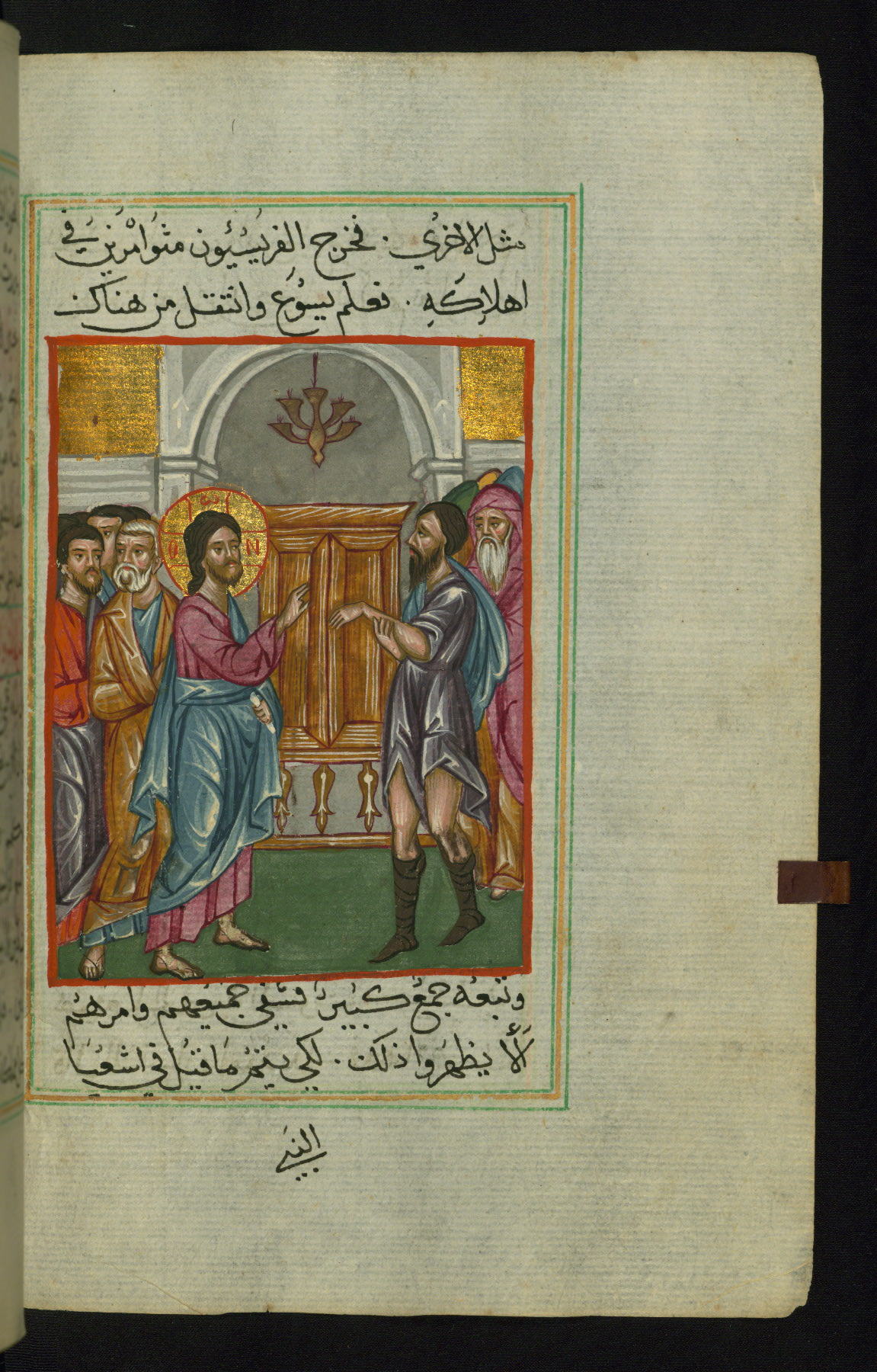
Jesus heals the man with a withered hand
Arabic manuscript of the Gospels by Matthew (Mattá), Mark (Marquṣ), Luke (Lūqā), and John (Yūḥannā)
Walters Ms. W.592, Gospels
Ilyās Bāsim Khūrī Bazzī Rāhib Anno Mundi 7192 / AD 1684
Abstract from the source
Text title
Anājīl
Vernacular: اناجيل
Abstract
This illuminated and illustrated Arabic manuscript of the Gospels by Matthew (Mattá), Mark (Marquṣ), Luke (Lūqā), and John (Yūḥannā) was copied in Egypt by Ilyās Bāsim Khūrī Bazzī Rāhib, who was most likely a Coptic monk, in Anno Mundi 7192 / 1684 CE. The text is written in naskh in black ink with rubrics in red. The decoration is comprised of illuminated headpieces, numerous floral paintings, and approximately fifty illustrations (fols. 3a, 8a, 10a, 18a, 20b, 23a, 24a, 25a, 31b, 39a, 41a, 43a, 47a, 48b, 58a, 74a, 81b, 85b, 86b, 88b, 89b, 131b, 134b, 137b, 138b, 143b, 151a, 157a, 161a, 166a, 169a, 188b, 190b, 192b, 196a, 201a, 204b, 207a, 208b, 212a, 215a, 219a, 223b, 231a, 234a, 240b, 244a, 245a, 254b, and 260a ). The brown goatskin binding with blind-tooled central oval medallion, pendants, and cornerpieces is contemporary with the manuscript.
9
posted on
09/09/2019 5:07:56 AM PDT
by
annalex
(fear them not)
To: annalex
Saint Peter Claver’s Story
A native of Spain, young Jesuit Peter Claver left his homeland forever in 1610 to be a missionary in the colonies of the New World. He sailed into Cartagena, a rich port city washed by the Caribbean. He was ordained there in 1615.
By this time the slave trade had been established in the Americas for nearly 100 years, and Cartagena was a chief center for it. Ten thousand slaves poured into the port each year after crossing the Atlantic from West Africa under conditions so foul and inhuman that an estimated one-third of the passengers died in transit. Although the practice of slave-trading was condemned by Pope Paul III and later labeled “supreme villainy” by Pope Pius IX, it continued to flourish.
Peter Claver’s predecessor, Jesuit Father Alfonso de Sandoval, had devoted himself to the service of the slaves for 40 years before Claver arrived to continue his work, declaring himself “the slave of the Negroes forever.”
As soon as a slave ship entered the port, Peter Claver moved into its infested hold to minister to the ill-treated and exhausted passengers. After the slaves were herded out of the ship like chained animals and shut up in nearby yards to be gazed at by the crowds, Claver plunged in among them with medicines, food, bread, brandy, lemons, and tobacco. With the help of interpreters he gave basic instructions and assured his brothers and sisters of their human dignity and God’s love. During the 40 years of his ministry, Claver instructed and baptized an estimated 300,000 slaves.
Fr. Claver’s apostolate extended beyond his care for slaves. He became a moral force, indeed, the apostle of Cartagena. He preached in the city square, gave missions to sailors and traders as well as country missions, during which he avoided, when possible, the hospitality of the planters and owners and lodged in the slave quarters instead.
After four years of sickness, which forced the saint to remain inactive and largely neglected, he [died] on September 8, 1654. The city magistrates, who had previously frowned at his solicitude for the black outcasts, ordered that he should be buried at public expense and with great pomp.
Peter Claver was canonized in 1888, and Pope Leo XIII declared him the worldwide patron of missionary work among black slaves.
Reflection
The Holy Spirit’s might and power are manifested in the striking decisions and bold actions of Peter Claver. A decision to leave one’s homeland never to return reveals a gigantic act of will difficult for us to imagine. Peter’s determination to serve forever the most abused, rejected, and lowly of all people is stunningly heroic. When we measure our lives against such a man’s, we become aware of our own barely used potential and of our need to open ourselves more to the jolting power of Jesus’ Spirit.
Saint Peter Claver is the Patron Saint of:
African Americans
African Missions
Colombia
Comedians
Communication Workers
Interracial Justice
10
posted on
09/09/2019 5:14:19 AM PDT
by
annalex
(fear them not)
To: annalex
11
posted on
09/09/2019 5:16:47 AM PDT
by
annalex
(fear them not)
To: All
12
posted on
09/09/2019 9:40:29 PM PDT
by
Salvation
("With God all things are possible." Matthew 19:26)
To: All
13
posted on
09/09/2019 9:41:19 PM PDT
by
Salvation
("With God all things are possible." Matthew 19:26)
To: All
14
posted on
09/09/2019 9:41:49 PM PDT
by
Salvation
("With God all things are possible." Matthew 19:26)
To: All
15
posted on
09/09/2019 9:42:19 PM PDT
by
Salvation
("With God all things are possible." Matthew 19:26)
To: All
16
posted on
09/09/2019 9:42:49 PM PDT
by
Salvation
("With God all things are possible." Matthew 19:26)
To: All
17
posted on
09/09/2019 9:43:27 PM PDT
by
Salvation
("With God all things are possible." Matthew 19:26)
To: All
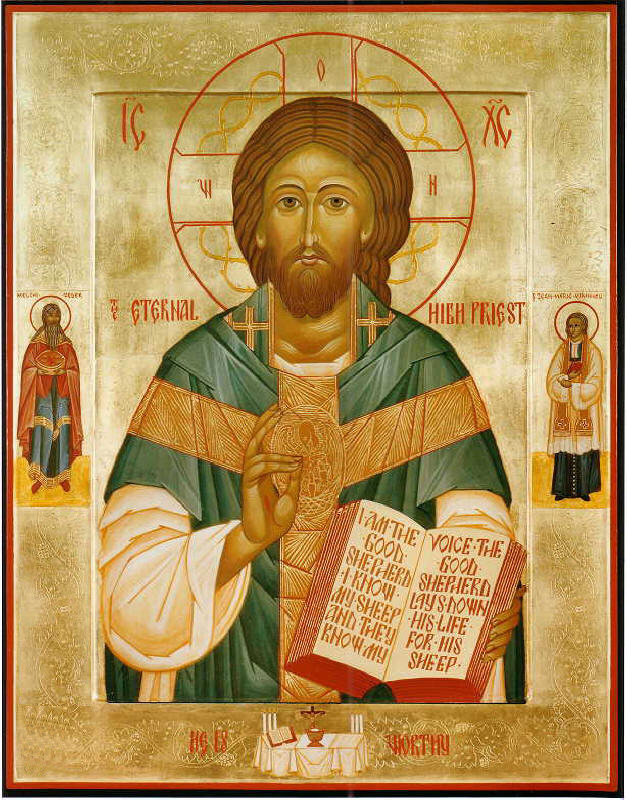
Jesus, High Priest
We thank you, God our Father, for those who have responded to your call to priestly ministry.
Accept this prayer we offer on their behalf: Fill your priests with the sure knowledge of your love.
Open their hearts to the power and consolation of the Holy Spirit.
Lead them to new depths of union with your Son.
Increase in them profound faith in the Sacraments they celebrate as they nourish, strengthen and heal us.
Lord Jesus Christ, grant that these, your priests, may inspire us to strive for holiness by the power of their example, as men of prayer who ponder your word and follow your will.
O Mary, Mother of Christ and our mother, guard with your maternal care these chosen ones, so dear to the Heart of your Son.
Intercede for our priests, that offering the Sacrifice of your Son, they may be conformed more each day to the image of your Son, our Lord and Savior, Jesus Christ. Amen.
Saint John Vianney, universal patron of priests, pray for us and our priests
This icon shows Jesus Christ, our eternal high priest.
The gold pelican over His heart represents self-sacrifice.
The border contains an altar and grapevines, representing the Mass, and icons of Melchizedek and St. Jean-Baptiste Vianney.
Melchizedek: king of righteousness (left icon) was priest and king of Jerusalem. He blessed Abraham and has been considered an ideal priest-king.
St. Jean-Baptiste Vianney is the patron saint of parish priests.
18
posted on
09/09/2019 9:44:37 PM PDT
by
Salvation
("With God all things are possible." Matthew 19:26)
To: All
Pray a Rosary each day for our nation.
1. Sign of the Cross: In the name of the Father, and of the Son, and of the Holy Spirit. Amen.
2. The Apostles Creed: I BELIEVE in God, the Father almighty, Creator of heaven and earth, and in Jesus Christ, His only Son, our Lord, who was conceived by the Holy Spirit, born of the Virgin Mary, suffered under Pontius Pilate, was crucified, died, and was buried. He descended into hell; on the third day he rose again from the dead; he ascended into heaven, and is seated at the right hand of God, the Father Almighty; from there He shall come to judge the living and the dead.
I believe in the Holy Spirit, the holy catholic Church, the communion of saints, the forgiveness of sins, the resurrection of the body, and the life everlasting. Amen.
3. The Lord's Prayer: OUR Father, who art in heaven, hallowed be Thy name. Thy kingdom come. Thy will be done on earth as it is in heaven. Give us this day our daily bread and forgive us our trespasses as we forgive those who trespass against us. And lead us not into temptation, but deliver us from evil. Amen.
4. (3) Hail Mary: HAIL Mary, full of grace, the Lord is with thee. Blessed art thou amongst women and blessed is the fruit of thy womb, Jesus. Holy Mary, Mother of God, pray for us sinners, now, and in the hour of our death. Amen. (Three times)
5. Glory Be: GLORY be to the Father, and to the Son, and to the Holy Spirit. As it was in the beginning, is now, and ever shall be, world without end. Amen.
6. Fatima Prayer: Oh, my Jesus, forgive us our sins, save us from the fires of hell, lead all souls to heaven, especially those in most need of your mercy.
Announce each mystery, then say 1 Our Father, 10 Hail Marys, 1 Glory Be and 1 Fatima prayer. Repeat the process with each mystery.
End with the Hail Holy Queen:
Hail, Holy Queen, Mother of Mercy, our life, our sweetness and our hope! To thee do we cry, poor banished children of Eve! To thee do we send up our sighs, mourning and weeping in this vale of tears! Turn then, most gracious advocate, thine eyes of mercy towards us; and after this, our exile, show unto us the blessed fruit of thy womb, Jesus!
O clement, O loving, O sweet Virgin Mary! Pray for us, O holy Mother of God, that we may be made worthy of the promises of Christ.
Final step -- The Sign of the Cross
The Mysteries of the Rosary By tradition, Catholics meditate on these Mysteries during prayers of the Rosary. The biblical references follow each of the Mysteries below.
The Joyful Mysteries
(Mondays and Saturdays)
1. The Annunciation (Luke 1:26-38) [Spiritual fruit - Humility]
2. The Visitation (Luke 1: 39-56) [Spiritual fruit - Love of Neighbor]
3. The Nativity (Luke 2:1-20) [Spiritual fruit - Poverty of Spirit]
4. The Presentation (Luke 2:21-38) [Spiritual fruit - Purity of mind & body]
5. The Finding of Jesus in the Temple (Luke 2:41-52) [Spiritual fruit - Obedience ]
19
posted on
09/09/2019 9:45:19 PM PDT
by
Salvation
("With God all things are possible." Matthew 19:26)
To: All

St. Michael the Archangel
~ PRAYER ~
St. Michael, the Archangel, defend us in battle
Be our protection against the wickedness
and snares of the devil;
May God rebuke him, we humbly pray,
and do thou, O Prince of the heavenly host,
by the power of God,
Cast into hell Satan and all the evil spirits
who prowl through the world seeking the ruin of souls.
Amen
+
20
posted on
09/09/2019 9:45:51 PM PDT
by
Salvation
("With God all things are possible." Matthew 19:26)
Navigation: use the links below to view more comments.
first 1-20, 21-31 next last
Disclaimer:
Opinions posted on Free Republic are those of the individual
posters and do not necessarily represent the opinion of Free Republic or its
management. All materials posted herein are protected by copyright law and the
exemption for fair use of copyrighted works.
FreeRepublic.com is powered by software copyright 2000-2008 John Robinson
