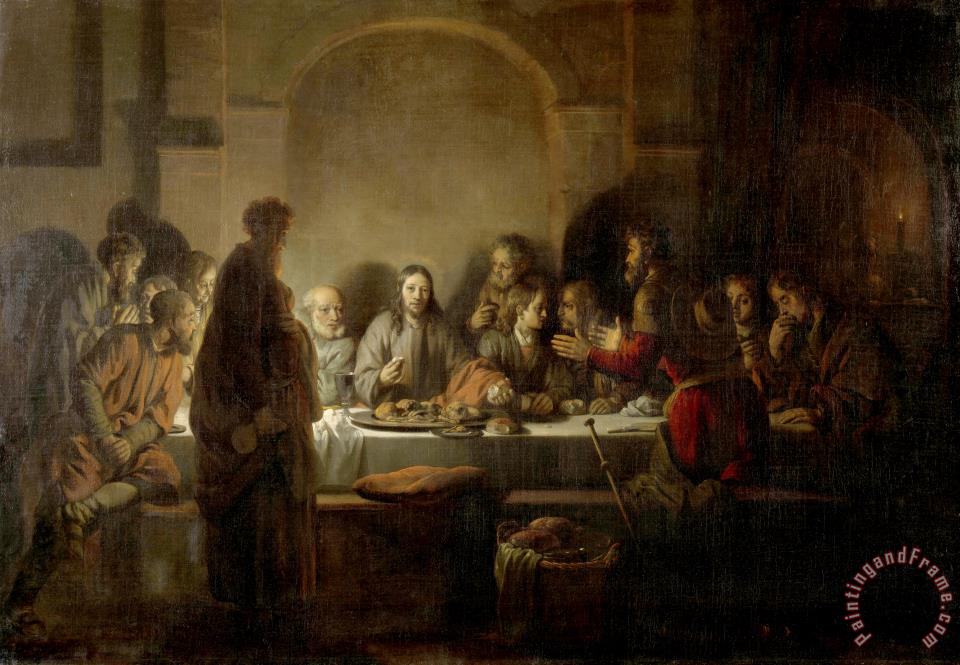
Last Supper
Gerbrand Van Den Eeckhout
1621-1674
Posted on 09/07/2019 9:05:24 PM PDT by Salvation
KEYWORDS: catholic; lk14; ordinarytime; prayer;
Please FReepmail me to get on/off the Alleluia Ping List.
From: Wisdom 9:13-18
Wisdom essential for discerning God’s will
*********************************************************************************************
Commentary:
9:13-18. These verses conclude the survey of wisdom, which as we saw is some-
times identified with the “holy Spirit” that God sends from on high (v. 17). The last
verse says that thanks to wisdom men are saved (v. 18), for through it they have
learned to understand God’s purposes. Left to himself, man cannot attain wisdom
because his reasoning powers are quite limited and he is often side-tracked (v.
14); moreover, the cares of life get in the way (v. 15); in the last analysis, man is
really quite limited (v. 16). In speaking like this, the writer is not saying that we
cannot discover truth; all he means is that God’s purposes, the Wisdom of God,
cannot be discovered by man on his own. But now that the Word has become
man, we can manage to know the mystery of God: “Because God did not wish
to be known any longer through the image and sign of living wisdom to be found
in created things, as happened in former times, it was his will that Wisdom itself
would become flesh, and that, having been made man, he would suffer death on
the cross; so that in all the days to come, everyone who believed in him could
be saved through their faith in the cross. In former times, the Wisdom of God
stamped his seal on all created things – and the presence of his sign is the rea-
son why we called them ‘created’ – to reveal himself and so make his Father
known. But later, this same Wisdom, who is the Word, was made flesh, as St
John says; and having overcome death and saved the human race, he revealed
himself in a clearer way and, through himself, revealed the Father” (St Athana-
sius, Contra arianos, 2, 81-82).
Verse 15 seems to contain the Platonic idea of the body being the prison of the
soul, but the sacred writer does not think that the soul pre-existed the body: all
he is doing is making the point that the physical part of man blinds him to spiri-
tual things. St Paul will expand on this when he talks about how his members
contend with his “inmost self”: “Wretched man that I am! Who will deliver me
from this body of death?” (Rom 7:24).
*********************************************************************************************
Source: “The Navarre Bible: Text and Commentaries”. Biblical text from the
Revised Standard Version and New Vulgate. Commentaries by members of
the Faculty of Theology, University of Navarre, Spain.
Published by Four Courts Press, Kill Lane, Blackrock, Co. Dublin, Ireland, and
by Scepter Publishers in the United States.
From: Philemon 9-10, 12-17
A Plea on Onesimus’ Behalf
[12] I am sending him back to you, sending my very heart. [13] I would have been
glad to keep him with me, in order that he might serve me on your behalf during
my imprisonment for the gospel; [14] but I preferred to do nothing without your
consent in order that your goodness might not be by compulsion but of your own
free will.
[15] Perhaps this is why he was parted from you for a while, that you might have
him back for ever, [16] no longer as a slave but more than a slave, as a beloved
brother, especially to me but how much more to you, both in the flesh and in the
Lord. [17] So if you consider me your partner, receive him as you would receive
me.
*********************************************************************************************
Commentary:
8-12. At this point St Paul gives his main reason for writing—to intercede for One-
simus. Typically, he appeals to Philemon’s charity, rather than demanding his
cooperation (cf. 2 Cor 1:23), and to support this appeal he refers to his (Paul’s)
being “an old man” and a “prisoner” for love of Jesus Christ (v. 9).
The Apostle’s generosity of spirit is plain to see: in spite of being imprisoned he
is self-forgetful and he uses every opportunity that presents itself to win converts
— as was the case with Onesimus; and now he intercedes on his behalf. If once
he was “useless” to his master, Onesimus can now be very “useful”; there is
here a play on words, because the name Onesimus means “useful”: it is as if he
were saying that maybe Onesimus did not formerly live up to his name, but now
he does; he has been very useful to Paul and now that he is going back he will
also be useful to Philemon, who should receive him as if he were the Apostle
himself (v. 12).
We should never have fixed ideas about people; despite mistakes and short-
comings, everyone can improve and, with God’s grace, undergo a true change
of heart.
The New Testament writings clearly show that the first Christians’ apostolate ex-
tended to all sectors of society with the result that Christians were to be found
everywhere. St John Chrysostom points this out as follows: “Aquila worked at a
manual wade; the lady who sold purple ran a workshop, another [Christian] was
in charge of a gaol; another a centurion, like Cornelius; another was sick, like
Timothy; another, Onesimus, was a slave and a fugitive; yet none of them found
any of this an obstacle, and all shone for their holiness—men and women, young
and old, slaves and free, soldiers and civilians” (”Hom. on St Matthew”, 43).
13-14. This is another example of the Apostle’s typical refinement. Although his
first idea was to keep Onesimus with him to help him during his imprisonment,
he prefers that he who has the force of law on his side (Roman law, in this in-
stance) should freely decide what action to take (cf. his approach to making
collections: 2 Cor 9:7).
In line with the teaching of Christ and his Apostles, the Second Vatican Council
“urges everyone, especially those responsible for educating others, to try to form
men and women with a respect for the moral order and who will obey lawful au-
thority and be lovers of true freedom — men, and women, who direct their activi-
ties with a sense of responsibility, and strive for what is true and just in willing
cooperation with others” (”Dignitatis Humanae”, 8).
St Paul’s refinement was not inspired only by reasons of friendship nor was it a
mere tactic: he wants people—in this case, Philemon—to come to free personal
decisions, for freedom is a great gift which God has given to every person. “If
only we lived like this, if only we knew how to imbue our behavior with generosi-
ty with a desire for understanding and peace! We would encourage the rightful
independence of all. Everyone would take a responsible approach to the tasks
that correspond to him in temporal matters” (St. J. Escriva, “Christ Is Passing
By”, 124).
15-16. At this point Paul’s thinking becomes exceptionally theological and inci-
sive. What at first sight could have been seen as something bad—Onesimus’ run-
ning away — can now be viewed in another light, the sharper light of divine provi-
dence: God can draw good out of evil, for “in everything, God works for good with
those who love him” (Rom 8:28); he has allowed this incident to happen so as
to give Onesimus the chance to discover the Christian faith.
Therefore, Philemon should now recognize him as a brother, for faith in Jesus
Christ makes us all children of the same Father (cf. Gal 3:27-28; Eph 6:9). “Look
at Paul writing on behalf of Onesimus, a runaway slave; he is not ashamed to
call him his child, his very heart, his brother, his partner. What can I say?”, St
John Chrysostom asks; “Jesus Christ lowered himself to the point of making our
slaves his brothers. If they are brothers of Jesus Christ, then they are also our
brothers” (”Hom. on Philem”, 2, ad loc.).
Due to this teaching slavery gradually died out. The teaching of the Church’s
Magisterium has contributed to a growing realization that all workers have innate
dignity and rights as men and as sons and daughters of God. In an early ency-
clical of modern times Leo XIII called on employers to see that “it is truly shame-
ful and inhuman to misuse men as though they were mere things designed just
to be used in the pursuit of gain”, and reminded them of their duties never “to
look upon workers as their bondsmen but to respect in every man his dignity
and worth as a man and a Christian” (”Rerum Novarum”, 16).
Christianity, then, elevates and gives a new dignity to interpersonal relationships,
thereby helping produce changes and improvements in social structures. Every
Christian insofar as he can should contribute to bringing these changes about,
but the methods used to do so must always be moral. Neglect to play one’s part
in social reform could even constitute a grave sin, a “social” sin against the virtue
of justice.
John Paul II teaches that “the term ‘social’ applies to every sin against justice in
interpersonal relationships, committed either by the individual against the commu-
nity or by the community against the individual. Also ‘social’ is every sin against
the rights of the human person, beginning with the right to life and including the
life of the unborn, or against a person’s physical integrity. Likewise ‘social’ is eve-
ry sin against others’ freedom, especially against the supreme freedom to believe
in God and adore him; ‘social’ is every sin against the dignity and honor of one’s
neighbor. Also ‘social’ is every sin against the common good and its exigencies
in relation to the whole broad spectrum of the rights and duties of citizens. The
term ‘social’ can be applied to sins of commission or omission on the part of po-
litical, economic or trade union leaders, who though in a position to do so do not
work diligently and wisely for the improvement and transformation of society ac-
cording to the requirements and potential of the given historic moment; as also
on the part of workers who through absenteeism or non-cooperation fail to en-
sure that their industries can continue to advance the well-being of the workers
themselves, of their families, and of the whole of society” (”Reconciliatio Et Pae-
nitentia”, 16).
17-21. Paul identifies himself with Onesimus because they share the same faith
— and Paul is an extremely generous person. Here we can clearly see his great
charity which leads him to love everyone much more than is his strict duly. “Be
convinced that justice alone is never enough to solve the great problems of man-
kind. When justice alone is done, do not be surprised if people are hurt: the dig-
nity of man, who is a son of God, requires much more. Charity must penetrate
and accompany justice because it sweetens and deifies everything: ‘God is love’
(1 Jn 4:16). Our motive in everything we do should be the Love of God, which
makes it easier for us to love our neighbor and which purifies all earthly love and
raises it on to a higher level” (St. J. Escriva, “Friends of God”, 172). It is not sur-
prising, then, that the Apostle should ask Philemon to charge it to his account
if Onesimus has wronged him or owes him anything (v. 18). And as if to confirm
this commitment with affection and good humor he as it were signs a docket pro-
mising to pay any charge there may be. However, he immediately goes on to re-
mind Philemon that if they worked out their accounts Philemon would be found
to be in debt to Paul, because it was due to Paul that he became a Christian (v.
l9). On this account Paul feels that he can ask him to forgive Onesimus: that
sign of love and affection would really do Paul good in his present circumstan-
ces. But, he goes on to say (it is a suggestion that delicately respects Phile-
mon’s decision) that he hopes Philemon’s obedience will lead him to do “even
more” (v. 21). As suggested in the Introduction to this letter he is probably ho-
ping that he will set Onesimus free. In the eyes of the law Onesimus is still a
slave; but as a Christian he is already a free man.
St Paul does not directly ask for Onesimus’ freedom, although he does hint at it,
encouraging his old master to set him free but leaving it up to him to decide (and
thereby merit). He reminds Philemon how generous he, Paul, was towards him
(vv. 18-19), in the hope that Philemon will reciprocate. “This is a repetition of the
same testimony he expressed earlier in his letter”, St John Chrysostom points
out; “’knowing that you will do even more than I say’: it is impossible to imagine
anything more persuasive, any more convincing argument than this tender regard
of his generosity which St Paul expresses; Philemon cannot but agree to his de-
mand” (”Hom. on Philem, ad loc.”).
*********************************************************************************************
Source: “The Navarre Bible: Text and Commentaries”. Biblical text from the
Revised Standard Version and New Vulgate. Commentaries by members of
the Faculty of Theology, University of Navarre, Spain.
Published by Four Courts Press, Kill Lane, Blackrock, Co. Dublin, Ireland, and
by Scepter Publishers in the United States.
From: Luke 14:25-33
Conditions For Following Jesus
*********************************************************************************************
Commentary:
26. These words of our Lord should not disconcert us. Love for God and for Je-
sus should have pride of place in our lives and we should keep away from any-
thing which obstructs this love: “In this world let us love everyone,” St. Gregory
the Great comments, “even though he be our enemy; but let us hate him who
opposes us on our way to God, though he be our relative [...]. We should then,
love, our neighbor; we should have charity towards all — towards relative and to-
wards strangers — but without separating ourselves from the love of God out of
love for them” (”In Evangelia Homiliae”, 37, 3). In the last analysis, it is a mat-
ter of keeping the proper hierarchy of charity: God must take priority over every-
thing.
This verse must be understood, therefore, in the context of all of our Lord’s tea-
chings (cf. Luke 6:27-35). These are “hard words. True, ‘hate’ does not exactly
express what Jesus meant. Yet He did put it very strongly, because He doesn’t
just mean ‘love less,’ as some people interpret it in an attempt to tone down the
sentence. The force behind these vigorous words does not lie in their implying
a negative or pitiless attitude, for the Jesus who is speaking here is none other
than that Jesus who commands us to love others as we love ourselves and who
gives up His life for mankind. These words indicate simply that we cannot be
half-hearted when it comes to loving God. Christ’s words could be translated as
‘love more, love better’, in the sense that a selfish or partial love is not enough:
we have to love others with the love of God” (St. J. Escriva, “Christ Is Passing
By”, 97). See the notes on Matthew 10:34-37; Luke 2:49.
As the Second Vatican Council explains, Christians “strive to please God rather
than men, always ready to abandon everything for Christ” (Vatican II, “Apostoli-
cam Actuositatem”, 4).
27. Christ “by suffering for us not only gave us an example so that we might fol-
low in His footsteps, but He also opened up a way. If we follow that way, life and
death becomes holy and acquire a new meaning” (Vatican II, “Gaudium Et Spes”,
22).
The way the Christian follows is that of imitating Christ. We can follow Him only
if we help Him bear His cross. We all have experience of suffering, and suffering
leads to unhappiness unless it is accepted with a Christian outlook. The Cross
is not a tragedy: it is God’s way of teaching us that through sin we can be sanc-
tified, becoming one with Christ and winning Heaven as a reward. This is why it
is so Christian to love pain: “Let us bless pain. Love pain. Sanctify pain....Glori-
fy pain!” (St. J. Escriva, “The Way”, 208).
28-35. Our Lord uses different examples to show that if mere human prudence
means that a person should try to work out in advance the risks he may run,
with all the more reason should a Christian embrace the cross voluntarily and
generously, because there is no other way he can follow Jesus Christ. “’Quia
hic homo coepit aedificare et non potuit consummare! He started to build and
was unable to finish!’ A sad commentary which, if you don’t want, need be
made about you: for you possess everything necessary to crown the edifice of
your sanctification — the grace of God and your own will.” (St. J. Escriva, “The
Way”, 324).
33. Earlier our Lord spoke about “hating” one’s parents and one’s very life; now
He equally vigorously requires us to be completely detached from possessions.
This verse is a direct application of the two foregoing parables: just as a king is
imprudent if he goes to war with an inadequate army, so anyone is foolish who
thinks he can follow our Lord without renouncing all his possessions. This re-
nunciation should really bite: our heart has to be unencumbered by anything ma-
terial if we are able to follow in our Lord’s footsteps. The reason is, as He tells us
later on, that it is impossible to “serve God and Mammon” (Luke 16:13). Not in-
frequently our Lord asks a person to practice total, voluntary poverty; and He
asks everyone to practice genuine detachment and generosity in the use of ma-
terial things. If a Christian has to be ready to give up even life itself, with all the
more reason should he renounce possessions: If you are a man of God, you will
seek to despise riches as intensely as men of the world seek to possess them”
(St. J. Escriva, “The Way”, 633). See the note on Luke 12:33-34.
Besides, for a soul to become filled with God it must first be emptied of every-
thing that could be an obstacle to God’s indwelling: “The doctrine that the Son
of God came to teach was contempt for all things in order to receive as a reward
the Spirit of God in himself. For, as long as the soul does not reject all things, it
has no capacity to receive the Spirit of God in pure transformation” (St. John of
the Cross, “Ascent of Mount Carmel”, Book 1, Chapter 5, 2).
*********************************************************************************************
Source: “The Navarre Bible: Text and Commentaries”. Biblical text from the
Revised Standard Version and New Vulgate. Commentaries by members of
the Faculty of Theology, University of Navarre, Spain.
Published by Four Courts Press, Kill Lane, Blackrock, Co. Dublin, Ireland, and
by Scepter Publishers in the United States.
Liturgical Colour: Green.
| First reading | Wisdom 9:13-18 © |
|---|
| Who can divine the will of God? |
|---|
| Responsorial Psalm |
|---|
| Psalm 89(90):3-6,12-14,17 © |
| Second reading |
|---|
| Philemon 9-10,12-17 © |
| He is a slave no longer, but a dear brother in the Lord |
|---|
| Gospel Acclamation | Jn15:15 |
|---|
| Or: | Ps118:135 |
|---|
| Gospel | Luke 14:25-33 © |
|---|
| Anyone who does not carry his cross and follow me cannot be my disciple |
|---|
| Luke | |||
| English: Douay-Rheims | Latin: Vulgata Clementina | Greek NT: Byzantine/Majority Text (2000) | |
| Luke 14 |
|||
| 25. | And there went great multitudes with him. And turning, he said to them: | Ibant autem turbæ multæ cum eo : et conversus dixit ad illos : | συνεπορευοντο δε αυτω οχλοι πολλοι και στραφεις ειπεν προς αυτους |
| 26. | If any man come to me, and hate not his father, and mother, and wife, and children, and brethren, and sisters, yea and his own life also, he cannot be my disciple. | Si quis venit ad me, et non odit patrem suum, et matrem, et uxorem, et filios, et fratres, et sorores, adhuc autem et animam suam, non potest meus esse discipulus. | ει τις ερχεται προς με και ου μισει τον πατερα αυτου και την μητερα και την γυναικα και τα τεκνα και τους αδελφους και τας αδελφας ετι δε και την εαυτου ψυχην ου δυναται μου μαθητης ειναι |
| 27. | And whosoever doth not carry his cross and come after me, cannot be my disciple. | Et qui non bajulat crucem suam, et venit post me, non potest meus esse discipulus. | και οστις ου βασταζει τον σταυρον αυτου και ερχεται οπισω μου ου δυναται ειναι μου μαθητης |
| 28. | For which of you having a mind to build a tower, doth not first sit down, and reckon the charges that are necessary, whether he have wherewithal to finish it: | Quis enim ex vobis volens turrim ædificare, non prius sedens computat sumptus, qui necessarii sunt, si habeat ad perficiendum, | τις γαρ εξ υμων ο θελων πυργον οικοδομησαι ουχι πρωτον καθισας ψηφιζει την δαπανην ει εχει τα εις απαρτισμον |
| 29. | Lest, after he hath laid the foundation, and is not able ti finish it, all that see it begin to mock him, | ne, posteaquam posuerit fundamentum, et non potuerit perficere, omnes qui vident, incipiant illudere ei, | ινα μηποτε θεντος αυτου θεμελιον και μη ισχυοντος εκτελεσαι παντες οι θεωρουντες αρξωνται εμπαιζειν αυτω |
| 30. | Saying: This man began to build, and was not able to finish. | dicentes : Quia hic homo cœpit ædificare, et non potuit consummare ? | λεγοντες οτι ουτος ο ανθρωπος ηρξατο οικοδομειν και ουκ ισχυσεν εκτελεσαι |
| 31. | Or what king, about to go to make war against another king, doth not first sit down, and think whether he be able, with ten thousand, to meet him that, with twenty thousand, cometh against him? | Aut quis rex iturus committere bellum adversus alium regem, non sedens prius cogitat, si possit cum decem millibus occurrere ei, qui cum viginti millibus venit ad se ? | η τις βασιλευς πορευομενος συμβαλειν ετερω βασιλει εις πολεμον ουχι καθισας πρωτον βουλευεται ει δυνατος εστιν εν δεκα χιλιασιν απαντησαι τω μετα εικοσι χιλιαδων ερχομενω επ αυτον |
| 32. | Or else, whilst the other is yet afar off, sending an embassy, he desireth conditions of peace. | Alioquin adhuc illo longe agente, legationem mittens rogat ea quæ pacis sunt. | ει δε μηγε ετι πορρω αυτου οντος πρεσβειαν αποστειλας ερωτα τα προς ειρηνην |
| 33. | So likewise every one of you that doth not renounce all that he possesseth, cannot be my disciple. | Sic ergo omnis ex vobis, qui non renuntiat omnibus quæ possidet, non potest meus esse discipulus. | ουτως ουν πας εξ υμων ος ουκ αποτασσεται πασιν τοις εαυτου υπαρχουσιν ου δυναται μου ειναι μαθητης |
Pray for Pope Francis.
50 Boko Haram Islamic Radicals Killed; 1,000 Hostages, Women and Children, Rescued in Nigeria
Nigeria: In the Face of Ongoing Islamist Attacks, the Faith is Growing
US Promises to Help Nigeria Exterminate Boko Haram
Is This Bishop Right about the Rosary Conquering Boko Haram? [Catholic Caucus]
Why Boko Haram and ISIS Target Women
Report reveals scale of Boko Haram violence inflictef on Nigerian Catholics
Military evacuating girls, women rescued from Boko Haram
Echos of Lepanto Nigerian bishop says rosary will bring down Boko Harm
After vision of Christ, Nigerian bishop says rosary will bring down Boko Haram (Catholic Caucus)
Nigerian Bishop Says Christ Showed Him How to Beat Islamic Terror Group
We thank you, God our Father, for those who have responded to your call to priestly ministry.
Accept this prayer we offer on their behalf: Fill your priests with the sure knowledge of your love.
Open their hearts to the power and consolation of the Holy Spirit.
Lead them to new depths of union with your Son.
Increase in them profound faith in the Sacraments they celebrate as they nourish, strengthen and heal us.
Lord Jesus Christ, grant that these, your priests, may inspire us to strive for holiness by the power of their example, as men of prayer who ponder your word and follow your will.
O Mary, Mother of Christ and our mother, guard with your maternal care these chosen ones, so dear to the Heart of your Son.
Intercede for our priests, that offering the Sacrifice of your Son, they may be conformed more each day to the image of your Son, our Lord and Savior, Jesus Christ. Amen.
Saint John Vianney, universal patron of priests, pray for us and our priests
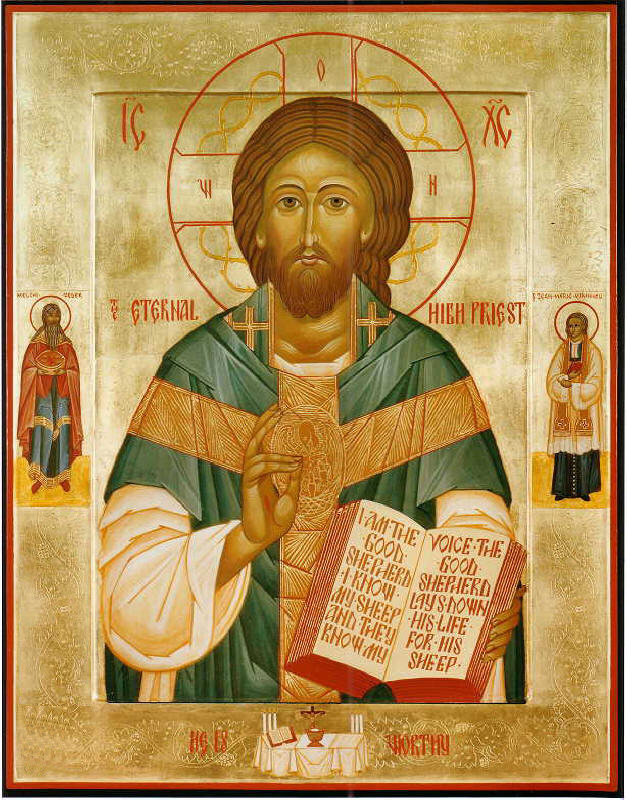
This icon shows Jesus Christ, our eternal high priest.
The gold pelican over His heart represents self-sacrifice.
The border contains an altar and grapevines, representing the Mass, and icons of Melchizedek and St. Jean-Baptiste Vianney.
Melchizedek: king of righteousness (left icon) was priest and king of Jerusalem. He blessed Abraham and has been considered an ideal priest-king.
St. Jean-Baptiste Vianney is the patron saint of parish priests.

1. Sign of the Cross: In the name of the Father, and of the Son, and of the Holy Spirit. Amen.
2. The Apostles Creed: I BELIEVE in God, the Father almighty, Creator of heaven and earth, and in Jesus Christ, His only Son, our Lord, who was conceived by the Holy Spirit, born of the Virgin Mary, suffered under Pontius Pilate, was crucified, died, and was buried. He descended into hell; on the third day he rose again from the dead; he ascended into heaven, and is seated at the right hand of God, the Father Almighty; from there He shall come to judge the living and the dead.
I believe in the Holy Spirit, the holy catholic Church, the communion of saints, the forgiveness of sins, the resurrection of the body, and the life everlasting. Amen.
3. The Lord's Prayer: OUR Father, who art in heaven, hallowed be Thy name. Thy kingdom come. Thy will be done on earth as it is in heaven. Give us this day our daily bread and forgive us our trespasses as we forgive those who trespass against us. And lead us not into temptation, but deliver us from evil. Amen.
4. (3) Hail Mary: HAIL Mary, full of grace, the Lord is with thee. Blessed art thou amongst women and blessed is the fruit of thy womb, Jesus. Holy Mary, Mother of God, pray for us sinners, now, and in the hour of our death. Amen. (Three times)
5. Glory Be: GLORY be to the Father, and to the Son, and to the Holy Spirit. As it was in the beginning, is now, and ever shall be, world without end. Amen.
6. Fatima Prayer: Oh, my Jesus, forgive us our sins, save us from the fires of hell, lead all souls to heaven, especially those in most need of your mercy.
Announce each mystery, then say 1 Our Father, 10 Hail Marys, 1 Glory Be and 1 Fatima prayer. Repeat the process with each mystery.
End with the Hail Holy Queen:
Hail, Holy Queen, Mother of Mercy, our life, our sweetness and our hope! To thee do we cry, poor banished children of Eve! To thee do we send up our sighs, mourning and weeping in this vale of tears! Turn then, most gracious advocate, thine eyes of mercy towards us; and after this, our exile, show unto us the blessed fruit of thy womb, Jesus!
O clement, O loving, O sweet Virgin Mary! Pray for us, O holy Mother of God, that we may be made worthy of the promises of Christ.
Final step -- The Sign of the Cross
The Mysteries of the Rosary By tradition, Catholics meditate on these Mysteries during prayers of the Rosary. The biblical references follow each of the Mysteries below.
The Glorious Mysteries
(Wednesdays and Sundays)
1.The Resurrection (Matthew 28:1-8, Mark 16:1-18, Luke 24:1-12, John 20:1-29) [Spiritual fruit - Faith]
2. The Ascension (Mark 16:19-20, Luke 24:50-53, Acts 1:6-11) [Spiritual fruit - Christian Hope]
3. The Descent of the Holy Spirit (Acts 2:1-13) [Spiritual fruit - Gifts of the Holy Spirit]
4. The Assumption [Spiritual fruit - To Jesus through Mary]
5. The Coronation [Spiritual fruit - Grace of Final Perseverance]

St. Michael the Archangel
~ PRAYER ~
St. Michael, the Archangel, defend us in battle
Be our protection against the wickedness
and snares of the devil;
May God rebuke him, we humbly pray,
and do thou, O Prince of the heavenly host,
by the power of God,
Cast into hell Satan and all the evil spirits
who prowl through the world seeking the ruin of souls.
Amen
+

Sea of Sorrow
Oh! on what a sea of sorrow
Was the Virgin-Mother cast,
When her eyes with tears o'erflowing
Gazed upon her Son aghast,
From the bloodstained gibbet taken,
Dying in her arms at last.
In her bitter desolation,
His sweet mouth, His bosom too,
Then His riven side beloved,
Then each hand, both wounded through,
Then His feet, with blood encrimsoned,
Her maternal tears bedew.
She, a hundred times and over,
Strains Him closely to her breast
Heart to Heart, arms arms enfolding,
Are His wounds on her impressed:
Thus, in sorrow's very kisses,
Melts her anguished soul to rest.
Oh, dear Mother! we beseech thee,
By the tears thine eyes have shed,
By the cruel death of Jesus
And His wounds' right royal red,
Make our hearts o'erflow with sorrow
From thy heart's deep fountainhead.
To the Father, Son, and Spirit,
Now we bend on equal knee:
Glory, sempiternal glory,
To the Most High Trinity;
Yea! perpetual praise and honor
Now and through all ages be.

Novena Prayer To Our Sorrowful Mother
Most Blessed and afflicted Virgin, Queen of Martyrs, who didst stand generously beneath the cross, beholding the agony of thy dying Son; by the sword of sorrow which then pierced thy soul, by the sufferings of thy sorrowful life, by the unutterable joy which now more than repays thee for them; look down with a mother's pity and tenderness, as I kneel before thee to compassionate thy sorrows, and to lay my petition with childlike confidence in thy wounded heart. I beg of thee, O my Mother, to plead continually for me with thy Son, since He can refuse thee nothing, and through the merits of His most sacred Passion and Death, together with thy own sufferings at the foot of the cross, so to touch His Sacred Heart, that I may obtain my request,
For to whom shall I fly in my wants and miseries, if not to thee, O Mother of mercy, who, having so deeply drunk the chalice of thy Son, canst most pity us poor exiles, still doomed to sigh in this vale of tears? Offer to Jesus but one drop of His Precious Blood, but one pang of His adorable Heart; remind Him that thou art our life, our sweetness, and our hope, and thou wilt obtain what I ask, through Jesus Christ our Lord. Amen.
Hail Mary
Virgin Most Sorrowful, pray for us
(Seven times each)

Mary, most holy Virgin and Queen of Martyrs, accept the sincere homage of my filial affection. Into thy Heart, pierced by so many swords, do thou welcome my poor soul. Receive it as the companion of thy sorrows at the foot of the Cross, on which Jesus died for the redemption of the world. With thee, O sorrowful Virgin, I will gladly suffer all the trials, contradictions, and infirmities which it shall please Our Lord to send me. I offer them all to thee in memory of thy sorrows, so that: every thought of my mind and every beat of my heart may be an act of compassion and of love for thee. And do thou, sweet Mother, have pity on me, reconcile me to thy Divine Son, Jesus; keep me in His grace and assist me in my last agony, so that I may be able to meet thee in Heaven and sing thy glories.
Most holy Virgin and Mother, whose soul was pierced by a sword of sorrow in the Passion of thy Divine Son, and who in His glorious Resurrection wast filled with never ending joy at His triumph, obtain for us who call upon thee, so to be partakers in the adversities of Holy Church and the Sorrows of the Sovereign Pontiff, as to be found worthy to rejoice with them in the consolations for which we pray, in the charity and peace of the same Christ our Lord. Amen.

Litany of the Seven Sorrows
| Lord, have mercy on us. Lord, have mercy on us. Christ, hear us. Christ, graciously hear us. God, the Father of heaven, God the Son, Redeemer of the world, . God the Holy Ghost, Holy Mary, Mother of God, Holy Virgin of virgins, Mother of the Crucified, Sorrowful Mother, Mournful Mother, Sighing Mother, Afflicted Mother, Foresaken Mother, . Desolate Mother, Mother most sad, Mother set around with anguish, Mother overwhelmed by grief, Mother transfixed by a sword, Mother crucified in thy heart, Mother bereaved of thy Son, Sighing Dove, Mother of Dolors, Fount of tears, Sea of bitterness, Field of tribulation, Mass of suffering, Mirror of patience, Rock of constancy, Remedy in perplexity, Joy of the afflicted, Ark of the desolate, Refuge of the abandoned,. Shiled of the oppressed, Conqueror of the incredulous, Solace of the wretched, Medicine of the sick, Help of the faint, Strength of the weak, Protectress of those who fight, Haven of the shipwrecked, Calmer of tempests, Companion of the sorrowful, Retreat of those who groan, Terror of the treacherous, Standard-bearer of the Martyrs, Treasure of the Faithful, Light of Confessors, Pearl of Virgins, . Comfort of Widows, . Joy of all Saints, Queen of thy Servants, Holy Mary, who alone art unexampled, Pray for us, most Sorrowful Virgin, |
Christ, have mercy on us. Christ, graciously hear us. |
|
| Let us pray, --- O God, in whose Passion, according to the prophecy of Simeon, a sword of grief pierced through the most sweet soul of Thy glorious Blessed Virgin Mother Mary: grant that we, who celebrate the memory of her Seven Sorrows, may obtain the happy effect of Thy Passion, Who lives and reigns world without end, Amen. |
||
| The Seven Sorrows of Our Lady 1. The Prophecy of Simeon 2. The Flight into Egypt . 3. The Loss of Jesus in the Temple 4. Mary meets Jesus Carrying the Cross 5. The Crucifixion 6. Mary Receives the Dead Body of Her Son 7. The Burial of Her Son and Closing of the Tomb. |
||
| Consecration to Our Lady of Sorrows Most holy Virgin and Queen of Martyrs, Mary, would that I could be in Heaven, there to contemplate the honors rendered to thee by the Most Holy Trinity and by the whole Heavenly Court! But since I am still a pilgrim in this vale of tears, receive from me, thy unworthy servant and a poor sinner, the most sincere homage and the most perfect act of vassalage a human creature can offer thee. In thy Immaculate Heart, pierced with so many swords of sorrow, I place today my poor soul forever; receive me as a partaker in thy dolors, and never suffer that I should depart from that Cross on which thy only begotten Son expired for me. With thee, O Mary, I will endure all the sufferings, contradictions, infirmities, with which it will please thy Divine Son to visit me in this life. All of them I offer to thee, in memory of the Dolors which thou didst suffer during thy life, that every thought of my mind, every beating of my heart may henceforward be an act of compassion to thy Sorrows, and of complacency for the glory thou now enjoyest in Heaven. Since then, O Dear Mother, I now compassionate thy Dolors, and rejoice in seeing thee glorified, do thou also have compassion on me, and reconcile me to thy Son Jesus, that I may become thy true and loyal son (daughter); come on my last day and assist me in my last agony, even as thou wert present at the Agony of thy Divine Son Jesus, that from this painful exile I may go to Heaven, there to be made partaker of thy glory. Amen. |
Litany of Sorrows
|
|
|

Prayer To Our Lady of Sorrows, by St. Bridget
O Blessed Virgin Mary, Immaculate Mother of God, who didst endure a martyrdom of love and grief beholding the sufferings and sorrows of Jesus! Thou didst cooperate in the benefit of my redemption by thine innumerable afflictions and by offering to the Eternal Father His only begotten Son as a holocaust and victim of propitiation for my sins. I thank thee for the unspeakable love which led thee to deprive thyself of the Fruit of thy womb, Jesus, true God and true Man, to save me, a sinner. Oh, make use of the unfailing intercession of thy sorrows with the Father and the Son, that I may steadfastly amend my life and never again crucify my loving Redeemer by new sins, and that, persevering till death in His grace. I may obtain eternal life through the merits of His Cross and Passion. Amen.
Mother of love, of sorrow and of mercy, pray for us.

Saint Alphonsus Liguori's Prayer To The Mother Of Sorrows
O, my Blessed Mother, it is not one sword only with which I have pierced thy heart, but I have done so with as many as are the sins which I have committed. O, Lady, it is not to thee, who art innocent, that sufferings are due, but to me, who am guilty of so many crimes. But since thou hast been pleased to suffer so much for me, by thy merits, obtain me great sorrow for my sins, and patience under the trials of this life, which will always be light in comparison with my demerits; for I have often deserved Hell.
Amen.

Lists Every Catholic Should be Familiar With: The 7 Sorrows (Dolours) and 7 Joys of Our Lady
The Seven Dolors (Sorrows) of Mary [Catholic/Orthodox Devotional]
Apparition in Africa: Our Lady of Sorrows [Catholic/Orthodox Caucus]
Feast of the Seven Sorrows of the Blessed Virgin Mary [Catholic Caucus Devotional]
Feast of Our Lady/Mother of Sorrows
Homilies on Our Lady of Sorrows
Starkenburg:Pilgrimage to Our Lady of Sorrows Shrine
Our Mother of Sorrows
ST. ALPHONSUS LIGUORI, OF THE DOLOURS OF MARY, The Glories [Sorrows] of Mary
Our Lady of Sorrows - Sep 15
Disclaimer: Opinions posted on Free Republic are those of the individual posters and do not necessarily represent the opinion of Free Republic or its management. All materials posted herein are protected by copyright law and the exemption for fair use of copyrighted works.