
The Marriage at Cana
Marten de Vos
1596-97
Oil on panel, 268 x 235 cm
O.-L. Vrouwekathedraal, Antwerp
Posted on 09/05/2019 9:54:46 PM PDT by Salvation
KEYWORDS: catholic; lk5; ordinarytime; prayer;
Please FReepmail me to get on/off the Alleluia Ping List.
From: Colossians 1:15-20
Hymn in Praise of Christ as Head of All Creation
*********************************************************************************************
Commentary:
15-20. Now we come to a very beautiful hymn in praise of Christ’s sublime dignity
as God and as man. This was a truth deserving emphasis in view of the danger to
the faith which the false apostles’ teaching represented (cf. note on vv. 7-8). How-
ever, quite apart from the particular situation in Colossae, the sublime teaching
contained in this canticle holds good for all times; it is one of the most important
Christological texts in St Paul’s writings.
The real protagonist of this passage is the Son of God made man, whose two na-
tures, divine and human, are always linked in the divine person of the Word. How-
ever, at some points St Paul stresses his divinity (vv. 16, 17, 18b and 19) and at
others his humanity (vv. 15, 18a, 18c and 20). The underlying theme of the hymn
is Christ’s total pre-eminence over all creation.
We can distinguish two stanzas in the hymn. In the first (vv. 15-17) Christ’s do-
minion is stated to embrace the entire cosmos, stemming as it does from his
action as Creator: “in him all things were created” (v. 16). This same statement
is made in the prologue to the fourth Gospel (cf. Jn 1:3), and it is implied in the
Book of Genesis, which tells us that creation was effected by God’s word (cf.
Gen 1:3, 6, 9, etc.). Since Christ is the Word of God, he is above all things, and
therefore St Paul stresses that all angels—irrespective of their hierarchy or order
— come under his sway.
Christ’s pre-eminence over natural creation is followed by his primacy in the eco-
nomy of supernatural salvation, a second creation worked by God through grace.
The second stanza (vv. 18-20) refers to this further primacy of Christ: by his death
on the cross, Christ has restored peace and has reconciled all things—the world
and mankind—to God. Jews and Gentiles both are called to form part of one body,
the Church, of which Christ is the head; and all the celestial powers are subject
to his authority.
This passage is, then, a sublime canticle celebrating Christ, the head by virtue
of his surpassing excellence and his salvific action. “The Son of God and of the
Blessed Virgin”, Pius XII teaches, “must be called the head of the Church for the
special reason of his preeminence. For the head holds the highest place. But
none holds a higher place than Christ as God for he is the Word of the Eternal
Father and is therefore justly called ‘the first-born of all creation’. None holds a
higher place than Christ as man, for he, born of the immaculate Virgin, is the
true and natural Son of God, and by reason of his miraculous and glorious resur-
rection by which he triumphed over death he is ‘the first-born from the dead’. And
none stands higher than he who, being the ‘one mediator between God and man’
(1 Tim 2:5), admirably unites earth with heaven; who, exalted on the Cross as
on his throne of mercy, has drawn all things to himself” (”Mystici Corporis”, 15).
15. By the unaided use of reason man can work out that God exists, but he
could never, on his own, have grasped the essence of God: in this sense God is
said to be invisible (cf. St Thomas, “Commentary on Col, ad loc.”). This is why it
is said in St John’s Gospel that “no one has ever seen God” (Jn 1:18).
In Sacred Scripture we are told that man was created “in the image of God” (Gen
1:26). However, only the second person of the Blessed Trinity, the Son, is the per-
fect image and likeness of the Father. “The image [likeness] of a thing may be
found in something else in two ways; in one way it is found in something of the
same specific nature—as the image of the king is found in his son; in another way
it is found in something of a different nature, as the king’s image on the coin. In
the first sense the Son is the image of the Father; in the second sense man is
called the image of God; and therefore in order to express the imperfect character
of the divine image in man, man is not simply called ‘the image’ but is referred to
as being ‘according to the image’, whereby is expressed a certain movement or
tendency to perfection. But it cannot be said that the Son of God is ‘according to
the image’, because he is the perfect image of the Father” (”Summa Theologiae”,
I, q. 35, a. 2 ad 3). And so, “for something to be truly an image, it has to proceed
from another as similar to it in species, or at least in some aspect of the species”
(”Summa Theologiae”, I, q. 35, a. 1, c.) To say that the Son is “image of the invi-
sible God” means that the Father and the Son are one-in-substance — that is,
both possess the same divine nature — with the nuance that the Son proceeds
from the Father. It also conveys the fact that they are two distinct persons, for
no one is the image of himself.
The supreme revelation of God is that effected by the Son of God through his In-
carnation. He is the only one who can say, “He who has seen me has seen the
Father” (Jn 14:9). His sacred humanity, therefore, reflects the perfections of God,
which he possesses by virtue of the hypostatic union—the union of divine nature
and human nature which occurs in his person, which is divine. The second Per-
son of the Trinity restored man to his original dignity. The image of God, imper-
fect though it be, which there is in every man and woman, was blurred by Adam’s
sin; but it was restored in Christ: God’s true self-image takes on a nature the
same as ours, and thanks to the redemption wrought by his death, we obtain
forgiveness of sins (v. 14).
Jesus Christ is the “first-born of all creation” by virtue of the hypostatic union.
He is, of course, prior to all creation, for he proceeds eternally from the Father
by generation. This the Church has always believed, and it proclaims it in the
Creed: “born of the Father before time began ..., begotten, not made, of one
being [consubstantial] with the Father” (”Nicene-Constantinopolitan Creed”).
In Jewish culture, the first-born was first in honor and in law. When the Apostle
calls Jesus “the first-born of all creation”, he is referring to the fact that Christ
has pre-eminence and headship over all created things, because not only does
he pre-date them but they were all created “through him” and “for him” (v. 16).
16-17. Jesus Christ is God; this is why he has pre-eminence over all created
things. The relationships between Christ and creation are spelled out by three
prepositions. “In him all things were created”: in Christ: he is their source, their
center and their model or exemplary cause. “All things were created through him
and for him”: through him, in other words, God the Father, through God the Son,
creates all things; and for him, because he is the last end, the purpose or goal
of everything.
St Paul goes on to say that “in him all things hold together”; “the Son of God
has not only created everything: he conserves everything in being; thus, if his
sovereign will were to cease to operate for even an instant, everything would re-
turn into the nothingness from which he drew everything that exists” (Chrysos-
tom, “Hom. on Col, ad loc.”).
All created things, then, continue in existence because they share, albeit in a
limited way, in Christ’s infinite fullness of existence or perfection. His dominion
extends not only over celestial things but also over all material things, however
insignificant they may seem: it embraces everything in heaven and in the physi-
cal universe.
The sacred text also points to Christ’s supremacy over invisible creation, that is,
over the angels and celestial hierarchies (cf. Heb 1:5). If St Paul stresses this
fact, it is to expose the errors of those who were depicting Jesus as a creature
intermediary between corporeal beings and spiritual created beings, and, there-
fore, lower than the angels.
18. “He is the head of the body, the church”: this image shows the relationship
of Christ with the Church, to which he sends his grace in abundance, bearing life
to all its members. ‘The head,” St Augustine says, “is our very Savior, who suf-
fered under Pontius Pilate and now, after rising from the dead, is seated at the
right hand of the Father. And his body is the Church [...] For the whole Church,
made up of the assembly of the faithful—for all the faithful are Christ’s members
— has Christ, as its head, who rules his body from on high” (”Enarrationes in
Psalmos”, 56, 1).
St Paul unequivocally teaches that the Church is a body. “Now if the Church is a
body it must be something one and undivided, according to the statement of St
Paul: ‘We, though many, are one body in Christ’ (Rom 12:5). And not only must
it be one and undivided, it must also be something concrete and visible, as our
Predecessor of happy memory, Leo XIII, says in his Encyclical “Satis Cognitum”:
‘By the very fact of being a body the Church is visible.’ It is therefore an aberra-
tion from divine truth to represent the Church as something intangible and invisi-
ble, as a mere ‘pneumatic’ entity joining together by an invisible link a number
of communities of Christians in spite of their difference in faith.
“But a body requires a number of members so connected that they help one ano-
ther. And, in fact, as in our mortal organism when one member suffers the others
suffer with it, and the healthy members come to the assistance of those who are
ailing, so in the Church individual members do not live only for themselves but
also help one another, alleviating their suffering and helping to build up the entire
body” (Pius XII, “Mystici Corporis”, 7).
“He is the beginning, the first-born from the dead”: this can be said because he
was the first man to rise from the dead, never again to die (cf. 1 Cor 15:20; Rev
1:5), and also because thanks to him it enabled men to experience resurrection
in glory (cf. 1 Cor 15:22; Rom 8:11), because they are justified through him (cf.
Rom 4:25).
So, just as the previous verses looked to Christ’s pre-eminent role in creations
the hymn now focuses on his primacy in a new creation—the rebirth of mankind,
and all creation in its train, in the supernatural order of grace and glory. Christ
rose from the dead to enable us also to walk in newness of life (cf. Rom 6:4).
Therefore, in every way Jesus Christ is “pre-eminent.”
19. The word “pleroma” translated here as “fullness”, has two meanings in Greek:
one, an active meaning, describes something that “fills” or “completes”; for exam-
ple, a ship’s full load can be referred to as its pleroma. The other meaning is pas-
sive, “that which is filled” or “that which is complete”, so that a ship can be said
to be “pleroma” when it is fully loaded. In this passage St Paul is using the word
in both senses: Christ is the fullness (passive sense) of the Godhead (cf. Col 2:9),
because he is full of all the perfections of the divine essence; and he is the full-
ness (active sense), because he fills the Church and all creation.
St John Chrysostom suggests that “the word ‘fullness’ is to be taken to mean
the divinity of Jesus Christ [...]. This term has been chosen the better to show
that the very essence of the godhead resides in Jesus Christ” (”Hom. on Col,
ad loc.”).
Since Christ possesses the divine nature, he also possesses the fullness of the
supernatural gifts, for himself and for all mankind. Hence St Thomas’ comment
that pleroma “reveals the dignity of the head in so far as it has the fullness of all
grace” (Commentary on Col, ad loc.). In this sense, Christ is the fullness of the
Church, for as its head he vivifies his body with all kinds of unmerited gifts. Final-
ly, the entire created universe can be termed the “fullness” (”pleroma”) of Christ,
because everything that exists in heaven and on earth has been created and is
maintained in existence by him (cf. vv. 16-17); they are ever-present to him and
are ruled by him (cf. Is 6:3; Ps 139:8; Wis 1:7; etc.). Thus, the world, which was
created good (cf. Gen 1:31) tends towards its fulfillment insofar as it clearly re-
flects the imprint God gave it at the start of creation.
20. Since Christ is pre-eminent over all creation, the Father chose to reconcile
all things to himself through him. Sin had cut man off from God, rupturing the per-
fect order which originally reigned in the created world. By shedding his blood on
the cross, Christ obtained peace for us; nothing in the universe falls outside the
scope of his peace-giving influence. He who in the beginning created all things in
heaven and on earth has reestablished peace throughout creation.
This reconciliation of all things, ushered in by Christ, is fostered by the Holy
Spirit who enables the Church to continue the process of reconciliation. However,
we will not attain the fullness of this reconciliation until we reach heaven, when
the entire created universe, along with mankind, will be perfectly renewed in
Christ (cf. “Lumen Gentium”, 48).
“The history of salvation — the salvation of the whole of humanity, as well as of
every human being of whatever period—is the wonderful history of a reconciliation;
the reconciliation whereby God, as Father, in the Blood and the Cross of his Son
made man, reconciles the world to himself and thus brings into being a new fa-
mily of those who have been reconciled.
“Reconciliation becomes necessary because there has been the break of sin
from which derive all the other forms of break within man and about him. Recon-
ciliation therefore, in order to be complete, necessarily requires liberation from
sin, which is to be rejected in its deepest roots. Thus a close internal link unites
“conversion” and “reconciliation”. It is impossible to split these two realities or to
speak of one and say nothing of the other (Bl. John Paul II, “Reconciliatio Et Pae-
nitentia”, 13).
Jesus Christ also counts on the cooperation of every individual Christian to apply
his work of redemption and peace to all creation. The founder of Opus Dei says,
in this connection: “We must love the world and work and all human things. For
the world is good. Adam’s sin destroyed the divine balance of creation; but God
the Father sent his only Son to reestablish peace, so that we his children by
adoption, might free creation from disorder and reconcile all things to God”
(”Christ Is Passing By”, 112).
*********************************************************************************************
Source: “The Navarre Bible: Text and Commentaries”. Biblical text from the
Revised Standard Version and New Vulgate. Commentaries by members of
the Faculty of Theology, University of Navarre, Spain.
Published by Four Courts Press, Kill Lane, Blackrock, Co. Dublin, Ireland, and
by Scepter Publishers in the United States.
From: Luke 5:33-39
A Discussion on Fasting
*********************************************************************************************
Commentary:
33-35. In the Old Testament God established certain days as days of fasting —
the main one being the “day of atonement” (Numbers 29:7; Acts 27:9). Fasting
implied total or partial abstinence from food or drink. Moses and Elijah fasted
(Exodus 34:28; 1 Kings 19:8) and our Lord Himself fasted in the desert for forty
days before beginning His public ministry. In the present passage Jesus gives
a deeper meaning to the word “fasting”—the deprivation of His physical presence
which His Apostles would experience after His death. All through His public life
Jesus is trying to prepare His disciples for the final parting. At first the Apostles
were not very robust and Christ’s physical presence did them more good than
the practice of fasting.
Christians should sometimes abstain from food. “Fast and abstain from flesh
meat when Holy Mother Church so ordains” (”St. Pius X Catechism”, 495). That
is the purpose of the fourth commandment of the Church, but it has a deeper
meaning, as St. Leo the Great tells us: “The merit of our fasts does not consist
only in abstinence from food; there is no use depriving the body of nourishment
if the soul does not cut itself off from iniquity and if the tongue does not cease
to speak evil” (”Sermo IV in Quadragesima”).
*********************************************************************************************
Source: “The Navarre Bible: Text and Commentaries”. Biblical text from the
Revised Standard Version and New Vulgate. Commentaries by members of
the Faculty of Theology, University of Navarre, Spain.
Published by Four Courts Press, Kill Lane, Blackrock, Co. Dublin, Ireland, and
by Scepter Publishers in the United States.
Liturgical Colour: Green.
| First reading |
|---|
| Colossians 1:15-20 © |
| All things were created through Christ and for Christ |
|---|
| Responsorial Psalm |
|---|
| Psalm 99(100):2-5 © |
| Gospel Acclamation | cf.Ps18:9 |
|---|
| Or: | Jn8:12 |
|---|
| Gospel | Luke 5:33-39 © |
|---|
| When the bridegroom is taken from them, then they will fast |
|---|
| Luke | |||
| English: Douay-Rheims | Latin: Vulgata Clementina | Greek NT: Byzantine/Majority Text (2000) | |
| Luke 5 |
|||
| 33. | And they said to him: Why do the disciples of John fast often, and make prayers, and the disciples of the Pharisees in like manner; but thine eat and drink? | At illi dixerunt ad eum : Quare discipuli Joannis jejunant frequenter, et obsecrationes faciunt, similiter et pharisæorum : tui autem edunt et bibunt ? | οι δε ειπον προς αυτον δια τι οι μαθηται ιωαννου νηστευουσιν πυκνα και δεησεις ποιουνται ομοιως και οι των φαρισαιων οι δε σοι εσθιουσιν και πινουσιν |
| 34. | To whom he said: Can you make the children of the bridegroom fast, whilst the bridegroom is with them? | Quibus ipse ait : Numquid potestis filios sponsi, dum cum illis est sponsus, facere jejunare ? | ο δε ειπεν προς αυτους μη δυνασθε τους υιους του νυμφωνος εν ω ο νυμφιος μετ αυτων εστιν ποιησαι νηστευειν |
| 35. | But the days will come, when the bridegroom shall be taken away from them, then shall they fast in those days. | Venient autem dies, cum ablatus fuerit ab illis sponsus : tunc jejunabunt in illis diebus. | ελευσονται δε ημεραι και οταν απαρθη απ αυτων ο νυμφιος τοτε νηστευσουσιν εν εκειναις ταις ημεραις |
| 36. | And he spoke also a similitude to them: That no man putteth a piece from a new garment upon an old garment; otherwise he both rendeth the new, and the piece taken from the new agreeth not with the old. | Dicebat autem et similitudinem ad illos : Quia nemo commissuram a novo vestimento immittit in vestimentum vetus : alioquin et novum rumpit, et veteri non convenit commissura a novo. | ελεγεν δε και παραβολην προς αυτους οτι ουδεις επιβλημα ιματιου καινου επιβαλλει επι ιματιον παλαιον ει δε μηγε και το καινον σχιζει και τω παλαιω ου συμφωνει το απο του καινου |
| 37. | And no man putteth new wine into old bottle: otherwise the new wine will break the bottles, and it will be spilled, and the bottles will be lost. | Et nemo mittit vinum novum in utres veteres : alioquin rumpet vinum novum utres, et ipsum effundetur, et utres peribunt : | και ουδεις βαλλει οινον νεον εις ασκους παλαιους ει δε μηγε ρηξει ο νεος οινος τους ασκους και αυτος εκχυθησεται και οι ασκοι απολουνται |
| 38. | But new wine must be put into new bottles; and both are preserved. | sed vinum novum in utres novos mittendum est, et utraque conservantur. | αλλα οινον νεον εις ασκους καινους βλητεον και αμφοτεροι συντηρουνται |
| 39. | And no man drinking old, hath presently a mind to new: for he saith, The old is better. | Et nemo bibens vetus, statim vult novum : dicit enim : Vetus melius est. | και ουδεις πιων παλαιον ευθεως θελει νεον λεγει γαρ ο παλαιος χρηστοτερος εστιν |
Such an interesting picture of the wedding feast at Cana!
Pray for Pope Francis.
50 Boko Haram Islamic Radicals Killed; 1,000 Hostages, Women and Children, Rescued in Nigeria
Nigeria: In the Face of Ongoing Islamist Attacks, the Faith is Growing
US Promises to Help Nigeria Exterminate Boko Haram
Is This Bishop Right about the Rosary Conquering Boko Haram? [Catholic Caucus]
Why Boko Haram and ISIS Target Women
Report reveals scale of Boko Haram violence inflictef on Nigerian Catholics
Military evacuating girls, women rescued from Boko Haram
Echos of Lepanto Nigerian bishop says rosary will bring down Boko Harm
After vision of Christ, Nigerian bishop says rosary will bring down Boko Haram (Catholic Caucus)
Nigerian Bishop Says Christ Showed Him How to Beat Islamic Terror Group
We thank you, God our Father, for those who have responded to your call to priestly ministry.
Accept this prayer we offer on their behalf: Fill your priests with the sure knowledge of your love.
Open their hearts to the power and consolation of the Holy Spirit.
Lead them to new depths of union with your Son.
Increase in them profound faith in the Sacraments they celebrate as they nourish, strengthen and heal us.
Lord Jesus Christ, grant that these, your priests, may inspire us to strive for holiness by the power of their example, as men of prayer who ponder your word and follow your will.
O Mary, Mother of Christ and our mother, guard with your maternal care these chosen ones, so dear to the Heart of your Son.
Intercede for our priests, that offering the Sacrifice of your Son, they may be conformed more each day to the image of your Son, our Lord and Savior, Jesus Christ. Amen.
Saint John Vianney, universal patron of priests, pray for us and our priests
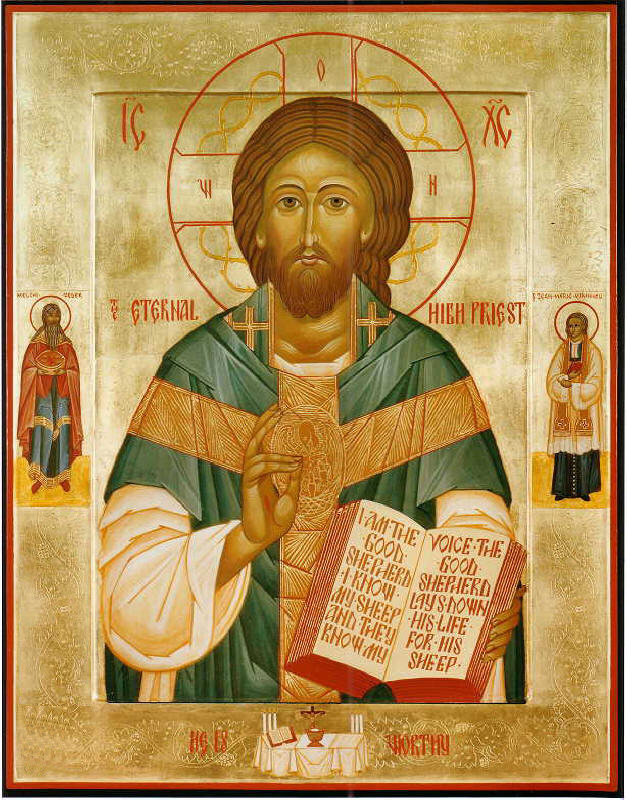
This icon shows Jesus Christ, our eternal high priest.
The gold pelican over His heart represents self-sacrifice.
The border contains an altar and grapevines, representing the Mass, and icons of Melchizedek and St. Jean-Baptiste Vianney.
Melchizedek: king of righteousness (left icon) was priest and king of Jerusalem. He blessed Abraham and has been considered an ideal priest-king.
St. Jean-Baptiste Vianney is the patron saint of parish priests.

1. Sign of the Cross: In the name of the Father, and of the Son, and of the Holy Spirit. Amen.
2. The Apostles Creed: I BELIEVE in God, the Father almighty, Creator of heaven and earth, and in Jesus Christ, His only Son, our Lord, who was conceived by the Holy Spirit, born of the Virgin Mary, suffered under Pontius Pilate, was crucified, died, and was buried. He descended into hell; on the third day he rose again from the dead; he ascended into heaven, and is seated at the right hand of God, the Father Almighty; from there He shall come to judge the living and the dead.
I believe in the Holy Spirit, the holy catholic Church, the communion of saints, the forgiveness of sins, the resurrection of the body, and the life everlasting. Amen.
3. The Lord's Prayer: OUR Father, who art in heaven, hallowed be Thy name. Thy kingdom come. Thy will be done on earth as it is in heaven. Give us this day our daily bread and forgive us our trespasses as we forgive those who trespass against us. And lead us not into temptation, but deliver us from evil. Amen.
4. (3) Hail Mary: HAIL Mary, full of grace, the Lord is with thee. Blessed art thou amongst women and blessed is the fruit of thy womb, Jesus. Holy Mary, Mother of God, pray for us sinners, now, and in the hour of our death. Amen. (Three times)
5. Glory Be: GLORY be to the Father, and to the Son, and to the Holy Spirit. As it was in the beginning, is now, and ever shall be, world without end. Amen.
6. Fatima Prayer: Oh, my Jesus, forgive us our sins, save us from the fires of hell, lead all souls to heaven, especially those in most need of your mercy.
Announce each mystery, then say 1 Our Father, 10 Hail Marys, 1 Glory Be and 1 Fatima prayer. Repeat the process with each mystery.
End with the Hail Holy Queen:
Hail, Holy Queen, Mother of Mercy, our life, our sweetness and our hope! To thee do we cry, poor banished children of Eve! To thee do we send up our sighs, mourning and weeping in this vale of tears! Turn then, most gracious advocate, thine eyes of mercy towards us; and after this, our exile, show unto us the blessed fruit of thy womb, Jesus!
O clement, O loving, O sweet Virgin Mary! Pray for us, O holy Mother of God, that we may be made worthy of the promises of Christ.
Final step -- The Sign of the Cross
The Mysteries of the Rosary By tradition, Catholics meditate on these Mysteries during prayers of the Rosary. The biblical references follow each of the Mysteries below.
The Sorrowful Mysteries
(Tuesdays and Fridays)
1. The Agony in the Garden (Matthew 26:36-46, Luke 22:39-46) [Spiritual fruit - God's will be done]
2. The Scourging at the Pillar (Matthew 27:26, Mark 15:15, John 19:1) [Spiritual fruit - Mortification of the senses]
3. The Crowning with Thorns (Matthew 27:27-30, Mark 15:16-20, John 19:2) [Spiritual fruit - Reign of Christ in our heart]
4. The Carrying of the Cross (Matthew 27:31-32, Mark 15:21, Luke 23:26-32, John 19:17) [Spiritual fruit - Patient bearing of trials]
5. The Crucifixion (Matthew 27:33-56, Mark 15:22-39, Luke 23:33-49, John 19:17-37) [Spiritual fruit - Pardoning of Injuries]
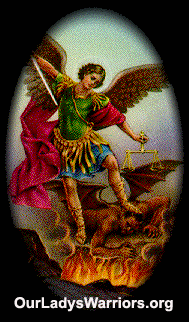
St. Michael the Archangel
~ PRAYER ~
St. Michael, the Archangel, defend us in battle
Be our protection against the wickedness
and snares of the devil;
May God rebuke him, we humbly pray,
and do thou, O Prince of the heavenly host,
by the power of God,
Cast into hell Satan and all the evil spirits
who prowl through the world seeking the ruin of souls.
Amen
+

Sea of Sorrow
Oh! on what a sea of sorrow
Was the Virgin-Mother cast,
When her eyes with tears o'erflowing
Gazed upon her Son aghast,
From the bloodstained gibbet taken,
Dying in her arms at last.
In her bitter desolation,
His sweet mouth, His bosom too,
Then His riven side beloved,
Then each hand, both wounded through,
Then His feet, with blood encrimsoned,
Her maternal tears bedew.
She, a hundred times and over,
Strains Him closely to her breast
Heart to Heart, arms arms enfolding,
Are His wounds on her impressed:
Thus, in sorrow's very kisses,
Melts her anguished soul to rest.
Oh, dear Mother! we beseech thee,
By the tears thine eyes have shed,
By the cruel death of Jesus
And His wounds' right royal red,
Make our hearts o'erflow with sorrow
From thy heart's deep fountainhead.
To the Father, Son, and Spirit,
Now we bend on equal knee:
Glory, sempiternal glory,
To the Most High Trinity;
Yea! perpetual praise and honor
Now and through all ages be.

Novena Prayer To Our Sorrowful Mother
Most Blessed and afflicted Virgin, Queen of Martyrs, who didst stand generously beneath the cross, beholding the agony of thy dying Son; by the sword of sorrow which then pierced thy soul, by the sufferings of thy sorrowful life, by the unutterable joy which now more than repays thee for them; look down with a mother's pity and tenderness, as I kneel before thee to compassionate thy sorrows, and to lay my petition with childlike confidence in thy wounded heart. I beg of thee, O my Mother, to plead continually for me with thy Son, since He can refuse thee nothing, and through the merits of His most sacred Passion and Death, together with thy own sufferings at the foot of the cross, so to touch His Sacred Heart, that I may obtain my request,
For to whom shall I fly in my wants and miseries, if not to thee, O Mother of mercy, who, having so deeply drunk the chalice of thy Son, canst most pity us poor exiles, still doomed to sigh in this vale of tears? Offer to Jesus but one drop of His Precious Blood, but one pang of His adorable Heart; remind Him that thou art our life, our sweetness, and our hope, and thou wilt obtain what I ask, through Jesus Christ our Lord. Amen.
Hail Mary
Virgin Most Sorrowful, pray for us
(Seven times each)

Mary, most holy Virgin and Queen of Martyrs, accept the sincere homage of my filial affection. Into thy Heart, pierced by so many swords, do thou welcome my poor soul. Receive it as the companion of thy sorrows at the foot of the Cross, on which Jesus died for the redemption of the world. With thee, O sorrowful Virgin, I will gladly suffer all the trials, contradictions, and infirmities which it shall please Our Lord to send me. I offer them all to thee in memory of thy sorrows, so that: every thought of my mind and every beat of my heart may be an act of compassion and of love for thee. And do thou, sweet Mother, have pity on me, reconcile me to thy Divine Son, Jesus; keep me in His grace and assist me in my last agony, so that I may be able to meet thee in Heaven and sing thy glories.
Most holy Virgin and Mother, whose soul was pierced by a sword of sorrow in the Passion of thy Divine Son, and who in His glorious Resurrection wast filled with never ending joy at His triumph, obtain for us who call upon thee, so to be partakers in the adversities of Holy Church and the Sorrows of the Sovereign Pontiff, as to be found worthy to rejoice with them in the consolations for which we pray, in the charity and peace of the same Christ our Lord. Amen.

Litany of the Seven Sorrows
| Lord, have mercy on us. Lord, have mercy on us. Christ, hear us. Christ, graciously hear us. God, the Father of heaven, God the Son, Redeemer of the world, . God the Holy Ghost, Holy Mary, Mother of God, Holy Virgin of virgins, Mother of the Crucified, Sorrowful Mother, Mournful Mother, Sighing Mother, Afflicted Mother, Foresaken Mother, . Desolate Mother, Mother most sad, Mother set around with anguish, Mother overwhelmed by grief, Mother transfixed by a sword, Mother crucified in thy heart, Mother bereaved of thy Son, Sighing Dove, Mother of Dolors, Fount of tears, Sea of bitterness, Field of tribulation, Mass of suffering, Mirror of patience, Rock of constancy, Remedy in perplexity, Joy of the afflicted, Ark of the desolate, Refuge of the abandoned,. Shiled of the oppressed, Conqueror of the incredulous, Solace of the wretched, Medicine of the sick, Help of the faint, Strength of the weak, Protectress of those who fight, Haven of the shipwrecked, Calmer of tempests, Companion of the sorrowful, Retreat of those who groan, Terror of the treacherous, Standard-bearer of the Martyrs, Treasure of the Faithful, Light of Confessors, Pearl of Virgins, . Comfort of Widows, . Joy of all Saints, Queen of thy Servants, Holy Mary, who alone art unexampled, Pray for us, most Sorrowful Virgin, |
Christ, have mercy on us. Christ, graciously hear us. |
|
| Let us pray, --- O God, in whose Passion, according to the prophecy of Simeon, a sword of grief pierced through the most sweet soul of Thy glorious Blessed Virgin Mother Mary: grant that we, who celebrate the memory of her Seven Sorrows, may obtain the happy effect of Thy Passion, Who lives and reigns world without end, Amen. |
||
| The Seven Sorrows of Our Lady 1. The Prophecy of Simeon 2. The Flight into Egypt . 3. The Loss of Jesus in the Temple 4. Mary meets Jesus Carrying the Cross 5. The Crucifixion 6. Mary Receives the Dead Body of Her Son 7. The Burial of Her Son and Closing of the Tomb. |
||
| Consecration to Our Lady of Sorrows Most holy Virgin and Queen of Martyrs, Mary, would that I could be in Heaven, there to contemplate the honors rendered to thee by the Most Holy Trinity and by the whole Heavenly Court! But since I am still a pilgrim in this vale of tears, receive from me, thy unworthy servant and a poor sinner, the most sincere homage and the most perfect act of vassalage a human creature can offer thee. In thy Immaculate Heart, pierced with so many swords of sorrow, I place today my poor soul forever; receive me as a partaker in thy dolors, and never suffer that I should depart from that Cross on which thy only begotten Son expired for me. With thee, O Mary, I will endure all the sufferings, contradictions, infirmities, with which it will please thy Divine Son to visit me in this life. All of them I offer to thee, in memory of the Dolors which thou didst suffer during thy life, that every thought of my mind, every beating of my heart may henceforward be an act of compassion to thy Sorrows, and of complacency for the glory thou now enjoyest in Heaven. Since then, O Dear Mother, I now compassionate thy Dolors, and rejoice in seeing thee glorified, do thou also have compassion on me, and reconcile me to thy Son Jesus, that I may become thy true and loyal son (daughter); come on my last day and assist me in my last agony, even as thou wert present at the Agony of thy Divine Son Jesus, that from this painful exile I may go to Heaven, there to be made partaker of thy glory. Amen. |
Litany of Sorrows
|
|
|

Prayer To Our Lady of Sorrows, by St. Bridget
O Blessed Virgin Mary, Immaculate Mother of God, who didst endure a martyrdom of love and grief beholding the sufferings and sorrows of Jesus! Thou didst cooperate in the benefit of my redemption by thine innumerable afflictions and by offering to the Eternal Father His only begotten Son as a holocaust and victim of propitiation for my sins. I thank thee for the unspeakable love which led thee to deprive thyself of the Fruit of thy womb, Jesus, true God and true Man, to save me, a sinner. Oh, make use of the unfailing intercession of thy sorrows with the Father and the Son, that I may steadfastly amend my life and never again crucify my loving Redeemer by new sins, and that, persevering till death in His grace. I may obtain eternal life through the merits of His Cross and Passion. Amen.
Mother of love, of sorrow and of mercy, pray for us.

Saint Alphonsus Liguori's Prayer To The Mother Of Sorrows
O, my Blessed Mother, it is not one sword only with which I have pierced thy heart, but I have done so with as many as are the sins which I have committed. O, Lady, it is not to thee, who art innocent, that sufferings are due, but to me, who am guilty of so many crimes. But since thou hast been pleased to suffer so much for me, by thy merits, obtain me great sorrow for my sins, and patience under the trials of this life, which will always be light in comparison with my demerits; for I have often deserved Hell.
Amen.

Lists Every Catholic Should be Familiar With: The 7 Sorrows (Dolours) and 7 Joys of Our Lady
The Seven Dolors (Sorrows) of Mary [Catholic/Orthodox Devotional]
Apparition in Africa: Our Lady of Sorrows [Catholic/Orthodox Caucus]
Feast of the Seven Sorrows of the Blessed Virgin Mary [Catholic Caucus Devotional]
Feast of Our Lady/Mother of Sorrows
Homilies on Our Lady of Sorrows
Starkenburg:Pilgrimage to Our Lady of Sorrows Shrine
Our Mother of Sorrows
ST. ALPHONSUS LIGUORI, OF THE DOLOURS OF MARY, The Glories [Sorrows] of Mary
Our Lady of Sorrows - Sep 15
Disclaimer: Opinions posted on Free Republic are those of the individual posters and do not necessarily represent the opinion of Free Republic or its management. All materials posted herein are protected by copyright law and the exemption for fair use of copyrighted works.