
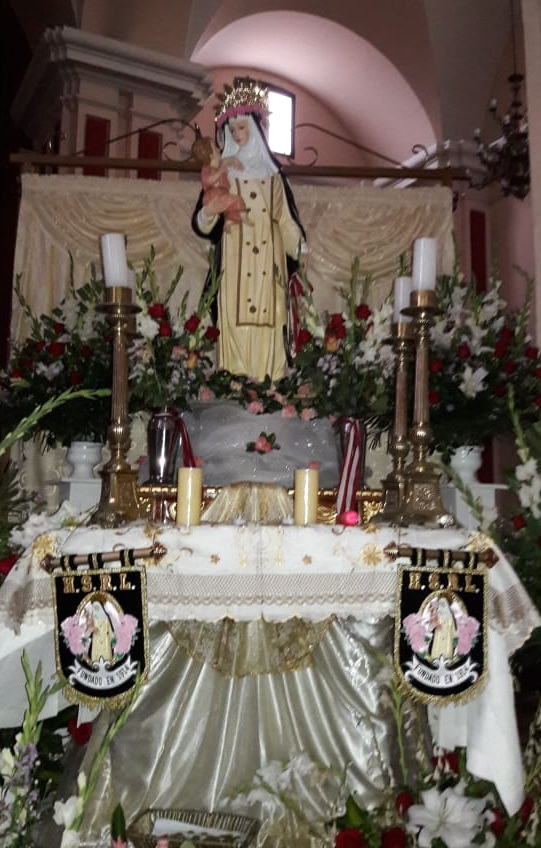
The Golden Altar
Iglesia de San Jose
Casco Viejo, Panama
Posted on 08/22/2019 11:28:45 PM PDT by Salvation
KEYWORDS: catholic; mt22; ordinarytime; prayer; saints;
Please FReepmail me to get on/off the Alleluia Ping List.
From: Ruth 1:1, 3-6, 14b-16, 22
Elimelech and his family migrate from Israel
[3] But Elimelech, the husband of Naomi, died, and she was left with her two
sons. [4] These took Moabite wives; the name of the one was Orpah and the
name of the other Ruth. They lived there about ten years; [5] and both Mahlon
and Chilion died, so that the woman was bereft of her two sons and her husband.
Ruth the Moabitess leaves her land and goes to Judah
[14] Then they lifted up their voices and wept again; and Orpah kissed her mo-
ther-in-law, but Ruth clung to her. [15] And she said, “See, your sister-in-law has
gone back to her people and to her gods; return after your sister-in-law.” [16] But
Ruth said, “Entreat me not to leave you or to return from following you; for where
you go I will go, and where you lodge I will lodge; your people shall be my people,
and your God my God;
[22] So Naomi returned, and Ruth the Moabitess her daughter-in-law with her,
who returned from the country of Moab. And they came to Bethlehem at the be-
ginning of barley harvest.
*********************************************************************************************
Commentary:
1-5. We are told why a family from Bethlehem in Judah had to leave their country
and migrate to Moab. The book of Judges reported on how the Moabites oppress-
sed the Benjaminites at the time of Eglon of Moab (Judg 3:12-14); however, there
is no sign here of Elimelech and his family being anyway wary of the Moabites.
They settle down in Moab peacefully and the two boys take Moabite wives. A
similar mutual respect is to he seen in David’s friendship with the king of Moab
which is recorded in some traditions (cf. 1 Sam 22:3-4).
The name Elimelech means “my God is king”, and that of Naomi, “my delight”;
Mahlon means “pain”; Chilion, “destruction”; Orpah, “she who turns her back”;
Ruth, “she who comforts”. All the names say something about the people who
bear them.
1:6-22. Naomi does not mislead her daughters-in-laws, to get them to go with
her. On the contrary, she spells out exactly what they find if they stay with her.
In the explanations she gives (vv. 11-13) one can see that she is thinking of the
law of levirate whereby if a man died without issue, his brother was supposed to
take his wife and the first born-son of that marriage would be the son of the first
husband in the eyes of the law (cf. Deut 25:5-10). This means that if Naomi were
to marry again and have another son, he would be a new brother-in-law to Ruth
and Orpah and, through the law of levirate, he would take them as wives. But
that law could be of no help in this particular situation.
Orpah makes a perfectly reasonable decision; she sorrowfully says goodbye
to Naomi and returns home. Maybe this makes Ruth’s decision all the more im-
pressive: she opts to leave her land and her family and accompany Naomi; back
to her dead husband’s country, where she (Ruth) had never been. Her determina-
tion says much for her fidelity to the God she came to know in her husband’s fa-
mily: “Where you go, I go, and where you lodge, I will lodge” (v. 16). Ruth did not
belong to Israel by birth; the text repeatedly mentions that she was a Moabitess
(1:4, 22; 2:2, 6, 21; 4:5, 10), a foreigner (2:10). But when she comes to know the
people of God, she decides to become a member of it and makes a binding oath
to this effect (v. 17). It was customary to spell out the penalties that would apply
if one failed to keep an oath. However, in the sacred text, those words, which
were usually rather chilling, are replaced by a general form of words such as
“May the Lord do so to me and more also” (v. 17; cf. 1 Sam 3:17; 2 Sam 3:9;
etc.).
Christian tradition has seen in Ruth the Church of the Gentiles — all those men
and women of every background who, coming to know the Lord through the wit-
ness borne by others, become part of the People of God: “In her [Ruth] we are
given a symbol of all of us who have been drawn from among all the peoples to
form part of the Church” (”Expositio Evangelii secundum Lucam, 3, 30)
*********************************************************************************************
Source: “The Navarre Bible: Text and Commentaries”. Biblical text from the
Revised Standard Version and New Vulgate. Commentaries by members of
the Faculty of Theology, University of Navarre, Spain.
Published by Four Courts Press, Kill Lane, Blackrock, Co. Dublin, Ireland, and
by Scepter Publishers in the United States.
From: Matthew 22:34-40
The Greatest Commandment of All
*********************************************************************************************
Commentary:
34-40. In reply to the question, our Lord points out that the whole law can be con-
densed into two commandments: the first and more important consists in uncon-
ditional love of God; the second is a consequence and result of the first, because
when man is loved, St. Thomas says, God is loved, for man is the image of God
(cf. “Commentary on St. Matthew”, 22:4).
A person who genuinely loves God also loves his fellows because he realizes
that they are his brothers and sisters, children of the same Father, redeemed by
the same blood of our Lord Jesus Christ: “this commandment we have from Him,
that he who loves God should love his brother also” (1 John 4:21). However, if we
love man for man’s sake without reference to God, this love will become an obsta-
cle in the way of keeping the first commandment, and then it is no longer genuine
love of our neighbor. But love of our neighbor for God’s sake is clear proof that we
love God: “If anyone says, ‘I love God’, but hates his brother, he is a liar” (1 John
4:20).
“You shall love your neighbor as yourself”: here our Lord establishes as the
guideline for our love of neighbor the love each of us has for himself; both love of
others and love of self are based on love of God. Hence, in some cases it can
happen that God requires us to put our neighbor’s need before our own; in others,
not: it depends on what value, in the light of God’s love, needs to be put on the
spiritual and material factors involved.
Obviously spiritual goods take absolute precedence over material ones, even
over life itself. Therefore, spiritual goods, be they our own or our neighbor’s, must
be the first to be safeguarded. If the spiritual good in question is the supreme one
of the salvation of the soul, no one is justified in putting his own soul into certain
danger of being condemned in order to save another, because given human free-
dom we can never be absolutely sure what personal choice another person may
make: this is the situation in the parable (cf. Matthew 25:1-13), where the wise
virgins refuse to give oil to the foolish ones; similarly St. Paul says that he would
wish himself to be rejected if that could save his brothers (cf. Romans 9:3) — an
unreal theoretical situation. However, what is quite clear is that we have to do all
we can to save our brothers, conscious that, if someone helps to bring a sinner
back to the Way, he will save himself from eternal death and cover a multitude
of his own sins (James 5:20). From all this we can deduce that self-love of the
right kind, based on God’s love for man, necessarily involves forgetting oneself
in order to love God and our neighbor for God.
37-38. The commandment of love is the most important commandment because
by obeying it man attains his own perfection (cf. Colossians 3:14). “The more a
soul loves,” St. John of the Cross writes, “the more perfect is it in that which it
loves; therefore this soul that is now perfect is wholly love, if it may thus be ex-
pressed, and all its actions are love and it employs all its faculties and posses-
sions in loving, giving all that it has, like the wise merchant, for this treasure of
love which it has found hidden in God [...]. For, even as the bee extracts from
all plants the honey that is in them, and has no use for them for aught else save
for that purpose, even so the soul with great facility extracts the sweetness of
love that is in all the things that pass through it; it loves God in each of them,
whether pleasant or unpleasant; and being, as it is, informed and protected by
love, it has neither feeling nor taste nor knowledge of such things, for, as we
have said, the soul knows naught but love, and its pleasure in all things and
occupations is ever, as we have said, the delight of the love of God” (”Spiritual
Canticle”, Stanza 27, 8).
*********************************************************************************************
Source: “The Navarre Bible: Text and Commentaries”. Biblical text from the
Revised Standard Version and New Vulgate. Commentaries by members of
the Faculty of Theology, University of Navarre, Spain.
Published by Four Courts Press, Kill Lane, Blackrock, Co. Dublin, Ireland, and
by Scepter Publishers in the United States.
Liturgical Colour: Green.
| First reading |
|---|
| Ruth 1:1,3-6,14-16,22 © |
| Ruth the Moabitess is brought to Bethlehem by Naomi |
|---|
| Responsorial Psalm |
|---|
| Psalm 145(146):5-10 © |
| Gospel Acclamation | Ps118:18 |
|---|
| Or: | Ps24:4,5 |
|---|
| Gospel |
|---|
| Matthew 22:34-40 © |
| The commandments of love |
|---|
| Matthew | |||
| English: Douay-Rheims | Latin: Vulgata Clementina | Greek NT: Byzantine/Majority Text (2000) | |
| Matthew 22 |
|||
| 34. | But the Pharisees hearing that he had silenced the Sadducees, came together: | Pharisæi autem audientes quod silentium imposuisset sadducæis, convenerunt in unum : | οι δε φαρισαιοι ακουσαντες οτι εφιμωσεν τους σαδδουκαιους συνηχθησαν επι το αυτο |
| 35. | And one of them, a doctor of the law, asking him, tempting him: | et interrogavit eum unus ex eis legis doctor, tentans eum : | και επηρωτησεν εις εξ αυτων νομικος πειραζων αυτον και λεγων |
| 36. | Master, which is the greatest commandment in the law? | Magister, quod est mandatum magnum in lege ? | διδασκαλε ποια εντολη μεγαλη εν τω νομω |
| 37. | Jesus said to him: Thou shalt love the Lord thy God with thy whole heart, and with thy whole soul, and with thy whole mind. | Ait illi Jesus : Diliges Dominum Deum tuum ex toto corde tuo, et in tota anima tua, et in tota mente tua. | ο δε ιησους εφη αυτω αγαπησεις κυριον τον θεον σου εν ολη καρδια σου και εν ολη ψυχη σου και εν ολη τη διανοια σου |
| 38. | This is the greatest and the first commandment. | Hoc est maximum, et primum mandatum. | αυτη εστιν πρωτη και μεγαλη εντολη |
| 39. | And the second is like to this: Thou shalt love thy neighbor as thyself. | Secundum autem simile est huic : Diliges proximum tuum, sicut teipsum. | δευτερα δε ομοια αυτη αγαπησεις τον πλησιον σου ως σεαυτον |
| 40. | On these two commandments dependeth the whole law and the prophets. | In his duobus mandatis universa lex pendet, et prophetæ. | εν ταυταις ταις δυσιν εντολαις ολος ο νομος και οι προφηται κρεμανται |
The first canonized saint of the New World has one characteristic of all saints—the suffering of opposition—and another characteristic which is more for admiration than for imitation—excessive practice of mortification.
She was born to parents of Spanish descent in Lima, Peru, at a time when South America was in its first century of evangelization. She seems to have taken Catherine of Siena as a model, in spite of the objections and ridicule of parents and friends.
The saints have so great a love of God that what seems bizarre to us, and is indeed sometimes imprudent, is simply a logical carrying out of a conviction that anything that might endanger a loving relationship with God must be rooted out. So, because her beauty was so often admired, Rose used to rub her face with pepper to produce disfiguring blotches. Later, she wore a thick circlet of silver on her head, studded on the inside, like a crown of thorns.
When her parents fell into financial trouble, she worked in the garden all day and sewed at night. Ten years of struggle against her parents began when they tried to make Rose marry. They refused to let her enter a convent, and out of obedience she continued her life of penance and solitude at home as a member of the Third Order of Saint Dominic. So deep was her desire to live the life of Christ that she spent most of her time at home in solitude.
During the last few years of her life, Rose set up a room in the house where she cared for homeless children, the elderly, and the sick. This was a beginning of social services in Peru. Though secluded in life and activity, she was brought to the attention of Inquisition interrogators, who could only say that she was influenced by grace.
What might have been a merely eccentric life was transfigured from the inside. If we remember some unusual penances, we should also remember the greatest thing about Rose: a love of God so ardent that it withstood ridicule from without, violent temptation, and lengthy periods of sickness. When she died at 31, the city turned out for her funeral. Prominent men took turns carrying her coffin.
It is easy to dismiss excessive penances of the saints as the expression of a certain culture or temperament. But a woman wearing a crown of thorns may at least prod our consciences. We enjoy the most comfort-oriented life in human history. We eat too much, drink too much, use a million gadgets, fill our eyes and ears with everything imaginable. Commerce thrives on creating useless needs on which to spend our money. It seems that when we have become most like slaves, there is the greatest talk of “freedom.” Are we willing to discipline ourselves in such an atmosphere?
Americas
Florists
Latin America
Peru
Philippines
South America
Pray for Pope Francis.
50 Boko Haram Islamic Radicals Killed; 1,000 Hostages, Women and Children, Rescued in Nigeria
Nigeria: In the Face of Ongoing Islamist Attacks, the Faith is Growing
US Promises to Help Nigeria Exterminate Boko Haram
Is This Bishop Right about the Rosary Conquering Boko Haram? [Catholic Caucus]
Why Boko Haram and ISIS Target Women
Report reveals scale of Boko Haram violence inflictef on Nigerian Catholics
Military evacuating girls, women rescued from Boko Haram
Echos of Lepanto Nigerian bishop says rosary will bring down Boko Harm
After vision of Christ, Nigerian bishop says rosary will bring down Boko Haram (Catholic Caucus)
Nigerian Bishop Says Christ Showed Him How to Beat Islamic Terror Group
We thank you, God our Father, for those who have responded to your call to priestly ministry.
Accept this prayer we offer on their behalf: Fill your priests with the sure knowledge of your love.
Open their hearts to the power and consolation of the Holy Spirit.
Lead them to new depths of union with your Son.
Increase in them profound faith in the Sacraments they celebrate as they nourish, strengthen and heal us.
Lord Jesus Christ, grant that these, your priests, may inspire us to strive for holiness by the power of their example, as men of prayer who ponder your word and follow your will.
O Mary, Mother of Christ and our mother, guard with your maternal care these chosen ones, so dear to the Heart of your Son.
Intercede for our priests, that offering the Sacrifice of your Son, they may be conformed more each day to the image of your Son, our Lord and Savior, Jesus Christ. Amen.
Saint John Vianney, universal patron of priests, pray for us and our priests
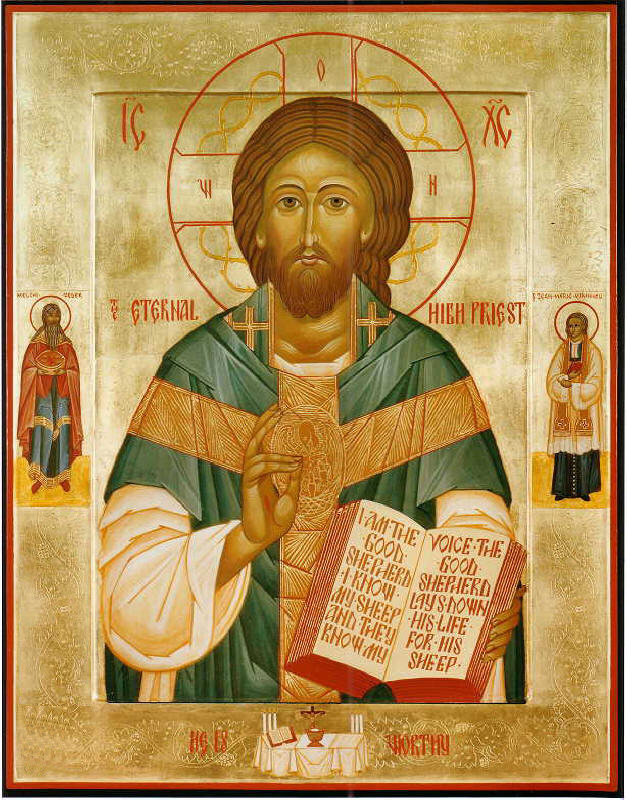
This icon shows Jesus Christ, our eternal high priest.
The gold pelican over His heart represents self-sacrifice.
The border contains an altar and grapevines, representing the Mass, and icons of Melchizedek and St. Jean-Baptiste Vianney.
Melchizedek: king of righteousness (left icon) was priest and king of Jerusalem. He blessed Abraham and has been considered an ideal priest-king.
St. Jean-Baptiste Vianney is the patron saint of parish priests.

1. Sign of the Cross: In the name of the Father, and of the Son, and of the Holy Spirit. Amen.
2. The Apostles Creed: I BELIEVE in God, the Father almighty, Creator of heaven and earth, and in Jesus Christ, His only Son, our Lord, who was conceived by the Holy Spirit, born of the Virgin Mary, suffered under Pontius Pilate, was crucified, died, and was buried. He descended into hell; on the third day he rose again from the dead; he ascended into heaven, and is seated at the right hand of God, the Father Almighty; from there He shall come to judge the living and the dead.
I believe in the Holy Spirit, the holy catholic Church, the communion of saints, the forgiveness of sins, the resurrection of the body, and the life everlasting. Amen.
3. The Lord's Prayer: OUR Father, who art in heaven, hallowed be Thy name. Thy kingdom come. Thy will be done on earth as it is in heaven. Give us this day our daily bread and forgive us our trespasses as we forgive those who trespass against us. And lead us not into temptation, but deliver us from evil. Amen.
4. (3) Hail Mary: HAIL Mary, full of grace, the Lord is with thee. Blessed art thou amongst women and blessed is the fruit of thy womb, Jesus. Holy Mary, Mother of God, pray for us sinners, now, and in the hour of our death. Amen. (Three times)
5. Glory Be: GLORY be to the Father, and to the Son, and to the Holy Spirit. As it was in the beginning, is now, and ever shall be, world without end. Amen.
6. Fatima Prayer: Oh, my Jesus, forgive us our sins, save us from the fires of hell, lead all souls to heaven, especially those in most need of your mercy.
Announce each mystery, then say 1 Our Father, 10 Hail Marys, 1 Glory Be and 1 Fatima prayer. Repeat the process with each mystery.
End with the Hail Holy Queen:
Hail, Holy Queen, Mother of Mercy, our life, our sweetness and our hope! To thee do we cry, poor banished children of Eve! To thee do we send up our sighs, mourning and weeping in this vale of tears! Turn then, most gracious advocate, thine eyes of mercy towards us; and after this, our exile, show unto us the blessed fruit of thy womb, Jesus!
O clement, O loving, O sweet Virgin Mary! Pray for us, O holy Mother of God, that we may be made worthy of the promises of Christ.
Final step -- The Sign of the Cross
The Mysteries of the Rosary By tradition, Catholics meditate on these Mysteries during prayers of the Rosary. The biblical references follow each of the Mysteries below.
The Sorrowful Mysteries
(Tuesdays and Fridays)
1. The Agony in the Garden (Matthew 26:36-46, Luke 22:39-46) [Spiritual fruit - God's will be done]
2. The Scourging at the Pillar (Matthew 27:26, Mark 15:15, John 19:1) [Spiritual fruit - Mortification of the senses]
3. The Crowning with Thorns (Matthew 27:27-30, Mark 15:16-20, John 19:2) [Spiritual fruit - Reign of Christ in our heart]
4. The Carrying of the Cross (Matthew 27:31-32, Mark 15:21, Luke 23:26-32, John 19:17) [Spiritual fruit - Patient bearing of trials]
5. The Crucifixion (Matthew 27:33-56, Mark 15:22-39, Luke 23:33-49, John 19:17-37) [Spiritual fruit - Pardoning of Injuries]
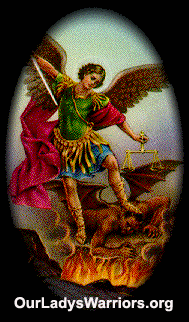
St. Michael the Archangel
~ PRAYER ~
St. Michael, the Archangel, defend us in battle
Be our protection against the wickedness
and snares of the devil;
May God rebuke him, we humbly pray,
and do thou, O Prince of the heavenly host,
by the power of God,
Cast into hell Satan and all the evil spirits
who prowl through the world seeking the ruin of souls.
Amen
+
Disclaimer: Opinions posted on Free Republic are those of the individual posters and do not necessarily represent the opinion of Free Republic or its management. All materials posted herein are protected by copyright law and the exemption for fair use of copyrighted works.