Free Republic
Browse · Search
Religion
Topics · Post Article

Skip to comments.

Catholic Caucus: Daily Mass Readings, 07-30-19. OM, St. Peter Chrysologus, Bishop and Doctor/Church
USCCB.org/RNAB ^ | 07-30-19 | Revised New American Bible

Posted on 07/29/2019 10:08:51 PM PDT by Salvation

July 30 2019

Tuesday of the Seventeenth Week in Ordinary Time

Reading 1 Ex 33:7-11; 34:5b-9, 28

The tent, which was called the meeting tent,
Moses used to pitch at some distance away, outside the camp.
Anyone who wished to consult the LORD
would go to this meeting tent outside the camp.
Whenever Moses went out to the tent, the people would all rise
and stand at the entrance of their own tents,
watching Moses until he entered the tent.
As Moses entered the tent, the column of cloud would come down
and stand at its entrance while the LORD spoke with Moses.
On seeing the column of cloud stand at the entrance of the tent,
all the people would rise and worship
at the entrance of their own tents.
The LORD used to speak to Moses face to face,
as one man speaks to another.
Moses would then return to the camp,
but his young assistant, Joshua, son of Nun,
would not move out of the tent.

Moses stood there with the LORD and proclaimed his name, "LORD."
Thus the LORD passed before him and cried out,
"The LORD, the LORD, a merciful and gracious God,
slow to anger and rich in kindness and fidelity,
continuing his kindness for a thousand generations,
and forgiving wickedness and crime and sin;
yet not declaring the guilty guiltless,
but punishing children and grandchildren
to the third and fourth generation for their fathers' wickedness!"
Moses at once bowed down to the ground in worship.
Then he said, "If I find favor with you, O LORD,
do come along in our company.
This is indeed a stiff-necked people;
yet pardon our wickedness and sins,
and receive us as your own."

So Moses stayed there with the LORD for forty days and forty nights,
without eating any food or drinking any water,
and he wrote on the tablets the words of the covenant,
the ten commandments.

Responsorial Psalm Ps 103:6-7, 8-9, 10-11, 12-13

R.(8a) The Lord is kind and merciful.
The LORD secures justice
and the rights of all the oppressed.
He has made known his ways to Moses,
and his deeds to the children of Israel.
R. The Lord is kind and merciful.
Merciful and gracious is the LORD,
slow to anger and abounding in kindness.
He will not always chide,
nor does he keep his wrath forever.
R. The Lord is kind and merciful.
Not according to our sins does he deal with us,
nor does he requite us according to our crimes.
For as the heavens are high above the earth,
so surpassing is his kindness toward those who fear him.
R. The Lord is kind and merciful.
As far as the east is from the west,
so far has he put our transgressions from us.
As a father has compassion on his children,
so the LORD has compassion on those who fear him.
R. The Lord is kind and merciful.

Alleluia

R. Alleluia, alleluia.
The seed is the word of God, Christ is the sower;
all who come to him will live for ever.
R. Alleluia, alleluia.

Gospel Mt 13:36-43

Jesus dismissed the crowds and went into the house.
His disciples approached him and said,
"Explain to us the parable of the weeds in the field."
He said in reply, "He who sows good seed is the Son of Man,
the field is the world, the good seed the children of the Kingdom.
The weeds are the children of the Evil One,
and the enemy who sows them is the Devil.
The harvest is the end of the age, and the harvesters are angels.
Just as weeds are collected and burned up with fire,
so will it be at the end of the age.
The Son of Man will send his angels,
and they will collect out of his Kingdom
all who cause others to sin and all evildoers.
They will throw them into the fiery furnace,
where there will be wailing and grinding of teeth.
Then the righteous will shine like the sun
in the Kingdom of their Father.
Whoever has ears ought to hear."

For the readings of the Optional Memorial of Saint Peter Chrysologus, please go here.


TOPICS: Catholic; General Discusssion; Prayer; Worship
KEYWORDS: catholic; mt13; ordinarytime; prayer; saints
Navigation: use the links below to view more comments.
first 1-2021-32 next last
For your reading, reflection, faith-sharing, comments, questions, discussion.

1 posted on 07/29/2019 10:08:52 PM PDT by Salvation
[ Post Reply | Private Reply | View Replies]

To: All

KEYWORDS: catholic; mt13; ordinarytime; prayer; saints;


2 posted on 07/29/2019 10:10:18 PM PDT by Salvation ("With God all things are possible." Matthew 19:26)
[ Post Reply | Private Reply | To 1 | View Replies]

To: nickcarraway; NYer; ELS; Pyro7480; livius; ArrogantBustard; Catholicguy; RobbyS; marshmallow; ...
Alleluia Ping

Please FReepmail me to get on/off the Alleluia Ping List.


3 posted on 07/29/2019 10:11:33 PM PDT by Salvation ("With God all things are possible." Matthew 19:26)
[ Post Reply | Private Reply | To 2 | View Replies]

To: All

From: Exodus 33:7-11; 34:5b-9, 28

The Tent of Meeting


[7] Now Moses used to take the tent and pitch it outside the camp, far off from
the camp; and he called it the tent of meeting. And every one who sought the
Lord would go out to the tent of meeting, which was outside the camp. [8] When-
ever Moses went out to the tent, all the people rose up, and every man stood at
his tent door, and looked after Moses, until he had gone into the tent. [9] When
Moses entered the tent, the pillar of cloud would descend and stand at the door
of the tent, and the Lord would speak with Moses. [10] And when all the people
saw the pillar of cloud standing at the door of the tent, all the people would rise
up and worship, every man at his tent door. [11] Thus the Lord used to speak to
Moses face to face, as a man speaks to his friend. When Moses turned again
into the camp, his servant Joshua the son of Nun, a young man, did not depart
from the tent.

[5] (God) stood with him (Moses) there, and (Moses) proclaimed the name of
the Lord.

God Appears


[6] The Lord passed before him, and proclaimed, “The Lord, the Lord, a God
merciful and gracious, slow to anger, and abounding in steadfast love and faith-
fulness, [7] keeping steadfast love for thousands, forgiving iniquity and transgres-
sion and sin, but who will by no means clear the guilty, visiting the iniquity of the
fathers upon the children and the children’s children, to the third and the fourth
generation.” [8] And Moses made haste to bow his head toward the earth, and
worshiped. [9] And he said, “If now I have found favor in thy sight, 0 Lord, let the
Lord, I pray thee, go in the midst of us, although it is a stiff-necked people; and
pardon our iniquity and our sin, and take us for thy inheritance.”

The Ritual Decalogue (Continuation)


[28] And he was there with the Lord forty days and forty nights; he neither ate
bread nor drank water. And he wrote upon the tables the words of the covenant,
the ten commandments.

*********************************************************************************************
Commentary:

33:7-11. The tent of meeting, sometimes called the tent of witness, and also the
sanctuary, normally means the main tent in the sacred precinct (cf. chaps. 25-
27). Here, however, it seems to be different firm the sanctuary, because the
sanctuary was located in the center of the encampment and was a place of wor-
ship, whereas this tent is pitched away from the camp and is used for consulta-
tion. This discrepancy may well be due to the fact that this passage belonged to
an older tradition than the Priestly one. Whereas the Priestly tradition lays the
stress on matters to do with worship, the earlier one would have focused more
on social matters.

The sacred writer, through this account, is showing that God continues to be pre-
sent but at a certain distance, and that only Moses has the privilege of speaking
to him “face to face” (cf. 33:20). The people are simply the silent witnesses of
the conversations which take place between God and Moses, but God still shows
them special favor.

34:1-28. This chapter narrating the renewal of the Covenant follows the same pat-
tern as the account of its original establishment (cf. Ex 19-24); but it is shorter,
concentrating on the two main protagonists, God and Moses. Thus, it begins
with the preparations for the theophany and for the encounter with the Lord (vv.
1-5); then follows the revelation of God, and Moses’ prayer (vv. 6-9); and it ends
with the renewal of the Covenant and the so-called Rite of the Covenant (vv.10-
28). The account hinges on the remaking of the tables of stone after the sin of
the golden calf; the tables symbolize God’s offer to keep to the pact and never
to go back on it.

34:1-5. The theophany is described very soberly here, but it has exactly the
same elements as given in chapter 19: very careful preparation by Moses (v 2;
cf. 19:10-11.); the people forbidden to approach the mountain (v.3; cf. 19:12-13);
God appearing wrapped in the cloud (v. 5; cf. 19:16-20).

Comparing the two accounts, this one says less about the transcendence of God
and puts more stress on his closeness to Moses: “he stood with him there” (v. 5).
God’s initiative in drawing close to man is clear to see; it lies at the very basis of
the Covenant.

“He proclaimed the name of the Lord” (v. 6); the context would suggest that it is
Moses who proclaims the name of the Lord, but the Hebrew could indeed be as
the RSV has it, “and he proclaimed his name, ‘Lord’ “. The same wording appears
in v. 6 implying that it is the Lord who is “proclaiming”, defining himself as he pro-
mised he would (cf 33:19). The sacred writer may have intentionally left these
words open to either interpretation; whether spoken by Moses or said directly by
God, they are equal from the revelation point of view.

34:6-7. In response to Moses’ pleading, the Lord makes himself manifest The
solemn repetition of the name of Yahweh (Lord) emphasizes that the Lord is in-
troducing himself liturgically to the assembled Israelites. In the description of
himself which follows (and which is repeated elsewhere, cf 20:5-6; Num 14:18;
Deut 5:9-18; etc.), two key attributes of God are underlined—justice and mercy.
God cannot let sin go unpunished, nor does he; the prophets, too, will teach that
sin is, first and foremost, something personal (cf. Jer 31:29; Ezek I 8:2ff). But
this ancient text refers only in a general way to the fact that God is just, and
puts more stress on his mercy. A person who is conscious of his own sin has
access to God only if he is sure that God can and will forgive him. “The concept
of ‘mercy’ in the Old Testament,” John Paul II comments, “has a long and rich
history. We have to refer back to it in order that the mercy revealed by Christ
may shine forth more clearly. [...] Sin too constitutes man’s misery. The people
of the Old Covenant experienced this misery from the time of the Exodus, when
they set up the golden calf. The Lord himself triumphed over this act of breaking
the covenant when he solemnly declared to Moses that he was a ‘God merciful
and gracious, slow to anger, and abounding in steadfast love and faithfulness’
(Ex 34:6). It is in this central revelation that the chosen people, and each of its
members, will find, every time that they have sinned, the strength and the mo-
tive for turning to the Lord to remind him of what he had exactly revealed about
himself and to beseech his forgiveness” (”Dives In Misericordia”, 4). On “God’s
jealousy”, see the note on 20:5-6.

[The note on 20:5-6 states: “A jealous God”: an antropomorphism emphasizing
the uniqueness of God. Since he is the only true God, he cannot abide either the
worship of other gods (cf. 34:14) or worship of idols. Idolatry is the gravest and
most condemned sin in the Bible (cf. “Catechism of the Catholic Church”, 2113).
Those in charge of worship in the temple are described as being “jealous” for the
Lord (cf. Num 25:13; 1 Kings 19:10, 14), because they have to watch to ensure
that no deviations occur. When expelling the money-changers from the temple
(Jn 2:17), Jesus refers to this aspect of priests’ responsibility: “Zeal for thy house
has consumed me” (Ps 69:9).

On the Lord’s merciful retribution, cf. the note on Ex 34:6-7.]

34:8-9. Moses once more implores the Lord on behalf of his people; he makes
three requests, which sum up many earlier petitions: he begs God to stay with
the people and protect them in their hazardous journeying in the desert (cf. 33:15-
17), to forgive the very grave sin they have committed (cf. 32:11-14), and finally to
make them his own property, thereby distinguishing them from all other peoples
(cf. 33:16) and restoring them to their status as “his own possession” (cf. 19:5).
These three requests are ones that were constantly on the lips of the people of
Israel and in the hearts of everyone who acknowledges God (cf. Ps 86:1-15; 103:
8-10; etc.).

34:7-8. The conclusion of the Covenant is described as soberly as its introduc-
tion (v. 10). On the meaning of the forty days, see the note on 24:12-18.

[The note on 24:12-18 states: ...then Moses stayed on the mountain for forty
days, in close contact with the Lord. These periods of time are not meant to be
exact but rather to show how intense Moses’ relationship with God was; they will
be evoked when important events are narrated later: thus, Elijah walked for forty
days in search of God (cf. 1 Kings 19:8) and Jesus will spend forty days in the
desert before beginning his public life (cf. Mt 4:2).]

*********************************************************************************************
Source: “The Navarre Bible: Text and Commentaries”. Biblical text from the
Revised Standard Version and New Vulgate. Commentaries by members of
the Faculty of Theology, University of Navarre, Spain.

Published by Four Courts Press, Kill Lane, Blackrock, Co. Dublin, Ireland, and
by Scepter Publishers in the United States.


4 posted on 07/29/2019 10:13:15 PM PDT by Salvation ("With God all things are possible." Matthew 19:26)
[ Post Reply | Private Reply | To 3 | View Replies]

To: All

From: Matthew 13:36-43

The Parable of the Weeds Explained


[36] Then He (Jesus) left the crowds and went into the house. And His disciples
came to Him, saying, “Explain to us the parable of the weeds of the field.” [37]
He answered, “He who sows the good seed is the Son of Man; [38] the field is
the world, and the good seed means the sons of the Kingdom; the weeds are the
sons of the evil one, [39] and the enemy who sowed them is the devil; the harvest
is the close of the age, and the reapers are angels. [40] Just as the weeds are
gathered and burned with fire, so will it be at the close of the age. [41] The Son
of Man will send His angels, and they will gather out of His Kingdom all causes
of sin and evildoers, [42] and throw them out into the furnace of fire; there men
will weep and gnash their teeth. [43] Then the righteous will shine like the sun in
the Kingdom of their Father. He who has ears, let him hear.”

*********************************************************************************************
Commentary:

36-43. While making its way on earth, the Church is composed of good and bad
people, just men and sinners: they are mixed in with one another until the harvest
time, the end of the world, when the Son of Man, in His capacity as Judge of the
living and the dead, will divide the good from the bad at the Last Judgment—the
former going to eternal glory, the inheritance of the saints; the latter, to the eter-
nal fire of Hell. Although the just and the sinners are now side by side, the Church
has the right and the duty to exclude those who cause scandal, especially those
who attack its doctrine and unity; this is can do through ecclesiastical excommu-
nication and other canonical penalties. However, excommunication has a medici-
nal and pastoral function—to correct those who are obstinate in error, and to pro-
tect others from them.

*********************************************************************************************
Source: “The Navarre Bible: Text and Commentaries”. Biblical text from the
Revised Standard Version and New Vulgate. Commentaries by members of
the Faculty of Theology, University of Navarre, Spain.

Published by Four Courts Press, Kill Lane, Blackrock, Co. Dublin, Ireland, and
by Scepter Publishers in the United States.


5 posted on 07/29/2019 10:14:18 PM PDT by Salvation ("With God all things are possible." Matthew 19:26)
[ Post Reply | Private Reply | To 4 | View Replies]

To: All
Scripture readings from the Jerusalem Bible by Darton, Longman & Todd

Readings at Mass

Liturgical Colour: Green.


First reading
Exodus 33:7-11,34:5-9,28 ©
'They are a headstrong people; but forgive us our faults'
Moses used to take the Tent and pitch it outside the camp, at some distance from the camp. He called it the Tent of Meeting. Anyone who had to consult the Lord would go out to the Tent of Meeting, outside the camp. Whenever Moses went out to the Tent, all the people would rise. Every man would stand at the door of his tent and watch Moses until he reached the Tent; the pillar of cloud would come down and station itself at the entrance to the Tent, and the Lord would speak with Moses. When they saw the pillar of cloud stationed at the entrance to the Tent, all the people would rise and bow low, each at the door of his tent. The Lord would speak with Moses face to face, as a man speaks with his friend. Then Moses would turn back to the camp, but the young man who was his servant, Joshua son of Nun, would not leave the Tent.
  And the Lord descended in the form of a cloud, and Moses stood with him there.
  He called on the name of the Lord. The Lord passed before him and proclaimed, ‘The Lord, a God of tenderness and compassion, slow to anger, rich in kindness and faithfulness; for thousands he maintains his kindness, forgives faults, transgression, sin; yet he lets nothing go unchecked, punishing the father’s fault in the sons and in the grandsons to the third and fourth generation.’ And Moses bowed down to the ground at once and worshipped. ‘If I have indeed won your favour, Lord,’ he said ‘let my Lord come with us, I beg. True, they are a headstrong people, but forgive us our faults and our sins, and adopt us as your heritage.’
  Moses stayed there with the Lord for forty days and forty nights, eating and drinking nothing. He inscribed on the tablets the words of the Covenant – the Ten Words.

Responsorial Psalm
Psalm 102(103):6-13 ©
The Lord is compassion and love.
The Lord does deeds of justice,
  gives judgement for all who are oppressed.
He made known his ways to Moses
  and his deeds to Israel’s sons.
The Lord is compassion and love.
The Lord is compassion and love,
  slow to anger and rich in mercy.
His wrath will come to an end;
  he will not be angry for ever.
The Lord is compassion and love.
He does not treat us according to our sins
  nor repay us according to our faults.
For as the heavens are high above the earth
  so strong is his love for those who fear him.
The Lord is compassion and love.
As far as the east is from the west
  so far does he remove our sins.
As a father has compassion on his sons,
  the Lord has pity on those who fear him.
The Lord is compassion and love.

Gospel Acclamation 1P1:25
Alleluia, alleluia!
The word of the Lord remains for ever:
What is this word?
It is the Good News that has been brought to you.
Alleluia!
Or:
Alleluia, alleluia!
The seed is the word of God, Christ the sower;
whoever finds this seed will remain for ever.
Alleluia!

Gospel
Matthew 13:36-43 ©
As the darnel is gathered up and burnt, so it will be at the end of time
Leaving the crowds, Jesus went to the house; and his disciples came to him and said, ‘Explain the parable about the darnel in the field to us.’ He said in reply, ‘The sower of the good seed is the Son of Man. The field is the world; the good seed is the subjects of the kingdom; the darnel, the subjects of the evil one; the enemy who sowed them, the devil; the harvest is the end of the world; the reapers are the angels. Well then, just as the darnel is gathered up and burnt in the fire, so it will be at the end of time. The Son of Man will send his angels and they will gather out of his kingdom all things that provoke offences and all who do evil, and throw them into the blazing furnace, where there will be weeping and grinding of teeth. Then the virtuous will shine like the sun in the kingdom of their Father. Listen, anyone who has ears!’

6 posted on 07/29/2019 10:18:39 PM PDT by Salvation ("With God all things are possible." Matthew 19:26)
[ Post Reply | Private Reply | To 5 | View Replies]

To: Salvation
Matthew
  English: Douay-Rheims Latin: Vulgata Clementina Greek NT: Byzantine/Majority Text (2000)
  Matthew 13
36 Then having sent away the multitudes, he came into the house, and his disciples came to him, saying: Expound to us the parable of the cockle of the field. Tunc, dimissis turbis, venit in domum : et accesserunt ad eum discipuli ejus, dicentes : Edissere nobis parabolam zizaniorum agri. τοτε αφεις τους οχλους ηλθεν εις την οικιαν ο ιησους και προσηλθον αυτω οι μαθηται αυτου λεγοντες φρασον ημιν την παραβολην των ζιζανιων του αγρου
37 Who made answer and said to them: He that soweth the good seed, is the Son of man. Qui respondens ait illis : Qui seminat bonum semen, est Filius hominis. ο δε αποκριθεις ειπεν αυτοις ο σπειρων το καλον σπερμα εστιν ο υιος του ανθρωπου
38 And the field, is the world. And the good seed are the children of the kingdom. And the cockle, are the children of the wicked one. Ager autem est mundus. Bonum vero semen, hi sunt filii regnum. Zizania autem, filii sunt nequam. ο δε αγρος εστιν ο κοσμος το δε καλον σπερμα ουτοι εισιν οι υιοι της βασιλειας τα δε ζιζανια εισιν οι υιοι του πονηρου
39 And the enemy that sowed them, is the devil. But the harvest is the end of the world. And the reapers are the angels. Inimicus autem, qui seminavit ea, est diabolus. Messis vero, consummatio sæculi est. Messores autem, angeli sunt. ο δε εχθρος ο σπειρας αυτα εστιν ο διαβολος ο δε θερισμος συντελεια του αιωνος εστιν οι δε θερισται αγγελοι εισιν
40 Even as cockle therefore is gathered up, and burnt with fire: so shall it be at the end of the world. Sicut ergo colliguntur zizania, et igni comburuntur : sic erit in consummatione sæculi. ωσπερ ουν συλλεγεται τα ζιζανια και πυρι καιεται ουτως εσται εν τη συντελεια του αιωνος τουτου
41 The Son of man shall send his angels, and they shall gather out of his kingdom all scandals, and them that work iniquity. Mittet Filius hominis angelos suos, et colligent de regno ejus omnia scandala, et eos qui faciunt iniquitatem : αποστελει ο υιος του ανθρωπου τους αγγελους αυτου και συλλεξουσιν εκ της βασιλειας αυτου παντα τα σκανδαλα και τους ποιουντας την ανομιαν
42 And shall cast them into the furnace of fire: there shall be weeping and gnashing of teeth. et mittent eos in caminum ignis. Ibi erit fletus et stridor dentium. και βαλουσιν αυτους εις την καμινον του πυρος εκει εσται ο κλαυθμος και ο βρυγμος των οδοντων
43 Then shall the just shine as the sun, in the kingdom of their Father. He that hath ears to hear, let him hear. Tunc justi fulgebunt sicut sol in regno Patris eorum. Qui habet aures audiendi, audiat. τοτε οι δικαιοι εκλαμψουσιν ως ο ηλιος εν τη βασιλεια του πατρος αυτων ο εχων ωτα ακουειν ακουετω

7 posted on 07/30/2019 5:04:18 AM PDT by annalex (fear them not)
[ Post Reply | Private Reply | To 1 | View Replies]

To: annalex
36. Then Jesus sent the multitude away, and went into the house: and his disciples came to him saying, Declare to us the parable of the tares of the field.
37. He answered and said to them, He that sows the good seed is the Son of man;
38. The field is the world; the good seed are the children of the kingdom; but the tares are the children of the wicked one;
39. The enemy that sowed them is the devil; the harvest is the end of the world; and the reapers are the angels.
40. As therefore the tares are gathered and burned in the fire, so shall it be in the end of this world.
41. The Son of man shall send forth his angels, and they shall gather out of his kingdom all things that offend, and them which do iniquity;
42. And shall cast them into a furnace of fire: there shall be wailing and gnashing of teeth.
43. Then shall the righteous shine forth as the sun in the kingdom of their Father. Who has ears to hear, let him hear.

CHRYS; The Lord had spoken to the multitude in parable that He might induce them to ask Him of their meaning yet, though He had spoken so many things in parables no man had yet asked Him anything, and therefore He sends them away; Then Jesus sent the multitude away, and went into the house. None of the Scribes followed Him here, from which it is clear that they followed Him for no other purpose than that they might catch Him in His discourse.

JEROME; The Lord sends away the multitude, and enters the house that His disciples might come to Him and ask Him privately of those things which the people neither deserved to hear, nor were able.

RABAN; Figuratively; Having sent away the multitude of unquiet Jews, He enters the Church of the Gentiles, and there expounds to believers heavenly sacraments, whence it follows, And his disciples came to him, saying, Explain to us the parable of the tares of the field.

CHRYS; Before, though desirous to learn, they had feared to ask; but now they ask freely and confidently because they had heard, To you it is given to know the mystery of the kingdom of heaven; and therefore they ask when alone, not envying the multitude to whom it was not so given. They pass over the parables of the leaven and the mustard seed as plain; and ask concerning the parable of the tares, which has some agreement with the foregoing parable concerning the seed, and shows somewhat more than that. And accordingly the Lord expounds it to them, as it follows, He answered and said to them, He that sows the good seed is the Son of man.

REMIG. The Lord styles Himself the Son of Man, that in that title He might set an example of humility; or perhaps because it was to come to pass that certain heretics would deny Him to be really man; or that through belief in His Humanity we might ascend to knowledge of His Divinity.

CHRYS; The field is the world. Seeing it is He that sows His own field, it is plain that this present world is His. It follows, The good seed are the children of the kingdom.

REMIG; That is, the saints, and elect men, who are counted as sons.

AUG; The tares the Lord expounds to mean, not as Manichaeus interprets, certain spurious parts inserted among the true Scriptures, but all the children of the Evil one, that is, the imitators of the fraud of the Devil. As it follows, The tares are the children of the evil one, by whom He would have us understand all the wicked and impious.

ID; For all weeds among corn are called tares. It follows, The enemy who sowed this is the Devil.

CHRYS; For this is part of the wiles of the Devil, to be ever mixing up truth with error. The harvest is the end of the world. In another place He says, speaking of the Samaritans, Lift up your eyes, and consider the fields that they are already white for the harvest; and again, The harvest truly is great, but the laborers are few, in which words He speaks of the harvest as being already present. How then does He here speak of it as something yet to come? Because He has used the figure of the harvest in two significations, as He says there that it is one that sows, and another that reaps; but here it is the same who both sows and reaps indeed there He brings forward the Prophets, not to distinguish them from Himself, but from the Apostles, for Christ Himself by His Prophets sowed among the Jews and Samaritans. The figure of harvest is thus applied to two different things. Speaking of first conviction and turning to the faith, He calls that the harvest, as that in which the whole is accomplished; but when He inquires into the fruits ensuing upon the hearing the word of God, then He calls the end of the world the harvest, as here.

REMIG; By the harvest is denoted the day of judgment, in which the good are to he separated from the evil; which will be done by the ministry of Angels, as it is said below, that the Son of Man shall come to judgment with His Angels. As then the tares are gathered and burned in the fire, so shall it be in the end of this world.

The Son of man shall send forth his Angels, and they shall gather out of his kingdom all offenses, and them which do iniquity.

AUG; Out of that kingdom in which are no offenses? The kingdom then is His kingdom which is here, namely, the Church.

ID; That the tares are first separated, signifies that by tribulation the wicked shall be separated from the righteous; and this is understood to be performed by good Angels, because the good can discharge duties of punishment with a good spirit, as a judge, or as the Law, but the wicked cannot fulfill offices of mercy.

CHRYS; Or we may understand it of the kingdom of the heavenly Church; and then there will be held out here a two-fold punishment; first that they fall from glory as that is said, And they shall gather out of his kingdom all offenses, to the end, that no offenses should be seen in His kingdom; and then that they burned. And they shall cast them into a furnace of fire.

JEROME; The offenses are to be referred to the tares.

GLOSS; The offenses, and, them that do iniquity, are to be distinguished as heretics and schismatics; the offenses referring to heretics; while by them that do iniquity are to be understood Schismatics. Otherwise; By offenses may be understood those that give their neighbor an occasion of falling, by those that do iniquity all other sinners.

RABAN; Observe, He says, Those that do iniquity, not, those who have done; because not they who have turned to penitence, but they only that abide in their sins are to be delivered to eternal torments.

CHRYS; Behold the unspeakable love of God towards men! He is ready to show mercy, slow to punish; when He sows, He sows Himself; when He punishes, He punishes by others, sending His Angels to that. It follows, There shall be weeping and gnashing of teeth.

REMIG; In these words is shown the reality of the resurrection of the body; and further, the twofold pains of hell, extreme heat, and extreme cold. And as the offenses are referred to the tares, so the righteous are reckoned among the children of the kingdom; concerning whom it follows, Then the righteous shall shine as the sun in the kingdom of their Father. For in the present world the light of the saints shines before men, but after the consummation of all things, the righteous themselves shall shine as the sun in the kingdom of their Father.

CHRYS; Not that they shall not shine with higher brightness, but because we know no degree of brightness that surpasses that of the sun, therefore He uses an example adapted to our understanding.

REMIG; That He says, Then shall they shine, implies that they now shine for an example to others, but they shall then shine as the sun to the praise of God. He that has ears to hear, let him hear.

RABAN; That is, Let him understand who has understanding, because all these things are to be understood mystically, and not literally.

Catena Aurea Matthew 13
8 posted on 07/30/2019 5:04:53 AM PDT by annalex (fear them not)
[ Post Reply | Private Reply | To 7 | View Replies]

To: annalex


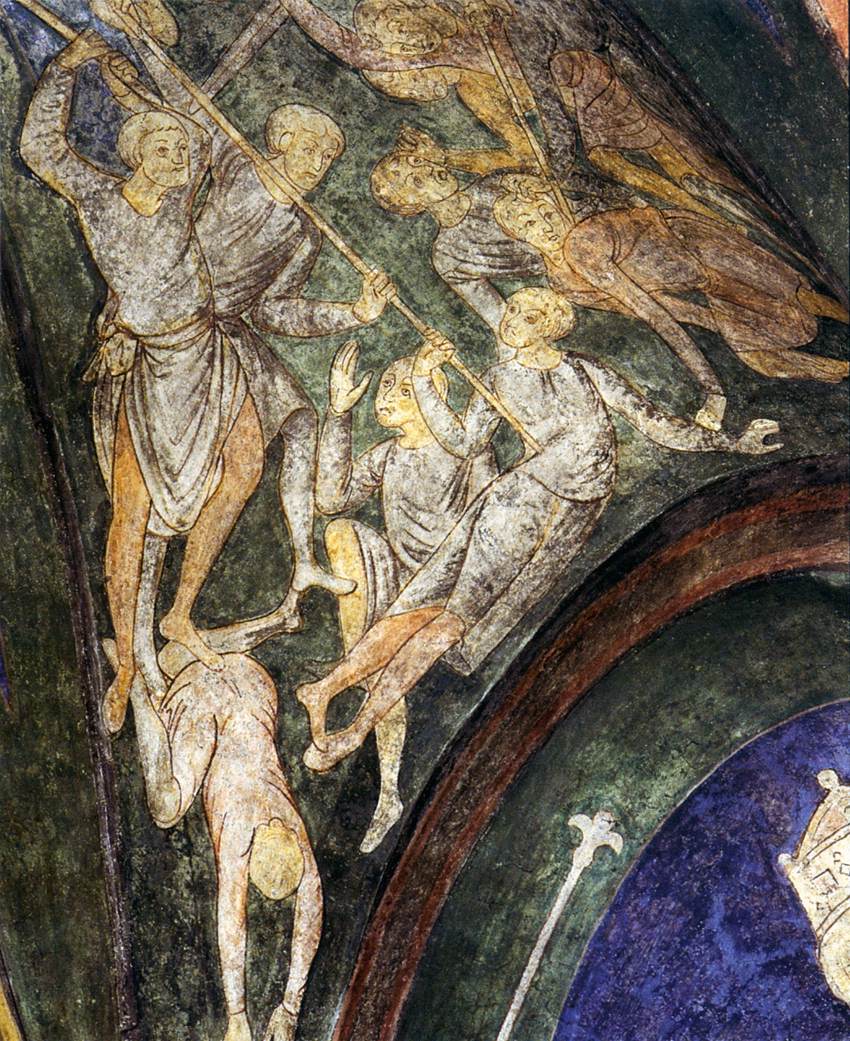
Last Judgment (detail)

c. 1180
Fresco
Doppelkirche, Schwarzrheindorf

9 posted on 07/30/2019 5:05:37 AM PDT by annalex (fear them not)
[ Post Reply | Private Reply | To 8 | View Replies]

To: annalex

Optional Memorial of Saint Peter Chrysologus

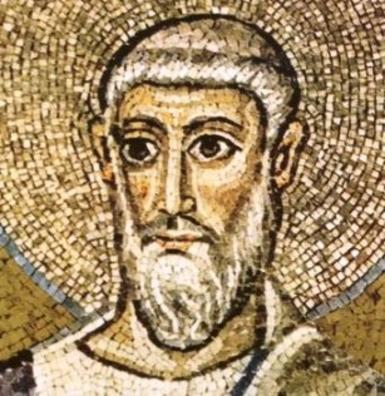
Saint Peter Chrysologus’ Story

A man who vigorously pursues a goal may produce results far beyond his expectations and his intentions. Thus it was with Peter ” of the Golden Words,” as he was called, who as a young man became bishop of Ravenna, the capital of the empire in the West.

At the time there were abuses and vestiges of paganism evident in his diocese, and these Peter was determined to battle and overcome. His principal weapon was the short sermon, and many of them have come down to us. They do not contain great originality of thought. They are, however, full of moral applications, sound in doctrine, and historically significant in that they reveal Christian life in fifth-century Ravenna. So authentic were the contents of his sermons that some 13 centuries later, he was declared a doctor of the Church by Pope Benedict XIII. He who had earnestly sought to teach and motivate his own flock was recognized as a teacher of the universal Church.

In addition to his zeal in the exercise of his office, Peter Chrysologus was distinguished by a fierce loyalty to the Church, not only in its teaching, but in its authority as well. He looked upon learning not as a mere opportunity but as an obligation for all, both as a development of God-given faculties and as a solid support for the worship of God.

Some time before his death around A.D. 450, Saint Peter Chrysologus returned to his birthplace of Imola, in northern Italy.


Reflection

Quite likely, it was Saint Peter Chrysologus’ attitude toward learning that gave substance to his exhortations. Next to virtue, learning, in his view, was the greatest improvement to the human mind and the support of true religion. Ignorance is not a virtue, nor is anti-intellectualism. Knowledge is neither more nor less a source of pride than physical, administrative, or financial prowess. To be fully human is to expand our knowledge—whether sacred or secular—according to our talent and opportunity.

franciscanmedia.org
St. Peter Chrysologus is patron saint against fever and against mad dogs
10 posted on 07/30/2019 5:17:05 AM PDT by annalex (fear them not)
[ Post Reply | Private Reply | To 9 | View Replies]

To: annalex

11 posted on 07/30/2019 5:19:21 AM PDT by annalex (fear them not)
[ Post Reply | Private Reply | To 10 | View Replies]

To: All

Pray for Pope Francis.


12 posted on 07/30/2019 5:03:43 PM PDT by Salvation ("With God all things are possible." Matthew 19:26)
[ Post Reply | Private Reply | To 11 | View Replies]

To: All
It's time to kneel down and pray for our nation (Sacramental Marriage)
13 posted on 07/30/2019 5:04:15 PM PDT by Salvation ("With God all things are possible." Matthew 19:26)
[ Post Reply | Private Reply | To 12 | View Replies]

To: All
Perpetual Novena for the Nation (Ecumenical)
Novena asking for St Michael The Archangel to stand with us and bring us victory
14 posted on 07/30/2019 5:04:56 PM PDT by Salvation ("With God all things are possible." Matthew 19:26)
[ Post Reply | Private Reply | To 13 | View Replies]

To: All
Prayers for The Religion Forum (Ecumenical)
15 posted on 07/30/2019 5:06:40 PM PDT by Salvation ("With God all things are possible." Matthew 19:26)
[ Post Reply | Private Reply | To 14 | View Replies]

To: All
7 Powerful Ways to Pray for Christians Suffering in the Middle East
16 posted on 07/30/2019 5:07:07 PM PDT by Salvation ("With God all things are possible." Matthew 19:26)
[ Post Reply | Private Reply | To 15 | View Replies]

To: All
Pray the Rosary!

50 Boko Haram Islamic Radicals Killed; 1,000 Hostages, Women and Children, Rescued in Nigeria
Nigeria: In the Face of Ongoing Islamist Attacks, the Faith is Growing
US Promises to Help Nigeria Exterminate Boko Haram
Is This Bishop Right about the Rosary Conquering Boko Haram? [Catholic Caucus]
Why Boko Haram and ISIS Target Women
Report reveals scale of Boko Haram violence inflictef on Nigerian Catholics
Military evacuating girls, women rescued from Boko Haram
Echos of Lepanto Nigerian bishop says rosary will bring down Boko Harm
After vision of Christ, Nigerian bishop says rosary will bring down Boko Haram (Catholic Caucus)
Nigerian Bishop Says Christ Showed Him How to Beat Islamic Terror Group
17 posted on 07/30/2019 5:08:09 PM PDT by Salvation ("With God all things are possible." Matthew 19:26)
[ Post Reply | Private Reply | To 16 | View Replies]

To: All

 
Jesus, High Priest
 

We thank you, God our Father, for those who have responded to your call to priestly ministry.

Accept this prayer we offer on their behalf: Fill your priests with the sure knowledge of your love.

Open their hearts to the power and consolation of the Holy Spirit.

Lead them to new depths of union with your Son.

Increase in them profound faith in the Sacraments they celebrate as they nourish, strengthen and heal us.

Lord Jesus Christ, grant that these, your priests, may inspire us to strive for holiness by the power of their example, as men of prayer who ponder your word and follow your will.

O Mary, Mother of Christ and our mother, guard with your maternal care these chosen ones, so dear to the Heart of your Son.

Intercede for our priests, that offering the Sacrifice of your Son, they may be conformed more each day to the image of your Son, our Lord and Savior, Jesus Christ. Amen.

Saint John Vianney, universal patron of priests, pray for us and our priests

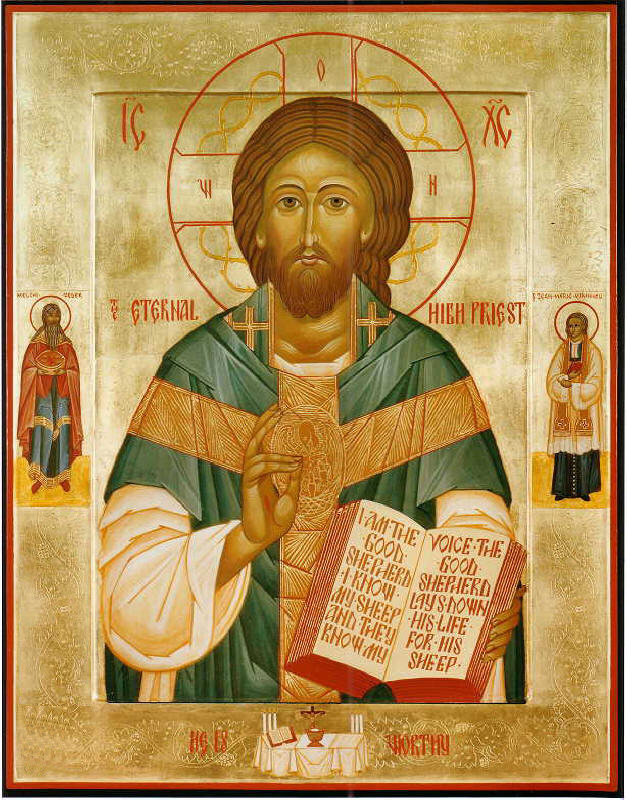
This icon shows Jesus Christ, our eternal high priest.

The gold pelican over His heart represents self-sacrifice.

The border contains an altar and grapevines, representing the Mass, and icons of Melchizedek and St. Jean-Baptiste Vianney.

Melchizedek: king of righteousness (left icon) was priest and king of Jerusalem.  He blessed Abraham and has been considered an ideal priest-king.

St. Jean-Baptiste Vianney is the patron saint of parish priests.


18 posted on 07/30/2019 7:36:48 PM PDT by Salvation ("With God all things are possible." Matthew 19:26)
[ Post Reply | Private Reply | To 17 | View Replies]

To: All
Pray a Rosary each day for our nation.

1. Sign of the Cross: In the name of the Father, and of the Son, and of the Holy Spirit. Amen.

2. The Apostles Creed: I BELIEVE in God, the Father almighty, Creator of heaven and earth, and in Jesus Christ, His only Son, our Lord, who was conceived by the Holy Spirit, born of the Virgin Mary, suffered under Pontius Pilate, was crucified, died, and was buried. He descended into hell; on the third day he rose again from the dead; he ascended into heaven, and is seated at the right hand of God, the Father Almighty; from there He shall come to judge the living and the dead.

I believe in the Holy Spirit, the holy catholic Church, the communion of saints, the forgiveness of sins, the resurrection of the body, and the life everlasting. Amen.

3. The Lord's Prayer: OUR Father, who art in heaven, hallowed be Thy name. Thy kingdom come. Thy will be done on earth as it is in heaven. Give us this day our daily bread and forgive us our trespasses as we forgive those who trespass against us. And lead us not into temptation, but deliver us from evil. Amen.

4. (3) Hail Mary: HAIL Mary, full of grace, the Lord is with thee. Blessed art thou amongst women and blessed is the fruit of thy womb, Jesus. Holy Mary, Mother of God, pray for us sinners, now, and in the hour of our death. Amen. (Three times)

5. Glory Be: GLORY be to the Father, and to the Son, and to the Holy Spirit. As it was in the beginning, is now, and ever shall be, world without end. Amen.

6. Fatima Prayer: Oh, my Jesus, forgive us our sins, save us from the fires of hell, lead all souls to heaven, especially those in most need of your mercy.

Announce each mystery, then say 1 Our Father, 10 Hail Marys, 1 Glory Be and 1 Fatima prayer. Repeat the process with each mystery.

End with the Hail Holy Queen:
Hail, Holy Queen, Mother of Mercy, our life, our sweetness and our hope! To thee do we cry, poor banished children of Eve! To thee do we send up our sighs, mourning and weeping in this vale of tears! Turn then, most gracious advocate, thine eyes of mercy towards us; and after this, our exile, show unto us the blessed fruit of thy womb, Jesus!

O clement, O loving, O sweet Virgin Mary! Pray for us, O holy Mother of God, that we may be made worthy of the promises of Christ.

Final step -- The Sign of the Cross

The Mysteries of the Rosary By tradition, Catholics meditate on these Mysteries during prayers of the Rosary. The biblical references follow each of the Mysteries below.

The Sorrowful Mysteries

(Tuesdays and Fridays)

1. The Agony in the Garden (Matthew 26:36-46, Luke 22:39-46) [Spiritual fruit - God's will be done]
2. The Scourging at the Pillar (Matthew 27:26, Mark 15:15, John 19:1) [Spiritual fruit - Mortification of the senses]
3. The Crowning with Thorns (Matthew 27:27-30, Mark 15:16-20, John 19:2) [Spiritual fruit - Reign of Christ in our heart]
4. The Carrying of the Cross (Matthew 27:31-32, Mark 15:21, Luke 23:26-32, John 19:17) [Spiritual fruit - Patient bearing of trials]
5. The Crucifixion (Matthew 27:33-56, Mark 15:22-39, Luke 23:33-49, John 19:17-37) [Spiritual fruit - Pardoning of Injuries]
19 posted on 07/30/2019 7:37:28 PM PDT by Salvation ("With God all things are possible." Matthew 19:26)
[ Post Reply | Private Reply | To 18 | View Replies]

To: All

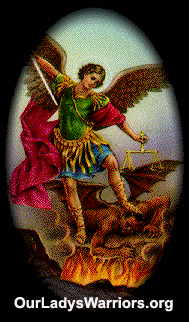
St. Michael the Archangel

~ PRAYER ~

St. Michael, the Archangel, defend us in battle
Be our protection against the wickedness
and snares of the devil;
May God rebuke him, we humbly pray,
and do thou, O Prince of the heavenly host,
by the power of God,
Cast into hell Satan and all the evil spirits
who prowl through the world seeking the ruin of souls.
Amen
+


20 posted on 07/30/2019 7:38:01 PM PDT by Salvation ("With God all things are possible." Matthew 19:26)
[ Post Reply | Private Reply | To 19 | View Replies]


Navigation: use the links below to view more comments.
first 1-2021-32 next last

Disclaimer: Opinions posted on Free Republic are those of the individual posters and do not necessarily represent the opinion of Free Republic or its management. All materials posted herein are protected by copyright law and the exemption for fair use of copyrighted works.

Free Republic
Browse · Search
Religion
Topics · Post Article

FreeRepublic, LLC, PO BOX 9771, FRESNO, CA 93794
FreeRepublic.com is powered by software copyright 2000-2008 John Robinson