Skip to comments.
Catholic Caucus: Sunday Mass Readings, 07-28-19, Seventeenth Sunday in Ordinary Time
USCCB.org/RNAB ^
| 07-28-19
| Revised New American Bible
Posted on 07/27/2019 9:04:03 PM PDT by Salvation
July 28 2019
Seventeenth Sunday in Ordinary Time
In those days, the LORD said: "The outcry against Sodom and Gomorrah is so great,
and their sin so grave,
that I must go down and see whether or not their actions
fully correspond to the cry against them that comes to me.
I mean to find out."
While Abraham's visitors walked on farther toward Sodom,
the LORD remained standing before Abraham.
Then Abraham drew nearer and said:
"Will you sweep away the innocent with the guilty?
Suppose there were fifty innocent people in the city;
would you wipe out the place, rather than spare it
for the sake of the fifty innocent people within it?
Far be it from you to do such a thing,
to make the innocent die with the guilty
so that the innocent and the guilty would be treated alike!
Should not the judge of all the world act with justice?"
The LORD replied,
"If I find fifty innocent people in the city of Sodom,
I will spare the whole place for their sake."
Abraham spoke up again:
"See how I am presuming to speak to my Lord,
though I am but dust and ashes!
What if there are five less than fifty innocent people?
Will you destroy the whole city because of those five?"
He answered, "I will not destroy it, if I find forty-five there."
But Abraham persisted, saying "What if only forty are found there?"
He replied, "I will forbear doing it for the sake of the forty."
Then Abraham said, "Let not my Lord grow impatient if I go on.
What if only thirty are found there?"
He replied, "I will forbear doing it if I can find but thirty there."
Still Abraham went on,
"Since I have thus dared to speak to my Lord,
what if there are no more than twenty?"
The LORD answered, "I will not destroy it, for the sake of the twenty."
But he still persisted:
"Please, let not my Lord grow angry if I speak up this last time.
What if there are at least ten there?"
He replied, "For the sake of those ten, I will not destroy it."
R.(3a) Lord, on the day I called for help, you answered me.
I will give thanks to you, O LORD, with all my heart,
for you have heard the words of my mouth;
in the presence of the angels I will sing your praise;
I will worship at your holy temple
and give thanks to your name.
R. Lord, on the day I called for help, you answered me.
Because of your kindness and your truth;
for you have made great above all things
your name and your promise.
When I called you answered me;
you built up strength within me.
R. Lord, on the day I called for help, you answered me.
The LORD is exalted, yet the lowly he sees,
and the proud he knows from afar.
Though I walk amid distress, you preserve me;
against the anger of my enemies you raise your hand.
R. Lord, on the day I called for help, you answered me.
Your right hand saves me.
The LORD will complete what he has done for me;
your kindness, O LORD, endures forever;
forsake not the work of your hands.
R. Lord, on the day I called for help, you answered me.
Brothers and sisters:
You were buried with him in baptism,
in which you were also raised with him
through faith in the power of God,
who raised him from the dead.
And even when you were dead
in transgressions and the uncircumcision of your flesh,
he brought you to life along with him,
having forgiven us all our transgressions;
obliterating the bond against us, with its legal claims,
which was opposed to us,
he also removed it from our midst, nailing it to the cross.
R.
Alleluia, alleluia.You have received a Spirit of adoption,
through which we cry, Abba, Father.
R.
Alleluia, alleluia.
Jesus was praying in a certain place, and when he had finished,
one of his disciples said to him,
"Lord, teach us to pray just as John taught his disciples."
He said to them, "When you pray, say:
Father, hallowed be your name,
your kingdom come.
Give us each day our daily bread
and forgive us our sins
for we ourselves forgive everyone in debt to us,
and do not subject us to the final test."
And he said to them, "Suppose one of you has a friend
to whom he goes at midnight and says,
'Friend, lend me three loaves of bread,
for a friend of mine has arrived at my house from a journey
and I have nothing to offer him,'
and he says in reply from within,
'Do not bother me; the door has already been locked
and my children and I are already in bed.
I cannot get up to give you anything.'
I tell you,
if he does not get up to give the visitor the loaves
because of their friendship,
he will get up to give him whatever he needs
because of his persistence.
"And I tell you, ask and you will receive;
seek and you will find;
knock and the door will be opened to you.
For everyone who asks, receives;
and the one who seeks, finds;
and to the one who knocks, the door will be opened.
What father among you would hand his son a snake
when he asks for a fish?
Or hand him a scorpion when he asks for an egg?
If you then, who are wicked,
know how to give good gifts to your children,
how much more will the Father in heaven
give the Holy Spirit to those who ask him?"
TOPICS: Catholic; General Discusssion; Prayer; Worship
KEYWORDS: catholic; lk11; ordinarytime; prayer
Navigation: use the links below to view more comments.
first 1-20, 21-38 next last
For your reading, reflection, faith-sharing, comments, questions, discussion.
1
posted on
07/27/2019 9:04:03 PM PDT
by
Salvation
To: All
KEYWORDS: catholic; lk11; ordinarytime; prayer;
2
posted on
07/27/2019 9:06:45 PM PDT
by
Salvation
("With God all things are possible." Matthew 19:26)
To: nickcarraway; NYer; ELS; Pyro7480; livius; ArrogantBustard; Catholicguy; RobbyS; marshmallow; ...
Alleluia PingPlease FReepmail me to get on/off the Alleluia Ping List.
3
posted on
07/27/2019 9:07:52 PM PDT
by
Salvation
("With God all things are possible." Matthew 19:26)
To: All
From: Genesis 18:20-32
Abraham Intercedes For Sodom (Continuation)
[20] Then the Lord said, “Because the outcry again Sodom and Gomorrah is
great and their sin is very grave, [21] I will go down to see whether they have
done altogether according to the outcry which has come to me; and if not, I will
know.”
[22] So the men turned from there, and went toward Sodom; but Abraham still
stood before the Lord. [23] Then Abraham drew near and said, “Wilt thou indeed
destroy the righteous with the wicked? [24] Suppose there are fifty righteous with-
in the city; wilt thou then destroy the place and not spare it for the fifty righteous
who are in it? [25] Far be it from thee to do such a thing, to slay the righteous
with the wicked, so that the righteous fare as the wicked! Far be that from thee!
Shall not the Judge of all the earth do right?” [26] And the Lord said, “If I find at
Sodom fifty righteous in the city, I will spare the whole place for their sake.” [27]
Abraham answered, “Behold, I have taken upon myself to speak to the Lord, I
who am but dust and ashes. [28] Suppose five of the fifty righteous are lacking?
Wilt thou destroy the whole city for lack of five?” And he said, “I will not destroy
it if I find forty-five there.” [29] Again he spoke to him, and said, “Suppose forty
are found there.” He answered, “For the sake of forty I will not do it.” [30] Then
he said, “Oh let not the Lord be angry, and I will speak. Suppose thirty are found
there.” He answered, “I will not do it, if I find thirty there.” [31] He said, “Behold,
I have taken upon myself to speak to the Lord. Suppose twenty are found there.”
He answered, “For the sake of twenty I will not destroy it.” [32] Then he said,
“Oh let not the Lord be angry, and I will speak again but this once. Suppose ten
are found there.” He answered, “For the sake of ten I will not destroy it.”
*********************************************************************************************
Commentary:
18:16-33. When interceding for Sodom and Gomorrah, Abraham argues in terms
of collective responsibility, as understood in ancient times in Israel: the entire
people shared the same fate even though not all of them sinned, for the sin some
affected all. According to that way of looking at things, if there were enough just
people in the city (Abraham did not dare go below ten) God would not have des-
troyed it. This way of thinking also shows how the salvation of many (even if they
are sinners) can come through the faithfulness of a few, thereby preparing the
way to see how the salvation of all mankind is brought about by the obedience
of one man alone, Jesus Christ.
The final outcome of this episode shows that, even though he destroys these
cities, God saves the righteous who live in them. God does not punish the just
man along with the sinner (as Abraham thought); a person is allowed to perish
or is saved depending on his personal behavior. This truth, which is found in the
Bible from the start, will be given special emphasis in the teaching of the pro-
phets, particularly Jeremiah and Ezekiel (cf. Jer 31:29-30; Ezek 18), who stress
individual and personal responsibility before God.
*********************************************************************************************
Source: “The Navarre Bible: Text and Commentaries”. Biblical text from the
Revised Standard Version and New Vulgate. Commentaries by members of
the Faculty of Theology, University of Navarre, Spain.
Published by Four Courts Press, Kill Lane, Blackrock, Co. Dublin, Ireland, and
by Scepter Publishers in the United States.
4
posted on
07/27/2019 9:09:35 PM PDT
by
Salvation
("With God all things are possible." Matthew 19:26)
To: All
From: Colossians 2:12-14
Defense of Sound Teaching in the Face of Heresy
[Brothers and sisters], [12] and you were buried with him in baptism, in which
you were also raised with him through faith in the working of God, who raised
him from the dead. [13] And you, who were dead in trespasses and the uncir-
cumcision of your flesh, God made alive together with him, having forgiven us all
our trespasses, [14] having canceled the bond which stood against us with its le-
gal demands; this he set aside, nailing it to the cross.
*********************************************************************************************
Commentary:
4-8. These verses reveal the Apostle’s pastoral solicitude for the faithful of Colos-
sae. Although physically absent, he is with them in spirit. He rejoices and gives
thanks to God for their steadfastness, but he leaves them in no doubt about the
dangers which threaten their faith. Clearly he is referring to those who were adul-
terating the Colossians’ faith by intruding erroneous ideas. By sophistry and de-
ceit they were trying to convince the faithful that it was better to have recourse
to angels rather than to Christ, arguing that angels were the chief mediators be-
tween God and men.
The Christian faith is not opposed to human scholarship and science, it rejects
only vain philosophy, that is, philosophy which boasts that it relies on reason
alone and which fails to respect revealed truths.
Over the centuries, people have often tried to adapt the truths of faith to the phi-
losophies or ideologies which happen to be in vogue. In this connection Leo XIII
said: “As the Apostle warns, ‘philosophy and empty deceit’ can deceive the
minds of Christians and corrupt the sincerity of men’s faith; the supreme pastors
of the Church, therefore, always see it as part of their role to foster as much as
they can sciences which merit that name, and at the same time to ensure by
special watchfulness, that human sciences are taught in keeping with the crite-
ria of Catholic faith—particularly philosophy, because proper methodology in the
other sciences is largely dependent on [correctness in] philosophy” (”Aeterni
Patris”, 1).
“The elemental spirits of the universe”: see the note on Gal 4:3.
9. This is such an important verse that it deserves close analysis. “Dwell”: the
Greek word means a stable way of living or residing, as distinct from a transitory
presence: in other words, the union of Christ’s human nature with his divine na-
ture is not just something which lasts for a while; it is permanent. “Deity”: the
Greek word can also be translated as “divinity”; in either case, the sentence
means that God has taken up a human nature, in such a way that, although it
was only the second divine Person, the Son, who became incarnate, by virtue
of the unity of the divine essence, where one divine person is present the other
two persons are also present.
This verse enunciates the profound mystery of the Incarnation in a different way
to John 1:14: “And the word became flesh and dwelt among us, full of grace and
truth; we have beheld his glory; glory as of the only Son from the Father” (cf. al-
so 1 in 1:1-2).
When the sacred text says that in Christ “the whole fullness of deity dwells bo-
dily”, it means, St John of Avila explains, “that it does not dwell in him merely
by grace, as in the case of the saints (men and angels both), but in another way
of greater substance and value, that is, by way of personal union” (”Audi, “Filia”,
84).
In Jesus Christ, then, there are two natures, divine and human, united in one per-
son, who is divine. This “hypostatic union” does not prevent each nature from ha-
ving all its own proper characteristics, for, as St Leo the Great defined, “the Word
has not changed into flesh, nor has flesh changed into Word; but each remains,
in a unity” (”Licet Per Nostros”, 2).
10. Since Christ is head of angels and men, the head of all creation (cf. Eph 1:
10) and especially head of the Church (cf. Col 1:18), all fullness is said to reside
in him (cf. note on Col 1:19). Hence, not only is he pre-eminent over all things but
“he fills the Church, which is his body and fullness, with his divine gifts (cf. Eph
1:22-23), so that it may increase and attain to all the fullness of God (cf. Eph 3:
19)” (Vatican II, “Lumen Gentium”, 7).
Union with Christ makes Christians sharers in his “fullness”, that is, in divine
grace (of which he is absolutely full and we have a partial share), in a word, in
his perfections.
That is why the members of the Church who “through the sacraments are united
in a hidden and real way to Christ” (”Lumen Gentium”, 7) can attain the fullness
of the Christian life.
It was very appropriate for St Paul to be instructing the Colossians in these truths
at this time, because it put them on their guard against preachers who were argu-
ing for exaggerated worship of angels, to the detriment of Christ’s unique, pre-
eminent mediation.
11-12. This is a reference to another error which the Judaizers were trying to
spread at Colossae and which was already treated in detail in the letters to the
Galatians and the Romans — the idea that it was necessary for Christians to be
circumcised. Physical circumcision affects the body, whereas what the Apostle,
by analogy, calls “the circumcision of Christ”, that is, Baptism, puts off the “bo-
dy of flesh” (an expression which seems to refer to whatever is sinful in man).
“We, who by means of (Christ) have reached God, have not been given fleshly
circumcision but rather spiritual circumcision [...]; we receive it by the mercy of
God in Baptism” (St Justin, “Dialogue with Trypho”, 43, 2). “By the sacrament
of Baptism, whenever it is properly conferred in the way the Lord determined and
received with the proper dispositions of soul, man becomes truly incorporated in-
to the crucified and glorified Christ and is reborn to a sharing of the divine life,
as the Apostle says: [Col 2:12 follows]” (Vatican II, “Unitatis Redintegratio”, 22).
As on other occasions (cf. Rom 6:4), St Paul, evoking the rite of immersion in
water, speaks of Baptism as a kind of burial (a sure sign that someone has died
to sin), and of resurrection to a new life, the life of grace. By this sacrament we
are associated with Christ’s death and burial so as to be able to rise with him.
“Christ by his resurrection signified our new life, which was reborn out of the old
death which submerged us in sin. This is what is brought about in us by the
great sacrament of Baptism: all those who receive this grace die to sin [...] and
are reborn to the new life” (St Augustine, “Enchiridion”, 41-42).
13-14. This is one of the central teachings of the epistle — that Jesus Christ is
the only mediator between God and men. The basic purpose of his mediation is
to reconcile men with God, through the forgiveness of their sins and the gift of
the life of grace, which is a sharing in God’s own life.
Verse 14 indicates how Christ achieved this purpose — by dying on the Cross.
All who were under the yoke of sin and the Law have been set free through his
death.
The Mosaic Law, to which the scribes and Pharisees added so many precepts
as to make it unbearable, had become (to use St Paul’s comparison) like a
charge sheet against man, because it imposed heavy burdens but did not pro-
vide the grace needed for bearing them. The Apostle very graphically says that
this charge sheet or “bond” was set aside and nailed on the Cross — making it
perfectly clear to all that Christ made more than ample satisfaction for our crimes.
“He has obliterated them,” St John Chrysostom comments, “not simply crossed
them out; he has obliterated them so effectively that no trace of them remains in
our soul. He has completely canceled them out, he has nailed them to the Cross
[...]. We were guilty and deserved the most rigorous of punishments because we
were all of us in sin! What, then, does the Son of God do? By his death on the
Cross he removes all our stains and exempts us from the punishment due to
them. He takes our charge-sheet, nails it to the Cross through his own person
and destroys it” (”Hom. on Col, ad loc.”).
*********************************************************************************************
Source: “The Navarre Bible: Text and Commentaries”. Biblical text from the
Revised Standard Version and New Vulgate. Commentaries by members of
the Faculty of Theology, University of Navarre, Spain.
Published by Four Courts Press, Kill Lane, Blackrock, Co. Dublin, Ireland, and
by Scepter Publishers in the United States.
5
posted on
07/27/2019 9:10:38 PM PDT
by
Salvation
("With God all things are possible." Matthew 19:26)
To: All
From: Luke 11:1-13
The Our Father
[1] He (Jesus) was praying in a certain place, and when He ceased, one of His
disciples said to Him, “Lord, teach us to pray, as John taught His disciples.”
[2] And He said to them, “When you pray, say: ‘Our Father, hallowed be Thy
name. Thy Kingdom come. [3] Give us each day our daily bread; [4] and forgive
us our sins, for we ourselves forgive every one who is indebted to us; and lead
us not into temptation.’”
Effective Prayer
[5] And He (Jesus) said to them (the disciples), “Which of you who has a friend
will go to him at midnight and say to him, ‘Friend, lend me three loaves; [6] for a
friend of mine has arrived on a journey, and I have nothing to set before him’; [7]
and he will answer from within, ‘Do not bother me; the door is now shut, and my
children are with me in bed; I cannot get up and give you anything’? [8] I tell you,
though he will not get up and give him anything because he is his friend, yet be-
cause of his importunity he will rise and give him whatever he needs. [9] And I
tell you, Ask, and it will be given to you; seek, and you will find; knock, and it
will be opened to you. [10] For every one who asks receives, and he who seeks
find, and to him who knocks it will be opened. [11] What father among you, if his
son asks for a fish, will instead of a fish give him a serpent; [12] or if he asks for
an egg, will give him a scorpion? [13] If you then, who are evil, know how to give
good gifts to your children, how much more will the Heavenly Father give the
Holy Spirit to those who ask Him!”
*********************************************************************************************
Commentary:
1-4. St. Luke gives us a shorter form of the Lord’s Prayer, or Our Father, than St.
Matthew (6:9-13). In Matthew there are seven petitions, in Luke only four. More-
over, St. Matthew’s version is given in the context of the Sermon on the Mount
and specifically as part of Jesus’ teaching on how to pray; St. Luke’s is set in
one of those occasions just after our Lord has been at prayer—two different con-
texts. There is nothing surprising about our Lord teaching the same thing on dif-
ferent occasions, not always using exactly the same words, not always at the
same length, but always stressing the same basic points. Naturally, the Church
uses the longer form of the Lord’s Prayer, that of St. Matthew.
“When the disciples asked the Lord Jesus, ‘Teach us to pray’, He replied by sa-
ying the words of the ‘Our Father’, thereby giving a concrete model which is also
a universal model. In fact, everything that can and must be said to the Father is
contained in those seven requests which we all know by heart. There is such
simplicity in them that even a child can learn them, but at the same time such
depth that a whole life can be spent meditating on their meaning. Isn’t that so?
Does not each of those petitions deal with something essential to our life, direc-
ting it totally towards God the Father? Doesn’t this prayer speak to us about
‘our daily bread’, ‘forgiveness of our sins, since we forgive others’ and about pro-
tecting us from ‘temptation’ and ‘delivering us from evil?’” (John Paul II, “General
Audience”, 14 March 1979).
The first thing our Lord teaches us to ask for is the glorification of God and the
coming of His Kingdom. That is what is really important—the Kingdom of God
and His justice (cf. Matthew 6:33). Our Lord also wants us to pray confident
that our Father will look after our material needs, for “your Heavenly Father
knows that you need them all” (Matthew 6:32). However, the Our Father makes
us aspire especially to possess the goods of the Holy Spirit, and invites us to
seek forgiveness (and to forgive others) and to avoid the danger of sinning. Fi-
nally the Our Father emphasizes the importance of vocal prayer. “’Domine,
doce nos orare. Lord teach us to pray!’ And our Lord replied: ‘When you pray
say: “Pater noster, qui es in coelis”... Our Father, who art in Heaven...’. What
importance we must attach to vocal prayer!” (St. J. Escriva, “The Way”, 84).
1. Jesus often went away to pray (cf. Luke 6:12; 22:39ff). This practice of the
Master causes His disciples to want to learn how to pray. Jesus teaches them
to do what He Himself does. Thus, when our Lord prays, He begins with the
Word “Father!”: “Father, into Thy hands I commit My spirit” (Luke 23:46); see
also Matthew 11:25; 26:42, 53; Luke 23:34; John 11:41; etc.). His prayer on
the Cross, “My God, My God,...” (Matthew 27:46), is not really an exception
to this rule, because there He is quoting Psalm 22, the desperate prayer of the
persecuted just man.
Therefore, we can say that the first characteristic prayer should have is the sim-
plicity of a son speaking to his Father. “You write: ‘To pray is to talk with God.
But about what?’ About what? About Him, about yourself: joys, sorrows, suc-
cesses, failures, noble ambitions, daily worries, weaknesses! And acts of
thanksgiving and petition: and love and reparation. In a word: to get to know
Him and to get to know yourself: ‘to get acquainted!’” (St. J. Escriva, “The Way”,
91).
2. “Hallowed be Thy name”: in this first petition of the Our Father “we pray that
God may be known, loved, honored and served by everyone and by ourselves in
particular.” This means that we want “unbelievers to come to a knowledge of the
true God, heretics to recognize their errors, schismatics to return to the unity of
the Church, sinners to be converted and the righteous to persevere in doing good.”
By this first petition, our Lord is teaching us that ‘we must desire God’s glory
more than our own interest and advantage.” This hallowing of God’s name is at-
tained “by prayer and good example and by directing all our thoughts, affections
and actions towards Him” (”St. Pius X Catechism”, 290-293).
“Thy Kingdom come”: “By the Kingdom of God we understand a triple spiritual
kingdom—the Kingdom of God in us, which is grace; the Kingdom of God on earth,
which is the Catholic Church; and the Kingdom of God in Heaven, which is eternal
bliss [...]. As regards grace, we pray that God reign in us with His sanctifying
grace, by which He is pleased to dwell in us as a king in his throne-room, and
that He keeps us united to Him by the virtues of faith, hope and charity, by which
He reigns in our intellect, in our heart and in our will [...]. As regards the Church,
we pray that it extend and spread all over the world for the salvation of men [...].
As regards Heaven, we pray that one day we be admitted to that eternal bliss for
which we have been created, where we will be totally happy” (”ibid.”, 294-297).
3. The Tradition of the Church usually interprets the “bread” as not only material
bread, since “man does not live by bread alone, but by every word that proceeds
from the mouth of God” (Matthew 4:4; Deuteronomy 8:3). Here Jesus wants us
to ask God for “what we need each day for soul and body [...]. For our soul we
ask God to sustain our spiritual life, that is, we beg Him to give us His grace, of
which we are continually in need [...]. The life of our soul is sustained mainly by
the divine word and by the Blessed Sacrament of the Altar [...]. For our bodies
we pray for what is needed to maintain us” (”St. Pius X Catechism”, 302-305).
Christian doctrine stresses two ideas in this petition of the Our Father: the first
is trust in Divine Providence, which frees us from excessive desire to accumulate
possessions to insure us against the future (cf. Luke 12:16-21); the other idea is
that we should take a brotherly interest in other people’s needs, thereby mode-
rating our selfish tendencies.
4. “So rigorously does God exact from us forgetfulness of injuries and mutual
affection and love, that He rejects and despises the gifts and sacrifices of those
who are not reconciled to one another” (”St. Pius V Catechism”, IV, 14, 16).
“This sisters, is something which we should consider carefully; it is such a
serious and important matter that God should pardon us our sins, which have
merited eternal fire, that we must pardon all trifling things which have been done
to us. As I have so few, Lord, even of these trifling things, to offer Thee, Thy par-
doning of me must be a free gift: there is abundant scope here for Thy mercy.
Blessed be Thou, who endurest one that is so poor” (St. Teresa of Avila, “Way
of Perfection”, Chapter 36).
“And lead us not into temptation”: it is not a sin to “feel” temptation but to “con-
sent” to temptation. It is also a sin to put oneself voluntarily into a situation
which can easily lead one to sin. God allows us to be tempted, in order to test
our fidelity, to exercise us in virtue and to increase our merits with the help of
grace. In this petition we ask the Lord to give us His grace not to be overcome
when put to the test, or to free us from temptation if we cannot cope with it.
5-10. One of the essential features of prayer is trusting perseverance. By this
simple example and others like it (cf. Luke 18:1-7) our Lord encourages us not
to desist in asking God to hear us. “Persevere in prayer. Persevere even when
your efforts seem barren. Prayer is always fruitful” (St. J. Escriva, “The Way”,
101).
9-10. Do you see the effectiveness of prayer when it is done properly? Are you
not convinced like me that, if we do not obtain what we ask God for, it is be-
cause we are not praying with faith, with a heart pure enough, with enough con-
fidence, or that we are not persevering in prayer the way we should? God has
never refused nor will ever refuse anything to those who ask for His graces in
the way they should. Prayer is the great recourse available to us to get out of
sin, to persevere in grace, to move God’s heart and to draw upon us all kinds
of blessing from Heaven, whether for the soul or to meet our temporal needs”
(St. John Mary Vianney, “Selected Sermons”, Fifth Sunday after Easter).
11-13. Our Lord uses the example of human parenthood as a comparison to
stress again the wonderful fact that God is our Father, for God’s fatherhood is
the source of parenthood in Heaven and on earth (cf. Ephesians 3:15). “The
God of our faith is not a distant Being who contemplates indifferently the fate
of men — their desires, their struggles, their sufferings. He is a Father who loves
His children so much that He sends the Word, the Second Person of the Most
Blessed Trinity, so that by taking on the nature of man He may die to redeem
us. He is the loving Father who now leads us gently to Himself, through the
action of the Holy Spirit who dwells in our hearts” (St. J. Escriva, “Christ Is
Passing By”, p. 84).
13. The Holy Spirit is God’s best gift to us, the great promise Christ gives His
disciples (cf. John 5:26), the divine fire which descends on the Apostles at Pen-
tecost, filling them with fortitude and freedom to proclaim Christ’s message (Acts
2). “The profound reality which we see in the texts of Holy Scripture is not a re-
membrance from the past, from some golden age of the Church which has since
been buried in history. Despite the weaknesses and the sins of every one of us,
it is the reality of today’s Church and the Church in all times. ‘I will pray to the
Father,’ our Lord told His disciples, ‘and He will give you another Counsellor to
be with you for ever.’ Jesus has kept His promise. He has risen from the dead
and, in union with the eternal Father, He sends us the Holy Spirit to sanctify us
and to give us life” (St. J. Escriva, “Christ Is Passing By”, 12).
********************************************************************************************
Source: “The Navarre Bible: Text and Commentaries”. Biblical text from the
Revised Standard Version and New Vulgate. Commentaries by members of
the Faculty of Theology, University of Navarre, Spain.
Published by Four Courts Press, Kill Lane, Blackrock, Co. Dublin, Ireland, and
by Scepter Publishers in the United States.
6
posted on
07/27/2019 9:11:33 PM PDT
by
Salvation
("With God all things are possible." Matthew 19:26)
To: All
Scripture readings from the Jerusalem Bible by Darton, Longman & Todd
Readings at Mass
Liturgical Colour: Green.
| First reading |
| Genesis 18:20-32 © |
| Abraham negotiates with the Lord |
The Lord said, ‘How great an outcry there is against Sodom and Gomorrah! How grievous is their sin! I propose to go down and see whether or not they have done all that is alleged in the outcry against them that has come up to me. I am determined to know.’
The men left there and went to Sodom while Abraham remained standing before the Lord. Approaching him he said, ‘Are you really going to destroy the just man with the sinner? Perhaps there are fifty just men in the town. Will you really overwhelm them, will you not spare the place for the fifty just men in it? Do not think of doing such a thing: to kill the just man with the sinner, treating just and sinner alike! Do not think of it! Will the judge of the whole earth not administer justice?’ the Lord replied, ‘If at Sodom I find fifty just men in the town, I will spare the whole place because of them.’
Abraham replied, ‘I am bold indeed to speak like this to my Lord, I who am dust and ashes. But perhaps the fifty just men lack five: will you destroy the whole city for five?’ ‘No,’ he replied ‘I will not destroy it if I find forty-five just men there.’ Again Abraham said to him, ‘Perhaps there will only be forty there.’ ‘I will not do it’ he replied ‘for the sake of the forty.’
Abraham said, ‘I trust my Lord will not be angry, but give me leave to speak: perhaps there will only be thirty there.’ ‘I will not do it’ he replied ‘if I find thirty there.’ He said, ‘I am bold indeed to speak like this, but perhaps there will only be twenty there.’ ‘I will not destroy it’ he replied ‘for the sake of the twenty.’ He said, ‘I trust my Lord will not be angry if I speak once more: perhaps there will only be ten.’ ‘I will not destroy it’ he replied ‘for the sake of the ten.’
| Responsorial Psalm |
| Psalm 137(138):1-3,6-8 © |
On the day I called, you answered me, O Lord.
I thank you, Lord, with all my heart:
you have heard the words of my mouth.
In the presence of the angels I will bless you.
I will adore before your holy temple.
On the day I called, you answered me, O Lord.
I thank you for your faithfulness and love,
which excel all we ever knew of you.
On the day I called, you answered;
you increased the strength of my soul.
On the day I called, you answered me, O Lord.
The Lord is high yet he looks on the lowly
and the haughty he knows from afar.
Though I walk in the midst of affliction
you give me life and frustrate my foes.
On the day I called, you answered me, O Lord.
You stretch out your hand and save me,
your hand will do all things for me.
Your love, O Lord, is eternal,
discard not the work of your hands.
On the day I called, you answered me, O Lord.
| Second reading |
| Colossians 2:12-14 © |
| Christ has brought you to life with him and forgiven us all our sins |
You have been buried with Christ, when you were baptised; and by baptism, too, you have been raised up with him through your belief in the power of God who raised him from the dead. You were dead, because you were sinners and had not been circumcised: he has brought you to life with him, he has forgiven us all our sins.
He has overridden the Law, and cancelled every record of the debt that we had to pay; he has done away with it by nailing it to the cross.
| Gospel Acclamation |
Jn1:14,12 |
Alleluia, alleluia!
The Word was made flesh and lived among us:
to all who did accept him
he gave power to become children of God.
Alleluia!
Alleluia, alleluia!
The spirit you received is the spirit of sons,
and it makes us cry out, ‘Abba, Father!’
Alleluia!
Once Jesus was in a certain place praying, and when he had finished one of his disciples said, ‘Lord, teach us to pray, just as John taught his disciples.’
He said to them, ‘Say this when you pray:
‘“Father, may your name be held holy,
your kingdom come;
give us each day our daily bread,
and forgive us our sins,
for we ourselves forgive each one who is in debt to us.
And do not put us to the test.”’
He also said to them:
‘Suppose one of you has a friend and goes to him in the middle of the night to say, “My friend, lend me three loaves, because a friend of mine on his travels has just arrived at my house and I have nothing to offer him”; and the man answers from inside the house, “Do not bother me. The door is bolted now, and my children and I are in bed; I cannot get up to give it you.” I tell you, if the man does not get up and give it him for friendship’s sake, persistence will be enough to make him get up and give his friend all he wants.
‘So I say to you: Ask, and it will be given to you; search, and you will find; knock, and the door will be opened to you. For the one who asks always receives; the one who searches always finds; the one who knocks will always have the door opened to him. What father among you would hand his son a stone when he asked for bread? Or hand him a snake instead of a fish? Or hand him a scorpion if he asked for an egg? If you then, who are evil, know how to give your children what is good, how much more will the heavenly Father give the Holy Spirit to those who ask him!’
7
posted on
07/27/2019 9:17:47 PM PDT
by
Salvation
("With God all things are possible." Matthew 19:26)
To: Salvation
| Luke |
| |
English: Douay-Rheims |
Latin: Vulgata Clementina |
Greek NT: Byzantine/Majority Text (2000) |
| |
Luke 11
|
| 1. |
AND it came to pass, that as he was in a certain place praying, when he ceased, one of his disciples said to him: Lord, teach us to pray, as John also taught his disciples. |
Et factum est : cum esset in quodam loco orans, ut cessavit, dixit unus ex discipulis ejus ad eum : Domine, doce nos orare, sicut docuit et Joannes discipulos suos. |
και εγενετο εν τω ειναι αυτον εν τοπω τινι προσευχομενον ως επαυσατο ειπεν τις των μαθητων αυτου προς αυτον κυριε διδαξον ημας προσευχεσθαι καθως και ιωαννης εδιδαξεν τους μαθητας αυτου |
| 2. |
And he said to them: When you pray, say: Father, hallowed be thy name. Thy kingdom come. |
Et ait illis : Cum oratis, dicite : Pater, sanctificetur nomen tuum. Adveniat regnum tuum. |
ειπεν δε αυτοις οταν προσευχησθε λεγετε πατερ ημων ο εν τοις ουρανοις αγιασθητω το ονομα σου ελθετω η βασιλεια σου γενηθητω το θελημα σου ως εν ουρανω και επι της γης |
| 3. |
Give us this day our daily bread. |
Panem nostrum quotidianum da nobis hodie. |
τον αρτον ημων τον επιουσιον διδου ημιν το καθ ημεραν |
| 4. |
And forgive us our sins, for we also forgive every one that is indebted to us. And lead us not into temptation. |
Et dimitte nobis peccata nostra, siquidem et ipsi dimittimus omni debenti nobis. Et ne nos inducas in tentationem. |
και αφες ημιν τας αμαρτιας ημων και γαρ αυτοι αφιεμεν παντι οφειλοντι ημιν και μη εισενεγκης ημας εις πειρασμον αλλα ρυσαι ημας απο του πονηρου |
| 5. |
And he said to them: Which of you shall have a friend, and shall go to him at midnight, and shall say to him: Friend, lend me three loaves, |
Et ait ad illos : Quis vestrum habebit amicum, et ibit ad illum media nocte, et dicet illi : Amice, commoda mihi tres panes, |
και ειπεν προς αυτους τις εξ υμων εξει φιλον και πορευσεται προς αυτον μεσονυκτιου και ειπη αυτω φιλε χρησον μοι τρεις αρτους |
| 6. |
Because a friend of mine is come off his journey to me, and I have not what to set before him. |
quoniam amicus meus venit de via ad me, et non habeo quod ponam ante illum, |
επειδη φιλος παρεγενετο εξ οδου προς με και ουκ εχω ο παραθησω αυτω |
| 7. |
And he from within should answer, and say: Trouble me not, the door is now shut, and my children are with me in bed; I cannot rise and give thee. |
et ille de intus respondens dicat : Noli mihi molestus esse, jam ostrium clausum est, et pueri mei mecum sunt in cubili : non possum surgere, et dare tibi. |
κακεινος εσωθεν αποκριθεις ειπη μη μοι κοπους παρεχε ηδη η θυρα κεκλεισται και τα παιδια μου μετ εμου εις την κοιτην εισιν ου δυναμαι αναστας δουναι σοι |
| 8. |
Yet if he shall continue knocking, I say to you, although he will not rise and give him, because he is his friend; yet, because of his importunity, he will rise, and give him as many as he needeth. |
Et si ille perseveraverit pulsans : dico vobis, etsi non dabit illi surgens eo quod amicus ejus sit, propter improbitatem tamen ejus surget, et dabit illi quotquot habet necessarios. |
λεγω υμιν ει και ου δωσει αυτω αναστας δια το ειναι αυτου φιλον δια γε την αναιδειαν αυτου εγερθεις δωσει αυτω οσον χρηζει |
| 9. |
And I say to you, Ask, and it shall be given you: seek, and you shall find: knock, and it shall be opened to you. |
Et ego dico vobis : Petite, et dabitur vobis ; quærite, et invenietis ; pulsate, et aperietur vobis. |
καγω υμιν λεγω αιτειτε και δοθησεται υμιν ζητειτε και ευρησετε κρουετε και ανοιγησεται υμιν |
| 10. |
For every one that asketh, receiveth; and he that seeketh, findeth; and to him that knocketh, it shall be opened. |
Omnis enim qui petit, accipit : et qui quærit, invenit : et pulsanti aperietur. |
πας γαρ ο αιτων λαμβανει και ο ζητων ευρισκει και τω κρουοντι ανοιγησεται |
| 11. |
And which of you, if he ask his father bread, will he give him a stone? or a fish, will he for a fish give him a serpent? |
Quis autem ex vobis patrem petit panem, numquid lapidem dabit illi ? aut piscem, numquid pro pisce serpentem dabit illi ? |
τινα δε υμων τον πατερα αιτησει ο υιος αρτον μη λιθον επιδωσει αυτω η και ιχθυν μη αντι ιχθυος οφιν επιδωσει αυτω |
| 12. |
Or if he shall ask an egg, will he reach him a scorpion? |
aut si petierit ovum, numquid porriget illi scorpionem ? |
η και εαν αιτηση ωον μη επιδωσει αυτω σκορπιον |
| 13. |
If you then, being evil, know how to give good gifts to your children, how much more will your Father from heaven give the good Spirit to them that ask him? |
Si ergo vos, cum sitis mali, nostis bona data dare filiis vestris : quanto magis Pater vester de cælo dabit spiritum bonum petentibus se ? |
ει ουν υμεις πονηροι υπαρχοντες οιδατε δοματα αγαθα διδοναι τοις τεκνοις υμων ποσω μαλλον ο πατηρ ο εξ ουρανου δωσει πνευμα αγιον τοις αιτουσιν αυτον |
(*) "γενηθητω το θελημα σου ως εν ουρανω και επι της γης", "be done Thy will as in Heaven so upon the earth" ending verse 2 is not translated.
(**) "αλλα ρυσαι ημας απο του πονηρου", "but deliver us from the evil one" ending verse 4 is not translated.
(***) Verse 8, while surprisingly compact, is matched in the translations without additions.
8
posted on
07/28/2019 8:09:31 AM PDT
by
annalex
(fear them not)
To: annalex
1. And it came to pass, that, as he was praying in a certain place, when he ceased, one of his disciples said to him, Lord, teach us to pray, as John also taught his disciples.
2. And he said to them, When you pray, say, Our Father which art in heaven, Hallowed be thy name. Thy kingdom come. Thy will be done, as in heaven, so in earth.
3. Give us day by day our daily bread.
4. And forgive us our sins; for we also forgive every one that is indebted to us. And lead us not into temptation; but deliver us from evil.
BEDE; After the account of the sisters, who signified the two lives of the Church, our Lord is not without reason related to have both Himself prayed, and taught His disciples to pray, seeing that the prayer which He taught contains in itself the mystery of each life, and the perfection of the lives themselves is to be obtained not by our own strength, but by prayer. Hence it is said, And it came to pass, that, as he was praying in a certain place.
CYRIL; Now whereas He possesses every good in abundance, why does He pray, since He is full, and has altogether need of nothing? To this we answer, that it befits Him, according to the manner of His dispensation in the flesh, to follow human observances at the time convenient for them. For if He eats and drinks, He rightly was used to pray, that He might teach us not to be lukewarm in this duty, but to be the more diligent and earnest in our prayers.
TIT. BOST. The disciples having seen a new way of life, desire a new form of prayer, since there were several prayers to be found in the Old Testament. Hence it follows, When he ceased, one of his disciples said to him, Lord, teach us to pray, in order that we might not sin against God in asking for one thing instead of another, or by approaching God in prayer in a manner that we ought not.
ORIGEN; And that he might point out the kind of teaching, the disciple proceeds, as John also taught his disciples. Of whom in truth you have told us, that among them that are born of women there had arisen none greater than he. And because you have commanded us to seek things that are great and eternal, whence shall we arrive at the knowledge of these but from You, our God and Savior?
GREG. NYSS.. He unfolds the teaching of prayer to His disciples, who wisely desire the knowledge of prayer, directing them how they ought to beseech God to hear them.
BASIL; There are two kinds of prayer, one composed of praise with humiliation, the other of petitions, and more subdued. Whenever then you pray, do not first break forth into petition; but if you condemn your inclination, supplicate God as if of necessity forced thereto. And when you begin to pray, forget all visible and invisible creatures, but commence with the praise of Him who created all things. Hence it is added, And he says to them, When you pray, say, Our Father.
PSEUDO-AUG. The first word, how gracious is it? You durst not raise your face to heaven, and suddenly you receive the grace of Christ. From an evil servant you are made a good son. Boast not then of your working, but of the grace of Christ; for therein is no arrogance, but faith. To proclaim what you have received is not pride, but devotion. Therefore raise your eyes to your Father, who begot you by Baptism, redeemed you by His Son. Say Father as a son, but claim no especial favor to t yourself. Of Christ alone is He the especial Father, of us the common Father. For Christ alone He begot, but us he created. And therefore according to Matthew when it is said, Our Father, it is added, which art in heaven, that is, in those heavens of which it was said, The heavens declare the glory of God. Heaven is where sin has ceased, and where there is no sting of death.
THEOPHYL. But He says not, which art in heaven, as though He were confined to that place, but to raise the hearer up to heaven, and draw him away from earthly things.
GREG. NYSS.. See how great a preparation you need, to be able to say boldly to God, O Father, for if you have your eyes fixed on worldly things, or court the praise of men, or are a slave to your passions, and utter this prayer, I seem to hear God saying, 'Whereas you that are of a corrupt life call the Author of the incorruptible your Father, you pollute with your defiled lips an incorruptible name. For He who commanded you to call Him Father, gave you not leave to utter lies. But the highest of e all good things is to glorify God's name in our lives. Hence He adds, Hallowed be thy name. For who is there so debased, as when He sees the pure life of those who believe, does not glorify the name invoked in such a life. He then who says in his prayer, Be thy name, which I call upon, hallowed in me, prays this, "May I through Your concurring aid be made just, abstaining from all evil."
CHRYS. For as when a man gazes upon the beauty of the heavens, he says, Glory be you, O God; so likewise when He beholds a man's virtuous actions, seeing that the virtue of man glorifies God much more than the heavens.
PSEUDO-AUG. Or it is said, Hallowed be thy name; that is, let Your holiness be known to all the world, and let it worthily praise You. For praise becomes the upright, and therefore He bids them pray for the cleansing of the whole world.
CYRIL; Since among those to whom the faith has not yet come, the name of God is still despised. But when the rays of truth shall have shined upon them, they will confess the Holy of Holies.
TIT. BOST. And because in the name of Jesus is the glory of God the Father, the name of the Father will be hallowed whenever Christ shall be known.
ORIGEN; Or, because the name of God is given by idolaters, and those who are in error, to idols and creatures, it has not as yet been so made holy, as to be separated from those things from which it ought to be. He teaches us therefore to pray that the name of God may be appropriated to the only true God; to whom alone belongs what follow, Thy kingdom come, to the end that may be put down all the rule, authority, and power, and kingdom of the world, together with sin which reigns in our mortal bodies.
GREG. NYSS.. We beseech also to be delivered by the Lord from corruption, to be taken out of death. Or, according to some, Thy kingdom come, that is, May Your Holy Spirit come upon us to purify us.
PSEUDO-AUG. For then comes the kingdom of God, when we have obtained His grace. For He Himself says, The kingdom of God is within you.
CYRIL; Or they who say this seem to wish to have the Savior of all again illuminating the world. But He has commanded us to desire in prayer that truly awful time, in order that men might know that it behoves them to live not in sloth and backwardness, lest that time bring upon them the fiery punishment, but rather honestly and according to His will, that that time may weave crowns for them. Hence it follows, according to Matthew, Thy will be done, as in heaven, so in earth.
CHRYS. As if He says, Enable us, O Lord, to follow the heavenly life, that whatever You will, we may will in also.
GREG. NYSS.. For sin since He says that the life of man after the resurrection will be like to that of Angels, it follows, that our life in this world should be so ordered with respect to that which we hope for hereafter, that living in the flesh we may not live according to the flesh. But hereby the true Physician of the souls destroys the nature of the disease, that those who have been seized with sickness, whereby they have departed from the Divine will, may forthwith be released from the disease by being joined to the Divine will. For the health of the soul is the due fulfillment of the will of God.
AUG. It seems according to the Evangelist Matthew, that the Lord's prayer contains seven petitions, but Luke has comprehended it in five. Nor in truth does the one disagree from the other, but the latter has suggested by his brevity how those seven are to be understood. For the name of God is hallowed in the spirit, but the kingdom of God is about to come at the resurrection of the body. Luke then, showing that the third petition is in a manner a repetition of the two former, wished to make it so understood by omitting it. He then added three others. And first, of daily bread, saying, Give us day by day our daily bread.
PSEUDO-AUG. In the Greek the word is that is, something added to the substance. It is not that bread which goes into the body, but that bread of everlasting life, which supports the substance of our soul. But the Latins call this "daily" bread, which the Greeks call "coming to." If it is daily bread, why is it eaten a year old, as is the custom with the Greeks in the east? Take daily what profits you for the day; so live that you may daily be thought worthy to receive. The death of our Lord is signified thereby, and the remission of sins, and cost you not daily partake of that bread of life? He who has a wound seeks to be cured; the wound is that we are under sin, the cure is the heavenly and dreadful Sacrament. If you receive daily, daily does "Today" come to you. Christ is to you Today; Christ rises to thee daily.
TIT. BOST. Or the bread of souls is the Divine power, bringing the everlasting life which is to come, as the bread which comes out of the earth preserves the temporal life. But by saying "daily," He signifies the Divine bread which comes and is to come, which we seek to be given to us daily, requiring a certain earnest and taste of it, seeing that the Spirit which dwells in us has wrought a virtue surpassing all human virtues, as chastity, humility, and the rest.
CYRIL; Now perhaps some think it unfit for saints to seek from God bodily goods, and for this reason assign to these words a spiritual sense. But granting that the chief concern of the saints should be to obtain spiritual gifts, still it becomes them to see that they seek without blame, according to our Lord's command, their common bread. For from the fact that He bids them ask for bread, that is daily food, it seems that He implies that they should possess nothing, but rather practice an honorable poverty. For it is not the part of those who have bread to seek it, but rather of those who are oppressed with want.
BASIL; As if He said, For your daily bread, namely, that which serves for our daily wants, trust not to yourself, but fly to God for it, making known to Him the necessities of your nature.
CHRYS. We must then require of God the necessities of life; not varieties of meats, and spiced wines, and the other things which please the palate, while they load your stomach and disturb your mind, but bread which is able to support the bodily substance, that is to say, which is sufficient only for the day, that we may take no thought of the morrow. But we make only one petition about things of sense, that the present life may not trouble us.
GREG. NYSS.. Having taught us to take confidence through good works, He next teaches us to implore the remission of our offenses, for it follows, And forgive us our sins.
TIT. BOST. This also was necessarily added, for no one is found without sin, that we should not be hindered from the holy participation on account of man's guilt. For whereas we are bound to render to Christ all manner of holiness, who makes His Spirit to dwell in us, we are to be blamed if we keep not our temples clean for Him. But this defect is supplied by the goodness of God, remitting to human frailty the severe punishment of sin. And this act is done justly by the just God, when we forgive as it were our debtors, those, namely, who have injured us, and have not restored what was due. Hence it follows, For we also forgive every one that is indebted to us.
CYRIL; For He wishes, if I may so speak, to make God the imitator of the patience which men practice, that the kindness which they have shown to their fellow servants, they should in like manner seek to receive in equal balance from God, who recompenses to each man justly, and knows how to have mercy upon all men.
CHRYS. Considering then these things, we ought to show mercy to our debtors. For they are to us if we are wise the cause of our greatest pardon; and though we perform only a few things, we shall find many. For we owe many and great debts to the Lord, of which if the least part should be exacted from us, we should soon perish.
PSEUDO-AUG. But what is the debt except sin? If you had not received, you would not owe money to another. And therefore sin is imputed to you. For you had money with which you were born rich, and made after the likeness and image of God, but you have lost what you then had. As when you put on pride you lose the gold of humility, you have receipted the devil's debt which was not necessary; the enemy held the bond, but the Lord crucified it, and canceled it with His blood. But the Lord is able, who has taken away our sins and forgiven our debts, to guard us against the snares of the devil, who is wont to produce sin in us. Hence it follows, And lead us not into temptation, such as we are not able to bear, but like the wrestler we wish only such temptation as the condition of man can sustain.
TIT. BOST. For it is impossible not to be tempted by the devil, but we make this prayer that we may not be abandoned to our temptations. Now that which happens by Divine permission, God is sometimes in Scripture said to do. And in this way by hindering not the increase of temptation which is above our strength, he leads us into temptation.
MAX. Or, the Lord commands us to pray, Lead us not into temptation, that is, let us not have experience of lustful and self-induced temptations. But James teaches those who contend only for the truth, not to be unnerved by involuntary and troublesome temptations, saying, lily brethren, count it all joy when you fall into divers temptations.
BASIL; It does not however become us to seek by our prayers bodily afflictions. For Christ has universally commanded men every where to pray that they enter not into temptation. But when one has already entered, it is fitting to ask from the Lord the power of enduring, that we may have fulfilled in us those words, He that endures to the end shall be saved.
AUG. But what Matthew has placed at the end, But deliver us from evil, Luke has not mentioned, that we might understand it belongs to the former, which was spoken of temptation. He therefore says, But deliver us, not, "And deliver us," clearly proving this to be but one petition, "Do not this, but this." But let every one know that he is therein delivered from evil, when he is not brought into temptation.
PSEUDO-AUG. For each man seeks to be delivered from evil, that is, from his enemies and sin, but he who gives himself up to God, fears not the devil, for if God is for us, who he can be against us?
5. And he said to them, Which of you shall have a friend, and shall go to him at midnight, and say to him, Friend, lend me three loaves;
6. For a friend of mine in his journey is come to me, and I have nothing to set before him?
7. And he from within shall answer and say, Trouble me not: the door is now shut, and my children are with me in bed; I cannot rise and give you.
8. I say to you, Though he will not rise and give him, because he is his friend, yet because of his importunity he will rise and give him as many as he needs.
CYRIL; The Savior had before taught, in answer to the request of His apostles, how men ought to pray. But it might happen that those who had received this wholesome teaching, poured forth their prayers indeed according to the form given to them, but carelessly and languidly, and then when they were not heard in the first or second prayer, left off praying. That this then might not be our case, he shows by means of a parable, that cowardice in our prayers is hurtful, but it is of great advantage to have patience in them. Hence it is said, And he says to them, Which of you shall have a friend.
THEOPHYL. God is that friend, who loves all men, and wills that all should be saved.
AMBROSE; Who is a greater friend to us, than He who delivered up His body for us? Now we have here another kind of command given us, that at all times, not only in the day, but at night, prayers should be offered up. For it follows, And shall go into him at midnight. As David did when he said, At midnight I will rise and give thanks to you. For he had no fear of awakening them from sleep, whom he knew to be ever watching. For if David who was occupied also in the necessary affairs of a kingdom was so holy, that seven times in the day he gave praise to God, what ought we to do who ought so much the more to pray, as we more frequently sin, through the weakness of our mind and body? But if you love the Lord your God, you will be able to gain favor, not only for thyself, but others. For it follows, And say to him, Friend, lend me three loaves, &c.
AUG. But what are these three loaves but the food of the heavenly mystery? For it may be that one has had a friend asking for what he cannot supply him with, and then finds that he has not what he is compelled to give. A friend then comes to you on his journey, that is, in this present life, in which all are traveling on as strangers, and no one remains possessor, but to every man is told, Pass on, O stranger, give place to him that is coming. Or perhaps some friend or yours comes from a bad road, (that is, an evil life,) wearied and not finding the truth, by hearing and receiving which he may become happy. He comes to you as to a Christian, and says, "Give me a reason," asking perhaps what you from the simplicity of your faith are ignorant of, and not having wherewith to satisfy his hunger, are compelled to seek it in the Lord's books. For perhaps what he asked is contained in the book, but obscure. You are not permitted to ask Paul himself, or Peter, or any prophet, for all that family is now resting with their Lord, and the ignorance of the world is very great, that is, it is midnight, and your friend who is urgent from hunger presses this, not contented with a simple faith; must he then be abandoned? Go therefore to the Lord Himself with whom the family is sleeping, Knock, and pray; of whom it is added, And he from within shall answer and say, Trouble me not. He delays to give, wishing that you should the more earnestly desire what is delayed, lest by being given at once it should grow common.
BASIL; For perhaps He delays purposely, to redouble your earnestness and coming to him, and that you may know what the gift of God is, and may anxiously guard what is given. For whatever a man acquires with much pains he strives to keep safe, lest with the loss of that he should lose his labor likewise.
GLOSS. He does not then take away the liberty of asking, but is the more anxious to kindle the desire of praying, by showing the difficulty of obtaining that we ask for. For it follows, The door is now shut.
AMBROSE; This is the door which Paul also requests may be opened to him, beseeching to be assisted not only by his oven prayers, but those also of the people, that a door of utterance may be opened to him to speak the mystery of Christ. And perhaps that is the door which John saw open, and it was said to him, Come up hither, and I will show you things which must be hereafter.
AUG. The time then referred to is that of the famine of the word, when the understanding is shut up, and they who dealt out the wisdom of the Gospel as it were bread, preached throughout the world, are now in their secret rest with the Lord. And this it is which is added, And my children are with me in bed.
GREG. NYSS.. Well does he call those who by the arms of righteousness have claimed to themselves freedom from passion, showing that the good which by practice we have acquired, had been from the beginning laid up in our nature. For when any one renouncing the flesh, by living in the exercise of a virtuous life, has overcome passion, then he becomes as a child, and is insensible to the passions. But by the bed we understand the rest of Christ.
GLOSS. And because of what has gone before he adds, I cannot rise and give you, which must have reference to the difficulty of obtaining.
AUG. Or else, the friend to whom the visit is made at midnight, for the loan of the three loaves, is evidently meant for an allegory, just as a person set in the midst of trouble might ask God that He would give him to understand the Trinity, by which he may console the troubles of this present life. For his distress is the midnight in which he is compelled to be so urgent in his request for the three. Now by the three loaves it is signified, that the Trinity is of one substance. But the friend coming from his journey is understood the desire of man, which ought to obey reason, but was as obedient to the custom of the world, which he calls the way, from all things passing along it. Now when man is converted to God, that desire also is reclaimed from custom. But if not consoled by that inward joy arising from the spiritual doctrine which declares the Trinity of the Creator, he is in great straits who is pressed down by earthly sorrows, seeing that from all outward delights he is commanded to abstain, anti within there is no refreshment from the delight of spiritual doctrine. And yet it is effected by prayer, that he who desires should receive understanding from God, even though there be no one by whom wisdom should be preached. For it follows, And if that man, shall continue, &c. The argument is drawn from the less to the greater. For, if a friend rises from his bed, and gives not from the force of friendship, but from weariness, how much more does God give who without weariness gives most abundantly whatever we ask?
AUG. But when you shall have obtained the three loaves, that is; the food and knowledge of the Trinity, you have both the source of life and of food. Fear not. Cease not. For that bread will not come to an end, but will put an end to your want. Learn and teach. Live and eat.
THEOPHYL. Or else, The midnight is the end of life, at which many come to God. But the friend is the Angel who receives the soul. Or, the midnight is the depth of temptations, in which he who has fallen, seeks from God three loaves, the relief of the wants of his body, soul, and spirit; through whom we run into no danger in our temptations. But the friend who comes from his journey is God Himself, who tries by temptations him who has nothing to set before him who is weakened in temptation. But when He says, And the door is shut, we must understand that we ought to be prepared before temptations. But after that we have fallen into them, the gate of preparation is shut, and being found unprepared, unless God keep us, we are ill danger.
9. And I say to you, Ask, and it shall be given you; seek, and you shall find; knock, and it shall be opened to you.
10. For every one that asks receives; and he that seeks finds; and to him that knocks it shall be opened.
11. If a son shall ask bread of any of you that is a father, will he give him a stone? or if he ask a fish, will he for a fish give him a serpent?
12. Or if he shall ask an egg, will he offer him a scorpion?
13. If you then, being evil, know how to give good gifts to your children: how much more shall your heavenly Father give the Holy Spirit to them that ask him?
AUG. Having laid aside the metaphor, our Lord added an exhortation, and expressly urged us to ask, seek, and knock, until we receive what we are seeking. Hence he says, And I say to you, Ask, and: it shall be given you.
CYRIL; The words, I say to you, have the force of an oath. For God does not lie, but whenever He makes known any thing to His hearers with an oath, he manifests the inexcusable littleness of our faith.
CHRYS. Now by asking, He means prayer, but by seeking, zeal and anxiety, as He adds, Seek, and you shall find. For those things which are sought require great care. And this is particularly the case with God. For there are many things which block up our senses. As then we search for lost gold, so let us anxiously seek after God. He shows also, that though He does not forthwith open the gates, we must yet wait. Hence he adds, Knock, and it shall be opened to you; for if you continue seeking, you shall surely receive. For this reason, and as the door shut makes you knock, therefore he did not at once consent that you might entreat.
GREEK EX. Or by the word knock perhaps he means seeking effectually, for one knocks with the hand, but the hand is the sign of a good work. Or these three may be distinguished in another way. For it is the beginning of virtue to ask to know the way of truth. But the second step is to seek how we must go by that way. The third step is when a man has reached the virtue to knock at the door, that he may enter upon the wide field of knowledge. All these things a man acquires by prayer. Or to ask indeed is to pray, but to seek is by good works to do things becoming our prayers. And to knock is to continue in prayer without ceasing.
AUG. But He would not so encourage us to ask were He not willing to give. Let human slothfulness blush, He is more willing to give than we to receive.
AMBROSE; Now he who promises any thing ought to convey a hope of the thing promised, that obedience may follow commands, faith, promises. And therefore he adds, For every one that asks receives.
ORIGEN; But some one may seek to know, how it comes that they who pray are not heard? To which we must answer, that whoso sets about seeking in the right way, omitting none of those things which avail to the obtaining of our requests, shall really receive what he has prayed to be given him. But if a man turns away from the object of a right petition, and asks not as it becomes him, he does not ask. And therefore it is, that when he does not receive, as is here promised, there is no falsehood. For so also when a master says, "Whoever will come to me, he shall receive the gift of instruction;" we understand it to imply a person going in real earnest to a master, that he may zealously and diligently devote himself to his teaching. Hence too James says, you ask and receive not, because you ask amiss, namely, for the sake of vain pleasures. But some one will say, Nay, when men ask to obtain divine knowledge, and to recover their virtue they do not obtain? To which we must answer, that they sought not to receive the good things for themselves, but that thereby they might reap praise.
BASIL; If also any one from indolence surrenders himself to his desires, and betrays himself into the hands of his enemies, God neither assists him nor hears him, because by sin he has alienated himself from God. It becomes then a man to offer whatever belongs to him, but to cry to God to assist him. Now we must ask for the Divine assistance not slackly, nor with a mind wavering to and fro, because such a one will not only not obtain what it seeks, but will the rather provoke God to anger. For if a man standing before a prince has his eye fixed within and without, lest perchance he should be punished, how much more before God ought he to stand watchful and trembling? But if when awakened by sin you are unable to pray steadfastly to the utmost of your power, check yourself, that when you stand before God you may direct your mind to Him. And God pardons you, because not from indifference, but infirmity, you cannot appear in His presence as you ought. If then you thus command yourself, do not depart until you receive. For whenever you ask and receive not, it is because your request was improperly made, either without faith, or lightly, or for things which are not good for you, or because you left off praying. But some frequently make the objection, "Why pray we? Is God then ignorant of what we have need?" He knows undoubtedly, and gives us richly all temporal things even before we ask. But we must first desire good works, and the kingdom of heaven; and then having desired, ask in faith and patience, bringing into our prayers whatever is good for us, convicted of no offense by our own conscience.
AMBROSE; The argument then persuading to frequent prayer, is the hope of obtaining what we pray for. The ground of persuasion was first in the command, afterwards it is contained in that example which He sets forth, adding, If a son shall ask bread of any of you, will he give him a stone? &c.
CYRIL; In these words our Savior gives us a very necessary piece of instruction. For oftentimes we rashly, from the impulse of pleasure, give way to hurtful desires. When we ask any such thing from God, we shall not obtain it. To show this, He brings an obvious example from those things which are before our eyes, in our daily experience. For when your son asks of you bread, you give it him gladly, because he seeks a wholesome food. But when from want of understanding he asks for a stone to eat, you give it him not, but rather hinders him from satisfying his hurtful desire. So that the sense may be, But which of you asking his father for bread, (which the father gives,) will he give him a stone? (that is, if he asked it.) There is the same argument also in the serpent and the fish; of which he adds, Or if he asks a fish, will he for a fish give him a serpent? And in like manner in the egg and scorpion, of which he adds, Or if he ask an egg, will he offer him a scorpion?
ORIGEN; Consider then this, if the bread be not indeed the food of the soul in knowledge, without which it can not be saved, as, for example, the well planned rule of a just life. But the fish is the love of instruction, as to know the constitution of the world, and the effects of the elements, and whatever else besides wisdom treats of. Therefore God does not in the place of bread offer a stone, which the devil wished Christ to eat, nor in the place of a fish does He give a serpent, which the Ethiopians eat who are unworthy to eat fishes. Nor generally in the place of what is nourishing does he give what is not eatable and injurious, which relates to the scorpion and egg.
AUG. Or by the bread is meant charity, because we have a greater desire of it, and it is so necessary, that without it all other things are nothing, as the table without bread is mean. Opposed to which is hardness of heart, which he compared to a stone. But by the fish is signified the belief in invisible things, either from the waters of baptism, or because it is taken out of invisible places which the eye cannot reach. Because also faith, though tossed about by the waves of this world, is not destroyed, it is rightly compared to a fish, in opposition to which he has placed the serpent on account of the poison of deceit, which by evil persuasion had its first seed in the first man. Or, by the egg is understood hope. For the egg is the young not yet formed, but hoped for through cherishing, opposed to which he has placed the scorpion, whose poisoned sting is to be dreaded behind; as the contrary to hope is to look back, since the hope of the future reaches forward to those things which are before.
AUG. What great things the world speaks to thee, and roars them behind your back to make you look behind! O unclean world, why clamor you! Why attempt to turn him away! You would detain him when you are perishing, what would you if you were abiding for ever? Whom would you not deceive with sweetness, when bitter you can infuse false food?
CYRIL; Now from the example just given he concludes, If then you being evil, (i.e. having a mind capable of wickedness, and not uniform and settled in good, as God,) know how to give good gifts; how much more shall your heavenly Father?
BEDE; Or, he calls the lovers of the world evil, who give those things which they judge good according to their sense, which are also good in their nature, and are useful to aid imperfect life. Hence he adds, Know how to give good gifts to your children. The Apostles even, who by the merit of their election had exceeded the goodness of mankind in general, are said to be evil in comparison with Divine goodness, since nothing is of itself good but God alone. But that which is added, How much more shall your heavenly Father give the Holy Spirit to them that ask him, for which Matthew has written, will give good things to them that ask him, shows that the Holy Spirit is the fullness of God's gifts, since all the advantages which are received from the grace of God's gifts flow from that source.
ATHAN. Now unless the Holy Spirit were of the substance of God, Who alone is good, He would by no means be called good, since our Lord refused to be called good, inasmuch as He was made man.
AUG. Therefore, O covetous man, what seek you? or if you seek any thing else, what will suffice you to whom the Lord is not sufficient?
Catena Aurea Luke 11
9
posted on
07/28/2019 8:10:32 AM PDT
by
annalex
(fear them not)
To: annalex
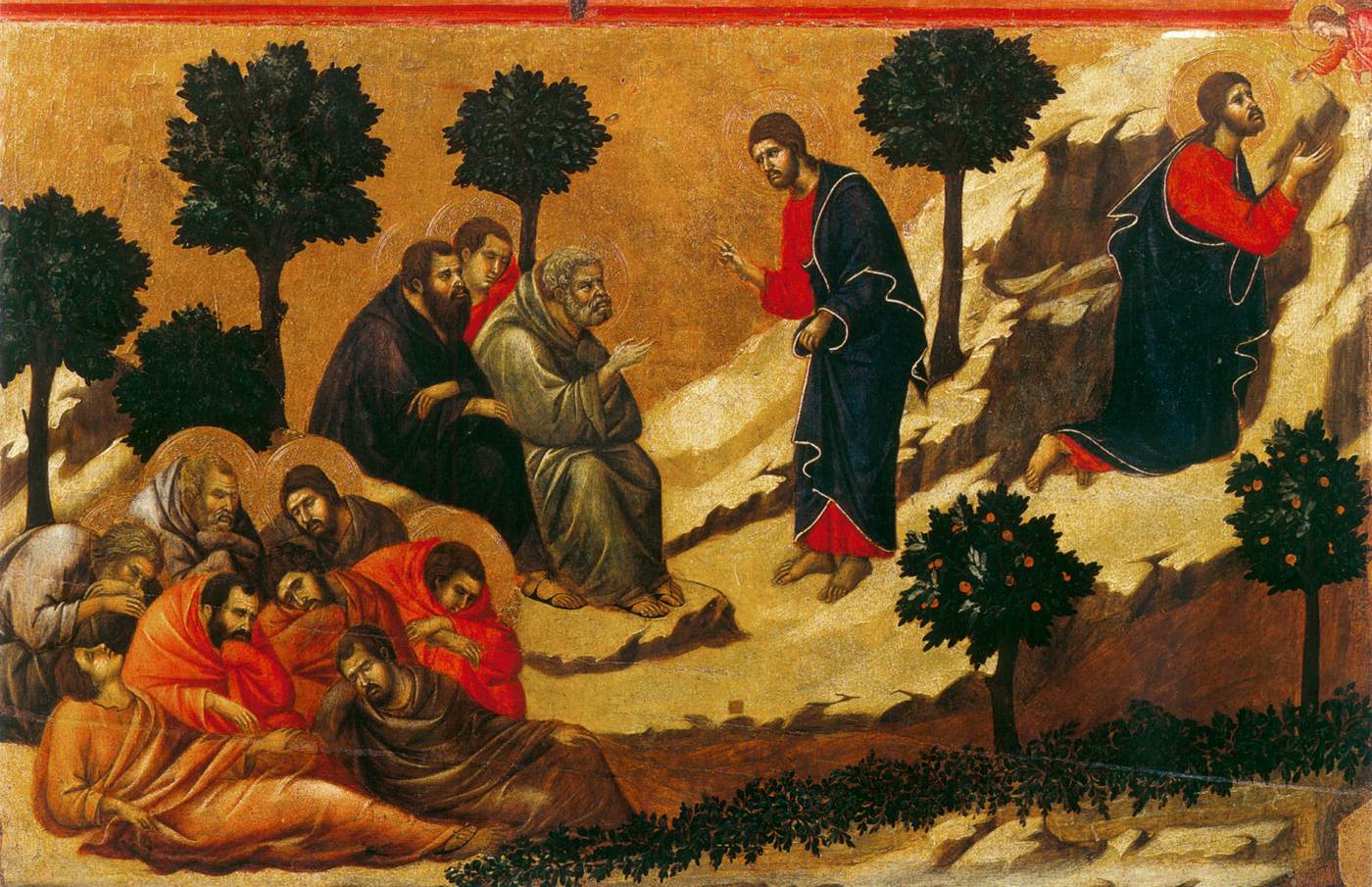
Agony in the Garden
Duccio di Buoninsegna
1308-11
Tempera on wood, 51 x 76 cm
Museo dell'Opera del Duomo, Siena
10
posted on
07/28/2019 8:11:16 AM PDT
by
annalex
(fear them not)
To: All
11
posted on
07/28/2019 10:00:03 AM PDT
by
Salvation
("With God all things are possible." Matthew 19:26)
To: All
12
posted on
07/28/2019 10:00:33 AM PDT
by
Salvation
("With God all things are possible." Matthew 19:26)
To: All
13
posted on
07/28/2019 10:01:02 AM PDT
by
Salvation
("With God all things are possible." Matthew 19:26)
To: All
14
posted on
07/28/2019 10:01:31 AM PDT
by
Salvation
("With God all things are possible." Matthew 19:26)
To: All
15
posted on
07/28/2019 10:02:10 AM PDT
by
Salvation
("With God all things are possible." Matthew 19:26)
To: All
16
posted on
07/28/2019 10:02:42 AM PDT
by
Salvation
("With God all things are possible." Matthew 19:26)
To: All
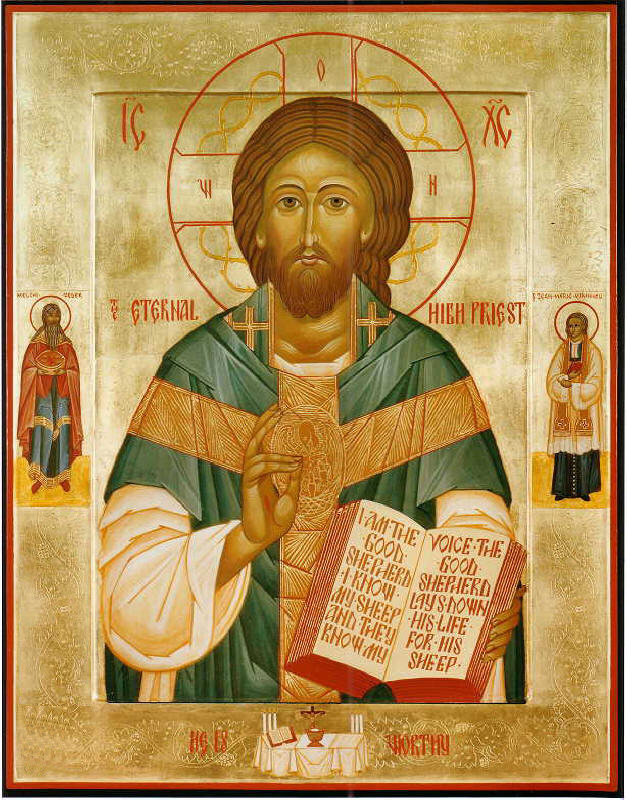
Jesus, High Priest
We thank you, God our Father, for those who have responded to your call to priestly ministry.
Accept this prayer we offer on their behalf: Fill your priests with the sure knowledge of your love.
Open their hearts to the power and consolation of the Holy Spirit.
Lead them to new depths of union with your Son.
Increase in them profound faith in the Sacraments they celebrate as they nourish, strengthen and heal us.
Lord Jesus Christ, grant that these, your priests, may inspire us to strive for holiness by the power of their example, as men of prayer who ponder your word and follow your will.
O Mary, Mother of Christ and our mother, guard with your maternal care these chosen ones, so dear to the Heart of your Son.
Intercede for our priests, that offering the Sacrifice of your Son, they may be conformed more each day to the image of your Son, our Lord and Savior, Jesus Christ. Amen.
Saint John Vianney, universal patron of priests, pray for us and our priests
This icon shows Jesus Christ, our eternal high priest.
The gold pelican over His heart represents self-sacrifice.
The border contains an altar and grapevines, representing the Mass, and icons of Melchizedek and St. Jean-Baptiste Vianney.
Melchizedek: king of righteousness (left icon) was priest and king of Jerusalem. He blessed Abraham and has been considered an ideal priest-king.
St. Jean-Baptiste Vianney is the patron saint of parish priests.
17
posted on
07/28/2019 3:31:55 PM PDT
by
Salvation
("With God all things are possible." Matthew 19:26)
To: All
Pray a Rosary each day for our nation.
1. Sign of the Cross: In the name of the Father, and of the Son, and of the Holy Spirit. Amen.
2. The Apostles Creed: I BELIEVE in God, the Father almighty, Creator of heaven and earth, and in Jesus Christ, His only Son, our Lord, who was conceived by the Holy Spirit, born of the Virgin Mary, suffered under Pontius Pilate, was crucified, died, and was buried. He descended into hell; on the third day he rose again from the dead; he ascended into heaven, and is seated at the right hand of God, the Father Almighty; from there He shall come to judge the living and the dead.
I believe in the Holy Spirit, the holy catholic Church, the communion of saints, the forgiveness of sins, the resurrection of the body, and the life everlasting. Amen.
3. The Lord's Prayer: OUR Father, who art in heaven, hallowed be Thy name. Thy kingdom come. Thy will be done on earth as it is in heaven. Give us this day our daily bread and forgive us our trespasses as we forgive those who trespass against us. And lead us not into temptation, but deliver us from evil. Amen.
4. (3) Hail Mary: HAIL Mary, full of grace, the Lord is with thee. Blessed art thou amongst women and blessed is the fruit of thy womb, Jesus. Holy Mary, Mother of God, pray for us sinners, now, and in the hour of our death. Amen. (Three times)
5. Glory Be: GLORY be to the Father, and to the Son, and to the Holy Spirit. As it was in the beginning, is now, and ever shall be, world without end. Amen.
6. Fatima Prayer: Oh, my Jesus, forgive us our sins, save us from the fires of hell, lead all souls to heaven, especially those in most need of your mercy.
Announce each mystery, then say 1 Our Father, 10 Hail Marys, 1 Glory Be and 1 Fatima prayer. Repeat the process with each mystery.
End with the Hail Holy Queen:
Hail, Holy Queen, Mother of Mercy, our life, our sweetness and our hope! To thee do we cry, poor banished children of Eve! To thee do we send up our sighs, mourning and weeping in this vale of tears! Turn then, most gracious advocate, thine eyes of mercy towards us; and after this, our exile, show unto us the blessed fruit of thy womb, Jesus!
O clement, O loving, O sweet Virgin Mary! Pray for us, O holy Mother of God, that we may be made worthy of the promises of Christ.
Final step -- The Sign of the Cross
The Mysteries of the Rosary By tradition, Catholics meditate on these Mysteries during prayers of the Rosary. The biblical references follow each of the Mysteries below.
The Glorious Mysteries
(Wednesdays and Sundays)
1.The Resurrection (Matthew 28:1-8, Mark 16:1-18, Luke 24:1-12, John 20:1-29) [Spiritual fruit - Faith]
2. The Ascension (Mark 16:19-20, Luke 24:50-53, Acts 1:6-11) [Spiritual fruit - Christian Hope]
3. The Descent of the Holy Spirit (Acts 2:1-13) [Spiritual fruit - Gifts of the Holy Spirit]
4. The Assumption [Spiritual fruit - To Jesus through Mary]
5. The Coronation [Spiritual fruit - Grace of Final Perseverance]
18
posted on
07/28/2019 3:48:30 PM PDT
by
Salvation
("With God all things are possible." Matthew 19:26)
To: All

St. Michael the Archangel
~ PRAYER ~
St. Michael, the Archangel, defend us in battle
Be our protection against the wickedness
and snares of the devil;
May God rebuke him, we humbly pray,
and do thou, O Prince of the heavenly host,
by the power of God,
Cast into hell Satan and all the evil spirits
who prowl through the world seeking the ruin of souls.
Amen
+
19
posted on
07/28/2019 3:49:10 PM PDT
by
Salvation
("With God all things are possible." Matthew 19:26)
To: All
Most Precious Blood of Our Lord Jesus Christ

July Devotion: The Precious Blood
Like the Sacred Wounds of Jesus, His Precious Blood deserves special honor because of its close relation to the Sacred Passion. That honor was given to it from the beginning by the Apostles who praised its redeeming power. (Rom. 5:9 "we are justified by His blood"; Heb. 13:12 "and so Jesus also, that He might sanctify the people by His blood, suffered outside the gate"; 1 John 1:7 "and the blood of Jesus Christ, His Son, cleanses us from all sin.")
The Church has always held devotion to the Precious Blood in high esteem. We continue to recognize and publicly acknowledge the profound indebtedness of the whole human race to Christ, Priest and Victim.
Standing at the foot of the cross, we see Jesus' head, hands, feet, and side pouring out streams of precious blood. It is precious because it:
• Redeems us and atones for our sins. Through His precious blood we are reconciled to God, made one with Him. Death ceases to be death and heaven's gates are opened to us.
• Cleanses us from all sin.
• Preserves us and keeps us safe from the grasp of evil. When the Father sees us washed in the Blood of the Lamb we are spared.
• Comforts us. It is the constant reminder that Jesus - true God and true man suffered and died to save us and to open heaven to us because He loves us.
• Sanctifies us. The same blood that justifies by taking away sin, continues to work within us. Its action gives us the grace to continue on the path toward the Kingdom of God. It assists us in achieving our new nature, leading us onward in subduing sin and in following the commands of God.
Jesus shed His precious blood seven times during His life on earth. They events were:
• Jesus shed His Blood in the Circumcision
• Jesus shed His Blood whilst praying in the Garden of Olives
• Jesus shed His Blood in the scourging
• Jesus shed His Blood in the crowning with thorns
• Jesus shed His Blood while carrying His cross
• Jesus shed His Blood in the crucifixion
• Jesus shed His Blood and water when His side was pierced
The Power of the Precious Blood
"I adore You, O Precious Blood of Jesus, flower of creation, fruit of virginity, ineffable instrument of the Holy Spirit, and I rejoice at the thought that You came from the drop of virginal blood on which eternal Love impressed its movement; You were assumed by the Word and deified in His person. I am overcome with emotion when I think of Your passing from the Blessed Virgin's heart into the heart of the Word, and, being vivified by the breath of the Divinity, becoming adorable because You became the Blood of God." (St. Albert the Great)
At their recent meeting, the U.S. Conference of Catholic Bishops had continuous Adoration of the Blessed Sacrament for "healing and peace." They encouraged parishes and communities to have ongoing Adoration of the Blessed Sacrament. In these dark months of woundedness, pain and violence we need to turn to the Precious Blood of Jesus in the Eucharist, for healing, peace, and light.
"What power we have in the Precious Blood of Jesus in the Holy Eucharist! He is there to protect us, to be our refuge and our redemption. (In Exodus 12, God told Moses to have His chosen people mark their door posts with the blood of an unblemished lamb, during the first Passover. Those who did this were spared when the Angel of the death passed by). This is why Archbishop Sheen said that we must call down the Blood of the Lamb, Jesus in the Most Blessed Sacrament. For, he warned, when we stop calling down the Blood of the Lamb, we start calling down the blood of each other." (From our book Bread of Life)
"And the Lamb on the throne will shepherd them. He will lead them to springs of life-giving water" (Rev 7:17).
"In the tumultuous events of our time, it is important to look to the Eucharist: it must be at the heart of the life of priests and consecrated people; the light and strength of spouses in putting into practice their commitment to fidelity, chastity and the apostolate; the ideal in education and in training children, adolescents and young people; the comfort and support of those who are troubled, of the sick and all who are weeping in the Gethsemane of life." (Pope John Paul II)
Precious Blood of Jesus, save us!
"The only time our Lord asked the Apostles for anything was the night when He went into His agony. But as often in the history of the church since that time, evil was awake, but the disciples were asleep. That is why there came out of His anguished and lonely Heart a sigh: 'Could you not watch one hour with Me?'" (Mt 26:40). Not for an hour of activity did he plead, but for an hour of friendship (Archbishop Fulton J. Sheen).
St. Maria Goretti, Patroness of Youth & Children of Mary, Feast-July 6 St. Maria of Italy (1890-1902), couldn't wait to make her First Communion. She wanted to receive Jesus in the Holy Eucharist so that she could become more beautiful and pure like Him; she wanted Him to live in her, close to her heart. After she received Jesus in the Blessed Sacrament for the first time, she stayed in Church for a long time after Mass to talk to Him. Maria's family lived with and worked for a farmer. His son Alessandro kept trying to make Maria sin against purity. One day, when everyone else was working, Alessandro grabbed Maria and tried to make her sin. Maria kept crying out for him to stop, and each time she did, he stabbed her. Courageously, Maria resisted him and was stabbed fourteen times. St. Maria died the next day.
"Look at Maria Goretti.... Like her, be capable of defending your purity of heart and body. Be committed to the struggle against evil and sin. Always esteem and love, purity and virginity." (Pope John Paul II, 1990)
A Prayer for Priests
O my God, help those priests who are faithful to remain faithful; to those who are falling, stretch forth Your Divine Hand that they may grasp it as their support. In the great ocean of Your mercy, lift those poor unfortunate ones who have fallen, that being engulfed therein they may receive the grace to return to Your Great Loving Heart. Amen. Precious Blood of Jesus, protect them!
The Eucharist is the fruit of our Lords Passion. Jesus gave up His Body on the cross so that He may give you His Body in the Holy Eucharist. Jesus poured out His very last drop of Blood on the cross so that He may fill you with His Divine Love each time that you receive Him in Holy Communion and visit Him in Eucharistic Adoration!
"The Eucharist, in the Mass and outside of the Mass, is the Body and Blood of Jesus Christ, and is therefore deserving of the worship that is given to the living God, and to Him alone" (Pope John Paul II, September 29, 1979, Phoenix Park, Ireland)
"The bread and wine, fruit of human hands, transformed through the power of the Holy Spirit into the body and blood of Christ, become a pledge of the 'new heaven and new earth,' announced by the Church in her daily mission." "In Christ, whom we adore present in the mystery of the Eucharist, the father uttered his final word with regard to humanity and human history." "To live the Eucharist, it is necessary, as well, to spend much time in adoration in front of the Blessed Sacrament, something which I myself experience every day drawing from it strength, consolation and assistance." "How could the Church fulfill her vocation without cultivating a constant relationship with the Eucharist, without nourishing herself with this food which sanctifies, without founding her missionary activity on this indispensable support?" "To evangelize the world there is need of apostles who are 'experts' in the celebration, adoration and contemplation of the Eucharist" (Pope John Paul II, World Mission Message 2004).
The Power of the Precious Blood of Jesus in the Holy Eucharist
"The Precious Blood belongs in an especial manner to men. Much more, therefore, does God invite them to come to its heavenly baths, and receive therein, not only the cleansing of their souls, but the power of a new and amazing life. Every doctrine in theology is a call to the Precious Blood. Every ceremony in the Church tells of it . . . . Every supernatural act is a growth of it. Everything that is holy on earth is either a leaf, bud, blossom or fruit of the Blood of Jesus. To its fountains God calls the sinner, that he may be lightened of his burdens. There is no remission of him in anything else. Only there is his lost sonship to be found. The saints are no less called by God to these invigorating streams. It is out of the Precious Blood that men draw martyrdoms, vocations, celebacies, austerities, heroic charities, and all the magnificent graces of high sanctity. The secret nourishment of prayer is from those fountains" (Father Faber, The Precious Blood).
The Most Precious Blood of Jesus
 July is traditionally associated with the Precious Blood of Our Lord. It may be customary to celebrate the votive Mass of the Precious Blood on July 1.
The extraordinary importance of the saving Blood of Christ has ensured a central place for its memorial in the celebration of this cultic mystery: at the centre of the Eucharistic assembly, in which the Church raises up to God in thanksgiving "the cup of blessing" (1 Cor 10, 16; cf Ps 115-116, 13) and offers it to the faithful as a "real communion with the Blood of Christ" (1 Cor 10, 16); and throughout the Liturgical Year. The Church celebrates the saving Blood of Christ not only on the Solemnity of the Body and Blood of Christ, but also on many other occasions, such that the cultic remembrance of the Blood of our redemption (cf 1 Pt 1, 18) pervades the entire Liturgical Year. Hence, at Vespers during Christmastide, the Church, addressing Christ, sings: "Nos quoque, qui sancto tuo redempti sumus sanguine, ob diem natalis tui hymnum novum concinimus." In the Paschal Triduum, the redemptive significance and efficacy of the Blood of Christ is continuously recalled in adoration. During the adoration of the Cross on Good Friday the Church sings the hymn: "Mite corpus perforatur, sanguis unde profluit; terra, pontus, astra, mundus quo lavanturflumine", and again on Easter Sunday, "Cuius corpus sanctissimum in ara crucis torridum, sed et cruorem roesum gustando, Deo vivimus (194).
Catholic Word of the Day: LITANY OF THE PRECIOUS BLOOD, 09-25-12
ST. GASPAR: Founder of the Society of the Precious Blood
Mass in the Cathedral of the Most Precious Blood of Our Lord Jesus Christ (London, 9/18)
Devotion to the Drops of Blood Lost by our Lord Jesus Christ on His Way to Calvary (Prayer/Devotion)
Chaplet of the Most Precious Blood
Catholic Word of the Day: PRECIOUS BLOOD, 12-03-11
The Traditional Feast of the Most Precious Blood of Our Lord Jesus Christ (Catholic Caucus)
Devotion to the Precious Blood
DOCTRINE OF THE BLOOD OF CHRIST
,,,,,,,,,,,,,,,,,,,,And More on the Precious Blood
Litany of the Most Precious Blood of Our Lord Jesus Christ
NOTHING IS MORE POTENT AGAINST EVIL THAN PLEADING THE PRECIOUS BLOOD OF CHRIST
Litany of the Most Precious Blood of Jesus
"Amen, amen, I say to you, unless you eat the flesh of the Son of Man and drink his blood, you do not have life within you" (Jn 6:53).
20
posted on
07/28/2019 3:50:02 PM PDT
by
Salvation
("With God all things are possible." Matthew 19:26)
Navigation: use the links below to view more comments.
first 1-20, 21-38 next last
Disclaimer:
Opinions posted on Free Republic are those of the individual
posters and do not necessarily represent the opinion of Free Republic or its
management. All materials posted herein are protected by copyright law and the
exemption for fair use of copyrighted works.
FreeRepublic.com is powered by software copyright 2000-2008 John Robinson