Skip to comments.
Catholic Caucus: Daily Mass Readings, 07-27-19
USCCB.org/RNAB ^
| 07-27-19
| Revised New American Bible
Posted on 07/26/2019 10:48:47 PM PDT by Salvation
July 27 2019
Saturday of the Sixteenth Week in Ordinary Time
When Moses came to the people
and related all the words and ordinances of the LORD,
they all answered with one voice,
"We will do everything that the LORD has told us."
Moses then wrote down all the words of the LORD and,
rising early the next day,
he erected at the foot of the mountain an altar
and twelve pillars for the twelve tribes of Israel.
Then, having sent certain young men of the children of Israel
to offer burnt offerings and sacrifice young bulls
as peace offerings to the LORD,
Moses took half of the blood and put it in large bowls;
the other half he splashed on the altar.
Taking the book of the covenant, he read it aloud to the people,
who answered, "All that the LORD has said, we will heed and do."
Then he took the blood and sprinkled it on the people, saying,
"This is the blood of the covenant
that the LORD has made with you
in accordance with all these words of his."
R.(14a) Offer to God a sacrifice of praise.
God the LORD has spoken and summoned the earth,
from the rising of the sun to its setting.
From Zion, perfect in beauty,
God shines forth.
R. Offer to God a sacrifice of praise.
"Gather my faithful ones before me,
those who have made a covenant with me by sacrifice."
And the heavens proclaim his justice;
for God himself is the judge.
R. Offer to God a sacrifice of praise.
"Offer to God praise as your sacrifice
and fulfill your vows to the Most High;
Then call upon me in time of distress;
I will rescue you, and you shall glorify me."
R. Offer to God a sacrifice of praise.
R. Alleluia, alleluia.
Humbly welcome the word that has been planted in you
and is able to save your souls.
R. Alleluia, alleluia.
Jesus proposed a parable to the crowds.
"The Kingdom of heaven may be likened to a man
who sowed good seed in his field.
While everyone was asleep his enemy came
and sowed weeds all through the wheat, and then went off.
When the crop grew and bore fruit, the weeds appeared as well.
The slaves of the householder came to him and said,
'Master, did you not sow good seed in your field?
Where have the weeds come from?'
He answered, 'An enemy has done this.'
His slaves said to him, 'Do you want us to go and pull them up?'
He replied, 'No, if you pull up the weeds
you might uproot the wheat along with them.
Let them grow together until harvest;
then at harvest time I will say to the harvesters,
"First collect the weeds and tie them in bundles for burning;
but gather the wheat into my barn."'"
TOPICS: Catholic; General Discusssion; Prayer; Worship
KEYWORDS: catholic; mt13; ordinarytime; prayer
Navigation: use the links below to view more comments.
first 1-20, 21-27 next last
For your reading, reflection, faith-sharing, comments, questions, discussion.
1
posted on
07/26/2019 10:48:47 PM PDT
by
Salvation
To: All
KEYWORDS: catholic; mt13; ordinarytime; prayer;
2
posted on
07/26/2019 10:49:41 PM PDT
by
Salvation
("With God all things are possible." Matthew 19:26)
To: nickcarraway; NYer; ELS; Pyro7480; livius; ArrogantBustard; Catholicguy; RobbyS; marshmallow; ...
Alleluia PingPlease FReepmail me to get on/off the Alleluia Ping List.
3
posted on
07/26/2019 10:50:40 PM PDT
by
Salvation
("With God all things are possible." Matthew 19:26)
To: All
From: Exodus 24:3-8
A sacred meal and sprinkling with blood
[3] Moses came and told the people all the words of the LORD and all the ordi-
nances; and all the people answered with one voice, and said, “All the words
which the LORD has spoken we will do.” [4] And Moses wrote all the words of
the LORD. And he rose early in the morning, and built an altar at the foot of the
mountain, and twelve pillars, according to the twelve tribes of Israel. [5] And he
sent young men of the people of Israel, who offered burnt offerings and sacrificed
peace offerings of oxen to the LORD. [6] And Moses took half of the blood and
put it in basins, and half of the blood he threw against the altar. [7] Then he took
the book of the covenant, and read it in the hearing of the people; and they said,
“All that the LORD has spoken we will do, and we will be obedient.” [8] And
Moses took the blood and threw it upon the people, and said, “Behold the blood
of the covenant which the LORD has made with you in accordance with all these
words.”
*********************************************************************************************
Commentary:
24:1-8. It was common practice for those peoples to ratify pacts by means of a
rite or a meal. This section recounts a meal or rite whereby the Covenant was
sealed. This event is very important for salvation history: it prefigures the sacri-
fice of Jesus Christ, which brought in the New Covenant.
The usual interpretation is that there were two stages in this ratification — first in-
volving Moses and the elders, that is, authorities (vv. 1-2, 9-11) and then the entire
people (vv. 3-8). Other commentators think that there was only one ceremony,
relayed by two different traditions. In both cases the final editor has tried to make
it clear that both the leaders and the people themselves took part in and formally
accepted the divine Covenant and all it laid down.
24:1-11. Nabab and Abihu are priests of Aaron’s line (cf. 6:33; 28:1; Lev 10:1-2);
the elders represent the people on important matters. The ceremony takes place
on the top of the mountain, which all the leaders ascended – Moses; the priests,
holders of religious authority; and the elders, that is, the civil and legal authori-
ties (cf. 18:21-26).
Only Moses has direct access to God (v. 2), but all are able to see God without
dying: what they see far outstrips in brilliance and luxury the great palaces and
temples of the East (cf. the vision of Isaiah in Is 6:10). In fact, they all share the
same table with God (v. 11): the description is reminiscent of a royal banquet, in
which the guests are treated on a par with the host: thus, the king of Babylonia
will show his benevolence to King Jehoiachin by having him as his dinner guest
(cf. 2 Kings 25:27-30). But it is, above all, a ritual banquet in which sharing the
same table shows the intimate relationship that exists between God and the
leaders of the people, and shows too that both parties are mutually responsible
for the covenant now being sealed.
24:3-8. The ceremony takes place on the ‘slope of the mountain; Moses alone is
the intermediary; but the protagonists are God and his people. The ceremony has
two parts — the reading and accepting of the clauses of the Covenant (vv. 3-4),
that is, the Words (Decalogue) and the laws (the so-called Code of the Covenant);
then comes the offering which seals the pact.
The acceptance of the clauses is done with all due solemnity, using the ritual
formula: “all the words which the Lord has spoken we will do”. The people, who
have already made this commitment (19:8), now repeat it after listening to Moses’
address (v. 3) and just before being sprinkled with the blood of the offering. The
binding force of the pact is thereby assured.
The offering has some very ancient features — the altar specially built for the
occasion (v. 4; cf. 20:25); the twelve pillars, probably set around the altar; the
young men, not priests, making the offerings; and particularly the sprinkling with
blood which is at the very core of the rite.
The dividing of the blood in two (one half for the altar which represents God, and
the other for the people) means that both commit themselves to the requirements
of the Covenant. There is evidence that nomadic peoples used to seal their pacts
with the blood of sacrificed animals. But there are no traces in the Bible of blood
being used in that way. This rite probably has deeper significance: given that
blood, which stands for life (cf. Gen 4), belongs to God alone, it must only be
poured on the altar or used to anoint people who are consecrated to God, such
as priests (cf. Ex 29:19-22). When Moses sprinkled the blood of the offering on
to the entire people, he was consecrating it, making it divine property and “a
kingdom of priests” (cf. 19:3-6). The Covenant therefore is not only a commit-
ment to obey its precepts but, particularly, the right to belong to the holy nation,
which is God’s possession. At the Last Supper, when instituting the Eucharist,
Jesus uses the very same terms, “blood of the Covenant”, thereby indicating the
nature of the new people of God who, having been redeemed, is fully “the holy
people of God” (cf. Mt 26:27 and par.; 1 Cor 11:23-25).
The Second Vatican Council has this to say about the connexion between the
New and Old Covenants, pointing out that the Church is the true people of God:
“God chose the Israelite race to be his own people and established a covenant
with it. He gradually instructed this people — in its history manifesting both him-
self and the decree of his will — and made it holy unto himself. All these things,
however, happened as a preparation and figure of that new and perfect covenant
which was to be ratified in Christ, and of the fuller revelation which was to be
given through the Word of God made flesh. […] Christ instituted this new cove-
nant, namely the new covenant in his blood (cf. 1 Cor 11:25); he called a race
made up of Jews and Gentiles which would he one, not according to the flesh,
but in the Spirit, and this race would he the new People of God” (”Lumen gen-
tium”, 4 and 9).
*********************************************************************************************
Source: “The Navarre Bible: Text and Commentaries”. Biblical text from the
Revised Standard Version and New Vulgate. Commentaries by members of
the Faculty of Theology, University of Navarre, Spain.
Published by Four Courts Press, Kill Lane, Blackrock, Co. Dublin, Ireland, and
by Scepter Publishers in the United States.
4
posted on
07/26/2019 10:54:21 PM PDT
by
Salvation
("With God all things are possible." Matthew 19:26)
To: All
From: Matthew 13:24-30
The Parable of the Weeds
[24] Another parable he (Jesus) put before them, saying, “The kingdom of
heaven may be compared to a man who sowed good seed in his field; [25]
but while men were sleeping, his enemy came and sowed weeds among the
wheat, and went away. [26] So when the plants came up and bore grain, then
the weeds appeared also. [27] And the servants of the householder came and
said to him, ‘Sir, did you not sow good seed in your field? How then has it
weeds?’ [28] He said to them, ‘An enemy has done this.’ The servants said to
him, ‘Then do you want us to go and gather them?’ [29] But he said, ‘No; lest
in gathering the weeds you root up the wheat along with them. [30] Let both
grow together until the harvest; and at harvest time I will tell the reapers, “Ga-
ther the weeds first and bind them in bundles to be burned, but gather the
wheat into my barn.’”
The Mustard Seed; The Leaven
[31] Another parable He put before them saying, “The Kingdom of Heaven is
like a grain of mustard seed which a man took and sowed in his field; [32] it
is the smallest of all seeds, but when it has grown it is the greatest of shrubs
and becomes a tree, so that the birds of the air come and make nests in its
branches.”
[33] He told them another parable. “The Kingdom of Heaven is like a leaven
which a woman took and hid in three measures of meal, till it was all lea-
vened.”
[34] All this Jesus said to the crowds in parables; indeed He said nothing to
them without a parable. [35] This was to fulfill what was spoken by the pro-
phet: “I will open my mouth in parables, I will utter what has been hidden
since the foundation of the world.”
The Parable of the Weeds Explained
[36] Then He left the crowds and went into the house. And His disciples
came to Him, saying, “Explain to us the parable of the weeds of the field.”
[37] He answered, “He who sows the good seed is the Son of Man; [38] the
field is the world, and the good seed means the sons of the Kingdom; the
weeds are the sons of the evil one, [39] and the enemy who sowed them is
the devil; the harvest is the close of the age, and the reapers are angels. [40]
Just as the weeds are gathered and burned with fire, so will it be at the close
of the age. [41] The Son of Man will send His angels, and they will gather out
of His Kingdom all causes of sin and evildoers, [42] and throw them out into
the furnace of fire; there men will weep and gnash their teeth. [43] Then the
righteous will shine like the sun in the Kingdom of their Father. He who has
ears, let him hear.”
***************************************************************************************
Commentary:
24-25. “The situation is clear: the field is fertile and the seed is good; the
Lord of the field has scattered the seed at the right moment and with great
skill. He even has watchmen to make sure that the field is protected. If, af-
terwards, there are weeds among the wheat, it is because men have failed
to respond, because they—and Christians in particular—have fallen asleep
and allowed the enemy to approach” (St. J. Escriva, “Christ Is Passing By”,
123).
25. This weed—cockle—looks very like wheat and can easily be mistaken for
it until the ears appear. If it gets ground up with wheat it contaminates the
flour and any bread made from that flour causes severe nausea when eaten.
In the East personal vengeance sometimes took the form of sowing cockle
among an enemy’s wheat. Roman law prescribed penalties for this crime.
28. “When the careless servants ask the Lord why weeds have grown in his
field, the explanation is obvious: ‘inimicus homo hoc fecit: an enemy has
done this.’ We Christians should have been on guard to make sure that the
good things placed in this world by the Creator were developed in the service
of truth and good. But we have fallen asleep—a sad thing, that sluggishness
of our heart while the enemy and all those who serve him worked incessant-
ly. You can see how the weeds have grown abundantly everywhere” (St. J.
Escriva, “Christ Is Passing By”, 123).
29-30. The end of this parable gives a symbolic explanation of why God al-
lows evil to have its way for a time—and for its ultimate extirpation. Evil is to
run its course on earth until the end of time; therefore, we should not be scan-
dalized by the presence of evil in the world. It will be obliterated not in this life,
but after death; at the Judgment (the harvest) the good will go to Heaven and
the bad to Hell.
31-32. Here, the man is Jesus Christ and the field, the world. The grain of
mustard seed is the preaching of the Gospel and the Church, which from ve-
ry small beginnings will spread throughout the world.
The parable clearly refers to the universal scope and spread of the Kingdom
of God: the Church, which embraces all mankind of every kind and condition,
in every latitude and in all ages, is forever developing in spite of obstacles,
thanks to God’s promise and aid.
33. This comparison is taken from everyday experience: just as leaven gra-
dually ferments all the dough, so the Church spreads to convert all nations.
The leaven is also a symbol of the individual Christian. Living in the middle
of the world and retaining his Christian quality, he wins souls for Christ by
his word and example: “Our calling to be children of God, in the midst of the
world, requires us not only to seek our own personal holiness, but also to go
out onto all the ways of the earth, to convert them into roadways that will car-
ry souls over all obstacles and lead them to the Lord. As we take part in all
temporal activities as ordinary citizens, we are to become leaven acting on
the mass” (St. J. Escriva, “Christ Is Passing By”, 120).
34-35. Revelation, God’s plans, are hidden (cf. Matthew 11:25) from those
who are disposed to accept them. The Evangelist wishes to emphasize the
need for simplicity and for docility to the Gospel. By recalling Psalm 78:2,
he tells us once more, under divine inspiration, that the Old Testament pro-
phecies find their fulfillment in our Lord’s preaching.
36-43. While making its way on earth, the Church is composed of good and
bad people, just men and sinners: they are mixed in with one another until
the harvest time, the end of the world, when the Son of Man, in His capacity
as Judge of the living and the dead, will divide the good from the bad at the
Last Judgment—the former going to eternal glory, the inheritance of the
saints; the latter, to the eternal fire of Hell. Although the just and the sinners
are now side by side, the Church has the right and the duty to exclude those
who cause scandal, especially those who attack its doctrine and unity; this
it can do through ecclesiastical excommunication and other canonical penal-
ties. However, excommunication has a medicinal and pastoral function — to
correct those who are obstinate in error, and to protect others from them.
*****************************************************************************************
Source: “The Navarre Bible: Text and Commentaries”. Biblical text from the
Revised Standard Version and New Vulgate. Commentaries by members of
the Faculty of Theology, University of Navarre, Spain.
Published by Four Courts Press, Kill Lane, Blackrock, Co. Dublin, Ireland, and
by Scepter Publishers in the United States.
5
posted on
07/26/2019 10:55:33 PM PDT
by
Salvation
("With God all things are possible." Matthew 19:26)
To: Salvation
Scripture readings from the Jerusalem Bible by Darton, Longman & Todd
Readings at Mass
Liturgical Colour: Green.
| First reading |
Exodus 24:3-8 © |
| This is the blood of the Covenant that the Lord has made with you |
Moses went and told the people all the commands of the Lord and all the ordinances. In answer, all the people said with one voice, ‘We will observe all the commands that the Lord has decreed.’ Moses put all the commands of the Lord into writing, and early next morning he built an altar at the foot of the mountain, with twelve standing-stones for the twelve tribes of Israel. Then he directed certain young Israelites to offer holocausts and to immolate bullocks to the Lord as communion sacrifices. Half of the blood Moses took up and put into basins, the other half he cast on the altar. And taking the Book of the Covenant he read it to the listening people, and they said, ‘We will observe all that the Lord has decreed; we will obey.’ Then Moses took the blood and cast it towards the people. This’ he said ‘is the blood of the Covenant that the Lord has made with you, containing all these rules.’
| Responsorial Psalm |
| Psalm 49(50):1-2,5-6,14-15 © |
Pay your sacrifice of thanksgiving to God.
The God of gods, the Lord,
has spoken and summoned the earth,
from the rising of the sun to its setting.
Out of Zion’s perfect beauty he shines.
Pay your sacrifice of thanksgiving to God.
‘Summon before me my people
who made covenant with me by sacrifice.’
The heavens proclaim his justice,
for he, God, is the judge.
Pay your sacrifice of thanksgiving to God.
Pay your sacrifice of thanksgiving to God
and render him your votive offerings.
Call on me in the day of distress.
I will free you and you shall honour me.’
Pay your sacrifice of thanksgiving to God.
| Gospel Acclamation |
Heb4:12 |
Alleluia, alleluia!
The word of God is something alive and active:
it can judge secret emotions and thoughts.
Alleluia!
Alleluia, alleluia!
Accept and submit to the word
which has been planted in you
and can save your souls.
Alleluia!
| Gospel |
| Matthew 13:24-30 © |
| Let them both grow till the harvest |
Jesus put another parable before the crowds: ‘The kingdom of heaven may be compared to a man who sowed good seed in his field. While everybody was asleep his enemy came, sowed darnel all among the wheat, and made off. When the new wheat sprouted and ripened, the darnel appeared as well. The owner’s servants went to him and said, “Sir, was it not good seed that you sowed in your field? If so, where does the darnel come from?” “Some enemy has done this” he answered. And the servants said, “Do you want us to go and weed it out?” But he said, “No, because when you weed out the darnel you might pull up the wheat with it. Let them both grow till the harvest; and at harvest time I shall say to the reapers: First collect the darnel and tie it in bundles to be burnt, then gather the wheat into my barn.”’
6
posted on
07/26/2019 10:59:01 PM PDT
by
Salvation
("With God all things are possible." Matthew 19:26)
To: Salvation
We are living in those times right now!! The DEVILS WEEDS are among us.
7
posted on
07/27/2019 3:12:01 AM PDT
by
Ann Archy
(Abortion....... The HUMAN Sacrifice to the god of Convenience.)
To: Salvation
| Matthew |
| |
English: Douay-Rheims |
Latin: Vulgata Clementina |
Greek NT: Byzantine/Majority Text (2000) |
| |
Matthew 13
|
| 24. |
Another parable he proposed to them, saying: The kingdom of heaven is likened to a man that sowed good seeds in his field. |
Aliam parabolam proposuit illis, dicens : Simile factum est regnum cælorum homini, qui seminavit bonum semen in agro suo : |
αλλην παραβολην παρεθηκεν αυτοις λεγων ωμοιωθη η βασιλεια των ουρανων ανθρωπω σπειροντι καλον σπερμα εν τω αγρω αυτου |
| 25. |
But while men were asleep, his enemy came and oversowed cockle among the wheat and went his way. |
cum autem dormirent homines, venit inimicus ejus, et superseminavit zizania in medio tritici, et abiit. |
εν δε τω καθευδειν τους ανθρωπους ηλθεν αυτου ο εχθρος και εσπειρεν ζιζανια ανα μεσον του σιτου και απηλθεν |
| 26. |
And when the blade was sprung up, and had brought forth fruit, then appeared also the cockle. |
Cum autem crevisset herba, et fructum fecisset, tunc apparuerunt et zizania. |
οτε δε εβλαστησεν ο χορτος και καρπον εποιησεν τοτε εφανη και τα ζιζανια |
| 27. |
And the servants of the goodman of the house coming said to him: Sir, didst thou not sow good seed in thy field? whence then hath it cockle? |
Accedentes autem servi patrisfamilias, dixerunt ei : Domine, nonne bonum semen seminasti in agro tuo ? unde ergo habet zizania ? |
προσελθοντες δε οι δουλοι του οικοδεσποτου ειπον αυτω κυριε ουχι καλον σπερμα εσπειρας εν τω σω αγρω ποθεν ουν εχει ζιζανια |
| 28. |
And he said to them: An enemy hath done this. And the servants said to him: Wilt thou that we go and gather it up? |
Et ait illis : Inimicus homo hoc fecit. Servi autem dixerunt ei : Vis, imus, et colligimus ea ? |
ο δε εφη αυτοις εχθρος ανθρωπος τουτο εποιησεν οι δε δουλοι ειπον αυτω θελεις ουν απελθοντες συλλεξομεν αυτα |
| 29. |
And he said: No, lest perhaps gathering up the cockle, you root up the wheat also together with it. |
Et ait : Non : ne forte colligentes zizania, eradicetis simul cum eis et triticum. |
ο δε εφη ου μηποτε συλλεγοντες τα ζιζανια εκριζωσητε αμα αυτοις τον σιτον |
| 30. |
Suffer both to grow until the harvest, and in the time of the harvest I will say to the reapers: Gather up first the cockle, and bind it into bundles to burn, but the wheat gather ye into my barn. |
Sinite utraque crescere usque ad messem, et in tempore messis dicam messoribus : Colligite primum zizania, et alligate ea in fasciculos ad comburendum : triticum autem congregate in horreum meum. |
αφετε συναυξανεσθαι αμφοτερα μεχρι του θερισμου και εν καιρω του θερισμου ερω τοις θερισταις συλλεξατε πρωτον τα ζιζανια και δησατε αυτα εις δεσμας προς το κατακαυσαι αυτα τον δε σιτον συναγαγετε εις την αποθηκην μου |
8
posted on
07/27/2019 10:34:12 AM PDT
by
annalex
(fear them not)
To: annalex
24. Another parable put he forth to them, saying, The kingdom of heaven is likened to man which sowed good seed in his field:
25. But while men slept, his enemy came and sowed tares among the wheat, and went his way.
26. But when the blade was sprung up, and brought forth fruit, then appeared the tares also.
27. So the servants of the householder came and said to him, Sir, did you not sow good seed in your field; from whence then has it tares?
28. He said to them, An enemy has done this. The servants said to him, Will you then that we go and gather them up?
29. But he said, No; lest while you gather up the tares, you root up also the wheat with them.
30. Let both grow together until the harvest: and in the time of harvest I will say to the reapers, Gather together first the tares, and bind them in bundles to burn them: but gather the wheat into my barn.
CHRYS; In the foregoing parable the Lord spoke to such as do not receive the word of God; here of those who receive a corrupting seed. This is the contrivance of the Devil, ever to mix error with truth.
JEROME; He set forth also this other parable, as it were a rich householder refreshing his guests with various meats, that each one according to the nature of his stomach might find some food adapted to him. He said not 'a second parable,' but another; for had He said 'a second,' we could not have looked for a third; but another prepares us for many more.
REMIG; Here He calls the Son of God Himself the kingdom of heaven; for He said, The kingdom of heaven is like to a man that sowed good seed in his field.
CHRYS; He then points out the manner of the Devil's snares, saying, While men slept, his enemy came and sowed tares in the midst of the wheat, and departed. He here shows that error arose after truth, as indeed the course of events testifies; for the false prophets came after the Prophets, the false apostles after the Apostles, and Antichrist after Christ. For unless the Devil sees somewhat to imitate, and some to lay in wait against, he does not attempt any thing. Therefore because he saw that this man bears fruit an hundred, this sixty, and this thirty fold, and that he was not able to carry off or to choke that which had taken root, he turns to other insidious practices, mixing up his own seed, which is a counterfeit of the true, and thereby imposes upon such as are prone to be deceived. So the parable speaks, not of another seed, but of tares which bear a great likeness to wheat corn. Further, the malignity of the Devil is shown in this, that he sowed when all else was completed, that he might do the greater hurt to the husbandman.
AUG; He says, While men slept, for while the heads of the Church were abiding in sleep, and after the Apostles had received the sleep of death, then came the Devil and sowed upon the rest those whom the Lord in His interpretation calls evil children. But we do well to inquire whether by such are meant heretics, or Catholics who lead evil lives. That He says, that they were sown among the wheat, seems to point out that they were all of one communion. But forasmuch as He interprets the field to mean not the Church, but the world, we may well understand it of the heretics, who in this world are mingled with the good; for they who live amiss in the same faith may better be taken of the chaff than of the tares, for the chaff has a stem and a root in common with the grain. While schismatics again may be likened to ears that have rotted, or to straws that are broken, crushed down, and cast forth of the field. Indeed it is not necessary that every heretic or schismatic should be corporally severed from the Church; for the Church bears many who do not so publicly defend their false opinions as to attract the attention of the multitude, which when they do, then are they expelled. When then the Devil had sown upon the true Church diverse evil errors and false opinions; that is to say, where Christ's name had gone before, there he scattered errors, himself was the rather hidden and unknown; for He says, And went his way though indeed in this parable, as we learn from His own interpretation, the Lord may be understood to have signified under the name of tares all stumbling-blocks and such as work iniquity
CHRYS; In what follows He more particularly draws the picture of an heretic, in the words, When the blade grew, and put forth fruit, then appeared the tares also. For heretics at first keep themselves in the shade; but when, they have had long license, and when men have held communication with them in discourse, then they pour forth their venom.
AUG; Or otherwise; when a man begins to be spiritual, discerning between things, then he begins to see errors; for he judges concerning whatsoever he hears or reads, whether it departs from the rule of truth; but until he is perfected in the same spiritual things, he might be disturbed at so many false heresies having existed under the Christian name, whence it follows, And the servants of the householder coming to him said to him, Did you not sow good seed in your field? How then has it tares? Are these servants then the same as those whom He afterwards calls reapers? Because in His exposition of the parable, He expounds the reapers to be the Angels, and none would dare say that the Angels were ignorant who had sowed tares, we should the rather understand that the faithful are here intended by the servants. And no wonder if they are also signified by the good seed; for the same thing admits of different likenesses according to its different signification; as speaking of Himself He says that He is the door, He is the shepherd.
REMIG. They came to the Lord not with the body but with the heart and desire of the soul; and from Him they gather that this was done by the craft of the Devil, whence it follows, And he said to them, An enemy has done this.
JEROME; The Devil is called a man that is an enemy because he has ceased to be God; and in the ninth Psalm it is written of him, Up, Lord, and let not man have the upper hand. Wherefore let not him sleep that is set over the Church, lest through his carelessness the enemy should sow therein tares, that is, the dogmas of the heretics.
CHRYS; He is called the enemy on account of the losses he inflicts on men; for the assaults of the Devil are made upon us, though their origin is not in his enmity towards us, but in his enmity towards God.
AUG; And when the servants of God knew that it was the Devil who had contrived this fraud, whereby when he found that he had no power in open warfare against a Master of such great name, he had introduced his fallacies under cover of that name itself, the desire might readily arise in them to remove such men from out of human affairs if opportunity should be given them; but they first appeal to God's justice whether they should so do; The servants said, Will you that we go and gather them out?
CHRYS; Wherein observe the thoughtfulness and affection of the servants; they hasten to root up the tares, thus showing their anxiety about the good seed; for this is all to which they look, not that any should be punished, but that which is sown should not perish. The Lord's answer follows, And he said to them, No.
JEROME; For repentance is left, and we are warned that we should not hastily cut off a brother, since one who is today corrupted with an erroneous dogma, may grow wiser tomorrow, and begin to defend the truth; wherefore it is added, Lest in gathering together the tares you root out the wheat also.
AUG; Wherein He renders them more patient and tranquil. For this He says, because good men while yet weak, have need in some things of being mixed up with bad, either that they may be proved by their means, or that by comparison with them they may be greatly stimulated and drawn to a better course. Or perhaps the wheat is declared to be rooted up if the tares should be gathered out of it, on account of many who though at first tares would after become wheat; yet they would never attain to this commendable change were they not patiently endured while they were evil. Thus were they rooted up, that wheat which they would become in time if spared, would be rooted up in them. It is then therefore He forbids that such should be taken away out of this life, lest in the endeavor to destroy the wicked, those of them should be destroyed among the rest who would turn out good; and lest also that benefit should be lost to the good which would accrue to them even against their will from mixing with the wicked. But this may be done seasonably when, in the end of all, there remains no more time for a change of life, or of advancing to the truth by taking opportunity and comparison of others' faults; therefore He adds, Let both grow together until the harvest, that is, until the judgment.
JEROME; But this seems to contradict that command, Put away the evil from among you. For if the rooting up be forbidden, and we are to abide in patience till the harvest time, how are we to cast forth any from among us? But between wheat and tares (which in Latin we call 'lolium') so long as it is only in blade, before the stalk has put forth an ear, there is very great resemblance, and none or little difference to distinguish them by. The Lord then warns us not to pass a hasty sentence on an ambiguous word, but to reserve it for His judgment, that when the day of judgment shall come, He may cast forth from the assembly of the saints no longer on suspicion but on manifest guilt.
AUG; For when any one of the number of Christians included in the Church is found in such sin as to incur an anathema, this is done, where danger of schism is not apprehended, with tenderness, not for his rooting out, but for his correction. But if he be not conscious of his sin, nor correct it by penitence, he will of his own choice go forth of the Church and be separated from her communion; whence when the Lord commanded, Suffer both to grow together till the harvest, He added the reason, Saying, lest when you would gather out the tares you root up the wheat also. This sufficiently shows, that when that fear has ceased, and when the safety of the crop is certain, that is when the crime is known to all, and is acknowledged as so execrable as to have no defenders, or not such as might cause any fear of a schism, then severity of discipline does not sleep, and its correction of error is so much the more efficacious as the observance of love had been more careful. But when the same infection has spread to a large number at once, nothing remains but sorrow and groans. Therefore let a man gently reprove whatever is in his power; what is not so let him bear with patience, and mourn over with affection, until He from above shall correct and heal, and let him defer till harvest time to root out the tares and winnow the chaff. But the multitude of the unrighteous is to be struck at with a general reproof, whenever there is opportunity of saying anything among the people; and above all when any scourge of the Lord from above gives opportunity, when they feel that they are scourged for their deserts; for then the calamity of the hearers opens their ears submissively to the words of their reprover, seeing the heart in affliction is ever more prone to the groans of confession than to the murmurs of resistance. And even when no tribulation lays upon them, should occasion serve, a word of reproof is usefully spent upon the multitude; for when separated it is wont to he fierce, when in a body it is wont to mourn.
CHRYS; This the Lord spoke to forbid any putting to death. Or we ought not to kill an heretic, seeing that so a never-ending war would be introduced into the world; and therefore He says, Lest you root out with them the wheat also; that is, if you draw the sword and put the heretic to death, it must needs be that many of the saints will fall upon them. Hereby He does not indeed forbid all restraint upon heretics, that their freedom of speech should be cut off, that their synods and their confessions should put broken up - but only forbids that they should be put to death.
AUG; This indeed was at first my own opinion, that no man was to be driven by force into the unity of Christ; but he was to be led by discourse, tended with in controversy, and overcome by argument, we might not have men feigning themselves to be Catholic whom we knew to be declared heretics. But this opinion of mine was overcome not by the authority of those who contradicted me, but by the examples of those that showed it in fact; for the tenor of those laws in enacting which Princes serve the Lord in fear, has had such good effect, that already some say, This we desired long ago; but now thanks be to God who has made the occasion for us, and has cut off our pleas of delay. Others say, This we have long known to be the truth; but we were held by a kind of old habit, thanks be to God who has broken our chains Others again; We knew not that this was true, and had no desire to learn it, but fear has driven us to give our attention to it, thanks be to the Lord who has banished our carelessness by the spur of terror. Others, We were deterred from entering in by false rumors, which we should not bare known to be false had we not entered in, and we should not have entered in had we not been compelled; thanks be to God who has broken up our preaching by the scourge of persecution, and has taught us by experience how empty and false things lying fame had reported concerning His Church. Others say, We thought indeed that it was of no importance in what place we held the faith of Christ but thanks be to the Lord who has gathered us together out of our division, and has shown us that it is consonant to unity of God that He should be worshipped in unity. Let then the Kings of the earth show themselves the servants of Christ by publishing laws in Christ's behalf.
ID; But who is there of you who has any wish that a heretic should perish, nay, that he should so much as lose all? Could the house of David have had peace in no other war but by the death of Absalom in that war which he waged against his father; notwithstanding his father gave strict commands to his servants that they should save him alive and unhurt, that on his repentance there might be room for fatherly affection to pardon; what then remained for him but to mourn over him when lost, and to console his domestic affliction by the peace which it had brought to his kingdom Thus our Catholic mother the Church, when by the loss of a few she gains many, soothes the sorrow of her motherly heart, healing it by the deliverance of so much people. Where then is that which those are accustomed to cry out, That it is free to all to believe? Whom has Christ done violence to? Whom has He compelled? Let them take the Apostle Paul; let them acknowledge in him Christ first compelling and afterwards teaching; first smiting and afterwards comforting. And it is wonderful to see him who entered into the Gospel by the force of a bodily infliction laboring therein more than all those who are called by word only. Why then should not the Church constrain her lost sons to return to her, when her lost sons constrained others to perish?
REMIG; It follows, And in the time of harvest I will say to the reapers, Gather together first the tares, and bind them in bundles to burn them. The harvest is the season of reaping which here designates the day of judgment, in which the good are to be separated from the bad.
CHRYS; But why does He say, Gather first the tares? That the good should have no fears lest the wheat should be rooted up with them.
JEROME; In that He says that the bundles of tares are to be cast into the fire, and the wheat gathered into barns, it is clear that heretics also and hypocrites are to be consumed in the fires of hell, while the saints who are here represented by the wheat are received into the barns, that is into heavenly mansions.
AUG; It may be asked why He commands more than one bundle or heap of tares to be formed? Perhaps because of the variety of heretics differing not only from the wheat, but also among themselves, each several heresy, separated from communion with all the others, is designated as a bundle; and perhaps they may even then begin to be bound together for burning, when they first sever themselves from Catholic communion, and begin to have their independent church; so that it is the burning and not the binding into bundles that will take place at the end of the world. But were this so, there would not be so many who become wise again, and return from error into the Catholic Church. Wherefore we must understand the binding into bundles to be what shall come to pass in the end, that punishment should fall on them not promiscuously, but in due proportion to the obstinacy and willfulness of each separate error.
RABAN; And it should be noted that, when He says, Sowed good seed, He intends that good will which is in the elect; when He adds, An enemy came, He intimates that watch should be kept against him; when as the tares grow up, He suffers it patiently, saying, An enemy has done this, He recommends to us patience; when He says, Lest in gathering the tares, &c. He sets us an example of discretion; when hen He says, Suffer both to grow together till the harvest He teaches us long-suffering; and, lastly, He inculcates justice, when He says, Bind them into bundles to burn.
Catena Aurea Matthew 13
9
posted on
07/27/2019 10:34:48 AM PDT
by
annalex
(fear them not)
To: annalex

Christ in Majesty
c. 1180
Fresco
Doppelkirche, Schwarzrheindorf
10
posted on
07/27/2019 10:38:08 AM PDT
by
annalex
(fear them not)
To: All
11
posted on
07/27/2019 12:28:30 PM PDT
by
Salvation
("With God all things are possible." Matthew 19:26)
To: All
12
posted on
07/27/2019 12:29:45 PM PDT
by
Salvation
("With God all things are possible." Matthew 19:26)
To: All
13
posted on
07/27/2019 12:30:23 PM PDT
by
Salvation
("With God all things are possible." Matthew 19:26)
To: All
14
posted on
07/27/2019 12:31:01 PM PDT
by
Salvation
("With God all things are possible." Matthew 19:26)
To: All
15
posted on
07/27/2019 12:31:44 PM PDT
by
Salvation
("With God all things are possible." Matthew 19:26)
To: All
16
posted on
07/27/2019 12:33:20 PM PDT
by
Salvation
("With God all things are possible." Matthew 19:26)
To: All
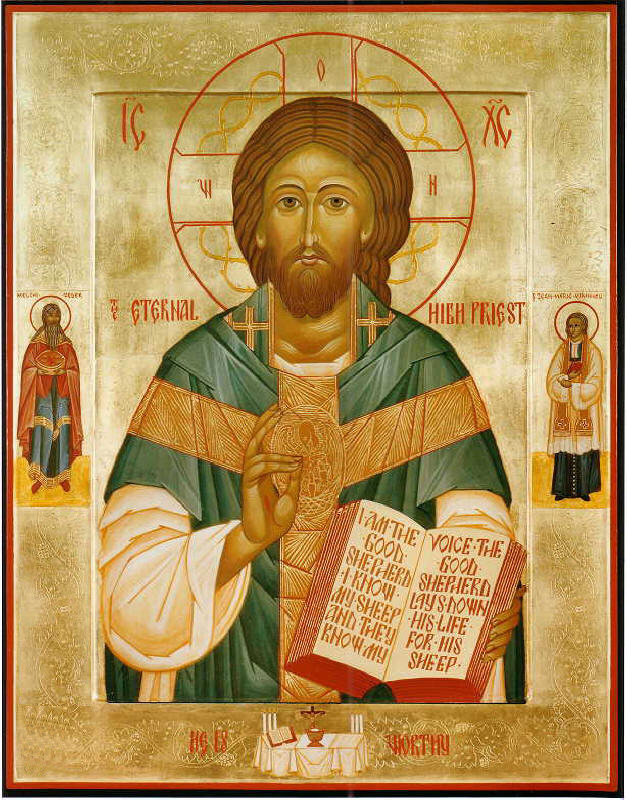
Jesus, High Priest
We thank you, God our Father, for those who have responded to your call to priestly ministry.
Accept this prayer we offer on their behalf: Fill your priests with the sure knowledge of your love.
Open their hearts to the power and consolation of the Holy Spirit.
Lead them to new depths of union with your Son.
Increase in them profound faith in the Sacraments they celebrate as they nourish, strengthen and heal us.
Lord Jesus Christ, grant that these, your priests, may inspire us to strive for holiness by the power of their example, as men of prayer who ponder your word and follow your will.
O Mary, Mother of Christ and our mother, guard with your maternal care these chosen ones, so dear to the Heart of your Son.
Intercede for our priests, that offering the Sacrifice of your Son, they may be conformed more each day to the image of your Son, our Lord and Savior, Jesus Christ. Amen.
Saint John Vianney, universal patron of priests, pray for us and our priests
This icon shows Jesus Christ, our eternal high priest.
The gold pelican over His heart represents self-sacrifice.
The border contains an altar and grapevines, representing the Mass, and icons of Melchizedek and St. Jean-Baptiste Vianney.
Melchizedek: king of righteousness (left icon) was priest and king of Jerusalem. He blessed Abraham and has been considered an ideal priest-king.
St. Jean-Baptiste Vianney is the patron saint of parish priests.
17
posted on
07/27/2019 3:41:18 PM PDT
by
Salvation
("With God all things are possible." Matthew 19:26)
To: All
Pray a Rosary each day for our nation.
1. Sign of the Cross: In the name of the Father, and of the Son, and of the Holy Spirit. Amen.
2. The Apostles Creed: I BELIEVE in God, the Father almighty, Creator of heaven and earth, and in Jesus Christ, His only Son, our Lord, who was conceived by the Holy Spirit, born of the Virgin Mary, suffered under Pontius Pilate, was crucified, died, and was buried. He descended into hell; on the third day he rose again from the dead; he ascended into heaven, and is seated at the right hand of God, the Father Almighty; from there He shall come to judge the living and the dead.
I believe in the Holy Spirit, the holy catholic Church, the communion of saints, the forgiveness of sins, the resurrection of the body, and the life everlasting. Amen.
3. The Lord's Prayer: OUR Father, who art in heaven, hallowed be Thy name. Thy kingdom come. Thy will be done on earth as it is in heaven. Give us this day our daily bread and forgive us our trespasses as we forgive those who trespass against us. And lead us not into temptation, but deliver us from evil. Amen.
4. (3) Hail Mary: HAIL Mary, full of grace, the Lord is with thee. Blessed art thou amongst women and blessed is the fruit of thy womb, Jesus. Holy Mary, Mother of God, pray for us sinners, now, and in the hour of our death. Amen. (Three times)
5. Glory Be: GLORY be to the Father, and to the Son, and to the Holy Spirit. As it was in the beginning, is now, and ever shall be, world without end. Amen.
6. Fatima Prayer: Oh, my Jesus, forgive us our sins, save us from the fires of hell, lead all souls to heaven, especially those in most need of your mercy.
Announce each mystery, then say 1 Our Father, 10 Hail Marys, 1 Glory Be and 1 Fatima prayer. Repeat the process with each mystery.
End with the Hail Holy Queen:
Hail, Holy Queen, Mother of Mercy, our life, our sweetness and our hope! To thee do we cry, poor banished children of Eve! To thee do we send up our sighs, mourning and weeping in this vale of tears! Turn then, most gracious advocate, thine eyes of mercy towards us; and after this, our exile, show unto us the blessed fruit of thy womb, Jesus!
O clement, O loving, O sweet Virgin Mary! Pray for us, O holy Mother of God, that we may be made worthy of the promises of Christ.
Final step -- The Sign of the Cross
The Mysteries of the Rosary By tradition, Catholics meditate on these Mysteries during prayers of the Rosary. The biblical references follow each of the Mysteries below.
The Joyful Mysteries
(Mondays and Saturdays)
1. The Annunciation (Luke 1:26-38) [Spiritual fruit - Humility]
2. The Visitation (Luke 1: 39-56) [Spiritual fruit - Love of Neighbor]
3. The Nativity (Luke 2:1-20) [Spiritual fruit - Poverty of Spirit]
4. The Presentation (Luke 2:21-38) [Spiritual fruit - Purity of mind & body]
5. The Finding of Jesus in the Temple (Luke 2:41-52) [Spiritual fruit - Obedience ]
18
posted on
07/27/2019 3:42:15 PM PDT
by
Salvation
("With God all things are possible." Matthew 19:26)
To: All
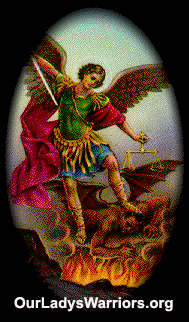
St. Michael the Archangel
~ PRAYER ~
St. Michael, the Archangel, defend us in battle
Be our protection against the wickedness
and snares of the devil;
May God rebuke him, we humbly pray,
and do thou, O Prince of the heavenly host,
by the power of God,
Cast into hell Satan and all the evil spirits
who prowl through the world seeking the ruin of souls.
Amen
+
19
posted on
07/27/2019 3:42:54 PM PDT
by
Salvation
("With God all things are possible." Matthew 19:26)
To: All
Pope’s Intention for July
The Integrity of Justice
That those who administer justice may work with integrity, and that the injustice which prevails in the world may not have the last word.
20
posted on
07/27/2019 3:54:05 PM PDT
by
Salvation
("With God all things are possible." Matthew 19:26)
Navigation: use the links below to view more comments.
first 1-20, 21-27 next last
Disclaimer:
Opinions posted on Free Republic are those of the individual
posters and do not necessarily represent the opinion of Free Republic or its
management. All materials posted herein are protected by copyright law and the
exemption for fair use of copyrighted works.
FreeRepublic.com is powered by software copyright 2000-2008 John Robinson