
The miracle of the loaves
1372
France
Posted on 06/22/2019 10:16:41 PM PDT by Salvation
KEYWORDS: catholic; jesuschrist; lk9; ordinarytime; prayer;
Please FReepmail me to get on/off the Alleluia Ping List.
From: 1 Corinthians 11:23-26
The Institution of the Eucharist
*********************************************************************************************
Commentary:
23-26. These verses clearly bear witness to the early Christians’ faith in the eu-
charistic mystery. St. Paul is writing around the year 57 — only twenty-seven
years since the institution of the Eucharist — reminding the Corinthians of what
they had been taught some years earlier (c. the year 51). The words “received”
and “delivered” are technical terms used to indicate that a teaching is part of
apostolic Tradition; cf. also 1 Corinthians 15:3. These two passages highlight
the importance of that apostolic Tradition. The words “I received from the Lord”
are a technical expression which means “I received through that Tradition which
goes back to the Lord Himself.”
There are three other New Testament accounts of the institution of the Eucharist
(Matthew 26:26-29; Mark 14:22-25; Luke 22:16-20). This account, which is most
like St. Luke’s, is the earliest of the four.
The text contains the fundamental elements of Christian faith in the mystery of
the Eucharist: 1) the institution of this Sacrament by Jesus Christ and His real
presence in it; 2) the institution of the Christian priesthood; 3) the Eucharist is
the sacrifice of the New Testament (cf. notes on Matthew 26:26-29; Mark
14:22-25; Luke 22:16-20; 1 Corinthians 10:14-22).
“Do this in remembrance of Me”: in instituting the Eucharist, our Lord charged
that it be re-enacted until the end of time (cf. Luke 22:19), thereby instituting the
priesthood. The Council of Trent teaches that Jesus Christ our Lord, at the Last
Supper, “offered His body and blood under the species of bread and wine to God
the Father and He gave His body and blood under the same species to the Apos-
tles to receive, making them priests of the New Testament at that time. [...] He
ordered the Apostles and their successors in the priesthood to offer this Sacra-
ment when He said, “Do this in remembrance of Me”, as the Catholic Church has
always understood and taught” (”De SS. Missae Sacrificio”, Chapter 1; cf. Canon
2). And so, Pope John Paul II teaches, the Eucharist is “the principal and central
reason-of-being of the Sacrament of the priesthood, which effectively came into
being at the moment of the institution of the Eucharist, and together with it” (”Let-
ter To All Bishops”, 24 February 1980).
The word “remembrance” is charged with the meaning of a Hebrew word which
was used to convey the essence of the feast of the Passover — commemoration
of the exodus from Egypt. For the Israelites the Passover rite not only reminded
them of a bygone event: they were conscious of making that event present, re-
viving it, in order to participate in it, in some way, generation after generation (cf.
Exodus 12:26-27; Deuteronomy 6:20-25). So, when our Lord commands His A-
postles to “do this in remembrance of Me”, it is not a matter of merely recalling
His supper but of renewing His own Passover sacrifice of Calvary, which already,
at the Last Supper, was present in an anticipated way.
*********************************************************************************************
Source: “The Navarre Bible: Text and Commentaries”. Biblical text from the
Revised Standard Version and New Vulgate. Commentaries by members of
the Faculty of Theology, University of Navarre, Spain.
Published by Four Courts Press, Kill Lane, Blackrock, Co. Dublin, Ireland, and
by Scepter Publishers in the United States.
Solemnity: Birth of St John the Baptist (Vigil)
From: Jeremiah 1:4-10
The Lord calls Jeremiah
*********************************************************************************************
Commentary:
1:1-19. The book of Jeremiah is a collection of the prophet’s oracles arranged
more by subject than in chronological order and interspersed with stories about
his life. The heading (vv. 1-3), as in most of the prophetical books, introduces the
prophet and tells when he lived. Then, as an introduction to the book, comes an
account of the call of Jeremiah (vv. 4-10) along with two visions that give a good
description of the man (vv. 11-12 and 13-19).
1:4-10. This account of the call of Jeremiah gives a very good idea of the myste-
rious nature of every divine call – a call from all eternity and involving no merit on
the part of the person called, in which God makes known to a soul the why and
wherefore of his or her life. No one comes into being by accident, for everything
that happens is part of God’s providence (v. 5). God’s action in creating a person
is described graphically – “formed” you in the womb – a word used to describe
what a potter does when he models something in clay. The Lord “knew” Jere-
miah—a reference to his choosing him for a specific mission (cf. Amos 3:2; Rom
8:29); God has a plan for each person, and he endows each with talents that
equip him or her to put that plan into effect. The passage also talks of a “conse-
cration”, that is, the earmarking of a person or thing for the service of God. God’s
plan for someone, made before the person is born, emerges in due course, when
he or she is old enough to take on the assignments that God has been preparing
him for. Glossing this passage, St John Chrysostom, has God say this: “I am
the one who knit you together in your mother’s womb. Your life is not a work of
nature, nor the fruit of suffering. I am the origin and cause of all things: you should
obey and offer yourself to me,” and he adds: “It does not begin with I consecrated
you: first, I knew you; then I consecrated you. Thus is the original choice shown,
and after the original choice, the particular calling” (Fragmenta in Ieremiam, 1).
When the mystery of a person’s calling begins to be revealed, their initial reac-
tion can be one of fear, because they are very conscious of their limitations and
feel that they are not up to the tasks that the Lord entrusts them with. Jeremiah,
for example, argues that he is too young (v. 6). We do not know how old he was
at the time, for the word he uses to describe his age (na’ar) is imprecise. He
was probably only an adolescent (cf. Gen 37:2; 1 Sam 2:18; 3:1-21). In respon-
ding to a vocation, one needs to listen, above all, to God who calls, who never
leaves his chosen ones on their own, and who always gives them the wherewi-
thal to carry out the mission he is charging them with (vv. 7-8).
The Lord’s symbolic gesture of putting out his hand to touch Jeremiah’s mouth,
as if to fill it with divine words, is similar to other gestures found in accounts of
the calling of prophets (cf. Is 6:7; Ezek 2:8-3:3; Dan 10:16). It is to tell the man
not to be concerned: he can rest assured that God will give him the right words
to express himself. It is a promise similar to that made by Jesus to his disci-
ples: he assured them of the Holy Spirit’s help when the time came for them to
bear witness to him (cf. Mt 10:19-20).
The assignment given to Jeremiah implies a heavy responsibility; he will need
fortitude if he is to carry it out (v. 10). It involves in the first place doing destruc-
tive things (plucking up, breaking down, destroying and overthrowing) and only
then come constructive roles (building and planning). St Gregory the Great will
apply the same idea to the attention that is called for in the pastoral care of the
faithful: “One cannot build up if what disturbs the foundation has not been des-
troyed. In other words, the sweet words of good preaching are sown in vain if
the thorns of self-love have not first been plucked from the hearts of listeners”
(Regular pastoralis, 3, 34).
*********************************************************************************************
Source: “The Navarre Bible: Text and Commentaries”. Biblical text from the
Revised Standard Version and New Vulgate. Commentaries by members of
the Faculty of Theology, University of Navarre, Spain.
Published by Four Courts Press, Kill Lane, Blackrock, Co. Dublin, Ireland, and
by Scepter Publishers in the United States.
From: 1 Peter 1:8-12
Praise and Thanksgiving to God
*********************************************************************************************
Commentary:
3-12. This passage, a hymn of praise and gratitude to God, developing what is
proclaimed in v. 2, is more explicit about the action of each Person of the Bles-
sed Trinity: by making his choice of Christians, God the Father has destined us
to a marvellous heritage in heaven (vv. 3-5); to attain this we need to love and be-
lieve in Jesus Christ our Lord (vv. 6-9); the Holy Spirit, who earlier proclaimed sal-
vation by the mouth of the Old Testament prophets, is now, through those who
preach the Gospel, announcing that salvation has arrived (vv. 10-12).
3. God brought about the work of Redemption “by his great mercy”. For God,
who is rich in mercy, out of the great love with which he loved us, even when we
were dead through our trespasses, made us alive together with Christ” (Eph 2:
4-5). And just as the work of Creation is a manifestation of God’s omnipotence,
so his new Creation is an expression of his mercy (cf. “Summa Theologiae”, II-II,
q. 30, a. 4; cf. note on 2 Cor 5:17).
“Through the resurrection of Jesus Christ from the dead”: the resurrection of our
Lord marks the climax of his salvific work, for it assures men of their redemption
and their own resurrection. In its Easter liturgy the Church joyfully reminds of this:
“He is the true Lamb who took away the sins of the world. By dying he destroyed
our death; by rising he restored our life” (”Easter Preface”, I).
10-12. These verses of thanksgiving (vv. 3-12) end with a reference to the role of
the Holy Spirit in salvation: he acted in the Old Testament through the prophets
by announcing salvation, and now, through preachers of the Gospel, he reveals
that it has come about.
The passage is a clear acknowledgment of the unity and continuity of the Old
and New Testaments: in the Old the sufferings and subsequent glorification of
Christ are proclaimed, in such a way that “what the prophets predicted as future
events,” says St Thomas, “the Apostles preached as something which had come
true” (”Commentary on Eph” 2:4). “The economy of the Old Testament was deli-
berately orientated to prepare for and declare in prophecy the coming of Christ,
Redeemer of all men, and of the messianic Kingdom (cf. Lk 24:44; Jn 5:39; 1 Pet
1:10) [...]. God, the inspirer and author of the books of both Testaments, in his
wisdom has so brought it about that the New should be hidden in the Old and that
the Old should be made manifest in the New. For although Christ founded the New
Covenant in his blood (cf. Lk 22:20; 1 Cor 11:25), still the books of the Old Testa-
ment, all of them caught up into the Gospel message, attain and show forth their
full meaning in the New Testament (cf. Mt 5:17; Lk 24:27; Rom 16:25-26; 2 Cor
3:14-16) and in their turn, shed light on it and explain it” (Vatican II, “Dei Verbum”,
15-16).
These verses show the Holy Spirit’s role as cause and guide of the evangelizing
activity of the Church. In the early days of the spread of Christianity, as des-
cribed in Acts, the action of the third Person of the Blessed Trinity was palpable.
12. The Greek word translated at the end of this verse as “look” contains the
idea of bending over carefully in order to get a better look. This metaphor, then,
depicts the angels in heaven contemplating with joy the mystery of salvation. St
Francis de Sales, referring to this passage, exclaims: “Now in this complacency
we satiate our soul with delights in such a manner that we do not yet cease to
desire to be satiated [...]. The fruition of a thing which always contents never les-
sens, but is renewed and flourishes incessantly; it is ever agreeable, ever desira-
ble. The perpetual contentment of heavenly lovers produces a desire perpetually
content” (”Treatise on the Love of God”, 5, 3).
*********************************************************************************************
Source: “The Navarre Bible: Text and Commentaries”. Biblical text from the
Revised Standard Version and New Vulgate. Commentaries by members of
the Faculty of Theology, University of Navarre, Spain.
Published by Four Courts Press, Kill Lane, Blackrock, Co. Dublin, Ireland, and
by Scepter Publishers in the United States.
Solemnity: The Most Holy Body and Blood of Christ (Corpus Christi)
From: Luke 9:11b-17
First Miracle of the Loaves and Fish
*********************************************************************************************
Commentary:
11-17. Jesus replies to His disciples knowing very well what He is going to do
(cf. John 6:5-6)—thereby teaching them little by little to trust in God’s omnipotence.
On this miracle see the notes on Matthew 14:14-21; 15:32; 15:33-38; Mark 6:34;
6:41; 6:42; 8:1-9; and John 6:5-9; 6:10; 6:11; 6:12-13.
[Matthew 14:14-21 states:
14-21. This episode must have occurred in the middle of springtime, because
the grass was green (Mark 6:40; John 6:10). In the Near East loaves were usual-
ly made very thin, which meant it was easy to break them by hand and distribute
them to those at table; this was usually done by the head of the household or the
senior person at the meal. Our Lord follows this custom, and the miracle occurs
when Jesus breaks the bread. The disciples then distribute it among the crowd.
Here again we can see Jesus’ desire to have people cooperate with Him.]
[Matthew 15:32 states:
32. The Gospels speak of our Lord’s mercy and compassion towards people’s
needs: here He is concerned about the crowds who are following Him and who
have no food. He always has a word of consolation, encouragement and forgive-
ness: He is never indifferent. However, what hurts Him most are sinners who go
through life without experiencing light and truth: He waits for them in the sacra-
ments of Baptism and Penance.]
[Matthew 15:33-38 states:
33-38. As in the case of the first multiplication (14:13-20), the Apostles provide
our Lord with the loaves and the fish. It was all they had. He also avails of the
Apostles to distribute the food — the result of the miracle — to the people. In dis-
tributing the graces of salvation God chooses to rely on the faithfulness and ge-
nerosity of men. “Many great things depend—don’t forget it—on whether you and
I live our lives as God wants” (St. J. Escriva, “The Way”, 755).
It is interesting to note that in both miracles of multiplication of loaves and fish
Jesus’s provides food in abundance but does not allow anything to go to waste.
All Jesus’ miracles, in addition to being concrete historical events, are also sym-
bols of supernatural realities. Here abundance of material food also signifies abun-
dance of divine gifts on the level of grace and glory: it refers spiritual resources
and eternal rewards; God gives people more graces than are strictly necessary.
This is borne out by Christian experience throughout history. St. Paul tells us
that “where sin increased, grace abounded all the more” (Rom 5:20); he speaks
of “the riches of His grace which He lavished upon us” (Eph 1:8) and tells his
disciple Timothy that “the grace of our Lord overflowed for me with the faith and
love that are in Christ Jesus” (1 Timothy 1:14).]
[Mark 6:34 states:
34. Our Lord had planned a period of rest, for Himself and His disciples, from the
pressures of the apostolate (Mark 6:31-32). And He has to change His plans be-
cause so many people come, eager to hear Him speak. Not only is He not an-
noyed with them: He feels compassion on seeing their spiritual need. “My peo-
ple are destroyed for lack of knowledge” (Hosea 4:6). They need instruction and
our Lord wants to meet this need by preaching to them. “Jesus is moved by hun-
ger and sorrow, but what moves Him most is ignorance” (St. J. Escriva, “Christ
Is Passing By”, 109).]
[Mark 6:41 states:
41. This miracle is a figure of the Holy Eucharist: Christ performed it shortly be-
fore promising that sacrament (cf. John 6:1ff), and the Fathers have always so in-
terpreted it. In this miracle Jesus shows His supernatural power and His love for
men — the same power and love as make it possible for Christ’s one and only bo-
dy to be present in the Eucharistic species to nourish the faithful down the centu-
ries. In the words of the sequence composed by St. Thomas Aquinas for the
Mass of Corpus Christi: “Be one or be a thousand fed, they eat alike that living
bread which, still received, ne’er wastes away.”
This gesture of our Lord — looking up to Heaven — is recalled in the Roman canon
of the Mass: “And looking up to Heaven, to You, His almighty Father.” At this
point in the Mass we are preparing to be present at a miracle greater than that
of the multiplication of the loaves — the changing of bread into His own body, of-
fered as food for all men.]
[Mark 6:42 states:
42. Christ wanted the left-overs to be collected (cf. John 6:12) to teach us not to
waste things God gives us, and also to have them as a tangible proof of the mi-
racle.
The collecting of the left-overs is a way of showing us the value of little things
done out of love for God—orderliness, cleanliness, finishing things completely. It
also reminds the sensitive believer of the extreme care that must be taken of the
Eucharistic species. Also, the generous scale of the miracle is an expression of
the largesse of the Messianic times. The Fathers recall that Moses distributed
the manna for each to eat as much as he needed but some left part of it for the
next day and it bred worms (Exodus 16:16-20). Elijah gave the widow just enough
to meet her needs (1 Kings 17:13-16). Jesus, on the other hand, gives generously
and abundantly.]
[Mark 8:1-9 states:
1-9. Jesus repeats the miracle of the multiplication of the loaves and the fish: the
first time (Mark 6:33-44) He acted because He saw a huge crowd like “sheep with-
a shepherd”; now He takes pity on them because they have been with Him for
three days and have nothing to eat.
This miracle shows how Christ rewards people who persevere in following Him:
the crowd had been hanging on His words, forgetful of everything else. We should
be like them, attentive and ready to do what He commands, without any vain con-
cern about the future, for that would amount to distrusting Divine Providence.]
[John 6:5-9 states:
5-9. Jesus is sensitive to people’s material and spiritual needs. Here we see Him
take the initiative to satisfy the hunger of the crowd of people who have been fol-
lowing Him.
Through these conversations and the miracle He is going to work, Jesus also tea-
ches His disciples to trust in Him whenever they meet up with difficulties in their
apostolic endeavors in the future: they should engage in them using whatever re-
sources they have—even if they are plainly inadequate, as was the case with the
five loaves and two fish. He will supply what is lacking. In the Christian life we
must put what we have at the service of our Lord, even if we do not think it
amounts to very much. He can make meager resources productive.
“We must, then, have faith and not be dispirited. We must not be stopped by any
kind of human calculation. To overcome the obstacles we have to throw ourselves
into the task so that the very effort we make will open up new paths” (St. J. Escri-
va, “Christ is Passing By”, 160).]
[John 6:10 states:
10. The evangelist gives us an apparently unimportant piece of information: “there
was much grass in the place.” This indicates that the miracle took place in the
height of the Palestinian spring, very near the Passover, as mentioned in verse 4.
There are very few big meadows in Palestine; even today there is one on the eas-
tern bank of the Lake of Gennesaret, called El-Batihah, where five thousand peo-
ple could fit seated: it may have been the site of this miracle.]
[John 6:11 states:
11. The account of the miracle begins with almost the very same words as those
which the Synoptics and St. Paul use to describe the institution of the Eucharist
(cf. Matthew 26:26; Mark 14:22; Luke 22:19; 1 Corinthians 11:25). This indicates
that the miracle, in addition to being an expression of Jesus’ mercy towards the
needy, is a symbol of the Blessed Eucharist, about which our Lord will speak a
little later on (cf. John 6:26-59).]
[John 6:12-13 states:
12-13. The profusion of detail shows how accurate this narrative is — the names
of the Apostles who address our Lord (verses 5,8), the fact that they were barley
loaves (verse 9), the boy who provided the wherewithal (verse 9) and, finally, Je-
sus telling them to gather up the leftovers.
This miracle shows Jesus’ divine power over matter, and His largesse recalls the
abundance of messianic benefits which the prophets had foretold (cf. Jeremiah
31:14).
Christ’s instruction to pick up the leftovers teaches us that material resources
are gifts of God and should not be wasted: they should be used in a spirit of po-
verty (cf. note on Mark 6:42). In this connection Paul VI pointed out that “after
liberally feeding the crowds, the Lord told His disciples to gather up what was
left over, lest anything should be lost (cf. John 6:12). What an excellent lesson
in thrift — in the finest and fullest meaning of the term — for our age, given as it
is to wastefulness! It carries with it the condemnation of a whole concept of so-
ciety wherein consumption tends to become an end in itself, with contempt for
the needy, and to the detriment, ultimately, of those very people who believed
themselves to be its beneficiaries, having become incapable of perceiving that
man is called to a higher destiny” (Pope Paul VI, “Address to Participants at
the World Food Conference”, 9 November 1974).]
*********************************************************************************************
Source: “The Navarre Bible: Text and Commentaries”. Biblical text from the
Revised Standard Version and New Vulgate. Commentaries by members of
the Faculty of Theology, University of Navarre, Spain.
Published by Four Courts Press, Kill Lane, Blackrock, Co. Dublin, Ireland, and
by Scepter Publishers in the United States.
From: Luke 1:5-17
The Birth of John the Baptist Foretold
[8] Now while he was serving as priest before God when his division was on duty,
[9] according to the custom of the priesthood, it fell to him by lot to enter the tem-
ple of Lord and burn incense. [10] And the whole multitude of the people were pra-
ying outside at the hour of incense. [11] And there appeared to him an angel of
the Lord standing on the right side of the altar of incense. [12] And Zechariah was
troubled when he saw him, and fear fell upon him. [13] But the angel said to him,
“Do not be afraid, Zechariah, for your prayer is heard, and your wife Elizabeth will
bear you a son, and you shall call his name John. [14] And you will have joy and
gladness, and many will rejoice at his birth; [15] for he will be great before the
Lord, and he shall drink no wine nor strong drink, and he will be filled with the Ho-
ly Spirit, even from his mother’s womb. [16] And he will turn many of the sons of
Israel to the Lord their God, [17] and he will go before him in the spirit and power
of Elijah, to turn the hearts of the fathers to the children and the disobedient to
the wisdom of the just, to make ready for the Lord a people prepared.”
*********************************************************************************************
Commentary:
6. After referring to the noble ancestry of Zechariah and Elizabeth, the evangelist
now speaks of a higher type of nobility, the nobility of virtue: “Both were righteous
before God.” “For not everyone who is righteous in men’s eyes is righteous in
God’s; men have one way of seeing and God another; men see externals but
God sees into the heart. It can happen that someone seems righteous because
his virtue is false and is practiced to win people’s approval; but he is not virtuous
in God’s sight if his righteousness is not born of simplicity of soul but is only si-
mulated in order to appear good.
“Perfect praise consists in being righteous before God, because only he can be
called perfect who is approved by Him who cannot be deceived” (St. Ambrose,
“Expositio Evangelii Sec. Lucam, in loc.”).
In the last analysis what a Christian must be is righteous before God. St. Paul is
advocating this when he tells the Corinthians, “But with me it is a very small thing
that I should be judged by you or by any human court. It is the Lord who judges
me. Therefore do not pronounce judgment before the time, before the Lord comes,
who will bring to light the things now hidden in darkness and will disclose the pur-
poses of the heart. Then every man will receive his commendation from God” (1
Corinthians 4:3ff). On the notion of the just or righteous man, see the note on
Matthew 1:19.
8. There were twenty-four groups or turns of priests to which functions were allo-
cated by the drawing of lots; the eighth group was that of the family of Abijah (cf.
1 Chronicles 24:7-19), to which Zechariah belonged.
9-10. Within the sacred precincts, in a walled-off area, stood the temple proper.
Rectangular in form, there was first a large area which was called “the Holy
Place”, in which was located the altar of incense referred to in verse 9. Behind
this was the inner sanctum, called “the Holy of Holies”, where the Ark of the
Covenant with the tablets of the Law used to be kept; only the high priest had
access to this, the most sacred part of the temple. The veil or great curtain of
the temple separated these two area from one another. The sacred building was
surrounded by a courtyard, called the courtyard of the priests and outside this,
at the front of the temple, was what was called the courtyard of the Israelites,
where the people stayed during the ceremony of incensing.
10. While the priest offered incense to God, the people in the courtyard joined
with him in spirit: even in the Old Testament every external act of worship was
meant to be accompanied by an interior disposition of self-offering to God.
With much more reason should there be this union between external and inter-
nal worship in the liturgical rites of the New Covenant (cf. “Mediator Dei”, 8), in
the liturgy of the Church. Besides, this consistency befits the nature of man,
comprised as he is of body and soul.
11. Angels are pure spirits, that is, they have no body of any kind; therefore,
“they do not appear to men exactly as they are; rather, they manifest themselves
in forms which God gives them so that they can be seen by those to whom He
sends them” (St. John Damascene, “De Fide Orthodoxa,” 2, 3).
In addition to adoring and serving God, angelic spirits act as God’s messengers
and channels of His providence towards men; this explains why they appear so
often in salvation history and why Sacred Scripture refers to them in so many
passages (cf., e.g. Hebrews 1:14).
Christ’s birth was such an important event that angels were given a very promi-
nent role in connection with it. Here, as at the Annunciation to Mary, the arch-
angel St. Gabriel is charged with delivering God’s message.
“It is no accident that the angel makes his appearance in the temple, for this an-
nounces the imminent coming of the true Priest and prepares the heavenly sacri-
fice at which the angels will minister. Let it not be doubted, then, that the angels
will be present when Christ is immolated” (St. Ambrose, “Expositio Evangelii
Sec. Lucam, in loc.”).
12. “No matter how righteous a man be, he cannot look at an angel without fee-
ling afraid; that is why Zechariah was alarmed: he could not but quake at the pre-
sence of the angel; he could not take the brightness that surrounded him” (St.
John Chrysostom, “De Incomprehensibili Dei Natura”). The reason for this is not
so much the angels’ superiority to man as the fact that the grandeur of God’s ma-
jesty shines out through the angel: “And the angel said to me, ‘Write this: Bles-
sed are those who are invited to the marriage supper of the Lamb.’ And he said
to me, ‘These are true words of God.’ Then I fell down at his feet to worship him,
but he said to me, ‘You must not do that! I am a fellow servant with you and your
brethren who hold the testimony of Jesus. Worship God’” (Revelation 19:9-10).
13. Through the archangel God intervenes in an exceptional way in the married
life of Zechariah and Elizabeth; but the message he brings has much wider refe-
rence; it has significance for the whole world. Elizabeth is already quite old but
she is going to have a son who will be called John (”God is gracious”) and he
will be the forerunner of the Messiah. This showed that “the fullness of time” (cf.
Galatians 4:4) was imminent, for which all righteous people of Israel had yearned
(cf. John 8:56; Hebrews 11:13).
“Your prayer is heard,” St. Jerome comments, “that is to say, you are given more
than you asked for. You prayed for the salvation of the people, and you have been
given the Precursor” (”Expositio Evangelium Sec. Lucam, in loc.”). Our Lord also
sometimes gives us more than we ask for: “There is a story about a beggar mee-
ting Alexander the Great and asking him for alms. Alexander stopped and instruc-
ted that the man be given the government of five cities. The beggar, totally con-
fused and taken aback, explained, ‘I didn’t ask for that much.’ And Alexander re-
plied, ‘You asked like the man you are; I give like the man I am” (St. J. Escriva,
“Christ Is Passing By”, 160). Since God responds so generously and gives us
more than we ask for, we should face up to difficulties and not be cowed by them.
14-17. The archangel St. Gabriel gives Zechariah three reasons why he should
rejoice over the birth of this child; first, because God will bestow exceptional ho-
liness on him (verse 15); second, because he will lead many to salvation (verse
16); and third, because his whole life, everything he does, will prepare the way
for the expected Messiah (verse 17).
In St. John the Baptist two prophecies of Malachi are fulfilled; in them we are told
that God will send a messenger ahead of Him to prepare the way for Him (Mala-
chi 3:1; 4:5-6). John prepares the way for the first coming of the Messiah in the
same way as Elijah will prepare the way for His second coming (cf. St. Ambrose,
“Expositio Evangelii Sec. Lucam, in loc.”; St. Thomas Aquinas, “Commentary on
St. Matthew”, 17, 11, “in loc.”). This is why Christ will say, “What did you go out
to see? A prophet? Yes, I tell you, and more than a prophet. This is he of whom
it is written, ‘Behold, I send My messenger before Thy face, who shall prepare
Thy way before Thee’” (Luke 7:26-27).
*********************************************************************************************
Source: “The Navarre Bible: Text and Commentaries”. Biblical text from the
Revised Standard Version and New Vulgate. Commentaries by members of
the Faculty of Theology, University of Navarre, Spain.
Published by Four Courts Press, Kill Lane, Blackrock, Co. Dublin, Ireland, and
by Scepter Publishers in the United States.
From: Isaiah 49:1-6
Second Song of the Servant of the Lord
*********************************************************************************************
Commentary:
49:1-55:13. Chapter 49 marks the start of the second section of the second part
of Isaiah. The first section (40:1-48:22) dealt with the release of the Jews from
exile in Babylon on the orders of the Lord, the ruler of the world and of all nations.
This second section sings of the restoration of Zion and the renewal of the peo-
ple.
Almost all the oracles here presuppose that Babylon has fallen and the exiles
have returned home (although neither event is explicitly referred to). Nor is there
mention of the universal scope of salvation: the focus is mainly on future hopes
and on Jerusalem.
Most of the oracles in this section were probably proclaimed, between the years
515 and 500 BC. If that was the case, then they were addressed to a disillusioned
people: the enthusiasm that came with the return from exile and the efforts made
to rebuild Jerusalem failed to produce the desired results: there are still class dif-
ferences, greed is plain to see, and huge sectors of society are experiencing po-
verty. The kind of Jerusalem that the exiles dreamed of had not come about: it
bore no relationship to what they were experiencing; nor did it fit the image of Je-
rusalem found in many texts of the Priestly tradition (cf. “Introduction to the Pen-
tateuch”, in “The Navarre Bible: Pentateuch” (p. 20). These oracles are designed
to dispel discouragement and to raise people’s hopes by telling them about the
liberator that God is going to send, the servant of the Lord, and by proclaiming
that the holy city (now given the sacred name of Zion) will very soon be restored.
In fact, the section can be divided into alternating poems on the servant and on
Zion: 49:1-13, the “servant” (second oracle); 49:14-50:3, “Zion”; 50:4-11, the “ser-
vant”, (third oracle and exhortation); 51:17-52:12, Zion; 52:13-53:12, the “servant”
(fourth oracle); 54:1-17, “Zion” (Jerusalem). Verses 1-13 of chapter 5
49:1-6. In the first Song of the Servant of the Lord (42:1-9) we meet the “servant”
for the first time and we are told of his mission to liberate the exiles. In this se-
cond song, the servant himself speaks. He addresses the “coastlands”, “peo-
ples from afar”, and he is conscious of having been chosen by God from his mo-
ther’s womb to carry out God’s plans of salvation even in those distant parts (cf.
vv. 1-3). Here we are told about two aspects of his mission, which we will hear
more about in the oracles that follow. First, he is to play a leading role in the re-
covery of the tribes and the repatriation of the exiles (v. 5); second, he will ex-
tend salvation to the ends of the earth (cf. v. 6).
This poem contains things that the servant has to say about himself (vv. 1-4),
and things that God says about the servant (vv. 5-6). The servant is well aware
that he was called by God, even from his mother’s womb, (like Jeremiah; cf. Jer
1:5) and has been charged with preaching to the pagan peoples (”the coast-
lands”) or at least to his compatriots in the diaspora (cf. v. 1; cf. Jer 1:1-10; 25:
13-38); he has been endowed with qualities that enable him to speak out, with
words that find their mark like arrows, even if that creates divisions (v. 2; cf. Jer
1:10); and also, despite the divine protection given him, he feels depressed and
disappointed, as happened to Jeremiah (vv. 3-4; cf. Jer 1:7; :8:18-20). Everything
that the servant does is grounded on what the Lord has told him: “You are my
servant, Israel” (v. 3). Some commentators are of the view that “Israel” here is a
later interpretation, put in to support the collectivist interpretation of the servant
that soon became widespread; but there is little evidence to support that: the
word “Israel” is missing only in one manuscript, and not an important one at that.
The mention of Israel does not argue against the servant’s being an individual ra-
ther than a collectivity, for in poetry a person can be addressed by his own name
or by his family name. In fact, both in biblical Israel and nowadays we often find
people using their place of birth as a surname.
In vv. 5-6 the Lord spells out the servant’s mission: it is to renew the people in
such a way that even non-Israelites can see the light and attain salvation. Al-
though the universal mission of the servant is not clearly defined here, for his
work is meant to be confined to the tribes of Jacob, still the achievement of this
objective (the re-assembling of Israel) will be a kind of light to help the pagan
nations see and acknowledge God. The expression “light to the nations”. (v. 6)
already occurred in the earlier poem (42:6); there it could be taken in a social
sense — to bring about the liberation of the exiles and captives; here, the reli-
gious meaning is clear: salvation will spread to all the nations.
To sum up, the servant of the Lord (be he an individual or a collectivity, or more
likely both) has been chosen by God, who loves him most specially; he has all
the main qualities of a prophet; and he must influence his compatriots so as to
enlighten those from outside, and bring them salvation.
The messianic interpretation of the servant figure, based on this second song,
was widespread among the Jews of Alexandria who made the Septuagint Greek
translation; it was also held by members of the Qumran community and by
some authors of the period between the Old and New Testaments (the author of
the “Book of Enoch”, for example). All these interpreted the servant as standing
for the entire people of Israel. Christians, from the beginning, applied the songs
of the servant to Jesus, and saw them as finding fulfillment in his life. Thus, al-
though the image of the “sharp sword” (v. 2) refers to the effectiveness of the
word of God, in Hebrews 4:12-13 we find it used with reference to Revelation as
a whole which is fully and perfectly manifested in Jesus Christ (cf. also Rev 1:16
and 2:12). We find the expression, “light to the nations” or “light to the peoples”
being applied by Simeon to Jesus (Lk 2:32). Indeed, in the Acts of the Apostles
it is applied to those who, in line with Jesus’ teaching and as cooperators in his
work of salvation, are setting out to preach to the Gentiles, as the words Paul
and Barnabas speak in the synagogue of Psidian Antioch testify: “It was neces-
sary that the word of God should be spoken first to you. Since you thrust it from
you, and judge yourselves unworthy of eternal life, behold, we turn to the Gentiles.
For so the Lord has commanded us, saying, ‘I have set you to be a light for the
Gentiles, that you may bring salvation to the uttermost parts of the earth” (Acts
13:46-47).
Hence the Church sees her mission as spreading the truth about Jesus, the light
that enlightens everyone: “The light, of God’s face shines in all its beauty on the
countenance of Jesus Christ, ‘the image of the invisible God’ (Col 1:15), the ‘re-
flection of God’s glory’ (Heb 1:3), ‘full of grace and truth’ (Jn 1:14). Christ is ‘the
way, and the truth, and the life’ (Jn 14:6). [...] Jesus Christ, the ‘light of the na-
tions’, shines: upon the face of his Church, which he sends forth to the whole
world to proclaim the Gospel to every creature (cf. Mk 16:15). Hence the Church,
as the people of God among the nations, while attentive to the new challenges of
history and to mankind’s efforts to discover the meaning of life, offers to everyone
the answer which comes from the truth about Jesus Christ and his Gospel” (St.
John Paul II, “Veritatis Splendor”, 2).
*********************************************************************************************
Source: “The Navarre Bible: Text and Commentaries”. Biblical text from the
Revised Standard Version and New Vulgate. Commentaries by members of
the Faculty of Theology, University of Navarre, Spain.
Published by Four Courts Press, Kill Lane, Blackrock, Co. Dublin, Ireland, and
by Scepter Publishers in the United States.
Liturgical Colour: Green.
| First reading |
|---|
| Zechariah 12:10-11,13:1 © |
| They will look on the one whom they have pierces |
|---|
| Responsorial Psalm |
|---|
| Psalm 62(63):2-6,8-9 © |
| Second reading |
|---|
| Galatians 3:26-29 © |
| All baptised in Christ, you have all clothed yourselves in Christ |
|---|
| Gospel Acclamation | Jn8:12 |
|---|
| Or: | Jn10:27 |
|---|
| Gospel | Luke 9:18-24 © |
|---|
| 'You are the Christ of God' |
|---|
| Luke | |||
| English: Douay-Rheims | Latin: Vulgata Clementina | Greek NT: Byzantine/Majority Text (2000) | |
| Luke 9 |
|||
| 11. | Which when the people knew, they followed him; and he received them, and spoke to them of the kingdom of God, and healed them who had need of healing. | Quod cum cognovissent turbæ, secutæ sunt illum : et excepit eos, et loquebatur illis de regno Dei, et eos, qui cura indigebant, sanabat. | οι δε οχλοι γνοντες ηκολουθησαν αυτω και δεξαμενος αυτους ελαλει αυτοις περι της βασιλειας του θεου και τους χρειαν εχοντας θεραπειας ιατο |
| 12. | Now the day began to decline. And the twelve came and said to him: Send away the multitude, that going into the towns and villages round about, they may lodge and get victuals; for we are here in a desert place. | Dies autem cœperat declinare, et accedentes duodecim dixerunt illi : Dimitte turbas, ut euntes in castella villasque quæ circa sunt, divertant, et inveniant escas : quia hic in loco deserto sumus. | η δε ημερα ηρξατο κλινειν προσελθοντες δε οι δωδεκα ειπον αυτω απολυσον τον οχλον ινα απελθοντες εις τας κυκλω κωμας και τους αγρους καταλυσωσιν και ευρωσιν επισιτισμον οτι ωδε εν ερημω τοπω εσμεν |
| 13. | But he said to them: Give you them to eat. And they said: We have no more than five loaves and two fishes; unless perhaps we should go and buy food for all this multitude. | Ait autem ad illos : Vos date illis manducare. At illi dixerunt : Non sunt nobis plus quam quinque panes et duo pisces : nisi forte nos eamus, et emamus in omnem hanc turbam escas. | ειπεν δε προς αυτους δοτε αυτοις υμεις φαγειν οι δε ειπον ουκ εισιν ημιν πλειον η πεντε αρτοι και ιχθυες δυο ει μητι πορευθεντες ημεις αγορασωμεν εις παντα τον λαον τουτον βρωματα |
| 14. | Now there were about five thousand men. And he said to his disciples: Make them sit down by fifties in a company. | Erant autem fere viri quinque millia. Ait autem ad discipulos suos : Facite illos discumbere per convivia quinquagenos. | ησαν γαρ ωσει ανδρες πεντακισχιλιοι ειπεν δε προς τους μαθητας αυτου κατακλινατε αυτους κλισιας ανα πεντηκοντα |
| 15. | And they did so; and made them all sit down. | Et ita fecerunt : et discumbere fecerunt omnes. | και εποιησαν ουτως και ανεκλιναν απαντας |
| 16. | And taking the five loaves and the two fishes, he looked up to heaven, and blessed them; and he broke, and distributed to his disciples, to set before the multitude. | Acceptis autem quinque panibus et duobus piscibus, respexit in cælum, et benedixit illis : et fregit, et distribuit discipulis suis, ut ponerent ante turbas. | λαβων δε τους πεντε αρτους και τους δυο ιχθυας αναβλεψας εις τον ουρανον ευλογησεν αυτους και κατεκλασεν και εδιδου τοις μαθηταις παρατιθεναι τω οχλω |
| 17. | And they did all eat, and were filled. And there were taken up of fragments that remained to them, twelve baskets. | Et manducaverunt omnes, et saturati sunt. Et sublatum est quod superfuit illis, fragmentorum cophini duodecim. | και εφαγον και εχορτασθησαν παντες και ηρθη το περισσευσαν αυτοις κλασματων κοφινοι δωδεκα |
Pray for Pope Francis.
50 Boko Haram Islamic Radicals Killed; 1,000 Hostages, Women and Children, Rescued in Nigeria
Nigeria: In the Face of Ongoing Islamist Attacks, the Faith is Growing
US Promises to Help Nigeria Exterminate Boko Haram
Is This Bishop Right about the Rosary Conquering Boko Haram? [Catholic Caucus]
Why Boko Haram and ISIS Target Women
Report reveals scale of Boko Haram violence inflictef on Nigerian Catholics
Military evacuating girls, women rescued from Boko Haram
Echos of Lepanto Nigerian bishop says rosary will bring down Boko Harm
After vision of Christ, Nigerian bishop says rosary will bring down Boko Haram (Catholic Caucus)
Nigerian Bishop Says Christ Showed Him How to Beat Islamic Terror Group

1. Sign of the Cross: In the name of the Father, and of the Son, and of the Holy Spirit. Amen.
2. The Apostles Creed: I BELIEVE in God, the Father almighty, Creator of heaven and earth, and in Jesus Christ, His only Son, our Lord, who was conceived by the Holy Spirit, born of the Virgin Mary, suffered under Pontius Pilate, was crucified, died, and was buried. He descended into hell; on the third day he rose again from the dead; he ascended into heaven, and is seated at the right hand of God, the Father Almighty; from there He shall come to judge the living and the dead.
I believe in the Holy Spirit, the holy catholic Church, the communion of saints, the forgiveness of sins, the resurrection of the body, and the life everlasting. Amen.
3. The Lord's Prayer: OUR Father, who art in heaven, hallowed be Thy name. Thy kingdom come. Thy will be done on earth as it is in heaven. Give us this day our daily bread and forgive us our trespasses as we forgive those who trespass against us. And lead us not into temptation, but deliver us from evil. Amen.
4. (3) Hail Mary: HAIL Mary, full of grace, the Lord is with thee. Blessed art thou amongst women and blessed is the fruit of thy womb, Jesus. Holy Mary, Mother of God, pray for us sinners, now, and in the hour of our death. Amen. (Three times)
5. Glory Be: GLORY be to the Father, and to the Son, and to the Holy Spirit. As it was in the beginning, is now, and ever shall be, world without end. Amen.
6. Fatima Prayer: Oh, my Jesus, forgive us our sins, save us from the fires of hell, lead all souls to heaven, especially those in most need of your mercy.
Announce each mystery, then say 1 Our Father, 10 Hail Marys, 1 Glory Be and 1 Fatima prayer. Repeat the process with each mystery.
End with the Hail Holy Queen:
Hail, Holy Queen, Mother of Mercy, our life, our sweetness and our hope! To thee do we cry, poor banished children of Eve! To thee do we send up our sighs, mourning and weeping in this vale of tears! Turn then, most gracious advocate, thine eyes of mercy towards us; and after this, our exile, show unto us the blessed fruit of thy womb, Jesus!
O clement, O loving, O sweet Virgin Mary! Pray for us, O holy Mother of God, that we may be made worthy of the promises of Christ.
Final step -- The Sign of the Cross
The Mysteries of the Rosary By tradition, Catholics meditate on these Mysteries during prayers of the Rosary. The biblical references follow each of the Mysteries below.
The Glorious Mysteries
(Wednesdays and Sundays)
1.The Resurrection (Matthew 28:1-8, Mark 16:1-18, Luke 24:1-12, John 20:1-29) [Spiritual fruit - Faith]
2. The Ascension (Mark 16:19-20, Luke 24:50-53, Acts 1:6-11) [Spiritual fruit - Christian Hope]
3. The Descent of the Holy Spirit (Acts 2:1-13) [Spiritual fruit - Gifts of the Holy Spirit]
4. The Assumption [Spiritual fruit - To Jesus through Mary]
5. The Coronation [Spiritual fruit - Grace of Final Perseverance]
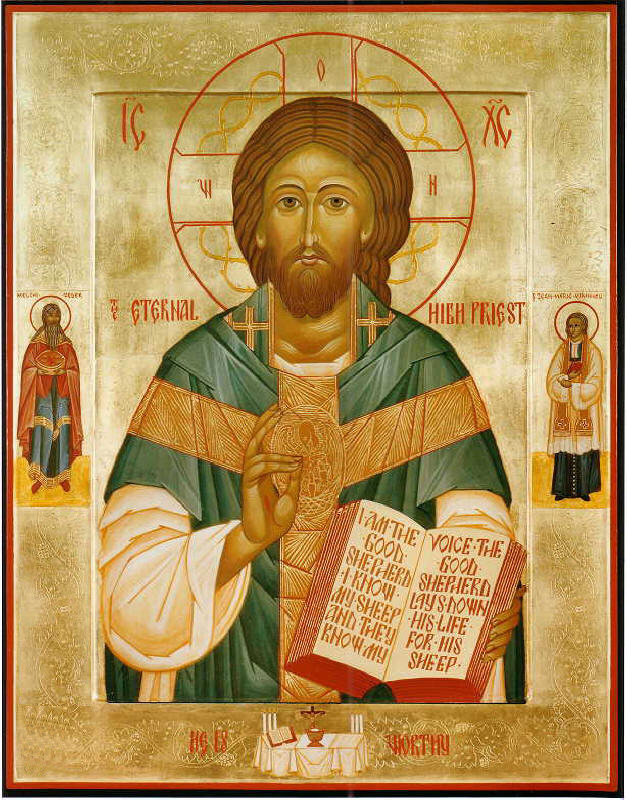
We thank you, God our Father, for those who have responded to your call to priestly ministry.
Accept this prayer we offer on their behalf: Fill your priests with the sure knowledge of your love.
Open their hearts to the power and consolation of the Holy Spirit.
Lead them to new depths of union with your Son.
Increase in them profound faith in the Sacraments they celebrate as they nourish, strengthen and heal us.
Lord Jesus Christ, grant that these, your priests, may inspire us to strive for holiness by the power of their example, as men of prayer who ponder your word and follow your will.
O Mary, Mother of Christ and our mother, guard with your maternal care these chosen ones, so dear to the Heart of your Son.
Intercede for our priests, that offering the Sacrifice of your Son, they may be conformed more each day to the image of your Son, our Lord and Savior, Jesus Christ. Amen.
Saint John Vianney, universal patron of priests, pray for us and our priests
This icon shows Jesus Christ, our eternal high priest.
The gold pelican over His heart represents self-sacrifice.
The border contains an altar and grapevines, representing the Mass, and icons of Melchizedek and St. Jean-Baptiste Vianney.
Melchizedek: king of righteousness (left icon) was priest and king of Jerusalem. He blessed Abraham and has been considered an ideal priest-king.
St. Jean-Baptiste Vianney is the patron saint of parish priests.
Disclaimer: Opinions posted on Free Republic are those of the individual posters and do not necessarily represent the opinion of Free Republic or its management. All materials posted herein are protected by copyright law and the exemption for fair use of copyrighted works.