Skip to comments.
Catholic Caucus: Daily Mass Readings, 06-08-19
USCCB.org/RNAB ^
| 06-08-19
| Revised New American Bible
Posted on 06/07/2019 10:02:29 PM PDT by Salvation
June 8 2019
Saturday of the Seventh Week of Easter - Mass in the Morning
When he entered Rome, Paul was allowed to live by himself,
with the soldier who was guarding him.
Three days later he called together the leaders of the Jews.
When they had gathered he said to them, "My brothers,
although I had done nothing against our people
or our ancestral customs,
I was handed over to the Romans as a prisoner from Jerusalem.
After trying my case the Romans wanted to release me,
because they found nothing against me deserving the death penalty.
But when the Jews objected, I was obliged to appeal to Caesar,
even though I had no accusation to make against my own nation.
This is the reason, then, I have requested to see you
and to speak with you, for it is on account of the hope of Israel
that I wear these chains."
He remained for two full years in his lodgings.
He received all who came to him, and with complete assurance
and without hindrance he proclaimed the Kingdom of God
and taught about the Lord Jesus Christ.
R. (see 7b) The just will gaze on your face, O Lord.
or:
R. Alleluia.
The LORD is in his holy temple;
the LORD's throne is in heaven.
His eyes behold,
his searching glance is on mankind.
R. The just will gaze on your face, O Lord.
or:
R. Alleluia.
The LORD searches the just and the wicked;
the lover of violence he hates.
For the LORD is just, he loves just deeds;
the upright shall see his face.
R. The just will gaze on your face, O Lord.
or:
R. Alleluia.
R. Alleluia, alleluia.
I will send to you the Spirit of truth, says the Lord;
he will guide you to all truth.
R. Alleluia, alleluia.
Peter turned and saw the disciple following whom Jesus loved,
the one who had also reclined upon his chest during the supper
and had said, "Master, who is the one who will betray you?"
When Peter saw him, he said to Jesus, "Lord, what about him?"
Jesus said to him, "What if I want him to remain until I come?
What concern is it of yours?
You follow me."
So the word spread among the brothers that that disciple would not die.
But Jesus had not told him that he would not die,
just "What if I want him to remain until I come?
What concern is it of yours?"
It is this disciple who testifies to these things
and has written them, and we know that his testimony is true.
There are also many other things that Jesus did,
but if these were to be described individually,
I do not think the whole world would contain the books
that would be written.
TOPICS: Catholic; General Discusssion; Prayer; Worship
KEYWORDS: catholic; easter; jn21; prayer
For your reading, reflection, faith-sharing, comments, questions, discussion.
1
posted on
06/07/2019 10:02:30 PM PDT
by
Salvation
To: All
KEYWORDS: catholic; easter; jn21; prayer;
2
posted on
06/07/2019 10:07:26 PM PDT
by
Salvation
("With God all things are possible." Matthew 19:26)
To: nickcarraway; NYer; ELS; Pyro7480; livius; ArrogantBustard; Catholicguy; RobbyS; marshmallow; ...
Alleluia PingPlease FReepmail me to get on/off the Alleluia Ping List.
3
posted on
06/07/2019 10:08:12 PM PDT
by
Salvation
("With God all things are possible." Matthew 19:26)
To: All
From: Acts 28:16-20, 30-31
Arrival in Rome (Continuation)
[16] And when we came into Rome, Paul was allowed to stay by himself, with
the soldier that guarded him.
Paul and the Roman Jews
[17] After three days he called together the local leaders of the Jews; and when
they had gathered, he said to them, “Brethren, though I had done nothing against
the people or the customs of our fathers, yet I was delivered prisoner from Jeru-
salem into the hands of the Romans. [18] When they had examined me, they
wished to set me at liberty, because there was no reason for the death penalty
in my case. [19] But when the Jews objected, I was compelled to appeal to Cae-
sar though I had no charge to bring against my nation. [20] For this reason there-
fore I have asked to see you and speak with you since it is because of the hope
of Israel that I am bound with this chain.”
Paul’s Ministry in Rome
[30] And he lived there two whole years at his own expense and welcomed all
who came to him, [31] preaching the kingdom of God and teaching about the
Lord Jesus Christ quite openly and unhindered.
*********************************************************************************************
Commentary:
16. Paul must have arrived in Rome around the year 61. He was allowed to stay
in a private house; in other words he was under “custodia militaris”, which meant
that the only restriction was that he was guarded by a soldier at all times.
This is the last verse where St Luke uses the first person plural.
17. In keeping with his missionary custom, Paul immediately addresses the
Jews of Rome; in fact there is no further mention of his contact with the Christians
in the city. The Apostle wants to give his fellow Jews a kind of last opportunity to
hear and understand the Gospel. He presents himself as a member of the Jewish
community who wants to take a normal part in the life of that community and
feels he has to explain his own position.
19. The use of Roman privileges by a Jew might have been regarded by Jews as
a sign of disrespect towards their own beliefs and customs. Therefore, Paul tries
to explain why he took the exceptional step of invoking his Roman citizenship
and appealing to Caesar.
30-31. “Not only was he not forbidden to preach in Rome”, St Bede writes, “but
despite the enormous power of Nero and all his crimes which history reports, he
remained free to proclaim the Gospel of Christ to the furthest parts of the West,
as he himself writes to the Romans: ‘At present, however, I am going to Jerusa-
lem with aid for the saints’ (Rom 15:25); and a little later: ‘When therefore I have
completed this, and have delivered to them what has been raised, I shall go on
by way of you to Spain’ (v. 28). Finally he was crowned with martyrdom in the
last years of Nero” (”Super Act Expositio, ad loc.”).
We do not know exactly what happened at the end of the two years. It may be
that Paul’s Jewish accusers did not appear, or they may have argued their case
before the imperial tribunal and Paul was found not guilty. At any event, he was
set free and Luke considers his task done—the work God gave him to do when
he inspired him to write his book.
“If you ask me”, St John Chrysostom observes, “why St Luke, who stayed with
the Apostle up to his martyrdom, did not bring his narrative up to that point, I will
reply that the Book of the Acts, in the form that has come down to us, perfectly
fulfills its author’s purpose. For the evangelists’ only aim was to write down the
most essential things” (”Hom. on Acts”, 1).
The kind of conventional way the book concludes has led many commentators
(from early times up to the present day) to think that it had already been finished
before Paul’s first imprisonment in Rome came to an end. Christian tradition has
nothing very concrete to say about exactly when the Acts of the Apostles was
written.
*********************************************************************************************
Source: “The Navarre Bible: Text and Commentaries”. Biblical text from the
Revised Standard Version and New Vulgate. Commentaries by members of
the Faculty of Theology, University of Navarre, Spain.
Published by Four Courts Press, Kill Lane, Blackrock, Co. Dublin, Ireland, and
by Scepter Publishers in the United States.
4
posted on
06/07/2019 10:43:59 PM PDT
by
Salvation
("With God all things are possible." Matthew 19:26)
To: All
From: John 21:20-25
Peter’s Primacy (Continuation)
[20] Peter turned and saw following them the disciple whom Jesus loved, and who
had lain close to His breast at the supper and had said, “Lord, who is it that is go-
ing to betray You?” [21] When Peter saw Him, he said to Jesus, “Lord, what about
this man?” [22] Jesus said to him, “If it is My will that he remain until I come, what
is that to you? Follow Me!” [23] The saying spread abroad among the brethren that
this disciple was not to die; yet Jesus did not say to him that he was not to die,
but, “If it is My will that he remain until I come, what is that to you?”
Conclusion
[24] This is the disciple who is bearing witness to these things, and who has writ-
ten these things; and we know that his testimony is true.
[25] But there are also many other things which Jesus did; were every one of them
to be written, I suppose that the world itself could not contain the books that would
be written.
*********************************************************************************************
Commentary:
20-23. According to St. Irenaeus (”Against Heresies”, II, 22, 5; III, 3, 4) St. John
outlived all the other Apostles, into the reign of Trajan (98-117 A.D.). Possibly the
evangelist wrote these verses to dispel the idea that he would not die. According
to the text, Jesus does not reply to Peter’s question. The important thing is not
to be curious about what the future will bring but to serve the Lord faithfully, kee-
ping to the way He has marked out for one.
24. This is an appeal to the testimony of the disciple “whom Jesus loved” as a
guarantee of the veracity of everything contained in the book: everything which
this Gospel says should be accepted by its readers as being absolutely true.
Many modern commentators think that verses 24 and 25 were added by disci-
ples of the Apostle, as a conclusion to the Gospel, when it began to be circula-
ted, a short time after St. John completed it. Be that as it may, the fact is that
both verses are to be found in all extant manuscripts of the Fourth Gospel.
25. St. John’s account, written under the inspiration of the Holy Spirit, has as its
purpose the strengthening of our faith in Jesus Christ through reflecting on what
our Lord said and did. Like the Fourth Gospel, we shall never be able to capture
the full richness and depth of our Lord’s personality. “Once one begins to be inte-
rested in Christ, one’s interest can never cease. There is always something more
to be known, to be said—infinitely more. St. John the Evangelist ends his Gospel
making this very point (John 21:25). Everything to do with Christ is so rich, there
are such depths for us to explore; such light, strength, joy, desire have their
source in Him. [...] His coming to the world, His presence in history and culture
and [...] His vital relationship with our conscience: everything suggests that it is
unseemly, unscientific and irreverent ever to think that we need not and cannot
advance further in contemplation of Jesus Christ” (Paul VI, “General Audience”,
20 February 1974).
*********************************************************************************************
Source: “The Navarre Bible: Text and Commentaries”. Biblical text from the
Revised Standard Version and New Vulgate. Commentaries by members of
the Faculty of Theology, University of Navarre, Spain.
Published by Four Courts Press, Kill Lane, Blackrock, Co. Dublin, Ireland, and
by Scepter Publishers in the United States.
5
posted on
06/07/2019 10:44:54 PM PDT
by
Salvation
("With God all things are possible." Matthew 19:26)
To: Salvation
Scripture readings from the Jerusalem Bible by Darton, Longman & Todd
Readings at Mass
Liturgical Colour: White.
| First reading |
| Acts 28:16-20,30-31 © |
| In Rome, Paul proclaimed the kingdom of God without hindrance from anyone |
On our arrival in Rome Paul was allowed to stay in lodgings of his own with the soldier who guarded him.
After three days he called together the leading Jews. When they had assembled, he said to them, ‘Brothers, although I have done nothing against our people or the customs of our ancestors, I was arrested in Jerusalem and handed over to the Romans. They examined me and would have set me free, since they found me guilty of nothing involving the death penalty; but the Jews lodged an objection, and I was forced to appeal to Caesar, not that I had any accusation to make against my own nation. That is why I have asked to see you and talk to you, for it is on account of the hope of Israel that I wear this chain.’
Paul spent the whole of the two years in his own rented lodging. He welcomed all who came to visit him, proclaiming the kingdom of God and teaching the truth about the Lord Jesus Christ with complete freedom and without hindrance from anyone.
| Responsorial Psalm |
| Psalm 10(11):4-5,7 © |
The upright shall see your face, O Lord.
or
Alleluia!
The Lord is in his holy temple,
the Lord, whose throne is in heaven.
His eyes look down on the world;
his gaze tests mortal men.
The upright shall see your face, O Lord.
or
Alleluia!
The Lord tests the just and the wicked;
the lover of violence he hates.
The Lord is just and loves justice;
the upright shall see his face.
The upright shall see your face, O Lord.
or
Alleluia!
| This disciple is the one who vouches for these things and we know that his testimony is true |
Peter turned and saw the disciple Jesus loved following them – the one who had leaned on his breast at the supper and had said to him, ‘Lord, who is it that will betray you?’ Seeing him, Peter said to Jesus, ‘What about him, Lord?’ Jesus answered, ‘If I want him to stay behind till I come, what does it matter to you? You are to follow me.’ The rumour then went out among the brothers that this disciple would not die. Yet Jesus had not said to Peter, ‘He will not die’, but, ‘If I want him to stay behind till I come.’
This disciple is the one who vouches for these things and has written them down, and we know that his testimony is true.
There were many other things that Jesus did; if all were written down, the world itself, I suppose, would not hold all the books that would have to be written.
6
posted on
06/07/2019 10:50:05 PM PDT
by
Salvation
("With God all things are possible." Matthew 19:26)
To: Salvation
| John |
| |
English: Douay-Rheims |
Latin: Vulgata Clementina |
Greek NT: Byzantine/Majority Text (2000) |
| |
John 21
|
| 20. |
Peter turning about, saw that disciple whom Jesus loved following, who also leaned on his breast at supper, and said: Lord, who is he that shall betray thee? |
Conversus Petrus vidit illum discipulum, quem diligebat Jesus, sequentem, qui et recubuit in cœna super pectus ejus, et dixit : Domine, quis est qui tradet te ? |
επιστραφεις δε ο πετρος βλεπει τον μαθητην ον ηγαπα ο ιησους ακολουθουντα ος και ανεπεσεν εν τω δειπνω επι το στηθος αυτου και ειπεν κυριε τις εστιν ο παραδιδους σε |
| 21. |
Him therefore when Peter had seen, he saith to Jesus: Lord, and what shall this man do? |
Hunc ergo cum vidisset Petrus, dixit Jesu : Domine, hic autem quid ? |
τουτον ιδων ο πετρος λεγει τω ιησου κυριε ουτος δε τι |
| 22. |
Jesus saith to him: So I will have him to remain till I come, what is it to thee? follow thou me. |
Dicit ei Jesus : Sic eum volo manere donec veniam, quid ad te ? tu me sequere. |
λεγει αυτω ο ιησους εαν αυτον θελω μενειν εως ερχομαι τι προς σε συ ακολουθει μοι |
| 23. |
This saying therefore went abroad among the brethren, that that disciple should not die. And Jesus did not say to him: He should not die; but, So I will have him to remain till I come, what is it to thee? |
Exiit ergo sermo iste inter fratres quia discipulus ille non moritur. Et non dixit ei Jesus : Non moritur, sed : Sic eum volo manere donec veniam, quid ad te ? |
εξηλθεν ουν ο λογος ουτος εις τους αδελφους οτι ο μαθητης εκεινος ουκ αποθνησκει και ουκ ειπεν αυτω ο ιησους οτι ουκ αποθνησκει αλλ εαν αυτον θελω μενειν εως ερχομαι τι προς σε |
| 24. |
This is that disciple who giveth testimony of these things, and hath written these things; and we know that his testimony is true. |
Hic est discipulus ille qui testimonium perhibet de his, et scripsit hæc : et scimus quia verum est testimonium ejus. |
ουτος εστιν ο μαθητης ο μαρτυρων περι τουτων και γραψας ταυτα και οιδαμεν οτι αληθης εστιν η μαρτυρια αυτου |
| 25. |
But there are also many other things which Jesus did; which, if they were written every one, the world itself, I think, would not be able to contain the books that should be written. |
Sunt autem et alia multa quæ fecit Jesus : quæ si scribantur per singula, nec ipsum arbitror mundum capere posse eos, qui scribendi sunt, libros. |
εστιν δε και αλλα πολλα οσα εποιησεν ο ιησους ατινα εαν γραφηται καθ εν ουδε αυτον οιμαι τον κοσμον χωρησαι τα γραφομενα βιβλια αμην |
7
posted on
06/08/2019 4:32:08 AM PDT
by
annalex
(fear them not)
To: annalex
20. Then Peter, turning about, sees the disciple whom Jesus loved following; which also leaned on his breast at supper, and said, Lord, which is he that betrays you?
21. Peter seeing him says to Jesus, Lord, and what shall this man do?
22. Jesus says to him, If I will that he tarry till I come, what is that to you? follow you me.
23. Then went this saying abroad among the brethren, that that disciple should not die: yet Jesus said not to him, He shall not die; but, If I will that he tarry till I come, what is that to you?
THEOPHYL. Peter hearing that he was to suffer death for Christ, asks whether John was to die: Then Peter, turning about, sees the disciple whom Jesus loved following; which also leaned on His breast at supper, and said, Lord, which is he that betrays you?
Peter seeing him says to Jesus, Lord, and what shall this man do?
AUG. He calls himself the disciple whom Jesus loved, because Jesus had a greater and more familiar love for him, than for the rest; so that He made him lie on His breast at supper. In this way John the more commends the divine excellency of that Gospel which he preached.
Some think, and they no contemptible commentators upon Scripture, that the reason why John was loved more than the rest, was, because he had lived in perfect chastity from his youth up. Then went this saying abroad among the brethren, that that disciple should not die: yet Jesus said not to him, He shall not die; but, If I will that he tarry till I come, what is that to you?
THEOPHYL. i.e. Shall he not die?
AUG. Jesus says to him, What is that to you? and He then repeats, Follow you Me, as if John would not follow Him, because he wished to remain till He came; Then went this saying abroad among the disciples, that disciple should not die. Was it not a natural inference of the disciple's? But John himself does awes With such a notion: Yet Jesus said not to him, He shall not die; but, If I will that he tarry till I come, what is that to you? But if any so will, let him contradict, and say that what John says is true, viz. that our Lord did not say that that disciple should not die, but that nevertheless this was signified by using such words as John records.
THEOPHYL. Or let him say, Christ did not deny that John was to die, for whatever is born cries; but said, I will that he tarry till I come, i.e. to live to the end of the world, and then he shall suffer martyrdom for Me. And therefore they confess that he still lives, but will be killed by Antichrist, and will preach Christ's name with Elias. But if his sepulcher be objected, then they say that he entered in alive, and went out of it afterwards.
AUG. Or perhaps he will allow that John still lies in his sepulcher at Ephesus, but asleep, not dead; and will give us a proof, that the soil over his grave is moist and watery, owing to his respiration. But why should our Lord grant it as a great privilege to the disciple whom He loved, that he should sleep this long time in the body, when he released Peter from the burden of the flesh by a glorious martyrdom, and gave him what Paul had longed for, when he said, I have a desire to depart and be with Christ? If there really takes place at John's grave that which report says, it is either done to commend his precious death, since that had not martyrdom to commend it, or for some other cause not known to us. Yet the question remains, Why did our Lord say of one who was about to die, I will that he tarry till I come? It may be asked too why our Lord loved John the most, when Peter loved our Lord the most? I might easily reply, that the one who loved Christ the more, was the better man, and the one whom Christ loved the more, the more blessed; only this would not be a defense of our Lord's justice. This important question then I will endeavor to answer. The Church acknowledges two modes of life, as divinely revealed, that by faith, and that by sight. The one is represented by the Apostle Peter, in respect of the primacy of his Apostleship; the other by John: wherefore to the one it is said, Follow Me, i.e. imitate Me in enduring temporal sufferings; of the other it is said, I will that he tarry till I come: as if to say, Do you follow Me, by the endurance of temporal sufferings, let him remain till I come to give everlasting bliss; or to open out the meaning more, Let action be perfected by following the example of My Passion, but let contemplation wait inchoate till at My coming it be completed: wait, not simply remain, continue, but wait for its completion at Christ's coming. Now in this life of action it is true, the more we love Christ, the more we are freed from sin; but He does not love us as we are, He frees us from sin, that we may not always remain as we are, but He loves us heretofore rather, because hereafter we shall not have that which displeases Him, and which He frees us from. So then let Peter love Him, that we may be freed from this mortality; let John be loved by Him, that we may be preserved in that immortality. John loved less than Peter, because, as he represented that life in which we are much more loved, our Lord said, I will that he remain (i.e. wait) till I come; seeing that that greater love we have not yet, but wait till we have it at His coming. And this intermediate state is represented by Peter who loves, but is loved less, for Christ loves us in our misery less than in our blessedness: and we again love the contemplation of truth such as it will be then, less in our present state, because as yet we neither know nor have it. But let none separate those illustrious Apostles; that which Peter represented, and that which John represented, both were sometime to be.
GLOSS. I will that he tarry, i.e. I will not that he suffer martyrdom, but wait for the quiet dissolution of the flesh, when I shall come and receive him into eternal blessedness.
THEOPHYL. When our Lord says to Peter, Follow Me, He confers upon him the superintendence over all the faithful, and at the same time bids him imitate Him in every thing, word and work. He shows too His affection for Peter; for those who are most dear to us, we bid follow us.
CHRYS. But if it be asked, How then did James assume the see of Jerusalem? I answer, that our Lord enthroned Peter, not as Bishop of this see, but as Doctor of the whole world: Then Peter, turning about, sees the disciple whom Jesus loved following, which also leaned on his breast at supper. It is not without meaning that that circumstance of leaning on His breast is mentioned, but to show what confidence Peter had after his denial.
For he who at the supper dared not ask himself, but gave his question to John to put, has the superintendence over his brethren committed to him, and whereas before he gave a question which concerned himself to another to put, he now asks questions himself of his Master concerning others. Our Lord then having foretold such great things of him, and committed the world to him, and prophesied his martyrdom, and made known his greater love, Peter wishing to have John admitted to a share of this calling, says, And what shall this man do? as if to say, Will he not go the same way with us? For Peter had great love for John, as appears from the Gospels and Acts of the Apostles, which give many proofs of their close friendship.
So Peter does John the same turn, that John had done him; thinking that he wanted to ask about himself, but was afraid, he puts the question for him. However, inasmuch as they were now going to have the care of the world committed to them, and could not remain together without injury to their charge, our Lord says, If I will that he tarry till I come, what is that to you? as if to say, Attend to the work committed to thee, and do it: if I will that he abide here, what is that to you?
THEOPHYL. Some have understood, Till I come, to mean, Till I come to punish the Jews who have crucified Me, and strike them with the Roman rod. For they say that this Apostle lived up to the time of Vespasian, who took Jerusalem, and dwelt near when it was taken. Or, Till I come, i.e. till I give him the commission to preach, for to you I commit now the pontificate of the world: and in this follow Me, but let him remain till I come and call him, as I do you now.
CHRYS. The Evangelist then corrects the opinion taken up by the disciples.
24. This is the disciple which testifies of these things, and wrote these things: and we know that his testimony is true.
25. And there are also many other things which Jesus did, the which, if they should be written every one, I suppose that even the world itself could not contain the books that should be written. Amen.
CHRYS. John appeals to his own knowledge of these events, having been witness of them: This is the disciple which testifies of these things. When we assert any undoubted fact in common life, we do not withhold our testimony: much less would he, who wrote by the inspiration of the Holy Ghost. And thus the other Apostles, And we are witnesses of these things, and wrote these things. John is only one who appeals to his own testimony; and he does so, because he was the last who wrote. And for this reason he often mentions Christ's love for him, i.e. to show the motive which led him to write, and to give weight to his history. And we know that his testimony is true. He was present at every event, even at the crucifixion, when our Lord committed His mother to him; circumstances which both show Christ's love, and his own importance as a witness. But if any believe not, let him consider what follows:
And there are also many other things which Jesus did. If, when there were so many things to relate, I have not said so much as the other, and have selected often reproaches and contumelies in preference to other things, it is evident that I have not written partially. One who wants to show another off to advantage does the very contrary, omits the dishonorable parts.
AUG. The which, if they should be written every one, I suppose that even the world itself could not contain the books that should, be written; meaning not the world had not space for them, but that the capacity of readers was not large enough to hold them: though sometimes words themselves may exceed the truth, and yet the thing they express be true; a mode of speech which is used not to explain an obscure and doubtful, but to magnify or estimate a plain, thing: nor does it involve any departure from the path of truth; inasmuch as the excess of the word over the truth is evidently only a figure of speech, and not a deception. This way of speaking the Greeks call hyperbole, and it is found in other parts of Scripture.
CHRYS. This is said to show the power of Him Who did the miracles; i. e that it was as easy for Him to do them, as it is for us to speak of them, seeing He is God over all, blessed for ever.
THE END.
Catena Aurea John 21
8
posted on
06/08/2019 4:32:58 AM PDT
by
annalex
(fear them not)
To: annalex

Christ Instructing Peter and John to Prepare for the Passover
Vincenzo Civerchio
1504
9
posted on
06/08/2019 4:33:37 AM PDT
by
annalex
(fear them not)
To: All
10
posted on
06/08/2019 5:55:51 PM PDT
by
Salvation
("With God all things are possible." Matthew 19:26)
To: All
11
posted on
06/08/2019 6:11:16 PM PDT
by
Salvation
("With God all things are possible." Matthew 19:26)
To: All
12
posted on
06/08/2019 6:11:49 PM PDT
by
Salvation
("With God all things are possible." Matthew 19:26)
To: All
13
posted on
06/08/2019 6:13:03 PM PDT
by
Salvation
("With God all things are possible." Matthew 19:26)
To: All
14
posted on
06/08/2019 6:17:21 PM PDT
by
Salvation
("With God all things are possible." Matthew 19:26)
To: All
15
posted on
06/08/2019 6:25:00 PM PDT
by
Salvation
("With God all things are possible." Matthew 19:26)
To: All
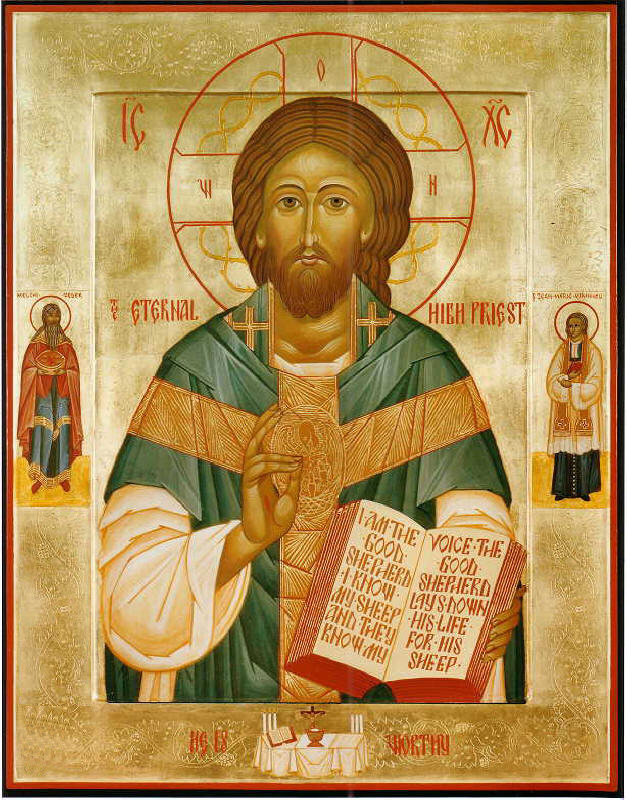
Jesus, High Priest
We thank you, God our Father, for those who have responded to your call to priestly ministry.
Accept this prayer we offer on their behalf: Fill your priests with the sure knowledge of your love.
Open their hearts to the power and consolation of the Holy Spirit.
Lead them to new depths of union with your Son.
Increase in them profound faith in the Sacraments they celebrate as they nourish, strengthen and heal us.
Lord Jesus Christ, grant that these, your priests, may inspire us to strive for holiness by the power of their example, as men of prayer who ponder your word and follow your will.
O Mary, Mother of Christ and our mother, guard with your maternal care these chosen ones, so dear to the Heart of your Son.
Intercede for our priests, that offering the Sacrifice of your Son, they may be conformed more each day to the image of your Son, our Lord and Savior, Jesus Christ. Amen.
Saint John Vianney, universal patron of priests, pray for us and our priests
This icon shows Jesus Christ, our eternal high priest.
The gold pelican over His heart represents self-sacrifice.
The border contains an altar and grapevines, representing the Mass, and icons of Melchizedek and St. Jean-Baptiste Vianney.
Melchizedek: king of righteousness (left icon) was priest and king of Jerusalem. He blessed Abraham and has been considered an ideal priest-king.
St. Jean-Baptiste Vianney is the patron saint of parish priests.
16
posted on
06/08/2019 6:25:45 PM PDT
by
Salvation
("With God all things are possible." Matthew 19:26)
To: All
Jesus, High Priest
We thank you, God our Father, for those who have responded to your call to priestly ministry.
Accept this prayer we offer on their behalf: Fill your priests with the sure knowledge of your love.
Open their hearts to the power and consolation of the Holy Spirit.
Lead them to new depths of union with your Son.
Increase in them profound faith in the Sacraments they celebrate as they nourish, strengthen and heal us.
Lord Jesus Christ, grant that these, your priests, may inspire us to strive for holiness by the power of their example, as men of prayer who ponder your word and follow your will.
O Mary, Mother of Christ and our mother, guard with your maternal care these chosen ones, so dear to the Heart of your Son.
Intercede for our priests, that offering the Sacrifice of your Son, they may be conformed more each day to the image of your Son, our Lord and Savior, Jesus Christ. Amen.
Saint John Vianney, universal patron of priests, pray for us and our priests
This icon shows Jesus Christ, our eternal high priest.
The gold pelican over His heart represents self-sacrifice.
The border contains an altar and grapevines, representing the Mass, and icons of Melchizedek and St. Jean-Baptiste Vianney.
Melchizedek: king of righteousness (left icon) was priest and king of Jerusalem. He blessed Abraham and has been considered an ideal priest-king.
St. Jean-Baptiste Vianney is the patron saint of parish priests.
18 posted on
04/27/2019 11:35:08 AM PDT by
Salvation ("With God all things are possible." Matthew 19:26)
To: All
Pray a Rosary each day for our nation.
1. Sign of the Cross: In the name of the Father, and of the Son, and of the Holy Spirit. Amen.
2. The Apostles Creed: I BELIEVE in God, the Father almighty, Creator of heaven and earth, and in Jesus Christ, His only Son, our Lord, who was conceived by the Holy Spirit, born of the Virgin Mary, suffered under Pontius Pilate, was crucified, died, and was buried. He descended into hell; on the third day he rose again from the dead; he ascended into heaven, and is seated at the right hand of God, the Father Almighty; from there He shall come to judge the living and the dead.
I believe in the Holy Spirit, the holy catholic Church, the communion of saints, the forgiveness of sins, the resurrection of the body, and the life everlasting. Amen.
3. The Lord's Prayer: OUR Father, who art in heaven, hallowed be Thy name. Thy kingdom come. Thy will be done on earth as it is in heaven. Give us this day our daily bread and forgive us our trespasses as we forgive those who trespass against us. And lead us not into temptation, but deliver us from evil. Amen.
4. (3) Hail Mary: HAIL Mary, full of grace, the Lord is with thee. Blessed art thou amongst women and blessed is the fruit of thy womb, Jesus. Holy Mary, Mother of God, pray for us sinners, now, and in the hour of our death. Amen. (Three times)
5. Glory Be: GLORY be to the Father, and to the Son, and to the Holy Spirit. As it was in the beginning, is now, and ever shall be, world without end. Amen.
6. Fatima Prayer: Oh, my Jesus, forgive us our sins, save us from the fires of hell, lead all souls to heaven, especially those in most need of your mercy.
Announce each mystery, then say 1 Our Father, 10 Hail Marys, 1 Glory Be and 1 Fatima prayer. Repeat the process with each mystery.
End with the Hail Holy Queen:
Hail, Holy Queen, Mother of Mercy, our life, our sweetness and our hope! To thee do we cry, poor banished children of Eve! To thee do we send up our sighs, mourning and weeping in this vale of tears! Turn then, most gracious advocate, thine eyes of mercy towards us; and after this, our exile, show unto us the blessed fruit of thy womb, Jesus!
O clement, O loving, O sweet Virgin Mary! Pray for us, O holy Mother of God, that we may be made worthy of the promises of Christ.
Final step -- The Sign of the Cross
The Mysteries of the Rosary By tradition, Catholics meditate on these Mysteries during prayers of the Rosary. The biblical references follow each of the Mysteries below.
The Joyful Mysteries
(Mondays and Saturdays)
1. The Annunciation (Luke 1:26-38) [Spiritual fruit - Humility]
2. The Visitation (Luke 1: 39-56) [Spiritual fruit - Love of Neighbor]
3. The Nativity (Luke 2:1-20) [Spiritual fruit - Poverty of Spirit]
4. The Presentation (Luke 2:21-38) [Spiritual fruit - Purity of mind & body]
5. The Finding of Jesus in the Temple (Luke 2:41-52) [Spiritual fruit - Obedience ]
17
posted on
06/08/2019 6:40:17 PM PDT
by
Salvation
("With God all things are possible." Matthew 19:26)
To: All
St. Michael the Archangel

St. Michael the Archangel
~ PRAYER ~
St. Michael, the Archangel, defend us in battle
Be our protection against the wickedness
and snares of the devil;
May God rebuke him, we humbly pray,
and do thou, O Prince of the heavenly host,
by the power of God,
Cast into hell Satan and all the evil spirits
who prowl through the world seeking the ruin of souls.
Amen
+
18
posted on
06/08/2019 6:41:31 PM PDT
by
Salvation
("With God all things are possible." Matthew 19:26)
Disclaimer:
Opinions posted on Free Republic are those of the individual
posters and do not necessarily represent the opinion of Free Republic or its
management. All materials posted herein are protected by copyright law and the
exemption for fair use of copyrighted works.
FreeRepublic.com is powered by software copyright 2000-2008 John Robinson