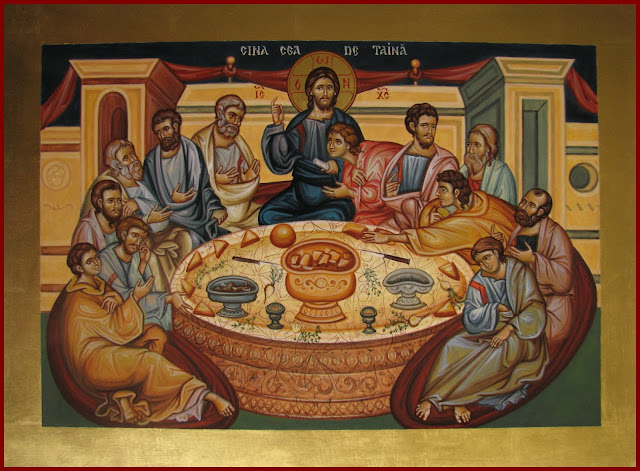
The Mystical Supper
(inscription in Romanian)
Casian Simona Cristina, iconographer
Posted on 05/18/2019 8:07:18 AM PDT by annalex
Below are the readings suggested for today's Memorial. However, readings for the Memorial may also be taken from the Common of Martyrs, #713-718 or the Common of Pastors: For a Pope, #719-724.
I do not have Salvation's mailing list. I have to grow my own. I haven't heard from her since she stopped posting. Please, pray for her well-being.
Please, drop me a freepmail if you want to be on this list and you aren't, or if you don't want to be on it and you are.
Please contribute your posts and make this thread beautiful. Remember the rules for Catholic Caucus prayer threads: no polemical content of any kind is allowed.
| Luke | |||
| English: Douay-Rheims | Latin: Vulgata Clementina | Greek NT: Byzantine/Majority Text (2000) | |
| Luke 22 |
|||
| 24. | And there was also a strife amongst them, which of them should seem to be the greater. | Facta est autem et contentio inter eos, quis eorum videretur esse major. | εγενετο δε και φιλονεικια εν αυτοις το τις αυτων δοκει ειναι μειζων |
| 25. | And he said to them: The kings of the Gentiles lord it over them; and they that have power over them, are called beneficent. | Dixit autem eis : Reges gentium dominantur eorum : et qui potestatem habent super eos, benefici vocantur. | ο δε ειπεν αυτοις οι βασιλεις των εθνων κυριευουσιν αυτων και οι εξουσιαζοντες αυτων ευεργεται καλουνται |
| 26. | But you not so: but he that is the greater among you, let him become as the younger; and he that is the leader, as he that serveth. | Vos autem non sic : sed qui major est in vobis, fiat sicut minor : et qui præcessor est, sicut ministrator. | υμεις δε ουχ ουτως αλλ ο μειζων εν υμιν γενεσθω ως ο νεωτερος και ο ηγουμενος ως ο διακονων |
| 27. | For which is greater, he that sitteth at table, or he that serveth? Is it not he that sitteth at table? But I am in the midst of you, as he that serveth: | Nam quis major est, qui recumbit, an qui ministrat ? nonne qui recumbit ? Ego autem in medio vestrum sum, sicut qui ministrat : | τις γαρ μειζων ο ανακειμενος η ο διακονων ουχι ο ανακειμενος εγω δε ειμι εν μεσω υμων ως ο διακονων |
| 28. | And you are they who have continued with me in my temptations: | vos autem estis, qui permansistis mecum in tentationibus meis. | υμεις δε εστε οι διαμεμενηκοτες μετ εμου εν τοις πειρασμοις μου |
| 29. | And I dispose to you, as my Father hath disposed to me, a kingdom; | Et ego dispono vobis sicut disposuit mihi Pater meus regnum, | καγω διατιθεμαι υμιν καθως διεθετο μοι ο πατηρ μου βασιλειαν |
| 30. | That you may eat and drink at my table, in my kingdom: and may sit upon thrones, judging the twelve tribes of Israel. | ut edatis et bibatis super mensam meam in regno meo, et sedeatis super thronos judicantes duodecim tribus Israël. | ινα εσθιητε και πινητε επι της τραπεζης μου [εν τη βασιλεια μου] και καθισεσθε επι θρονων κρινοντες τας δωδεκα φυλας του ισραηλ |

St. John I was a sixth-century pope and martyr. John was born in the Italian province of Tuscany, and was elected Bishop of Rome (that is, pope) in 523. The Mediterranean world was, by this time, divided into the Eastern and Western Empires, each having a separate emperor.
Christianity was also divided (though not in a geographic sense) by the Arian heresy, which denied the divinity of Christ. King Theodoric, the German chieftain who was in effect the Western emperor, was himself an Arian, though he was initially tolerant of the Catholics in his kingdom. Soon after John was elected pope, Justin, the Eastern emperor, began repressing the Arians in the East. Theodoric was upset by this, and he forced John and other religious leaders from the West to visit Justin in Constantinople (capital of the Eastern empire) for the purpose of lessening the restrictions placed upon the Arians. (Because religious questions had political implications, it was not uncommon for kings to involve themselves in religion, and for bishops to find themselves involved in politics.)
Little is known about the outcome of the negotiations Pope John conducted with Emperor Justin, but because the two leaders got along well together, a paranoid Theodoric assumed they were plotting against him. When John returned to Italy in 526, Theodoric had him arrested. Pope John died soon after he was imprisoned, perhaps as a result of the treatment he received, thus earning a martyr’s crown. John was the first of twenty-three popes of that name, and the first one to be canonized a saint.
Sometimes religion is inescapably involved in politics. As St. John knew, when this happens, our primary loyalty must be to Christ, not to the rulers of this world.
Ping
“I haven’t heard from her since she stopped posting. Please, pray for her well-being.”
Yes, she hasn’t responded to my inquiry either.
Disclaimer: Opinions posted on Free Republic are those of the individual posters and do not necessarily represent the opinion of Free Republic or its management. All materials posted herein are protected by copyright law and the exemption for fair use of copyrighted works.