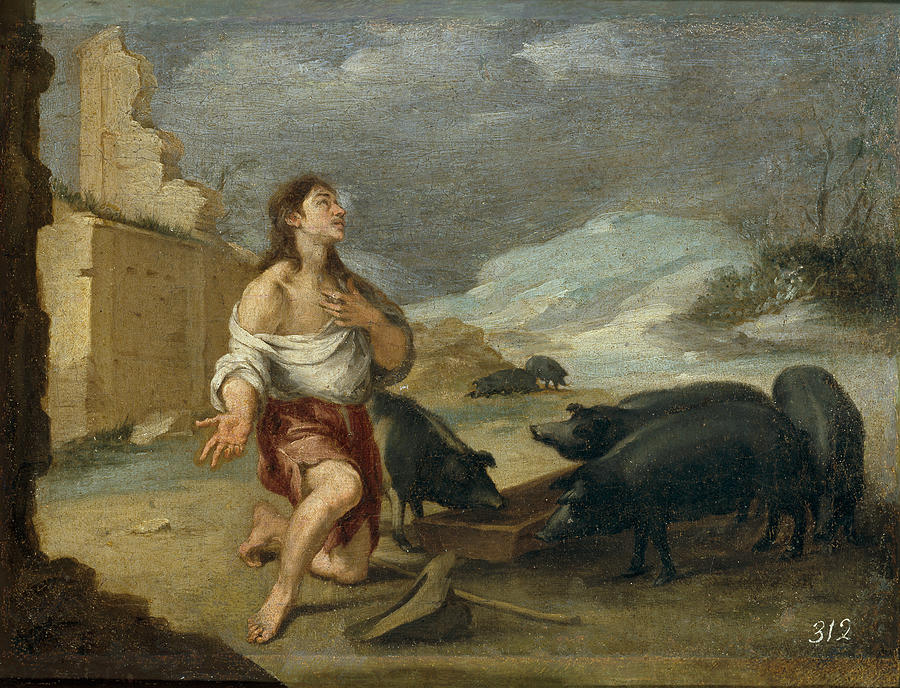
The Prodigal Son Abandoned
Bartolome Esteban Murillo (1617 - 1682)
Posted on 03/30/2019 9:37:34 PM PDT by Salvation
KEYWORDS: catholic; lent; lk15; prayer;
Please FReepmail me to get on/off the Lenten Ping List.
From: Joshua 5:9a, 10-12
Celebration of the Passover at Gilgal
[10] While the people of Israel were encamped in Gilgal they kept the passover
on the fourteenth day of the month at evening in the plains of Jericho. [11] And
on the morrow after the passover, on that very day, they ate of the produce of
the land, unleavened cakes and parched grain. [12] And the manna ceased on
the morrow, when they ate of the produce of the land; and the people of Israel
had manna no more, but ate of the fruit of the land of Canaan that year.
*********************************************************************************************
Commentary:
5:1-9. Semitic peoples practised circumcision as an initiation rite for entry into
manhood. Israelites observed it on the eighth day after birth, and it has an emi-
nently religious meaning: it shows that the person is a member of the people of
God (cf. the notes on Gen 17:1-14 and Lev 12:1-4). It was specifically laid down
that a person had to be circumcised to be able to celebrate Passover (Ex 12:43-
49).
The reason given here for the circumcision of the people at Gilgal (that is, the
fact that the circumcision of males born during the desert years had been post-
poned) makes sense. However, the fact that the circumcising takes place at this
particular point is highly significant: it is a way of showing that this people which
has come to the gates of the promised land has attained its maturity after its
long pilgrimage in the desert. Israel truly is, after the Covenant of Sinai, a people
who belong to God.
5:10-12. Once the men have been circumcised and can celebrate the Passover,
that feast is held in the promised land for the first time. The Israelites are able to
use grain from that region to make the unleavened bread; and now that they
have access to the agricultural products of the land, they are no longer provided
with manna — the food God gave daily to them in the desert.
God was perfectly ready to provide them with miraculous food when they needed
special protection in the desert, where food of any kind was in short supply. But
once they can fend for themselves, by working the land, God ceases to give
them any special help.
*********************************************************************************************
Source: “The Navarre Bible: Text and Commentaries”. Biblical text from the
Revised Standard Version and New Vulgate. Commentaries by members of
the Faculty of Theology, University of Navarre, Spain.
Published by Four Courts Press, Kill Lane, Blackrock, Co. Dublin, Ireland, and
by Scepter Publishers in the United States.
From: 2 Corinthians 5:17-21
The Ministry of Reconciliation (Continuation)
*********************************************************************************************
Commentary:
16-17. “Even though we once regarded Christ from a human point of view”: Paul
seems to be referring to knowledge based only on external appearances and on
human criteria. Paul’s Judaizing opponents do look on things from a human point
of view, as Paul himself did before his conversion. Nothing he says here can be
taken as implying that St Paul knew Jesus personally during his life on earth (he
goes on to say that now he does not know him personally); what he is saying is
that previously he judged Christ on the basis of his own Pharisee prejudices;
now, on the other hand, he knows him as God and Savior of men.
In v. 17 he elaborates on this contrast between before and after his conversion,
as happens to Christians through Baptism. For through the grace of Baptism a
person becomes a member of Christ’s body, he lives by and is “in Christ” (cf.,
e.g., Gal 6:15; Eph 2:10, 15f; Cor 3:9f); the Redemption brings about a new crea-
tion. Commenting on this passage St Thomas Aquinas reminds us that creation
is the step from non-being to being, and that in the supernatural order, after origi-
nal sin, “a new creation was necessary, whereby (creatures) would be made
with the life of grace; this truly is a creation from nothing, because those without
grace are nothing (cf. 1 Cor 13:2) [...]. St Augustine says, ‘for sin is nothingness,
and men become nothingness when they sin’” (”Commentary on 2 Cor, ad loc.”).
“The new has come”: St John Chrysostom points out the radical change which
the Incarnation of our Lord Jesus Christ has brought about, and the consequent
difference between Judaism and Christianity: “Instead of the earthly Jerusalem,
we have received that Jerusalem which is above; and instead of a material tem-
ple we have seen a spiritual temple; instead of tablets of stone, holding the di-
vine Law, our own bodies have become the sanctuary of the Holy Spirit; instead
of circumcision, Baptism; instead of manna, the Lord’s body; instead of water
from a rock, blood from his side; instead of Moses’ or Aaron’s rod, the cross of
the Savior; instead of the promised land, the kingdom of heaven” (”Hom on 2
Cor”, 11).
18-21. The reconciliation of mankind with God—whose friendship we lost through
original sin—has been brought about by Christ’s death on the cross. Jesus, who
is like men in all things “yet without sinning” (Heb 4:14), bore the sins of men
(cf. s 53:4-12) and offered himself on the cross as an atoning sacrifice for all
those sins (cf. 1 Pet 2:22-25), thereby reconciling men to God; through this sa-
crifice we became the righteousness of God, that is, we are justified, made just
in God’s sight (cf. Rom 1:17; 3:24-26 and notes). The Church reminds us of this
in the rite of sacramental absolution: “God, the Father of mercies, through the
death and resurrection of his son has reconciled the world to himself [...].”
Our Lord entrusted the Apostles with this ministry of reconciliation (v. 18), this
“message of reconciliation” (v. 19), to pass it on to all men: elsewhere in the
New Testament it is described as the “message of salvation” (Acts 13:26), the
“word of grace” (Acts 14:3; 20:32), the “word of life” ( 1 Jn 1: 1). Thus, the Apos-
tles were our Lord’s ambassadors to men, to whom St Paul addresses a pres-
sing call: “be reconciled to God”, that is, apply to yourselves the reconciliation
obtained by Jesus Christ—which is done mainly through the sacraments of Bap-
tism and Penance. “The Lord Jesus instituted in his Church the sacrament of
Penance, so that those who have committed sins after Baptism might be recon-
ciled with God, whom they have offended, and with the Church itself whom they
have injured” (John Paul II, “Aperite Portas, 5).
21. “He made him to be sin”: obviously St Paul does not mean that Christ was
guilty of sin; he does not say “to be a sinner” but “to be sin”. “Christ had no sin,”
St Augustine says; “he bore sins, but he did not commit them” (”Enarrationes
in Psalmos”, 68, 1, 10).
According to the rite of atoning sacrifices (cf. Lev 4:24; 5:9; Num 19:9; Mic 6:7;
Ps 40:7) the word “sin”, corresponding to the Hebrew “asam”, refers to the ac-
tual act of sacrifice or to the victim being offered. Therefore, this phrase means
“he made him a victim for sin” or “a sacrifice for sin”. It should be remembered
that in the Old Testament nothing unclean or blemished could be offered to God;
the offering of an unblemished animal obtained God’s pardon for the transgres-
sion which one wanted to expiate. Since Jesus was the most perfect of victims
offered for us, he made full atonement for all sins. In the Letter to the Hebrews,
when comparing Christ’s sacrifice with that of the priests of the Old Testament,
it is expressly stated that “every priest stands daily at his service, offering re-
peatedly the same sacrifices, which can never take away sins. But when Christ
had offered for all time a single sacrifice for sins, he sat down at the right hand
of God, then to wait until his enemies should be made a stool for his feet. For
by a single offering he has perfected for all time those who are sanctified” (Heb
10:11-14).
This concentrated sentence also echoes the Isaiah prophecy about the sacrifice
of the Servant of Yahweh; Christ, the head of the human race, makes men sha-
rers in the grace and glory he achieved through his sufferings: “upon him was the
chastisement that made us whole, and with his stripes we are healed” (Is 53:5).
Jesus Christ, burdened with our sins and offering himself on the cross as a sacri-
fice for them, brought about the Redemption: the Redemption is the supreme ex-
ample both of God’s justice—which requires atonement befitting the offense — and
of his mercy, that mercy which makes him love the world so much that “he gave
his only Son” (Jn 3:16). “In the Passion and Death of Christ — in the fact that the
Father did not spare his own Son, but ‘for our sake made him sin’ — absolute jus-
tice is expressed, for Christ undergoes the Passion and Cross because of the
sins of humanity. This constitutes even a ‘superabundance’ of justice, for the sins
of man are ‘compensated for’ by the sacrifice of the Man-God. Nevertheless, this
justice, which is properly justice ‘to God’s measure’, springs completely from love,
from the love of the Father and of the Son, and completely bears fruit in love. Pre-
cisely for this reason the divine justice revealed in the Cross of Christ is to God’s
measure’, because it springs from love and is accomplished in love, producing
fruits of salvation. The divine dimension of redemption is put into effect not only
by bringing justice to bear upon sin, but also by restoring to love that creative po-
wer in man thanks to which he once more has access to the fullness of life and
holiness that come from God. In this way, redemption involves the revelation of
mercy in its fullness” (St John Paul II, “Dives In Misercordia”, 7).
*********************************************************************************************
Source: “The Navarre Bible: Text and Commentaries”. Biblical text from the
Revised Standard Version and New Vulgate. Commentaries by members of
the Faculty of Theology, University of Navarre, Spain.
Published by Four Courts Press, Kill Lane, Blackrock, Co. Dublin, Ireland, and
by Scepter Publishers in the United States.
From: Luke 15:1-3; 11-32
Parables of God’s Mercy
The Prodigal Son
[25] “Now his elder son was in the field; and as he came and drew near to the
house, he heard music and dancing. [26] And he called one of the servants and
asked what this meant. [27] And he said to him, ‘Your brother has come, and
your father has killed the fatted calf, because he has received him safe and
sound.’ [28] But he was angry and refused to go in. His father came out and
entreated him, [29] but he answered his father, ‘Lo, these many years I have
served you, and I never disobeyed your command; yet you never gave me a kid,
that I might make merry with my friends. [30] But when this son of yours came,
who has devoured your living with harlots, you killed for him the fatted calf!’ [31]
And he said to him, ‘Son, you are always with me, and all that is mine is yours.
[32] It was fitting to make merry and be glad, for this your brother was dead, and
is alive; he was lost, and is found.’”
*********************************************************************************************
Commentary:
1-32. Jesus’ actions manifest God’s mercy: He receives sinners in order to con-
vert them. The scribes and Pharisees, who despised sinners, just cannot under-
stand why Jesus acts like this; they grumble about Him; and Jesus uses the
opportunity to tell these Mercy parables. “The Gospel writer who particularly
treats of these themes in Christ’s teaching is Luke, whose Gospel has earned
the title of ‘the Gospel of mercy’” (St. John Paul II, “Dives In Misericordia”, 3).
In this chapter St. Luke reports three of these parables in which Jesus describes
the infinite, fatherly mercy of God and His joy at the conversion of the sinner.
The Gospel teaches that no one is excluded from forgiveness and that sinners
can become beloved children of God if they repent and are converted. So much
does God desire the conversion of sinners that each of these parables ends with
a refrain, as it were, telling of the great joy in Heaven over a sinner who repents.
1-2. This is not the first time that publicans and sinners approach Jesus (cf. Mat-
thew 9:10). They are attracted by the directness of the Lord’s preaching and by
His call to self-giving and love. The Pharisees in general were jealous of His in-
fluence over the people (cf. Matthew 26:2-5; John 11:47), a jealousy which can
also beset Christians; a severity of outlook which does not accept that, no mat-
ter how great his sins may have been, a sinner can change and become a saint;
a blindness which prevents a person from recognizing and rejoicing over the good
done by others. Our Lord criticized this attitude when He replied to His disciples’
complaints about others casting out devils in His name: “Do not forbid him; for
no one who does a mighty work in My name will be able soon after to speak evil
of Me” (Mark 9:39). And St. Paul rejoiced that others proclaimed Christ and even
overlooked the fact they did so out of self-interest, provided Christ was preached
(cf. Philippians 1:17-18).
11. This is one of Jesus’ most beautiful parables, which teaches us once more
that God is a kind and understanding Father (cf. Matthew 6:8; Romans 8:15; 2
Corinthians 1:3). The son who asks for his part of the inheritance is a symbol of
the person who cuts himself off from God through sin. “Although the word ‘mer-
cy’ does not appear, this parable nevertheless expresses the essence of the di-
vine mercy in a particularly clear way” (St. John Paul II, “Dives In Misericordia”,
5).
12. “That son, who receives from the father the portion of the inheritance that is
due him and leaves home to squander it in a far country ‘in loose living’, in a cer-
tain sense is the man of every period, beginning with the one who was the first
to lose the inheritance of grace and original justice. The analogy at this point is
very wide-ranging. The parable indirectly touches upon every breach of the cove-
nant of love, every loss of grace, every sin” (”Dives In Misericordia”, 5).
14-15. At this point in the parable we are shown the unhappy effects of sin. The
young man’s hunger evokes the anxiety and emptiness a person feels when he
is far from God. The prodigal son’s predicament describes the enslavement which
sin involves (cf. Romans 1:25; 6:6; Galatians 5:1): by sinning one loses the free-
dom of the children of God (cf. Romans 8:21; Galatians 4:31; 5:13) and hands
oneself over the power of Satan.
17-21. His memory of home and his conviction that his father loves him cause
the prodigal son to reflect and to decide to set out on the right road. “Human life
is in some way a constant returning to our Father’s house. We return through
contrition, through the conversion of heart which means a desire to change, a
firm decision to improve our life and which, therefore, is expressed in sacrifice
and self-giving. We return to our Father’s house by means of that sacrament of
pardon in which, by confessing our sins, we put on Jesus Christ again and be-
come His brothers, members of God’s family” (St. J. Escriva, “Christ is Passing
By”, 64).
20-24. God always hopes for the return of the sinner; He wants him to repent.
When the young man arrives home his father does not greet him with reproaches
but with immense compassion, which causes him to embrace his son and cover
him with kisses.
20. “There is no doubt that in this simple but penetrating analogy the figure of the
father reveals to us God as Father. The conduct of the father in the parable and
his whole behavior, which manifests his internal attitude, enables us to rediscover
the individual threads of the Old Testament vision of mercy in a synthesis which
is totally new, full of simplicity and depth. The father of the prodigal son is faithful
to this fatherhood, faithful to the love that he had always lavished on his son. This
fidelity is expressed in the parable not only by his immediate readiness to wel-
come him home when he returns after having squandered his inheritance; it is ex-
pressed even more fully by that joy, that merrymaking for the squanderer after his
return, merrymaking which is so generous that it provokes the opposition and ha-
tred of the elder brother, who had never gone far away from his father and had ne-
ver abandoned the home.
“The father’s fidelity to himself [...] is at the same time expressed in a manner
particularly charged with affection. We read, in fact, that when the father saw
the prodigal son returning home ‘he had compassion, ran to meet him, threw his
arms around his neck and kissed him.’ He certainly does this under the influence
of a deep affection, and this also explains his generosity towards his son, that
generosity which so angers the elder son” (”Dives In Misericordia”, 6).
“When God runs towards us, we cannot keep silent, but with St. Paul we ex-
claim, “Abba Pater”: ‘Father, my Father!’ (Romans 8:15), for, though He is the
creator of the universe, He doesn’t mind our not using high-sounding titles, nor
worry about our not acknowledging His greatness. He wants us to call Him
Father; He wants us to savor that word, our souls filling with joy [...].
“God is waiting for us, like the father in the parable, with open arms, even though
we don’t deserve it. It doesn’t matter how great our debt is. Just like the prodigal
son, all we have to do is open our heart, to be homesick for our Father’s house,
to wonder at and rejoice in the gift which God makes us of being able to call our-
selves His children, of really being His children, even though our response to Him
has been so poor” (St. J. Escriva, “Christ Is Passing By”, 64).
25-30. God’s mercy is so great that man cannot grasp it: as we can see in the
case of the elder son, who thinks his father loves the younger son excessively,
his jealousy prevents him from understanding how his father can do so much to
celebrate the recovery of the prodigal; it cuts him off from the joy that the whole
family feels. “It’s true that he was a sinner. But don’t pass so final a judgment
on him. Have pity in your heart, and don’t forget that he may yet be an Augus-
tine, while you remain just another mediocrity” (St. J. Escriva, “The Way”, 675).
We should also consider that if God has compassion towards sinners, He must
have much much more towards those who strive to be faithful to Him. St. The-
rese of Lisieux understood this very well: “What joy to remember that our Lord
is just; that He makes allowances for all our shortcomings, and knows full well
how weak we are. What have I to fear then? Surely the God of infinite justice
who pardons the prodigal son with such mercy will be just with me ‘who am al-
ways with Him’?” (”The Story of a Soul”, Chapter 8).
32. “Mercy, as Christ has presented it in the parable of the prodigal son, has the
interior form of the love that in the New Testament is called AGAPE. This love is
able to reach down to every prodigal son, to every human misery, and above all
to every form of moral misery, to sin. When this happens, the person who is the
object of mercy does not feel humiliated, but rather found again and ‘restored to
value’. The father first and foremost expresses to him his joy, that he has been
‘found again’ and that he has ‘returned to life’. This joy indicates a good that has
remained intact: even if he is a prodigal, a son does not cease to be truly his fa-
ther’s son; it also indicates a good that has been found again, which in the case
of the prodigal son was his return to the truth about himself” (”Dives In Misericor-
dia”, 6).
*********************************************************************************************
Source: “The Navarre Bible: Text and Commentaries”. Biblical text from the
Revised Standard Version and New Vulgate. Commentaries by members of
the Faculty of Theology, University of Navarre, Spain.
Published by Four Courts Press, Kill Lane, Blackrock, Co. Dublin, Ireland, and
by Scepter Publishers in the United States.
Liturgical Colour: Rose or Violet.
| First reading | Joshua 5:9-12 © |
|---|
| The Israelites celebrate their first Passover in the Promised Land |
|---|
| Responsorial Psalm |
|---|
| Psalm 33(34):2-7 © |
| Second reading |
|---|
| 2 Corinthians 5:17-21 © |
| God reconciled himself to us through Christ |
|---|
| Gospel Acclamation | Lk15:18 |
|---|
| Gospel |
|---|
| Luke 15:1-3,11-32 © |
| The prodigal son |
|---|
| Luke | |||
| English: Douay-Rheims | Latin: Vulgata Clementina | Greek NT: Byzantine/Majority Text (2000) | |
| Luke 15 |
|||
| 1. | NOW the publicans and sinners drew near unto him to hear him. | Erant autem appropinquantes ei publicani, et peccatores ut audirent illum. | ησαν δε εγγιζοντες αυτω παντες οι τελωναι και οι αμαρτωλοι ακουειν αυτου |
| 2. | And the Pharisees and the scribes murmured, saying: This man receiveth sinners, and eateth with them. | Et murmurabant pharisæi, et scribæ, dicentes : Quia hic peccatores recipit, et manducat cum illis. | και διεγογγυζον οι φαρισαιοι και οι γραμματεις λεγοντες οτι ουτος αμαρτωλους προσδεχεται και συνεσθιει αυτοις |
| 3. | And he spoke to them this parable, saying: | Et ait ad illos parabolam istam dicens : | ειπεν δε προς αυτους την παραβολην ταυτην λεγων |
| [...] | |||
| 11. | And he said: A certain man had two sons: | Ait autem : Homo quidam habuit duos filios : | ειπεν δε ανθρωπος τις ειχεν δυο υιους |
| 12. | And the younger of them said to his father: Father, give me the portion of substance that falleth to me. And he divided unto them his substance. | et dixit adolescentior ex illis patri : Pater, da mihi portionem substantiæ, quæ me contingit. Et divisit illis substantiam. | και ειπεν ο νεωτερος αυτων τω πατρι πατερ δος μοι το επιβαλλον μερος της ουσιας και διειλεν αυτοις τον βιον |
| 13. | And not many days after, the younger son, gathering all together, went abroad into a far country: and there wasted his substance, living riotously. | Et non post multos dies, congregatis omnibus, adolescentior filius peregre profectus est in regionem longinquam, et ibi dissipavit substantiam suam vivendo luxuriose. | και μετ ου πολλας ημερας συναγαγων απαντα ο νεωτερος υιος απεδημησεν εις χωραν μακραν και εκει διεσκορπισεν την ουσιαν αυτου ζων ασωτως |
| 14. | And after he had spent all, there came a mighty famine in that country; and he began to be in want. | Et postquam omnia consummasset, facta est fames valida in regione illa, et ipse cœpit egere. | δαπανησαντος δε αυτου παντα εγενετο λιμος ισχυρος κατα την χωραν εκεινην και αυτος ηρξατο υστερεισθαι |
| 15. | And he went and cleaved to one of the citizens of that country. And he sent him into his farm to feed swine. | Et abiit, et adhæsit uni civium regionis illius : et misit illum in villam suam ut pasceret porcos. | και πορευθεις εκολληθη ενι των πολιτων της χωρας εκεινης και επεμψεν αυτον εις τους αγρους αυτου βοσκειν χοιρους |
| 16. | And he would fain have filled his belly with the husks the swine did eat; and no man gave unto him. | Et cupiebat implere ventrem suum de siliquis, quas porci manducabant : et nemo illi dabat. | και επεθυμει γεμισαι την κοιλιαν αυτου απο των κερατιων ων ησθιον οι χοιροι και ουδεις εδιδου αυτω |
| 17. | And returning to himself, he said: How many hired servants in my father's house abound with bread, and I here perish with hunger? | In se autem reversus, dixit : Quanti mercenarii in domo patris mei abundant panibus, ego autem hic fame pereo ! | εις εαυτον δε ελθων ειπεν ποσοι μισθιοι του πατρος μου περισσευουσιν αρτων εγω δε λιμω απολλυμαι |
| 18. | I will arise, and will go to my father, and say to him: Father, I have sinned against heaven, and before thee: | surgam, et ibo ad patrem meum, et dicam ei : Pater, peccavi in cælum, et coram te : | αναστας πορευσομαι προς τον πατερα μου και ερω αυτω πατερ ημαρτον εις τον ουρανον και ενωπιον σου |
| 19. | I am not worthy to be called thy son: make me as one of thy hired servants. | jam non sum dignus vocari filius tuus : fac me sicut unum de mercenariis tuis. | και ουκετι ειμι αξιος κληθηναι υιος σου ποιησον με ως ενα των μισθιων σου |
| 20. | And rising up he came to his father. And when he was yet a great way off, his father saw him, and was moved with compassion, and running to him fell upon his neck, and kissed him. | Et surgens venit ad patrem suum. Cum autem adhuc longe esset, vidit illum pater ipsius, et misericordia motus est, et accurrens cecidit super collum ejus, et osculatus est eum. | και αναστας ηλθεν προς τον πατερα αυτου ετι δε αυτου μακραν απεχοντος ειδεν αυτον ο πατηρ αυτου και εσπλαγχνισθη και δραμων επεπεσεν επι τον τραχηλον αυτου και κατεφιλησεν αυτον |
| 21. | And the son said to him: Father, I have sinned against heaven, and before thee, I am not now worthy to be called thy son. | Dixitque ei filius : Pater, peccavi in cælum, et coram te : jam non sum dignus vocari filius tuus. | ειπεν δε αυτω ο υιος πατερ ημαρτον εις τον ουρανον και ενωπιον σου και ουκετι ειμι αξιος κληθηναι υιος σου |
| 22. | And the father said to his servants: Bring forth quickly the first robe, and put it on him, and put a ring on his hand, and shoes on his feet: | Dixit autem pater ad servos suos : Cito proferte stolam primam, et induite illum, et date annulum in manum ejus, et calceamenta in pedes ejus : | ειπεν δε ο πατηρ προς τους δουλους αυτου εξενεγκατε την στολην την πρωτην και ενδυσατε αυτον και δοτε δακτυλιον εις την χειρα αυτου και υποδηματα εις τους ποδας |
| 23. | And bring hither the fatted calf, and kill it, and let us eat and make merry: | et adducite vitulum saginatum, et occidite, et manducemus, et epulemur : | και ενεγκαντες τον μοσχον τον σιτευτον θυσατε και φαγοντες ευφρανθωμεν |
| 24. | Because this my son was dead, and is come to life again: was lost, and is found. And they began to be merry. | quia hic filius meus mortuus erat, et revixit : perierat, et inventus est. Et cœperunt epulari. | οτι ουτος ο υιος μου νεκρος ην και ανεζησεν και απολωλως ην και ευρεθη και ηρξαντο ευφραινεσθαι |
| 25. | Now his elder son was in the field, and when he came and drew nigh to the house, he heard music and dancing: | Erat autem filius ejus senior in agro : et cum veniret, et appropinquaret domui, audivit symphoniam et chorum : | ην δε ο υιος αυτου ο πρεσβυτερος εν αγρω και ως ερχομενος ηγγισεν τη οικια ηκουσεν συμφωνιας και χορων |
| 26. | And he called one of the servants, and asked what these things meant. | et vocavit unum de servis, et interrogavit quid hæc essent. | και προσκαλεσαμενος ενα των παιδων επυνθανετο τι ειη ταυτα |
| 27. | And he said to him: Thy brother is come, and thy father hath killed the fatted calf, because he hath received him safe. | Isque dixit illi : Frater tuus venit, et occidit pater tuus vitulum saginatum, quia salvum illum recepit. | ο δε ειπεν αυτω οτι ο αδελφος σου ηκει και εθυσεν ο πατηρ σου τον μοσχον τον σιτευτον οτι υγιαινοντα αυτον απελαβεν |
| 28. | And he was angry, and would not go in. His father therefore coming out began to entreat him. | Indignatus est autem, et nolebat introire. Pater ergo illius egressus, cœpit rogare illum. | ωργισθη δε και ουκ ηθελεν εισελθειν ο ουν πατηρ αυτου εξελθων παρεκαλει αυτον |
| 29. | And he answering, said to his father: Behold, for so many years do I serve thee, and I have never transgressed thy commandment, and yet thou hast never given me a kid to make merry with my friends: | At ille respondens, dixit patri suo : Ecce tot annis servio tibi, et numquam mandatum tuum præterivi : et numquam dedisti mihi hædum ut cum amicis meis epularer. | ο δε αποκριθεις ειπεν τω πατρι ιδου τοσαυτα ετη δουλευω σοι και ουδεποτε εντολην σου παρηλθον και εμοι ουδεποτε εδωκας εριφον ινα μετα των φιλων μου ευφρανθω |
| 30. | But as soon as this thy son is come, who hath devoured his substance with harlots, thou hast killed for him the fatted calf. | Sed postquam filius tuus hic, qui devoravit substantiam suam cum meretricibus, venit, occidisti illi vitulum saginatum. | οτε δε ο υιος σου ουτος ο καταφαγων σου τον βιον μετα πορνων ηλθεν εθυσας αυτω τον μοσχον τον σιτευτον |
| 31. | But he said to him: Son, thou art always with me, and all I have is thine. | At ipse dixit illi : Fili, tu semper mecum es, et omnia mea tua sunt : | ο δε ειπεν αυτω τεκνον συ παντοτε μετ εμου ει και παντα τα εμα σα εστιν |
| 32. | But it was fit that we should make merry and be glad, for this thy brother was dead and is come to life again; he was lost, and is found. | epulari autem, et gaudere oportebat, quia frater tuus hic mortuus erat, et revixit ; perierat, et inventus est. | ευφρανθηναι δε και χαρηναι εδει οτι ο αδελφος σου ουτος νεκρος ην και ανεζησεν και απολωλως ην και ευρεθη |
Pray for Pope Francis.
50 Boko Haram Islamic Radicals Killed; 1,000 Hostages, Women and Children, Rescued in Nigeria
Nigeria: In the Face of Ongoing Islamist Attacks, the Faith is Growing
US Promises to Help Nigeria Exterminate Boko Haram
Is This Bishop Right about the Rosary Conquering Boko Haram? [Catholic Caucus]
Why Boko Haram and ISIS Target Women
Report reveals scale of Boko Haram violence inflicted on Nigerian Catholics
Military evacuating girls, women rescued from Boko Haram
Echos of Lepanto Nigerian bishop says rosary will bring down Boko Harm
After vision of Christ, Nigerian bishop says rosary will bring down Boko Haram (Catholic Caucus)
Nigerian Bishop Says Christ Showed Him How to Beat Islamic Terror Group
We thank you, God our Father, for those who have responded to your call to priestly ministry.
Accept this prayer we offer on their behalf: Fill your priests with the sure knowledge of your love.
Open their hearts to the power and consolation of the Holy Spirit.
Lead them to new depths of union with your Son.
Increase in them profound faith in the Sacraments they celebrate as they nourish, strengthen and heal us.
Lord Jesus Christ, grant that these, your priests, may inspire us to strive for holiness by the power of their example, as men of prayer who ponder your word and follow your will.
O Mary, Mother of Christ and our mother, guard with your maternal care these chosen ones, so dear to the Heart of your Son.
Intercede for our priests, that offering the Sacrifice of your Son, they may be conformed more each day to the image of your Son, our Lord and Savior, Jesus Christ. Amen.
Saint John Vianney, universal patron of priests, pray for us and our priests
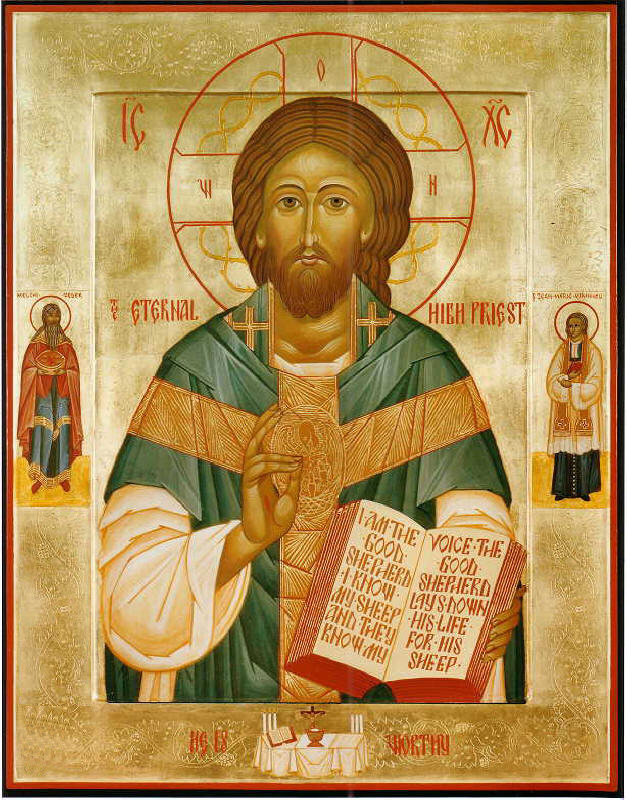
This icon shows Jesus Christ, our eternal high priest.
The gold pelican over His heart represents self-sacrifice.
The border contains an altar and grapevines, representing the Mass, and icons of Melchizedek and St. Jean-Baptiste Vianney.
Melchizedek: king of righteousness (left icon) was priest and king of Jerusalem. He blessed Abraham and has been considered an ideal priest-king.
St. Jean-Baptiste Vianney is the patron saint of parish priests.

1. Sign of the Cross: In the name of the Father, and of the Son, and of the Holy Spirit. Amen.
2. The Apostles Creed: I BELIEVE in God, the Father almighty, Creator of heaven and earth, and in Jesus Christ, His only Son, our Lord, who was conceived by the Holy Spirit, born of the Virgin Mary, suffered under Pontius Pilate, was crucified, died, and was buried. He descended into hell; on the third day he rose again from the dead; he ascended into heaven, and is seated at the right hand of God, the Father Almighty; from there He shall come to judge the living and the dead.
I believe in the Holy Spirit, the holy catholic Church, the communion of saints, the forgiveness of sins, the resurrection of the body, and the life everlasting. Amen.
3. The Lord's Prayer: OUR Father, who art in heaven, hallowed be Thy name. Thy kingdom come. Thy will be done on earth as it is in heaven. Give us this day our daily bread and forgive us our trespasses as we forgive those who trespass against us. And lead us not into temptation, but deliver us from evil. Amen.
4. (3) Hail Mary: HAIL Mary, full of grace, the Lord is with thee. Blessed art thou amongst women and blessed is the fruit of thy womb, Jesus. Holy Mary, Mother of God, pray for us sinners, now, and in the hour of our death. Amen. (Three times)
5. Glory Be: GLORY be to the Father, and to the Son, and to the Holy Spirit. As it was in the beginning, is now, and ever shall be, world without end. Amen.
6. Fatima Prayer: Oh, my Jesus, forgive us our sins, save us from the fires of hell, lead all souls to heaven, especially those in most need of your mercy.
Announce each mystery, then say 1 Our Father, 10 Hail Marys, 1 Glory Be and 1 Fatima prayer. Repeat the process with each mystery.
End with the Hail Holy Queen:
Hail, Holy Queen, Mother of Mercy, our life, our sweetness and our hope! To thee do we cry, poor banished children of Eve! To thee do we send up our sighs, mourning and weeping in this vale of tears! Turn then, most gracious advocate, thine eyes of mercy towards us; and after this, our exile, show unto us the blessed fruit of thy womb, Jesus!
O clement, O loving, O sweet Virgin Mary! Pray for us, O holy Mother of God, that we may be made worthy of the promises of Christ.
Final step -- The Sign of the Cross
The Mysteries of the Rosary By tradition, Catholics meditate on these Mysteries during prayers of the Rosary. The biblical references follow each of the Mysteries below.
The Glorious Mysteries
(Wednesdays and Sundays)
1.The Resurrection (Matthew 28:1-8, Mark 16:1-18, Luke 24:1-12, John 20:1-29) [Spiritual fruit - Faith]
2. The Ascension (Mark 16:19-20, Luke 24:50-53, Acts 1:6-11) [Spiritual fruit - Christian Hope]
3. The Descent of the Holy Spirit (Acts 2:1-13) [Spiritual fruit - Gifts of the Holy Spirit]
4. The Assumption [Spiritual fruit - To Jesus through Mary]
5. The Coronation [Spiritual fruit - Grace of Final Perseverance]
Pray a Rosary each day for our nation.
1. Sign of the Cross: In the name of the Father, and of the Son, and of the Holy Spirit. Amen.
2. The Apostles Creed: I BELIEVE in God, the Father almighty, Creator of heaven and earth, and in Jesus Christ, His only Son, our Lord, who was conceived by the Holy Spirit, born of the Virgin Mary, suffered under Pontius Pilate, was crucified, died, and was buried. He descended into hell; on the third day he rose again from the dead; he ascended into heaven, and is seated at the right hand of God, the Father Almighty; from there He shall come to judge the living and the dead.
I believe in the Holy Spirit, the holy catholic Church, the communion of saints, the forgiveness of sins, the resurrection of the body, and the life everlasting. Amen.
3. The Lord's Prayer: OUR Father, who art in heaven, hallowed be Thy name. Thy kingdom come. Thy will be done on earth as it is in heaven. Give us this day our daily bread and forgive us our trespasses as we forgive those who trespass against us. And lead us not into temptation, but deliver us from evil. Amen.
4. (3) Hail Mary: HAIL Mary, full of grace, the Lord is with thee. Blessed art thou amongst women and blessed is the fruit of thy womb, Jesus. Holy Mary, Mother of God, pray for us sinners, now, and in the hour of our death. Amen. (Three times)
5. Glory Be: GLORY be to the Father, and to the Son, and to the Holy Spirit. As it was in the beginning, is now, and ever shall be, world without end. Amen.
6. Fatima Prayer: Oh, my Jesus, forgive us our sins, save us from the fires of hell, lead all souls to heaven, especially those in most need of your mercy.
Announce each mystery, then say 1 Our Father, 10 Hail Marys, 1 Glory Be and 1 Fatima prayer. Repeat the process with each mystery.
End with the Hail Holy Queen:
Hail, Holy Queen, Mother of Mercy, our life, our sweetness and our hope! To thee do we cry, poor banished children of Eve! To thee do we send up our sighs, mourning and weeping in this vale of tears! Turn then, most gracious advocate, thine eyes of mercy towards us; and after this, our exile, show unto us the blessed fruit of thy womb, Jesus!
O clement, O loving, O sweet Virgin Mary! Pray for us, O holy Mother of God, that we may be made worthy of the promises of Christ.
Final step -- The Sign of the Cross
The Mysteries of the Rosary By tradition, Catholics meditate on these Mysteries during prayers of the Rosary. The biblical references follow each of the Mysteries below.
The Sorrowful Mysteries
(Tuesdays and Fridays)
1. The Agony in the Garden (Matthew 26:36-46, Luke 22:39-46) [Spiritual fruit - God's will be done]
2. The Scourging at the Pillar (Matthew 27:26, Mark 15:15, John 19:1) [Spiritual fruit - Mortification of the senses]
3. The Crowning with Thorns (Matthew 27:27-30, Mark 15:16-20, John 19:2) [Spiritual fruit - Reign of Christ in our heart]
4. The Carrying of the Cross (Matthew 27:31-32, Mark 15:21, Luke 23:26-32, John 19:17) [Spiritual fruit - Patient bearing of trials]
5. The Crucifixion (Matthew 27:33-56, Mark 15:22-39, Luke 23:33-49, John 19:17-37) [Spiritual fruit - Pardoning of Injuries]
Disclaimer: Opinions posted on Free Republic are those of the individual posters and do not necessarily represent the opinion of Free Republic or its management. All materials posted herein are protected by copyright law and the exemption for fair use of copyrighted works.