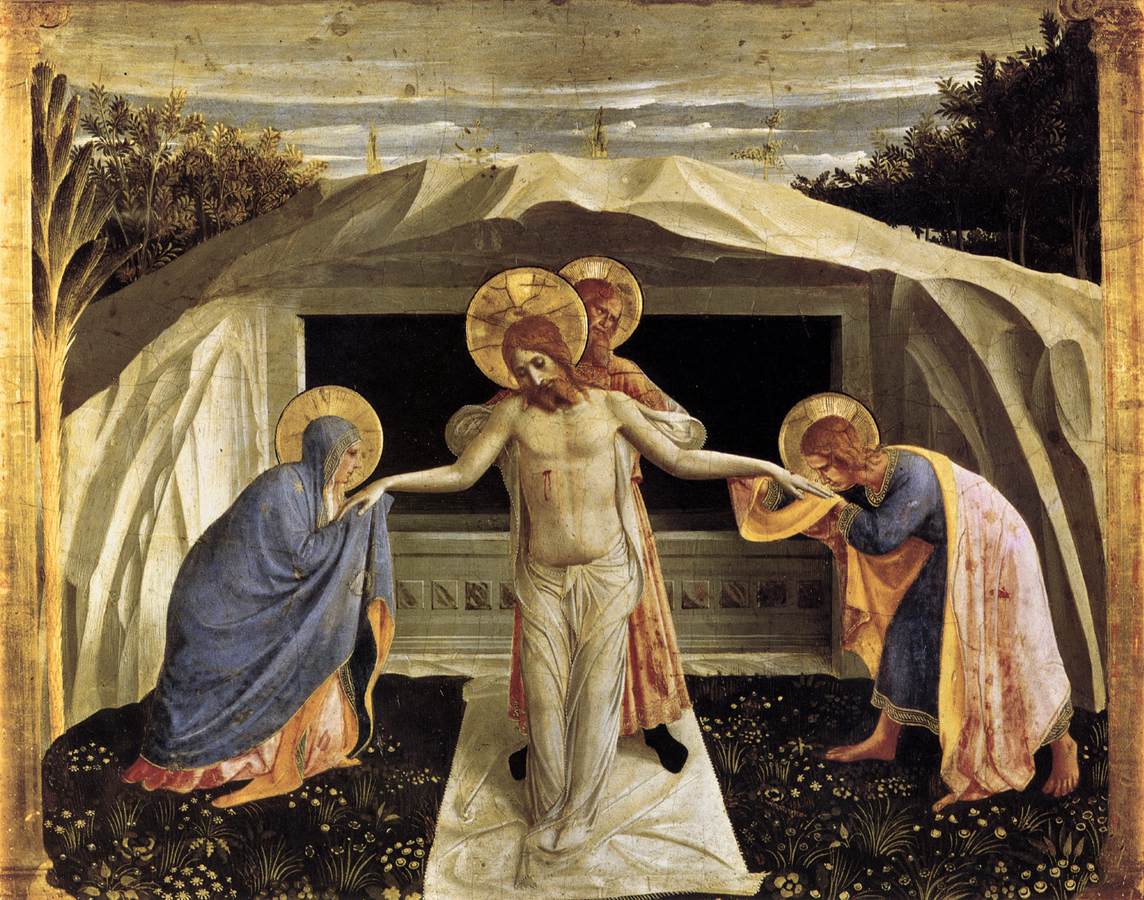
Entombment
Fra Angelico
1438-40
Tempera on wood, 38 x 46 cm
Alte Pinakothek, Munich
Posted on 03/13/2019 12:23:50 AM PDT by Salvation
KEYWORDS: catholic; lent; lk11; prayer;
Please FReepmail me to get on/off the Lenten Ping List.
From: Jonah 3:1-10
Jonah preaches repentance in Nineveh
The people of Nineveh do penance
[6] Then tidings reached the king of Nineveh, and he arose from his throne, re-
moved his robe, and covered himself with sackcloth, and sat in ashes. [7] And
he made proclamation and published through Nineveh, “By the decree of the king
and his nobles: Let neither man nor beast, herd nor flock, taste anything; let them
not feed, or drink water, [8] but let man and beast be covered with sackcloth, and
let them cry mightily to God; yea, let every one turn from his evil way and from the
violence which is in his hands. [9] Who knows, God may yet repent and turn from
his fierce anger, so that we perish not?”
[10] When God saw what they did, how they turned from their evil way, God re-
pented of the evil which he had said he would do to them; and he did not do it.
*********************************************************************************************
Commentary:
3:1-4:11. The second part of the book has a similar structure to the first — God
and Jonah (3:1-3; cf. 1:1-3); Jonah and Gentiles (3:4-10; cf. 1:4-16); Jonah and
God (4:1-11; cf. 1:17-2:10). However, the reader is now psychologically prepared
for what will happen: Jonah’s preaching will produce the desired result and the Ni-
nevites will be converted. So, the story is geared to the last chapter which poses
and solves the question that chapter 3 provokes. The episode described in this
second part is therefore a practical illustration of the scope of God’s mercy. It
was used as such in the debate with the Gnostics who argued that there was a
difference between the good God (the God revealed in the New Testament) and
the God revealed in the Old Testament: “See how the stress is laid on the grea-
test name and quality of God, his Mercy; that is, God is patient with evildoers,
and rich in mercy and compassion for those who recognize their faults and re-
pent them, as the Ninevites did. If such a Being as he is so good, you […] have
to admit that he can do no evil for, as Marcion himself once said, a good tree
cannot bear bad fruit” (Tertullian, “Adversus Marcionem”, 2, 24).
3:1-4. God renews his command to Jonah. And this time Jonah obeys. Maybe
the vows he promised to fulfil in 2:9 had to do with this — going to preach in Nine-
veh. Anyway, the success of his mission is assured, because it depends not on
Jonah but on the Lord: it would take three days to cross Nineveh (v. 3), but he
has only gone one day in his journey and the people convert (cf. 3:5).
3:5-10. The account of the conversion of the Ninevites looks like a straight copy
from other biblical passages, particularly from the prophet Jeremiah: Jeremiah is
the “prophet to the nations” (Jer 1:5), and Jonah is sent to the archetypal Gentile
city. There are many little things in this passage that are reminiscent of Jeremiah:
in the book of Jeremiah, Jerusalem is called the “great city”, which is what Nine-
veh is called here (1:2; 3:2; cf. Jer 22:8-9), and both books have similar turns of
phrase such as “let every one turn from his evil way”, and “man and beast”,
“from the greatest to the least” (3:5, 8; cf. Jer 6:14; 8:10; 36:3, 7), etc. This pas-
sage is particularly reminiscent of the call for a fast made by Jeremiah in the time
of King Jehoiakim; in Jeremiah 36 we are told how the prophet warned of misfor-
tunes to come and proclaimed a fast for conversion (Jer 36:9), but the king refu-
sed to listen. Jonah, too, announces the destruction of Nineveh, but it is the Ni-
nevites themselves who proclaim a general fast, as if God were speaking through
them. Their own king establishes what the fast will involve, and he issues a de-
cree that sounds just like something a prophet would have said (vv. 7-9); cf. Joel
2:12-14). Furthermore, the king of the Ninevites seems to be quite familiar with bi-
blical teaching, for he is well aware (cf. Jer 36:3, 9) that displays of penance will
not automatically stay God’s hand; the king has a genuine change of heart and is
ready to submit to God (v. 9), and when God sees that these people are ready to
mend their ways, he revokes his decision to punish them (v. 10). The episode
bears out Jeremiah’s teaching about repentance (cf. Jer 18:7-8).
The difference between the Ninevites and the Israelites can be seen in the use
that Jesus makes of this passage when he compares his Jewish contemporaries
with their ancestors: “The men of Nineveh will arise at the judgment with this ge-
neration and condemn it; for they repented at the preaching of Jonah, and behold,
something greater than Jonah is here” (Mt 12:41). It is not surprising, then, that
in Christian tradition, the Ninevites are referred to as a model of repentance: “Let
us cast our minds back over the history of men, and see how the Lord, in one ge-
neration after another, granted a time of penance to those who desired to be con-
verted to him. Noah preached salvation, and those who listened to him were saved.
Jonah told the Ninevites that their city would be destroyed, and they repented of
their sins and asked God for forgiveness and were saved by the power of their
pleading, even though they were not part of the chosen people” (St Clement of
Rome, “Ad Corinthios”, 7, 5-7).
And another text by a great Father of the Eastern Church says: “Do not dwell on
how little time you have, but on the love of the Master. The inhabitants of Nine-
veh cooled God’s wrath in three days. They did not despair at how little time was
left to them; their troubled souls won over the goodness of the Master, and he
brought about their salvation” (St John Chrysostom, “De incomprehensibile Dei
natura”, 6).
*********************************************************************************************
Source: “The Navarre Bible: Text and Commentaries”. Biblical text from the
Revised Standard Version and New Vulgate. Commentaries by members of
the Faculty of Theology, University of Navarre, Spain.
Published by Four Courts Press, Kill Lane, Blackrock, Co. Dublin, Ireland, and
by Scepter Publishers in the United States.
From: Luke 11:29-32
The Sign of Jonah
*********************************************************************************************
Commentary:
29-32. Jonah was the prophet who led the Ninevites to do penance: his actions
and preaching they saw as signifying that God had sent him (cf. note on Mat-
thew 12:41-42).
[Note on Matthew 12:41-42 states:
41-42. Nineveh was a city in Mesopotamia (modern Iraq) to which the prophet Jo-
nah was sent. The Ninevites did penance (John 3:6-9) because they recognized
the prophet and accepted his message; whereas Jerusalem does not wish to re-
cognize Jesus, of whom Jonah was merely a figure. The queen of the South was
the queen of Sheba in southwestern Arabia, who visited Solomon (1 Kings 10:1-
10) and was in awe of the wisdom with which God had endowed the King of Isra-
el. Jesus is also prefigured in Solomon, whom Jewish tradition saw as the epito-
me of the wise man. Jesus’ reproach is accentuated by the example of pagan
converts, and gives us a glimpse of the universal scope of Christianity, which will
take root among the Gentiles.
There is a certain irony in what Jesus says about “something greater” than Jonah
or Solomon having come: really, He is infinitely greater, but Jesus prefers to tone
down the difference between Himself and any figure, no matter how important, in
the Old Testament.]
*********************************************************************************************
Source: “The Navarre Bible: Text and Commentaries”. Biblical text from the
Revised Standard Version and New Vulgate. Commentaries by members of
the Faculty of Theology, University of Navarre, Spain.
Published by Four Courts Press, Kill Lane, Blackrock, Co. Dublin, Ireland, and
by Scepter Publishers in the United States.
Liturgical Colour: Violet.
| First reading | Jonah 3:1-10 © |
|---|
| The Ninevites repent, and God spares them |
|---|
| Responsorial Psalm |
|---|
| Psalm 50(51):3-4,12-13,18-19 © |
| Gospel Acclamation | Ezk33:11 |
|---|
| Or: | Joel2:12-13 |
|---|
| Gospel | Luke 11:29-32 © |
|---|
| As Jonah became a sign to the Ninevites, so will the Son of Man be a sign |
|---|
| Luke | |||
| English: Douay-Rheims | Latin: Vulgata Clementina | Greek NT: Byzantine/Majority Text (2000) | |
| Luke 11 |
|||
| 29. | And the multitudes running together, he began to say: This generation is a wicked generation: it asketh a sign, and a sign shall not be given it, but the sign of Jonas the prophet. | Turbis autem concurrentibus cœpit dicere : Generatio hæc, generatio nequam est : signum quærit, et signum non dabitur ei, nisi signum Jonæ prophetæ. | των δε οχλων επαθροιζομενων ηρξατο λεγειν η γενεα αυτη πονηρα εστιν σημειον επιζητει και σημειον ου δοθησεται αυτη ει μη το σημειον ιωνα του προφητου |
| 30. | For as Jonas was a sign to the Ninivites; so shall the Son of man also be to this generation. | Nam sicut fuit Jonas signum Ninivitis, ita erit et Filius hominis generationi isti. | καθως γαρ εγενετο ιωνας σημειον τοις νινευιταις ουτως εσται και ο υιος του ανθρωπου τη γενεα ταυτη |
| 31. | The queen of the south shall rise in the judgment with the men of this generation, and shall condemn them: because she came from the ends of the earth to hear the wisdom of Solomon; and behold more than Solomon here. | Regina austri surget in judicio cum viris generationis hujus, et condemnabit illos : quia venit a finibus terræ audire sapientiam Salomonis : et ecce plus quam Salomon hic. | βασιλισσα νοτου εγερθησεται εν τη κρισει μετα των ανδρων της γενεας ταυτης και κατακρινει αυτους οτι ηλθεν εκ των περατων της γης ακουσαι την σοφιαν σολομωνος και ιδου πλειον σολομωνος ωδε |
| 32. | The men of Ninive shall rise in the judgment with this generation, and shall condemn it; because they did penance at the preaching of Jonas; and behold more than Jonas here. | Viri Ninivitæ surgent in judicio cum generatione hac, et condemnabunt illam : quia pœnitentiam egerunt ad prædicationem Jonæ, et ecce plus quam Jonas hic. | ανδρες νινευι αναστησονται εν τη κρισει μετα της γενεας ταυτης και κατακρινουσιν αυτην οτι μετενοησαν εις το κηρυγμα ιωνα και ιδου πλειον ιωνα ωδε |
Our local Serra Club sponsored a Vocations Rally for all sixth graders in the diocese today. That’s where I have been for the better part of the day.
There were three venues for the kids.
1. Of course, a fun and games, music and pep talk
2. An introduction to different orders of priesthood and consecrated religious life
3. And a panel composed of Bishop Smith of archdpdx
The Director of vocations,
A seminarian
and a consecrated virgin from a local order.
Beautiful
Pray for Pope Francis.
50 Boko Haram Islamic Radicals Killed; 1,000 Hostages, Women and Children, Rescued in Nigeria
Nigeria: In the Face of Ongoing Islamist Attacks, the Faith is Growing
US Promises to Help Nigeria Exterminate Boko Haram
Is This Bishop Right about the Rosary Conquering Boko Haram? [Catholic Caucus]
Why Boko Haram and ISIS Target Women
Report reveals scale of Boko Haram violence inflicted on Nigerian Catholics
Military evacuating girls, women rescued from Boko Haram
Echos of Lepanto Nigerian bishop says rosary will bring down Boko Harm
After vision of Christ, Nigerian bishop says rosary will bring down Boko Haram (Catholic Caucus)
Nigerian Bishop Says Christ Showed Him How to Beat Islamic Terror Group
We thank you, God our Father, for those who have responded to your call to priestly ministry.
Accept this prayer we offer on their behalf: Fill your priests with the sure knowledge of your love.
Open their hearts to the power and consolation of the Holy Spirit.
Lead them to new depths of union with your Son.
Increase in them profound faith in the Sacraments they celebrate as they nourish, strengthen and heal us.
Lord Jesus Christ, grant that these, your priests, may inspire us to strive for holiness by the power of their example, as men of prayer who ponder your word and follow your will.
O Mary, Mother of Christ and our mother, guard with your maternal care these chosen ones, so dear to the Heart of your Son.
Intercede for our priests, that offering the Sacrifice of your Son, they may be conformed more each day to the image of your Son, our Lord and Savior, Jesus Christ. Amen.
Saint John Vianney, universal patron of priests, pray for us and our priests
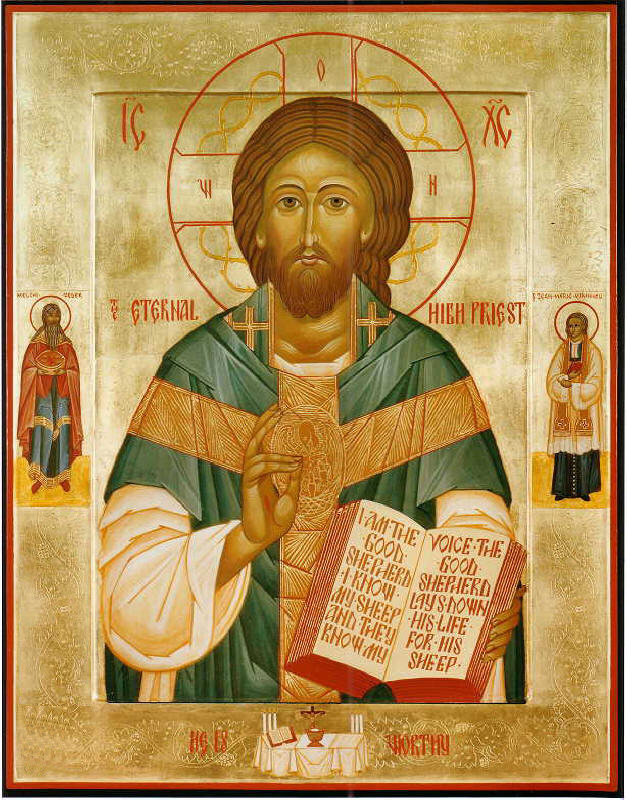
This icon shows Jesus Christ, our eternal high priest.
The gold pelican over His heart represents self-sacrifice.
The border contains an altar and grapevines, representing the Mass, and icons of Melchizedek and St. Jean-Baptiste Vianney.
Melchizedek: king of righteousness (left icon) was priest and king of Jerusalem. He blessed Abraham and has been considered an ideal priest-king.
St. Jean-Baptiste Vianney is the patron saint of parish priests.

1. Sign of the Cross: In the name of the Father, and of the Son, and of the Holy Spirit. Amen.
2. The Apostles Creed: I BELIEVE in God, the Father almighty, Creator of heaven and earth, and in Jesus Christ, His only Son, our Lord, who was conceived by the Holy Spirit, born of the Virgin Mary, suffered under Pontius Pilate, was crucified, died, and was buried. He descended into hell; on the third day he rose again from the dead; he ascended into heaven, and is seated at the right hand of God, the Father Almighty; from there He shall come to judge the living and the dead.
I believe in the Holy Spirit, the holy catholic Church, the communion of saints, the forgiveness of sins, the resurrection of the body, and the life everlasting. Amen.
3. The Lord's Prayer: OUR Father, who art in heaven, hallowed be Thy name. Thy kingdom come. Thy will be done on earth as it is in heaven. Give us this day our daily bread and forgive us our trespasses as we forgive those who trespass against us. And lead us not into temptation, but deliver us from evil. Amen.
4. (3) Hail Mary: HAIL Mary, full of grace, the Lord is with thee. Blessed art thou amongst women and blessed is the fruit of thy womb, Jesus. Holy Mary, Mother of God, pray for us sinners, now, and in the hour of our death. Amen. (Three times)
5. Glory Be: GLORY be to the Father, and to the Son, and to the Holy Spirit. As it was in the beginning, is now, and ever shall be, world without end. Amen.
6. Fatima Prayer: Oh, my Jesus, forgive us our sins, save us from the fires of hell, lead all souls to heaven, especially those in most need of your mercy.
Announce each mystery, then say 1 Our Father, 10 Hail Marys, 1 Glory Be and 1 Fatima prayer. Repeat the process with each mystery.
End with the Hail Holy Queen:
Hail, Holy Queen, Mother of Mercy, our life, our sweetness and our hope! To thee do we cry, poor banished children of Eve! To thee do we send up our sighs, mourning and weeping in this vale of tears! Turn then, most gracious advocate, thine eyes of mercy towards us; and after this, our exile, show unto us the blessed fruit of thy womb, Jesus!
O clement, O loving, O sweet Virgin Mary! Pray for us, O holy Mother of God, that we may be made worthy of the promises of Christ.
Final step -- The Sign of the Cross
The Mysteries of the Rosary By tradition, Catholics meditate on these Mysteries during prayers of the Rosary. The biblical references follow each of the Mysteries below.
The Glorious Mysteries
(Wednesdays and Sundays)
1.The Resurrection (Matthew 28:1-8, Mark 16:1-18, Luke 24:1-12, John 20:1-29) [Spiritual fruit - Faith]
2. The Ascension (Mark 16:19-20, Luke 24:50-53, Acts 1:6-11) [Spiritual fruit - Christian Hope]
3. The Descent of the Holy Spirit (Acts 2:1-13) [Spiritual fruit - Gifts of the Holy Spirit]
4. The Assumption [Spiritual fruit - To Jesus through Mary]
5. The Coronation [Spiritual fruit - Grace of Final Perseverance]
Disclaimer: Opinions posted on Free Republic are those of the individual posters and do not necessarily represent the opinion of Free Republic or its management. All materials posted herein are protected by copyright law and the exemption for fair use of copyrighted works.