Skip to comments.
Catholic Caucus: Daily Mass Readings, 03-10-19, First Sunday of Lent
USCCB.org/RNAB ^
| 03-10-19
| Revised New American Bible
Posted on 03/09/2019 9:04:18 PM PST by Salvation
March 10 2019
First Sunday of Lent
Moses spoke to the people, saying:
"The priest shall receive the basket from you
and shall set it in front of the altar of the LORD, your God.
Then you shall declare before the Lord, your God,
'My father was a wandering Aramean
who went down to Egypt with a small household
and lived there as an alien.
But there he became a nation
great, strong, and numerous.
When the Egyptians maltreated and oppressed us,
imposing hard labor upon us,
we cried to the LORD, the God of our fathers,
and he heard our cry
and saw our affliction, our toil, and our oppression.
He brought us out of Egypt
with his strong hand and outstretched arm,
with terrifying power, with signs and wonders;
and bringing us into this country,
he gave us this land flowing with milk and honey.
Therefore, I have now brought you the firstfruits
of the products of the soil
which you, O LORD, have given me.'
And having set them before the Lord, your God,
you shall bow down in his presence."
R. (cf. 15b) Be with me, Lord, when I am in trouble.
You who dwell in the shelter of the Most High,
who abide in the shadow of the Almighty,
say to the LORD, "My refuge and fortress,
my God in whom I trust."
R. Be with me, Lord, when I am in trouble.
No evil shall befall you,
nor shall affliction come near your tent,
For to his angels he has given command about you,
that they guard you in all your ways.
R. Be with me, Lord, when I am in trouble.
Upon their hands they shall bear you up,
lest you dash your foot against a stone.
You shall tread upon the asp and the viper;
you shall trample down the lion and the dragon.
R. Be with me, Lord, when I am in trouble.
Because he clings to me, I will deliver him;
I will set him on high because he acknowledges my name.
He shall call upon me, and I will answer him;
I will be with him in distress;
I will deliver him and glorify him.
R. Be with me, Lord, when I am in trouble.
Brothers and sisters:
What does Scripture say?
The word is near you,
in your mouth and in your heart—that is, the word of faith that we preach—,
for, if you confess with your mouth that Jesus is Lord
and believe in your heart that God raised him from the dead,
you will be saved.
For one believes with the heart and so is justified,
and one confesses with the mouth and so is saved.
For the Scripture says,
No one who believes in him will be put to shame.For there is no distinction between Jew and Greek;
the same Lord is Lord of all,
enriching all who call upon him.
For "everyone who calls on the name of the Lord will be saved."
Verse Before the Gospel Mt 4:4b
One does not live on bread alone,
but on every word that comes forth from the mouth of God.
Filled with the Holy Spirit, Jesus returned from the Jordan
and was led by the Spirit into the desert for forty days,
to be tempted by the devil.
He ate nothing during those days,
and when they were over he was hungry.
The devil said to him,
"If you are the Son of God,
command this stone to become bread."
Jesus answered him,
"It is written, One does not live on bread alone."
Then he took him up and showed him
all the kingdoms of the world in a single instant.
The devil said to him,
"I shall give to you all this power and glory;
for it has been handed over to me,
and I may give it to whomever I wish.
All this will be yours, if you worship me."
Jesus said to him in reply,
"It is written:
You shall worship the Lord, your God,
and him alone shall you serve."
Then he led him to Jerusalem,
made him stand on the parapet of the temple, and said to him,
"If you are the Son of God,
throw yourself down from here, for it is written:
He will command his angels concerning you, to guard you,
and:
With their hands they will support you,
lest you dash your foot against a stone."
Jesus said to him in reply,
"It also says,
You shall not put the Lord, your God, to the test."
When the devil had finished every temptation,
he departed from him for a time.
TOPICS: Catholic; General Discusssion; Prayer; Worship
KEYWORDS: catholic; lent; lk4; prayer
Navigation: use the links below to view more comments.
first 1-20, 21-40, 41-48 next last
For your reading, reflection, faith-sharing, comments, questions, discussion.
1
posted on
03/09/2019 9:04:18 PM PST
by
Salvation
To: All
KEYWORDS: catholic; lent; lk4; prayer;
2
posted on
03/09/2019 9:05:03 PM PST
by
Salvation
("With God all things are possible." Matthew 19:26)
To: nickcarraway; NYer; ELS; Pyro7480; livius; ArrogantBustard; Catholicguy; RobbyS; marshmallow; ...
Praise to you, Lord Jesus Christ PingPlease FReepmail me to get on/off the Lenten Ping List.
3
posted on
03/09/2019 9:05:50 PM PST
by
Salvation
("With God all things are possible." Matthew 19:26)
To: All
From: Deuteronomy 26:4-10
First Fruits
(Moses spoke to the people saying,) [4] “Then the priest shall take the basket
from your hand, and set it down before the altar of the Lord your God.
[5] “And you shall make response before the Lord your God, ‘A wandering Ara-
mean was my father; and he went down into Egypt and sojourned there, few in
number; and there he became a nation, great, mighty, and populous. [6] And
the Egyptians treated us harshly, and afflicted us, and laid upon us hard bon-
dage. [7] Then we cried to the Lord the God of our fathers, and the Lord heard
our voice, and saw our affliction, our toil, and our oppression; [8] and the Lord
brought us out of Egypt with a mighty hand and an outstretched arm, with great
terror, with signs and wonders; [9] and he brought us into this place and gave
us this land, a land flowing with milk and honey. [10] And behold, now I bring the
first of the fruit of the ground, which thou, O Lord, hast given me.’ And you shall
set it down before the Lord your God, and worship before the Lord your God.
*********************************************************************************************
Commentary:
26:1-11. The Deuteronomic Code, which began by specifying that there should
be only one sanctuary (cf. chap. 12), concludes by giving the prayers that were
to be said in that sanctuary in connection with the offering of the first fruits.
The offering of the first fruits was an appropriate way for Israel to express grati-
tude for the great deeds done by God, the “magnalia Dei”, the wonders he
worked in liberating the people from bondage and establishing them in the pro-
mised land.
The prayer that is said on this occasion (vv. 5-9) is a kind of historical-religious
Creed, a very important one, which takes in all the main features of Old Testa-
ment faith. It is a summary of the history of Israel, centered on its deliverance
from Egypt and settlement in the promised land. These two saving actions form
a paradigm: they are the hinges on which this “creed” (vv. 8-9) turns. Other Old
Testament passages containing similar “professions of faith” are to be found in
Deut 6:20-23; Josh 24:1-13; Neh 9:4ff; Jer 32:16-25 and Ps 136.
Jacob is portrayed as a key figure in the early history of the people of Israel; he
personifies the patriarchal era. The reference to him not by name but as a “wan-
dering Aramaean” (v. 5) underlines the contrast between the miserable circum-
stances of Israel earlier and settlement in the promised land. Jacob could be
called an Aramaean because Abraham may have been connected with the mi-
grations of Aramaean tribes. Moreover, one must bear in mind the long years
Jacob spent in north-eastern Mesopotamia, and his Aramaean wives (Gen 29-
30). The prayer at the first-fruits offering heightens the contrast between the po-
verty of the homeless, landless Aramaean and the prosperity of the rich land-
owner enjoying his freedom in a land flowing with milk and honey.
*********************************************************************************************
Source: “The Navarre Bible: Text and Commentaries”. Biblical text from the
Revised Standard Version and New Vulgate. Commentaries by members of
the Faculty of Theology, University of Navarre, Spain.
Published by Four Courts Press, Kill Lane, Blackrock, Co. Dublin, Ireland, and
by Scepter Publishers in the United States.
4
posted on
03/09/2019 9:06:54 PM PST
by
Salvation
("With God all things are possible." Matthew 19:26)
To: All
From: Romans 10:8-13
Israel’s Infidelity (Continuation)
[8] But what does it [Moses’ writing] say? The word is near you, on your lips
and in your heart (that is, the word of faith which we preach); [9] because, If
you confess with your lips that Jesus is Lord and believe in your heart that
God raised him from the dead, you will be saved. [10] For man believes with
his heart and so is justified, and he confesses with his lips and so is saved.
[11] The scripture says, “No one who believes in him will be put to shame.”
[12] For there is no distinction between Jew and Greek; the same Lord is
Lord of all and bestows his riches upon all who call upon him. [13] For, “eve-
ry one who calls upon the name of the Lord will be saved.”
******************************************************************************************
Commentary:
6-8. St Paul here quotes and applies some words from Deuteronomy: “This
commandment,” Moses tells the people of Israel, “which I command you this
day is not too hard for you, neither is it far off. It is not in heaven, that you
should say, ‘Who will go up for us to heaven, and bring it to us, that we may
hear it and do it? [...] Who will go over the sea for us, and bring it to us, that
we may hear it and do it?’ But the word is very near you; it is in your mouth
and in your heart, so that you can do it” (Deut 30:11-14). The law which God
handed to Moses, then, clearly revealed his will and made it much easier to
fulfill. By the Incarnation, the Word of God became flesh and dwelt among us
and showed us the way to God. For the Christian the life and teaching of the
Word made flesh are divine precepts and commandments. Through his Incar-
nation Jesus Christ brought us grace and truth; by rising from the dead he
conquered death; and by ascending into heaven and, with the Father, sen-
ding the Holy Spirit, he perfected his work of redemption.
9. At least from the third century B.C. we have documentary evidence that,
out of respect, the Jews did not utter the name “Yahweh” but generally re-
ferred to God instead as “Lord”. The first Christians, by giving Christ the title
of “Lord”, were making a profession of faith in the divinity of Jesus.
10. To make the act of faith, human free will must necessarily be involved as
St Thomas explains when commenting on this passage: “He very rightly says
that man believes with his heart. Because everything else to do with external
worship of God, man can do it against his will, but he cannot believe if he
does not want to believe. So, the mind of a believer is not obliged to adhere
to the truth by rational necessity, as is the case with human knowledge: it
is moved by the will” (”Commentary on Rom, ad loc.”)
However, in order to live by faith, in addition to internal assent external pro-
fession of faith is required; man is made up of body and soul and therefore
he tends by nature to express his inner convictions externally; when the ho-
nor of God or the good of one’s neighbor requires it, one even has an obliga-
tion to profess one’s faith externally. For example, in the case of persecution
we are obliged to profess our faith, even at the risk of life, if, on being interro-
gated about our beliefs, our silence would lead people to suppose that we
did not believe or that we did not hold our faith to be the true faith and our bad
example would cause others to fall away from the faith. However, external pro-
fession is an obligation not only in extreme situations of that kind. In all situa-
tions — be they ordinary or exceptional — God will always help us to confess
our faith boldly (cf. Mt 10:32-33; Lk 12:8).
******************************************************************************************
Source: “The Navarre Bible: Text and Commentaries”. Biblical text from the
Revised Standard Version and New Vulgate. Commentaries by members of
the Faculty of Theology, University of Navarre, Spain.
Published by Four Courts Press, Kill Lane, Blackrock, Co. Dublin, Ireland, and
by Scepter Publishers in the United States.
5
posted on
03/09/2019 9:07:38 PM PST
by
Salvation
("With God all things are possible." Matthew 19:26)
To: All
From: Luke 4:1-13
Jesus Fasts and Is Tempted in the Wilderness
[1] And Jesus, full of the Holy Spirit, returned from the Jordan and was led by
the Spirit [2] for forty days in the wilderness, tempted by the devil. And He ate
nothing in those days; and when they were ended, He was hungry. [3] The devil
said to Him, “If You are the Son of God, command this stone to become bread.”
[4] And Jesus answered him, “It is written, ‘Man shall not live by bread alone.’”
[5] And the devil took Him up, and showed Him all the kingdoms of the world in
a moment of time, [6] and said to Him, “To You I will give all this authority and
glory; for it has been delivered to me, and I give it to whom I will. [7] If you, then,
will worship me, it shall all be yours.” [8] And Jesus answered, “It is written,
‘You shall worship the Lord your God, and Him only shall you serve.’”
[9] And he took Him to Jerusalem, and set Him on the pinnacle of the temple,
and said to Him, “If You are the Son of God, throw Yourself down from here;
[10] for it is written, ‘He will give His angels charge of you, to guard you,’ [11]
and ‘On their hands they will bear you up, lest you strike your foot against a
stone.’”
[12] And Jesus answered him, “It is said, ‘You shall not tempt the Lord your
God.’” [13] And when the devil had ended every temptation, he departed from
Him until an opportune time.
*********************************************************************************************
Commentary:
1-13. Here we see the devil interfere with Jesus’ life for the first time. He does
so very brazenly. Our Lord is about to begin His public ministry, so it is a parti-
cularly important point in His work of salvation.
“The whole episode is a mystery which man cannot hope to understand — God
submitting to temptation, letting the Evil One have his way. But we can meditate
upon it, asking our Lord to help us understand the teaching it contains” (St. J.
Escriva, “Christ Is Passing By”, 61).
Christ, true God and true man, made Himself like us in everything except sin (cf.
Philippians 2:7; Hebrews 2:7; 4:15) and voluntarily underwent temptation. “How
fortunate we are,” exclaims the Cure of Ars, “how lucky to have a God as a mo-
del. Are we poor? We have a God who is born in a stable, who lies in a manger.
Are we despised? We have a God who led the way, who was crowned with
thorns, dressed in a filthy red cloak and treated as a madman. Are we tormen-
ted by pain and suffering? Before our eyes we have a God covered with wounds,
dying in unimaginable pain. Are we being persecuted? How can we dare com-
plain when we have a God who is being put to death by executioners? Finally,
are we being tempted by the demon? We have our lovable Redeemer; He was
also tempted by the demon and was twice taken up by that hellish spirit: there-
fore, no matter what sufferings, pains or temptations we are experiencing, we
always have, everywhere, our God leading the way for us and assuring us of vic-
tory as long as we genuinely desire it” (”Selected Sermons”, First Sunday of
Lent).
Jesus teaches us therefore that no one should regard himself as incorruptible
and proof against temptation; He shows us how we should deal with temptation
and exhorts us to have confidence in His mercy, since He Himself experienced
temptation (cf. Hebrews 2:18).
For further explanation of this passage, see the notes on Matthew 4:3-11.
13. Our Lord’s temptations sum up every kind of temptation man can experience:
“Scripture would not have said”, St. Thomas comments, “that once all the temp-
tation ended the devil departed from Him, unless the matter of all sins were inclu-
ded in the three temptations already related. For the causes of temptation are
the causes of desires — namely, lust of the flesh, desire for glory, eagerness for
power” (”Summa Theologiae”, III, q. 41, a. 4 ad 4).
By conquering every kind of temptation, Jesus shows us how to deal with the
snares of the devil. It was as a man that He was tempted and as a man that He
resisted: “He did not act as God, bringing His power into play; if He had done
so, how could we have availed of His example? Rather, as a man He made use
of the resources which He has in common with us” (St. Ambrose, “Expositio
Evangelii Sec. Lucam, in loc.”).
He wanted to show us the methods to use to defeat the devil — prayer, fasting,
watchfulness, not dialoguing with temptation, having the words of God’s Scrip-
ture on our lips and putting our trust in the Lord.
“Until an opportune time”, that is, until it is time for Jesus to undergo His pas-
sion. The devil often appears in the course of our Lord’s public life (cf., for exam-
ple, Mark 12:28), but it will be at the Passion—”this is your hour, and the power
of darkness” (Luke 22:53)—that he will be most clearly seen in his role as temp-
ter. Jesus will forewarn His disciples about this and once more assure them of
victory (cf. John 12:31; 14:30). Through the passion, death and resurrection of
Christ, the devil will be overpowered once and for all. And by virtue of Christ’s
victory we are enabled to overcome all temptations.
*********************************************************************************************
Source: “The Navarre Bible: Text and Commentaries”. Biblical text from the
Revised Standard Version and New Vulgate. Commentaries by members of
the Faculty of Theology, University of Navarre, Spain.
Published by Four Courts Press, Kill Lane, Blackrock, Co. Dublin, Ireland, and
by Scepter Publishers in the United States. We encourage readers to purchase
The Navarre Bible for personal study. See Scepter Publishers for details.
“Ignorance of Scripture is ignorance of Christ.” — St Jerome
“The Father uttered one Word; that Word is His Son, and He utters Him forever
in everlasting silence: and in silence the soul has to hear it.
— St John of the Cross
Ad Majorem Dei Gloriam (To the Greater Glory of God)
For: Sunday, February 17, 2013
1st Sunday of Lent
From: Luke 4:1-13
Jesus Fasts and Is Tempted in the Wilderness
[1] And Jesus, full of the Holy Spirit, returned from the Jordan and was led by
the Spirit [2] for forty days in the wilderness, tempted by the devil. And He ate
nothing in those days; and when they were ended, He was hungry. [3] The devil
said to Him, “If You are the Son of God, command this stone to become bread.”
[4] And Jesus answered him, “It is written, ‘Man shall not live by bread alone.’”
[5] And the devil took Him up, and showed Him all the kingdoms of the world in
a moment of time, [6] and said to Him, “To You I will give all this authority and
glory; for it has been delivered to me, and I give it to whom I will. [7] If you, then,
will worship me, it shall all be yours.” [8] And Jesus answered, “It is written,
‘You shall worship the Lord your God, and Him only shall you serve.’”
[9] And he took Him to Jerusalem, and set Him on the pinnacle of the temple,
and said to Him, “If You are the Son of God, throw Yourself down from here;
[10] for it is written, ‘He will give His angels charge of you, to guard you,’ [11]
and ‘On their hands they will bear you up, lest you strike your foot against a
stone.’”
[12] And Jesus answered him, “It is said, ‘You shall not tempt the Lord your
God.’” [13] And when the devil had ended every temptation, he departed from
Him until an opportune time.
*********************************************************************************************
Commentary:
1-13. Here we see the devil interfere with Jesus’ life for the first time. He does
so very brazenly. Our Lord is about to begin His public ministry, so it is a parti-
cularly important point in His work of salvation.
“The whole episode is a mystery which man cannot hope to understand — God
submitting to temptation, letting the Evil One have his way. But we can meditate
upon it, asking our Lord to help us understand the teaching it contains” (St. J.
Escriva, “Christ Is Passing By”, 61).
Christ, true God and true man, made Himself like us in everything except sin (cf.
Philippians 2:7; Hebrews 2:7; 4:15) and voluntarily underwent temptation. “How
fortunate we are,” exclaims the Cure of Ars, “how lucky to have a God as a mo-
del. Are we poor? We have a God who is born in a stable, who lies in a manger.
Are we despised? We have a God who led the way, who was crowned with
thorns, dressed in a filthy red cloak and treated as a madman. Are we tormen-
ted by pain and suffering? Before our eyes we have a God covered with wounds,
dying in unimaginable pain. Are we being persecuted? How can we dare com-
plain when we have a God who is being put to death by executioners? Finally,
are we being tempted by the demon? We have our lovable Redeemer; He was
also tempted by the demon and was twice taken up by that hellish spirit: there-
fore, no matter what sufferings, pains or temptations we are experiencing, we
always have, everywhere, our God leading the way for us and assuring us of vic-
tory as long as we genuinely desire it” (”Selected Sermons”, First Sunday of
Lent).
Jesus teaches us therefore that no one should regard himself as incorruptible
and proof against temptation; He shows us how we should deal with temptation
and exhorts us to have confidence in His mercy, since He Himself experienced
temptation (cf. Hebrews 2:18).
For further explanation of this passage, see the notes on Matthew 4:3-11.
13. Our Lord’s temptations sum up every kind of temptation man can experience:
“Scripture would not have said”, St. Thomas comments, “that once all the temp-
tation ended the devil departed from Him, unless the matter of all sins were inclu-
ded in the three temptations already related. For the causes of temptation are
the causes of desires — namely, lust of the flesh, desire for glory, eagerness for
power” (”Summa Theologiae”, III, q. 41, a. 4 ad 4).
By conquering every kind of temptation, Jesus shows us how to deal with the
snares of the devil. It was as a man that He was tempted and as a man that He
resisted: “He did not act as God, bringing His power into play; if He had done
so, how could we have availed of His example? Rather, as a man He made use
of the resources which He has in common with us” (St. Ambrose, “Expositio
Evangelii Sec. Lucam, in loc.”).
He wanted to show us the methods to use to defeat the devil — prayer, fasting,
watchfulness, not dialoguing with temptation, having the words of God’s Scrip-
ture on our lips and putting our trust in the Lord.
“Until an opportune time”, that is, until it is time for Jesus to undergo His pas-
sion. The devil often appears in the course of our Lord’s public life (cf., for exam-
ple, Mark 12:28), but it will be at the Passion—”this is your hour, and the power
of darkness” (Luke 22:53)—that he will be most clearly seen in his role as temp-
ter. Jesus will forewarn His disciples about this and once more assure them of
victory (cf. John 12:31; 14:30). Through the passion, death and resurrection of
Christ, the devil will be overpowered once and for all. And by virtue of Christ’s
victory we are enabled to overcome all temptations.
*********************************************************************************************
Source: “The Navarre Bible: Text and Commentaries”. Biblical text from the
Revised Standard Version and New Vulgate. Commentaries by members of
the Faculty of Theology, University of Navarre, Spain.
Published by Four Courts Press, Kill Lane, Blackrock, Co. Dublin, Ireland, and
by Scepter Publishers in the United States.
6
posted on
03/09/2019 9:08:21 PM PST
by
Salvation
("With God all things are possible." Matthew 19:26)
To: Salvation
Scripture readings from the Jerusalem Bible by Darton, Longman & Todd
Readings at Mass
Liturgical Colour: Violet.
| First reading |
| Deuteronomy 26:4-10 © |
| The creed of the Chosen People |
Moses said to the people: ‘The priest shall take the pannier from your hand and lay it before the altar of the Lord your God. Then, in the sight of the Lord your God, you must make this pronouncement:
‘“My father was a wandering Aramaean. He went down into Egypt to find refuge there, few in numbers; but there he became a nation, great, mighty, and strong. The Egyptians ill-treated us, they gave us no peace and inflicted harsh slavery on us. But we called on the Lord, the God of our fathers. The Lord heard our voice and saw our misery, our toil and our oppression; and the Lord brought us out of Egypt with mighty hand and outstretched arm, with great terror, and with signs and wonders. He brought us here and gave us this land, a land where milk and honey flow. Here then I bring the first-fruits of the produce of the soil that you, the Lord, have given me.”
‘You must then lay them before the Lord your God, and bow down in the sight of the Lord your God.’
| Responsorial Psalm |
| Psalm 90(91):1-2,10-15 © |
Be with me, O Lord, in my distress.
He who dwells in the shelter of the Most High
and abides in the shade of the Almighty
says to the Lord: ‘My refuge,
my stronghold, my God in whom I trust!’
Be with me, O Lord, in my distress.
Upon you no evil shall fall,
no plague approach where you dwell.
For you has he commanded his angels,
to keep you in all your ways.
Be with me, O Lord, in my distress.
They shall bear you upon their hands
lest you strike your foot against a stone.
On the lion and the viper you will tread
and trample the young lion and the dragon.
Be with me, O Lord, in my distress.
His love he set on me, so I will rescue him;
protect him for he knows my name.
When he calls I shall answer: ‘I am with you,’
I will save him in distress and give him glory.
Be with me, O Lord, in my distress.
| Second reading |
Romans 10:8-13 © |
| The creed of the Christian |
Scripture says: The word (that is the faith we proclaim) is very near to you, it is on your lips and in your heart. If your lips confess that Jesus is Lord and if you believe in your heart that God raised him from the dead, then you will be saved. By believing from the heart you are made righteous; by confessing with your lips you are saved. When scripture says: those who believe in him will have no cause for shame, it makes no distinction between Jew and Greek: all belong to the same Lord who is rich enough, however many ask his help, for everyone who calls on the name of the Lord will be saved.
Praise to you, O Christ, king of eternal glory!
Man does not live on bread alone,
but on every word that comes from the mouth of God.
Praise to you, O Christ, king of eternal glory!
| The temptation in the wilderness |
Filled with the Holy Spirit, Jesus left the Jordan and was led by the Spirit through the wilderness, being tempted there by the devil for forty days. During that time he ate nothing and at the end he was hungry. Then the devil said to him, ‘If you are the Son of God, tell this stone to turn into a loaf.’ But Jesus replied, ‘Scripture says: Man does not live on bread alone.’
Then leading him to a height, the devil showed him in a moment of time all the kingdoms of the world and said to him, ‘I will give you all this power and the glory of these kingdoms, for it has been committed to me and I give it to anyone I choose. Worship me, then, and it shall all be yours.’ But Jesus answered him, ‘Scripture says:
You must worship the Lord your God,
and serve him alone.’
Then he led him to Jerusalem and made him stand on the parapet of the Temple. ‘If you are the Son of God,’ he said to him ‘throw yourself down from here, for scripture says:
He will put his angels in charge of you
to guard you,
and again:
They will hold you up on their hands
in case you hurt your foot against a stone.’
But Jesus answered him, ‘It has been said:
You must not put the Lord your God to the test.’
Having exhausted all these ways of tempting him, the devil left him, to return at the appointed time.
7
posted on
03/09/2019 9:14:48 PM PST
by
Salvation
("With God all things are possible." Matthew 19:26)
To: All
8
posted on
03/10/2019 3:26:51 PM PDT
by
Salvation
("With God all things are possible." Matthew 19:26)
To: All
9
posted on
03/10/2019 3:46:55 PM PDT
by
Salvation
("With God all things are possible." Matthew 19:26)
To: All
10
posted on
03/10/2019 3:47:47 PM PDT
by
Salvation
("With God all things are possible." Matthew 19:26)
To: All
11
posted on
03/10/2019 3:51:03 PM PDT
by
Salvation
("With God all things are possible." Matthew 19:26)
To: All
12
posted on
03/10/2019 3:59:01 PM PDT
by
Salvation
("With God all things are possible." Matthew 19:26)
To: All
13
posted on
03/10/2019 3:59:29 PM PDT
by
Salvation
("With God all things are possible." Matthew 19:26)
To: All
14
posted on
03/10/2019 4:00:11 PM PDT
by
Salvation
("With God all things are possible." Matthew 19:26)
To: All
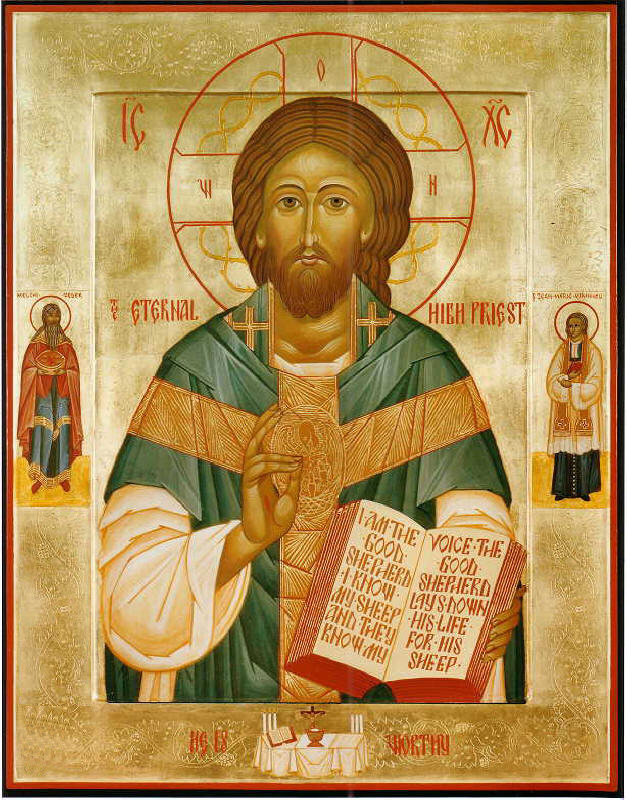
Jesus, High Priest
We thank you, God our Father, for those who have responded to your call to priestly ministry.
Accept this prayer we offer on their behalf: Fill your priests with the sure knowledge of your love.
Open their hearts to the power and consolation of the Holy Spirit.
Lead them to new depths of union with your Son.
Increase in them profound faith in the Sacraments they celebrate as they nourish, strengthen and heal us.
Lord Jesus Christ, grant that these, your priests, may inspire us to strive for holiness by the power of their example, as men of prayer who ponder your word and follow your will.
O Mary, Mother of Christ and our mother, guard with your maternal care these chosen ones, so dear to the Heart of your Son.
Intercede for our priests, that offering the Sacrifice of your Son, they may be conformed more each day to the image of your Son, our Lord and Savior, Jesus Christ. Amen.
Saint John Vianney, universal patron of priests, pray for us and our priests
This icon shows Jesus Christ, our eternal high priest.
The gold pelican over His heart represents self-sacrifice.
The border contains an altar and grapevines, representing the Mass, and icons of Melchizedek and St. Jean-Baptiste Vianney.
Melchizedek: king of righteousness (left icon) was priest and king of Jerusalem. He blessed Abraham and has been considered an ideal priest-king.
St. Jean-Baptiste Vianney is the patron saint of parish priests.
15
posted on
03/10/2019 4:51:24 PM PDT
by
Salvation
("With God all things are possible." Matthew 19:26)
To: All
Pray a Rosary each day for our nation.
1. Sign of the Cross: In the name of the Father, and of the Son, and of the Holy Spirit. Amen.
2. The Apostles Creed: I BELIEVE in God, the Father almighty, Creator of heaven and earth, and in Jesus Christ, His only Son, our Lord, who was conceived by the Holy Spirit, born of the Virgin Mary, suffered under Pontius Pilate, was crucified, died, and was buried. He descended into hell; on the third day he rose again from the dead; he ascended into heaven, and is seated at the right hand of God, the Father Almighty; from there He shall come to judge the living and the dead.
I believe in the Holy Spirit, the holy catholic Church, the communion of saints, the forgiveness of sins, the resurrection of the body, and the life everlasting. Amen.
3. The Lord's Prayer: OUR Father, who art in heaven, hallowed be Thy name. Thy kingdom come. Thy will be done on earth as it is in heaven. Give us this day our daily bread and forgive us our trespasses as we forgive those who trespass against us. And lead us not into temptation, but deliver us from evil. Amen.
4. (3) Hail Mary: HAIL Mary, full of grace, the Lord is with thee. Blessed art thou amongst women and blessed is the fruit of thy womb, Jesus. Holy Mary, Mother of God, pray for us sinners, now, and in the hour of our death. Amen. (Three times)
5. Glory Be: GLORY be to the Father, and to the Son, and to the Holy Spirit. As it was in the beginning, is now, and ever shall be, world without end. Amen.
6. Fatima Prayer: Oh, my Jesus, forgive us our sins, save us from the fires of hell, lead all souls to heaven, especially those in most need of your mercy.
Announce each mystery, then say 1 Our Father, 10 Hail Marys, 1 Glory Be and 1 Fatima prayer. Repeat the process with each mystery.
End with the Hail Holy Queen:
Hail, Holy Queen, Mother of Mercy, our life, our sweetness and our hope! To thee do we cry, poor banished children of Eve! To thee do we send up our sighs, mourning and weeping in this vale of tears! Turn then, most gracious advocate, thine eyes of mercy towards us; and after this, our exile, show unto us the blessed fruit of thy womb, Jesus!
O clement, O loving, O sweet Virgin Mary! Pray for us, O holy Mother of God, that we may be made worthy of the promises of Christ.
Final step -- The Sign of the Cross
The Mysteries of the Rosary By tradition, Catholics meditate on these Mysteries during prayers of the Rosary. The biblical references follow each of the Mysteries below.
The Glorious Mysteries
(Wednesdays and Sundays)
1.The Resurrection (Matthew 28:1-8, Mark 16:1-18, Luke 24:1-12, John 20:1-29) [Spiritual fruit - Faith]
2. The Ascension (Mark 16:19-20, Luke 24:50-53, Acts 1:6-11) [Spiritual fruit - Christian Hope]
3. The Descent of the Holy Spirit (Acts 2:1-13) [Spiritual fruit - Gifts of the Holy Spirit]
4. The Assumption [Spiritual fruit - To Jesus through Mary]
5. The Coronation [Spiritual fruit - Grace of Final Perseverance]
16
posted on
03/10/2019 4:52:14 PM PDT
by
Salvation
("With God all things are possible." Matthew 19:26)
To: All
Or --
Pray a Rosary each day for our nation.
1. Sign of the Cross: In the name of the Father, and of the Son, and of the Holy Spirit. Amen.
2. The Apostles Creed: I BELIEVE in God, the Father almighty, Creator of heaven and earth, and in Jesus Christ, His only Son, our Lord, who was conceived by the Holy Spirit, born of the Virgin Mary, suffered under Pontius Pilate, was crucified, died, and was buried. He descended into hell; on the third day he rose again from the dead; he ascended into heaven, and is seated at the right hand of God, the Father Almighty; from there He shall come to judge the living and the dead.
I believe in the Holy Spirit, the holy catholic Church, the communion of saints, the forgiveness of sins, the resurrection of the body, and the life everlasting. Amen.
3. The Lord's Prayer: OUR Father, who art in heaven, hallowed be Thy name. Thy kingdom come. Thy will be done on earth as it is in heaven. Give us this day our daily bread and forgive us our trespasses as we forgive those who trespass against us. And lead us not into temptation, but deliver us from evil. Amen.
4. (3) Hail Mary: HAIL Mary, full of grace, the Lord is with thee. Blessed art thou amongst women and blessed is the fruit of thy womb, Jesus. Holy Mary, Mother of God, pray for us sinners, now, and in the hour of our death. Amen. (Three times)
5. Glory Be: GLORY be to the Father, and to the Son, and to the Holy Spirit. As it was in the beginning, is now, and ever shall be, world without end. Amen.
6. Fatima Prayer: Oh, my Jesus, forgive us our sins, save us from the fires of hell, lead all souls to heaven, especially those in most need of your mercy.
Announce each mystery, then say 1 Our Father, 10 Hail Marys, 1 Glory Be and 1 Fatima prayer. Repeat the process with each mystery.
End with the Hail Holy Queen:
Hail, Holy Queen, Mother of Mercy, our life, our sweetness and our hope! To thee do we cry, poor banished children of Eve! To thee do we send up our sighs, mourning and weeping in this vale of tears! Turn then, most gracious advocate, thine eyes of mercy towards us; and after this, our exile, show unto us the blessed fruit of thy womb, Jesus!
O clement, O loving, O sweet Virgin Mary! Pray for us, O holy Mother of God, that we may be made worthy of the promises of Christ.
Final step -- The Sign of the Cross
The Mysteries of the Rosary By tradition, Catholics meditate on these Mysteries during prayers of the Rosary. The biblical references follow each of the Mysteries below.
The Sorrowful Mysteries
(Tuesdays and Fridays)
1. The Agony in the Garden (Matthew 26:36-46, Luke 22:39-46) [Spiritual fruit - God's will be done]
2. The Scourging at the Pillar (Matthew 27:26, Mark 15:15, John 19:1) [Spiritual fruit - Mortification of the senses]
3. The Crowning with Thorns (Matthew 27:27-30, Mark 15:16-20, John 19:2) [Spiritual fruit - Reign of Christ in our heart]
4. The Carrying of the Cross (Matthew 27:31-32, Mark 15:21, Luke 23:26-32, John 19:17) [Spiritual fruit - Patient bearing of trials]
5. The Crucifixion (Matthew 27:33-56, Mark 15:22-39, Luke 23:33-49, John 19:17-37) [Spiritual fruit - Pardoning of Injuries]
17
posted on
03/10/2019 4:52:53 PM PDT
by
Salvation
("With God all things are possible." Matthew 19:26)
To: All

St. Michael the Archangel
~ PRAYER ~
St. Michael, the Archangel, defend us in battle
Be our protection against the wickedness
and snares of the devil;
May God rebuke him, we humbly pray,
and do thou, O Prince of the heavenly host,
by the power of God,
Cast into hell Satan and all the evil spirits
who prowl through the world seeking the ruin of souls.
Amen
+
18
posted on
03/10/2019 4:53:42 PM PDT
by
Salvation
("With God all things are possible." Matthew 19:26)
To: All
March Devotion: Saint Joseph
Since the 16th century Catholic piety has assigned entire months to special devotions. Due to the solemnity of Saint Joseph on March 19, this month is devoted to this great saint, the foster father of Christ. "It greatly behooves Christians, while honoring the Virgin Mother of God, constantly to invoke with deep piety and confidence her most chaste spouse, Saint Joseph. We have a well grounded conviction that such is the special desire of the Blessed Virgin herself." --Pope Leo XIII FOR OUR WORK
Glorious Saint Joseph, pattern of all who are devoted to toil, obtain for me the grace to toil in the spirit of penance, in order thereby to atone for my many sins; to toil conscientiously, putting devotion to duty before my own inclinations; to labor with thankfulness and joy, deeming it an honor to employ and to develop, by my labor, the gifts I have received from Almighty God; to work with order, peace, moderation, and patience, without ever shrinking from weariness and difficulties; to work above all with a pure intention and with detachment from self, having always before my eyes the hour of death and the accounting which I must then render of time ill-spent, of talents unemployed, of good undone, and of my empty pride in success, which is so fatal to the work of God. All for Jesus, all through Mary, all in imitation of thee, 0 Patriarch Joseph! This shall be my motto in life and in death. Amen.
FOR THE INTERCESSION OF SAINT JOSEPH
O Joseph, virgin-father of Jesus, most pure spouse of the Virgin Mary, pray every day for us to the same Jesus, the Son of God, that we, being defended by the power of His grace and striving dutifully in life, may be crowned by Him at the hour of death.
Prayer Source: Prayer Book, The by Reverend John P. O'Connell, M.A., S.T.D. and Jex Martin, M.A., The Catholic Press, Inc., Chicago, Illinois, 1954
St. Joseph
St. Joseph was an ordinary manual laborer although descended from the royal house of David. In the designs of Providence he was destined to become the spouse of the Mother of God. His high privilege is expressed in a single phrase, "Foster-father of Jesus." About him Sacred Scripture has little more to say than that he was a just man-an expression which indicates how faithfully he fulfilled his high trust of protecting and guarding God's greatest treasures upon earth, Jesus and Mary.
The darkest hours of his life may well have been those when he first learned of Mary's pregnancy; but precisely in this time of trial Joseph showed himself great. His suffering, which likewise formed a part of the work of the redemption, was not without great providential import: Joseph was to be, for all times, the trustworthy witness of the Messiah's virgin birth. After this, he modestly retires into the background of holy Scripture.
Of St. Joseph's death the Bible tells us nothing. There are indications, however, that he died before the beginning of Christ's public life. His was the most beautiful death that one could have, in the arms of Jesus and Mary. Humbly and unknown, he passed his years at Nazareth, silent and almost forgotten he remained in the background through centuries of Church history. Only in more recent times has he been accorded greater honor. Liturgical veneration of St. Joseph began in the fifteenth century, fostered by Sts. Brigid of Sweden and Bernadine of Siena. St. Teresa, too, did much to further his cult.
At present there are two major feasts in his honor. On March 19 our veneration is directed to him personally and to his part in the work of redemption, while on May 1 we honor him as the patron of workmen throughout the world and as our guide in the difficult matter of establishing equitable norms regarding obligations and rights in the social order.
Excerpted from The Church's Year of Grace, Pius Parsch.
St. Joseph is invoked as patron for many causes. He is the patron of the Universal Church. He is the patron of the dying because Jesus and Mary were at his death-bed. He is also the patron of fathers, of carpenters, and of social justice. Many religious orders and communities are placed under his patronage.
Patron: Against doubt; against hesitation; Americas; Austria; Diocese of Baton Rouge, Louisiana; California; Belgium; Bohemia; bursars; cabinetmakers; Canada; Carinthia; carpenters; China; Church; confectioners; craftsmen; Croatian people (in 1687 by decree of the Croatian parliament) dying people; emigrants; engineers; expectant mothers; families; fathers; Florence, Italy; happy death; holy death; house hunters; immigrants; interior souls; Korea; laborers; Diocese of La Crosse, Wisconsin; Archdiocese of Louisville, Kentucky; Diocese of Manchester, New Hampshire; Mexico; Diocese of Nashville, Tennessee; New France; New World; Oblates of Saint Joseph; people in doubt; people who fight Communism; Peru; pioneers; pregnant women; protection of the Church; Diocese of San Jose, California; diocese of Sioux Falls, South Dakota; social justice; Styria, Austria; travelers; Turin Italy; Tyrol Austria; unborn children Universal Church; Vatican II; Viet Nam; Diocese of Wheeling-Charleston West Virginia; wheelwrights; workers; working people.
Symbols: Bible; branch; capenter's square; carpenter's tools; chalice; cross; hand tools; infant Jesus; ladder; lamb; lily; monstrance; old man holding a lily and a carpenter's tool such as a square; old man holding the infant Jesus; plane; rod.
Pope Pius X composed this prayer to St. Joseph, patron of working people, that expresses concisely the Christian attitude toward labor. It summarizes also for us the lessons of the Holy Family's work at Nazareth.
Glorious St. Joseph, model of all who devote their lives to labor, obtain for me the grace to work in the spirit of penance in order thereby to atone for my many sins; to work conscientiously, setting devotion to duty in preference to my own whims; to work with thankfulness and joy, deeming it an honor to employ and to develop by my labor the gifts I have received from God; to work with order, peace, moderation, and patience, without ever shrinking from weariness and difficulties; to work above all with a pure intention and with detachment from self, having always before my eyes the hour of death and the accounting which I must then render of time ill spent, of talents wasted, of good omitted, and of vain complacency in success, which is so fatal to the work of God.
All for Jesus, all through Mary, all in imitation of you, O Patriarch Joseph! This shall be my motto in life and in death, Amen.
Litany of Saint Joseph
Lord, have mercy on us.
Christ, have mercy on us.
Lord, have mercy on us.
Christ, hear us.
Christ, graciously hear us.
God, the Father of Heaven, have mercy on us.
God, the Son, Redeemer of the world, have mercy on us.
God, the Holy Ghost, have mercy on us.
Holy Trinity, One God, have mercy on us.
Holy Mary, pray for us.
Holy Joseph, pray for us.
Illustrious Son of David, pray for us.
Light of the Patriarchs, pray for us.
Spouse of the Mother of God, pray for us.
Chaste Guardian of the Virgin, pray for us.
Foster-Father of the Son of God, pray for us.
Faithful Protector of Christ, pray for us.
Head of the Holy Family, pray for us.
Joseph most just, pray for us.
Joseph most chaste, pray for us.
Joseph most prudent, pray for us.
Joseph most courageous, pray for us.
Joseph most obedient, pray for us.
Joseph most faithful, pray for us.
Mirror of patience, pray for us.
Lover of poverty, pray for us.
Model of working men, pray for us.
Ornament of the domestic life, pray for us.
Guardian of virgins, pray for us.
Pillar of the family, pray for us.
Consoler of the miserable, pray for us.
Hope of the sick, pray for us.
Patron of the dying, pray for us.
Terror of demons, pray for us.
Protector of the Holy Church, pray for us.
Lamb of God, who takest away the sins of the world, Spare us, O Lord.
Lamb of God, who takest away the sins of the world, Graciously hear us, O Lord.
Lamb of God, who takest away the sins of the world, Have mercy on us.
V. He hath made him master of His house.
R. And ruler of all His possessions.
Let us pray.
O God, who in Thy ineffable providence didst vouchsafe to choose blessed Joseph to be the Spouse of Thy most holy Mother: grant, we beseech Thee, that we may have him for our intercessor in Heaven, whom on earth we venerate as out most holy Protector. Who livest and reignest world without end. Amen.
Was St. Joseph a tzadik?
St. Joseph: Patron saint of three Popes [Catholic Caucus]
St. Joseph and the Staircase
St. Joseph, Foster Father, Novena [Catholic/Orthodox Caucus]
Patron of a “Happy Death” A Special Role for St. Joseph [Catholic/Orhtodox Caucus]
Lists Every Catholic Should be Familiar With: The 7 Sorrows and 7 Joys of St. Joseph
Catholic Group Blasts Pelosi For Invoking St. Joseph on Pro-Abortion Health Care Bill
THE SEVEN SORROWS AND SEVEN JOYS OF ST. JOSEPH
Joseph, Mary and Jesus: A Model Family
Season of Announcement - Revelation to Joseph
In hard times, don't forget about the humble carpenter Joseph
Saint Joseph: Complete submission to the will of God (Pope Benedict XVI) (Catholic/Orthodox Caucus)
St. Joseph as Head of the Holy Family (Catholic/Orthodox Caucus)
St. Joseph, Patron of a Peaceful Death [Catholic Caucus]
Octave: St. Joseph, A 'Man’s Man', Calling Men to Jesus
St. Teresa de Avila's Devotion to St. Joseph (Catholic Caucus)
Catholic Men's National Day of Prayer, MARCH 15, 2008, The Solemnity of St. Joseph (Catholic Caucus)
The Role and Responsibility of Fatherhood - St. Joseph as Model
St. Joseph - Foster Father of Jesus
Some divine intervention in real estate-[Bury St. Joseph Statues in Ground]
Many Turn To Higher Power For Home Sales
St. Joseph the Worker, Memorial, May 1
Catholic Devotions: St. Joseph the Worker
Nothing Will Be Denied Him (St. Joseph)
The Heart of a Father [St. Joseph]
St. Joseph's DAY
Quemadmodum Deus - Decree Under Blessed Pius IX, Making St. Joseph Patron of the Church
Father & Child (Preaching on St. Joseph)
March 19 - Feast of St. Joseph - Husband of Mary - Intercessor of civil leaders
St. Joseph's Spirit of Silence
St. Joseph's Humility (By St. Francis de Sales)
St. Joseph [Husband of the Blessed Virgin Mary], Solemnity, March 19
St Joseph’s Paternal Love
The Heart of St. Joseph
MORE THAN PATRON OF HOMES, IT'S TIME FOR ST. JOSEPH TO GAIN HIGHEST OF RECOGNITION [Fatherhood]
The Importance of Devotion to St. Joseph
St. Francis de Sales on St. Joseph (Some Excerpts for St. Joseph's Day 2004)
St. Joseph: REDEMPTORIS CUSTOS (Guardian Of The Redeemer)
(Saint) Joseph the Patriarch: A Reflection on the Solemnity of St. Joseph
How I Rediscovered a "Neglected" Saint: Work of Art Inspires Young Man to Rediscover St. Joseph
Novena to Saint Joseph
O Saint Joseph, whose protection is so great, so strong, so prompt before the throne of God, I place in you all my interests and desires.
O Saint Joseph, assist me by your powerful intercession and obtain for me from your Divine Son all spiritual blessings through Jesus Christ, Our Lord; so that having engaged here below your heavenly power, I may offer my thanksgiving and homage to the most loving of Fathers.
O Saint Joseph, I never weary contemplating you and Jesus asleep in your arms; I dare not approach while He reposes near your heart. Press Him in my name and kiss His fine head for me, and ask Him to return the Kiss when I draw my dying breath, Amen.
O Saint Joseph, hear my prayers and obtain my petitions. O Saint Joseph, pray for me. (mention your intention)
St. Joseph Novena
O good father Joseph! I beg you, by all your sufferings, sorrows and joys, to obtain for me what I ask.
(Here name your petition).
Obtain for all those who have asked my prayers, everything that is useful to them in the plan of God. Be near to me in my last moments, that I may eternally sing the praises of Jesus, Mary and Joseph. Amen.
(Our Father, Hail Mary, Glory Be)
19
posted on
03/10/2019 4:54:21 PM PDT
by
Salvation
("With God all things are possible." Matthew 19:26)
To: All
March, 2019
The Holy Father's Prayer Intention
Recognition of the Right of Christian Communities: That Christian communities, especially those who are persecuted, feel that they are close to Christ and have their rights respected.
20
posted on
03/10/2019 4:54:55 PM PDT
by
Salvation
("With God all things are possible." Matthew 19:26)
Navigation: use the links below to view more comments.
first 1-20, 21-40, 41-48 next last
Disclaimer:
Opinions posted on Free Republic are those of the individual
posters and do not necessarily represent the opinion of Free Republic or its
management. All materials posted herein are protected by copyright law and the
exemption for fair use of copyrighted works.
FreeRepublic.com is powered by software copyright 2000-2008 John Robinson

