
Christ Blessing the Children
Nicolaes Maes
1652-53
Oil on canvas, 206 x 154 cm
National Gallery, London
Posted on 03/01/2019 10:43:51 PM PST by Salvation
KEYWORDS: catholic; mk10; ordinarytime; prayer;
Please FReepmail me to get on/off the Alleluia Ping List.
From: Sirach 17:1-15
God and Man
The Divine Judge. A Call to Repentance
*********************************************************************************************
Commentary:
16:24-23:27. These chapters are the second of the five parts we can distinguish
in the book of Sirach. Like all the other parts it opens with doctrinal instruction
(16:24-18:14), dealing this time with the divine Wisdom manifested by the Crea-
tor in all his works; this is followed (18:15-23:27) by a series of practical tea-
chings. As in the previous part it is not easy to see any clear order in the ma-
xims. However, further emphasis is put here on prudence in speech.
16:24-18:14 The doctrinal introduction to the first part of the book (1:1-2:18) sum-
marized the main ideas in the book and put the focus, mainly, on the Lord, the
only God, as being the source of wisdom. Now the author goes on to explain that,
in creating the universe, the Most High arranged all his works in order and laid
down laws to govern them (16:27). First (cf. 16:24-31) we find teachings from the
first chapters of Genesis: creation took place “from [in] the beginning” (16:26a;
Gen 1:1); God determined the order of things (16:26b; Gen 1:3-2:3); with the re-
sult that it “was good” (Gen 1:4, 10, 12, 18, 21, 25, 31 and Sir 16:29b) and “he
covered its surface with all kinds of living beings” (16:30; Gen 1:20-31).
Pre-eminent among these created beings is man, made in the image of God (cf.
17:3; Gen 1:26-27). When it sees the harmony of the universe and all the living
things that populate it, the human mind can recognize that there is a pattern to
all this and can work its way up to God (17: 1-10). St Paul, in his Letter to the
Romans, makes the point, again that “his (God’s) invisible nature, namely, his
eternal power and deity, has been clearly perceived in the things that have been
made” (Rom 1:20). In addition, man has been given divine law to help him lead
a life in line with what God has revealed to him over the course of time. And the
supernatural revelation of the Law through Moses makes God’s wisdom shine
even brighter (17:11-17).
This brings the writer to reflect on God as Judge, and on man as someone who
must render an account to his creator, not just as regards his external actions
but as regards even his inmost thoughts. This is a well-argued case for conver-
sion to God (cf. 17:19-32). Ben Sirach has clear ideas about the meaning of life
and death, but the New Testament sees further. He knows that the Lord will “re-
compense” people (cf. 17:23), but he does not go so far as to say that there is
life after death (17:27-31).In any event, for the author the main thing is to give
praise to God (17:27-29); hence his call to conversion (17:24, 26, 29).
The doctrinal introduction to this second part of the book concludes with reflec-
tions on the majesty and compassion of God—so vast compared to man (18:1-
14).Having established just how limited man is, Ben Sirach asks himself: What
is man, and what good can he do? God is under no obligation to care for man,
to encourage him to do good or to guard him against evil. This sapiential style
of writing is rhetorical: it is meant to draw attention to God’s kindness and mer-
cy towards man. The sacred writer does not have access to God’s last revela-
tion in the form of Jesus Christ; but by contemplating God’s favors to Israel he
is able to get more insights into man and the nature of man. John Paul II points
out that: “These are questions in every human heart, as the poetic genius of
every time and every people has shown, posing again and again — almost as
the prophetic voice of humanity — the “serious question” which makes human
beings truly what they are.
They are questions which express the urgency of finding a reason for existence,
in every moment, at life’s most important and decisive times as well as more or-
dinary times. These questions show the deep reasonableness of human exis-
tence, since they summon human intelligence and will to search freely for a solu-
tion which can reveal the full meaning of life. These enquiries, therefore, are the
highest expression of human nature; which is why the answer to them is the
gauge of the depth of his engagement with his own existence. In particular, when
“the why of things” is explored in full harmony with the search for the ultimate an-
swer, then human reason reaches its zenith and opens to the religious impulse.
The religious impulse is the highest expression of the human being’s free and per-
sonal search for the divine” (”Fides Et Ratio”, note 28).
*********************************************************************************************
Source: “The Navarre Bible: Text and Commentaries”. Biblical text from the
Revised Standard Version and New Vulgate. Commentaries by members of
the Faculty of Theology, University of Navarre, Spain.
Published by Four Courts Press, Kill Lane, Blackrock, Co. Dublin, Ireland, and
by Scepter Publishers in the United States.
From: Mark 10:13-16
Jesus and the Children
*********************************************************************************************
Commentary:
13-16. This Gospel account has an attractive freshness and vividness about it
which may be connected with St. Peter, from whom St. Mark would have taken
the story. It is one of the few occasions when the Gospels tell us that Christ
became angry. What provoked His anger was the disciples’ intolerance: they
felt that these people bringing children to Jesus were a nuisance: it meant a
waste of His time; Christ had more serious things to do than be involved with
little children. The disciples were well-intentioned; it was just that they were
applying the wrong criteria. What Jesus had told them quite recently had not
registered: “Whoever receives one such child in My name receives Me; and
whoever receives Me, receives not Me but Him who sent Me” (Mark 9:37).
Our Lord also stresses that a Christian has to become like a child to enter the
Kingdom of Heaven. “To be little you have to believe as children believe, to love
as children love, to abandon yourself as children do..., to pray as children pray”
(St. J. Escriva, “Holy Rosary”, Prologue).
Our Lord’s words express simply and graphically the key doctrine of man’s divine
sonship: God is our Father and we are His sons and daughters, His children; the
whole of religion is summed up in the relationship of a son with His good Father.
This awareness of God as Father involves a sense of dependence on our Father
in Heaven and trusting abandonment to His loving providence—in the way a child
trusts its father or mother; the humility of recognizing that we can do nothing by
ourselves; simplicity and sincerity, which make us straightforward and honest in
our dealings with God and man.
*********************************************************************************************
Source: “The Navarre Bible: Text and Commentaries”. Biblical text from the
Revised Standard Version and New Vulgate. Commentaries by members of
the Faculty of Theology, University of Navarre, Spain.
Published by Four Courts Press, Kill Lane, Blackrock, Co. Dublin, Ireland, and
by Scepter Publishers in the United States.
Liturgical Colour: Green.
| First reading |
|---|
| Ecclesiasticus 17:1-13 © |
| Their ways cannot be hidden from his sight |
|---|
| Responsorial Psalm |
|---|
| Psalm 102(103):13-18 © |
| Gospel Acclamation | Mt11:25 |
|---|
| Gospel | Mark 10:13-16 © |
|---|
| It is to such as these little children that the kingdom of God belongs |
|---|
| Mark | |||
| English: Douay-Rheims | Latin: Vulgata Clementina | Greek NT: Byzantine/Majority Text (2000) | |
| Mark 10 |
|||
| 13. | And they brought to him young children, that he might touch them. And the disciples rebuked them that brought them. | Et offerebant illi parvulos ut tangeret illos. Discipuli autem comminabantur offerentibus. | και προσεφερον αυτω παιδια ινα αψηται αυτων οι δε μαθηται επετιμων τοις προσφερουσιν |
| 14. | Whom when Jesus saw, he was much displeased, and saith to them: Suffer the little children to come unto me, and forbid them not; for of such is the kingdom of God. | Quos cum videret Jesus, indigne tulit, et ait illis : Sinite parvulos venire ad me, et ne prohibueritis eos : talium enim est regnum Dei. | ιδων δε ο ιησους ηγανακτησεν και ειπεν αυτοις αφετε τα παιδια ερχεσθαι προς με μη κωλυετε αυτα των γαρ τοιουτων εστιν η βασιλεια του θεου |
| 15. | Amen I say to you, whosoever shall not receive the kingdom of God as a little child, shall not enter into it. | Amen dico vobis : Quisquis non receperit regnum Dei velut parvulus, non intrabit in illud. | αμην λεγω υμιν ος εαν μη δεξηται την βασιλειαν του θεου ως παιδιον ου μη εισελθη εις αυτην |
| 16. | And embracing them, and laying his hands upon them, he blessed them. | Et complexans eos, et imponens manus super illos, benedicebat eos. | και εναγκαλισαμενος αυτα τιθεις τας χειρας επ αυτα ευλογει αυτα |
Pray for Pope Francis.
50 Boko Haram Islamic Radicals Killed; 1,000 Hostages, Women and Children, Rescued in Nigeria
Nigeria: In the Face of Ongoing Islamist Attacks, the Faith is Growing
US Promises to Help Nigeria Exterminate Boko Haram
Is This Bishop Right about the Rosary Conquering Boko Haram? [Catholic Caucus]
Why Boko Haram and ISIS Target Women
Report reveals scale of Boko Haram violence inflicted on Nigerian Catholics
Military evacuating girls, women rescued from Boko Haram
Echos of Lepanto Nigerian bishop says rosary will bring down Boko Harm
After vision of Christ, Nigerian bishop says rosary will bring down Boko Haram (Catholic Caucus)
Nigerian Bishop Says Christ Showed Him How to Beat Islamic Terror Group
We thank you, God our Father, for those who have responded to your call to priestly ministry.
Accept this prayer we offer on their behalf: Fill your priests with the sure knowledge of your love.
Open their hearts to the power and consolation of the Holy Spirit.
Lead them to new depths of union with your Son.
Increase in them profound faith in the Sacraments they celebrate as they nourish, strengthen and heal us.
Lord Jesus Christ, grant that these, your priests, may inspire us to strive for holiness by the power of their example, as men of prayer who ponder your word and follow your will.
O Mary, Mother of Christ and our mother, guard with your maternal care these chosen ones, so dear to the Heart of your Son.
Intercede for our priests, that offering the Sacrifice of your Son, they may be conformed more each day to the image of your Son, our Lord and Savior, Jesus Christ. Amen.
Saint John Vianney, universal patron of priests, pray for us and our priests
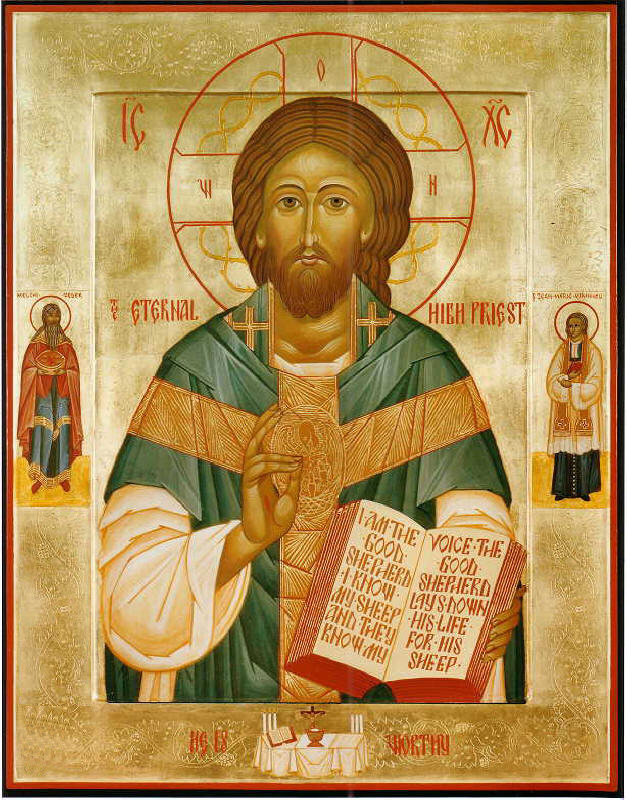
This icon shows Jesus Christ, our eternal high priest.
The gold pelican over His heart represents self-sacrifice.
The border contains an altar and grapevines, representing the Mass, and icons of Melchizedek and St. Jean-Baptiste Vianney.
Melchizedek: king of righteousness (left icon) was priest and king of Jerusalem. He blessed Abraham and has been considered an ideal priest-king.
St. Jean-Baptiste Vianney is the patron saint of parish priests.

1. Sign of the Cross: In the name of the Father, and of the Son, and of the Holy Spirit. Amen.
2. The Apostles Creed: I BELIEVE in God, the Father almighty, Creator of heaven and earth, and in Jesus Christ, His only Son, our Lord, who was conceived by the Holy Spirit, born of the Virgin Mary, suffered under Pontius Pilate, was crucified, died, and was buried. He descended into hell; on the third day he rose again from the dead; he ascended into heaven, and is seated at the right hand of God, the Father Almighty; from there He shall come to judge the living and the dead.
I believe in the Holy Spirit, the holy catholic Church, the communion of saints, the forgiveness of sins, the resurrection of the body, and the life everlasting. Amen.
3. The Lord's Prayer: OUR Father, who art in heaven, hallowed be Thy name. Thy kingdom come. Thy will be done on earth as it is in heaven. Give us this day our daily bread and forgive us our trespasses as we forgive those who trespass against us. And lead us not into temptation, but deliver us from evil. Amen.
4. (3) Hail Mary: HAIL Mary, full of grace, the Lord is with thee. Blessed art thou amongst women and blessed is the fruit of thy womb, Jesus. Holy Mary, Mother of God, pray for us sinners, now, and in the hour of our death. Amen. (Three times)
5. Glory Be: GLORY be to the Father, and to the Son, and to the Holy Spirit. As it was in the beginning, is now, and ever shall be, world without end. Amen.
6. Fatima Prayer: Oh, my Jesus, forgive us our sins, save us from the fires of hell, lead all souls to heaven, especially those in most need of your mercy.
Announce each mystery, then say 1 Our Father, 10 Hail Marys, 1 Glory Be and 1 Fatima prayer. Repeat the process with each mystery.
End with the Hail Holy Queen:
Hail, Holy Queen, Mother of Mercy, our life, our sweetness and our hope! To thee do we cry, poor banished children of Eve! To thee do we send up our sighs, mourning and weeping in this vale of tears! Turn then, most gracious advocate, thine eyes of mercy towards us; and after this, our exile, show unto us the blessed fruit of thy womb, Jesus!
O clement, O loving, O sweet Virgin Mary! Pray for us, O holy Mother of God, that we may be made worthy of the promises of Christ.
Final step -- The Sign of the Cross
The Mysteries of the Rosary By tradition, Catholics meditate on these Mysteries during prayers of the Rosary. The biblical references follow each of the Mysteries below.
The Joyful Mysteries
(Mondays and Saturdays)
1. The Annunciation (Luke 1:26-38) [Spiritual fruit - Humility]
2. The Visitation (Luke 1: 39-56) [Spiritual fruit - Love of Neighbor]
3. The Nativity (Luke 2:1-20) [Spiritual fruit - Poverty of Spirit]
4. The Presentation (Luke 2:21-38) [Spiritual fruit - Purity of mind & body]
5. The Finding of Jesus in the Temple (Luke 2:41-52) [Spiritual fruit - Obedience ]
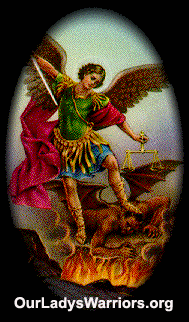
St. Michael the Archangel
~ PRAYER ~
St. Michael, the Archangel, defend us in battle
Be our protection against the wickedness
and snares of the devil;
May God rebuke him, we humbly pray,
and do thou, O Prince of the heavenly host,
by the power of God,
Cast into hell Satan and all the evil spirits
who prowl through the world seeking the ruin of souls.
Amen
+
FOR OUR WORK
Glorious Saint Joseph, pattern of all who are devoted to toil, obtain for me the grace to toil in the spirit of penance, in order thereby to atone for my many sins; to toil conscientiously, putting devotion to duty before my own inclinations; to labor with thankfulness and joy, deeming it an honor to employ and to develop, by my labor, the gifts I have received from Almighty God; to work with order, peace, moderation, and patience, without ever shrinking from weariness and difficulties; to work above all with a pure intention and with detachment from self, having always before my eyes the hour of death and the accounting which I must then render of time ill-spent, of talents unemployed, of good undone, and of my empty pride in success, which is so fatal to the work of God. All for Jesus, all through Mary, all in imitation of thee, 0 Patriarch Joseph! This shall be my motto in life and in death. Amen.
FOR THE INTERCESSION OF SAINT JOSEPH
O Joseph, virgin-father of Jesus, most pure spouse of the Virgin Mary, pray every day for us to the same Jesus, the Son of God, that we, being defended by the power of His grace and striving dutifully in life, may be crowned by Him at the hour of death.
Prayer Source: Prayer Book, The by Reverend John P. O'Connell, M.A., S.T.D. and Jex Martin, M.A., The Catholic Press, Inc., Chicago, Illinois, 1954
St. Joseph
St. Joseph was an ordinary manual laborer although descended from the royal house of David. In the designs of Providence he was destined to become the spouse of the Mother of God. His high privilege is expressed in a single phrase, "Foster-father of Jesus." About him Sacred Scripture has little more to say than that he was a just man-an expression which indicates how faithfully he fulfilled his high trust of protecting and guarding God's greatest treasures upon earth, Jesus and Mary.
The darkest hours of his life may well have been those when he first learned of Mary's pregnancy; but precisely in this time of trial Joseph showed himself great. His suffering, which likewise formed a part of the work of the redemption, was not without great providential import: Joseph was to be, for all times, the trustworthy witness of the Messiah's virgin birth. After this, he modestly retires into the background of holy Scripture.
Of St. Joseph's death the Bible tells us nothing. There are indications, however, that he died before the beginning of Christ's public life. His was the most beautiful death that one could have, in the arms of Jesus and Mary. Humbly and unknown, he passed his years at Nazareth, silent and almost forgotten he remained in the background through centuries of Church history. Only in more recent times has he been accorded greater honor. Liturgical veneration of St. Joseph began in the fifteenth century, fostered by Sts. Brigid of Sweden and Bernadine of Siena. St. Teresa, too, did much to further his cult.
At present there are two major feasts in his honor. On March 19 our veneration is directed to him personally and to his part in the work of redemption, while on May 1 we honor him as the patron of workmen throughout the world and as our guide in the difficult matter of establishing equitable norms regarding obligations and rights in the social order.
Excerpted from The Church's Year of Grace, Pius Parsch.

St. Joseph is invoked as patron for many causes. He is the patron of the Universal Church. He is the patron of the dying because Jesus and Mary were at his death-bed. He is also the patron of fathers, of carpenters, and of social justice. Many religious orders and communities are placed under his patronage.
Patron: Against doubt; against hesitation; Americas; Austria; Diocese of Baton Rouge, Louisiana; California; Belgium; Bohemia; bursars; cabinetmakers; Canada; Carinthia; carpenters; China; Church; confectioners; craftsmen; Croatian people (in 1687 by decree of the Croatian parliament) dying people; emigrants; engineers; expectant mothers; families; fathers; Florence, Italy; happy death; holy death; house hunters; immigrants; interior souls; Korea; laborers; Diocese of La Crosse, Wisconsin; Archdiocese of Louisville, Kentucky; Diocese of Manchester, New Hampshire; Mexico; Diocese of Nashville, Tennessee; New France; New World; Oblates of Saint Joseph; people in doubt; people who fight Communism; Peru; pioneers; pregnant women; protection of the Church; Diocese of San Jose, California; diocese of Sioux Falls, South Dakota; social justice; Styria, Austria; travelers; Turin Italy; Tyrol Austria; unborn children Universal Church; Vatican II; Viet Nam; Diocese of Wheeling-Charleston West Virginia; wheelwrights; workers; working people.
Symbols: Bible; branch; capenter's square; carpenter's tools; chalice; cross; hand tools; infant Jesus; ladder; lamb; lily; monstrance; old man holding a lily and a carpenter's tool such as a square; old man holding the infant Jesus; plane; rod.
Pope Pius X composed this prayer to St. Joseph, patron of working people, that expresses concisely the Christian attitude toward labor. It summarizes also for us the lessons of the Holy Family's work at Nazareth.
Glorious St. Joseph, model of all who devote their lives to labor, obtain for me the grace to work in the spirit of penance in order thereby to atone for my many sins; to work conscientiously, setting devotion to duty in preference to my own whims; to work with thankfulness and joy, deeming it an honor to employ and to develop by my labor the gifts I have received from God; to work with order, peace, moderation, and patience, without ever shrinking from weariness and difficulties; to work above all with a pure intention and with detachment from self, having always before my eyes the hour of death and the accounting which I must then render of time ill spent, of talents wasted, of good omitted, and of vain complacency in success, which is so fatal to the work of God.
All for Jesus, all through Mary, all in imitation of you, O Patriarch Joseph! This shall be my motto in life and in death, Amen.
Litany of Saint Joseph
Lord, have mercy on us.
Christ, have mercy on us.
Lord, have mercy on us.
Christ, hear us.
Christ, graciously hear us.
God, the Father of Heaven, have mercy on us.
God, the Son, Redeemer of the world, have mercy on us.
God, the Holy Ghost, have mercy on us.
Holy Trinity, One God, have mercy on us.
Holy Mary, pray for us.
Holy Joseph, pray for us.
Illustrious Son of David, pray for us.
Light of the Patriarchs, pray for us.
Spouse of the Mother of God, pray for us.
Chaste Guardian of the Virgin, pray for us.
Foster-Father of the Son of God, pray for us.
Faithful Protector of Christ, pray for us.
Head of the Holy Family, pray for us.
Joseph most just, pray for us.
Joseph most chaste, pray for us.
Joseph most prudent, pray for us.
Joseph most courageous, pray for us.
Joseph most obedient, pray for us.
Joseph most faithful, pray for us.
Mirror of patience, pray for us.
Lover of poverty, pray for us.
Model of working men, pray for us.
Ornament of the domestic life, pray for us.
Guardian of virgins, pray for us.
Pillar of the family, pray for us.
Consoler of the miserable, pray for us.
Hope of the sick, pray for us.
Patron of the dying, pray for us.
Terror of demons, pray for us.
Protector of the Holy Church, pray for us.
Lamb of God, who takest away the sins of the world, Spare us, O Lord.
Lamb of God, who takest away the sins of the world, Graciously hear us, O Lord.
Lamb of God, who takest away the sins of the world, Have mercy on us.
V. He hath made him master of His house.
R. And ruler of all His possessions.
Let us pray.
O God, who in Thy ineffable providence didst vouchsafe to choose blessed Joseph to be the Spouse of Thy most holy Mother: grant, we beseech Thee, that we may have him for our intercessor in Heaven, whom on earth we venerate as out most holy Protector. Who livest and reignest world without end. Amen.
Was St. Joseph a tzadik?
St. Joseph: Patron saint of three Popes [Catholic Caucus]
St. Joseph and the Staircase
St. Joseph, Foster Father, Novena [Catholic/Orthodox Caucus]
Patron of a “Happy Death” A Special Role for St. Joseph [Catholic/Orhtodox Caucus]
Lists Every Catholic Should be Familiar With: The 7 Sorrows and 7 Joys of St. Joseph
Catholic Group Blasts Pelosi For Invoking St. Joseph on Pro-Abortion Health Care Bill
THE SEVEN SORROWS AND SEVEN JOYS OF ST. JOSEPH
Joseph, Mary and Jesus: A Model Family
Season of Announcement - Revelation to Joseph
In hard times, don't forget about the humble carpenter Joseph
Saint Joseph: Complete submission to the will of God (Pope Benedict XVI) (Catholic/Orthodox Caucus)
St. Joseph as Head of the Holy Family (Catholic/Orthodox Caucus)
St. Joseph, Patron of a Peaceful Death [Catholic Caucus]
Octave: St. Joseph, A 'Man’s Man', Calling Men to Jesus
St. Teresa de Avila's Devotion to St. Joseph (Catholic Caucus)
Catholic Men's National Day of Prayer, MARCH 15, 2008, The Solemnity of St. Joseph (Catholic Caucus)
The Role and Responsibility of Fatherhood - St. Joseph as Model
St. Joseph - Foster Father of Jesus
Some divine intervention in real estate-[Bury St. Joseph Statues in Ground]
Many Turn To Higher Power For Home Sales
St. Joseph the Worker, Memorial, May 1
Catholic Devotions: St. Joseph the Worker
Nothing Will Be Denied Him (St. Joseph)
The Heart of a Father [St. Joseph]
St. Joseph's DAY
Quemadmodum Deus - Decree Under Blessed Pius IX, Making St. Joseph Patron of the Church
Father & Child (Preaching on St. Joseph)
March 19 - Feast of St. Joseph - Husband of Mary - Intercessor of civil leaders
St. Joseph's Spirit of Silence
St. Joseph's Humility (By St. Francis de Sales)
St. Joseph [Husband of the Blessed Virgin Mary], Solemnity, March 19
St Joseph’s Paternal Love
The Heart of St. Joseph
MORE THAN PATRON OF HOMES, IT'S TIME FOR ST. JOSEPH TO GAIN HIGHEST OF RECOGNITION [Fatherhood]
The Importance of Devotion to St. Joseph
St. Francis de Sales on St. Joseph (Some Excerpts for St. Joseph's Day 2004)
St. Joseph: REDEMPTORIS CUSTOS (Guardian Of The Redeemer)
(Saint) Joseph the Patriarch: A Reflection on the Solemnity of St. Joseph
How I Rediscovered a "Neglected" Saint: Work of Art Inspires Young Man to Rediscover St. Joseph
Novena to Saint Joseph
O Saint Joseph, whose protection is so great, so strong, so prompt before the throne of God, I place in you all my interests and desires.
O Saint Joseph, assist me by your powerful intercession and obtain for me from your Divine Son all spiritual blessings through Jesus Christ, Our Lord; so that having engaged here below your heavenly power, I may offer my thanksgiving and homage to the most loving of Fathers.
O Saint Joseph, I never weary contemplating you and Jesus asleep in your arms; I dare not approach while He reposes near your heart. Press Him in my name and kiss His fine head for me, and ask Him to return the Kiss when I draw my dying breath, Amen.
O Saint Joseph, hear my prayers and obtain my petitions. O Saint Joseph, pray for me. (mention your intention)
St. Joseph Novena
O good father Joseph! I beg you, by all your sufferings, sorrows and joys, to obtain for me what I ask.
(Here name your petition).
Obtain for all those who have asked my prayers, everything that is useful to them in the plan of God. Be near to me in my last moments, that I may eternally sing the praises of Jesus, Mary and Joseph. Amen.
(Our Father, Hail Mary, Glory Be)

Disclaimer: Opinions posted on Free Republic are those of the individual posters and do not necessarily represent the opinion of Free Republic or its management. All materials posted herein are protected by copyright law and the exemption for fair use of copyrighted works.