Skip to comments.
Catholic Caucus: Sunday Mass Readings, 11-18-18, Thirty-third Sunday in Ordinary Time
USCCB.org/RNAB ^
| 11-18-18
| Revised New American Bible
Posted on 11/17/2018 8:59:57 PM PST by Salvation
November 18, 2018
Thirty-third Sunday in Ordinary Time
In those days, I Daniel,
heard this word of the Lord:
"At that time there shall arise
Michael, the great prince,
guardian of your people;
it shall be a time unsurpassed in distress
since nations began until that time.
At that time your people shall escape,
everyone who is found written in the book.
"Many of those who sleep in the dust of the earth shall awake;
some shall live forever,
others shall be an everlasting horror and disgrace.
"But the wise shall shine brightly
like the splendor of the firmament,
and those who lead the many to justice
shall be like the stars forever."
R. (1) You are my inheritance, O Lord!
O LORD, my allotted portion and my cup,
you it is who hold fast my lot.
I set the LORD ever before me;
with him at my right hand I shall not be disturbed.
R. You are my inheritance, O Lord!
Therefore my heart is glad and my soul rejoices,
my body, too, abides in confidence;
because you will not abandon my soul to the netherworld,
nor will you suffer your faithful one to undergo corruption.
R. You are my inheritance, O Lord!
You will show me the path to life,
fullness of joys in your presence,
the delights at your right hand forever.
R. You are my inheritance, O Lord!
Brothers and sisters:
Every priest stands daily at his ministry,
offering frequently those same sacrifices
that can never take away sins.
But this one offered one sacrifice for sins,
and took his seat forever at the right hand of God;
now he waits until his enemies are made his footstool.
For by one offering
he has made perfect forever those who are being consecrated.
Where there is forgiveness of these,
there is no longer offering for sin.
R.
Alleluia, alleluia.Be vigilant at all times
and pray that you have the strength to stand before the Son of Man.
R.
Alleluia, alleluia.
Jesus said to his disciples:
"In those days after that tribulation
the sun will be darkened,
and the moon will not give its light,
and the stars will be falling from the sky,
and the powers in the heavens will be shaken.
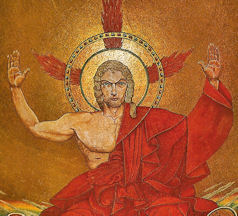
"And then they will see 'the Son of Man coming in the clouds'
with great power and glory,
and then he will send out the angels
and gather his elect from the four winds,
from the end of the earth to the end of the sky.
"Learn a lesson from the fig tree.
When its branch becomes tender and sprouts leaves,
you know that summer is near.
In the same way, when you see these things happening,
know that he is near, at the gates.
Amen, I say to you,
this generation will not pass away
until all these things have taken place.
Heaven and earth will pass away,
but my words will not pass away.
"But of that day or hour, no one knows,
neither the angels in heaven, nor the Son, but only the Father."
TOPICS: Catholic; General Discusssion; Prayer; Worship
KEYWORDS: catholic; mk13; ordinarytime; prayer
Navigation: use the links below to view more comments.
first previous 1-20, 21-40, 41-47 next last
To: All
Arlington Catholic Herald
Gospel commentary: Listening for the tone of truth
Fr. Matthew Zuberbueler
11/16/18
John 18:33-37
In an age bombarded by information and words it can be instructive to slow down long enough to listen — to hear the Eternal Word speak.
In the frenetic way of communicating by text and by email there has emerged an additional kind of punctuation that includes all manner of little images (happy faces, sad faces, etc.) and gets more and more involved and detailed with each new level of technological “advancement.” These “emojis” can actually help if they bring some tone to a conversation. Without the smiley face, the person on what used to be called the other end of the line might read a joking text in a very serious way. Serious consequences can follow when there is no tone.
Pilate and Jesus have a face to face conversation in our Gospel passage this Sunday. Their tone was evident and clear as they spoke to each other. When we read it today, however, we don’t have the benefit of hearing their tone. The Scriptures bring the saving mysteries and inspiring instructive stories to us. By prayer and study we can learn and live the very wisdom of God. This occurs gradually within us, especially when we are willing to spend time with the sacred texts and absorb them little by little.
Was Pilate brusque and abusive when he questioned Jesus: “Are you the King of the Jews?” Or was he more matter of fact? Did he ask in a mocking tone? Did their conversation begin calmly but grow into one more contentious? It can be fruitful to pray through this exchange in a careful and attentive way, imagining each of them, their expressions and reactions, their purposes. Of course, we can and should bring our knowledge from other contexts to our prayer about this conversation.
“I am not a Jew, am I?” “What have you done?” “Then you are a king?” Each of these questions of Pilate would sound quite different based on his degree of sincere interest or his increasing irritated impatience, for example. Can we hear these things in his voice? As we pray, can we see and feel and hear the response of Jesus, ever patient and compassionate?
It is interesting that the responses of Jesus strike a recognizable tone. One might try to read something else into them but they betray a calm, confident, compassionate, humble tone. From Jesus, who would have been justified in choosing not to dignify any question from Pilate with a response, we find an effort to plant a seed of truth. Was Jesus leaving Pilate with the words that would save him later?
Of all the words of Jesus in this interrogating kind of conversation, only this sentence seems ambiguous in tone: “You say I am a king.” Everything else Jesus says stands clearly and hits a clear target. This one is one that can be difficult to understand. Was Jesus saying “You said that, not me”? Or “Even you’re saying so now”? It seems likely that the language scholars and any scholar could shed some light on it. Meanwhile, we might pray it as Jesus’ way of engaging Pilate to think about, to ponder, to be changed by the words that follow: “For this I was born and for this I came into the world, to testify to the truth. Everyone who belongs to the truth listens to my voice."
Jesus the king did not go around calling himself a king. He did call himself “the way, the truth, and the life.” Continue praying the passage beyond the part given in Mass today to find the famous words of Pilate, “What is truth?” What was Pilate’s tone in those words? Scoffing, skeptical, curious, cynical, bored? What was Jesus’ response? In the text Jesus says no words at all. In his eyes, in his manner, in Jesus’ presence there was an unmistakable tone. Did Pilate get it? Do we? Listening to Jesus’ voice — not disregarding it — means we belong to the truth, which means, of course, we belong to him.
Fr. Zuberbueler is pastor of St. Anthony of Padua Church in Falls Church.
21
posted on
11/17/2018 9:54:15 PM PST
by
Salvation
("With God all things are possible." Matthew 19:26)
To: All
https://www.theworkofgod.org/Devotns/Euchrist/HolyMass/gospels.asp?key=35
Year B - 33th Sunday in ordinary time
Heaven and earth shall pass away, but my word shall not pass away.
Mark 13:24-32
24 But in those days, after that tribulation, the sun shall be darkened, and the moon shall not give her light.
25 And the stars of heaven shall be falling down, and the powers that are in heaven, shall be moved.
26 And then shall they see the Son of man coming in the clouds, with great power and glory.
27 And then shall he send his angels, and shall gather together his elect from the four winds, from the uttermost part of the earth to the uttermost part of heaven.
28 Now of the fig tree learn you parable. When the branch thereof is now tender, and the leaves are come forth, you know that summer is very near.
29 So you also when you shall see these things come to pass, know ye that it is very nigh, even at the doors.
30 Amen I say to you, that this generation shall not pass, until all these things be done.
31 Heaven and earth shall pass away, but my word shall not pass away.
32 But of that day or hour no man knows, neither the angels in heaven, nor the Son, but the Father.
Inspiration of the Holy Spirit - From the Sacred Heart of Jesus
Matter is temporal, but the spirit is eternal. God has created the world for a purpose. Just as the farmer waits for the day of harvest, the day will come when I will come to collect the fruit of my vineyard.
The materialistic man thinks that everything will end with death; this is why he tries to enjoy life to the full while ignoring the divine laws and endangering the life of his soul. The man who acknowledges life after death knows that there will be an unknown spiritual world that does not depend of his control but of the divine will.
Every human being has to be born, then he grows and eventually dies according to the will of God. No one has come back from the dead. This is everyone’s fate.
I came back from the dead because I triumphed over it; I have promised the gift of the resurrection to those who follow me. Sin is the reason for which everyone has to die, for this Adam and Eve received the sentence to return to dust from where they had been created.
I have come to open the doors of the Heavenly Paradise, in which all the elected will begin their new life after the resurrection and will live in the glory of eternity.
He who meditates about his own death, feels fear of the chastisement of God for his sins, and begins to prepare himself for eternal life. My word is the seed that begins to grow and gives fruit in his soul, it warns him of danger and takes him though the way of life.
There are many who are interested in knowing when the final day of the world will be. Through the centuries there have been false prophecies; and many have been deceived. I tell you sincerely, the end must come to each one on the day of his own death. This is the reason for which you must be prepared, because no one knows the day nor the hour, only my Heavenly Father, whose authority is absolute. Regarding the end of times, there will also come that moment, but this must not be the preoccupation for the soul that looks for God.
Heaven and earth will pass. Everything that is material will disappear, but my words are the words that gave origin to creation, the words of salvation, the words of eternal life that will never lose their value. He who has ears, listen.
Author: Joseph of Jesus and Mary
22
posted on
11/17/2018 9:57:12 PM PST
by
Salvation
("With God all things are possible." Matthew 19:26)
To: All
Archdiocese of Washington
As winter approaches and the end of the liturgical year draws near, we ponder the passing quality of this world and the fading of its glories. Jesus’ words in today’s Gospel reading must surely have shocked, even horrified, His apostles. Let’s look at His stunning words and seek to apply them in our own life.
The Place of this Gospel – Jesus is standing just outside of Jerusalem. In the last two months we have followed Him on His final journey: leaving Galilee, heading south along the Jordan River, passing through Jericho, and now making the nearly 2000-foot ascent to Jerusalem.
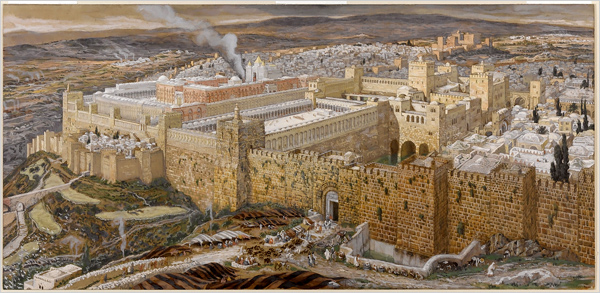
In today’s Gospel, Jesus is at the top of the Mount of Olives with His apostles. From this vantage point, they look across the Kidron Valley to the magnificent Temple and all of Jerusalem spread out before them. The apostles marvel at the glorious beauty of the Temple. Its large, perfectly-carved, white, gilded, ashlar stones gleam like the sun. Indeed, it was one of the wonders of the ancient world, so beautiful and majestic.
Jesus challenges their admiration. He shocks them with the admonition that all the glory they see is soon to be destroyed, that not one stone will be left on another, that it will all be thrown down (Mk 13:2). Shocked, the apostles ask Him when this will happen and what signs will precede this awful event.
In what has become known as “Mount Olivet discourse,” the Lord warns, in great detail, of the coming destruction of the Temple and indeed of all Jerusalem. The Gospels of Matthew, Mark, and Luke all contain similar descriptions of what Jesus said on the Mount of Olives, overlooking Jerusalem in her glorious heyday.
Jesus warns of wars and rumors of wars. He speaks of a time in the near future when nation will rise against nation and a terrible conflict will ensue. In effect, He warns His disciples and their followers to have nothing to do with the coming wars. He tells them that when they see Jerusalem being surrounded by an army, they should know that her destruction is at hand. If someone is on a man’s rooftop, he should not to go back into the house to gather his possessions; rather, he should get out immediately. If someone is out in the field, he should not reenter the city of Jerusalem; rather, he should flee to the hills. Jerusalem is doomed for its lack of faith and zealots are picking up the war with the Romans that they are destined to lose (Luke 21, Matt 24, Mark 13).
All of this leads us to today’s Gospel (from the Mount Olivet discourse), which picks up in the middle. Jesus warns of days of tribulation, when the sun will be darkened, the moon will not give its light, and the stars will fall from the sky!
In reading a text like this, we must not fall prey to an overly literal interpretation. Jesus is using prophetic language, a way of speaking that is meaningful, but not to be understood scientifically or literally. Stars do not actually fall from the sky!
If I were to say, “The world has been turned upside down,” you wouldn’t expect that if you looked back toward Earth from outer space you would see Australia at the top and North America at the bottom. If I were to say, “It’s raining cats and dogs,” you wouldn’t expect to look out your window and see animals coming down from the sky and landing on the front lawn. Although I’m speaking figuratively, you understand what I mean.
So it is with Jesus’ use of prophetic imagery. Speaking of the heavenly luminaries as being darkened or cast down is a prophetic way of saying that all the fixed points, all the ways by which we tell time, know the seasons, navigate, and find perspective will be lost to us! The world as the Jewish people know it, centered on the Temple and rooted in their liturgical calendar, is about to be swept away. To the ancient Jewish people, the Temple was Big Ben. It was both the clock of the liturgical cycle and the great visual center of Israel.
The Lord is teaching them that what they see as the hub of all they do is about to be taken away. The Temple, with all its rituals, its liturgical cycles, and its endless slaughter of animals in sacrifice for sin, is about to be replaced. These ancient rituals merely pointed to Jesus and all that He would do. Jesus is now the Temple; He is also the Lamb Sacrifice. All that the Temple pointed to is fulfilled in Jesus. Thus, the Temple is at an end. Jesus is ushering in a New Covenant.
In the Mount Olivet discourse, Jesus prophesies the end of the Temple, which will take place in a biblical 40 years. Sure enough, 40 years later (in A.D. 70), the Roman Army, after having surrounded Jerusalem for a period of 3 ½ months, breached the walls, poured into the city, and destroyed the Temple and all of Jerusalem. In this epic battle, according to Josephus, 1.2 million Jewish people lost their lives. As Jesus prophesied, not one stone was left on another. According to Josephus, so complete was the destruction of Jerusalem, that when the Romans had finished their work it was not clear that the city had ever existed.
So, this is the place of this Gospel, a place of epic significance in the ancient world. An era of 1000 years was coming to an end. The world as the Jewish people knew it was ending. The Temple has never been rebuilt; it has been replaced by a Judaism without sacrifice, a rabbinic, a synagogue system. In 2000 years, despite several attempts, the Jewish Temple has never been rebuilt. Everything Jesus predicted came to pass. This is the historical place and context of today’s Gospel.
What does this mean for us, some 2000 years later? Let’s consider three basic themes.
1. The Perspective of Passing – Toward the end of the Gospel passage, the Lord says, Heaven and earth will pass away, but my words will not pass away. Note the definitiveness of this statement: this world will pass away. All of the things that impress us: the might of the powerful, the influence of the popular, the glory of all the glitterati—all of this will pass away.
Indeed, even now it is passing away, its destruction is at hand. Scripture says,
- The world in its present form is passing away (1 Cor 7:31).
- We have here, no lasting city (Heb 13:14).
- Put not your trust in princes, in mortal men in whom there is no hope. Take their breath, they return to clay, and their plans that day come to nothing (Psalm 146:3-4).
Yes, all of the glory, even what seems beautiful and fair, is passing away. Don’t be so impressed by this world’s offerings. All of it—no matter how powerful, influential, or sturdy it may seem—is slated for destruction. It is already passing away.
Some years ago, I was in a museum and in one of the exhibits saw a photograph of a family from about the 1880s. At the bottom of the photo was this inscription: “My family, as it appeared for a brief time last summer”—a poignant caption. I thought of the people in that photo, every one of them now dead. I also knew that the house in front of which the photo was taken had long since been destroyed, replaced by an expanding city district of buildings. All is passing; nothing remains here for long.
Painful though this perspective may be, it is important and healing. It brings with it a string kind of serenity. Like every truth, the truth that all things are passing sets us free. As for man, his days, or the flower of the field are like the grass. The wind blows, and he is gone, and his place never sees him anymore (Psalm 130:15-16). We are reminded not to set down too many roots here so that we are not resentful when this world passes away.
2. The Permanence Proclaimed – The Lord tells us that His words will not pass away. Although the world will pass away, the truth and the Word of God will remain forever.
Too many people root their lives in passing things. The challenge for us is to root our lives in the Word of God, which remains forever. Worldly glories, power, access, and wealth—all these things fade and disappear, but God’s wisdom and His plan remain forever.
Consider, for a moment, the Church. The Lord has said that the forces of Hell would strive to prevail, overpower, and destroy the Church, but He promised that such attempts would never be successful (Matt 16:18). The Church is indefectible, by God’s Word, by His promise. No weapons, no war waged against the Church, will prevail.
In all of this the Lord has been proven correct. The Church has seen the Roman Empire, the Carolingian Empire, the British Empire, the Soviet Socialist Republic, and many others rise to power only to fade and disappear.
How many heresies, how many philosophies have come and gone in the age of the Church? How many have laughed at the Church, announcing that she was passé, that her day was over, and that they would bury her? The Church has buried every one of her undertakers, outlived every one of her critics. Despite every prediction of her demise, she has persevered until this very day. By God’s grace, she has a permanence that outlasts every one of her enemies. She has read the funeral rites over every single prophet of her doom, and she will continue to do so.
In recounting all of this we do not simply gloat that an institution known as the Church has survived. Rather, we announce that the Church is the Bride of Christ and also His Body. The Church cannot be destroyed, not because of human ingenuity but on account of the power and grace of God. She will endure even though at times she will suffer, be ridiculed, or be marginalized. She will outlive every enemy. She will emerge from every persecution. She will never be removed. For the Church is the Body of Christ, the living Word of God. Though the world will pass away, the Word of the Lord will remain forever!
3. The Priority Prescribed – If this world as we know it is passing away, and the Lord, His Kingdom, His Church, and His Word will remain forever, what should be our priority? The Lord says, in effect, that we know very well what our priority should be, but we willfully ignore it.
Learn a lesson from the fig tree. When its branch becomes tender and sprouts leaves, you know that summer is near. In the same way, when you see these things happening, know that he is near, at the gates (Matt 24:32-33).
Yes, we know very well that the Day of Judgment is coming. Too easily, though, we dream on and do not follow the prescribed priority. Wealth, fame, and glory are all uncertain and clearly passing, but death, judgment, Heaven, and Hell are certain and remain forever. We too easy fiddle on with things that are uncertain and passing while neglecting what is certain and eternal. Ridiculous!
It would be foolish to book passage on a sinking ship. Similarly, it is imprudent to make this world and its demands our fundamental priority. It is wise to set our sights on, and lay hold of, the Kingdom that lasts forever.
It is sad that so many spend people their time “rearranging the deck chairs on the Titanic” of this world. It is tragic how much time, effort, and passion we spend on things that pass through our fingers like sand. So much of our effort is expended on furthering our career, amassing wealth, and enlarging our home; so little is spent on improving our spiritual life.
Parents spend more time worrying about what college their children will attend than where they will spend eternity. If their child is failing math, they will go to great lengths to hire tutors to improve his test scores. Never mind that the child barely knows the four Gospels, the difference between the Old Testament and the New Testament, or even who Adam and Eve were. Never mind all that; we need to make sure they understand polynomials! It is fine that parents care about math scores and college venues, but how sad it is that eternal things often go unattended.
The greatest duty of parents is to prepare their children for eternity, yet far more time and effort is often spent preparing them for passing things like a career. While education and career are important, eternal life is far more so. A son or daughter may graduate from Harvard Law School and become a famous attorney yet still go to Hell!
What are our priorities? Frankly, most of our priorities are not things that matter to God. Even if we attain the passing things for which we strive, they will all ultimately slip through our fingers. We obsess over passing things like our physical health while neglecting enduring things like our spiritual health. We should care for our bodies, but even more should we care for our souls. If we would expend as much effort looking for a time and place to pray as we do searching for a restaurant for dinner, we would be spiritual heavyweights rather than physically overweight.
In today’s Gospel the Lord stands before the Temple: an impressive building, a symbol of power and of worldly glories. Impressed by it though the Apostles are, the Lord is not impressed with passing things. He counsels us to get our priorities straight and to focus on things that last: His Word, which never passes away, and our ultimate destiny, where we will spend eternity.
We find time for everything else, why not for prayer, Scripture, fellowship in the Church, and the sacraments?
What are your priorities? Be honest, now, be honest.
This world is passing away. Far more essential for us than power, prestige, money, possessions, worldly philosophies, and the latest trends, is the Word of the Lord, which never passes away.
The world will laugh and say that God’s word is out-of-date, old-fashioned, or even hateful, bigoted, and intolerant. In the end, time will prove where wisdom is. Long after our current critics, those who scorn the teachings of the Lord in the Scriptures and the Church, have passed on, we will still be here preaching Christ and Him crucified.
None of this is meant to sound triumphalist. It is simply rooted in a Word of truth that the Lord spoke long ago on a hillside overlooking glorious buildings soon to be reduced to rubble and an age soon to pass away. He said simply this: Heaven and earth will pass away but my words will not pass away.
In the end, Jesus wins. I know because I checked the end of the story. You can look it up (Rev 20-23). Get on the winning team. Stop trying to amass a treasure here that you can’t keep anyway.
23
posted on
11/18/2018 7:56:17 AM PST
by
Salvation
("With God all things are possible." Matthew 19:26)
To: All
24
posted on
11/18/2018 7:56:43 AM PST
by
Salvation
("With God all things are possible." Matthew 19:26)
To: All
Sunday Gospel Reflections33rd Sunday in Ordinary Time
Reading I: Daniel 12:1-3 II: Hebrews 10:11-14,18
Gospel Mark 13:24-32
24 "But in those days, after that tribulation, the sun will be darkened, and the moon will not give its light,
25 and the stars will be falling from heaven, and the powers in the heavens will be shaken.
26 And then they will see the Son of man coming in clouds with great power and glory.
27 And then he will send out the angels, and gather his elect from the four winds, from the ends of the earth to the ends of heaven.
28 "From the fig tree learn its lesson: as soon as its branch becomes tender and puts forth its leaves, you know that summer is near.
29 So also, when you see these things taking place, you know that he is near, at the very gates.
30 Truly, I say to you, this generation will not pass away before all these things take place.
31 Heaven and earth will pass away, but my words will not pass away.
32 "But of that day or that hour no one knows, not even the angels in heaven, nor the Son, but only the Father.
Interesting Details
- Chapter 13 contains the farewell teachings of Jesus in the Gospel of Mark, which are appropriate for a Sunday near the end of the liturgical year.
- The structure of the passage makes the message clear. There are two main parts. In each part, a main message is surrounded by similar ideas.
- In part one, the main idea in v. 26, "the Son of Man coming in the clouds with great power and glory" is proclaimed by the whole universe (represented by the sun, moon, stars, and heavens in v. 24-25, and four winds, ends the earth and sky in v. 27). Jesus uses these figures to signify the whole universe, not to make specific predictions about single events.
- In part two, the main idea--be watchful because no one knows the day--is surrounded by two parables. The first parable is that of the fig tree in v.28. The second parable is after this passage, from v. 33 to verse 37, the end of the chapter.
- The last teaching in Mark is different from but congruent with the farewell discourses in the other three Gospels (John 14-17: be united in love; Mt 28:16-20, Lk 24:36-49 and Act 1:6-11: spread the Good News). The way to prepare for the glorious return of Jesus is to spread the Gospel which leads to unity in love.
One Main Point Jesus will come again in full glory, proclaimed by the whole universe. No one knows when that will happen, so be watchful.
Reflections
- Am I watchful and hopeful for the glorious coming of Jesus? How do I do that?
- What would be the opposite of being watchful and hopeful? Am I doing that, too?
- Does my preparation for Jesus' final coming include spreading the Gospel and lead to unity in love?
25
posted on
11/18/2018 9:12:37 AM PST
by
Salvation
("With God all things are possible." Matthew 19:26)
To: Salvation
| Mark |
| |
English: Douay-Rheims |
Latin: Vulgata Clementina |
Greek NT: Byzantine/Majority Text (2000) |
| |
Mark 13
|
| 24. |
But in those days, after that tribulation, the sun shall be darkened, and the moon shall not give her light. |
Sed in illis diebus, post tribulationem illam, sol contenebrabitur, et luna non dabit splendorem suum : |
αλλ εν εκειναις ταις ημεραις μετα την θλιψιν εκεινην ο ηλιος σκοτισθησεται και η σεληνη ου δωσει το φεγγος αυτης |
| 25. |
And the stars of heaven shall be falling down, and the powers that are in heaven, shall be moved. |
et stellæ cæli erunt decidentes, et virtutes, quæ in cælis sunt, movebuntur. |
και οι αστερες του ουρανου εσονται εκπιπτοντες και αι δυναμεις αι εν τοις ουρανοις σαλευθησονται |
| 26. |
And then shall they see the Son of man coming in the clouds, with great power and glory. |
Et tunc videbunt Filium hominis venientem in nubibus cum virtute multa et gloria. |
και τοτε οψονται τον υιον του ανθρωπου ερχομενον εν νεφελαις μετα δυναμεως πολλης και δοξης |
| 27. |
And then shall he send his angels, and shall gather together his elect from the four winds, from the uttermost part of the earth to the uttermost part of heaven. |
Et tunc mittet angelos suos, et congregabit electos suos a quatuor ventis, a summo terræ usque ad summum cæli. |
και τοτε αποστελει τους αγγελους αυτου και επισυναξει τους εκλεκτους αυτου εκ των τεσσαρων ανεμων απ ακρου γης εως ακρου ουρανου |
| 28. |
Now of the fig tree learn ye a parable. When the branch thereof is now tender, and the leaves are come forth, you know that summer is very near. |
A ficu autem discite parabolam. Cum jam ramus ejus tener fuerit, et nata fuerint folia, cognoscitis quia in proximo sit æstas : |
απο δε της συκης μαθετε την παραβολην οταν αυτης ηδη ο κλαδος απαλος γενηται και εκφυη τα φυλλα γινωσκετε οτι εγγυς το θερος εστιν |
| 29. |
So you also when you shall see these things come to pass, know ye that it is very nigh, even at the doors. |
sic et vos cum videritis hæc fieri, scitote quod in proximo sit, in ostiis. |
ουτως και υμεις οταν ταυτα ιδητε γινομενα γινωσκετε οτι εγγυς εστιν επι θυραις |
| 30. |
Amen I say to you, that this generation shall not pass, until all these things be done. |
Amen dico vobis, quoniam non transibit generatio hæc, donec omnia ista fiant. |
αμην λεγω υμιν οτι ου μη παρελθη η γενεα αυτη μεχρις ου παντα ταυτα γενηται |
| 31. |
Heaven and earth shall pass away, but my word shall not pass away. |
Cælum et terra transibunt, verba autem mea non transibunt. |
ο ουρανος και η γη παρελευσεται οι δε λογοι μου ου μη παρελθωσιν |
| 32. |
But of that day or hour no man knoweth, neither the angels in heaven, nor the Son, but the Father. |
De die autem illo vel hora nemo scit, neque angeli in cælo, neque Filius, nisi Pater. |
περι δε της ημερας εκεινης η ωρας ουδεις οιδεν ουδε οι αγγελοι οι εν ουρανω ουδε ο υιος ει μη ο πατηρ |
26
posted on
11/18/2018 10:06:01 AM PST
by
annalex
(fear them not)
To: annalex
24. But in those days, after that tribulation, the sun shall be darkened, and the moon shall not give her light,
25. And the stars of heaven shall fall, and the powers that are in heaven shall be shaken.
26. And then shall they see the Son of man coming in the clouds with great power and glory.
27. And then shall he send his angels, and shall gather together his elect from the four winds, from the uttermost part of the earth to the uttermost part of heaven.
BEDE; Some however refer this to the time of the Jewish captivity, where many, declaring themselves to be Christs, drew after them crowds of deluded persons; but during the siege of the city there was no Christian to whom the Divine exhortation, not to follow false teachers, could apply. Wherefore it is better to understand it of heretics, who, coming to oppose the Church, pretended to be Christs; the first of whom was Simon Magus, but that last one, greater than the rest, is Antichrist.
It goes on: But take you heed: behold, I have foretold you all things.
AUG. For He did not only foretell to His disciples the good things which He would give to His saints and faithful ones, but also the woes in which this world was to abound, that we might look for our reward at the end of the world with more confidence, from feeling the woes in like manner announced as about to precede the end of the world.
THEOPHYL. But after the coming of Antichrist, the frame of the world shall be altered and changed, for the stars shall be obscured on account of the abundance of the brightness of Christ. Wherefore it goes on: But in those days, after that tribulation, the sun shall be darkened, and the moon shall not give her light;
and the stars of heaven shall fall.
BEDE; For the stars in the day of judgment shall appear obscure, not by any lessening of their own light, but because of the brightness of the true light, that is, of the most high Judge coming upon them; although there is nothing to prevent its being taken to mean, that the sun and moon with all the other heavenly bodies then for a time are really to lose their light, just as we are told was the case with the sun at the time of our Lord's Passion. But after the day of judgment, when there shall be a new sky and a new earth, then shall happen what Isaiah says: Moreover, the light of the moon shall be as the light of the sun, and the light of the sun shall be sevenfold. There follows, And the powers of heaven shall be shaken.
THEOPHYL. That is, the Angelic virtues shall be astonished, seeing that such great things are done, and that their fellow-servants are judged.
BEDE; What wonder is it that men should be troubled at this judgment, the sight of which makes the very Angelic powers to tremble? What will the stories of the house do when the pillars shake? What does the shrub of the wilderness undergo, when hen the cedar of paradise is moved?
PSEUDO-JEROME; Or else, the sun shall be darkened, at the coldness of their hearts, as in the winter time. And the moon shall not give her light with serenity, in this time of quarrel, and the stars of heaven shall fail in their light, when the seed of Abraham shall all but disappear, for to it they are likened. And the powers of heaven shall be stilled up to the wrath of vengeance, when they shall be sent by the Son of Man at His coming, of whose Advent it is said, And, then shall they see the Son of Man coming in the clouds with great power and glory, He, that is, who first came down like rain into the fleece of Gideon in all lowliness.
AUG. For since it was said by the Angels to the Apostles, He shall so come in like manner as you have seen him go into heaven, rightly do we believe that He will come not only in the same body, but on a cloud, since He is to come as He went away, and a cloud received Him as He was going.
THEOPHYL But they shall see the Lord as the Son of Man, that is, in the body, for that which is seen is body.
AUG. For the vision of the Son of Man is shown even to the bad, but the vision of the form of God to the pure in heart alone, for they shall see God. And because the wicked cannot see the Son of God, as He is in the form of God, equal to the Father, and at the same time both just and wicked are to see Him as Judge of the quick and dead, before Whom they shall be judged, it was necessary that the Son of Man should receive power to judge.
Concerning the execution of which power, there is immediately added And then shall he send his angels.
THEOPHYL. Observe that Christ sends the Angels as well as the Father; where then are they who say that He is not equal to the Father? For the Angels go forth to gather together the faithful, who are chosen, that they may be carried into the air to meet Jesus Christ. Wherefore it goes on: And gather together his elect from the four winds.
PSEUDO-JEROME; As corn winnowed from the threshing-floor of the whole earth.
BEDE; By the four winds, He means the four parts of the world, the east the west, the north, and the south. And lest any one should think that the elect are to be gathered together only from the four edges of the world, and not from the midland regions as well as the borders, He has fitly added, From the uttermost part of earth, to the uttermost part of heaven, that is from the extremities of the earth to its utmost bounds, where the circle of the heavens appears to those who look from afar to rest upon the boundaries of the earth. No one therefore shall be elect in that day who remains behind and does not meet the Lord in the air, when He comes to judgment. The reprobate also shall come to judgment, that when it is finished they may be scattered abroad and perish from before the face of God.
28. Now learn a parable of the fig tree; When her branch is yet tender, and puts forth leaves, you know that summer is near:
29. So you in like manner, when you shall see these things come to pass, know that it is nigh, even at the doors.
30. Verily I say to you, that this generation shall not pass, till all these things be done.
31. Heaven and earth shall pass away: but my words shall not pass away.
BEDE; Under the example of a tree the Lord gave a pattern of the end, saying, Now learn a parable of the fig tree, when her branch is yet tender, and puts forth leaves, you know that summer is near. So you in like manner, when you shall see these things come to pass, know that it is nigh, even at the doors.
THEOPHYL. As if He had said, As when the fig tree puts forth its leaves, summer follows at once, so also after the woes of Antichrist, at once, without an interval, shall be the coming of Christ, who will be to the just as summer after winter, but to sinners, winter after summer.
AUG. All that is said by the three Evangelists concerning the Advent of our Lord, if diligently compared together and examined, will perchance be found to belong to His daily coming in His body, that is, the Church, except those places where that last coming is so promised, as if it were approaching; for instance in the last part of the discourse according to Matthew, the coming itself is clearly expressed, where it is said, When the Son of Man shall come in his glory.
For what does he refer to in the words, when you shall see these things come to pass, but those things which He has mentioned above, amongst which it is said, And then you shall see the Son of Man coming in the clouds. The end therefore shall not be then, but then it shall be near at hand. Or are we to say, that not all those things which are mentioned above are to be taken in, but only some of them, that is, leaving out these words, Then shall you see the Son of man coming; for that shall be the end itself, and not its approach only. But Matthew has declared that it is to be received without exception, saying, When you shall see all these things, know that it is near, even at the doors. That which is said above must therefore be taken thus; And he shall send his angels, and gather together the elect from the four winds; that is, He shall collect His elect from the four winds of heaven, which He does in the whole of the last hour, coming in His members as in clouds.
BEDE; This fruit-bearing of the fig tree may also be understood to mean the state of the synagogue, which was condemned to everlasting barrenness, because when the Lord came, it had no fruits of righteousness in those who were then unfaithful. But the Apostle has said, that when the fullness of the Gentiles is come in, all Israel shall be saved. What means this, but that the tree, which has been long barren, shall then yield the fruit, which it had withheld? When this shall happen, doubt not that a summer of true peace is at hand.
PSEUDO-JEROME; Or else, the leaves which come forth are words now spoken, the summer at hand is the day of Judgment, in which every tree shall show what it had within it, deadness for burning, or greenness to be planted with the tree of life. There follows Verily I say to you, This generation shall not pass, till these things; be done.
BEDE; By generation He either means the whole race of mankind, or specially the Jews.
THEOPHYL. Or else, This generation shall not pass away, that is, the generation of Christians, until all things be fulfilled, which were spoken concerning Jerusalem and the coming of Antichrist; for He does not mean the generation of the Apostles, for the greater part of the Apostles did not live up to the destruction of Jerusalem.
But He says this of the generation of Christians, wishing to console His disciples, lest they should believe that the faith should fail at that time; for the immovable elements shall first fail, before the words of Christ fail; wherefore it is added, Heaven and earth shall pass away, but my words shall not pass away.
BEDE; The heaven which shall pass away is not the ethereal or starry heaven, but the heaven where is the air. For wherever the water of the judgment could reach, there also, according to the words of the blessed Peter, the fire of judgment shall reach. But the heaven and the earth shall pass away in that form which they now have, but in their essence they shall last without end.
32. But of that day and that hour knows no man, no, not the angels which are in heaven, neither the Son, but the Father.
THEOPHYL. The Lord wishing to prevent His disciples from asking about that day and hour, says, But of that day and that hour knows no man, no, not the angels which are in heaven, neither the Son, but the Father. For if He had said, I know, but I will not reveal it to you, He would have saddened them not a little; but He acted more wisely, and prevents their asking such a question, lest they should importune Him, by saying, neither the Angels nor I.
HILARY; This ignorance of the day and hour is urged against the Only-Begotten God, as if, God born of God had not the same perfection of nature as God. But first, let common sense decide whether it is credible that He, who is the cause that all things are, and are to be, should be ignorant of any out of all these things. For how can it be beyond the knowledge of that nature, by which and in which that which is to be done is contained? And can He be ignorant of that day, which is the day of His own Advent? Human substances foreknow as far as they can what they intend to do, and the knowledge of what is to be done, follows upon the will to act. How then can the Lord of glory, from ignorance of the day of His coming, be believed to be of that imperfect nature, which has on it a necessity of coming, and has not attained to the knowledge of its own advent?
But again, how much more room for blasphemy will there be, if a feeling of envy is ascribed to God the Father, in that He has withheld the knowledge of His beatitude from Him to whom He gave a foreknowledge of His death. But if there are in Him all the treasures of knowledge, He is not ignorant of this day; rather we ought to remember that the treasures of wisdom in Him are hidden; His ignorance therefore must be connected with the hiding of the treasures of wisdom, which are in Him. For in all cases, in which God declares Himself ignorant, He is not under the power of ignorance, but either it is not a fit time for speaking, or it is an economy of not acting.
But if God is said then to have known that Abraham loved Him, when He did not hide that His knowledge from Abraham, it follows, that the Father is said to know the day, because He did not hide it from the Son. If therefore the Son knew not the day, it is a Sacrament of His being silent, as on the contrary the Father alone is said to know, because He is not silent. But God forbid that any new and bodily changes should be ascribed to the Father or the Son. Lastly, lest He should be said to be ignorant from weakness, He has immediately added, Take you heed, watch and pray, for you know not when the time is.
PSEUDO-JEROME; For we must needs watch with our souls before the death of the body.
Catena Aurea Mark 13
27
posted on
11/18/2018 10:06:34 AM PST
by
annalex
(fear them not)
To: annalex

Christ Walks on the Water
12th-13th Century
Duomo di Monreale
Monreale, Sicily
28
posted on
11/18/2018 10:14:02 AM PST
by
annalex
(fear them not)
To: All
'Those who do not consider themselves under obligation to perform all Christ's commandments study the law of God in a literal manner, 'understanding neither what they say nor what they affirm' (1 Tim. 1:7). Therefore they think that they can fulfill it by their own works.' St. Mark the Ascetic
29
posted on
11/18/2018 2:23:18 PM PST
by
Salvation
("With God all things are possible." Matthew 19:26)
To: All
|

The Angelus
|
The Angel of the Lord declared to Mary:
And she conceived of the Holy Spirit.
Hail Mary, full of grace, the Lord is with thee; blessed art thou among women and blessed is the fruit of thy womb, Jesus. Holy Mary, Mother of God, pray for us sinners, now and at the hour of
our death. Amen.
Behold the handmaid of the Lord: Be it done unto me according to Thy word.
Hail Mary . . .
And the Word was made Flesh: And dwelt among us.
Hail Mary . . .
Pray for us, O Holy Mother of God, that we may be made worthy of the promises of Christ.
Let us pray:
Pour forth, we beseech Thee, O Lord, Thy grace into our hearts; that we, to whom the incarnation of Christ, Thy Son, was made known by the message of an angel, may by His Passion and Cross be brought to the glory of His Resurrection, through the same Christ Our Lord.
Amen.
"Hail, full of grace, the Lord is with you" (Lk 1:28) "Blessed are you among women,
and blessed is the fruit of your womb"
(Lk 1:42). |
30
posted on
11/18/2018 2:24:21 PM PST
by
Salvation
("With God all things are possible." Matthew 19:26)
To: All
31
posted on
11/18/2018 2:45:53 PM PST
by
Salvation
("With God all things are possible." Matthew 19:26)
To: All
32
posted on
11/18/2018 2:47:37 PM PST
by
Salvation
("With God all things are possible." Matthew 19:26)
To: All
33
posted on
11/18/2018 4:00:24 PM PST
by
Salvation
("With God all things are possible." Matthew 19:26)
To: Salvation
CATHOLIC ALMANACSunday, November 18
Liturgical Color: Green
Today is the optional memorial of the
Dedication of the Basilicas of Peter and
Paul in Rome. The Basilica of St. Paul
was built over Paul's gravesite in 324
A.D. It has been restored and expanded
several times but retains the original floor
plan.
34
posted on
11/18/2018 4:26:29 PM PST
by
Salvation
("With God all things are possible." Matthew 19:26)
To: All
Catholic Culture
Ordinary Time: November 18th
Thirty-Third Sunday of Ordinary Time
MASS READINGS
November 18, 2018 (Readings on USCCB website)
COLLECT PRAYER
Grant us, we pray, O Lord our God, the constant gladness of being devoted to you, for it is full and lasting happiness to serve with constancy the author of all that is good. Through our Lord Jesus Christ, your Son, who lives and reigns with you in the unity of the Holy Spirit, one God, for ever and ever.
show
Recipes (3)
show
Activities (3)
show
Prayers (2)
show
Library (3)
» Enjoy our Liturgical Seasons series of e-books!
Old Calendar: Sixth Resumed Sunday after Epiphany
Jesus said to his disciples: "In those days after that tribulation the sun will be darkened, and the moon will not give its light, and the stars will be falling from the sky, and the powers in the heavens will be shaken. And then they will see 'the Son of Man coming in the clouds' with great power and glory, and then he will send out the angels and gather his elect from the four winds, from the end of the earth to the end of the sky (Mk 13:24-27)."
The feasts of the Churches of Peter and Paul and Rose Philippine Duchesne , which are ordinarily celebrated today, are superseded by the Sunday liturgy.
Click here for commentary on the readings in the Extraordinary Form of the Roman Rite.
Sunday Readings
The first reading is taken from the Book of Daniel 12:1-3. Today's reading puts before our eyes the fact that this world will have an end marked by great upheavals and disasters. However, these will be followed immediately by a new and everlasting existence.
The second reading is from the Letter of St. Paul the Hebrews 10:11-4; 18. St. Paul continues to compare the priesthood of Christ with the Jewish priesthood.
The Gospel is from the Gospel of Mark 13:24-32. There are some obscurities in this extract from St. Mark. Firstly, because Christ was discussing and answering questions on two distinct topics : the destruction of the temple and the end of the world. Secondly, because we may not have the ipsissima verba of Christ here, as many exegetes suggest. The message we must learn from today's gospel comes across without any ambiguity or doubt : we must always be ready to face our judgement for we know not the day nor the hour when we will be called from this life. When or how this world will end is of no great importance to us; what is important is that we shall leave this world very soon and our eternity will depend on the state of our consciences at the moment of our departure.
This is the steadying thought the Church, in her wisdom, wishes to put before our minds today. We all know that we must die someday. We are strangers and pilgrims on this earth; we have not here a lasting city, as St. Augustine says. No sane person among us will try to deny this and yet, many of us are so immersed in the things of this world that we forget or try to forget that we must leave this world soon. This is very natural : life is a precious gift and as our earthly life is the only one of which we have experience our every inclination is to hold on to it at all costs. Even when our intelligence tells us that it can, in spite of all our endeavors, end very soon we try to convince our¬selves that that "very soon" is really in the distant future.
We have God's word for it and the example of Christ's resurrection to a life of glory. Let us appreciate the truth that our death on earth is not the end of life but rather the beginning of the true life that will never end. As the liturgy says in the Mass for the Dead : "Life is changed (by death) not taken away." Our death is the doorway through which we pass into the unending life. The years on earth are a gift of God to enable us to earn the infinitely greater gift which in his loving mercy he has prepared for us from all eternity.
God in his mercy is calling on each one of us to be ready when our call comes. We can do nothing about the when or the where of that call, but we can do much about the state of our relationship with God when death comes; in fact, aided by God's grace we can ensure that all will be well with us. We cannot avoid a sudden death, but we can avoid an unprepared death by striving always to live in peace with God. This does not mean that we must be always on our knees praying to God and that we must take no interest in the things and the joys of this world. Far from it. God wants us to use the things of this world, but to use them so that they will not hinder us on our journey.
A very practical way to see how we stand in relation to God and to the things of this world, is for each one of us to ask himself today : "How would I fare if I were called to render an account of stewardship tonight?" This is the practical question that God, through today's readings, is asking us to put to ourselves. If, to our dismay, we find there are several things which have to be put right before facing our judge we will start right away to put them right. We may get another chance, another warning, and we may not. If we value our eternal happiness we will take this warning; we will put our books in order; we will make peace with God and our neighbors—and with God's grace we will do all in our power to persevere in this good resolution.
Excerpted from The Sunday Readings by Fr. Kevin O'Sullivan, O.F.M.
35
posted on
11/18/2018 4:40:35 PM PST
by
Salvation
("With God all things are possible." Matthew 19:26)
To: All
The Word Among Us
Meditation: Mark 13:24-32
33rd Sunday in Ordinary Time
Of that day or hour, no one knows. (Mark 13:32)
When Jesus said that “no one knows” when the Second Coming would happen, was he saying that even he didn’t know? It sure seems that way. Maybe he was reminding us that he had submitted to the limitations of being human, just like us. Yes, he was fully divine, but he was also fully human. And that entailed certain limitations. This is why Luke tells us that Jesus was always increasing in wisdom “before God and man” (Luke 2:52).
Today, however, Jesus knows when he will come again. The problem is, we still don’t know!
Repeatedly throughout history, people have tried to predict the end of the world. St. Paul thought it was just around the corner. St. Hippolytus of Rome and St. Irenaeus of Lyon thought it would happen in AD 500. John Wesley, the first Methodist, thought the end would come in 1836. Many Christian leaders—and no shortage of psychics—have also weighed in. Not surprisingly, many of these people then recalculated the dates after their first predictions didn’t come true, only to have their followers disappointed again.
Some believers are more cautious. They tell us that we will see specific clues when the time is near. They point to certain signs—a war in the Middle East, a drought in Africa, earthquakes in Peru, or some other disaster. When those signs occur, it means that Jesus is very near.
Still, no human being knows when Jesus will come. It could be today. It may not be for thousands of years.
St. Francis had a different take on the subject. Once, when he was working in the garden, a friar asked, “What would you be doing now if you knew that Jesus was coming back today?” Francis replied, “I would keep hoeing my garden.” Francis knew he was trying his best to be ready, and there was nothing more he could do.
The point is, Jesus will come. So our best answer is the same as it has always been: be ready.
“Come, Lord Jesus!”
Daniel 12:1-3
Psalm 16:5, 8-11
Hebrews 10:11-14, 18
36
posted on
11/18/2018 4:53:34 PM PST
by
Salvation
("With God all things are possible." Matthew 19:26)
To: All
Daily Gospel CommentaryOrigen (c.185-253)
priest and theologian
Homilies on the book of Joshua, no.16, 3 ; SC 71
"Then they will see the Son of Man coming... with great power"
“A very large part of the land still remains to be conquered” (Jos 13:1)... Consider our Lord and Savior's first coming, when he came to sow the word on earth. He gained hold of the whole earth by force of this sowing alone. He put opposing powers and the rebel angels who control the nations to flight and, at the same time, sowed his word and spread abroad his churches. This is his first possession of the land.
Follow me, however... through the subtlety of Scripture and I will show you what the second conquest of the land means, of which it was said to Joshua / Jesus that much had been left. Hear Saint Paul's words: “He must reign until he has made all his enemies his footstool” (cf. 1Cor 15:25; Ps 110[109]:1). This is the land of which it was said that it had been left until everything has been completely subjected under his feet and that thus he would make all people his heritage... With regard to our own times, we are well aware of things “that remain” and are not yet subject under Jesus' feet, yet he must take possession of all things. For there is no end to the world until everything has been subjected to him. Indeed, the prophet said: “All nations shall be subject to him, from the ends of the rivers to the ends of the earth; the Ethiopians shall bow before him” (cf. Ps 72[71] LXX) and “From beyond the rivers of Ethiopia they shall bring him offerings” (Zeph 3:10).
From this it follows that, at his second coming, Jesus will rule over that land of which there remains much to possess. But how blessed will be those who were his subjects from his first coming! Truly, they will be loaded with gifts in spite of the resistance of so many enemies and the attacks of so many foes; they will receive... their share of the Promised Land. But when submission has been carried out by force, on that day when “the last enemy, who is death, shall have been destroyed” (1Cor 15:26), there can be no more favor for those who refuse to submit.
37
posted on
11/18/2018 5:29:14 PM PST
by
Salvation
("With God all things are possible." Matthew 19:26)
To: Salvation
A Christian Pilgrim
THE SECOND COMING OF CHRIST
(A biblical refection on the 33rd SUNDAY IN ORDINARY TIME [YEAR B] – 18 NOVEMBER 2018)

Gospel Reading: Mark 13:24-32
First Reading: Daniel 12:1-3; Psalms: Psalm 16:5,8-11; Second Reading: Hebrews 10:11-14,18
The Scripture Text
“But in those days, after that tribulation, the sun will be darkened, and the moon will not give its light, and the stars will be falling from heaven, and the powers in the heavens will be shaken. And then they will see the Son of man coming in clouds with great power and glory. And then He will send out the angels, and gather His elect from the four winds, from the ends of the earth to the ends of heaven.
“From the fig tree learn its lesson: as soon as its branch becomes tender and puts forth its leaves, you know that summer is near. So also, when you see these things taking place, you know that He is near, at the very gates. Truly, I say to you, before all these things take place. Heaven and earth will pass away, but My words will not pass away.
“But of that day or that hour no one knows, not even the angels in heaven, nor the Son, but only the Father. Take heed, watch and pray; for you do not know when the time with come. It is like a man going on a journey, when he leaves home and puts his servants in charge, each with his work, and commands the doorkeeper to be on the watch. Watch therefore – for you do not know when the master of the house will come, in the evening, or at midnight, or at cockcrow, or in the morning – lest he come suddenly and find you asleep. And what I say to you I say to all: Watch.” (Mark 13:24-32 RSV)
Today’s Gospel is an example of apocalyptic writing, a special type of literature that uses symbolic language and deals with both a specific historical situation as well as the end of time. For instance, some biblical scholars believe the words in today’s Gospel describe what happened when the Romans captured Jerusalem in 70 A.D. but many people also think this reading refers to the end of the world.

Because enemies were usually persecuting the intended audience, the authors of apocalyptic writings used symbolic language to give hope without risking increased persecution should the writing fall into the wrong hands. For instance, if the author simply tried to encourage his people to persevere by saying the king will one day die and his oppressive tactics will end, there was the possibility the king may intercept his writing and persecute his subjects even more because of it. However, if the author writes that the lion (the king) with the ten horns (symbolizing power) will one day be slain, the king will not know what this means and will probably dismiss it as gibberish.
The author of the words in today’s Gospel reading addresses early Christians whom the Romans were persecuting and killing because of their faith in the risen Lord. Mark tells them that even though they have to endure many terrifying ordeals (the reference to the sun and the moon being darkened is symbolic apocalyptic language for trials and tribulations) they should remain faithful to Jesus who promises to save them. Mark quotes Jesus as saying that even if heaven and earth pass away, He will still fulfill His promise to be with them in their time of need.
We have to remember that authors of apocalyptic literature wrote to give hope, not to instil fear. The message of apocalyptic writings is that no matter how bad the situation becomes, God will intervene in history and will vindicate those who remain faithful to Him. Therefore, anyone who uses apocalyptic writings like the book of Revelation to scare us is either deliberately misusing Scripture or really does not understand it.
According to New Testament apocalyptic writings, those of us who believe in Jesus have nothing to fear because He is more powerful than anything else. All we need to do is put our faith and trust in Him and He’ll take care of the rest. Do you trust the Lord enough to do that or do you tend to rely on your own power and abilities?
(Adapted from Jerome J. Sabatowich, Cycling Through the Gospels – Gospel Commentaries for Cycles A, B, and C, pages 222-223.)
Prayer: Jesus, I trust in You, I give You my burdens and ask You to help me bear them. Teach me to be always confident in Your presence. Come, Lord Jesus! Amen.
38
posted on
11/18/2018 5:49:30 PM PST
by
Salvation
("With God all things are possible." Matthew 19:26)
To: Salvation
39
posted on
11/18/2018 5:52:03 PM PST
by
Salvation
("With God all things are possible." Matthew 19:26)
To: All
Marriage = One Man and One Woman Until Death Do Us PartDaily Marriage Tip for November 18, 2018:
“The wise shall shine brightly like the splendor of the firmament.” (Dan 12:3) Wisdom is a precious gift and blessing to husbands and wives, fathers and mothers. Pray to the Holy Spirit for wisdom today to live your vocation well.
40
posted on
11/18/2018 5:58:11 PM PST
by
Salvation
("With God all things are possible." Matthew 19:26)
Navigation: use the links below to view more comments.
first previous 1-20, 21-40, 41-47 next last
Disclaimer:
Opinions posted on Free Republic are those of the individual
posters and do not necessarily represent the opinion of Free Republic or its
management. All materials posted herein are protected by copyright law and the
exemption for fair use of copyrighted works.
FreeRepublic.com is powered by software copyright 2000-2008 John Robinson