Skip to comments.
Catholic Caucus: Daily Mass Readings, 06-01-18, M, St. Justin, Martyr
USCCB.org/RNAB ^
| 06-01-18
| Revised New American Bible
Posted on 05/31/2018 8:32:04 PM PDT by Salvation
June 1, 2018
Memorial of Saint Justin, Martyr
Beloved:
The end of all things is at hand.
Therefore be serious and sober-minded
so that you will be able to pray.
Above all, let your love for one another be intense,
because love covers a multitude of sins.
Be hospitable to one another without complaining.
As each one has received a gift, use it to serve one another
as good stewards of God's varied grace.
Whoever preaches, let it be with the words of God;
whoever serves, let it be with the strength that God supplies,
so that in all things God may be glorified through Jesus Christ,
to whom belong glory and dominion forever and ever. Amen.
Beloved, do not be surprised that a trial by fire is occurring among you,
as if something strange were happening to you.
But rejoice to the extent that you share in the sufferings of Christ,
so that when his glory is revealed
you may also rejoice exultantly.
R. (13b)
The Lord comes to judge the earth.Say among the nations: The LORD is king.
He has made the world firm, not to be moved;
he governs the peoples with equity.
R.
The Lord comes to judge the earth.Let the heavens be glad and the earth rejoice;
let the sea and what fills it resound;
let the plains be joyful and all that is in them!
Then shall all the trees of the forest exult.
R.
The Lord comes to judge the earth.Before the LORD, for he comes;
for he comes to rule the earth.
He shall rule the world with justice
and the peoples with his constancy.
R.
The Lord comes to judge the earth.
R.
Alleluia, alleluia.I chose you from the world,
to go and bear fruit that will last, says the Lord.
R.
Alleluia, alleluia.
Jesus entered Jerusalem and went into the temple area.
He looked around at everything and, since it was already late,
went out to Bethany with the Twelve.
The next day as they were leaving Bethany he was hungry.
Seeing from a distance a fig tree in leaf,
he went over to see if he could find anything on it.
When he reached it he found nothing but leaves;
it was not the time for figs.
And he said to it in reply, "May no one ever eat of your fruit again!"
And his disciples heard it.
They came to Jerusalem,
and on entering the temple area
he began to drive out those selling and buying there.
He overturned the tables of the money changers
and the seats of those who were selling doves.
He did not permit anyone to carry anything through the temple area.
Then he taught them saying, "Is it not written:
My house shall be called a house of prayer for all peoples?
But you have made it a den of thieves."
The chief priests and the scribes came to hear of it
and were seeking a way to put him to death,
yet they feared him
because the whole crowd was astonished at his teaching.
When evening came, they went out of the city.
Early in the morning, as they were walking along,
they saw the fig tree withered to its roots.
Peter remembered and said to him, "Rabbi, look!
The fig tree that you cursed has withered."
Jesus said to them in reply, "Have faith in God.
Amen, I say to you, whoever says to this mountain,
'Be lifted up and thrown into the sea,'
and does not doubt in his heart
but believes that what he says will happen,
it shall be done for him.
Therefore I tell you, all that you ask for in prayer,
believe that you will receive it and it shall be yours.
When you stand to pray,
forgive anyone against whom you have a grievance,
so that your heavenly Father may in turn
forgive you your transgressions."
TOPICS: Catholic; General Discusssion; Prayer; Worship
KEYWORDS: catholic; mk11; ordinarytime; prayer; saints
Navigation: use the links below to view more comments.
first 1-20, 21-35 next last
For your reading, reflection, faith-sharing, comments, questions, discussion.
1
posted on
05/31/2018 8:32:04 PM PDT
by
Salvation
To: All
KEYWORDS: catholic; mk11; ordinarytime; prayer; saints;
2
posted on
05/31/2018 8:33:08 PM PDT
by
Salvation
("With God all things are possible." Matthew 19:26)
To: nickcarraway; NYer; ELS; Pyro7480; livius; ArrogantBustard; Catholicguy; RobbyS; marshmallow; ...
Alleluia PingPlease FReepmail me to get on/off the Alleluia Ping List.
3
posted on
05/31/2018 8:34:19 PM PDT
by
Salvation
("With God all things are possible." Matthew 19:26)
To: All
From: 1 Peter 4:7-13
A call for charity
[7] The end of all things is at hand; therefore keep sane and sober for your pra-
yers. [8] Above all hold unfailing your love for one another, since love covers a
multitude of sins. [9] Practice hospitality ungrudgingly to one another. [10] As
each has received a gift, employ it for one another, as good stewards of God’s
varied grace; [11] whoever speaks, as one who utters oracles of God; whoever
renders service, as one who renders it by the strength which God supplies: in
order that in everything God may be glorified through Jesus Christ. To him be-
long glory and dominion for ever and ever. Amen.
The Christian meaning of suffering
[12] Beloved, do not be surprised at the fiery ordeal which comes upon you to
prove you, as though something strange were happening to you. [13] But rejoice
in so far as you share Christ’s sufferings, that you may also rejoice and be glad
when his glory is revealed.
*********************************************************************************************
Commentary:
1-6. The Apostle continues his exposition, possibly following the pattern of baptis-
mal instruction. Christians have to identify with Christ, dead and risen: they have
died with him, to rise with him (cf. Rom 6:3); their lives can no longer be the way
they were before Baptism, even if the change of lifestyle results in their being mis-
understood and reviled. They should remember that they will in due course
appear before the Judge of the living and the dead, Jesus Christ.
“Whoever has suffered in the flesh has ceased from sin” (v. 1): this looks like a
legal adage, meaning that one who has suffered the pain of death has paid for
all his crimes (cf. Rom 6:7). St Peter would have adapted it to give it a theologi-
cal meaning: Christians, by dying mystically with Christ in Baptism, have had
all their sins forgiven and therefore it does not make sense to continue to live in
them (cf. Rom 6:1ff; 1 Jn 3:9; 5:18).
This new mode of behaviour has led to opposition from pagans, who cannot un-
derstand why they have given up the vices they previously indulged in. Some of
the sins mentioned (sins not common among Jews), and the reference to abuse
by Gentiles, suggest that the letter was originally written to Christian converts
from paganism. The reaction of the pagans to their behaviour, constituting as it
does a moral reproach for their sinful lives, is nothing new: Why did Cain kill A-
bel, St John asks himself, and he replies, “Because his deeds were evil and his
brother’s righteous” (1 Jn 3:12). This type of reaction is always liable to occur.
In this connexion the Apostle reminds them that Judgment is nigh (cf. note on
4:7), and that judgment will show everything up in its true light. He who “is ready
to judge the living and the dead” (v. 5) is Jesus Christ; in many other passages
of the New Testament it reads “who will come to judge” (cf. 5:4; Acts 10:42; 2
Tim 4:1): this must have been a standard formula in early Christian catechesis,
which passed into the Apostles’ Creed.
6. “The gospel was preached even to the dead”: it is not easy to work out what
this means; it may be an allusion to our Lord descending into the bosom of Abra-
ham (cf. 3:19-20). However, St Peter is possibly referring to Christians who have
already died without seeing, in this life, the final victory of Christ: the preaching
they heard, and their lives according to the Gospel (which brought them insults
from their contemporaries), have not been in vain.
In either case, St Peter would be referring to those who remained faithful to God,
whose life seemed folly to people without supernatural outlook. This passage is
evocative of the following text from the Book of Wisdom: “The souls of the right-
eous are in the hand of God, and no torment will ever touch them. In the eyes of
the foolish they seemed to have died, and their departure was thought to be an
affliction, and their going from us to be their destruction; but they are at peace.
For though in the sight of men they were punished, their hope is full of immorta-
lity” (Wis 3:1-4).
7-11. “The end of all things is at hand”: the incarnation of Jesus Christ marked
the beginning of the last days, a period which extends to the end of the world
and the Last Judgment (cf. note on 1 Jn 2:18). That is why the last stage of the
world “is at hand”, or, as some translate it, “has arrived”. Because the End is
imminent (cf. 4:5), St Peter urges them to practise prayer and charity, Christ’s
“new commandment” (cf. Jn 13:34-35), and also hospitality, which was highly
valued among the Semites and encouraged among Christians (cf., e.g., Rom
12:13; 1 Tim 3:2; 5:10).
This readiness to make available to others the gifts one has received from God,
will cause God to be glorified in everything through Jesus Christ (v. 11). The pas-
sage ends with a doxology or hymn in praise of Christ (possibly as a formula
used in early liturgy and familiar to the first Christians). As elsewhere in the New
Testament, the doxology does not appear at the end of the letter (cf. Rom 1:25;
9:5; Gal 1:5; Eph 3:21); in fact only three epistles end with a doxology (Romans,
Jude and 2 Peter). Therefore, the fact that the doxology comes at this point does
not mean that it originally marked the end of the letter; it may indicate that St Pe-
ter has been following up to this point the structure of an early form of baptismal
catechesis. The themes dealt with in the rest of the letter, the style, and even
the vocabulary, all support the view that the same author is writing throughout.
8. “Love covers a multitude of sins”: this quotation from the Old Testament (Prov
10:12; cf. Jas 5:20) can be taken to refer both to other people’s sins (which chari-
ty understands and forgives) and to one’s own. After teaching us to pray in the
Our Father, “Forgive us our trespasses as we forgive those who trespass against
us”, our Lord added: “if you forgive men their trespasses, your heavenly Father
also will forgive you” (Mt 6:12, 14). And, when he pardoned the sinful woman, he
said, “her sins, which are many, are forgiven, for she loved much” (Lk 7:47).
The Church teaches that perfect love for God wins pardon for sins, but it stresses
that that love includes a desire to receive the sacrament of Penance, for one can-
not love God without wanting to do what he has laid down: “The Sacred Council
also teaches that even if it sometimes happens that a person has this contrition
made perfect by charity and becomes reconciled to God prior to receiving this
sacrament, his reconciliation should not be attributed to his contrition but rather
to his desire for the sacrament which is included in his contrition” (Council of
Trent, De Sacramento paenitentiae, chap. 4).
10-11. The Christian receives various gifts from God, that is, charisms or graces
given mainly for the benefit of others: they should not be kept for oneself but used
for the purpose for which they were intended.
Speaking of the apostolic action of the faithful, the Second Vatican Council re-
calls that “the Holy Spirit sanctifies the people of God through the ministry and
the sacraments. However, for the exercise of the apostolate he gives the special
gifts besides (cf. 1 Cor 12:7), ‘apportioning them to each one as he wills’ (1 Cor
12:11), so that each and all, putting at the service of others the grace received,
may be ‘as good stewards of God’s varied grace’ (1 Pet 4:10), for the building up
of the whole body in charity (cf. Eph 4:16). From the reception of these charisms,
even the most ordinary ones, there arises for each of the faithful the right and du-
ty of exercising them in the Church and in the world for the good of men and the
development of the Church” (Apostolicam actuositatem, 3).
12-19. St Peter now returns to the main theme of this part of the letter (3:13 - 4:
19) — the trials Christians unjustly suffer on account of being followers of Christ
(cf. 1: 6-7; 2:18-25; 3:13-17). They should not be surprised or ashamed by this;
rather, it should make them happy and lead them to glorify God, for if they share
in Christ’s suffering it means they will also share in his exaltation. St John of A-
vila wrote: “God wants to open our eyes and have us realize what favours are
being done us in things the world regards as disadvantages, and how honoured
we are to be scoffed at for seeking the honour of God, and what great reward
awaits us for our present depression, and how God’s gentle, sweet and loving
arms are opened wide to receive those wounded in doing battle on his behalf’
(Letter, 58).
Moreover, the “spirit of God” will rest on them (v. 14): our Lord promised the spe-
cial assistance of the Holy Spirit to persecuted Christians hauled before courts
on account of their faith (cf. Mt 10:19-20); St Peter here calls him “the spirit of
glory”, because his indwelling in the Christian is a guarantee and an anticipation
of eternal glory (cf. 2 Cor 1:22).
Before the divine judgment which lies ahead (it is one of the frequent themes of
the letter) no one can be complacent (vv. 17-18). The Apostle’s severe warnings
are reminiscent of those Jesus gave the women of Jerusalem on his way to Cal-
vary: “if they do this when the wood is green, what will happen when it is dry?”
(Lk 23:31). However, if one has suffered on Christ’s account in this life it is clear
that one can approach the judgment with greater confidence (cf. Mt 5:11-12; 10:
32).
13. “To the prospect of the Kingdom of God,” Bl. Pope John Paul II taught, “is
linked hope in that glory which has its beginning in the Cross of Christ. The Re-
surrection revealed this glory — eschatological glory — which in the Cross of
Christ was completely obscured by the immensity of suffering. Those who share
in the suffering of Christ are also called, through their own sufferings, to share in
glory” (Salvifici doloris, 22).
*********************************************************************************************
Source: “The Navarre Bible: Text and Commentaries”. Biblical text from the
Revised Standard Version and New Vulgate. Commentaries by members of
the Faculty of Theology, University of Navarre, Spain.
Published by Four Courts Press, Kill Lane, Blackrock, Co. Dublin, Ireland, and
by Scepter Publishers in the United States.
4
posted on
05/31/2018 8:36:07 PM PDT
by
Salvation
("With God all things are possible." Matthew 19:26)
To: All
The Messiah Enters Jerusalem (Continuation)
[11] And He (Jesus) entered Jerusalem, and went into the temple; and when He
had looked around at everything, as it was already late, He went out to Bethany
with the Twelve.
The Barren Fig Tree. The Expulsion of the Money-Changers
[12] On the following day, when they came from Bethany, He was hungry. [13]
And seeing in the distance a fig tree in leaf, He went to see if He could find any-
thing on it. When He came to it, He found nothing but leaves, for it was not the
season for figs. [14] And He said to it, “May no one ever eat fruit from you again.”
And His disciples heard it.
[15] And they came to Jerusalem. And He entered the temple and began to drive
out those who sold and those who bought in the temple, and He overturned the
tables of the money-changers and the seats of those who sold pigeons; [16] and
He would not allow any one to carry anything through the temple. [17] And He
taught, and said to them, “Is it not written, ‘My house shall be called a house of
prayer for all the nations’? But you have made it a den of robbers.” [18] And the
chief priests and the scribes heard it and sought a way to destroy Him; for they
feared Him, because all the multitude was astonished at His teaching. [19] And
when evening came they went out of the city.
[20] As they passed by in the morning, they saw the fig tree withered away to its
roots. [21] And Peter remembered and said to Him, “Master, look! The fig tree
which You cursed has withered.” [22] And Jesus answered them, “Have faith in
God. [23] Truly, I say to you, whoever says to this mountain, ‘Be taken up and
cast into the sea,’ and does not doubt in his heart, but believes that what he says
will come to pass, it will be done for him. [24] Therefore I tell you, whatever you
ask in prayer, believe that you receive it, and you will. [25] And whenever you
stand praying, forgive, if you have anything against any one; so that your Father
also who is in Heaven may forgive you your trespasses.”
*********************************************************************************************
Commentary:
12. Jesus’ hunger is another sign of His being truly human. When we contem-
plate Jesus we should feel Him very close to us; He is true God and true man.
His experience of hunger shows that He understands us perfectly: He has shared
our needs and limitations. “How generous our Lord is in humbling Himself and ful-
ly accepting His human condition! He does not use His divine power to escape
from difficulties or effort. Let’s pray that He will teach us to be tough, to love work,
to appreciate the human and divine nobility of savoring the consequences of self-
giving” (St. J. Escriva, “Christ Is Passing By”, 161).
13-14. Jesus, of course, knew that it was not the right time for figs; therefore, He
was not looking for figs to eat. His action must have a deeper meaning. The Fat-
hers of the Church, whose interpretation St. Bede reflects in his commentary on
this passage, tells us that the miracle has an allegorical purpose: Jesus had
come among His own people, the Jews, hungry to find fruit of holiness and good
works, but all He found were external practices—leaves without fruit. Similarly,
when He enters the temple, He upbraids those present for turning the temple of
God, which is a house of prayer (prayer is the fruit of piety), into a place of com-
merce (mere leaves). “So you”, St. Bede concludes, “if you do not want to be
condemned by Christ, should guard against being a barren tree, by offering to
Jesus, who made Himself poor, the fruit of piety which He expects of you” (”In
Marci Evangelium Expositio, in loc.”).
God wants both fruit and foliage; when, because the right intention is missing,
there are only leaves, only appearances, we must suspect that there is nothing
but purely human action, with no supernatural depth—behavior which results from
ambition, pride and a desire to attract attention.
“We have to work a lot on this earth and we must do our work well, since it is
our daily task that we have to sanctify. But let us never forget to do everything for
God’s sake. If were to do it ourselves, out of pride, we could produce nothing but
leaves, and no matter how luxuriant they were, neither God nor our fellow man
would find any good in them” (St. J. Escriva, “Friends of God”, 202).
15-18. Our Lord does not abide lack of faith or piety in things to do with the wor-
ship of God. If He acts so vigorously to defend the temple of the Old Law, it indi-
cates how we should truly conduct ourselves in the Christian temple, where He
is really and truly present in the Blessed Eucharist. “Piety has its own good
manners. Learn them. It’s a shame to see those ‘pious’ people who don’t know
how to attend Mass — even though they go daily — nor how to bless themselves
(they throw their hands about in the weirdest fashion), nor how to bend the knee
before the Tabernacle (their ridiculous genuflections seem a mockery), nor how
to bow their heads reverently before a picture of our Lady” (St. J. Escriva, “The
Way”, 541). Cf. note on Matthew 21:12-13.
20-25. Jesus speaks to us here about the power of prayer. For prayer to be effec-
tive, absolute faith and trust are required: “A keen and living faith. Like Peter’s.
When you have it — our Lord has said so — you will move mountains, the human-
ly insuperable obstacles that rise up against your apostolic undertakings” (St. J.
Escriva, “The Way”, 489).
For prayer to be effective, we also need to love our neighbor, forgiving him every-
thing: if we do, then God our Father will also forgive us. Since we are all sinners
we need to admit the fact before God and ask His pardon (cf. Luke 18:9-14).
When Christ taught us to pray He required that we have these predispositions (cf.
Matthew 6:12; also Matthew 5:23 and notes on same). Here is how Theophylact
(”Ennaratio in Evangelium Marci, in loc.”) puts it: “When you pray, if you have any-
thing against anyone, forgive him, so that your Father who is in Heaven may for-
give you [...]. He who believes with great affection raises his whole heart to God
and, in David’s words, opens his soul to God. If he expands his heart before God
in this way, he becomes one with Him, and his burning heart is surer of obtaining
what he desires.”
Even when he is in the state of sin, man should seek God out in prayer; Jesus
places no limitations at all: “Whatever you ask...” Therefore, our personal unwor-
thiness should not be an excuse for not praying confidently to God. Nor should
the fact that God already knows our needs be an excuse for not turning to Him.
St. Teresa explains this when she prays: “O my God, can it be better to keep
silent about my necessities, hoping that Thou wilt relieve them? No, indeed, for
Thou, my Lord and my Joy, knowing how many they must be and how it will al-
leviate them if we speak to Thee of them, dost bid us pray to Thee and say that
Thou will not fail to give” (St. Teresa, “Exclamations”, 5). Cf. notes on Matthew
6:5-6 and Matthew 7:7-11.
26. As the RSV note points out, many ancient manuscripts add a v. 26: but it is
clearly an addition, taken straight from Matthew 6:15. This addition was included
by the editors of the Old Vulgate.
*********************************************************************************************
Source: “The Navarre Bible: Text and Commentaries”. Biblical text from the
Revised Standard Version and New Vulgate. Commentaries by members of
the Faculty of Theology, University of Navarre, Spain.
Published by Four Courts Press, Kill Lane, Blackrock, Co. Dublin, Ireland, and
by Scepter Publishers in the United States.
5
posted on
05/31/2018 8:36:50 PM PDT
by
Salvation
("With God all things are possible." Matthew 19:26)
To: All
Scripture readings from the Jerusalem Bible by Darton, Longman & Todd
Readings at Mass
Liturgical Colour: Red.
| First reading |
1 Peter 4:7-13 © |
| Each of you has received a special grace |
Everything will soon come to an end, so, to pray better, keep a calm and sober mind. Above all, never let your love for each other grow insincere, since love covers over many a sin. Welcome each other into your houses without grumbling. Each one of you has received a special grace, so, like good stewards responsible for all these different graces of God, put yourselves at the service of others. If you are a speaker, speak in words which seem to come from God; if you are a helper, help as though every action was done at God’s orders; so that in everything God may receive the glory, through Jesus Christ, since to him alone belong all glory and power for ever and ever. Amen.
My dear people, you must not think it unaccountable that you should be tested by fire. There is nothing extraordinary in what has happened to you. If you can have some share in the sufferings of Christ, be glad, because you will enjoy a much greater gladness when his glory is revealed.
| Responsorial Psalm |
| Psalm 95(96):10-13 © |
The Lord comes to rule the earth.
Proclaim to the nations: ‘God is king.’
The world he made firm in its place;
he will judge the peoples in fairness.
The Lord comes to rule the earth.
Let the heavens rejoice and earth be glad,
let the sea and all within it thunder praise,
let the land and all it bears rejoice,
all the trees of the wood shout for joy
at the presence of the Lord for he comes,
he comes to rule the earth.
The Lord comes to rule the earth.
With justice he will rule the world,
he will judge the peoples with his truth.
The Lord comes to rule the earth.
| Gospel Acclamation |
Mt5:16 |
Alleluia, alleluia!
Your light must shine in the sight of men,
so that, seeing your good works,
they may give the praise to your Father in heaven.
Alleluia!
| The fig tree; the cleansing of the Temple |
After he had been acclaimed by the crowds, Jesus entered Jerusalem and went into the Temple. He looked all round him, but as it was now late, he went out to Bethany with the Twelve.
Next day as they were leaving Bethany, he felt hungry. Seeing a fig tree in leaf some distance away, he went to see if he could find any fruit on it, but when he came up to it he found nothing but leaves; for it was not the season for figs. And he addressed the fig tree. ‘May no one ever eat fruit from you again’ he said. And his disciples heard him say this.
So they reached Jerusalem and he went into the Temple and began driving out those who were selling and buying there; he upset the tables of the money changers and the chairs of those who were selling pigeons. Nor would he allow anyone to carry anything through the Temple. And he taught them and said, ‘Does not scripture say: My house will be called a house of prayer for all the peoples? But you have turned it into a robbers’ den.’ This came to the ears of the chief priests and the scribes, and they tried to find some way of doing away with him; they were afraid of him because the people were carried away by his teaching. And when evening came he went out of the city.
Next morning, as they passed by, they saw the fig tree withered to the roots. Peter remembered. ‘Look, Rabbi,’ he said to Jesus, ‘the fig tree you cursed has withered away.’ Jesus answered, ‘Have faith in God. I tell you solemnly, if anyone says to this mountain, “Get up and throw yourself into the sea,” with no hesitation in his heart but believing that what he says will happen, it will be done for him. I tell you therefore: everything you ask and pray for, believe that you have it already, and it will be yours. And when you stand in prayer, forgive whatever you have against anybody, so that your Father in heaven may forgive your failings too. But if you do not forgive, your Father in heaven will not forgive your failings either.’
6
posted on
05/31/2018 8:43:22 PM PDT
by
Salvation
("With God all things are possible." Matthew 19:26)
To: All
7
posted on
05/31/2018 8:45:40 PM PDT
by
Salvation
("With God all things are possible." Matthew 19:26)
To: All
8
posted on
05/31/2018 8:46:06 PM PDT
by
Salvation
("With God all things are possible." Matthew 19:26)
To: All
9
posted on
05/31/2018 8:46:32 PM PDT
by
Salvation
("With God all things are possible." Matthew 19:26)
To: All
10
posted on
05/31/2018 8:46:55 PM PDT
by
Salvation
("With God all things are possible." Matthew 19:26)
To: All
11
posted on
05/31/2018 8:48:09 PM PDT
by
Salvation
("With God all things are possible." Matthew 19:26)
To: All
12
posted on
05/31/2018 8:48:58 PM PDT
by
Salvation
("With God all things are possible." Matthew 19:26)
To: All
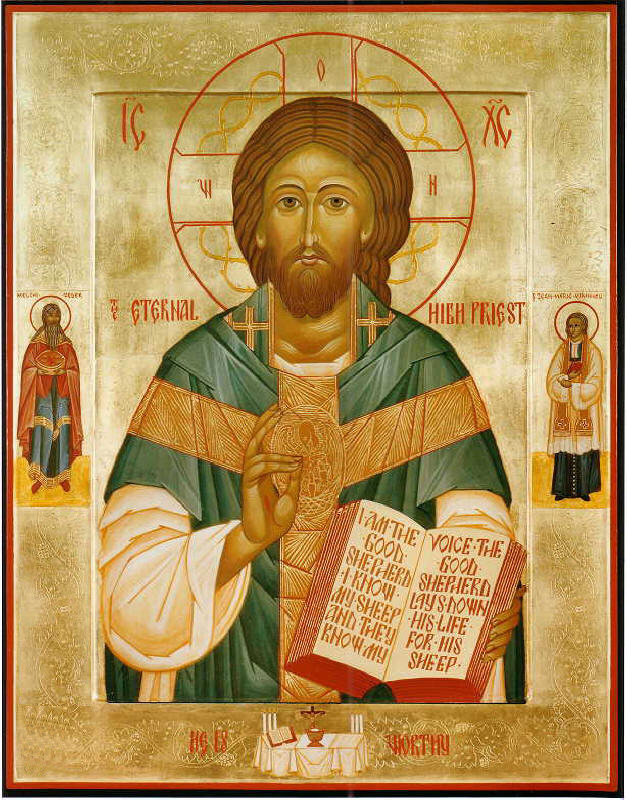
Jesus, High Priest
We thank you, God our Father, for those who have responded to your call to priestly ministry.
Accept this prayer we offer on their behalf: Fill your priests with the sure knowledge of your love.
Open their hearts to the power and consolation of the Holy Spirit.
Lead them to new depths of union with your Son.
Increase in them profound faith in the Sacraments they celebrate as they nourish, strengthen and heal us.
Lord Jesus Christ, grant that these, your priests, may inspire us to strive for holiness by the power of their example, as men of prayer who ponder your word and follow your will.
O Mary, Mother of Christ and our mother, guard with your maternal care these chosen ones, so dear to the Heart of your Son.
Intercede for our priests, that offering the Sacrifice of your Son, they may be conformed more each day to the image of your Son, our Lord and Savior, Jesus Christ. Amen.
Saint John Vianney, universal patron of priests, pray for us and our priests
This icon shows Jesus Christ, our eternal high priest.
The gold pelican over His heart represents self-sacrifice.
The border contains an altar and grapevines, representing the Mass, and icons of Melchizedek and St. Jean-Baptiste Vianney.
Melchizedek: king of righteousness (left icon) was priest and king of Jerusalem. He blessed Abraham and has been considered an ideal priest-king.
St. Jean-Baptiste Vianney is the patron saint of parish priests.
13
posted on
05/31/2018 8:50:04 PM PDT
by
Salvation
("With God all things are possible." Matthew 19:26)
To: All
Pray a Rosary each day for our nation.
1. Sign of the Cross: In the name of the Father, and of the Son, and of the Holy Spirit. Amen.
2. The Apostles Creed: I BELIEVE in God, the Father almighty, Creator of heaven and earth, and in Jesus Christ, His only Son, our Lord, who was conceived by the Holy Spirit, born of the Virgin Mary, suffered under Pontius Pilate, was crucified, died, and was buried. He descended into hell; on the third day he rose again from the dead; he ascended into heaven, and is seated at the right hand of God, the Father Almighty; from there He shall come to judge the living and the dead.
I believe in the Holy Spirit, the holy catholic Church, the communion of saints, the forgiveness of sins, the resurrection of the body, and the life everlasting. Amen.
3. The Lord's Prayer: OUR Father, who art in heaven, hallowed be Thy name. Thy kingdom come. Thy will be done on earth as it is in heaven. Give us this day our daily bread and forgive us our trespasses as we forgive those who trespass against us. And lead us not into temptation, but deliver us from evil. Amen.
4. (3) Hail Mary: HAIL Mary, full of grace, the Lord is with thee. Blessed art thou amongst women and blessed is the fruit of thy womb, Jesus. Holy Mary, Mother of God, pray for us sinners, now, and in the hour of our death. Amen. (Three times)
5. Glory Be: GLORY be to the Father, and to the Son, and to the Holy Spirit. As it was in the beginning, is now, and ever shall be, world without end. Amen.
6. Fatima Prayer: Oh, my Jesus, forgive us our sins, save us from the fires of hell, lead all souls to heaven, especially those in most need of your mercy.
Announce each mystery, then say 1 Our Father, 10 Hail Marys, 1 Glory Be and 1 Fatima prayer. Repeat the process with each mystery.
End with the Hail Holy Queen:
Hail, Holy Queen, Mother of Mercy, our life, our sweetness and our hope! To thee do we cry, poor banished children of Eve! To thee do we send up our sighs, mourning and weeping in this vale of tears! Turn then, most gracious advocate, thine eyes of mercy towards us; and after this, our exile, show unto us the blessed fruit of thy womb, Jesus!
O clement, O loving, O sweet Virgin Mary! Pray for us, O holy Mother of God, that we may be made worthy of the promises of Christ.
Final step -- The Sign of the Cross
The Mysteries of the Rosary By tradition, Catholics meditate on these Mysteries during prayers of the Rosary. The biblical references follow each of the Mysteries below.
The Sorrowful Mysteries
(Tuesdays and Fridays)
1. The Agony in the Garden (Matthew 26:36-46, Luke 22:39-46) [Spiritual fruit - God's will be done]
2. The Scourging at the Pillar (Matthew 27:26, Mark 15:15, John 19:1) [Spiritual fruit - Mortification of the senses]
3. The Crowning with Thorns (Matthew 27:27-30, Mark 15:16-20, John 19:2) [Spiritual fruit - Reign of Christ in our heart]
4. The Carrying of the Cross (Matthew 27:31-32, Mark 15:21, Luke 23:26-32, John 19:17) [Spiritual fruit - Patient bearing of trials]
5. The Crucifixion (Matthew 27:33-56, Mark 15:22-39, Luke 23:33-49, John 19:17-37) [Spiritual fruit - Pardoning of Injuries]
14
posted on
05/31/2018 8:51:52 PM PDT
by
Salvation
("With God all things are possible." Matthew 19:26)
To: All

St. Michael the Archangel
~ PRAYER ~
St. Michael, the Archangel, defend us in battle
Be our protection against the wickedness
and snares of the devil;
May God rebuke him, we humbly pray,
and do thou, O Prince of the heavenly host,
by the power of God,
Cast into hell Satan and all the evil spirits
who prowl through the world seeking the ruin of souls.
Amen
+
15
posted on
05/31/2018 8:53:48 PM PDT
by
Salvation
("With God all things are possible." Matthew 19:26)
To: All
June, 2018
The Holy Father's Prayer Intention
Universal – Social Networks, That social networks may work towards that inclusiveness which respects others for their differences.
16
posted on
05/31/2018 9:01:43 PM PDT
by
Salvation
("With God all things are possible." Matthew 19:26)
To: All
'This sentence has been passed upon the world; this is the law of God; that all things which have come into existence die; and that those which have increased grow old; and that the strong be weakened; and that the large be diminished; and that when they have been weakened and diminished they come to an end.' St. Cyprian of Carthage
17
posted on
05/31/2018 9:05:03 PM PDT
by
Salvation
("With God all things are possible." Matthew 19:26)
To: All
Daily Gospel Commentary
Friday of the Eighth week in Ordinary Time
Commentary of the day Saint Jerome (347-420), priest, translator of the Bible, Doctor of the Church
Sermons on Saint Mark's Gospel, no.8 ; SC 494 It was not yet the season for figs
"It was not the season for figs." The apostle Paul gives an interpretation of this passage in his letter to the Romans: "I do not want you to be unaware of this mystery, brethren: a hardening has come on Israel in part until the full number of the Gentiles comes in. Thus all Israel will be saved" (Rm 11:25-26). If our Lord had found fruit on this fig tree then the full number of the Gentiles would not have come in. But because the full number of Gentiles has come in, all Israel will eventually be saved... In addition, we find this passage in the Revelation of Saint John: "Seven thousand will believe from the tribe of Judah, twelve thousand from the tribe of Reuben" and the same for the other tribes (cf. Rv 7:5-8). They were forty-four thousand in all who would believe...
If Israel had believed, our Lord would not have been crucified, and if our Lord had not been crucified, the mass of the Gentiles would not have been saved. Thus the Jews would become believers but would not believe until the end of the world. It was not yet the season for them to believe in the cross... Their unbelief is our faith; their fall, our rising. It was not the time for them that it might become the time for us.
18
posted on
05/31/2018 9:07:49 PM PDT
by
Salvation
("With God all things are possible." Matthew 19:26)
To: All
June Devotion: The Sacred Heart
Since the 16th century Catholic piety has assigned entire months to special devotions. The month of June is set apart for devotion to the Sacred Heart of Jesus. "From among all the proofs of the infinite goodness of our Savior none stands out more prominently than the fact that, as the love of the faithful grew cold, He, Divine Love Itself, gave Himself to us to be honored by a very special devotion and that the rich treasury of the Church was thrown wide open in the interests of that devotion." These words of Pope Pius XI refer to the Sacred Heart Devotion, which in its present form dates from the revelations given to Saint Margaret Mary Alacoque in 1673-75. The devotion consists in the divine worship of the human heart of Christ, which is united to His divinity and which is a symbol of His love for us. The aim of the devotion is to make our Lord king over our hearts by prompting them to return love to Him (especially through an act of consecration by which we offer to the Heart of Jesus both ourselves and all that belongs to us) and to make reparation for our ingratitude to God.
INVOCATION
O Heart of love, I put all my trust in Thee; for I fear all things from my own weakness, but I hope for all things from Thy goodness.
Saint Margaret Mary Alacoque
PRAYER TO THE SACRED HEART
Devotion to the Sacred Heart was the characteristic note of the piety of Saint Gertrude the Great (1256-1302), Benedictine nun and renowned mystic. She was, in fact, the first great exponent of devotion to the Sacred Heart. In our efforts to honor the Heart of Jesus we have this prayer as a model for our own:
Hail! O Sacred Heart of Jesus, living and quickening source of eternal life, infinite treasure of the Divinity, and burning furnace of divine love. Thou art my refuge and my sanctuary, 0 my amiable Savior. Consume my heart with that burning fire with which Thine is ever inflamed. Pour down on my soul those graces which flow from Thy love, and let my heart be so united with Thine, that our wills may be one, and mine in all things be conformed to Thine. May Thy divine will be equally the standard and rule of all my desires and of all my actions. Amen.
Saint Gertrude
FOR THE CHURCH
O most holy Heart of Jesus, shower Thy blessings in abundant measure upon Thy holy Church, upon the Supreme Pontiff and upon all the clergy; to the just grant perseverance; convert sinners; enlighten unbelievers; bless our relations, friends and benefactors; assist the dying; deliver the holy souls in purgatory; and extend over all hearts the sweet empire of Thy love. Amen.
A PRAYER OF TRUST
O God, who didst in wondrous manner reveal to the virgin, Margaret Mary, the unsearchable riches of Thy Heart, grant that loving Thee, after her example, in all things and above all things, we may in Thy Heart find our abiding home.
Roman Missal
ACT OF LOVE
Reveal Thy Sacred Heart to me, O Jesus, and show me Its attractions. Unite me to It for ever. Grant that all my aspirations and all the beats of my heart, which cease not even while I sleep, may be a testimonial to Thee of my love for Thee and may say to Thee: Yes, Lord, I am all Thine;
pledge of my allegiance to Thee rests ever in my heart will never cease to be there. Do Thou accept the slight amount of good that I do and be graciously pleased to repair all m] wrong-doing; so that I may be able to bless Thee in time and in eternity. Amen.
Cardinal Merry del Val
MEMORARE TO THE SACRED HEART
Remember, O most sweet Jesus, that no one who has had recourse to Thy Sacred Heart, implored its help, or sought its mercy was ever abandoned. Encouraged with confidence, O tenderest of hearts, we present ourselves before Thee, crushed beneath the weight of our sins. In our misery, O Sacred Heart of Jesus, despise not our simple prayers, but mercifully grant our requests. Amen.
Prayer Source: Prayer Book, The by Reverend John P. O'Connell, M.A., S.T.D. and Jex Martin, M.A., The Catholic Press, Inc., Chicago, Illinois, 1954
Only for Love: The Sacred Heart and the Priesthood [Catholic Caucus]
Catholic Word of the Day: LITANY OF THE SACRED HEART, 10-19-09
Devotion to the Sacred Heart of Jesus
Devotion to the Sacred Heart Today
The Biblical Foundation of Devotion to the Sacred Heart of Jesus [Ecumenical]
Heart to Heart (Sacred Heart of Jesus Devotion) [St. Margaret Mary Alacoque]
(June) The Month of the Sacred Heart {Catholic/Orthodox Caucus]
First Friday Devotion to the Sacred Heart of Jesus [St. Margaret Mary Alacoque]
The Heart of the World (On the Sacred Heart of Jesus) (Catholic Caucus)
The Sacred Heart Is The Holy Eucharist(Catholic Caucus)
The Origin of the Sacred Heart Badge
Importance of Devotion to the Sacred Heart
An Awesome Homily on the Solemnity of the Sacred Heart of Jesus by Father Edmond Kline
Catholic Prayer and Devotion: June the Month of the Sacred Heart
Catholic Devotions: Sacred Heart of Jesus
Pope Urges Jesuits to Spread Sacred Heart Devotion
Homilies preached by Father Altier on the Feast of the Sacred Heart
Catholic Meditation and Devotion: The Sacred Heart of Jesus
Daily Recomendation to the Sacred Heart of Jesus powerful prayer!
The Sacred Heart and the Eucharist
The Love of the Sacred Heart
On the Sacred Heart - "We Adore God's Love of Humanity"
HAURIETIS AQUAS (On Devotion To The Sacred Heart) - Encyclical by Pope Pius XII
Solemnity Most Sacred Heart of Jesus and Immaculate Heart of Mary
Sacred Heart a Feast of God's Love, Says John Paul II
The Sacred Heart of Jesus: Symbol of Combativity and the Restoration of Christendom
Devotion to the Sacred Heart of Jesus-The Early Church, Middle Ages up to St. Margaret Mary
See this Heart
‘God Will Act and Will Reign’
About Devotion To The Sacred Heart:The Story Of Saint Margaret Mary Alacoque
Rediscover Feast of Sacred Heart, John Paul II Tells Youth
"Behold this Heart which has loved men so much, and yet men do not want to love Me in return. Through you My divine Heart wishes to spread its love everywhere on earth."
- Jesus to Saint Margaret Mary
Our Lord also made 12 promises to St. Margaret Mary for those that are devoted to His Sacred Heart.
-
I will give them all the graces necessary for their state in life.
-
I will give peace in their families.
-
I will console them in all their troubles.
-
They shall find in My Heart an assured refuge during life and especially at the hour of death.
-
I will pour abundant blessings on all their undertakings.
-
Sinners shall find in My Heart the source and infinite ocean of mercy.
-
Tepid souls shall become fervent.
-
Fervent souls shall speedily rise to great perfection.
-
I will bless the homes in which the image of My Sacred Heart shall be exposed and honoured.
-
I will give to priests the power to touch the most hardened hearts.
-
Those who propagate this devotion shall have their name written in My Heart, and it shall never be effaced.
-
The all-powerful love of My Heart will grant to all those who shall receive Communion on the First Friday of nine consecutive months the grace of final repentance; they shall not die under My displeasure, nor without receiving their Sacraments; My Heart shall be their assured refuge at the last hour.
19
posted on
05/31/2018 9:10:41 PM PDT
by
Salvation
("With God all things are possible." Matthew 19:26)
To: All
|

The Angelus
|
The Angel of the Lord declared to Mary:
And she conceived of the Holy Spirit.
Hail Mary, full of grace, the Lord is with thee; blessed art thou among women and blessed is the fruit of thy womb, Jesus. Holy Mary, Mother of God, pray for us sinners, now and at the hour of
our death. Amen.
Behold the handmaid of the Lord: Be it done unto me according to Thy word.
Hail Mary . . .
And the Word was made Flesh: And dwelt among us.
Hail Mary . . .
Pray for us, O Holy Mother of God, that we may be made worthy of the promises of Christ.
Let us pray:
Pour forth, we beseech Thee, O Lord, Thy grace into our hearts; that we, to whom the incarnation of Christ, Thy Son, was made known by the message of an angel, may by His Passion and Cross be brought to the glory of His Resurrection, through the same Christ Our Lord.
Amen.
"Hail, full of grace, the Lord is with you" (Lk 1:28) "Blessed are you among women,
and blessed is the fruit of your womb"
(Lk 1:42). |
Virus-free. www.avg.com |
20
posted on
05/31/2018 9:12:04 PM PDT
by
Salvation
("With God all things are possible." Matthew 19:26)
Navigation: use the links below to view more comments.
first 1-20, 21-35 next last
Disclaimer:
Opinions posted on Free Republic are those of the individual
posters and do not necessarily represent the opinion of Free Republic or its
management. All materials posted herein are protected by copyright law and the
exemption for fair use of copyrighted works.
FreeRepublic.com is powered by software copyright 2000-2008 John Robinson