
Olomouc Missal
1413
Manuscript, 415 x 295 mm
Town Archive, Brno
Posted on 05/20/2018 9:24:45 PM PDT by Salvation
KEYWORDS: catholic; jn19; ordinarytime; prayer; saints;
Please FReepmail me to get on/off the Alleluia Ping List.
From: Genesis 3:9-15, 20
Temptation and the First Sin (Continuation)
[20] The man called his wife’s name Eve, because she was the mother of all li-
ving.
********************************************************************************************
Commentary:
3:7-13. This passage begins the description of the effects of the original sin.
Man and woman have come to know evil, and it shows, initially, in a most direct
way — in their own bodies. The inner harmony described in Genesis 2:25 is bro-
ken, and concupiscence rears its head. Their friendship with God is also broken,
and they flee from his presence, to avoid their nakedness being seen. As if his
Creator could not see them! The harmony between man and woman is also frac-
tured: he puts the blame on her, and she puts it on the serpent. But all three
share in the responsibility, and therefore all three are going to pay the penalty.
“The harmony in which they found themselves, thanks to original justice, is now
destroyed: the control of the soul’s spiritual faculties over the body is shattered:
the union of man and woman becomes subject to tensions (cf. Gen 3:7-16),
their relations henceforth marked by lust and domination. Harmony with creation
is broken: visible creation has become alien and hostile to man (cf. Gen 3:17,
19). Because of man, creation is now subject ‘to its bondage to decay’ (Rom 8:
21). Finally, the consequence explicitly foretold for this disobedience will come
true: man will ‘return to the ground’ (Gen 3:19), for out of it he was taken. ‘Death
makes its entrance into human history’ (cf. Roman 5:12)” (”Catechism of the
Catholic Church”, 400).
3:14-15. The punishment God imposes on the serpent includes confrontation
between woman and the serpent, between mankind and evil, with the promise
that man will come out on top. That is why this passage is called the “Proto-
gospel”: it is the first announcement to mankind of the good news of the Re-
deemer-Messiah. Clearly, a bruise to the head is deadly, whereas a bruise to
the heel is curable.
As the Second Vatican Council teaches, “God, who creates and conserves all
things by his Word, (cf. In 1:3), provides men with constant evidence of himself
in created realities (cf. Rom 1:19-20). And furthermore, wishing to open up the
way to heavenly salvation, by promising redemption (cf. Gen 3:15); and he has
never ceased to take care of the human race. For he wishes to give eternal life
to all those who seek salvation by patience in well-doing (cf. Rom 2:6-7)” (”Dei
Verbum”, 3).
Victory over the devil will be brought about by a descendant of the woman, the
Messiah. The Church has always read these verses as being messianic, refer-
ring to Jesus Christ; and it was seen in the woman the mother of the promised
Savior; the Virgin Mary is the new Eve. “The earliest documents, as they are
read in the Church and are understood in the light of a further and full revelation,
bring the figure of a woman, Mother of the Redeemer, into a gradually clearer
light. Considered in this light, she is already prophetically foreshadowed in the
promise of victory over the serpent which was given to our first parents after
their fall into sin (cf. Gen 3:15) [...]. Hence not a few of the early Fathers gladly
assert with Irenaeus in their preaching: ‘the knot of Eve’s disobedience was un-
tied by Mary’s obedience: what the virgin Eve bound through her disbelief, Mary
loosened by her faith’ (St Irenaeus, “Adv. haer.” 3, 22, 4) Comparing Mary with
Eve, they call her ‘Mother of the living’ (St Epiphanius, “Adv. haer. Panarium”
78, 18) and frequently claim: ‘death through Eve, life through Mary’ (St Jerome,
“Epistula” 22, 21; etc.)” (Vatican II, “Lumen Gentium”, 55-56).
So, woman is going to have a key role in that victory over the devil. In his Latin
translation of the Bible, the “Vulgate”, St Jerome in fact reads the relevant pas-
sage as “she [the woman] shall bruise your head”. That woman is the Blessed
Virgin, the new Eve and the mother of the Redeemer, who shares (by anticipa-
tion and pre-eminently) in the victory of her Son. Sin never left its mark on her,
and the Church proclaims her as the Immaculate Conception.
St Thomas explains that the reason why God did not prevent the first man from
sinning was because ‘God allows evils to be done in order to draw forth some
greater good. Thus St Paul says, ‘Where sin increased, grace abounded all the
more’ (Rom 5:20); and the “Exultet” sings, ‘O happy fault,...which gained for us
so great a Redeemer’” (”Summa Theologiae”, 3, 1, 3 and 3; cf. “Catechism of
the Catholic Church”, 412).
********************************************************************************************
Source: “The Navarre Bible: Text and Commentaries”. Biblical text from the
Revised Standard Version and New Vulgate. Commentaries by members of
the Faculty of Theology, University of Navarre, Spain.
Published by Four Courts Press, Kill Lane, Blackrock, Co. Dublin, Ireland, and
by Scepter Publishers in the United States.
From: Acts 1:12-14
The Apostolic College
*********************************************************************************************
Commentary:
13-14. St Luke mentions the twelve Apostles by name, with the exception of Ju-
das Iscariot.
This is the first passage which tells of the spiritual life and devout practices of
the disciples. Significantly it places the emphasis on prayer, in keeping with our
Lord’s own practice and with his constant recommendation to his followers (cf.
Mt 6:5, 14:23; etc.).
“Prayer is the foundation of the spiritual edifice. Prayer is all-powerful” (St. J. Es-
criva, “The Way”, 83). It can truly be said that prayer is the bedrock of the Church,
which will be made manifest with the coming of the Holy Spirit. The prayer of the
disciples, including the women, in the company of Mary would have been a sup-
plication of entreaty and praise and thanksgiving to God. This union of hearts and
feelings produced by prayer is a kind of anticipation of the gifts the Holy Spirit will
bring.
“We are told this time and again in the passage narrating the lives of the first fol-
lowers of Christ. ‘All these with one accord devoted themselves to prayer (Acts
1:14). [...] Prayer was then, as it is today, the only weapon, the most powerful
means, for winning the battles of our interior struggle” (St. J. Escriva, “Friends of
God”, 242).
Here we see Mary as the spiritual center round which Jesus’ intimate friends ga-
ther: tradition has meditated on this “tableau”, and found it to depict our Lady’s
motherhood over the whole Church, both at its beginning and over the course of
the centuries.
On 21 November 1964, at the closing of the third session of Vatican II, Paul VI
solemnly proclaimed Mary Mother of the Church: “Our vision of the Church must
include loving contemplation of the marvels which God worked in his holy Mother.
And knowledge of the true Catholic doctrine about Mary will always be the key
to correct understanding of the mystery of Christ and of the Church.
Reflection on the close ties linking Mary and the Church, so clearly indicated by
the present constitution [”Lumen Gentium”], allows us to think this is the most
appropriate moment to satisfy a desire which, as we pointed out at the end of
the last session, many council Fathers have made their own, calling insistently
for an explicit declaration during this council of the maternal role which the Bles-
sed Virgin exercises towards the Christian people. To this end we have consi-
dered it opportune to dedicate a title in honor of the Virgin which has been pro-
posed in different parts of the Catholic world and which we find particularly tou-
ching, for it sums up in a wonderfully succinct way the privileged position which
this council has recognized the Blessed Virgin to have in the Church.
“And so, for the glory of the Virgin and for our consolation, we proclaim Mary
Most Holy to be the Mother of the Church, that is, Mother of the entire people of
God, faithful as well as pastors, who call her loving Mother, and we desire that
from now on she be honored and invoked by the entire people of God under this
most pleasing title.”
The text makes reference to Jesus’ “brethren”, an expression which also appears
in the Gospels. Given that the Christian faith teaches us that the Virgin Mary had
no children other than Jesus, whom she conceived by the action of the Holy Spi-
rit and without intervention of man, this expression cannot mean that Jesus had
blood brothers or sisters.
The explanation lies in the peculiarities of Semitic languages. The word used in
the New Testament translates a Hebrew term which applied to all the members
of a family group and was used for even distant cousins (cf. Lev 10:4) and for ne-
phews (Gen 13:8). See note on Mt 12:46-47. In the New Testament then; the
word “brethren” has a very wide meaning—as happens, also, for example, with
the word “apostle.”
At one point Jesus describes those who hear and keep his word as his “breth-
ren” (Lk 8:21), which seems to imply that, in addition to meaning belonging to
the same family group, the word “brother” in the New Testament may be a de-
signation for certain disciples who were particularly loyal to our Lord.
St Paul, for his part, uses this term for all Christians (cf., for example, 1 Cor 1:
10; etc), as does St Peter, according to Acts 12:17.
*********************************************************************************************
Source: “The Navarre Bible: Text and Commentaries”. Biblical text from the
Revised Standard Version and New Vulgate. Commentaries by members of
the Faculty of Theology, University of Navarre, Spain.
Published by Four Courts Press, Kill Lane, Blackrock, Co. Dublin, Ireland, and
by Scepter Publishers in the United States.
From: John 19:25-34
The Crucifixion and Death of Jesus (Continuation)
[28] After this Jesus, knowing that all was now finished said (to fulfill the Scrip-
ture), “I thirst.” [29] A bowl full of vinegar stood there; so they put a sponge full
of the vinegar on hyssop and held it to his mouth. [30] When Jesus had received
the vinegar, he said “It is finished”; and he bowed his head and gave up his spirit.
Jesus’ Side is Pierced. His Burial
*********************************************************************************************
Commentary:
25. Whereas the Apostles, with the exception of St. John, abandon Jesus in the
hour of His humiliation, these pious women, who had followed Him during His pu-
blic life (cf. Lk 8:2-3) now stay with their Master as He dies on the cross (cf. note
on Mt 27:55-56).
St. John Paul II explained that our Lady’s faithfulness was shown in four ways:
first, in her generous desire to do all that God wanted of her (cf. Lk 1:34); second,
in her total acceptance of God’s will (cf. Lk 1:38); third, in the consistency be-
tween her life and the commitment of faith which she made; and, finally, in her
withstanding this test. “And only a consistency that lasts throughout the whole of
life can be called faithfulness. Mary’s ‘fiat’ in the Annunciation finds its fullness in
the silent ‘fiat’ that she repeats at the foot of the Cross” (”Homily in Mexico Cathe-
dral”, 26 January 1979).
The Church has always recognized the dignity of women and their important role
in salvation history. It is enough to recall the veneration which from the earliest
times the Christian people have had for the Mother of Christ, the Woman “par ex-
cellence” and the most sublime and most privileged creature ever to come from
the hands of God. Addressing a special message to women, the Second Vatican
Council said, among other things: “Women in trial, who stand upright at the foot
of the cross like Mary, you who so often in history have given to men the strength
to battle unto the very end and to give witness to the point of martyrdom, aid
them now still once more to retain courage in their great undertakings, while at
the same time maintaining patience and an esteem for humble beginnings” (Va-
tican II, “Message To Women”, 8 December 1965).
26-27. “The spotless purity of John’s whole life makes him strong before the Cross.
The other apostles fly from Golgotha: he, with the Mother of Christ, remains. Don’t
forget that purity strengthens and invigorates the character” (St. J. Escriva, “The
Way”, 144).
Our Lord’s gesture in entrusting His Blessed Mother to the disciple’s care, has a
dual meaning (see p. 19 above and pp. 35ff). For one thing it expresses His filial
love for the Virgin Mary. St Augustine sees it as a lesson Jesus gives us on how
to keep the fourth commandment: “Here is a lesson in morals. He is doing what
He tells us to do and, like a good Teacher, He instructs His own by example,
that it is the duty of good children to take care of their parents; as though the
wood on which His dying members were fixed were also the chair of the teaching
Master” (St Augustine, “In Ioann. Evang.”, 119, 2).
Our Lord’s words also declare that Mary is our Mother: “The Blessed Virgin also
advanced in her pilgrimage of faith, and faithfully persevered in her union with her
Son unto the cross, where she stood, in keeping with the divine plan, enduring
with her only begotten Son the intensity of His suffering, associating herself with
His sacrifice in her mother’s heart, and lovingly consenting to the immolation of
this victim who was born of her. Finally, she was given by the same Christ Jesus
dying on the cross as a mother to His disciple” (Vatican II, “Lumen Gentium”,
58).
All Christians, who are represented in the person of John, are children of Mary.
By giving us His Mother to be our Mother, Christ demonstrates His love for His
own to the end (cf. Jn 13:1). Our Lady’s acceptance of John as her son show her
motherly care for us: “the Son of God, and your Son, from the Cross indicated a
man to you, Mary, and said: ‘Behold, your son’ (Jn 19:26). And in that man He
entrusted to you every person, He entrusted everyone to you. And you, who at
the moment of the Annunciation, concentrated the whole program of your life in
those simple words: ‘Behold, I am the handmaid of the Lord; let it be to me ac-
cording to your word’ (Lk 1:38): embrace everyone, draw close to everyone, seek
everyone out with motherly care. Thus is accomplished what the last Council
said about your presence in the mystery of Christ and the Church. In a wonderful
way you are always found in the mystery of Christ, your only Son, because you
are present wherever men and women, His brothers and sisters, are present,
wherever the Church is present” (St. John Paul II, “Homily in the Basilica of Gua-
dalupe”, 27 January 1979).
“John, the disciple whom Jesus loved, brought Mary into his home, into his life.
Spiritual writers have seen these words of the Gospel as an invitation to all Chris-
tians to bring Mary into their lives. Mary certainly wants us to invoke her, to ap-
proach her confidently, to appeal to her as our mother, asking her to ‘show that
you are our mother’” (St. J. Escriva, “Christ Is Passing By”, 140).
Sl. John Paul II constantly treats our Lady as his Mother. In bidding farewell to
the Virgin of Czestochowa he prayed in this way: “Our Lady of the Bright Moun-
tain, Mother of the Church! Once more I consecrate myself to you ‘in your mater-
nal slavery of love’. ‘Totus tuus!’ I am yours! I consecrate to you the whole Church
— everyone to the ends of the earth! I consecrate to you humanity; I consecrate
to you all men and women, my brothers and sisters. All peoples and all nations.
I consecrate to you Europe and all the continents. I consecrate to you Rome and
Poland, united, through your servant, by a fresh bond of love. Mother, accept us!
Mother, do not abandon us! Mother, be our guide!” (”Farewell Address” at Jasna
Gora Shrine, 6 June 1979).
28-29. This was foretold in the Old Testament: “They gave me poison for food,
and for my thirst they gave me vinegar to drink” (Ps 69:21). This does not mean
that they gave Jesus vinegar to increase his suffering; it was customary to offer
victims of crucifixion water mixed with vinegar to relieve their thirst. In addition to
the natural dehydration Jesus was suffering, we can see in his thirst an expres-
sion of his burning desire to do his Father’s will and to save a souls: “On the
Cross he cried out “Sitio”!, ‘I thirst’. He thirsts for us, for our love, for our souls
and for all the souls we ought to be bringing to him along the way of the Cross,
which is the way to immortality and heavenly glory” (St. J. Escriva, “Friends of
God”, 202).
30. Jesus, nailed on the cross, dies to atone for all the sins and vileness of man.
Despite his sufferings he dies serenely, majestically, bowing his head now that he
has accomplished the mission entrusted to him. “Who can sleep when he wishes
to, as Jesus died when he wished to? Who can lay aside his clothing when he wi-
shes to, as he put off the flesh when he chose to?... What must be hope or fear to
find his power when he comes in judgment, if it can be seen to be so great at the
moment of his death!” (St Augustine, “In loann. Evang.”, 119, 6).
“Let us meditate on our Lord, wounded from head to foot out of love for us. Using
a phrase which approaches the truth, although it does not express its full reality,
we can repeat the words of an ancient writer: ‘The body of Christ is a portrait in
pain’. At the first sight of Christ bruised and broken — just a lifeless body taken
down from the cross and given to his Mother — at the sight of Jesus destroyed in
this way, we might have thought he had failed utterly. Where are the crowds that
once followed him, where is the kingdom he foretold? But this is victory, not defeat.
We are nearer the resurrection than ever before; we are going to see the glory
which he has won with his obedience” (St. J. Escriva, “Christ is Passing By”, 95).
31-33. Jesus dies on the Preparation day of the Passover — the “Parasceve” —
that is, the eve, when the paschal lambs were officially sacrificed in the Temple.
By stressing this, the evangelist implies that Christ’s sacrifice took the place of
the sacrifices of the Old Law and inaugurated the New Alliance in his Blood (cf.
Heb 9:12).
The Law of Moses required that the bodies should be taken down before nightfall
(Deut 21:22-23); this is why Pilate is asked to have their legs broken, to bring on
death and allow them to be buried before it gets dark, particularly since the next
day is the feast of the Passover.
On the date of Jesus’ death see “The Dates of the Life of our Lord Jesus Christ”
in “The Navarre Bible: St Mark” pp. 48ff.
34. The outflow of blood and water has a natural explanation. Probably the water
was an accumulation of liquid in the lungs due to Jesus’ intense sufferings.
As on other occasions, the historical events narrated in the fourth Gospel are la-
den with meaning. St Augustine and Christian tradition see the sacrament and
the Church itself flowing from Jesus’ open side: “Here was opened wide the door
of life, from which the sacraments of the Church have flowed out, without which
there is no entering in unto life which is true life. [...] Here the second Adam with
bowed head slept upon the cross, that thence a wife might be formed of him, flo-
wing from his side while he slept. O death, by which the dead come back to life!
is there anything purer than this Blood, any wound more healing!” (St Augustine,
“In Ioann. Evang.”, 120, 2).
The Second Vatican Council, for its part, teaches: “The Church—that is, the king-
dom of Christ—already present in mystery, grows visibly through the power of God
in the world. The origin and growth of the Church are symbolized by the blood
and water which flowed from the open side of the crucified Jesus (Vatican II, “Lu-
men Gentium”, 3).
“Jesus on the cross, with his heart overflowing with love for men, is such an elo-
quent commentary on the value of people and things that words only get in the
way. People, their happiness and their life, are so important that the very Son of
God gave himself to redeem and cleanse and raise them up” (St. J. Escriva,
“Christ is Passing By”, 165).
*********************************************************************************************
Source: “The Navarre Bible: Text and Commentaries”. Biblical text from the
Revised Standard Version and New Vulgate. Commentaries by members of
the Faculty of Theology, University of Navarre, Spain.
Published by Four Courts Press, Kill Lane, Blackrock, Co. Dublin, Ireland, and
by Scepter Publishers in the United States.
Liturgical Colour: White.
| First reading | James 3:13-18 © |
|---|
| Show wisdom and avoid ambition |
|---|
| Responsorial Psalm |
|---|
| Psalm 18(19):8-10,15 © |
| Gospel Acclamation |
|---|
| Gospel | Mark 9:14-29 © |
|---|
| Help the little faith I have! |
|---|
Pray for Pope Francis.
50 Boko Haram Islamic Radicals Killed; 1,000 Hostages, Women and Children, Rescued in Nigeria
Nigeria: In the Face of Ongoing Islamist Attacks, the Faith is Growing
US Promises to Help Nigeria Exterminate Boko Haram
Is This Bishop Right about the Rosary Conquering Boko Haram? [Catholic Caucus]
Why Boko Haram and ISIS Target Women
Report reveals scale of Boko Haram violence inflicted on Nigerian Catholics
Military evacuating girls, women rescued from Boko Haram
Echos of Lepanto Nigerian bishop says rosary will bring down Boko Harm
After vision of Christ, Nigerian bishop says rosary will bring down Boko Haram (Catholic Caucus)
Nigerian Bishop Says Christ Showed Him How to Beat Islamic Terror Group
| John | |||
| English: Douay-Rheims | Latin: Vulgata Clementina | Greek NT: Byzantine/Majority Text (2000) | |
| John 19 |
|||
| 25. | Now there stood by the cross of Jesus, his mother, and his mother's sister, Mary of Cleophas, and Mary Magdalen. | Stabant autem juxta crucem Jesu mater ejus, et soror matris ejus, Maria Cleophæ, et Maria Magdalene. | ειστηκεισαν δε παρα τω σταυρω του ιησου η μητηρ αυτου και η αδελφη της μητρος αυτου μαρια η του κλωπα και μαρια η μαγδαληνη |
| 26. | When Jesus therefore had seen his mother and the disciple standing whom he loved, he saith to his mother: Woman, behold thy son. | Cum vidisset ergo Jesus matrem, et discipulum stantem, quem diligebat, dicit matri suæ : Mulier, ecce filius tuus. | ιησους ουν ιδων την μητερα και τον μαθητην παρεστωτα ον ηγαπα λεγει τη μητρι αυτου γυναι ιδου ο υιος σου |
| 27. | After that, he saith to the disciple: Behold thy mother. And from that hour, the disciple took her to his own. | Deinde dicit discipulo : Ecce mater tua. Et ex illa hora accepit eam discipulus in sua. | ειτα λεγει τω μαθητη ιδου η μητηρ σου και απ εκεινης της ωρας ελαβεν ο μαθητης αυτην εις τα ιδια |
| 28. | Afterwards, Jesus knowing that all things were now accomplished, that the scripture might be fulfilled, said: I thirst. | Postea sciens Jesus quia omnia consummata sunt, ut consummaretur Scriptura, dixit : Sitio. | μετα τουτο ιδων ο ιησους οτι παντα ηδη τετελεσται ινα τελειωθη η γραφη λεγει διψω |
| 29. | Now there was a vessel set there full of vinegar. And they, putting a sponge full of vinegar and hyssop, put it to his mouth. | Vas ergo erat positum aceto plenum. Illi autem spongiam plenam aceto, hyssopo circumponentes, obtulerunt ori ejus. | σκευος ουν εκειτο οξους μεστον οι δε πλησαντες σπογγον οξους και υσσωπω περιθεντες προσηνεγκαν αυτου τω στοματι |
| 30. | Jesus therefore, when he had taken the vinegar, said: It is consummated. And bowing his head, he gave up the ghost. | Cum ergo accepisset Jesus acetum, dixit : Consummatum est. Et inclinato capite tradidit spiritum. | οτε ουν ελαβεν το οξος ο ιησους ειπεν τετελεσται και κλινας την κεφαλην παρεδωκεν το πνευμα |
| 31. | Then the Jews, (because it was the parasceve,) that the bodies might not remain on the cross on the sabbath day, (for that was a great sabbath day,) besought Pilate that their legs might be broken, and that they might be taken away. | Judæi ergo (quoniam parasceve erat) ut non remanerent in cruce corpora sabbato (erat enim magnus dies ille sabbati), rogaverunt Pilatum ut frangerentur eorum crura, et tollerentur. | οι ουν ιουδαιοι ινα μη μεινη επι του σταυρου τα σωματα εν τω σαββατω επει παρασκευη ην ην γαρ μεγαλη η ημερα εκεινου του σαββατου ηρωτησαν τον πιλατον ινα κατεαγωσιν αυτων τα σκελη και αρθωσιν |
| 32. | The soldiers therefore came; and they broke the legs of the first, and of the other that was crucified with him. | Venerunt ergo milites : et primi quidem fregerunt crura, et alterius, qui crucifixus est cum eo. | ηλθον ουν οι στρατιωται και του μεν πρωτου κατεαξαν τα σκελη και του αλλου του συσταυρωθεντος αυτω |
| 33. | But after they were come to Jesus, when they saw that he was already dead, they did not break his legs. | Ad Jesum autem cum venissent, ut viderunt eum jam mortuum, non fregerunt ejus crura, | επι δε τον ιησουν ελθοντες ως ειδον αυτον ηδη τεθνηκοτα ου κατεαξαν αυτου τα σκελη |
| 34. | But one of the soldiers with a spear opened his side, and immediately there came out blood and water. | sed unus militum lancea latus ejus aperuit, et continuo exivit sanguis et aqua. | αλλ εις των στρατιωτων λογχη αυτου την πλευραν ενυξεν και ευθεως εξηλθεν αιμα και υδωρ |
We thank you, God our Father, for those who have responded to your call to priestly ministry.
Accept this prayer we offer on their behalf: Fill your priests with the sure knowledge of your love.
Open their hearts to the power and consolation of the Holy Spirit.
Lead them to new depths of union with your Son.
Increase in them profound faith in the Sacraments they celebrate as they nourish, strengthen and heal us.
Lord Jesus Christ, grant that these, your priests, may inspire us to strive for holiness by the power of their example, as men of prayer who ponder your word and follow your will.
O Mary, Mother of Christ and our mother, guard with your maternal care these chosen ones, so dear to the Heart of your Son.
Intercede for our priests, that offering the Sacrifice of your Son, they may be conformed more each day to the image of your Son, our Lord and Savior, Jesus Christ. Amen.
Saint John Vianney, universal patron of priests, pray for us and our priests
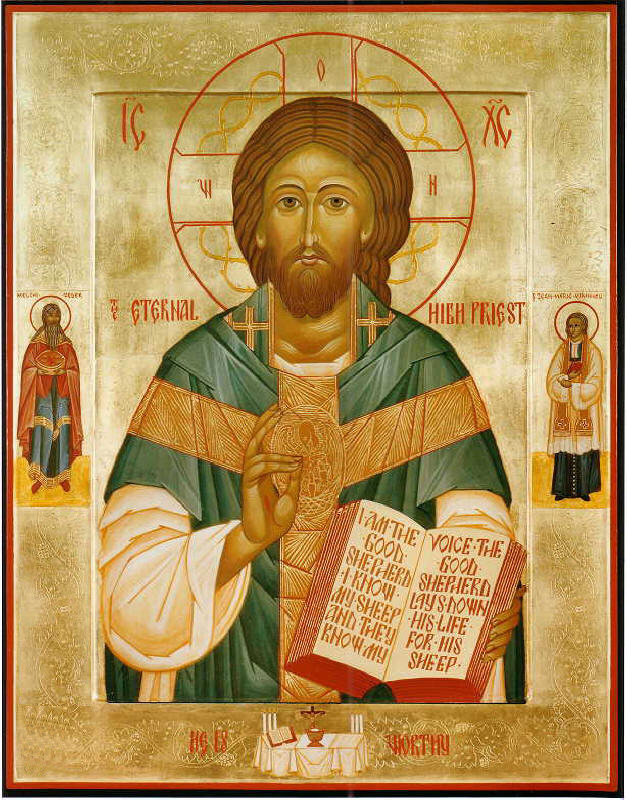
This icon shows Jesus Christ, our eternal high priest.
The gold pelican over His heart represents self-sacrifice.
The border contains an altar and grapevines, representing the Mass, and icons of Melchizedek and St. Jean-Baptiste Vianney.
Melchizedek: king of righteousness (left icon) was priest and king of Jerusalem. He blessed Abraham and has been considered an ideal priest-king.
St. Jean-Baptiste Vianney is the patron saint of parish priests.

1. Sign of the Cross: In the name of the Father, and of the Son, and of the Holy Spirit. Amen.
2. The Apostles Creed: I BELIEVE in God, the Father almighty, Creator of heaven and earth, and in Jesus Christ, His only Son, our Lord, who was conceived by the Holy Spirit, born of the Virgin Mary, suffered under Pontius Pilate, was crucified, died, and was buried. He descended into hell; on the third day he rose again from the dead; he ascended into heaven, and is seated at the right hand of God, the Father Almighty; from there He shall come to judge the living and the dead.
I believe in the Holy Spirit, the holy catholic Church, the communion of saints, the forgiveness of sins, the resurrection of the body, and the life everlasting. Amen.
3. The Lord's Prayer: OUR Father, who art in heaven, hallowed be Thy name. Thy kingdom come. Thy will be done on earth as it is in heaven. Give us this day our daily bread and forgive us our trespasses as we forgive those who trespass against us. And lead us not into temptation, but deliver us from evil. Amen.
4. (3) Hail Mary: HAIL Mary, full of grace, the Lord is with thee. Blessed art thou amongst women and blessed is the fruit of thy womb, Jesus. Holy Mary, Mother of God, pray for us sinners, now, and in the hour of our death. Amen. (Three times)
5. Glory Be: GLORY be to the Father, and to the Son, and to the Holy Spirit. As it was in the beginning, is now, and ever shall be, world without end. Amen.
6. Fatima Prayer: Oh, my Jesus, forgive us our sins, save us from the fires of hell, lead all souls to heaven, especially those in most need of your mercy.
Announce each mystery, then say 1 Our Father, 10 Hail Marys, 1 Glory Be and 1 Fatima prayer. Repeat the process with each mystery.
End with the Hail Holy Queen:
Hail, Holy Queen, Mother of Mercy, our life, our sweetness and our hope! To thee do we cry, poor banished children of Eve! To thee do we send up our sighs, mourning and weeping in this vale of tears! Turn then, most gracious advocate, thine eyes of mercy towards us; and after this, our exile, show unto us the blessed fruit of thy womb, Jesus!
O clement, O loving, O sweet Virgin Mary! Pray for us, O holy Mother of God, that we may be made worthy of the promises of Christ.
Final step -- The Sign of the Cross
The Mysteries of the Rosary By tradition, Catholics meditate on these Mysteries during prayers of the Rosary. The biblical references follow each of the Mysteries below.
The Joyful Mysteries
(Mondays and Saturdays)
1. The Annunciation (Luke 1:26-38) [Spiritual fruit - Humility]
2. The Visitation (Luke 1: 39-56) [Spiritual fruit - Love of Neighbor]
3. The Nativity (Luke 2:1-20) [Spiritual fruit - Poverty of Spirit]
4. The Presentation (Luke 2:21-38) [Spiritual fruit - Purity of mind & body]
5. The Finding of Jesus in the Temple (Luke 2:41-52) [Spiritual fruit - Obedience ]
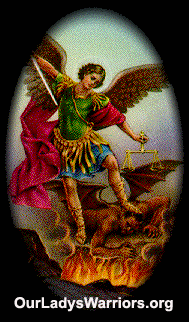
St. Michael the Archangel
~ PRAYER ~
St. Michael, the Archangel, defend us in battle
Be our protection against the wickedness
and snares of the devil;
May God rebuke him, we humbly pray,
and do thou, O Prince of the heavenly host,
by the power of God,
Cast into hell Satan and all the evil spirits
who prowl through the world seeking the ruin of souls.
Amen
+
|
May Devotion: Blessed Virgin Mary
|

Since the 16th century Catholic piety has assigned entire months to special devotions. Toward the end of the eighteenth century a zealous Jesuit priest, Father Lalomia, started among the students of the Roman college of his Society the practice of dedicating May to Our Lady. The devotion, which others had promoted in a small way, soon spread to other Jesuit Colleges and to the entire Latin church and since that time it has been a regular feature of Catholic life.
INVOCATIONS
Thou who wast a virgin before thy delivery, pray for us. Hail Mary, etc.
Thou who wast a virgin in thy delivery, pray for us. Hail Mary, etc.
Thou who wast a virgin after thy delivery, pray for us. Hail Mary, etc.
My Mother, deliver me from mortal sin.
Hail Mary (three times).
Mother of love, of sorrow and of mercy, pray for us.
Remember, O Virgin Mother of God, when thou shalt stand before the face of the Lord, that thou speak favorable things in our behalf and that He may turn away His indignation from us.
Roman Missal
Thou art my Mother, O Virgin Mary: keep me safe lest I ever offend thy dear Son, and obtain for me the grace to please Him always and in all things.
FOR THE HELP OF THE BLESSED VIRGIN MARY
May we be assisted, we beseech Thee, 0 Lord, by the worshipful intercession of Thy glorious Mother, the ever-Virgin Mary; that we, who have been enriched by her perpetual blessings, may be delivered from all dangers, and through her loving kindness made to be of one heart and mind: who livest and reignest world without end. Amen.
Roman Missal
THE SALVE REGINA
Hail, holy Queen, Mother of mercy, hail, our life, our sweetness, and our hope! To thee do we cry, poor banished children of Eve! To thee do we send up our sighs, mourning and weeping in this vale of tears! Turn then, most gracious advocate, thine eyes of mercy towards us; and after this, our exile, show unto us the blessed fruit of thy womb, Jesus! O clement, O loving, O sweet Virgin Mary!
Roman Breviary
PRAYER TO THE BLESSED VIRGIN MARY
O blessed Virgin Mary, who can worthily repay thee thy just dues of praise and thanksgiving, thou who by the wondrous assent of thy will didst rescue a fallen world? What songs of praise can our weak human nature recite in thy honor, since it is by thy intervention alone that it has found
the way to restoration? Accept, then, such poor thanks as we have here to offer, though they be unequal to thy merits; and, receiving our vows, obtain by thy prayers the remission of our offenses. Carry thou our prayers within the sanctuary of the heavenly audience, and bring forth from it the antidote of our reconciliation. May the sins we bring before Almighty God through thee, become pardonable through thee; may what we ask for with sure confidence, through thee be granted. Take our offering, grant us our requests, obtain pardon for what we fear, for thou art the sole hope of sinners. Through thee we hope for the remission of our sins, and in thee, 0 blessed Lady, is our hope of reward. Holy Mary, succour the miserable, help the fainthearted, comfort the sorrowful, pray for thy people, plead for the clergy, intercede for all women consecrated to God; may all who keep thy holy commemoration feel now thy help and protection. Be thou ever ready to assist us when we pray, and bring back to us the answers to our prayers. Make it thy continual care to pray for the people of God, thou who, blessed by God, didst merit to bear the Redeemer of the world, who liveth and reigneth, world without end. Amen.
Saint Augustine
PETITION TO MARY
Most holy Virgin Immaculate, my Mother Mary, to thee who art the Mother of my Lord, the queen of the universe, the advocate, the hope, the refuge of sinners, I who am the most miserable of all sinners, have recourse this day. I venerate thee, great queen, and I thank thee for the many graces thou hast bestowed upon me even unto this day; in particular for having delivered me from the hell which I have so often deserved by my sins. I love thee, most dear Lady; and for the love I bear thee, I promise to serve thee willingly for ever and to do what I can to make thee loved by others also. I place in thee all my hopes for salvation; accept me as thy servant and shelter me under thy mantle, thou who art the Mother of mercy. And since thou art so powerful with God, deliver me from all temptations, or at least obtain for me the strength to overcome them until death. From thee I implore a true love for Jesus Christ. Through thee I hope to die a holy death. My dear Mother, by the love thou bearest to Almighty God, I pray thee to assist me always, but most of all at the last moment of my life. Forsake me not then, until thou shalt see me safe in heaven, there to bless thee and sing of thy mercies through all eternity. Such is my hope. Amen.
Saint Alphonsus Liguori
Magnificat Prayer
My being proclaims the greatness of the Lord, my spirit finds joy in God my savior,
For he has looked upon his servant in her lowliness; all ages to come shall call me blessed.
God who is mighty has done great things for me,
holy is his name; His mercy is from age to age on those who fear him. He has shown might with his arm; he has confused the proud in their inmost thoughts. He has deposed the mighty from their thrones and raised the lowly to high places. The hungry he has given every good thing, while the rich he has sent empty away. He has upheld Israel his servant, ever mindful of his mercy; Even as he promised our fathers, promised Abraham and his descendants forever.
(Lk 1:46-55)
TO MARY, REFUGE OF SINNERS
Hail, most gracious Mother of mercy, hail, Mary, for whom we fondly yearn, through whom we obtain forgiveness! Who would not love thee? Thou art our light in uncertainty, our comfort in sorrow, our solace in the time of trial, our refuge from every peril and temptation. Thou art our sure hope of salvation, second only to thy only-begotten Son; blessed are they who love thee, our Lady! Incline, I beseech thee, thy ears of pity to the entreaties of this thy servant, a miserable sinner; dissipate the darkness of my sins by the bright beams of thy holiness, in order that I may be acceptable in thy sight.
FOR THE GRACE OF LOVE
O Mary, my dear Mother, how much I love thee! And yet in reality how little! Thou dost teach me what I ought to know, for thou teachest me what Jesus is to me and what I ought to be for Jesus. Dearly beloved Mother, how close to God thou art, and how utterly filled with Him! In the measure that we know God, we remind ourselves of thee. Mother of God, obtain for me the grace of loving my Jesus; obtain for me the grace of loving thee!
Cardinal Merry del Val
TO THE BLESSED VIRGIN MARY FOR MAY
O most august and blessed Virgin Mary! Holy Mother of God! glorious Queen of heaven and earth! powerful protectress of those who love thee, and unfailing advocate of all who invoke thee! look down, I beseech thee, from thy throne of glory on thy devoted child; accept the solemn offering I present thee of this month, specially dedicated to thee, and receive my ardent, humble desire, that by my love and fervor I could worthily honor thee, who, next to God, art deserving of all honor. Receive me, 0 Mother of Mercy, among thy best beloved children; extend to me thy maternal tenderness and solicitude; obtain for me a place in the Heart of Jesus, and a special share in the gifts of His grace. 0 deign, I beseech thee, to recognize my claims on thy protection, to watch over my spiritual and temporal interests, as well as those of all who are dear to me; to infuse into my soul the spirit of Christ, and to teach me thyself to become meek, humble, charitable, patient, and submissive to the will of God.
May my heart bum with the love of thy Divine Son, and of thee, His blessed Mother, not for a month alone, but for time and eternity; may I thirst for the promotion of His honor and thine, and contribute, as far as I can, to its extension. Receive me, 0 Mary, the refuge of sinners! Grant me a Mother's blessing and a Mother's care, now, and at the hour of my death. Amen.
TO OUR LADY
Saint John Vianney, better known as the Cure of Ars, when asked how long he had loved Mary, said: "I loved her almost before I could know her." In this prayer he expresses that love.
O thou most holy virgin Mary, who dost evermore stand before the most holy Trinity, and to whom it is granted at all times to pray for us to thy most beloved Son; pray for me in all my necessities; help me, combat for me, and obtain for me the pardon of all my sins. Help me especially at my last hour; and when I can no longer give any sign of the use of reason, then do thou encourage me, make the sign of the cross for me, and fight for me against the enemy. Make in my name a profession of faith; favor me with a testimony of my salvation, and never let me despair of the mercy of God. Help me to overthrow the wicked enemy. When I can no longer say: "Jesus, Mary, and Joseph, I place my soul in your hands," do thou say it for me; when I can no longer hear human words of consolation, do thou comfort me. Leave me not before I have been judged; and if I have to expiate my sins in purgatory, oh! pray for me earnestly; and admonish my friends to procure for me a speedy enjoyment of the blessed sight of God. Lessen my sufferings, deliver me speedily, and lead my soul into heaven with thee: that, united with all the elect, I may there bless and praise my God and thee for all eternity. Amen.
Saint John Vianney
ACT OF REPARATION
O blessed Virgin, Mother of God, look down in mercy from heaven, where thou art enthroned as Queen, upon me, a miserable sinner, thine unworthy servant. Although I know full well my own unworthiness, yet in order to atone for the offenses that are done to thee by impious and blasphemous
tongues, from the depths of my heart I praise and extol thee as the purest, the fairest, the holiest creature of all God's handiwork. I bless thy holy name, I praise thine exalted privilege of being truly Mother of God, ever virgin, conceived without stain of sin, co-redemptrix of the human race. I bless the Eternal Father who chose thee in an especial way for His daughter; I bless the Word Incarnate who took upon Himself our nature in thy bosom and so made thee His Mother; I bless the Holy Spirit who took thee as His bride. All honor, praise and thanksgiving to the ever-blessed Trinity, who predestined thee and loved thee so exceedingly from all eternity as to exalt thee above all creatures to the most sublime heights. 0 Virgin, holy and merciful, obtain for all who offend thee the grace of repentance, and graciously accept this poor act of homage from me thy servant, obtaining likewise for me from thy divine Son the pardon and remission of all my sins. Amen.
Prayer Source: Prayer Book, The by Reverend John P. O'Connell, M.A., S.T.D. and Jex Martin, M.A., The Catholic Press, Inc., Chicago, Illinois, 1954
| Memorare of the Blessed Virgin Mary |

Remember O Most Gracious Virgin Mary!
That never was it known
That anyone who fled to thy protection,
Implored thy help or sought thy intercession
Was left unaided.
Inspired by this confidence, I fly unto Thee!
O Virgin of virgins, My Mother!
To Thee I come before Thee I stand,
Sinful and Sorrowful,
Oh Mother of the Word Incarnate,
Despise not my petitions, but in thy mercy,
Hear and answer me.
Amen
Who Is Our Lady of Laus? "My name is Mary" (CATHOLIC CAUCUS)
What Happened to the Virgin Mary After Pentecost? [Catholic/Orthodox Caucus)
Saint Thomas Aquinas on the Hail Mary (Catholic Caucus)
Yes, Mary DOES Know
How Can Mary Hear Thousands Simultaneously?
Fr Paul Schenck: Immaculate Conception Tells us Who Mary Is and Who We Are (Catholic Caucus)
Mary,Our Lady of Quatlasupe,She who crushes the head of the serpent, is leading...(Catholic Caucus)
MARY, MOTHER OF EVANGELIZATION [Cath-Orth caucus]
On Mary, Model of Faith, Charity and Union with Christ [Weekly Audience]
Why Don't You honor Mary?
Columbus and the Virgin Mary [Catholic Caucus]
Pope Francis: Mary's faith unties the knot of sin
Pope consecrates world to immaculate heart of Mary
Mary, Mother of God
Mary 'can only bring us to God,' expert says as entrustment nears
Pope Francis: "Mary, look upon us" (Mass in Cagliari)
Devotion to the Most Holy Name of Mary [Catholic/Orthodox Caucus]
Pope Francis: contemplate the "suffering humanity" of Jesus and the sweetness of Mary
Mary's Nativity Draws Tens of Thousands to Indian Basilica
Veneration of Mary in Luke 11:27-28
Pope at Mass: Learning from Mary to keep the Word of God
Pope: Mary is always in a hurry to help us (first pastoral visit to a diocese in Rome)
Catholic Word of the Day: MARY'S SINLESSNESS, 04-01-13
Letter #47: To Mary (Pope Francis prays at (tomb of Pope St. Pius V) [Catholic Caucus]
Catholic Word of the Day: MARY'S VIRGINITY, 02-26-13
Mariaphobic Response Syndrome: Part Two
Mariaphobic Response Syndrome: Part One
A Mother's Love, The Blessed Virgin Mary Saying YES To God
Chesterton on devotion to the Blessed Virgin Mary [Ecumenical]
The Perpetual Virginity of Blessed Mary
A Comparison is Instituted Between the Disobedient and Sinning Eve and the Virgin Mary..
Magnificat: The Hymn of the Blessed Virgin Mary [Catholic Caucus]
The Blessed Virgin Mary's Role in the Celibate Priest's Spousal... (Pt 2) (CATHOLIC CAUCUS)
The Blessed Virgin Mary's Role in the Celibate Priest's Spousal and Paternal Love (CATHOLIC CAUCUS)
Discovering Mary [Excellent New Book For Converts]
Beginning Our Lady's Month [Catholic Caucus]
Give it all to Mary [Catholic Caucus]
JESUS LIVING IN MARY: HANDBOOK, SPIRITUALITY OF ST. LOUIS DE MONTFORT, ROSARY [Ecumenical]
Mary, Tabernacle of the Lord By Archbishop Fulton Sheen(Catholic Caucus)
A ... Discovers Mary
Mary is our Mother and Queen of the New Davidic Kingdom (Scriptures Agree With Catholic Church)
Hail Mary
Holy Water Silhouette (Virgin Mary -video))
How could Mary be the Mother of God?
Mary, the Mother of God (a defense)
Calling Mary "Mother of God" Tells Us Who Jesus Is
The Holy Spirit And Mary (Catholic Caucus)
Mary, Our Cause of Rejoicing
Mary in Byzantine Doctrine and Devotion (Catholic / Orthodox Caucus)
Radio Replies First Volume - Devotion to Mary
The Blessed Virgin Mary and the Catholic Discovery of America(Catholic Caucus)
Mary is the star that guides us to holiness, says Holy Father during Angelus [Catholic Caucus]
The Efficacy and Power of One Hail Mary [Ecumenical]
When Did Belief in the Virgin Birth Begin?
Mary, Motherhood, and the Home BY Archbishop Fulton Sheen
On Mary, Mother of Priests
Benedict reflects on Mary and the priesthood [Catholic Caucus]
Radio Replies First Volume - Mary
Scholar says ... neglect lessons from Virgin Mary
Mary and the Sword Continued Part #2 by Bishop Fulton J. Sheen
Mary and the Sword by Bishop Fulton J. Sheen(Catholic Caucus)
Why Did Mary Offer a Sin Offering? [Ecumenical]
Mary and Intercessory Prayer
Mary: Holy Mother
Mary not just for Catholics anymore
Pope concludes Month of Mary in the Vatican Gardens
Consecration to Mary(Catholic Caucus)
Mary's Marching Orders
Praying the Hail Mary Like Never Before [Ecumenical]
Our Lady of the Most Blessed Sacrament [Catholic Caucus]
Catholic Caucus: The Catechism of St. Thomas Aquinas - THE HAIL MARY
Our Jewish Roots: The Immaculate Conception [Ecumenical]
The Blessed Virgin in the History of Christianity [Ecumenical]
Archbishop Sheen Today! -- Mary and the Moslems
Mary Immaculate: Patroness of the United States [Catholic/Orthodox Caucus]
"The Woman He Loved": Fulton Sheen and the Blessed Mother(Catholic Caucus)
September 12: The Most Holy Name of Mary and Militant Islam
Catholic Devotional: Feast of the Holy Name of Mary
A Homily on the Feast of the Most Holy Name of Mary
May Devotion: Blessed Virgin Mary
Catholic Caucus: Mary, The Power of Her Name [The Most Holy Name of the Blessed Virgin Mary]
Disclaimer: Opinions posted on Free Republic are those of the individual posters and do not necessarily represent the opinion of Free Republic or its management. All materials posted herein are protected by copyright law and the exemption for fair use of copyrighted works.