
Christ Cleansing the Temple
Luca Giordano (1634-1705)
Oil on canvas
Bob Jones University Collection, Greenville
Posted on 03/03/2018 9:57:31 PM PST by Salvation
KEYWORDS: catholic; jn2; lent; prayer; saints;
Please FReepmail me to get on/off the Lenten Ping List.
From: Exodus 20:1-17
The Ten Commandments
[3] “You shall have no other gods before me.
[4] “You shall not make for yourself a graven image, or any likeness of anything
that is in heaven above, or that is in the earth beneath, or that is in the water un-
der the earth; [5] you shall not bow down to them or serve them; for I the LORD
your God am a jealous God, visiting the iniquity of the fathers upon the children
to the third and the fourth generation of those who hate me, [6] but showing
steadfast love to thousands of those who love me and keep my commandments.
[7] “You shall not take the name of the Lord your God in vain; for the LORD will
not hold him guiltless who takes his name in vain.
[8] “Remember the sabbath day, to keep it holy. [9] Six days you shall labor, and
do all your work; [10] but the seventh day is a sabbath to the LORD your God; in
it you shall not do any work, you, or your son, or your daughter, your manservant,
or your maidservant, or your cattle, or the sojourner who is within your gates; [11]
for in six days the LORD made heaven and earth, the sea, and all that is in them,
and rested the seventh day; therefore the LORD blessed the sabbath day and
hallowed it.
[12] “Honor your father and your mother, that your days may be long in
the land which the LORD your God gives you.
[13] “You shall not kill.
[14] “You shall not commit adultery.
[15] “You shall not steal.
[16] “You shall not bear false witness against your neighbor.
[17] “You shall not covet your neighbor’s house; you shall not covet your neigh-
bor’s wife, or his manservant, or his maidservant, or his ox, or his ass, or any-
thing that is your neighbor’s.”
*********************************************************************************************
Commentary:
20:1-21. “Decalogue” comes from the Greek, meaning “ten words” (cf. the literal
sense of Deut 4:13). It consists of the Ten Commandments or moral code, recor-
ded here and in Deuteronomy 5:6-21. The Decalogue is dealt with in a very spe-
cial way here: for one thing, it is embedded in the account of the theophany, slot-
ted in between 19:19 and 20:18; for another, attached to the concise command-
ments (identical in Exodus and Deuteronomy) are other more elaborate command-
ments (giving reasons and explanations) which differ as between the two versions.
The fact that the Decalogue (and not any other legal code of the Pentateuch) is
repeated practically verbatim in Exodus and Deuteronomy and has from ancient
times been reproduced separately, as the Nash papyrus (2nd century BC) shows,
indicates the importance the Decalogue always had among the people of Israel
as a moral code.
On the supposition that the versions in Exodus and Deuteronomy can be reduced
to a single original text, the variations between them can be explained in terms of
the applications of the commandments to the circumstances of the period when
each version was made; the final redaction, which we have here, is the one held
to be inspired. The apodictic form (future imperative, second person: “You shall
not kill”) is that proper to biblical commandments and it differs from the casuisti-
cal type of wording that Israel shares with other Semitic people, as can be seen
from the Code of the Covenant (chaps 21-23).
The ten commandments are the core of Old Testament ethics and they retain
their value in the New Testament. Jesus often reminds people about them (cf. Lk
18:20) and he fills them out (cf. Mt 5:17ff). The Fathers and Doctors of the Church
have commented on them at length because, as St Thomas points out, all the
precepts of the natural law are contained in the Decalogue: the universal precepts,
such as “Do good and avoid evil”, “which are primary and general, are contained
therein as principles in their proximate conclusions, while conversely, those which
are mediated by the wise are contained in them as conclusions in their principles”
(”Summa Theologiae”, 1-2, 100, 3).
The commandments tend to be divided up in two different ways: thus, Jews and
many Christian confessions divide the first commandment into two—the precept
to adore only one God (vv. 2-3) and that of not making images (vv. 3-6); whereas
Catholics and Lutherans (following St Augustine) make these commandments
one and divide into two the last commandments (not to covet one’s neighbor’s
wife: the ninth; and not to covet his goods: the tenth).
There is nothing sacrosanct about these divisions (their purpose is pedagogi-
cal); whichever way the commandments are divided, the Decalogue stands. In
our commentary we follow St Augustine’s division and make reference to the
teaching of the Church, because the Ten Commandments contain the core of
Christian morality (cf. the notes on Deut 5:1-22).
20:2. Hittite peoples (some of whose political and social documents have sur-
vived) used to begin peace treaties with an historical introduction, that is, by re-
counting the victory of a king over a vassal on whom specific obligations were
being imposed. In a similar sort of way, the Decalogue begins by recalling the
Exodus. However, what we have here is something radically different from a Hit-
tite pact, because the obligation that the commandments imply is not based on
a defeat but on a deliverance. God is offering the commandments to the people
whom he has delivered from bondage, whereas human princes imposed their
codes on peoples whom they had reduced to vassalage. The commandments
are therefore an expression of the Covenant. Acceptance of them is a sign that
man has attained maturity in his freedom. “Man becomes free when he enters
into the Covenant of God? (Aphraates, “Demonstrationes”, 12). Jesus stressed
the same idea: “My yoke is easy, and my burden is light” (Mt 11:30).
20:3-6 “You shall love God above all things” is the wording of the first command-
ment given in most catechisms (cf. “Catechism of the Catholic Church”, 2083)
summarizing the teaching of Jesus (cf. Mk 12:28-31, which quotes the text of
Deuteronomy 6:4-5. In the ten commandments this precept covers two aspects
— monotheism (v. 3) and the obligation not to adore idols or images of the Lord
(vv. 4-6). Belief in the existence of only one God is the backbone of the entire
Bible message. The prophets will openly teach monotheism, holding that God
is the sovereign Lord of the universe and of time; but this ban on other gods it-
self implies the sure conviction that there is only one true God. “You shall have
no other gods before [or, besides] me”, implies a belief in one God, that is mo-
notheism.
The ban on images was something that marked Israel as different from other peo-
ples. The ban not only covered idols or images of other gods, but also represen-
tations of the Lord.
The one true God is spiritual and transcendent: he cannot be controlled or mani-
pulated (unlike the gods of Israel’s neighbors). On the basis of the mystery of the
incarnate Word Christians began to depict scenes from the Gospel and in so do-
ing they knew that this was not at odds with God’s freedom nor did it make for
idolatry. The Church venerates images because they are representations either
of Jesus who, being truly man had a body, or of saints, who as human beings
were portrayable and worthy of veneration. The Second Vatican Council recom-
mended the veneration of sacred images, while calling for sobriety and beauty:
“The practice of placing sacred images in churches so that they be venerated by
the faithful is to be maintained. Nevertheless their number should be moderate
and their relative positions should reflect right order. For otherwise the Christian
people may find them incongruous and they may foster devotion of doubtful ortho-
doxy” (”Sacrosancturn Concilium”, 125).
20:5-6. “A jealous God”: an anthropomorphism emphasizing the uniqueness of
God. Since he is the only true God, he cannot abide either the worship of other
gods (cf. 34:14) or worship of idols. Idolatry is the gravest and most condemned
sin in the Bible (cf. “Catechism of the Catholic Church”, 2113). Those in charge
of worship in the temple are described as being “jealous” for the Lord (cf. Num
25:13; 1 Kings 19:10, 14), because they have to watch to ensure that no devia-
tions occur. When expelling the money-changers from the temple (Jn 2:17), Je-
sus refers to this aspect of priests’ responsibility; “Zeal for thy house has con-
sumed me” (Ps 69:9).
On the Lord’s merciful retribution, cf. the note on Ex 34:6-7.
20:7. Respect for God’s name is respect for God himself. Hence this prohibition
on invoking the name of the Lord to gain credence for evil, be it at a trial (by com-
mitting perjury), or by swearing to do something evil, or by blasphemy (cf. Sir 23:
7-12). In ancient times, Israel’s neighbors used the names of their gods in magi-
cal conjuration; in such a situation the invoking of the Lord’s name is idolatrous.
In general, this commandment forbids any abuse, any disrespect, any irreverent
use of the name of God. And, to put it positively, “The second commandment
‘prescribes respect for the Lord’s name’. Like the first commandment, it belongs
to the virtue of religion and more particularly it governs our use of speech in sa-
cred matters” (”Catechism of the Catholic Church”, 2142).
20:8-11 Israel’s history evidently influenced the formulation of the sabbath precept,
given that the usual apodictic mode is not used and that the prescriptions concer-
ning this day are very well developed.
The commandment includes three ideas: the sabbath is a holy day, dedicated to
the Lord; work is forbidden on it; one reason for it is to imitate God, who rested
from creation on the seventh day.
The sabbath is a holy day, that is, different from ordinary days (cf. Lev 23:3) be-
cause it is dedicated to God. No special rites are prescribed but the word “rem-
ember” (different from “observe” in Deuteronomy 5:10) is a word with cultic asso-
ciations. Whatever the etymology or social origin of the sabbath was, in the Bible
it is always something holy (cf. 16:22-30).
Sabbath rest implies that there is an obligation to work on the previous six days
(v. 9). Work is the only justification for rest. The Hebrew word “sabat” actually
means “sabbath” and “rest”. But on this day rest acquires a cultic value, for no
special sacrifices or rites are prescribed for the sabbath: the whole community,
and even animals, render homage to God by ceasing from their labors.
20:12 The fourth is the first commandment to do with interpersonal relationships
(the subject of the second “table” as ancient Christian writers used to term these
commandments: cf. “Catechism of the Catholic Church”, 2197). Like the sabbath
precept, it is couched in a positive way, its direct reference is to family members.
The fact that it comes immediately after the precepts that refer to God shows its
importance. Parents, in effect, represent God within the family circle.
The commandment has to do not only with young children (cf. Prov 19:26; 20:
20; 23:22;; 30:17), who have a duty to remain subject to their parents (Deut 21:
18-21), but to all children whatever their age, because it is offenses committed
by older children that incur a curse (cf. Deut 17:16).
The promise of a long life to those who keep this commandment shows how im-
portant it is for the individual, and also the importance the family has for society.
The Second Vatican Council summed up the value of the family by calling it the
“domestic church” (”Lumen Gentium”, 11; cf. Bl. John Paul II, “Familiaris Con-
sortio”, 21).
20:13. The fifth commandment directly forbids vengeful killing of one’s enemy,
that is, murder; so it protects the sacredness of human life. The prohibition on
murder already comes across in the account of the death of Abel (cf. Gen 4:10)
and the precepts given to Noah (cf. Gen 9:6): life is something that belongs to
God alone.
Revelation and the teaching of the Church tell us more about the scope of this
precept: it is only in very specific circumstances (such as social or personal self-
defense) that a person may be deprived of his or her life. Obviously, the killing of
weaker members of society (abortion, direct euthanasia) is a particularly grave
sin.
The encyclical “Evangelium Vitae” spells out the Church’s teaching on this com-
mandment which “has absolute value when it refers to the ‘innocent person’. [...]
Therefore, by the authority which Christ conferred upon Peter and his Succes-
sors, and in communion with the Bishops of the Catholic Church, ‘I confirm that
the direct and voluntary killing of an innocent human being is always gravely im-
moral’” (Bl. John Paul II, “Evangelium Vitae”, 57).
Our Lord taught that the positive meaning of this commandment was the obliga-
tion to practise charity (cf. Mt 5:21-26): “In the Sermon on the Mount, the Lord
recalls the commandment, ‘You shall not kill’ (Mt 5:21), and adds to it the pro-
scription of anger, hatred and vengeance. Going further, Christ asks his disciples
to turn the other cheek, to love their enemies (cf. Mt 5:22-28). He did not defend
himself and told Peter to leave his sword in its sheath (cf. Mt 26:52)?” (”Cate-
chism of the Catholic Church”, 2262).
20:14. The sixth commandment is orientated to safeguarding the holiness of mar-
riage. In the Old Testament there were very severe penalties for those who com-
mitted adultery (cf. Deut 22:23ff; Lev 20:10). As Revelation progresses, it will be-
come clear that not only is adultery grave, because it damages the rights of the
other spouse, but every sexual disorder degrades the dignity of the person and is
an offense against God (cf., e.g., Prov 7:8-27; 23:27-28). Jesus Christ, by his life
and teaching, showed the positive thrust of this precept (cf. Mt 5:27-32): “Jesus
came to restore creation to the purity of its origins. In the Sermon on the Mount,
he interprets God’s plan strictly: ‘You have heard that it was said, “You shall not
commit adultery.” But I say to you that every one who looks at a woman lustfully
has already committed adultery with her in his heart’ (Mt 5:27-28). What God has
joined together, let not man put asunder (cf. Mt 19:6). The tradition of the Church
has understood the sixth commandment as encompassing the whole of human
sexuality” (”Catechism of the Catholic Church”, 2336).
20:15. Because the Decalogue is regulating inter-personal relationships, this
commandment condemns firstly the abducting of persons in order to sell them
into slavery (cf. Deut 24:7) but obviously it covers unjust appropriation of ano-
ther’s goods. The Church continues to remind us that every violation of the right
to property is unjust (cf. “Catechism of the Catholic Church”, 2409); but this is
particularly true if actions of that type lead to the enslavement of human beings,
or to depriving them of their dignity, as happens in traffic in children, trade in hu-
man embryos, the taking of hostages, arbitrary arrest or imprisonment, racial se-
gregation, concentration camps, etc. “The seventh commandment forbids acts
or enterprises that for any reason—selfish or ideological, commercial or totalita-
rian—lead to the “enslavement of human beings”, to their being bought, sold and
exchanged like merchandise, in disregard for their personal dignity. It is a sin a-
gainst the dignity of persons and their fundamental rights to reduce them by vio-
lence to their productive value or to a source of profit. St Paul directed a Chris-
tian master to treat his Christian slave ‘no longer as a slave but more than a
slave, as a beloved brother...both in the flesh and in the Lord’ (Philem 16)” (”Ca-
techism of the Catholic Church”, 24 14).
20:16. Giving false testimony in court can cause one’s neighbor irreparable da-
mage because an innocent person may be found guilty. But, given that truth and
fidelity in human relationships is the basis of social life (cf. Vatican II, “Gaudium
Et Spes”, 26), this commandment prohibits lying, defamation (cf. Sir 7:12-13),
calumny and the saying of anything that might detract from a neighbor’s dignity
(cf. Jas 3:1-12). “This moral prescription flows from the vocation of the holy peo-
ple to bear witness to their God who is the truth and wills the truth. Offenses a-
gainst the truth express by word or deed a refusal to commit oneself to moral
uprightness: they are fundamental infidelities to God and, in this sense, they un-
dermine the foundations of the covenant” (”Catechism of the Catholic Church”,
2464).
20:17. The wording of this precept is different from that in Deuteronomy: there
the distinction is made between coveting one’s neighbor’s wife and coveting his
goods (cf. Deut 5:21). “St John distinguishes three kinds of covetousness or con-
cupiscence: lust of the flesh, lust of the eyes and pride of life (cf. 1 Jn 2:16). In
the Catholic catechetical tradition, the ninth commandment forbids carnal concu-
piscence; the tenth forbids coveting another’s goods” (”Catechism of the Catholic
Church”, 2514).
*********************************************************************************************
Source: “The Navarre Bible: Text and Commentaries”. Biblical text from the
Revised Standard Version and New Vulgate. Commentaries by members of
the Faculty of Theology, University of Navarre, Spain.
Published by Four Courts Press, Kill Lane, Blackrock, Co. Dublin, Ireland, and
by Scepter Publishers in the United States.
From: 1 Corinthians 1:22-25
The Wisdom of the Cross
*********************************************************************************************
Commentary:
20-25. After stressing the importance of the message of the Cross, St Paul now
contrasts the wisdom of God and the wisdom of the world.
By “wisdom of the world” he means the attitude of man when he is not pursuing
his proper goal: this term “world”, which has various meanings in Sacred Scripture
(cf. note on Jn 17:14-16), in St Paul has the pejorative meaning of “all sinful men”,
people estranged from God (cf. 1 Cor 1:27; 2:12; 3:19; 5:10; 11:32). This human
wisdom cannot attain knowledge of God (cf. Rom 1:19-25), either because it de-
mands external signs or because it accepts only rational arguments.
For the Jews only signs will do—miracles which prove God’s presence (cf. Mt
12:38ff; Lk 11:29); they want to base their faith on things the senses can perceive.
For people with this attitude, the cross of Christ is a scandal, that is, a stumbling
block, which makes it impossible for them to gain access to divine things, because
they have in some way imposed limits as to how God may reveal himself and how
he may not.
The Greeks—St Paul is referring to the Rationalists of his time—think that they are
the arbiters of truth, and that anything which cannot be proved by logical argument
is nonsense. “For the world, that is, for the prudent of the world, their wisdom
turned into blindness; it could not lead them to see God [...]. Therefore, since the
world had become puffed up by the vanity of its dogmas, the Lord set in place the
faith whereby believers would be saved by what seemed unworthy and foolish, so
that, all human conjecture being of no avail, only the grace of God might reveal
what the human mind cannot take in” (St Leo the Great, “Fifth Nativity Sermon”).
Christians, whom God has called out from among the Jews and the Gentiles, do
attain the wisdom of God, which consists in faith, “a supernatural virtue. By that
faith, with the inspiration and help of God’s grace, we believe that what he has
revealed is true—not because its intrinsic truth is seen by the natural light of rea-
son, but because of the authority of God who reveals it, who can neither deceive
nor be deceived” (Vatican I, “Dei Filius”, chap. 3). The same council goes on to
teach that faith is in conformity with reason (cf. Rom 12:1) and that, in addition
to God’s help, external signs—miracles and prophecies—and rational argument
do act as supports of faith.
21. “In the wisdom of God ...”: this has been interpreted in two ways, which com-
plement one another. Roughly, the first interpretation is this: according to God’s
most wise designs, since the world could not attain knowledge of God by its own
efforts, through philosophy, through those elaborate systems of thought the
Greeks were so proud of, God decided to save believers through the preaching of
the Cross, which to human eyes seemed foolishness, a stumbling block (v. 22).
The second interpretation, favored by many Fathers and by St Thomas Aquinas,
contrasts divine wisdom—as manifested in creation and in the Old Testament—
with human wisdom. It runs on these lines: since the world, because of its distor-
ted view of things, failed to attain knowledge of God, despite the way he manifes-
ted himself in creation (cf. Rom 1:19-20) and Sacred Scripture, God has decided
to save man in a remarkable, paradoxical way which better reflects divine wisdom
—the preaching of the Cross.
In both interpretations it is clear that the Apostle is trying to squeeze into one
expression a number of truths—that God’s salvific plans are eternal; that human
wisdom, which is capable, on its own, of discovering God through his works, has
become darkened; that the Cross is the climax of the all-wise plans of God; that
man cannot be truly wise unless he accepts “the wisdom of the cross”, no matter
how paradoxical it may seem.
25. In his plan of salvation God our Lord wants to use things which to man’s mind
seem foolish and weak, so that his wisdom and power will shine out all the more.
“All that Jesus Christ did for us has been meritorious for us; it has all been neces-
sary and advantageous to our salvation; his very weakness has been for us no
less useful than his majesty. For, if by the power of his divinity he has released
us from the captivity of sin, he has also, through the weakness of his flesh, des-
troyed death’s rights. As the Apostle so beautifully said, ‘the weakness of God is
stronger than men’; indeed, by this folly he has been pleased to save the world
by combating the wisdom of the world and confounding the wise; for, possessing
the nature of God and being equal to God, he abased himself, taking the form of
a servant; being rich, he became poor for love of us: being great, he became little;
being exalted, humble; he became weak, who was powerful; he suffered hunger
and thirst, he wore himself out on the roads and suffered of his own free will and
not by necessity. This type of folly, I repeat: has it not meant for us a way of wis-
dom, a model of justice and an example of holiness, as the same Apostle says:
‘The foolishness of God is wiser than men’? So true is this, that death has freed
us from death, life has freed us from error, and grace from sin” (St Bernard, “De
Laudibus Novae Militiae”, XI, 27).
*********************************************************************************************
Source: “The Navarre Bible: Text and Commentaries”. Biblical text from the
Revised Standard Version and New Vulgate. Commentaries by members of
the Faculty of Theology, University of Navarre, Spain.
Published by Four Courts Press, Kill Lane, Blackrock, Co. Dublin, Ireland, and
by Scepter Publishers in the United States.
From: John 2:13-25
The Cleansing of the Temple
[23] Now when he was in Jerusalem at the Passover feast, many believed in his
name when they saw the signs which he did; [24] but Jesus did not trust himself
to them, [25] because he knew all men and needed no one to bear witness of
mail; for he himself knew what was in man.
*********************************************************************************************
Commentary:
13. “The Passover of the Jews”: this is the most important religious feast for the
people of the Old Testament, the prefiguring of the Christian Easter (cf. note on
Mt 26:2). The Jewish Passover was celebrated on the fourteenth day of the month
of Nisan and was followed by the festival week of the Azymes (unleavened bread).
According to the Law of Moses, on those days every male Israelite had to “appear
before the Lord God” (Ex 34:23; Deut 16:16)—hence the pious custom of making
a pilgrimage to the temple of Jerusalem for these days, hence the crowd and all
the vendors to supply the needs of the pilgrims; this trading gave rise to abuses.
“Jesus went up to Jerusalem”: by doing this Jesus publicly shows that he ob-
serves the Law of God. But, as we shall soon see, he goes to the temple as the
only-begotten Son who must ensure that all due decorum is observed in the
House of the Father: “And from thenceforth Jesus, the Anointed of God, always
begins by reforming abuses and purifying from sin; both when he visits his
Church, and when he visits the Christian soul” (Origen, “Hom. on St John”, 1).
14-15. Every Israelite had to offer as a passover sacrifice an ox or a sheep, if he
was wealthy; or two turtle-doves or two pigeons if he was not (Lev 5:7). In addi-
tion he had to pay a half shekel every year, if he was twenty or over. The half
shekel, which was the equivalent of a day’s pay of a worker, was a special coin
also called temple money (cf. Ex 30:13); other coins in circulation (denarii, drach-
mas, etc.) were considered impure because they bore the image of pagan rulers.
During the Passover, because of the extra crowd, the outer courtyard of the tem-
ple, the court of the Gentiles, was full of traders, money changers etc., and ine-
vitably this meant noise, shouting, bellowing, manure etc. Prophets had already
fulminated against these abuses, which grew up with the tacit permission of the
temple authorities, who made money by permitting trading. Cf. notes on Mt 21:
12-13 and Mk 11:15-18.
16-17. “Zeal for thy house will consume me”—a quotation from Psalm 69:10. Je-
sus has just made a most significant assertion: “You shall not make my Father’s
house a house of trade.” By calling God his Father and acting so energetically,
he is proclaiming he is the Messiah, the Son of God. Jesus’ zeal for his Father’s
glory did not escape the attention of his disciples who realized that what he did
fulfilled the words of Psalm 69.
18-22. The temple of Jerusalem, which had replaced the previous sanctuary
which the Israelites carried around in the wilderness, was the place selected by
God during the Old Covenant to express his presence to the people in a special
way. But this was only an imperfect anticipation or prefiguring of the full expres-
sion of his presence among men—the Word of God became man. Jesus, in whom
“the whole fullness of deity dwells bodily” (Col 2:9), is the full presence of God
here on earth and, therefore, the true temple of God. Jesus identifies the temple
of Jerusalem with his own body, and by so doing refers to one of the most pro-
found truths about himself—the Incarnation. After the ascension of the Lord into
heaven this real and very special presence of God among men is continued in
the sacrament of the Blessed Eucharist.
Christ’s words and actions as he expels the traders from the temple clearly show
that he is the Messiah foretold by the prophets. That is why some Jews approach
him and ask him to give a sign of his power (cf. Mt 16:1; Mk 8:11; Lk 11:29). Je-
sus’ reply (v. 20), whose meaning remains obscure until his resurrection, the Je-
wish authorities try to turn into an attack on the temple—which merits the death
penalty (Mt 26:61; Mk 14:58; cf. Jer 26:4ff); later they will taunt him with it when
he is suffering on the cross (Mt 27:40; A 15:29) and later still in their case against
St Stephen before the Sanhedrin they will claim to have heard him repeat it (Acts
6:14).
There was nothing derogatory in what Jesus said, contrary to what false witnes-
ses made out. The miracle he offers them, which he calls “the Sign of Jonah” (cf.
Mt 16:4), will be his own resurrection on the third day. Jesus is using a metaphor,
as if to say: Do you see this temple? Well, imagine if it were destroyed, would it
not be a great miracle to rebuild it in three days? That is what I will do for you as
a sign. For you will destroy my body, which is the true temple, and I will rise
again on the third day.
No one understood what he was saying. Jews and disciples alike thought he was
speaking about rebuilding the temple which Herod the Great had begun to con-
struct in 19-20 B.C. Later on the disciples grasped what he really meant.
23-25. Jesus’ miracles moved many to recognize that he had extraordinary, di-
vine powers. But that falls short of perfect theological faith. Jesus knew their faith
was limited, and that they were not very deeply attached to him: they were inte-
rested in him as a miracle-worker. This explains why he did not trust them (cf.
Jn 6:15, 26) “Many people today are like that. They carry the name of faithful,
but they are ickle and inconstant”, comments Chrysostom (”Hom. on St John”,
23, 1).
Jesus’ knowledge of men’s hearts is another sign of his divinity; for example, Na-
thanael and the Samaritan woman recognized him as the Messiah because they
were convinced by the evidence of supernatural power he showed by reading their
hearts (cf. Jn 1:49; 4:29).
*********************************************************************************************
Source: “The Navarre Bible: Text and Commentaries”. Biblical text from the
Revised Standard Version and New Vulgate. Commentaries by members of
the Faculty of Theology, University of Navarre, Spain.
Published by Four Courts Press, Kill Lane, Blackrock, Co. Dublin, Ireland, and
by Scepter Publishers in the United States.
Liturgical Colour: Violet.
| First reading | Exodus 20:1-17 © |
|---|
| The Law given at Sinai |
|---|
| Alternative First reading |
|---|
| Exodus 20:1-3,7-8,12-17 © |
| The Law given at Sinai |
|---|
| Responsorial Psalm |
|---|
| Psalm 18(19):8-11 © |
| Second reading |
|---|
| 1 Corinthians 1:22-25 © |
| The crucified Christ, the power and wisdom of God |
|---|
| Gospel Acclamation | Jn11:25, 26 |
|---|
| Or | Jn3:16 |
|---|
| Gospel | John 2:13-25 © |
|---|
| Destroy this sanctuary and in three days I will raise it up |
|---|
| John | |||
| English: Douay-Rheims | Latin: Vulgata Clementina | Greek NT: Byzantine/Majority Text (2000) | |
| John 2 |
|||
| 13. | And the pasch of the Jews was at hand, and Jesus went up to Jerusalem. | Et prope erat Pascha Judæorum, et ascendit Jesus Jerosolymam : | και εγγυς ην το πασχα των ιουδαιων και ανεβη εις ιεροσολυμα ο ιησους |
| 14. | And he found in the temple them that sold oxen and sheep and doves, and the changers of money sitting. | et invenit in templo vendentes boves, et oves, et columbas, et numularios sedentes. | και ευρεν εν τω ιερω τους πωλουντας βοας και προβατα και περιστερας και τους κερματιστας καθημενους |
| 15. | And when he had made, as it were, a scourge of little cords, he drove them all out of the temple, the sheep also and the oxen, and the money of the changers he poured out, and the tables he overthrew. | Et cum fecisset quasi flagellum de funiculis, omnes ejecit de templo, oves quoque, et boves, et numulariorum effudit æs, et mensas subvertit. | και ποιησας φραγελλιον εκ σχοινιων παντας εξεβαλεν εκ του ιερου τα τε προβατα και τους βοας και των κολλυβιστων εξεχεεν το κερμα και τας τραπεζας ανεστρεψεν |
| 16. | And to them that sold doves he said: Take these things hence, and make not the house of my Father a house of traffic. | Et his qui columbas vendebant, dixit : Auferte ista hinc, et nolite facere domum patris mei, domum negotiationis. | και τοις τας περιστερας πωλουσιν ειπεν αρατε ταυτα εντευθεν μη ποιειτε τον οικον του πατρος μου οικον εμποριου |
| 17. | And his disciples remembered, that it was written: The zeal of thy house hath eaten me up. | Recordati sunt vero discipuli ejus quia scriptum est : Zelus domus tuæ comedit me. | εμνησθησαν δε οι μαθηται αυτου οτι γεγραμμενον εστιν ο ζηλος του οικου σου καταφαγεται με |
| 18. | The Jews, therefore, answered, and said to him: What sign dost thou shew unto us, seeing thou dost these things? | Responderunt ergo Judæi, et dixerunt ei : Quod signum ostendis nobis, quia hæc facis ? | απεκριθησαν ουν οι ιουδαιοι και ειπον αυτω τι σημειον δεικνυεις ημιν οτι ταυτα ποιεις |
| 19. | Jesus answered, and said to them: Destroy this temple, and in three days I will raise it up. | Respondit Jesus, et dixit eis : Solvite templum hoc, et in tribus diebus excitabo illud. | απεκριθη ιησους και ειπεν αυτοις λυσατε τον ναον τουτον και εν τρισιν ημεραις εγερω αυτον |
| 20. | The Jews then said: Six and forty years was this temple in building; and wilt thou raise it up in three days? | Dixerunt ergo Judæi : Quadraginta et sex annis ædificatum est templum hoc, et tu in tribus diebus excitabis illud ? | ειπον ουν οι ιουδαιοι τεσσαρακοντα και εξ ετεσιν ωκοδομηθη ο ναος ουτος και συ εν τρισιν ημεραις εγερεις αυτον |
| 21. | But he spoke of the temple of his body. | Ille autem dicebat de templo corporis sui. | εκεινος δε ελεγεν περι του ναου του σωματος αυτου |
| 22. | When therefore he was risen again from the dead, his disciples remembered, that he had said this, and they believed the scripture, and the word that Jesus had said. | Cum ergo resurrexisset a mortuis, recordati sunt discipuli ejus, quia hoc dicebat, et crediderunt scripturæ et sermoni quem dixit Jesus. | οτε ουν ηγερθη εκ νεκρων εμνησθησαν οι μαθηται αυτου οτι τουτο ελεγεν και επιστευσαν τη γραφη και τω λογω ω ειπεν ο ιησους |
| 23. | Now when he was at Jerusalem, at the pasch, upon the festival day, many believed in his name, seeing his signs which he did. | Cum autem esset Jerosolymis in Pascha in die festo, multi crediderunt in nomine ejus, videntes signa ejus, quæ faciebat. | ως δε ην εν τοις ιεροσολυμοις εν τω πασχα εν τη εορτη πολλοι επιστευσαν εις το ονομα αυτου θεωρουντες αυτου τα σημεια α εποιει |
| 24. | But Jesus did not trust himself unto them, for that he knew all men, | Ipse autem Jesus non credebat semetipsum eis, eo quod ipse nosset omnes, | αυτος δε ο ιησους ουκ επιστευεν εαυτον αυτοις δια το αυτον γινωσκειν παντας |
| 25. | And because he needed not that any should give testimony of man: for he knew what was in man. | et quia opus ei non erat ut quis testimonium perhiberet de homine : ipse enim sciebat quid esset in homine. | και οτι ου χρειαν ειχεν ινα τις μαρτυρηση περι του ανθρωπου αυτος γαρ εγινωσκεν τι ην εν τω ανθρωπω |
Pray for Pope Francis.
Nigeria: In the Face of Ongoing Islamist Attacks, the Faith is Growing
US Promises to Help Nigeria Exterminate Boko Haram
Is This Bishop Right about the Rosary Conquering Boko Haram? [Catholic Caucus]
Why Boko Haram and ISIS Target Women
Report reveals scale of Boko Haram violence inflicted on Nigerian Catholics
Military evacuating girls, women rescued from Boko Haram
Echos of Lepanto Nigerian bishop says rosary will bring down Boko Harm
After vision of Christ, Nigerian bishop says rosary will bring down Boko Haram (Catholic Caucus)
Nigerian Bishop Says Christ Showed Him How to Beat Islamic Terror Group
We thank you, God our Father, for those who have responded to your call to priestly ministry.
Accept this prayer we offer on their behalf: Fill your priests with the sure knowledge of your love.
Open their hearts to the power and consolation of the Holy Spirit.
Lead them to new depths of union with your Son.
Increase in them profound faith in the Sacraments they celebrate as they nourish, strengthen and heal us.
Lord Jesus Christ, grant that these, your priests, may inspire us to strive for holiness by the power of their example, as men of prayer who ponder your word and follow your will.
O Mary, Mother of Christ and our mother, guard with your maternal care these chosen ones, so dear to the Heart of your Son.
Intercede for our priests, that offering the Sacrifice of your Son, they may be conformed more each day to the image of your Son, our Lord and Savior, Jesus Christ. Amen.
Saint John Vianney, universal patron of priests, pray for us and our priests
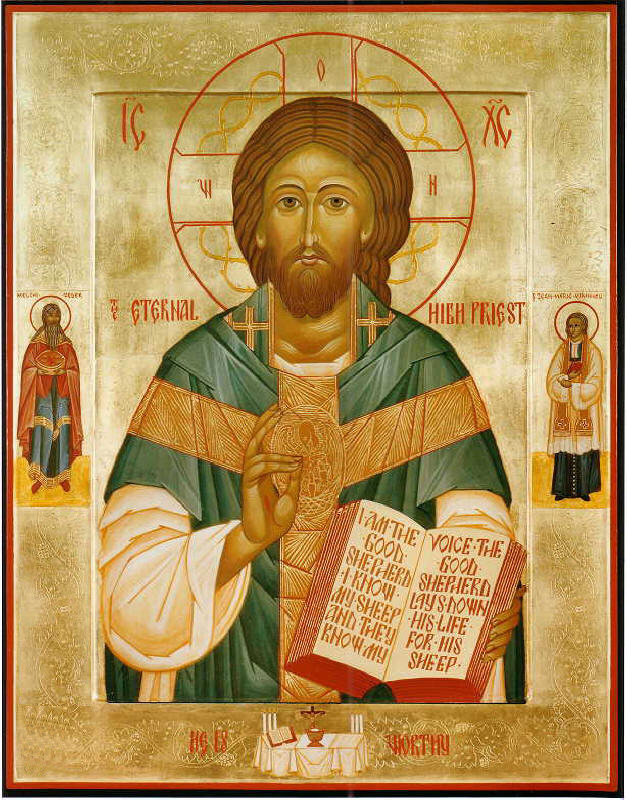
This icon shows Jesus Christ, our eternal high priest.
The gold pelican over His heart represents self-sacrifice.
The border contains an altar and grapevines, representing the Mass, and icons of Melchizedek and St. Jean-Baptiste Vianney.
Melchizedek: king of righteousness (left icon) was priest and king of Jerusalem. He blessed Abraham and has been considered an ideal priest-king.
St. Jean-Baptiste Vianney is the patron saint of parish priests.

1. Sign of the Cross: In the name of the Father, and of the Son, and of the Holy Spirit. Amen.
2. The Apostles Creed: I BELIEVE in God, the Father almighty, Creator of heaven and earth, and in Jesus Christ, His only Son, our Lord, who was conceived by the Holy Spirit, born of the Virgin Mary, suffered under Pontius Pilate, was crucified, died, and was buried. He descended into hell; on the third day he rose again from the dead; he ascended into heaven, and is seated at the right hand of God, the Father Almighty; from there He shall come to judge the living and the dead.
I believe in the Holy Spirit, the holy catholic Church, the communion of saints, the forgiveness of sins, the resurrection of the body, and the life everlasting. Amen.
3. The Lord's Prayer: OUR Father, who art in heaven, hallowed be Thy name. Thy kingdom come. Thy will be done on earth as it is in heaven. Give us this day our daily bread and forgive us our trespasses as we forgive those who trespass against us. And lead us not into temptation, but deliver us from evil. Amen.
4. (3) Hail Mary: HAIL Mary, full of grace, the Lord is with thee. Blessed art thou amongst women and blessed is the fruit of thy womb, Jesus. Holy Mary, Mother of God, pray for us sinners, now, and in the hour of our death. Amen. (Three times)
5. Glory Be: GLORY be to the Father, and to the Son, and to the Holy Spirit. As it was in the beginning, is now, and ever shall be, world without end. Amen.
6. Fatima Prayer: Oh, my Jesus, forgive us our sins, save us from the fires of hell, lead all souls to heaven, especially those in most need of your mercy.
Announce each mystery, then say 1 Our Father, 10 Hail Marys, 1 Glory Be and 1 Fatima prayer. Repeat the process with each mystery.
End with the Hail Holy Queen:
Hail, Holy Queen, Mother of Mercy, our life, our sweetness and our hope! To thee do we cry, poor banished children of Eve! To thee do we send up our sighs, mourning and weeping in this vale of tears! Turn then, most gracious advocate, thine eyes of mercy towards us; and after this, our exile, show unto us the blessed fruit of thy womb, Jesus!
O clement, O loving, O sweet Virgin Mary! Pray for us, O holy Mother of God, that we may be made worthy of the promises of Christ.
Final step -- The Sign of the Cross
The Mysteries of the Rosary By tradition, Catholics meditate on these Mysteries during prayers of the Rosary. The biblical references follow each of the Mysteries below.
The Glorious Mysteries
(Wednesdays and Sundays)
1.The Resurrection (Matthew 28:1-8, Mark 16:1-18, Luke 24:1-12, John 20:1-29) [Spiritual fruit - Faith]
2. The Ascension (Mark 16:19-20, Luke 24:50-53, Acts 1:6-11) [Spiritual fruit - Christian Hope]
3. The Descent of the Holy Spirit (Acts 2:1-13) [Spiritual fruit - Gifts of the Holy Spirit]
4. The Assumption [Spiritual fruit - To Jesus through Mary]
5. The Coronation [Spiritual fruit - Grace of Final Perseverance]
Pray a Rosary each day for our nation.
1. Sign of the Cross: In the name of the Father, and of the Son, and of the Holy Spirit. Amen.
2. The Apostles Creed: I BELIEVE in God, the Father almighty, Creator of heaven and earth, and in Jesus Christ, His only Son, our Lord, who was conceived by the Holy Spirit, born of the Virgin Mary, suffered under Pontius Pilate, was crucified, died, and was buried. He descended into hell; on the third day he rose again from the dead; he ascended into heaven, and is seated at the right hand of God, the Father Almighty; from there He shall come to judge the living and the dead.
I believe in the Holy Spirit, the holy catholic Church, the communion of saints, the forgiveness of sins, the resurrection of the body, and the life everlasting. Amen.
3. The Lord's Prayer: OUR Father, who art in heaven, hallowed be Thy name. Thy kingdom come. Thy will be done on earth as it is in heaven. Give us this day our daily bread and forgive us our trespasses as we forgive those who trespass against us. And lead us not into temptation, but deliver us from evil. Amen.
4. (3) Hail Mary: HAIL Mary, full of grace, the Lord is with thee. Blessed art thou amongst women and blessed is the fruit of thy womb, Jesus. Holy Mary, Mother of God, pray for us sinners, now, and in the hour of our death. Amen. (Three times)
5. Glory Be: GLORY be to the Father, and to the Son, and to the Holy Spirit. As it was in the beginning, is now, and ever shall be, world without end. Amen.
6. Fatima Prayer: Oh, my Jesus, forgive us our sins, save us from the fires of hell, lead all souls to heaven, especially those in most need of your mercy.
Announce each mystery, then say 1 Our Father, 10 Hail Marys, 1 Glory Be and 1 Fatima prayer. Repeat the process with each mystery.
End with the Hail Holy Queen:
Hail, Holy Queen, Mother of Mercy, our life, our sweetness and our hope! To thee do we cry, poor banished children of Eve! To thee do we send up our sighs, mourning and weeping in this vale of tears! Turn then, most gracious advocate, thine eyes of mercy towards us; and after this, our exile, show unto us the blessed fruit of thy womb, Jesus!
O clement, O loving, O sweet Virgin Mary! Pray for us, O holy Mother of God, that we may be made worthy of the promises of Christ.
Final step -- The Sign of the Cross
The Mysteries of the Rosary By tradition, Catholics meditate on these Mysteries during prayers of the Rosary. The biblical references follow each of the Mysteries below.
The Sorrowful Mysteries
(Tuesdays and Fridays)
1. The Agony in the Garden (Matthew 26:36-46, Luke 22:39-46) [Spiritual fruit - God's will be done]
2. The Scourging at the Pillar (Matthew 27:26, Mark 15:15, John 19:1) [Spiritual fruit - Mortification of the senses]
3. The Crowning with Thorns (Matthew 27:27-30, Mark 15:16-20, John 19:2) [Spiritual fruit - Reign of Christ in our heart]
4. The Carrying of the Cross (Matthew 27:31-32, Mark 15:21, Luke 23:26-32, John 19:17) [Spiritual fruit - Patient bearing of trials]
5. The Crucifixion (Matthew 27:33-56, Mark 15:22-39, Luke 23:33-49, John 19:17-37) [Spiritual fruit - Pardoning of Injuries]
Disclaimer: Opinions posted on Free Republic are those of the individual posters and do not necessarily represent the opinion of Free Republic or its management. All materials posted herein are protected by copyright law and the exemption for fair use of copyrighted works.