Posted on 12/24/2017 7:19:29 AM PST by Salvation
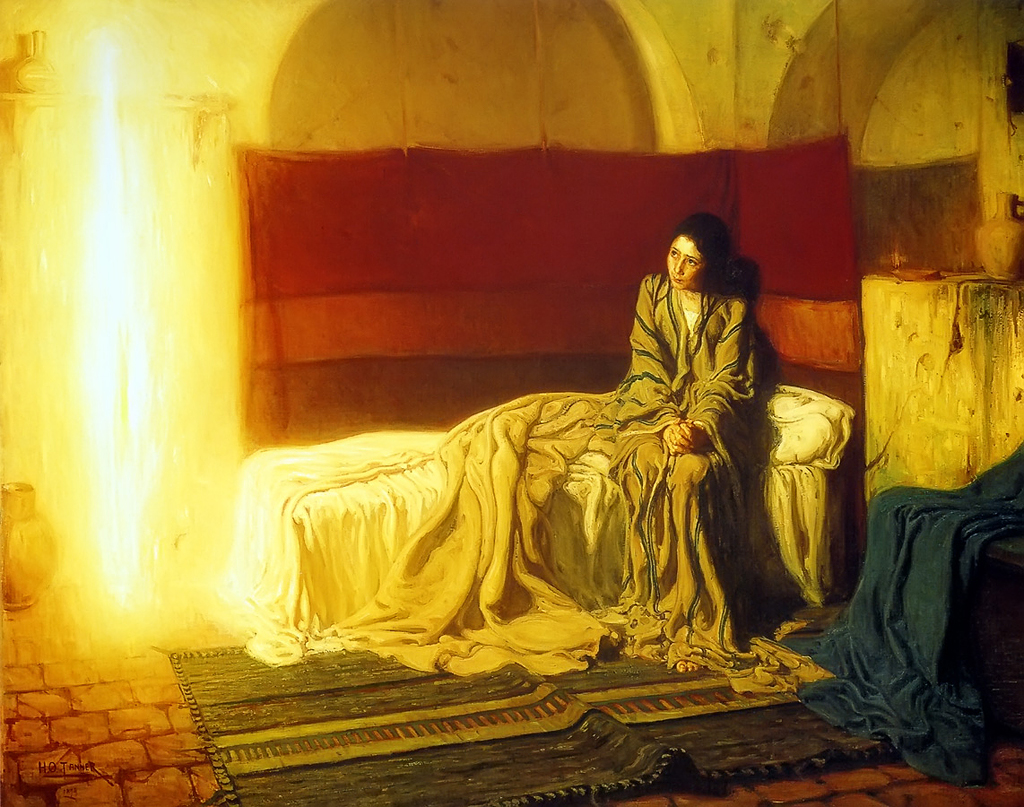
In the Gospel for this Fourth Sunday of Advent, we step back nine months to March 25th, the feast of the Annunciation, an all-but-hidden event that changed the world. God, whose focal presence departed the Temple just prior to the Babylonian invasion (cf Ez 10:18) and the loss of the Ark of the Covenant, now returns to the ark of Mary’s womb. The glorious presence of God returns now to His people, in an obscure town of fewer than three hundred, a town so small that no road led to it.
We are reading here of a pivotal moment in the history of mankind. God not only returns to His people but also becomes one with them in the Incarnation.
We do well to consider four aspects of this crucial moment. As we do so, we consider not only Mary’s glories but ours as well (in a subordinate yet real way). Mary is the perfect disciple and her glories typify in a most excellent way the glories that God wishes to bestow upon us, though in a different but still substantial way. Let’s look at four aspects of this Gospel.
I. The RESPECT of God – The text says, The angel Gabriel was sent from God to a town of Galilee called Nazareth, to a virgin betrothed to a man name Joseph and the virgin’s name was Mary … Mary said “Behold, I am the handmaid of the Lord. May it be done to me according to your word.”
Note that God asks Mary for her cooperation. Although the angel Gabriel’s words are not delivered in the form of a question, it is clear from Mary’s response that she considers this to be a request from God. She says yes, understanding it as a request rather than merely a statement of what shall be.
Here we see an important indicator of God’s respect for Mary’s freedom. Surely He has prepared her and equipped her with every good grace to say yes, but in the end her freely offered yes is significant. It is something that God seeks and respects. Otherwise, why would He bother to send an angel at all? Why would He come through Mary at all? Why not simply appear suddenly as a full-grown man and start to work? As it is, God wills to come through Mary (cf Gen 3:15) and seeks her yes in the place of Eve’s no.
God’s respect for Mary’s freely offered yes also extends to us. Indeed, we can see here how God’s respect is in direct contrast to the behavior of the devil, who provokes, shouts, and intrudes. Through cultural noise and other avenues, Satan tempts and provokes us. God, however, whispers and respectfully invites. He does not force a decision on us but rather summons us in love and then patiently awaits our answer.
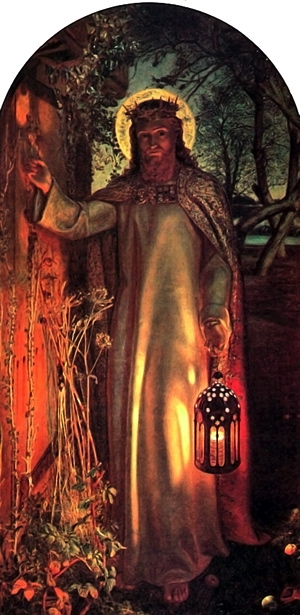
In Scripture we read this of Jesus: Behold, I stand at the door and knock; if any one hears my voice and opens the door, I will come in to him and eat with him, and he with me (Rev 3:20). Hence, although all-powerful and able to coerce, God does not do so; He does not act violently or impose His will. He respects the freedom He Himself gave us and invites us to cooperate in His plan for us.
God respects Mary’s and our freedom; He “needs” us to open the door for Him to go to work.
II. The Revelation of God – Note the great love, appreciation, and regard that God extends to Mary through the angel. The text says, Hail, Full of grace! The Lord is with you … Do not be afraid, Mary, for you have found favor with God.
Gabriel reveals Mary’s sinless state. Mary is surely God’s masterpiece, the result of His grace and work. She is sinless by being “full of grace.” Filled with grace, she has no room in her for sin.
In his greeting, Gabriel speaks to Mary’s dignity and perfection: Χαιρε κεχαριτωμενη (Chaire, Kecharitomene) (Hail, full of grace). Kecharitomene (full of grace) is a perfect, passive participle indicating an action completed (perfected) in the past but still operative in the present. Thus Gabriel salutes her not by her name, “Mary,” but in a different way: “Hail to her who was perfectly graced and is so now!” Mary had been freed of all sin in the past. She was and is perfectly, fully graced. Gabriel greets Mary and regards respectfully the work of God in her.
In a less perfect (but still true) way, God also loves us and loves in us the perfection we will one day attain by His grace and mercy. A couple of texts come to mind:
God does not love us because we are good. Rather, God loves us and then if we accept His love we are good. Mary was, by a singular grace, wholly open to God’s love and perfection. If we are faithful, each of us will one day become the man or woman God has always intended us to be.
God shows great regard for Mary (through Gabriel) and also knows the glory we will one day share.
III. The RIDDLE in the middle – There remains Mary’s mysterious question: “How will this be since I do not know man?” Had she been thinking in biological terms she would have known the obvious answer to the question: she and Joseph would conceive. But her question implies that she had other notions about her future than regular marital relations.
Some contend that the question does not really come from Mary, but rather is a rhetorical question placed here by Luke so that the angel can inform us, the readers, that God alone is the true Father of the Son. Such a notion seems more like the concoction of nervous moderns attempting to solve the mystery. Reducing a pivotal question like this to a mere literary device seems unbecoming.
Catholic tradition sees evidence here of the doctrine of Mary’s perpetual virginity. To be sure, many other questions are raised by this resolution. Why would two people get married and then live as virgins? Were such arrangements common at that time? (It would seem not.)
In the end, Mary’s question seems to point to some expectation on her part that she would “not know man” going forward. We are not going to be able to completely satisfy our curiosity in this matter and ultimately it is none of our business.
One thing is sure: the Church teaches, without ambiguity, that Mary remained ever-virgin. It seems reasonable to conclude that Mary’s question indicates that she was clear on this. There remains also an element of mystery that we must respect.
Protestants and others who deny Mary’s perpetual virginity have some thinking to do. Mary’s question is neither meaningless nor naïve. It is a true question with a true context and it ought to be respected as at least pointing to her virginity even if it does not prove it.
IV. The REASSURANCE of God – Mary is in the presence of an archangel. This alone is frightening enough, but in addition her world is shifting dramatically. Hence, her fear and anxiety are understandable. Gabriel gives Mary a number of reassurances: Do not be afraid Mary, for you have found favor with God … Behold you will conceive in your womb and bear a son and you shall name him Jesus. He will be great and will be called the Son of the most high, and the Lord God will give him the throne of David his father, and he will rule over the house of Jacob forever, and of his Kingdom there will be no end …
In effect, Gabriel is telling Mary that however the details unfold, there will be total victory in the end; she is to bear a son, who is the Son of the most High God and who will have a kingdom that will never end or be conquered. In spite of any concerns she has, this will all lead to victory.
Mary will need this reassurance for there are some difficult days ahead: homelessness at the time of Jesus’ birth, the flight to Egypt, Simeon’s prophecy that a sword would pierce her heart, and the actual thrusting of that sword while she is at the foot of the cross. This knowledge of ultimate victory is an important reassurance for her to hold close.
It is an important reassurance for us as well. We, too, have some difficult valleys to cross, some arduous hills to climb. We must constantly keep in mind the end of the story: Jesus is the victor. Even if we might think that we are losing, total victory belongs to Jesus in the end and to us if we stay with Him. The conclusion of the story is already declared: Jesus wins, overwhelmingly. All of His enemies will be placed under His feet (e.g., Rev 20-22; 1 Cor 15:25-26; John 16:33 inter al).
Consider this magnificent passage from Isaiah:
I am God there is no other. At the beginning I foretell the outcome; in advance, things not yet done. I say that my plan shall stand. I accomplish my every purpose. Yes, I have spoken, I will accomplish it; I have planned it and I will do it. Listen to me you fainthearted, you who seem far from the victory of justice: I am bringing on my justice, it is not far off, my salvation shall not tarry; I will put salvation within Zion, and give my glory to Israel (Isaiah 46:12ff).
If we were to memorize and internalize this passage, so many of our fears and anxieties would flee; our trust would build and we would live victorious lives. At times it may seem that evil has the upper hand, but God has the ultimate victory. No matter how dark it may appear at any given time, God has already won; it’s just that the news has not yet leaked out.
This truth and reassurance must be emblazoned on our hearts, for like Mary, we have difficult days in our future. All the more reason that God’s reassurance is essential for us. It got Mary through the cross and it will get us through our trials.
Hence, we have here a pivotal moment in history, when God’s presence returns to the human family. And it all happens so quietly, in Nazareth, a town so small that there was not even a road that led to it. Quietly, but clearly and powerfully, He has thrust the first blow at Satan’s realm. God’s Victory is certain.
Monsignor Pope Ping!
There is no riddle is one understands the Greek behind this.
As explained before, but will do so again for the readers of the post.
εἶπεν δὲ Μαριὰμ πρὸς τὸν ἄγγελον Πῶς ἔσται τοῦτο, ἐπεὶ ἄνδρα οὐ γινώσκω;
A literal translation would read as:
said moreover Mary to the angel, How will be this, since a man not I know?
Let's rule out what she is not asking about.
The verb for know is γινώσκω.
It is a present indicative active verb, 1st person singular.
γινώσκω conveys the following meaning:
1097 ginṓskō – properly, to know, especially through personal experience (first-hand acquaintance). 1097 /ginṓskō ("experientially know") is used for example in Lk 1:34, "And Mary [a virgin] said to the angel, 'How will this be since I do not know (1097 /ginṓskō = sexual intimacy) a man?'" http://biblehub.com/greek/1097.htm
Is Mary saying she doesn't know a man as in "I know Joseph?" No. She knows Joseph. She knew other men in the neighborhood. So we can rule out this kind of knowing.
This leaves us with the other kind of "knowing" as in the sexual intimacy realm.
In Greek, the present describes an action that normally occurs in the present. It can be either a continuous or undefined action. The time of the verb is from the standpoint of the speaker/writer....not the reader. (Mounce, Basics of Biblical Greek, 131)
The indicative is the mood of reality. It is used to present an assertion as a non-contingent(or unqualified)statement. If used in a question it probes for information.
The next verb to examine is "will be" (ἔσται). This is the Greek verb expressing the English "to be".
It is a Future, Active, Indicative, 3rd person, singular.
With that in mind let's understand the context of this statement.
Joseph and Mary are bethrothed in every manner except one: They haven't had sexual intercourse.
Gabriel has appeared to Mary and told her she has been favored by God.
Next he tells her she is going to have a baby and it is going to be the Messiah.
Mary is stunned to say the least as probably would any Hebrew girl of this time if given the same news.
Mary, knowing she hasn't had sexual intercourse with Joseph...nor any other man (how will this be since a man not I know?)
Mary is asking how is this going to happen as she's a virgin. She's been a good girl.
Gabriel answers in Luke 1:35 and tells her how this will happen. Mary said "be it done to me according to the word of you.." v38.
Now that we have context and an understanding of the two key verbs in the passage we can answer the question….was Mary making a perpetual vow of virginity in her reply to Gabriel?
The answer is no.
If this had been the intent, Luke could have used the Future or the Perfect tense. He did not.
She was explaining to Gabriel she couldn’t be pregnant as she had not in the past and was not currently having sexual intercourse. There is nothing in her answer to suggest this was a pledge of virginity or that she had intended to be a virgin.
Matthew tells us Joseph kept her a virgin until she gave birth to a Son; and he called His name Jesus. (Matt 1:25 NASB). After His birth the couple could enjoy the benefit of the marriage bed.
The other key to understanding this passage is to recall who the writer is. Luke. The beloved physician.
Luke was a doctor. He tells us in Luke 1:1-4 that he’s completed a thorough investigation, including eyewitnesses, so we might know the exact truth about the things you have been taught. Luke wrote his gospel somewhere between 60-70 AD.
It is important to understand this as Luke’s terminology is important in chapter 2 where he uses the term πρωτότοκον which conveys the meaning of first born, eldest. We derive our English word prototype from this.
If he were attempting to convey that Mary had given birth to only Jesus he could have used the Greek word μονογενής which conveys the meaning of one of a mind, one of a class.
The word is used nine times in the New Testament. Luke uses it three times in relation to other family situations (Lk 7:12; 8:42; 9:38) It is never used in relation to describing Jesus as being the only son of Mary. It is used by John 5x to describe Jesus as the ONLY begotten Son of God (Jn 1:14; 18; 3:16,18, 1 John 4:9). The other usage is in Hebrews 11:17 again referring to Jesus as the ONLY begotten Son of God.
Luke, being the good doctor, would know if Mary had other children or not.
There is no end, unless you are looking backward. There is only a series of new beginnings.
That is fairly simple With out going the length you did, but the most simple thing is that it proves nothing.
I
Personally I don’t know if Mary had other children or not but
if the best any one can do to prove it is to insist that Jesus
had brethren they just as well forget it.
And this along with the fact that the ones named as brothers
of Jesus is said to be the sons of others rather than Mary
and josepth.
If understood in context it does.
Your understanding of the context? or mine?.
To me there is more than one version of false
doctrine, one is that the Catholics call Mary
a perpetual Virgin just on their assumption as
there is no written proof.The protestaint’s deny that Mary is a perpetual virgin just on assumption.
Both of them posibly false doctrine.
There is also an anti scripture doctrine such as calling the bishops father which Jesus said in very plain words not to do
and he even explained the reason.
So this arguing about Mary being a virgin is nothing but knit picking to me and I can see where it is very possible but just
not proven.
I see Roman Catholicism has invited Luther back on the bus today!
The context of the NT.
I have no ties to Luther or any other reformer except in My view they give me a reason to go to the scriptures if I want
to know something.
I could easily believe Mary to be a virgin for life and I strongly favor the belief that Jesus was her only child
Roman Catholics labor under the delusion all non-Catholics follow Luther. To be honest, they seem more fascinated with the guy than anyone else.
Wonderful post.
You have a point.
“Gabriel reveals Mary’s sinless state. Mary is surely God’s masterpiece, the result of His grace and work. She is sinless by being “full of grace.” Filled with grace, she has no room in her for sin.”
If Mary was sinless as the rcc believes then why in v.8 did she require a sin offering?
Luke 2:22-24
22 And when the days for their purification according to the law of Moses were completed, they brought Him up to Jerusalem to present Him to the Lord 23 (as it is written in the Law of the Lord, “Every firstborn male that opens the womb shall be called holy to the Lord”), 24 and to offer a sacrifice according to what was said in the Law of the Lord, “A pair of turtledoves or two young pigeons.”
Leviticus 12:6-8
6 ‘When the days of her purification are completed, for a son or for a daughter, she shall bring to the priest at the doorway of the tent of meeting a one year old lamb for a burnt offering and a young pigeon or a turtledove for a sin offering. 7 Then he shall offer it before the Lord and make atonement for her, and she shall be cleansed from the flow of her blood. This is the law for her who bears a child, whether a male or a female. 8 But if she cannot afford a lamb, then she shall take two turtledoves or two young pigeons, the one for a burnt offering and the other for a sin offering; and the priest shall make atonement for her, and she will be clean.’”
IAW with the rcc Rev 12 speaks of Mary, but wait Rev 12 says she cried out, being in labor and in pain to give birth. Yet according to Gen 3:16 that pain is punishment for the sin that all women must bear for they are all sinners as all man is.
Genesis 3:16
16 To the woman He said,
“I will greatly multiply
Your pain [a]in childbirth,
In pain you will bring forth children;
Yet your desire will be for your husband,
And he will rule over you.”
Revelation 12:1-2
12 A great sign appeared in heaven: a woman clothed with the sun, and the moon under her feet, and on her head a crown of twelve stars;2 and she was with child; and she *cried out, being in labor and in pain to give birth.
This is just Diana/Artemis worship renamed mary worship.
“I see Roman Catholicism has invited Luther back on the bus today!”
When your bucket is full of holes as the rcc’s theology is that leaves them no choice but to attempt to plug them with redirection.
They somehow have overlooked those little details.
As a confessional Lutheran I follow Christ not Luther. I also recognize there are several places Luther did not get far enough away from catholic error. But then as Protestants we recognize our clergy are fallible as well as we are. We have no need to imagine infallibility in our leaders. He only One that is infallible is Christ and we have Him revealed in Scripture.
Disclaimer: Opinions posted on Free Republic are those of the individual posters and do not necessarily represent the opinion of Free Republic or its management. All materials posted herein are protected by copyright law and the exemption for fair use of copyrighted works.