Skip to comments.
Catholic Caucus: Sunday Mass Readings, 07-30-17, Seventeenth Sunday in Ordinary Time
USCCB.org/RNAB ^
| 07-30-17
| Revised New American Bible
Posted on 07/29/2017 8:12:16 PM PDT by Salvation
July 30, 2017
Seventeenth Sunday in Ordinary Time
The LORD appeared to Solomon in a dream at night.
God said, "Ask something of me and I will give it to you."
Solomon answered:
"O LORD, my God, you have made me, your servant, king
to succeed my father David;
but I am a mere youth, not knowing at all how to act.
I serve you in the midst of the people whom you have chosen,
a people so vast that it cannot be numbered or counted.
Give your servant, therefore, an understanding heart
to judge your people and to distinguish right from wrong.
For who is able to govern this vast people of yours?"
The LORD was pleased that Solomon made this request.
So God said to him:
"Because you have asked for this—
not for a long life for yourself,
nor for riches,
nor for the life of your enemies,
but for understanding so that you may know what is right—
I do as you requested.
I give you a heart so wise and understanding
that there has never been anyone like you up to now,
and after you there will come no one to equal you."
R. (97a)
Lord, I love your commands.I have said, O LORD, that my part
is to keep your words.
The law of your mouth is to me more precious
than thousands of gold and silver pieces.
R.
Lord, I love your commands.Let your kindness comfort me
according to your promise to your servants.
Let your compassion come to me that I may live,
for your law is my delight.
R.
Lord, I love your commands.For I love your command
more than gold, however fine.
For in all your precepts I go forward;
every false way I hate.
R.
Lord, I love your commands.Wonderful are your decrees;
therefore I observe them.
The revelation of your words sheds light,
giving understanding to the simple.
R.
Lord, I love your commands.
Brothers and sisters:
We know that all things work for good for those who love God,
who are called according to his purpose.
For those he foreknew he also predestined
to be conformed to the image of his Son,
so that he might be the firstborn
among many brothers and sisters.
And those he predestined he also called;
and those he called he also justified;
and those he justified he also glorified.
R.
Alleluia, alleluia.Blessed are you, Father, Lord of heaven and earth;
for you have revealed to little ones the mysteries of the kingdom.
R.
Alleluia, alleluia.
Jesus said to his disciples:
"The kingdom of heaven is like a treasure buried in a field,
which a person finds and hides again,
and out of joy goes and sells all that he has and buys that field.
Again, the kingdom of heaven is like a merchant
searching for fine pearls.
When he finds a pearl of great price,
he goes and sells all that he has and buys it.
Again, the kingdom of heaven is like a net thrown into the sea,
which collects fish of every kind.
When it is full they haul it ashore
and sit down to put what is good into buckets.
What is bad they throw away.
Thus it will be at the end of the age.
The angels will go out and separate the wicked from the righteous
and throw them into the fiery furnace,
where there will be wailing and grinding of teeth.
"Do you understand all these things?"
They answered, "Yes."
And he replied,
"Then every scribe who has been instructed in the kingdom of heaven
is like the head of a household
who brings from his storeroom both the new and the old."
Jesus said to his disciples:
"The kingdom of heaven is like a treasure buried in a field,
which a person finds and hides again,
and out of joy goes and sells all that he has and buys that field.
Again, the kingdom of heaven is like a merchant
searching for fine pearls.
When he finds a pearl of great price,
he goes and sells all that he has and buys it."
TOPICS: Catholic; General Discusssion; Prayer; Worship
KEYWORDS: catholic; mt13; ordinarytime; prayer; saints
Navigation: use the links below to view more comments.
first 1-20, 21-40, 41-49 next last
For your reading, reflection, faith-sharing, comments, questions, discussion.
1
posted on
07/29/2017 8:12:16 PM PDT
by
Salvation
To: All
KEYWORDS: catholic; mt13; ordinarytime; prayer; saints;
2
posted on
07/29/2017 8:14:07 PM PDT
by
Salvation
("With God all things are possible." Matthew 19:26)
To: nickcarraway; NYer; ELS; Pyro7480; livius; ArrogantBustard; Catholicguy; RobbyS; marshmallow; ...
Alleluia PingPlease FReepmail me to get on/off the Alleluia Ping List.
3
posted on
07/29/2017 8:14:58 PM PDT
by
Salvation
("With God all things are possible." Matthew 19:26)
To: Salvation
From: 1 Kings 3:5-12
Solomon”s Request of God (Continuation)
[4] And the king (Solomon) went to Gibeon to sacrifice there, for that was the
great high place; Solomon used to offer a thousand burnt offerings upon that al-
tar. [5] At Gibeon the LORD appeared to Solomon in a dream by night; and God
said, “€œAsk what I shall give you.”€ [6] And Solomon said, “œThou hast shown great
and steadfast love to thy servant David my father, because he walked before thee
in faithfulness, in righteousness, and in uprightness of heart toward thee; and
thou hast kept for him this great and steadfast love, and hast given him a son to
sit on his throne this day. [7] And now, O LORD my God, thou hast made thy
servant king in place of David my father, although I am but a little child; I do not
know how to go out or come in. [8] And thy servant is in the midst of thy people
whom thou hast chosen, a great people, that cannot be numbered or counted for
multitude. [9] Give thy servant therefore an understanding mind to govern thy peo-
ple, that I may discern between good and evil; for who is able to govern this thy
great people?”
[10] lt pleased the Lord that Solomon had asked this. [11] And God said to him,
“€œBecause you have asked this, and have not asked for yourself long life or riches
or the life of your enemies, but have asked for yourself understanding to discern
what is right, [12] behold, I now do according to your word. Behold, I give you a
wise and discerning mind, so that none like you has been before you and none
like you shall arise after you. [13] I give you also what you have not asked, both
riches and honor, so that no other king shall compare with you, all your days.”
*********************************************************************************************
Commentary:
3:1-11:1:43. The reign of Solomon became idealized in the memory of Israel.
The sacred writer of 1 and 2 Kings gives him much more space than any other
king. First we are shown his wisdom (3:1-5:14), which would become proverbial
and would cause wisdom books such as Proverbs, Ecclesiastes and the Book
of Wisdom to be attributed to him, and also poetical books such as the Song of
Songs and a collection of Psalms. He then goes on to deal with the king”€™s public
works programme (5:15-9:9), especially the building of the temple and its dedica-
tion, for that temple would become the center of the religious life of the people.
On these two scores Solomon became famous inside and outside Israel, as ex-
plained in 9:10-10:29. Finally, with a realism rare among historians of the time,
the writer exposes the king”€™s sins and failings towards the end of his reign (11:
1-40).
The reign of Solomon is depicted in these chapters in all its splendor — and all
its weakness. The splendor derives from the wisdom with which God endows
the king (3:1-5:14) and is to be found in Solomon”€™s great buildings (especially
the temple: 5:15-7:51), in his prayer at the dedication of the temple (8:1-9:9) and
in the booming commerce which gives Solomon great prestige and untold wealth
(9:10-10:29). The king”€™s weakness lies in his unfaithfulness to God, for, to please
his foreign wives, he introduces the worship of other gods into the country. There
are political weaknesses, too: cracks are appearing in the (north-south) union,
and enemies exist inside and outside the state (11:1-40).
3:1-5:14. The most important trait of Solomon is his wisdom, to which our Lord
refers in the Gospel (cf. Mt 12:45). The sacred writer shows here the source and
evidence of that wisdom: it is a gift from God, his answer to the king”€™s prayer
(3:12-14), and it can be seen in the way Solomon administers justice (3:16-28)
and in the way that court and kingdom are organized, that is, in the typical func-
tions of a king (4:1-24). The more he acts with wisdom, the wiser he becomes
(4:29-34).
3:2-14. The “€œhigh places”€ (v. 2) were altars built in open country, on the top of
some hill, and under a shady tree, where Canaanites and Israelites of this period
offered sacrifices to the divinity. From the time of King Josiah”€™s reform in 622 this
type of worship was expressly forbidden in case the worship of God should be-
come associated with worship of local gods, baals (cf. 2 Kings 23:4-20).
Gibeon, about 10 km. (6 miles) northwest of Jerusalem, belonged to the tribe of
Benjamin (cf. Josh 18:25) and was one of the cities given over to the Levites (cf.
Josh 21:17) in which according to Chronicles, the desert tent or tabernacle was
kept for a time (cf. 1 Chron 21:29). The fact that the Lord should speak to Solo-
mon here also means that he is confirming him as king of Israel.
Solomon”€™s request pleases the Lord because it is made with humility (cf. v. 7)
and because he asks not for material things but for “€œan understanding mind”€ so
as to be able to govern well (vv. 9-14). Solomon”€™s request is an anticipation of the
proper order which, according to Christ”€™s teaching, should be present in prayer
of petition: “€œThe one Master and Lord teaches us how and in what order we ought
to pray to God for the things we want; since we indicate and express our desires
and petitions in, prayer, then we pray properly and well when the order of our peti-
tions matches the right order of desires. True charity teaches us that we ought to
dedicate ourselves and all our desires to God; God, the supreme Good, deserves
the highest form of love. And God cannot be loved from the heart, exclusively, if
his honor and glory are not valued above all other things and creatures; all good
things, those we have and those we do not possess, all things that are called
good, must be subordinated to the supreme Good from whom they derive their
goodness”€ (”Roman Catechism”, 4, 10, 1).
*********************************************************************************************
Source: “The Navarre Bible: Text and Commentaries”. Biblical text from the
Revised Standard Version and New Vulgate. Commentaries by members of
the Faculty of Theology, University of Navarre, Spain.
Published by Four Courts Press, Kill Lane, Blackrock, Co. Dublin, Ireland, and
by Scepter Publishers in the United States.
4
posted on
07/29/2017 8:16:18 PM PDT
by
Salvation
("With God all things are possible." Matthew 19:26)
To: All
From: Romans 8:28-30
Christians are Children of God (Continuation)
[28] We know that in everything God works for good with those who love him,
who are called according to his purpose. [29] For those whom he foreknew he
also predestined to be conformed to the image of his Son, in order that he might
be the first-born among many brethren. [30] And those whom he predestined he
also called; and those whom he called he also justified; and those whom he jus-
tified he also glorified.
*********************************************************************************************
Commentary:
28. Awareness of God as Father helps us see all the events of our life as orche-
strated by the lovable Will of God. Our Father gives us what is best for us and
expects us to discover his paternal love in adverse as well as in favorable events.
“Notice”, St Bernard points out, “that he does not say that things suit our whims
but that they work for our good. They serve not caprice but usefulness; not plea-
sure but salvation; not what we desire but what is good for us. In that sense eve-
rything works for our good, even death itself, even sin [...]. Is it not the case that
sins do good to him who on their account becomes more humble, more fervent,
more solicitous, more on guard, more prudent?” (”De Fallacia Et Brevitate Vitae”,
6). If we have this optimistic, hopeful attitude, we will overcome every difficulty
we meet: “The whole world seems to be coming down on top of you. Whichever
way you turn you find no way out. This time, it is impossible to overcome the
difficulties.
“But, have you again forgotten that God is your Father?—all-powerful, infinitely
wise, full of mercy. He would never send you anything evil. That thing that is
worrying you is good for you, even though those earthbound eyes of yours may
not be able to see it now.
“’Omnia in bonum!’ Lord, once again and always, may your most wise Will be
done!” (St. J. Escriva, “The Way of the Cross”, IX, 4).
29. Christ is called the “first-born” for many reasons. He is “the first-born of all
creation” (Col 1:15) because he is eternally begotten and because “all things
were made through him” (Jn 1:3). He is also the new Adam and therefore the
head of the human race in the work of redemption (cf. 1 Cor 15:22, 45). He is
“the first-born from the dead” (cf. Col 1:18; Rev 1:5) and therefore is the head
of all those who have reached heaven and all who are awaiting their future resur-
rection (1 Cor 15:20, 23). Finally, he is the “first-born among many brethren” be-
cause, in the order of grace, he gives us a share in his divine sonship: by means
of habitual grace—”sanctifying” grace—we become children of God and brothers
and sisters of Jesus Christ. “For, just as God chose to communicate to others
his natural goodness, giving them a share in that goodness, so that he might
be not only good but also the author of good things; so the Son of God chose
to communicate to others a sonship like his own, so that he might be not only
a son, but the first-born of many sons” (St Thomas Aquinas, “Commentary on
Rom, ad loc.”).
This remarkable fact is what leads the Christian to imitate Christ: our divine
sonship moves us to reflect the words and gestures of his Only-begotten Son.
“Lord, help me decide to tear off, through penance, this pitiful mask I have fa-
shioned with my wretched doings.... Then, and only then, by following the path
of contemplation and atonement, will my life begin to copy faithfully the features
of your life. We will find ourselves becoming more and more like you.
“We will be other Christs, Christ himself, ‘ipse Christus’” (St. J. Escriva, “The
Way of the Cross”, VI).
*********************************************************************************************
Source: “The Navarre Bible: Text and Commentaries”. Biblical text from the
Revised Standard Version and New Vulgate. Commentaries by members of
the Faculty of Theology, University of Navarre, Spain.
Published by Four Courts Press, Kill Lane, Blackrock, Co. Dublin, Ireland, and
by Scepter Publishers in the United States.
5
posted on
07/29/2017 8:17:11 PM PDT
by
Salvation
("With God all things are possible." Matthew 19:26)
To: All
From: Matthew 13:44-52
The Hidden Treasure; The Pearl
(Jesus said to His disciples,) [44] “The Kingdom of Heaven is like treasure hid-
den in a field, which a man found and covered up; then in his joy he goes and
sells all that he has and buys that field.
[45] “Again, the Kingdom of Heaven is like a merchant in search of fine pearls,
[46] who, on finding one pearl of great value, went and sold all that he had and
bought it.
The Net
[47] “Again, the Kingdom of Heaven is like a net which was thrown into the sea
and gathered fish of every kind; [48] when it was full, men drew it ashore and sat
down and sorted the good into vessels but threw away the bad. [49] So it will be
at the close of the age. The angels will come out and separate the evil from the
righteous, [50] and throw them into the furnace of fire; there men will weep and
gnash their teeth.
[51] “Have you understood all this?” They said to Him, “Yes.” [52] And He said
to them, “Therefore every scribe who has been trained for the Kingdom of Heaven
is like a householder who brings out of his treasure what is new and what is old.”
[53] And when Jesus had finished these parables He went away from there.
*********************************************************************************************
Commentary:
44-46. In these two parables Jesus shows the supreme value of the Kingdom
of Heaven, and the attitude people need if they are to attain it. The parables are
very alike, but it is interesting to note the differences: the treasure means abun-
dance of gifts; the pearl indicates the beauty of the Kingdom. The treasure is
something stumbled upon; the pearl, the result of a lengthy search; but in both
instances the finder is filled with joy. Faith, vocation, true wisdom, desire for
Heaven, are things which sometimes are discovered suddenly and unexpected-
ly, and sometimes after much searching (cf. St. Gregory the Great, “In Evange-
lia Homilae”, 11). However, the man’s attitude is the same in both parables and
is described in the same terms: “he goes and sells all that he has and buys it”:
detachment, generosity, is indispensable for obtaining the treasure.
“Anyone who understands the Kingdom which Christ proposes realizes that it is
worth staking everything to obtain it [...]. The Kingdom of Heaven is difficult to
win. No one can be sure of achieving it, but the humble cry of a repentant man
can open wide its doors” (St. J. Escriva, “Christ Is Passing By”, 180).
47. “Fish of every kind”: almost all the Greek manuscripts and early translations
say “All kinds of things”. A dragnet is very long and about two meters wide; when
it is extended between two boats it forms double or triple mesh with the result
that when it is pulled in it collects all sorts of things in addition to fish — algae,
weeds, rubbish, etc.
This parable is rather like the parable of the cockle, but in a fishing context: the
net is the Church, the sea the world.
We can easily find in this parable the dogmatic truth of the Judgment: at the end
of time God will judge men and separate the good from the bad. It is interesting
to note our Lord’s repeated references to the last things, especially Judgment
and Hell: He emphasizes these truths because of man’s great tendency to forget
them: “All these things are said to make sure that no one can make the excuse
that he does not know about them: this excuse would be valid only if eternal pu-
nishment were spoken about in ambiguous terms” (St. Gregory the Great, “In
Evangelia Homilae”, 11).
52. “Scribe”: among the Jews a scribe was a religious teacher, a specialist in sa-
cred Scripture and its application to life. Our Lord here uses this word to refer to
the Apostles, who will have the role of teachers in His Church. Thus, the Apos-
tles and their successors, the Bishops, are the “Ecclesia docens”, the teaching
Church; they have the authority and the mission to teach. The Pope and the Bi-
shops exercise this authority directly and are also helped in this by priests. The
other members of the Church form the “Ecclesia discens”, the learning Church.
However, every disciple of Christ, every Christian who has received Christ’s tea-
ching, has a duty to pass this teaching on to others, in language they can un-
derstand; therefore, he should make sure he has a good grasp of Christian doc-
trine. The treasure of Revelation is so rich that it can provide teaching which ap-
plies to all times and situations. It is for the word of God to enlighten all ages
and situations—not the other way around. Therefore, the Church and its pastors
preach, not new things, but a single unchanging truth contained in the treasure
of Revelation: for the past two thousand years the Gospel has always been
“good news”.
*********************************************************************************************
Source: “The Navarre Bible: Text and Commentaries”. Biblical text from the
Revised Standard Version and New Vulgate. Commentaries by members of
the Faculty of Theology, University of Navarre, Spain.
Published by Four Courts Press, Kill Lane, Blackrock, Co. Dublin, Ireland, and
by Scepter Publishers in the United States.
6
posted on
07/29/2017 8:18:09 PM PDT
by
Salvation
("With God all things are possible." Matthew 19:26)
To: All
Scripture readings from the Jerusalem Bible by Darton, Longman & Todd
Readings at Mass
Liturgical Colour: Green.
| First reading |
| 1 Kings 3:5,7-12 © |
The Lord appeared to Solomon in a dream and said, ‘Ask what you would like me to give you.’ Solomon replied, ‘O Lord my God, you have made your servant king in succession to David my father. But I am a very young man, unskilled in leadership. Your servant finds himself in the midst of this people of yours that you have chosen, a people so many its number cannot be counted or reckoned. Give your servant a heart to understand how to discern between good and evil, for who could govern this people of yours that is so great?’ It pleased the Lord that Solomon should have asked for this. ‘Since you have asked for this’ the Lord said ‘and not asked for long life for yourself or riches or the lives of your enemies, but have asked for a discerning judgement for yourself, here and now I do what you ask. I give you a heart wise and shrewd as none before you has had and none will have after you.’
| Responsorial Psalm |
| Psalm 118(119):57,72,76-77,127-130 © |
Lord, how I love your law!
My part, I have resolved, O Lord,
is to obey your word.
The law from your mouth means more to me
than silver and gold.
Lord, how I love your law!
Let your love be ready to console me
by your promise to your servant.
Let your love come and I shall live
for your law is my delight.
Lord, how I love your law!
That is why I love your commands
more than finest gold,
why I rule my life by your precepts,
and hate false ways.
Lord, how I love your law!
Your will is wonderful indeed;
therefore I obey it.
The unfolding of your word gives light
and teaches the simple.
Lord, how I love your law!
| Second reading |
Romans 8:28-30 © |
We know that by turning everything to their good, God co-operates with all those who love him, with all those he has called according to his purpose. They are the ones he chose specially long ago and intended to become true images of his Son, so that his Son might be the eldest of many brothers. He called those he intended for this; those he called he justified, and with those he justified he shared his glory.
| Gospel Acclamation |
Jn15:15 |
Alleluia, alleluia!
I call you friends, says the Lord,
because I have made known to you
everything I have learnt from my Father.
Alleluia!
Alleluia, alleluia!
Blessed are you, Father,
Lord of heaven and earth,
for revealing the mysteries of the kingdom
to mere children.kingdom.
Alleluia!
EITHER:
| Gospel |
| Matthew 13:44-52 © |
| He sells everything he owns and buys the field |
Jesus said to the crowds, ‘The kingdom of heaven is like treasure hidden in a field which someone has found; he hides it again, goes off happy, sells everything he owns and buys the field.
‘Again, the kingdom of heaven is like a merchant looking for fine pearls; when he finds one of great value he goes and sells everything he owns and buys it.
‘Again, the kingdom of heaven is like a dragnet cast into the sea that brings in a haul of all kinds. When it is full, the fishermen haul it ashore; then, sitting down, they collect the good ones in a basket and throw away those that are no use. This is how it will be at the end of time: the angels will appear and separate the wicked from the just to throw them into the blazing furnace where there will be weeping and grinding of teeth.
‘Have you understood all this?’ They said, ‘Yes.’ And he said to them, ‘Well then, every scribe who becomes a disciple of the kingdom of heaven is like a householder who brings out from his storeroom things both new and old.’
OR:
| Alternative Gospel |
| Matthew 13:44-46 © |
| He sells everything he owns and buys the field |
Jesus said to the crowds: ‘The kingdom of heaven is like treasure hidden in a field which someone has found; he hides it again, goes off happy, sells everything he owns and buys the field.
‘Again, the kingdom of heaven is like a merchant looking for fine pearls; when he finds one of great value he goes and sells everything he owns and buys it.’
7
posted on
07/29/2017 8:20:01 PM PDT
by
Salvation
("With God all things are possible." Matthew 19:26)
To: All
Please pray for Pope Francis.
8
posted on
07/29/2017 8:22:52 PM PDT
by
Salvation
("With God all things are possible." Matthew 19:26)
To: All
9
posted on
07/29/2017 8:33:45 PM PDT
by
Salvation
("With God all things are possible." Matthew 19:26)
To: All
10
posted on
07/29/2017 8:38:47 PM PDT
by
Salvation
("With God all things are possible." Matthew 19:26)
To: Salvation
11
posted on
07/29/2017 8:41:50 PM PDT
by
Salvation
("With God all things are possible." Matthew 19:26)
To: All
12
posted on
07/29/2017 8:43:39 PM PDT
by
Salvation
("With God all things are possible." Matthew 19:26)
To: All
13
posted on
07/29/2017 8:44:18 PM PDT
by
Salvation
("With God all things are possible." Matthew 19:26)
To: All
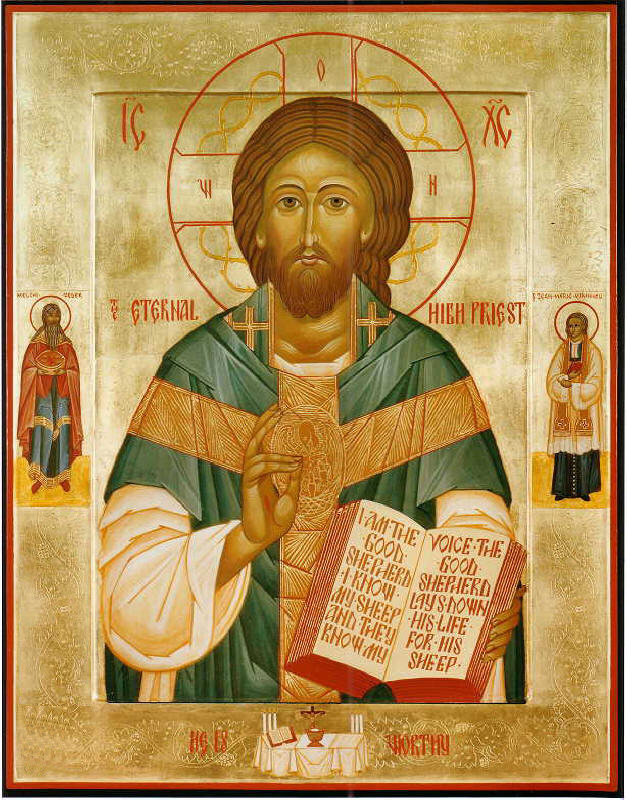
Jesus, High Priest
We thank you, God our Father, for those who have responded to your call to priestly ministry.
Accept this prayer we offer on their behalf: Fill your priests with the sure knowledge of your love.
Open their hearts to the power and consolation of the Holy Spirit.
Lead them to new depths of union with your Son.
Increase in them profound faith in the Sacraments they celebrate as they nourish, strengthen and heal us.
Lord Jesus Christ, grant that these, your priests, may inspire us to strive for holiness by the power of their example, as men of prayer who ponder your word and follow your will.
O Mary, Mother of Christ and our mother, guard with your maternal care these chosen ones, so dear to the Heart of your Son.
Intercede for our priests, that offering the Sacrifice of your Son, they may be conformed more each day to the image of your Son, our Lord and Savior, Jesus Christ. Amen.
Saint John Vianney, universal patron of priests, pray for us and our priests
This icon shows Jesus Christ, our eternal high priest.
The gold pelican over His heart represents self-sacrifice.
The border contains an altar and grapevines, representing the Mass, and icons of Melchizedek and St. Jean-Baptiste Vianney.
Melchizedek: king of righteousness (left icon) was priest and king of Jerusalem. He blessed Abraham and has been considered an ideal priest-king.
St. Jean-Baptiste Vianney is the patron saint of parish priests.
14
posted on
07/29/2017 10:15:31 PM PDT
by
Salvation
("With God all things are possible." Matthew 19:26)
To: All
Pray a Rosary each day for our nation.
1. Sign of the Cross: In the name of the Father, and of the Son, and of the Holy Spirit. Amen.
2. The Apostles Creed: I BELIEVE in God, the Father almighty, Creator of heaven and earth, and in Jesus Christ, His only Son, our Lord, who was conceived by the Holy Spirit, born of the Virgin Mary, suffered under Pontius Pilate, was crucified, died, and was buried. He descended into hell; on the third day he rose again from the dead; he ascended into heaven, and is seated at the right hand of God, the Father Almighty; from there He shall come to judge the living and the dead.
I believe in the Holy Spirit, the holy catholic Church, the communion of saints, the forgiveness of sins, the resurrection of the body, and the life everlasting. Amen.
3. The Lord's Prayer: OUR Father, who art in heaven, hallowed be Thy name. Thy kingdom come. Thy will be done on earth as it is in heaven. Give us this day our daily bread and forgive us our trespasses as we forgive those who trespass against us. And lead us not into temptation, but deliver us from evil. Amen.
4. (3) Hail Mary: HAIL Mary, full of grace, the Lord is with thee. Blessed art thou amongst women and blessed is the fruit of thy womb, Jesus. Holy Mary, Mother of God, pray for us sinners, now, and in the hour of our death. Amen. (Three times)
5. Glory Be: GLORY be to the Father, and to the Son, and to the Holy Spirit. As it was in the beginning, is now, and ever shall be, world without end. Amen.
6. Fatima Prayer: Oh, my Jesus, forgive us our sins, save us from the fires of hell, lead all souls to heaven, especially those in most need of your mercy.
Announce each mystery, then say 1 Our Father, 10 Hail Marys, 1 Glory Be and 1 Fatima prayer. Repeat the process with each mystery.
End with the Hail Holy Queen:
Hail, Holy Queen, Mother of Mercy, our life, our sweetness and our hope! To thee do we cry, poor banished children of Eve! To thee do we send up our sighs, mourning and weeping in this vale of tears! Turn then, most gracious advocate, thine eyes of mercy towards us; and after this, our exile, show unto us the blessed fruit of thy womb, Jesus!
O clement, O loving, O sweet Virgin Mary! Pray for us, O holy Mother of God, that we may be made worthy of the promises of Christ.
Final step -- The Sign of the Cross
The Mysteries of the Rosary By tradition, Catholics meditate on these Mysteries during prayers of the Rosary. The biblical references follow each of the Mysteries below.
The Glorious Mysteries
(Wednesdays and Sundays)
1.The Resurrection (Matthew 28:1-8, Mark 16:1-18, Luke 24:1-12, John 20:1-29) [Spiritual fruit - Faith]
2. The Ascension (Mark 16:19-20, Luke 24:50-53, Acts 1:6-11) [Spiritual fruit - Christian Hope]
3. The Descent of the Holy Spirit (Acts 2:1-13) [Spiritual fruit - Gifts of the Holy Spirit]
4. The Assumption [Spiritual fruit - To Jesus through Mary]
5. The Coronation [Spiritual fruit - Grace of Final Perseverance]
15
posted on
07/29/2017 10:18:15 PM PDT
by
Salvation
("With God all things are possible." Matthew 19:26)
To: All
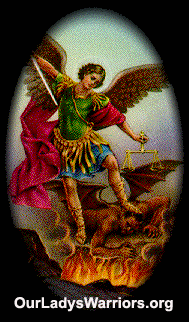
St. Michael the Archangel
~ PRAYER ~
St. Michael, the Archangel, defend us in battle
Be our protection against the wickedness
and snares of the devil;
May God rebuke him, we humbly pray,
and do thou, O Prince of the heavenly host,
by the power of God,
Cast into hell Satan and all the evil spirits
who prowl through the world seeking the ruin of souls.
Amen
+
16
posted on
07/29/2017 10:20:04 PM PDT
by
Salvation
("With God all things are possible." Matthew 19:26)
To: All
St. Michael the Archangel
~ PRAYER ~
St. Michael, the Archangel, defend us in battle
Be our protection against the wickedness
and snares of the devil;
May God rebuke him, we humbly pray,
and do thou, O Prince of the heavenly host,
by the power of God,
Cast into hell Satan and all the evil spirits
who prowl through the world seeking the ruin of souls.
Amen
+
17
posted on
07/29/2017 10:21:20 PM PDT
by
Salvation
("With God all things are possible." Matthew 19:26)
To: All
Most Precious Blood of Our Lord Jesus Christ

July Devotion: The Precious Blood
Like the Sacred Wounds of Jesus, His Precious Blood deserves special honor because of its close relation to the Sacred Passion. That honor was given to it from the beginning by the Apostles who praised its redeeming power. (Rom. 5:9 "we are justified by His blood"; Heb. 13:12 "and so Jesus also, that He might sanctify the people by His blood, suffered outside the gate"; 1 John 1:7 "and the blood of Jesus Christ, His Son, cleanses us from all sin.")
The Church has always held devotion to the Precious Blood in high esteem. We continue to recognize and publicly acknowledge the profound indebtedness of the whole human race to Christ, Priest and Victim.
Standing at the foot of the cross, we see Jesus' head, hands, feet, and side pouring out streams of precious blood. It is precious because it:
• Redeems us and atones for our sins. Through His precious blood we are reconciled to God, made one with Him. Death ceases to be death and heaven's gates are opened to us.
• Cleanses us from all sin.
• Preserves us and keeps us safe from the grasp of evil. When the Father sees us washed in the Blood of the Lamb we are spared.
• Comforts us. It is the constant reminder that Jesus - true God and true man suffered and died to save us and to open heaven to us because He loves us.
• Sanctifies us. The same blood that justifies by taking away sin, continues to work within us. Its action gives us the grace to continue on the path toward the Kingdom of God. It assists us in achieving our new nature, leading us onward in subduing sin and in following the commands of God.
Jesus shed His precious blood seven times during His life on earth. They events were:
• Jesus shed His Blood in the Circumcision
• Jesus shed His Blood whilst praying in the Garden of Olives
• Jesus shed His Blood in the scourging
• Jesus shed His Blood in the crowning with thorns
• Jesus shed His Blood while carrying His cross
• Jesus shed His Blood in the crucifixion
• Jesus shed His Blood and water when His side was pierced
The Power of the Precious Blood
"I adore You, O Precious Blood of Jesus, flower of creation, fruit of virginity, ineffable instrument of the Holy Spirit, and I rejoice at the thought that You came from the drop of virginal blood on which eternal Love impressed its movement; You were assumed by the Word and deified in His person. I am overcome with emotion when I think of Your passing from the Blessed Virgin's heart into the heart of the Word, and, being vivified by the breath of the Divinity, becoming adorable because You became the Blood of God." (St. Albert the Great)
At their recent meeting, the U.S. Conference of Catholic Bishops had continuous Adoration of the Blessed Sacrament for "healing and peace." They encouraged parishes and communities to have ongoing Adoration of the Blessed Sacrament. In these dark months of woundedness, pain and violence we need to turn to the Precious Blood of Jesus in the Eucharist, for healing, peace, and light.
"What power we have in the Precious Blood of Jesus in the Holy Eucharist! He is there to protect us, to be our refuge and our redemption. (In Exodus 12, God told Moses to have His chosen people mark their door posts with the blood of an unblemished lamb, during the first Passover. Those who did this were spared when the Angel of the death passed by). This is why Archbishop Sheen said that we must call down the Blood of the Lamb, Jesus in the Most Blessed Sacrament. For, he warned, when we stop calling down the Blood of the Lamb, we start calling down the blood of each other." (From our book Bread of Life)
"And the Lamb on the throne will shepherd them. He will lead them to springs of life-giving water" (Rev 7:17).
"In the tumultuous events of our time, it is important to look to the Eucharist: it must be at the heart of the life of priests and consecrated people; the light and strength of spouses in putting into practice their commitment to fidelity, chastity and the apostolate; the ideal in education and in training children, adolescents and young people; the comfort and support of those who are troubled, of the sick and all who are weeping in the Gethsemane of life." (Pope John Paul II)
Precious Blood of Jesus, save us!
"The only time our Lord asked the Apostles for anything was the night when He went into His agony. But as often in the history of the church since that time, evil was awake, but the disciples were asleep. That is why there came out of His anguished and lonely Heart a sigh: 'Could you not watch one hour with Me?'" (Mt 26:40). Not for an hour of activity did he plead, but for an hour of friendship (Archbishop Fulton J. Sheen).
St. Maria Goretti, Patroness of Youth & Children of Mary, Feast-July 6 St. Maria of Italy (1890-1902), couldn't wait to make her First Communion. She wanted to receive Jesus in the Holy Eucharist so that she could become more beautiful and pure like Him; she wanted Him to live in her, close to her heart. After she received Jesus in the Blessed Sacrament for the first time, she stayed in Church for a long time after Mass to talk to Him. Maria's family lived with and worked for a farmer. His son Alessandro kept trying to make Maria sin against purity. One day, when everyone else was working, Alessandro grabbed Maria and tried to make her sin. Maria kept crying out for him to stop, and each time she did, he stabbed her. Courageously, Maria resisted him and was stabbed fourteen times. St. Maria died the next day.
"Look at Maria Goretti.... Like her, be capable of defending your purity of heart and body. Be committed to the struggle against evil and sin. Always esteem and love, purity and virginity." (Pope John Paul II, 1990)
A Prayer for Priests
O my God, help those priests who are faithful to remain faithful; to those who are falling, stretch forth Your Divine Hand that they may grasp it as their support. In the great ocean of Your mercy, lift those poor unfortunate ones who have fallen, that being engulfed therein they may receive the grace to return to Your Great Loving Heart. Amen. Precious Blood of Jesus, protect them!
The Eucharist is the fruit of our Lords Passion. Jesus gave up His Body on the cross so that He may give you His Body in the Holy Eucharist. Jesus poured out His very last drop of Blood on the cross so that He may fill you with His Divine Love each time that you receive Him in Holy Communion and visit Him in Eucharistic Adoration!
"The Eucharist, in the Mass and outside of the Mass, is the Body and Blood of Jesus Christ, and is therefore deserving of the worship that is given to the living God, and to Him alone" (Pope John Paul II, September 29, 1979, Phoenix Park, Ireland)
"The bread and wine, fruit of human hands, transformed through the power of the Holy Spirit into the body and blood of Christ, become a pledge of the 'new heaven and new earth,' announced by the Church in her daily mission." "In Christ, whom we adore present in the mystery of the Eucharist, the father uttered his final word with regard to humanity and human history." "To live the Eucharist, it is necessary, as well, to spend much time in adoration in front of the Blessed Sacrament, something which I myself experience every day drawing from it strength, consolation and assistance." "How could the Church fulfill her vocation without cultivating a constant relationship with the Eucharist, without nourishing herself with this food which sanctifies, without founding her missionary activity on this indispensable support?" "To evangelize the world there is need of apostles who are 'experts' in the celebration, adoration and contemplation of the Eucharist" (Pope John Paul II, World Mission Message 2004).
The Power of the Precious Blood of Jesus in the Holy Eucharist
"The Precious Blood belongs in an especial manner to men. Much more, therefore, does God invite them to come to its heavenly baths, and receive therein, not only the cleansing of their souls, but the power of a new and amazing life. Every doctrine in theology is a call to the Precious Blood. Every ceremony in the Church tells of it . . . . Every supernatural act is a growth of it. Everything that is holy on earth is either a leaf, bud, blossom or fruit of the Blood of Jesus. To its fountains God calls the sinner, that he may be lightened of his burdens. There is no remission of him in anything else. Only there is his lost sonship to be found. The saints are no less called by God to these invigorating streams. It is out of the Precious Blood that men draw martyrdoms, vocations, celebacies, austerities, heroic charities, and all the magnificent graces of high sanctity. The secret nourishment of prayer is from those fountains" (Father Faber, The Precious Blood).
The Most Precious Blood of Jesus
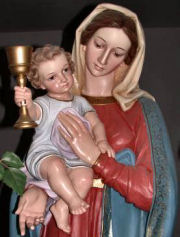 July is traditionally associated with the Precious Blood of Our Lord. It may be customary to celebrate the votive Mass of the Precious Blood on July 1.
The extraordinary importance of the saving Blood of Christ has ensured a central place for its memorial in the celebration of this cultic mystery: at the centre of the Eucharistic assembly, in which the Church raises up to God in thanksgiving "the cup of blessing" (1 Cor 10, 16; cf Ps 115-116, 13) and offers it to the faithful as a "real communion with the Blood of Christ" (1 Cor 10, 16); and throughout the Liturgical Year. The Church celebrates the saving Blood of Christ not only on the Solemnity of the Body and Blood of Christ, but also on many other occasions, such that the cultic remembrance of the Blood of our redemption (cf 1 Pt 1, 18) pervades the entire Liturgical Year. Hence, at Vespers during Christmastide, the Church, addressing Christ, sings: "Nos quoque, qui sancto tuo redempti sumus sanguine, ob diem natalis tui hymnum novum concinimus." In the Paschal Triduum, the redemptive significance and efficacy of the Blood of Christ is continuously recalled in adoration. During the adoration of the Cross on Good Friday the Church sings the hymn: "Mite corpus perforatur, sanguis unde profluit; terra, pontus, astra, mundus quo lavanturflumine", and again on Easter Sunday, "Cuius corpus sanctissimum in ara crucis torridum, sed et cruorem roesum gustando, Deo vivimus (194).
Catholic Word of the Day: LITANY OF THE PRECIOUS BLOOD, 09-25-12
ST. GASPAR: Founder of the Society of the Precious Blood
Mass in the Cathedral of the Most Precious Blood of Our Lord Jesus Christ (London, 9/18)
Devotion to the Drops of Blood Lost by our Lord Jesus Christ on His Way to Calvary (Prayer/Devotion)
Chaplet of the Most Precious Blood
Catholic Word of the Day: PRECIOUS BLOOD, 12-03-11
The Traditional Feast of the Most Precious Blood of Our Lord Jesus Christ (Catholic Caucus)
Devotion to the Precious Blood
DOCTRINE OF THE BLOOD OF CHRIST
,,,,,,,,,,,,,,,,,,,,And More on the Precious Blood
Litany of the Most Precious Blood of Our Lord Jesus Christ
NOTHING IS MORE POTENT AGAINST EVIL THAN PLEADING THE PRECIOUS BLOOD OF CHRIST
Litany of the Most Precious Blood of Jesus
"Amen, amen, I say to you, unless you eat the flesh of the Son of Man and drink his blood, you do not have life within you" (Jn 6:53).
18
posted on
07/29/2017 10:21:54 PM PDT
by
Salvation
("With God all things are possible." Matthew 19:26)
To: All
July, 2017
Pope's Prayer Intention
Lapsed Christians: That our brothers and sisters who have strayed from the faith, through our prayer and witness to the Gospel, may rediscover the merciful closeness of the Lord and the beauty of the Christian life.
19
posted on
07/29/2017 10:22:50 PM PDT
by
Salvation
("With God all things are possible." Matthew 19:26)
To: All
Daily Gospel Commentary
Seventeenth Sunday in Ordinary Time
Commentary of the day Saint Thomas Aquinas (1225-1274), Dominican theologian, Doctor of the Church
Homily on the Creed“The reign of God is like a treasure”
It is logical that the aim of all our desires, that is to say, eternal life, should be mentioned at the end of everything that has been given us to believe in the Creed with the words: “Eternal life. Amen.”… In eternal life, there is the union of man with God…, perfect praise…, and the perfect satisfaction of our desires, for there, every blessed person will possess even more than what he desired and hoped for. In this life, no one can fulfill his desire; nothing created can ever satisfy the human being’s desire. God alone satisfies, and that infinitely. That is why we only come to rest in God, as Saint Augustine says: “You have made us for yourself, Lord, and our heart is restless until it rests in you.”
Since in the homeland, the saints will possess God perfectly, it is obvious that not only their desire will be satisfied, but that in addition it will overflow with glory. That is why the Lord said: “Come, share your master’s joy.” (Mt 25:21) And Saint Augustine said about that: “It is not all of joy that will enter into those who rejoice, but those who rejoice will enter entirely into joy.” In a Psalm we say: “I shall be satisfied when your glory is revealed,” (63:3), and in another one: “He will grant you your heart’s requests.” (Ps 37:4) … For if a person desires delights, that is where supreme and perfect delight will be found, for it will consist in the sovereign good, which is God himself: “Delights at your right hand forever.” (Ps 16:11)
20
posted on
07/29/2017 10:41:27 PM PDT
by
Salvation
("With God all things are possible." Matthew 19:26)
Navigation: use the links below to view more comments.
first 1-20, 21-40, 41-49 next last
Disclaimer:
Opinions posted on Free Republic are those of the individual
posters and do not necessarily represent the opinion of Free Republic or its
management. All materials posted herein are protected by copyright law and the
exemption for fair use of copyrighted works.
FreeRepublic.com is powered by software copyright 2000-2008 John Robinson