Skip to comments.
Catholic Caucus: Sunday Mass Readings, 03-26-17, Fourth Sunday of Lent [Laetare Sunday]
USCCB.org/RNAB ^
| 03-26-17
| Revised New American Bible
Posted on 03/25/2017 8:28:01 PM PDT by Salvation
March 26, 2017
Fourth Sunday of Lent
The LORD said to Samuel:
"Fill your horn with oil, and be on your way.
I am sending you to Jesse of Bethlehem,
for I have chosen my king from among his sons."
As Jesse and his sons came to the sacrifice,
Samuel looked at Eliab and thought,
"Surely the LORD's anointed is here before him."
But the LORD said to Samuel:
"Do not judge from his appearance or from his lofty stature,
because I have rejected him.
Not as man sees does God see,
because man sees the appearance
but the LORD looks into the heart."
In the same way Jesse presented seven sons before Samuel,
but Samuel said to Jesse,
"The LORD has not chosen any one of these."
Then Samuel asked Jesse,
"Are these all the sons you have?"
Jesse replied,
"There is still the youngest, who is tending the sheep."
Samuel said to Jesse,
"Send for him;
we will not begin the sacrificial banquet until he arrives here."
Jesse sent and had the young man brought to them.
He was ruddy, a youth handsome to behold
and making a splendid appearance.
The LORD said,
"There—anoint him, for this is the one!"
Then Samuel, with the horn of oil in hand,
anointed David in the presence of his brothers;
and from that day on, the spirit of the LORD rushed upon David.
R. (1)
The Lord is my shepherd; there is nothing I shall want.The LORD is my shepherd; I shall not want.
In verdant pastures he gives me repose;
beside restful waters he leads me;
he refreshes my soul.
R.
The Lord is my shepherd; there is nothing I shall want.He guides me in right paths
for his name's sake.
Even though I walk in the dark valley
I fear no evil; for you are at my side
With your rod and your staff
that give me courage.
R.
The Lord is my shepherd; there is nothing I shall want.You spread the table before me
in the sight of my foes;
you anoint my head with oil;
my cup overflows.
R.
The Lord is my shepherd; there is nothing I shall want.Only goodness and kindness follow me
all the days of my life;
and I shall dwell in the house of the LORD
for years to come.
R.
The Lord is my shepherd; there is nothing I shall want.
Brothers and sisters:
You were once darkness,
but now you are light in the Lord.
Live as children of light,
for light produces every kind of goodness
and righteousness and truth.
Try to learn what is pleasing to the Lord.
Take no part in the fruitless works of darkness;
rather expose them, for it is shameful even to mention
the things done by them in secret;
but everything exposed by the light becomes visible,
for everything that becomes visible is light.
Therefore, it says:
"Awake, O sleeper,
and arise from the dead,
and Christ will give you light."
Verse Before the Gospel Jn 8:12
I am the light of the world, says the Lord;
whoever follows me will have the light of life.
As Jesus passed by he saw a man blind from birth.
His disciples asked him,
"Rabbi, who sinned, this man or his parents,
that he was born blind?"
Jesus answered,
"Neither he nor his parents sinned;
it is so that the works of God might be made visible through him.
We have to do the works of the one who sent me while it is day.
Night is coming when no one can work.
While I am in the world, I am the light of the world."
When he had said this, he spat on the ground
and made clay with the saliva,
and smeared the clay on his eyes,
and said to him,
"Go wash in the Pool of Siloam" —which means Sent—.
So he went and washed, and came back able to see.
His neighbors and those who had seen him earlier as a beggar said,
"Isn't this the one who used to sit and beg?"
Some said, "It is, "
but others said, "No, he just looks like him."
He said, "I am."
So they said to him, "How were your eyes opened?"
He replied,
"The man called Jesus made clay and anointed my eyes
and told me, 'Go to Siloam and wash.'
So I went there and washed and was able to see."
And they said to him, "Where is he?"
He said, "I don't know."
They brought the one who was once blind to the Pharisees.
Now Jesus had made clay and opened his eyes on a sabbath.
So then the Pharisees also asked him how he was able to see.
He said to them,
"He put clay on my eyes, and I washed, and now I can see."
So some of the Pharisees said,
"This man is not from God,
because he does not keep the sabbath."
But others said,
"How can a sinful man do such signs?"
And there was a division among them.
So they said to the blind man again,
"What do you have to say about him,
since he opened your eyes?"
He said, "He is a prophet."
Now the Jews did not believe
that he had been blind and gained his sight
until they summoned the parents of the one who had gained his sight.
They asked them,
"Is this your son, who you say was born blind?
How does he now see?"
His parents answered and said,
"We know that this is our son and that he was born blind.
We do not know how he sees now,
nor do we know who opened his eyes.
Ask him, he is of age;
he can speak for himself."
His parents said this because they were afraid of the Jews,
for the Jews had already agreed
that if anyone acknowledged him as the Christ,
he would be expelled from the synagogue.
For this reason his parents said,
"He is of age; question him."
So a second time they called the man who had been blind
and said to him, "Give God the praise!
We know that this man is a sinner."
He replied,
"If he is a sinner, I do not know.
One thing I do know is that I was blind and now I see."
So they said to him,
"What did he do to you?
How did he open your eyes?"
He answered them,
"I told you already and you did not listen.
Why do you want to hear it again?
Do you want to become his disciples, too?"
They ridiculed him and said,
"You are that man's disciple;
we are disciples of Moses!
We know that God spoke to Moses,
but we do not know where this one is from."
The man answered and said to them,
"This is what is so amazing,
that you do not know where he is from, yet he opened my eyes.
We know that God does not listen to sinners,
but if one is devout and does his will, he listens to him.
It is unheard of that anyone ever opened the eyes of a person born blind.
If this man were not from God,
he would not be able to do anything."
They answered and said to him,
"You were born totally in sin,
and are you trying to teach us?"
Then they threw him out.
When Jesus heard that they had thrown him out,
he found him and said, "Do you believe in the Son of Man?"
He answered and said,
"Who is he, sir, that I may believe in him?"
Jesus said to him,
"You have seen him,
the one speaking with you is he."
He said,
"I do believe, Lord," and he worshiped him.
Then Jesus said,
"I came into this world for judgment,
so that those who do not see might see,
and those who do see might become blind."
Some of the Pharisees who were with him heard this
and said to him, "Surely we are not also blind, are we?"
Jesus said to them,
"If you were blind, you would have no sin;
but now you are saying, 'We see,' so your sin remains.
As Jesus passed by he saw a man blind from birth.
He spat on the ground and made clay with the saliva,
and smeared the clay on his eyes, and said to him,
"Go wash in the Pool of Siloam" — which means Sent —.
So he went and washed, and came back able to see.
His neighbors and those who had seen him earlier as a beggar said,
"Isn't this the one who used to sit and beg?"
Some said, "It is, "
but others said, "No, he just looks like him."
He said, "I am."
They brought the one who was once blind to the Pharisees.
Now Jesus had made clay and opened his eyes on a sabbath.
So then the Pharisees also asked him how he was able to see.
He said to them,
"He put clay on my eyes, and I washed, and now I can see."
So some of the Pharisees said,
"This man is not from God,
because he does not keep the sabbath."
But others said,
"How can a sinful man do such signs?"
And there was a division among them.
So they said to the blind man again,
"What do you have to say about him,
since he opened your eyes?"
He said, "He is a prophet."
They answered and said to him,
"You were born totally in sin,
and are you trying to teach us?"
Then they threw him out.
When Jesus heard that they had thrown him out,
he found him and said, "Do you believe in the Son of Man?"
He answered and said,
"Who is he, sir, that I may believe in him?"
Jesus said to him,
"You have seen him, and
the one speaking with you is he."
He said,
"I do believe, Lord," and he worshiped him.
TOPICS: Catholic; General Discusssion; Prayer; Worship
KEYWORDS: catholic; jn9; lent; prayer
Navigation: use the links below to view more comments.
first 1-20, 21-40, 41-48 next last
For your reading, reflection, faith-sharing, comments, questions, discussion.
1
posted on
03/25/2017 8:28:01 PM PDT
by
Salvation
To: All
KEYWORDS: catholic; jn9; lent; prayer;
2
posted on
03/25/2017 8:29:47 PM PDT
by
Salvation
("With God all things are possible." Matthew 19:26)
To: nickcarraway; NYer; ELS; Pyro7480; livius; ArrogantBustard; Catholicguy; RobbyS; marshmallow; ...
Praise to you, Lord Jesus Christ PingPlease FReepmail me to get on/off the Lenten Ping List.
3
posted on
03/25/2017 8:31:16 PM PDT
by
Salvation
("With God all things are possible." Matthew 19:26)
To: All
From: 1 Sm 16:1b, 6-7, 10-13a
David is Anointed
[1b] The Lord said to Samuel, “How long will you grieve over Saul, seeing I have
rejected him from being king over Israel? Fill your horn with oil, and go; I will
send you to Jesse the Bethlehemite, for I have provided for myself a king among
his sons.”
[6] When they came, he looked on Eliab and thought, “Surely the Lord’s anoin-
ted is before him.” [7] But the Lord said to Samuel, “Do not look on his appea-
rance or on the height of his stature because I have rejected him; for the Lord
sees not as man sees; man looks on the outward appearance, but the Lord
looks on the heart.”
[10] And Jesse made seven of his sons pass before Samuel. And Samuel said
to Jesse, “The Lord has not chosen these.” [11] And Samuel said to Jesse,
“Are all your sons here?” And he said, “There remains yet the youngest, but be-
hold, he is keeping the sheep.” And Samuel said to Jesse, “Send and fetch him;
for we will not sit down till he comes here.” [12] And he sent, and brought him in.
Now he was ruddy, and had beautiful eyes, and was handsome. And the Lord
said, “Arise, anoint him; for this is he.” [13a] Then Samuel took the horn of oil,
and anointed him in the midst of his brothers; and the Spirit of the Lord came
mightily upon David from that day forward.
*********************************************************************************************
Commentary:
16:1-31:13. This, the last section of 1 Samuel, begins with an account of Samu-
el’s anointing of David, in a private, familial setting, is reminiscent of Saul’s anoin-
ting, which was also done in secret (cf. 10:1-16). The narrative emphasizes that
David does not in any way merit his election: he is a nobody, from a family of no
importance: no genealogy is provided, apart from the name of Jesse, his father
(v. 5); he is the youngest of his brothers (vv. 11-12) and, like the rest of his family,
he works as a shepherd: he doesn’t come from a noble or military or priestly fa-
mily. He could have no claim to be anointed king.
God’s gratuitous choice of this shepherd boy gives deep, religious meaning to his
reception by Saul (16:14-23) and by the people, when he later kills Goliath (17:55
-18:5). David’s qualities and feats would not have been enough to advance him,
had not God first singled him out. David is a type of those who in the Christian dis-
pensation are called to offices in the Church: what matters is not background, per-
sonal qualities or material resources but the realization that one is called by God.
Also, one needs to bear in mind that “man looks on the outward appearance, but
the Lord looks on the heart” (v. 7); from this derives the requirement to live and
act in keeping with the call one is given. “For by his power to know himself in the
depths of his being he rises above the whole universe of mere objects. When he
is drawn to think about his real self, he turns to those deep recesses of his being
where God who probes the heart awaits him, and where he himself decides his
own destiny in the sight of God” (Vatican II, “Gaudium Et Spes”, 14).
*********************************************************************************************
Source: “The Navarre Bible: Text and Commentaries”. Biblical text from the
Revised Standard Version and New Vulgate. Commentaries by members of
the Faculty of Theology, University of Navarre, Spain.
Published by Four Courts Press, Kill Lane, Blackrock, Co. Dublin, Ireland, and
by Scepter Publishers in the United States.
4
posted on
03/25/2017 8:35:06 PM PDT
by
Salvation
("With God all things are possible." Matthew 19:26)
To: All
From: Ephesians 5:8-14
Walking in the Light
[5] For once you were darkness, but now you are light in the Lord; walk as chil-
dren of light [9] (for the fruit of light is found in all that is good and right and true),
[10] and try to learn what is pleasing to the Lord. [11] Take no part in the unfruit-
ful works of darkness, but instead expose them. [12] For it is a shame even to
speak of the things that they do in secret; [13] but when anything is exposed by
the light it becomes visible, for anything that becomes visible is light.
[14] Therefore it is said,
“Awake, O sleeper, and arise from the dead,
and Christ shall give you light.”
*********************************************************************************************
Commentary:
8-9. In contrast to the Christian’s previous situation, which St Paul describes as
“darkness”, he now goes on to speak about the proper course for a believer, for
someone enlightened by faith. The Christian is in a different position from that of
a pagan; he knows our Lord Jesus Christ and he has a new way of thinking: he
is a “child of light”, because Christ has given him insight into the criteria which
should govern his behavior. In his new life, he should be light; he has been reborn
to be the “light of the world” (cf. Mt 5:14-16; Jn 1:5; 8:12), a pursuer of all that is
good and right and true; this means that he has a new way of being and thinking
and acting, and is an example and a help to those around him. There is no room
for excuses when what is at stake is the salvation of souls to whom we could be
giving a helping hand: “Do not say, I cannot help others,” St John Chrysostom
preached; “if you are truly a Christian, it is impossible for you not to be able to
do so [...]. If we act properly, every thing else will follow as a natural conse-
quence. Christians’ light cannot be hidden, a lamp so brilliant cannot fail to be
seen” (”Hom. on Acts”, 20).
10. Created in the image and likeness of God, man is guided by reason, which
can lead him to recognize his Creator and shape his life in line with the moral
law God has impressed upon creation itself. He should always be trying to grow
in wisdom and knowledge: that is an essential feature of the human spirit. The
Second Vatican Council explained this in these terms: “The intellectual nature
of man finds at last its perfection, as it should, in wisdom, which gently draws
the human mind to look for and to love what is true and good. Filled with wisdom
man is led through visible realities to those which cannot be seen” (”Gaudium Et
Spes”, 15). If a person uses his natural intellect properly, it will bring him closer
to God; moreover, the light of faith gives one a supernatural capacity to obtain
better insight into the nature of God and his plans, and greater discernment as
to what to do to please God.
A person who is in love tries to discover what the loved one likes, in order to do
what pleases the loved one. The love of God should also lead one to prove that
love with deeds, and not leave it at the level of words. If one is to offer God ac-
tions which are pleasing to him, one needs to have a good grasp of his com-
mandments, of Christian doctrine and moral teaching. A first sign of the sinceri-
ty of a person’s love of God is the effort he makes to obtain good spiritual and
doctrinal training; that shows that he is at least making an effort in the right di-
rection.
11-13. By his word and example, a Christian sheds light on all human realities,
and thereby helps others to distinguish right from wrong. Anything that becomes
visible is “light”: that is, when things are properly identified—when good is shown
to be good, and evil exposed for what it is (charitably but unambiguously) — the
result is to dispel the confusion and moral relativism which does such harm to
society. Hence the Second Vatican Council’s exhortation to all Christians, espe-
cially lay people: “At a time when new questions are being put and when grave
errors aiming at undermining religion, the moral order and human society itself
are rampant, the Council earnestly exhorts the laity to take a more active part,
each according to his or her talents and knowledge and in fidelity to the mind of
the Church, in the explanation and defense of Christian principles and in the cor-
rect application of them to the problems of our times” (”Apostolicam Actuosita-
tem”, 6).
14. St Paul seems to be quoting from an early liturgical hymn, which depicts
Baptism as true enlightenment (cf. Heb 6:4; 10:32). By their good works — the
light of the world—Christians can help “the dead”, that is, those separated from
God by sin, to move out of darkness into the light, where they will attain through
Baptism that new life which membership of Christ brings. The Apostle is compa-
ring this situation to the luminous clarity a person obtains when he awakens from
a deep sleep, in contrast to the profound darkness experienced by one who re-
mains asleep. A sinner’s conversion is the equivalent of rising up out of the sleep
of death into a new existence, life in a new world illuminated by Christ, who pos-
sesses and radiates the glorious light of God (cf. Heb 1:3).
*********************************************************************************************
Source: “The Navarre Bible: Text and Commentaries”. Biblical text from the
Revised Standard Version and New Vulgate. Commentaries by members of
the Faculty of Theology, University of Navarre, Spain.
Published by Four Courts Press, Kill Lane, Blackrock, Co. Dublin, Ireland, and
by Scepter Publishers in the United States.
5
posted on
03/25/2017 8:35:46 PM PDT
by
Salvation
("With God all things are possible." Matthew 19:26)
To: All
From: John 9:1-41
The Cure of the Man Born Blind
[1] As He (Jesus) passed by, He saw a man blind from his birth. [2] And His
disciples asked Him, “Rabbi, who sinned, this man or his parents, that he was
born blind?” [3] Jesus answered, “It was not that this man sinned, or his parents,
but that the works of God might be made manifest in him. [4] We must work the
works of Him who sent Me, while it is day; night comes, when no one can work.
[5] As long as I am in the world, I am the light of the world.” [6] As He said this,
He spat on the ground and made clay of the spittle and anointed the man’s eyes
with the clay, [7] saying to him, “Go, wash in the pool of Siloam” (which means
Sent). So he went and washed and came back seeing. [8] The neighbors and
those who had seen him before as a beggar, said, “Is not this the man who used
to sit and beg?” [9] Some said, “It is he”; others said, “No, but he is like him.”
He said, “I am the man.” [10] They said to him, “Then how were your eyes
opened?” [11] The man called Jesus made clay and anointed my eyes and said
to me, ‘Go to Siloam and wash’; so I went and washed and received my sight.”
[12] They said to him, “Where is He?” He said, “I do not know.”
[13] They brought to the Pharisees the man who had formerly been blind. [14]
Now it was a Sabbath day when Jesus made the clay and opened his eyes.
[15] The Pharisees again asked him how he had received his sight. And he said
to them, “He put clay on my eyes, and I washed, and I see.” [16] Some of the
Pharisees said, “This Man is not from God, for He does not keep the Sabbath.”
But others said, “How can a man who is a sinner do such things?” There was
a division among them. [17] So they again said to the blind man, “What do you
say about Him, since He has opened your eyes?” He said, “He is a prophet.”
[18] The Jews did not believe that he had been blind and had received his sight,
until they called the parents of the man who had received his sight, [19] and
asked them, “Is this your son, who you say was born blind? How then does he
now see?” [20] His parents answered, “We know that this is our son, and that
he was born blind; [21] but how he now sees we do not know, nor do we know
who opened his eyes. Ask him; he is of age, he will speak for himself.” [22]
His parents said this because they feared the Jews, for the Jews had already
agreed that if any one should confess Him to be Christ, he was to be put out
of the synagogue. [23] Therefore his parents said, “He is of age, ask him.”
The Blindness of the Jews
[24] So for the second time they called the man who had been blind, and said to
him, “Give God the praise; we know that this Man is a sinner.” [25] He answered,
“Whether He is a sinner, I do not know; one thing I know, that though I was blind,
now I see.” [26] They said to him, “What did He do to you? How did He open your
eyes?” [27] He answered them, “I have told you already, and you would not listen.
Why do you want to hear it again? Do you too want to become His disciples?”
[28] And they reviled him, saying, “You are His disciple, but we are disciples of
Moses. [29] We know that God has spoken to Moses, but as for this Man, we do
not know where He comes from.” [30] The man answered, “Why, this is a marvel!
You do not know where He comes from, and yet He opened my eyes. [31] We
know that God does not listen to sinners, but if any one is a worshipper of God
and does His will, God listens to him. [32] Never since the world began has it
been heard that any one opened the eyes of a man born blind. [33] If this Man
were not from God, He could do nothing.” [34] They answered him, “You were
born in utter sin and would you teach us?” And they cast him out.
[35] Jesus heard that they had cast him out and having found him, He said, “Do
you believe in the Son of Man?” [36] He answered, “And who is He, Sir, that I
may believe in Him?” [37] Jesus said to him, “You have seen Him, and it is He
who speaks to you.” [38] He said, “Lord, I believe”; and he worshipped Him.
[39] Jesus said, “For judgment I came into this world, that those who do not see
may see, and that those who see may become blind.” [40] Some of the Phari-
sees near Him heard this, and they said to Him, “Are we also blind?” [41] Jesus
said to them, “If you were blind, you would have no guilt; but now that you say,
‘We see’, your guilt remains.”
*********************************************************************************************
Commentary:
2-3. The disciples’ question echoes general Jewish views on the causes of ill-
ness and of misfortunes in general: they regarded them as punishment for perso-
nal sins (cf. Job 4:7-8; 2 Maccabees 7:18), or as the sins of parents being visited
on their children (cf. Tobit 3:3).
We know through Revelation (cf. Genesis 3:16-19; Romans 5:12; etc.) that the
origin of all the misfortunes which afflict mankind is sin—Original Sin and later per-
sonal sin. However, this does not mean that each misfortune or illness has its
immediate cause in a personal sin, as if God inflicted or allowed evils to happen
in direct proportion to every sin committed. Suffering, which is so often a factor
in the life of the just man, can be a resource God sends him to cleanse him of
his imperfections, to exercise him in virtue and to unite him to the sufferings of
Christ the Redeemer, who although He was innocent, bore in Himself the punish-
ments our sins merited (cf. Isaiah 53:4; 1 Peter 2:24; 1 John 3:5). For example,
our Lady and St. Joseph and all the Saints have experienced intense suffering,
thereby sharing in the redemptive suffering of Christ.
4-5. The “day” refers to Jesus’ life on earth. Hence the urgency with which He
approaches the task of doing the will of the Father until He reaches His death,
which He compares with “night”. This “night” can also be understood as refer-
ring to the end of the world; in this passage it means that the Redemption of
men brought about by Christ needs to be continued by the Church throughout
the centuries, and also that Christians should strive to spread the Kingdom of
God.
“Time is precious, time passes, time is a phase of experiment with regard to our
decisive and definitive fate. Our future and eternal destiny depends on the proof
we give of faithfulness to our duties. Time is a gift from God; it is a question posed
by God’s love to our free and, it can be said, fateful answer. We must be sparing
of time, in order to use it well, in the intense activity of our life of work, love and
suffering. Idleness or boredom have no place in the life of a Christian! Rest, yes,
when necessary (cf. Mark 6:31), but always with a view to vigilance, which only
on the last day will open to a light on which the sun will never set” (Paul VI, “Ho-
mily”, 1 January 1976).
Jesus proclaims that He is the Light of the world because His life among men
has given us the ultimate meaning of the world, of the life of every man and eve-
ry woman, and of mankind as a whole. Without Jesus all creation is in dark-
ness, it does not understand itself, it does not know where it is going. “Only in
the mystery of the Incarnate Word does the mystery of man take on light. [...]
Through Christ and in Christ, the riddles of sorrow and death grow meaningful;
apart from His Gospel they overwhelm us” (Vatican II, “Gaudium Et Spes”, 22).
Jesus warns us—as He will do more clearly in John 12:35-36—of the need to let
ourselves be enlightened by the Light, which is He Himself (cf. John 1:9-12).
6-7. This cure is done in two stages—Jesus’ action on the eyes of the blind man,
and the man being told to go and wash in the pool of Siloam. Our Lord also used
saliva to cure a man who was deaf and dumb (cf. Mark 7:33) and another blind
man (cf. Mark 8:23). The pool of Siloam was a reservoir built by King Hezekiah
in the seventh century B.C., to supply Jerusalem with water (cf. Kings 20:20;
2 Chronicles 32:30); the prophets regarded these waters as a sign of divine favor
(cf. Isaiah 8:6; 22:11). St. John, using the broader etymology of the word Siloam,
applies it to Jesus who is the “One sent” by the Father. Our Lord works through
the medium of matter to produce effects which exceed anything matter can do.
Something similar will occur with the Sacraments: through His word He will con-
fer on material media the power of spiritually regenerating man.
Our Lord’s instruction to the blind man is reminiscent of the miracle of Naaman,
the Syrian general who was cured of leprosy when, on the instruction of the pro-
phet Elisha, he washed seven times in the waters of the Jordan (cf. 2 Kings 5:
1ff). Naaman had hesitated before obeying; whereas the blind man obeys prompt-
ly without asking questions or raising objections.
“What an example of firm faith the blind man gives us! A living, operative faith. Do
you behave like this when God commands, when so often you cannot see, when
your soul is worried and the light is gone? What power could the water possibly
contain that when the blind man’s eyes were moistened with it they were cured?
Surely some mysterious eye salve, or a precious medicine made up in the labora-
tory of some wise alchemist, would have done better? But the man believed; he
acted upon the command of God, and he returned with eyes full of light” (St. J.
Escriva, “Friends of God”, 193).
8-34. After recounting the miracle, the Evangelist reports the doubts of the man’s
friends and neighbors (verses 8-12) and inquiry made by the Pharisees: they ques-
tion the man (verses 13-17), his parents (verses 18-23), and then the man again,
whom they end up condemning and expelling from their presence (verses 24-34).
This passage is so full of detail that it looks like an eyewitness account.
The Fathers and Doctors of the Church have seen this miracle as symbolizing
the Sacrament of Baptism in which, through the medium of water, the soul is
cleansed and receives the light of faith: “He sent the man to the pool called the
pool of Siloam, to be cleansed and to be enlightened, that is, to be baptized and
receive in Baptism full enlightenment” (St. Thomas Aquinas, “Commentary on
St. John, in loc.”).
This episode also reflects the different attitudes of people to our Lord and His mi-
racles. The blind man, a straightforward person, believes in Jesus as envoy, pro-
phet (verses 17, 33) and Son of God (verses 17, 33, 38); whereas the Pharisees
persist in not wanting to see or believe, despite the clear evidence before them
(verses 24-34).
In this miracle Jesus once again reveals Himself as the light of the world. This
bears out the statement in the prologue: “The true light that enlightens every man
was coming into the world” (1-9). Not only does He give light to the eyes of the
blind man: He enlightens his soul, leading him to make an act of faith in His divi-
nity (verse 38). At the same time we can see the obvious drama of those whose
blindness darkens their minds, as our Lord said in His dialogue with Nicodemus:
“The light has come into the world, and men loved darkness rather than light, be-
cause their deeds were evil” (John 3:19).
14-16. The Pharisees bring up the same accusation as they did when the para-
lyzed man was cured beside the pool (John 5:10) and as on other occasions Je-
sus has broken the Law because He cures the sick on the Sabbath (cf. Luke 13:
16; 14:5, etc.). Christ had often taught that observance of the law of Sabbath rest
(cf. Exodus 20:8, 11; 21:13; Deuteronomy 5:14) was compatible with the duty to
do good (cf. Matthew 12:3-8; Mark 2:28; Luke 6:5). Charity, the good of others,
takes precedence over all the other commandments (cf. note on Matthew 12:3-
8). If rules are given precedence in a blind sort of way over the inescapable obliga-
tions of justice and charity, the result is fanaticism, which always goes against
the Gospel and even against right reason—as happens in this instance with the
Pharisees. Their minds are so closed that they do not want to see God’s hand
in something which simply could not be done without divine power. The dilemma
they pose themselves—is He a man of God, as His miracles imply; or a sinner,
because He does not keep the Sabbath (cf. Mark 3:23-30)? — can only arise in
people whose outlook is that of religious fanatics. Their mistaken interpretation
of how certain precepts should be kept leads them to forget the essence of the
Law — love of God and love of neighbor.
To avoid accepting Jesus’ divinity, the Pharisees reject the only possible correct
interpretation of the miracle; whereas the blind man—like all unprejudiced people
open to the truth—finds solid grounds in the miracle for confessing that Christ
works through the power of God (John 9:33): “He supported and confirmed His
preaching by miracles to arouse faith of His hearers and give them assurance,
but not to coerce them” (Vatican II, “Dignitatis Humanae”, 11).
24. “Give God the praise”: a solemn declaration, like an oath, exhorting a person
to tell the truth. But the Pharisees are not looking for the truth: they want to inti-
midate the man to get him to withdraw his statement. They try to pressurize him
by warning him: “We know this Man is a sinner”. St. Augustine comments:
“What do they mean, Give God the praise? They mean, deny what you have
received. Clearly, this is not to give God the praise, but rather to blaspheme
against God” (”In Ioann. Evang.”, 44, 11).
25-34. This interrogation shows that the miracle was so patent that not even His
enemies could deny it. Our Lord worked many miracles during His public ministry,
showing that He had complete power over everything, in other words that He was
divine.
Rationalism, basing itself on an erroneous philosophical principle, refuses to ac-
cept that God can intervene in a supernatural way in this world; it therefore de-
nies the possibility of miracles: but the Church has always taught that miracles
do happen and that they serve a purpose: “If any one shall say that miracles are
impossible, and therefore all the accounts regarding them, even those contained
in Holy Scripture, are to be dismissed as fabulous or mythical; or that miracles
can never be known with certainty, and that the divine origin of Christianity cannot
be proved by them—let him be “anathema” (Vatican I, “Dei Filius”, Chapter 3, and
Canon 4).
29. Everyone saw the miracle, but the Pharisees are so stubborn that they will
not accept the significance of the event, not even after questioning the man him-
self and his parents. “The sin of the Pharisees did not consist in not seeing God
in Christ, but in voluntarily shutting themselves up within themselves, in not let-
ting Jesus, who is the light, open their eyes” (St. J. Escriva, “Christ Is Passing
By”, 71).
As this episode proceeds, the faith of the man himself deepens. He begins by
recognizing Jesus as a prophet (verse 17) and he ends up acknowledging His
divinity (verse 35); whereas over the same course of events the authorities be-
come more and more obstinate—moving from doubt (verse 16), through the blas-
phemous assertion that Jesus is a sinner, to eventually expelling the beggar
(verse 34)—a useful warning about the danger of pride which can blind one to the
obvious.
34. After the Babylonian exile (sixth century B.C.), a Jewish custom developed
of expelling from the synagogue those who had committed certain crimes. This
took two forms—temporary expulsion for thirty days as a disciplinary measure,
and permanent expulsion, which later was often imposed on Jews who became
Christians. What is being referred to here is probably permanent expulsion,
which was what was planned (verse 22) and which is noted elsewhere in the
Gospels (cf. 12:42; 16:2; Luke 6:22).
35-38. This does not seem to have been an accidental meeting. The Pharisees
have cast the man out of the synagogue; our Lord not only receives him but helps
him make an act of faith in His divinity: “Now with the face of his heart washed
and with his conscience cleansed, he acknowledges Him to be not only the Son
of Man but Son of God” (St. Augustine, “In Ioann. Evang.”, 44, 15). This dialogue
reminds us of Jesus’ conversation with the Samaritan woman (cf. John 4:26).
39. This judgment which our Lord pronounces follows on the act of faith of the
man who has been cured, and the persistent obstinacy of the Pharisees. He has
not come to condemn the world but to save it (cf. John 3:17), but His presence
among us already involves a judgment, because each of us has to take a stand
on whether to reject or accept Jesus. Christ’s coming implies the fall of some and
the salvation of others (cf. Luke 2:34). In this sense, we will fall into one of two
categories (cf. John 3:18-21; 12:47-48): on the one hand, the humble of heart (cf.
Matthew 11:25), who recognize their failings and who go to Jesus in search of for-
giveness (these will receive the light He is speaking of); on the other hand, those
who are satisfied with themselves and think that they do not need Christ or His
word (they say they see but they are blind). Thus we ourselves decide our ulti-
mate fate, depending on whether we accept or reject Jesus.
40-41. Jesus’ words sting the Pharisees, who are always looking to catch Him
out in something He says. They realize that He is referring to them and they ask
Him, “Are we also blind?” Jesus’ answer is quite clear: they can see but they do
not want to: therefore they are unworthy. “If you realized you were blind, if you ad-
mitted you were blind and ran to the physician, you would have no sin, for I have
come to take away sin; but because you say that you can see, you remain in
your blindness” (St. Augustine, “In Ioann. Evang.”, 45, 17).
*********************************************************************************************
Source: “The Navarre Bible: Text and Commentaries”. Biblical text from the
Revised Standard Version and New Vulgate. Commentaries by members of
the Faculty of Theology, University of Navarre, Spain.
Published by Four Courts Press, Kill Lane, Blackrock, Co. Dublin, Ireland, and
by Scepter Publishers in the United States.
6
posted on
03/25/2017 8:36:25 PM PDT
by
Salvation
("With God all things are possible." Matthew 19:26)
To: All
Scripture readings from the Jerusalem Bible by Darton, Longman & Todd
Readings at Mass
Liturgical Colour: Rose or Violet.
| First reading |
| 1 Samuel 16:1,6-7,10-13 © |
The Lord said to Samuel, ‘Fill your horn with oil and go. I am sending you to Jesse of Bethlehem, for I have chosen myself a king among his sons.’ When Samuel arrived, he caught sight of Eliab and thought, ‘Surely the Lord’s anointed stands there before him,’ but the Lord said to Samuel, ‘Take no notice of his appearance or his height, for I have rejected him: God does not see as man sees: man looks at appearances but the Lord looks at the heart.’ Jesse presented his seven sons to Samuel, but Samuel said to Jesse, ‘The Lord has not chosen these.’ He then asked Jesse, ‘Are these all the sons you have?’ He answered, ‘There is still one left, the youngest; he is out looking after the sheep.’ Then Samuel said to Jesse, ‘Send for him; we will not sit down to eat until he comes.’ Jesse had him sent for, a boy of fresh complexion, with fine eyes and pleasant bearing. The Lord said, ‘Come, anoint him, for this is the one.’ At this, Samuel took the horn of oil and anointed him where he stood with his brothers; and the spirit of the Lord seized on David and stayed with him from that day on.
| Responsorial Psalm |
Psalm 22(23) © |
The Lord is my shepherd: there is nothing I shall want.
The Lord is my shepherd;
there is nothing I shall want.
Fresh and green are the pastures
where he gives me repose.
Near restful waters he leads me,
to revive my drooping spirit.
The Lord is my shepherd: there is nothing I shall want.
He guides me along the right path;
he is true to his name.
If I should walk in the valley of darkness
no evil would I fear.
You are there with your crook and your staff;
with these you give me comfort.
The Lord is my shepherd: there is nothing I shall want.
You have prepared a banquet for me
in the sight of my foes.
My head you have anointed with oil;
my cup is overflowing.
The Lord is my shepherd: there is nothing I shall want.
Surely goodness and kindness shall follow me
all the days of my life.
In the Lord’s own house shall I dwell
for ever and ever.
The Lord is my shepherd: there is nothing I shall want.
| Second reading |
| Ephesians 5:8-14 © |
You were darkness once, but now you are light in the Lord; be like children of light, for the effects of the light are seen in complete goodness and right living and truth. Try to discover what the Lord wants of you, having nothing to do with the futile works of darkness but exposing them by contrast. The things which are done in secret are things that people are ashamed even to speak of; but anything exposed by the light will be illuminated and anything illuminated turns into light. That is why it is said:
Wake up from your sleep,
rise from the dead,
and Christ will shine on you.
| Gospel Acclamation |
Jn8:12 |
Glory to you, O Christ, you are the Word of God!
I am the light of the world, says the Lord;
whoever follows me will have the light of life.
Glory to you, O Christ, you are the Word of God!
EITHER:
| The blind man went off and washed himself, and came away with his sight restored |
As Jesus went along, he saw a man who had been blind from birth. His disciples asked him, ‘Rabbi, who sinned, this man or his parents, for him to have been born blind?’ ‘Neither he nor his parents sinned,’ Jesus answered ‘he was born blind so that the works of God might be displayed in him.
‘As long as the day lasts
I must carry out the work of the one who sent me;
the night will soon be here when no one can work.
As long as I am in the world
I am the light of the world.’
Having said this, he spat on the ground, made a paste with the spittle, put this over the eyes of the blind man, and said to him, ‘Go and wash in the Pool of Siloam’ (a name that means ‘sent’). So the blind man went off and washed himself, and came away with his sight restored.
His neighbours and people who earlier had seen him begging said, ‘Isn’t this the man who used to sit and beg?’ Some said, ‘Yes, it is the same one.’ Others said, ‘No, he only looks like him.’ The man himself said, ‘I am the man.’ So they said to him, ‘Then how do your eyes come to be open?’ ‘The man called Jesus’ he answered ‘made a paste, daubed my eyes with it and said to me, “Go and wash at Siloam”; so I went, and when I washed I could see.’ They asked, ‘Where is he?’ ‘I don’t know’ he answered.
They brought the man who had been blind to the Pharisees. It had been a sabbath day when Jesus made the paste and opened the man’s eyes, so when the Pharisees asked him how he had come to see, he said, ‘He put a paste on my eyes, and I washed, and I can see.’ Then some of the Pharisees said, ‘This man cannot be from God: he does not keep the sabbath.’ Others said, ‘How could a sinner produce signs like this?’ And there was disagreement among them. So they spoke to the blind man again, ‘What have you to say about him yourself, now that he has opened your eyes?’ ‘He is a prophet’ replied the man. However, the Jews would not believe that the man had been blind and had gained his sight, without first sending for his parents and asking them, ‘Is this man really your son who you say was born blind? If so, how is it that he is now able to see?’ His parents answered, ‘We know he is our son and we know he was born blind, but we do not know how it is that he can see now, or who opened his eyes. He is old enough: let him speak for himself.’ His parents spoke like this out of fear of the Jews, who had already agreed to expel from the synagogue anyone who should acknowledge Jesus as the Christ. This was why his parents said, ‘He is old enough; ask him.’
So the Jews again sent for the man and said to him, ‘Give glory to God! For our part, we know that this man is a sinner.’ The man answered, ‘I don’t know if he is a sinner; I only know that I was blind and now I can see.’ They said to him, ‘What did he do to you? How did he open your eyes?’ He replied, ‘I have told you once and you wouldn’t listen. Why do you want to hear it all again? Do you want to become his disciples too?’ At this they hurled abuse at him: ‘You can be his disciple,’ they said ‘we are disciples of Moses: we know that God spoke to Moses, but as for this man, we do not know where he comes from.’ The man replied, ‘Now here is an astonishing thing! He has opened my eyes, and you don’t know where he comes from! We know that God doesn’t listen to sinners, but God does listen to men who are devout and do his will. Ever since the world began it is unheard of for anyone to open the eyes of a man who was born blind; if this man were not from God, he couldn’t do a thing.’ ‘Are you trying to teach us,’ they replied ‘and you a sinner through and through, since you were born!’ And they drove him away.
Jesus heard they had driven him away, and when he found him he said to him, ‘Do you believe in the Son of Man?’ ‘Sir,’ the man replied ‘tell me who he is so that I may believe in him.’ Jesus said, ‘You are looking at him; he is speaking to you.’ The man said, ‘Lord, I believe’, and worshipped him.
Jesus said:
‘It is for judgement
that I have come into this world,
so that those without sight may see
and those with sight turn blind.’
Hearing this, some Pharisees who were present said to him, ‘We are not blind, surely?’ Jesus replied:
‘Blind? If you were,
you would not be guilty,
but since you say, “We see,”
your guilt remains.’
OR:
| Alternative Gospel |
| John 9:1,6-9,13-17,34-38 © |
| The blind man went off and washed himself, and came away with his sight restored |
As Jesus went along, he saw a man who had been blind from birth. He spat on the ground, made a paste with the spittle, put this over the eyes of the blind man, and said to him, ‘Go and wash in the Pool of Siloam’ (a name that means ‘sent’). So the blind man went off and washed himself, and came away with his sight restored.
His neighbours and people who earlier had seen him begging said, ‘Isn’t this the man who used to sit and beg?’ Some said, ‘Yes, it is the same one.’ Others said, ‘No, he only looks like him.’ The man himself said, ‘I am the man.’
They brought the man who had been blind to the Pharisees. It had been a sabbath day when Jesus made the paste and opened the man’s eyes, so when the Pharisees asked him how he had come to see, he said, ‘He put a paste on my eyes, and I washed, and I can see.’ Then some of the Pharisees said, ‘This man cannot be from God: he does not keep the sabbath.’ Others said, ‘How could a sinner produce signs like this?’ And there was disagreement among them. So they spoke to the blind man again, ‘What have you to say about him yourself, now that he has opened your eyes?’ ‘He is a prophet’ replied the man.
‘Are you trying to teach us,’ they replied ‘and you a sinner through and through, since you were born!’ And they drove him away.
Jesus heard they had driven him away, and when he found him he said to him, ‘Do you believe in the Son of Man?’ ‘Sir,’ the man replied ‘tell me who he is so that I may believe in him.’ Jesus said, ‘You are looking at him; he is speaking to you.’ The man said, ‘Lord, I believe’, and worshipped him.
7
posted on
03/25/2017 8:40:03 PM PDT
by
Salvation
("With God all things are possible." Matthew 19:26)
To: All
8
posted on
03/25/2017 8:43:49 PM PDT
by
Salvation
("With God all things are possible." Matthew 19:26)
To: All
9
posted on
03/25/2017 8:57:06 PM PDT
by
Salvation
("With God all things are possible." Matthew 19:26)
To: All
10
posted on
03/25/2017 8:57:32 PM PDT
by
Salvation
("With God all things are possible." Matthew 19:26)
To: All
11
posted on
03/25/2017 8:58:06 PM PDT
by
Salvation
("With God all things are possible." Matthew 19:26)
To: All
12
posted on
03/25/2017 8:58:53 PM PDT
by
Salvation
("With God all things are possible." Matthew 19:26)
To: All
13
posted on
03/25/2017 8:59:27 PM PDT
by
Salvation
("With God all things are possible." Matthew 19:26)
To: All
14
posted on
03/25/2017 9:00:03 PM PDT
by
Salvation
("With God all things are possible." Matthew 19:26)
To: All
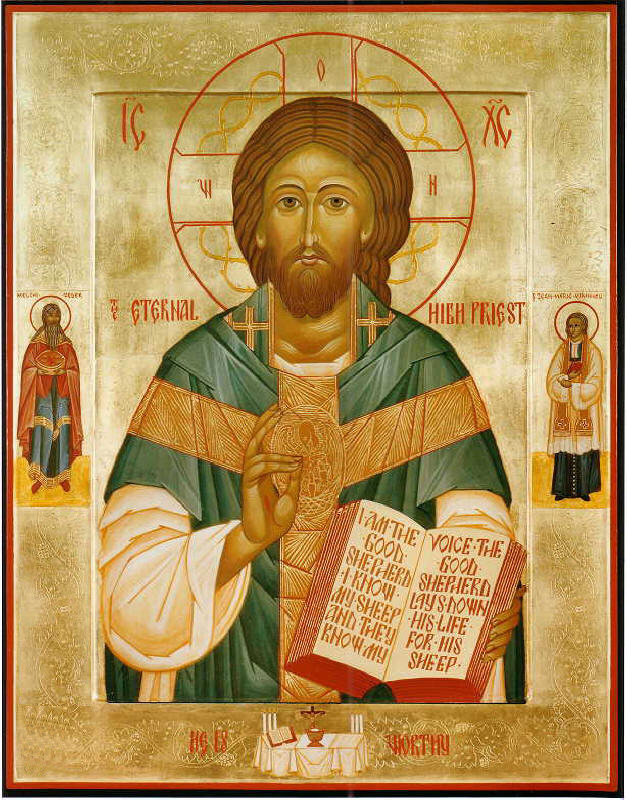
Jesus, High Priest
We thank you, God our Father, for those who have responded to your call to priestly ministry.
Accept this prayer we offer on their behalf: Fill your priests with the sure knowledge of your love.
Open their hearts to the power and consolation of the Holy Spirit.
Lead them to new depths of union with your Son.
Increase in them profound faith in the Sacraments they celebrate as they nourish, strengthen and heal us.
Lord Jesus Christ, grant that these, your priests, may inspire us to strive for holiness by the power of their example, as men of prayer who ponder your word and follow your will.
O Mary, Mother of Christ and our mother, guard with your maternal care these chosen ones, so dear to the Heart of your Son.
Intercede for our priests, that offering the Sacrifice of your Son, they may be conformed more each day to the image of your Son, our Lord and Savior, Jesus Christ. Amen.
Saint John Vianney, universal patron of priests, pray for us and our priests
This icon shows Jesus Christ, our eternal high priest.
The gold pelican over His heart represents self-sacrifice.
The border contains an altar and grapevines, representing the Mass, and icons of Melchizedek and St. Jean-Baptiste Vianney.
Melchizedek: king of righteousness (left icon) was priest and king of Jerusalem. He blessed Abraham and has been considered an ideal priest-king.
St. Jean-Baptiste Vianney is the patron saint of parish priests.
15
posted on
03/25/2017 9:01:53 PM PDT
by
Salvation
("With God all things are possible." Matthew 19:26)
To: All
Pray a Rosary each day for our nation.
1. Sign of the Cross: In the name of the Father, and of the Son, and of the Holy Spirit. Amen.
2. The Apostles Creed: I BELIEVE in God, the Father almighty, Creator of heaven and earth, and in Jesus Christ, His only Son, our Lord, who was conceived by the Holy Spirit, born of the Virgin Mary, suffered under Pontius Pilate, was crucified, died, and was buried. He descended into hell; on the third day he rose again from the dead; he ascended into heaven, and is seated at the right hand of God, the Father Almighty; from there He shall come to judge the living and the dead.
I believe in the Holy Spirit, the holy catholic Church, the communion of saints, the forgiveness of sins, the resurrection of the body, and the life everlasting. Amen.
3. The Lord's Prayer: OUR Father, who art in heaven, hallowed be Thy name. Thy kingdom come. Thy will be done on earth as it is in heaven. Give us this day our daily bread and forgive us our trespasses as we forgive those who trespass against us. And lead us not into temptation, but deliver us from evil. Amen.
4. (3) Hail Mary: HAIL Mary, full of grace, the Lord is with thee. Blessed art thou amongst women and blessed is the fruit of thy womb, Jesus. Holy Mary, Mother of God, pray for us sinners, now, and in the hour of our death. Amen. (Three times)
5. Glory Be: GLORY be to the Father, and to the Son, and to the Holy Spirit. As it was in the beginning, is now, and ever shall be, world without end. Amen.
6. Fatima Prayer: Oh, my Jesus, forgive us our sins, save us from the fires of hell, lead all souls to heaven, especially those in most need of your mercy.
Announce each mystery, then say 1 Our Father, 10 Hail Marys, 1 Glory Be and 1 Fatima prayer. Repeat the process with each mystery.
End with the Hail Holy Queen:
Hail, Holy Queen, Mother of Mercy, our life, our sweetness and our hope! To thee do we cry, poor banished children of Eve! To thee do we send up our sighs, mourning and weeping in this vale of tears! Turn then, most gracious advocate, thine eyes of mercy towards us; and after this, our exile, show unto us the blessed fruit of thy womb, Jesus!
O clement, O loving, O sweet Virgin Mary! Pray for us, O holy Mother of God, that we may be made worthy of the promises of Christ.
Final step -- The Sign of the Cross
The Mysteries of the Rosary By tradition, Catholics meditate on these Mysteries during prayers of the Rosary. The biblical references follow each of the Mysteries below.
The Glorious Mysteries
(Wednesdays and Sundays)
1.The Resurrection (Matthew 28:1-8, Mark 16:1-18, Luke 24:1-12, John 20:1-29) [Spiritual fruit - Faith]
2. The Ascension (Mark 16:19-20, Luke 24:50-53, Acts 1:6-11) [Spiritual fruit - Christian Hope]
3. The Descent of the Holy Spirit (Acts 2:1-13) [Spiritual fruit - Gifts of the Holy Spirit]
4. The Assumption [Spiritual fruit - To Jesus through Mary]
5. The Coronation [Spiritual fruit - Grace of Final Perseverance]
16
posted on
03/25/2017 9:04:12 PM PDT
by
Salvation
("With God all things are possible." Matthew 19:26)
To: All
OR:
Pray a Rosary each day for our nation.
1. Sign of the Cross: In the name of the Father, and of the Son, and of the Holy Spirit. Amen.
2. The Apostles Creed: I BELIEVE in God, the Father almighty, Creator of heaven and earth, and in Jesus Christ, His only Son, our Lord, who was conceived by the Holy Spirit, born of the Virgin Mary, suffered under Pontius Pilate, was crucified, died, and was buried. He descended into hell; on the third day he rose again from the dead; he ascended into heaven, and is seated at the right hand of God, the Father Almighty; from there He shall come to judge the living and the dead.
I believe in the Holy Spirit, the holy catholic Church, the communion of saints, the forgiveness of sins, the resurrection of the body, and the life everlasting. Amen.
3. The Lord's Prayer: OUR Father, who art in heaven, hallowed be Thy name. Thy kingdom come. Thy will be done on earth as it is in heaven. Give us this day our daily bread and forgive us our trespasses as we forgive those who trespass against us. And lead us not into temptation, but deliver us from evil. Amen.
4. (3) Hail Mary: HAIL Mary, full of grace, the Lord is with thee. Blessed art thou amongst women and blessed is the fruit of thy womb, Jesus. Holy Mary, Mother of God, pray for us sinners, now, and in the hour of our death. Amen. (Three times)
5. Glory Be: GLORY be to the Father, and to the Son, and to the Holy Spirit. As it was in the beginning, is now, and ever shall be, world without end. Amen.
6. Fatima Prayer: Oh, my Jesus, forgive us our sins, save us from the fires of hell, lead all souls to heaven, especially those in most need of your mercy.
Announce each mystery, then say 1 Our Father, 10 Hail Marys, 1 Glory Be and 1 Fatima prayer. Repeat the process with each mystery.
End with the Hail Holy Queen:
Hail, Holy Queen, Mother of Mercy, our life, our sweetness and our hope! To thee do we cry, poor banished children of Eve! To thee do we send up our sighs, mourning and weeping in this vale of tears! Turn then, most gracious advocate, thine eyes of mercy towards us; and after this, our exile, show unto us the blessed fruit of thy womb, Jesus!
O clement, O loving, O sweet Virgin Mary! Pray for us, O holy Mother of God, that we may be made worthy of the promises of Christ.
Final step -- The Sign of the Cross
The Mysteries of the Rosary By tradition, Catholics meditate on these Mysteries during prayers of the Rosary. The biblical references follow each of the Mysteries below.
The Sorrowful Mysteries
(Tuesdays and Fridays)
1. The Agony in the Garden (Matthew 26:36-46, Luke 22:39-46) [Spiritual fruit - God's will be done]
2. The Scourging at the Pillar (Matthew 27:26, Mark 15:15, John 19:1) [Spiritual fruit - Mortification of the senses]
3. The Crowning with Thorns (Matthew 27:27-30, Mark 15:16-20, John 19:2) [Spiritual fruit - Reign of Christ in our heart]
4. The Carrying of the Cross (Matthew 27:31-32, Mark 15:21, Luke 23:26-32, John 19:17) [Spiritual fruit - Patient bearing of trials]
5. The Crucifixion (Matthew 27:33-56, Mark 15:22-39, Luke 23:33-49, John 19:17-37) [Spiritual fruit - Pardoning of Injuries]
17
posted on
03/25/2017 9:04:46 PM PDT
by
Salvation
("With God all things are possible." Matthew 19:26)
To: All
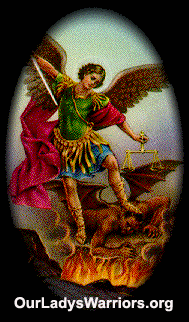
St. Michael the Archangel
~ PRAYER ~
St. Michael, the Archangel, defend us in battle
Be our protection against the wickedness
and snares of the devil;
May God rebuke him, we humbly pray,
and do thou, O Prince of the heavenly host,
by the power of God,
Cast into hell Satan and all the evil spirits
who prowl through the world seeking the ruin of souls.
Amen
+
18
posted on
03/25/2017 9:09:48 PM PDT
by
Salvation
("With God all things are possible." Matthew 19:26)
To: All
March Devotion: Saint Joseph
Since the 16th century Catholic piety has assigned entire months to special devotions. Due to the solemnity of Saint Joseph on March 19, this month is devoted to this great saint, the foster father of Christ. "It greatly behooves Christians, while honoring the Virgin Mother of God, constantly to invoke with deep piety and confidence her most chaste spouse, Saint Joseph. We have a well grounded conviction that such is the special desire of the Blessed Virgin herself." --Pope Leo XIII FOR OUR WORK
Glorious Saint Joseph, pattern of all who are devoted to toil, obtain for me the grace to toil in the spirit of penance, in order thereby to atone for my many sins; to toil conscientiously, putting devotion to duty before my own inclinations; to labor with thankfulness and joy, deeming it an honor to employ and to develop, by my labor, the gifts I have received from Almighty God; to work with order, peace, moderation, and patience, without ever shrinking from weariness and difficulties; to work above all with a pure intention and with detachment from self, having always before my eyes the hour of death and the accounting which I must then render of time ill-spent, of talents unemployed, of good undone, and of my empty pride in success, which is so fatal to the work of God. All for Jesus, all through Mary, all in imitation of thee, 0 Patriarch Joseph! This shall be my motto in life and in death. Amen.
FOR THE INTERCESSION OF SAINT JOSEPH
O Joseph, virgin-father of Jesus, most pure spouse of the Virgin Mary, pray every day for us to the same Jesus, the Son of God, that we, being defended by the power of His grace and striving dutifully in life, may be crowned by Him at the hour of death.
Prayer Source: Prayer Book, The by Reverend John P. O'Connell, M.A., S.T.D. and Jex Martin, M.A., The Catholic Press, Inc., Chicago, Illinois, 1954
St. Joseph
St. Joseph was an ordinary manual laborer although descended from the royal house of David. In the designs of Providence he was destined to become the spouse of the Mother of God. His high privilege is expressed in a single phrase, "Foster-father of Jesus." About him Sacred Scripture has little more to say than that he was a just man-an expression which indicates how faithfully he fulfilled his high trust of protecting and guarding God's greatest treasures upon earth, Jesus and Mary.
The darkest hours of his life may well have been those when he first learned of Mary's pregnancy; but precisely in this time of trial Joseph showed himself great. His suffering, which likewise formed a part of the work of the redemption, was not without great providential import: Joseph was to be, for all times, the trustworthy witness of the Messiah's virgin birth. After this, he modestly retires into the background of holy Scripture.
Of St. Joseph's death the Bible tells us nothing. There are indications, however, that he died before the beginning of Christ's public life. His was the most beautiful death that one could have, in the arms of Jesus and Mary. Humbly and unknown, he passed his years at Nazareth, silent and almost forgotten he remained in the background through centuries of Church history. Only in more recent times has he been accorded greater honor. Liturgical veneration of St. Joseph began in the fifteenth century, fostered by Sts. Brigid of Sweden and Bernadine of Siena. St. Teresa, too, did much to further his cult.
At present there are two major feasts in his honor. On March 19 our veneration is directed to him personally and to his part in the work of redemption, while on May 1 we honor him as the patron of workmen throughout the world and as our guide in the difficult matter of establishing equitable norms regarding obligations and rights in the social order.
Excerpted from The Church's Year of Grace, Pius Parsch.
St. Joseph is invoked as patron for many causes. He is the patron of the Universal Church. He is the patron of the dying because Jesus and Mary were at his death-bed. He is also the patron of fathers, of carpenters, and of social justice. Many religious orders and communities are placed under his patronage.
Patron: Against doubt; against hesitation; Americas; Austria; Diocese of Baton Rouge, Louisiana; California; Belgium; Bohemia; bursars; cabinetmakers; Canada; Carinthia; carpenters; China; Church; confectioners; craftsmen; Croatian people (in 1687 by decree of the Croatian parliament) dying people; emigrants; engineers; expectant mothers; families; fathers; Florence, Italy; happy death; holy death; house hunters; immigrants; interior souls; Korea; laborers; Diocese of La Crosse, Wisconsin; Archdiocese of Louisville, Kentucky; Diocese of Manchester, New Hampshire; Mexico; Diocese of Nashville, Tennessee; New France; New World; Oblates of Saint Joseph; people in doubt; people who fight Communism; Peru; pioneers; pregnant women; protection of the Church; Diocese of San Jose, California; diocese of Sioux Falls, South Dakota; social justice; Styria, Austria; travelers; Turin Italy; Tyrol Austria; unborn children Universal Church; Vatican II; Viet Nam; Diocese of Wheeling-Charleston West Virginia; wheelwrights; workers; working people.
Symbols: Bible; branch; capenter's square; carpenter's tools; chalice; cross; hand tools; infant Jesus; ladder; lamb; lily; monstrance; old man holding a lily and a carpenter's tool such as a square; old man holding the infant Jesus; plane; rod.
Pope Pius X composed this prayer to St. Joseph, patron of working people, that expresses concisely the Christian attitude toward labor. It summarizes also for us the lessons of the Holy Family's work at Nazareth.
Glorious St. Joseph, model of all who devote their lives to labor, obtain for me the grace to work in the spirit of penance in order thereby to atone for my many sins; to work conscientiously, setting devotion to duty in preference to my own whims; to work with thankfulness and joy, deeming it an honor to employ and to develop by my labor the gifts I have received from God; to work with order, peace, moderation, and patience, without ever shrinking from weariness and difficulties; to work above all with a pure intention and with detachment from self, having always before my eyes the hour of death and the accounting which I must then render of time ill spent, of talents wasted, of good omitted, and of vain complacency in success, which is so fatal to the work of God.
All for Jesus, all through Mary, all in imitation of you, O Patriarch Joseph! This shall be my motto in life and in death, Amen.
Litany of Saint Joseph
Lord, have mercy on us.
Christ, have mercy on us.
Lord, have mercy on us.
Christ, hear us.
Christ, graciously hear us.
God, the Father of Heaven, have mercy on us.
God, the Son, Redeemer of the world, have mercy on us.
God, the Holy Ghost, have mercy on us.
Holy Trinity, One God, have mercy on us.
Holy Mary, pray for us.
Holy Joseph, pray for us.
Illustrious Son of David, pray for us.
Light of the Patriarchs, pray for us.
Spouse of the Mother of God, pray for us.
Chaste Guardian of the Virgin, pray for us.
Foster-Father of the Son of God, pray for us.
Faithful Protector of Christ, pray for us.
Head of the Holy Family, pray for us.
Joseph most just, pray for us.
Joseph most chaste, pray for us.
Joseph most prudent, pray for us.
Joseph most courageous, pray for us.
Joseph most obedient, pray for us.
Joseph most faithful, pray for us.
Mirror of patience, pray for us.
Lover of poverty, pray for us.
Model of working men, pray for us.
Ornament of the domestic life, pray for us.
Guardian of virgins, pray for us.
Pillar of the family, pray for us.
Consoler of the miserable, pray for us.
Hope of the sick, pray for us.
Patron of the dying, pray for us.
Terror of demons, pray for us.
Protector of the Holy Church, pray for us.
Lamb of God, who takest away the sins of the world, Spare us, O Lord.
Lamb of God, who takest away the sins of the world, Graciously hear us, O Lord.
Lamb of God, who takest away the sins of the world, Have mercy on us.
V. He hath made him master of His house.
R. And ruler of all His possessions.
Let us pray.
O God, who in Thy ineffable providence didst vouchsafe to choose blessed Joseph to be the Spouse of Thy most holy Mother: grant, we beseech Thee, that we may have him for our intercessor in Heaven, whom on earth we venerate as out most holy Protector. Who livest and reignest world without end. Amen.
Was St. Joseph a tzadik?
St. Joseph: Patron saint of three Popes [Catholic Caucus]
St. Joseph and the Staircase
St. Joseph, Foster Father, Novena [Catholic/Orthodox Caucus]
Patron of a “Happy Death” A Special Role for St. Joseph [Catholic/Orhtodox Caucus]
Lists Every Catholic Should be Familiar With: The 7 Sorrows and 7 Joys of St. Joseph
Catholic Group Blasts Pelosi For Invoking St. Joseph on Pro-Abortion Health Care Bill
THE SEVEN SORROWS AND SEVEN JOYS OF ST. JOSEPH
Joseph, Mary and Jesus: A Model Family
Season of Announcement - Revelation to Joseph
In hard times, don't forget about the humble carpenter Joseph
Saint Joseph: Complete submission to the will of God (Pope Benedict XVI) (Catholic/Orthodox Caucus)
St. Joseph as Head of the Holy Family (Catholic/Orthodox Caucus)
St. Joseph, Patron of a Peaceful Death [Catholic Caucus]
Octave: St. Joseph, A 'Man’s Man', Calling Men to Jesus
St. Teresa de Avila's Devotion to St. Joseph (Catholic Caucus)
Catholic Men's National Day of Prayer, MARCH 15, 2008, The Solemnity of St. Joseph (Catholic Caucus)
The Role and Responsibility of Fatherhood - St. Joseph as Model
St. Joseph - Foster Father of Jesus
Some divine intervention in real estate-[Bury St. Joseph Statues in Ground]
Many Turn To Higher Power For Home Sales
St. Joseph the Worker, Memorial, May 1
Catholic Devotions: St. Joseph the Worker
Nothing Will Be Denied Him (St. Joseph)
The Heart of a Father [St. Joseph]
St. Joseph's DAY
Quemadmodum Deus - Decree Under Blessed Pius IX, Making St. Joseph Patron of the Church
Father & Child (Preaching on St. Joseph)
March 19 - Feast of St. Joseph - Husband of Mary - Intercessor of civil leaders
St. Joseph's Spirit of Silence
St. Joseph's Humility (By St. Francis de Sales)
St. Joseph [Husband of the Blessed Virgin Mary], Solemnity, March 19
St Joseph’s Paternal Love
The Heart of St. Joseph
MORE THAN PATRON OF HOMES, IT'S TIME FOR ST. JOSEPH TO GAIN HIGHEST OF RECOGNITION [Fatherhood]
The Importance of Devotion to St. Joseph
St. Francis de Sales on St. Joseph (Some Excerpts for St. Joseph's Day 2004)
St. Joseph: REDEMPTORIS CUSTOS (Guardian Of The Redeemer)
(Saint) Joseph the Patriarch: A Reflection on the Solemnity of St. Joseph
How I Rediscovered a "Neglected" Saint: Work of Art Inspires Young Man to Rediscover St. Joseph
Novena to Saint Joseph
O Saint Joseph, whose protection is so great, so strong, so prompt before the throne of God, I place in you all my interests and desires.
O Saint Joseph, assist me by your powerful intercession and obtain for me from your Divine Son all spiritual blessings through Jesus Christ, Our Lord; so that having engaged here below your heavenly power, I may offer my thanksgiving and homage to the most loving of Fathers.
O Saint Joseph, I never weary contemplating you and Jesus asleep in your arms; I dare not approach while He reposes near your heart. Press Him in my name and kiss His fine head for me, and ask Him to return the Kiss when I draw my dying breath, Amen.
O Saint Joseph, hear my prayers and obtain my petitions. O Saint Joseph, pray for me. (mention your intention)
St. Joseph Novena
O good father Joseph! I beg you, by all your sufferings, sorrows and joys, to obtain for me what I ask.
(Here name your petition).
Obtain for all those who have asked my prayers, everything that is useful to them in the plan of God. Be near to me in my last moments, that I may eternally sing the praises of Jesus, Mary and Joseph. Amen.
(Our Father, Hail Mary, Glory Be)
19
posted on
03/25/2017 9:10:18 PM PDT
by
Salvation
("With God all things are possible." Matthew 19:26)
To: All
February, 2017
Pope's Intention
Support for Persecuted Christians: That persecuted Christians may be supported by the prayers and material help of the whole Church.
20
posted on
03/25/2017 9:10:48 PM PDT
by
Salvation
("With God all things are possible." Matthew 19:26)
Navigation: use the links below to view more comments.
first 1-20, 21-40, 41-48 next last
Disclaimer:
Opinions posted on Free Republic are those of the individual
posters and do not necessarily represent the opinion of Free Republic or its
management. All materials posted herein are protected by copyright law and the
exemption for fair use of copyrighted works.
FreeRepublic.com is powered by software copyright 2000-2008 John Robinson

