Skip to comments.
Catholic Caucus: Sunday Mass Readings, 03-19-17, Third Sunday of Lent
USCCB.org/RNAB ^
| 03-19-17
| Revised New American Bible
Posted on 03/18/2017 6:37:32 PM PDT by Salvation
March 19, 2017
Third Sunday of Lent
In those days, in their thirst for water,
the people grumbled against Moses,
saying, "Why did you ever make us leave Egypt?
Was it just to have us die here of thirst
with our children and our livestock?"
So Moses cried out to the LORD,
"What shall I do with this people?
a little more and they will stone me!"
The LORD answered Moses,
"Go over there in front of the people,
along with some of the elders of Israel,
holding in your hand, as you go,
the staff with which you struck the river.
I will be standing there in front of you on the rock in Horeb.
Strike the rock, and the water will flow from it
for the people to drink."
This Moses did, in the presence of the elders of Israel.
The place was called Massah and Meribah,
because the Israelites quarreled there
and tested the LORD, saying,
"Is the LORD in our midst or not?"
R. (8)
If today you hear his voice, harden not your hearts.Come, let us sing joyfully to the LORD;
let us acclaim the Rock of our salvation.
Let us come into his presence with thanksgiving;
let us joyfully sing psalms to him.
R.
If today you hear his voice, harden not your hearts.Come, let us bow down in worship;
let us kneel before the LORD who made us.
For he is our God,
and we are the people he shepherds, the flock he guides.
R.
If today you hear his voice, harden not your hearts.Oh, that today you would hear his voice:
"Harden not your hearts as at Meribah,
as in the day of Massah in the desert,
Where your fathers tempted me;
they tested me though they had seen my works."
R.
If today you hear his voice, harden not your hearts.
Brothers and sisters:
Since we have been justified by faith,
we have peace with God through our Lord Jesus Christ,
through whom we have gained access by faith
to this grace in which we stand,
and we boast in hope of the glory of God.
And hope does not disappoint,
because the love of God has been poured out into our hearts
through the Holy Spirit who has been given to us.
For Christ, while we were still helpless,
died at the appointed time for the ungodly.
Indeed, only with difficulty does one die for a just person,
though perhaps for a good person one might even find courage to die.
But God proves his love for us
in that while we were still sinners Christ died for us.
Lord, you are truly the Savior of the world;
give me living water, that I may never thirst again.
Jesus came to a town of Samaria called Sychar,
near the plot of land that Jacob had given to his son Joseph.
Jacob's well was there.
Jesus, tired from his journey, sat down there at the well.
It was about noon.
A woman of Samaria came to draw water.
Jesus said to her,
"Give me a drink."
His disciples had gone into the town to buy food.
The Samaritan woman said to him,
"How can you, a Jew, ask me, a Samaritan woman, for a drink?"
—For Jews use nothing in common with Samaritans.—
Jesus answered and said to her,
"If you knew the gift of God
and who is saying to you, 'Give me a drink, '
you would have asked him
and he would have given you living water."
The woman said to him,
"Sir, you do not even have a bucket and the cistern is deep;
where then can you get this living water?
Are you greater than our father Jacob,
who gave us this cistern and drank from it himself
with his children and his flocks?"
Jesus answered and said to her,
"Everyone who drinks this water will be thirsty again;
but whoever drinks the water I shall give will never thirst;
the water I shall give will become in him
a spring of water welling up to eternal life."
The woman said to him,
"Sir, give me this water, so that I may not be thirsty
or have to keep coming here to draw water."
Jesus said to her,
"Go call your husband and come back."
The woman answered and said to him,
"I do not have a husband."
Jesus answered her,
"You are right in saying, 'I do not have a husband.'
For you have had five husbands,
and the one you have now is not your husband.
What you have said is true."
The woman said to him,
"Sir, I can see that you are a prophet.
Our ancestors worshiped on this mountain;
but you people say that the place to worship is in Jerusalem."
Jesus said to her,
"Believe me, woman, the hour is coming
when you will worship the Father
neither on this mountain nor in Jerusalem.
You people worship what you do not understand;
we worship what we understand,
because salvation is from the Jews.
But the hour is coming, and is now here,
when true worshipers will worship the Father in Spirit and truth;
and indeed the Father seeks such people to worship him.
God is Spirit, and those who worship him
must worship in Spirit and truth."
The woman said to him,
"I know that the Messiah is coming, the one called the Christ;
when he comes, he will tell us everything."
Jesus said to her,
"I am he, the one speaking with you."
At that moment his disciples returned,
and were amazed that he was talking with a woman,
but still no one said, "What are you looking for?"
or "Why are you talking with her?"
The woman left her water jar
and went into the town and said to the people,
"Come see a man who told me everything I have done.
Could he possibly be the Christ?"
They went out of the town and came to him.
Meanwhile, the disciples urged him, "Rabbi, eat."
But he said to them,
"I have food to eat of which you do not know."
So the disciples said to one another,
"Could someone have brought him something to eat?"
Jesus said to them,
"My food is to do the will of the one who sent me
and to finish his work.
Do you not say, 'In four months the harvest will be here'?
I tell you, look up and see the fields ripe for the harvest.
The reaper is already receiving payment
and gathering crops for eternal life,
so that the sower and reaper can rejoice together.
For here the saying is verified that 'One sows and another reaps.'
I sent you to reap what you have not worked for;
others have done the work,
and you are sharing the fruits of their work."
Many of the Samaritans of that town began to believe in him
because of the word of the woman who testified,
"He told me everything I have done."
When the Samaritans came to him,
they invited him to stay with them;
and he stayed there two days.
Many more began to believe in him because of his word,
and they said to the woman,
"We no longer believe because of your word;
for we have heard for ourselves,
and we know that this is truly the savior of the world."
Jesus came to a town of Samaria called Sychar,
near the plot of land that Jacob had given to his son Joseph.
Jacob's well was there.
Jesus, tired from his journey, sat down there at the well.
It was about noon.
A woman of Samaria came to draw water.
Jesus said to her,
"Give me a drink."
His disciples had gone into the town to buy food.
The Samaritan woman said to him,
"How can you, a Jew, ask me, a Samaritan woman, for a drink?"
—For Jews use nothing in common with Samaritans.—
Jesus answered and said to her,
"If you knew the gift of God
and who is saying to you, 'Give me a drink, '
you would have asked him
and he would have given you living water."
The woman said to him,
"Sir, you do not even have a bucket and the cistern is deep;
where then can you get this living water?
Are you greater than our father Jacob,
who gave us this cistern and drank from it himself
with his children and his flocks?"
Jesus answered and said to her,
"Everyone who drinks this water will be thirsty again;
but whoever drinks the water I shall give will never thirst;
the water I shall give will become in him
a spring of water welling up to eternal life."
The woman said to him,
"Sir, give me this water, so that I may not be thirsty
or have to keep coming here to draw water.
"I can see that you are a prophet.
Our ancestors worshiped on this mountain;
but you people say that the place to worship is in Jerusalem."
Jesus said to her,
"Believe me, woman, the hour is coming
when you will worship the Father
neither on this mountain nor in Jerusalem.
You people worship what you do not understand;
we worship what we understand,
because salvation is from the Jews.
But the hour is coming, and is now here,
when true worshipers will worship the Father in Spirit and truth;
and indeed the Father seeks such people to worship him.
God is Spirit, and those who worship him
must worship in Spirit and truth."
The woman said to him,
"I know that the Messiah is coming, the one called the Christ;
when he comes, he will tell us everything."
Jesus said to her,
"I am he, the one who is speaking with you."
Many of the Samaritans of that town began to believe in him.
When the Samaritans came to him,
they invited him to stay with them;
and he stayed there two days.
Many more began to believe in him because of his word,
and they said to the woman,
"We no longer believe because of your word;
for we have heard for ourselves,
and we know that this is truly the savior of the world."
TOPICS: Catholic; General Discusssion; Prayer; Worship
KEYWORDS: catholic; jn4; lent; prayer; saints
Navigation: use the links below to view more comments.
first 1-20, 21-40, 41-49 next last
For your reading, reflection, faith-sharing, comments, questions, discussion.
1
posted on
03/18/2017 6:37:32 PM PDT
by
Salvation
To: All
KEYWORDS: catholic; jn4; lent; prayer; saints;
2
posted on
03/18/2017 6:40:02 PM PDT
by
Salvation
("With God all things are possible." Matthew 19:26)
To: nickcarraway; NYer; ELS; Pyro7480; livius; ArrogantBustard; Catholicguy; RobbyS; marshmallow; ...
Praise to you, Lord Jesus Christ PingPlease FReepmail me to get on/off the Lenten Ping List.
3
posted on
03/18/2017 6:41:06 PM PDT
by
Salvation
("With God all things are possible." Matthew 19:26)
To: All
From: Exodus 17:3-7
The Water from the Rock
[3] But the people thirsted there for water, and the people murmured against Mo-
ses, and said, “Why did you bring us up out of Egypt, to kill us and our children
and our cattle with thirst?” [4] So Moses cried to the LORD, “What shall I do with
this people? They are almost ready to stone me.” [5] And the LORD said to Mo-
ses, “Pass on before the people, taking with you some of the elders of Israel;
and take in your hand the rod with which you struck the Nile, and go. [6] Behold,
I will stand before you there on the rock at Horeb; and you shall strike the rock,
and water shall come out of it, that the people may drink.” And Moses did so, in
the sight of the elders of Israel. [7] And he called the name of the place Massah
and Meribah, because of the faultfinding of the children of Israel, and because
they put the Lord to the proof by saying, “Is the LORD among us or not?”
*********************************************************************************************
Commentary:
17:1-7. The severity of desert life (notably hunger and thirst) leads God to help
the Israelites in various ways, all of them full of theological implications. The mi-
racle of the manna, which was preceded by that of the water which Moses made
drinkable (15:22-25), is followed by a new work of wonder to do with water: Mo-
ses causes water to flow from a rock. This happened at Rephidim, probably what
is now Wadi Refayid, some 13 km (8 miles) from Djebel Mfisa.
The sons of Israel’s faith in God and in Moses has been strengthening little by lit-
tle; but they often doubt whether God is there at all (v. 7). They begin to murmur
and to seek proofs of his presence: have they been brought out of Egypt to die,
or to attain salvation? The water which Moses causes to come out of the rock is
a further sign to bolster their faith. This episode names two places — Meribah,
which in popular etymology means “contention”, “dispute”, “lawsuit”, and Mas-
sah, which is “proof’, “test”, “temptation”. Many biblical passages recall this sin
( cf. Deut 6: 16; 9:22-24; 33:8; Ps 95:8-9), even adding that Moses himself lacked
faith and struck the rock twice (cf. Num 20:1-13; Deut: 32:51; Ps 106:32). Lack of
trust in the goodness and power of God means tempting God and it is a grave sin
against faith — even more so in the case of Moses, who had experienced God’s
special love and who ought to have given good example. When man meets some
contradiction or some difficulty he cannot immediately solve, his faith may waver
but he should never doubt, because “if deliberately cultivated, doubt can lead to
spiritual blindness” (”Catechism of the Catholic Church”, 2008).
There is a rabbinical tradition which says that the rock stayed with the Israelites
throughout their sojourn in the desert; St Paul refers to this legend when he says
“the Rock was Christ” (1 Cor 10:4). On the basis of biblical references to the won-
drous nature of waters (cf. Ps 78:15-16; 105:4; Wis 11:4-14) the Fathers said this
episode prefigures the wonderful effects of Baptism: “See the mystery: ‘Moses’ is
the Prophet; the rod is the word of God; the priest touches the rock with the word
of God, and water flows, and the people of God drink” (St Ambrose, “De Sacra-
mentis”, 8, 5, 1, 3).
*********************************************************************************************
Source: “The Navarre Bible: Text and Commentaries”. Biblical text from the
Revised Standard Version and New Vulgate. Commentaries by members of
the Faculty of Theology, University of Navarre, Spain.
Published by Four Courts Press, Kill Lane, Blackrock, Co. Dublin, Ireland, and
by Scepter Publishers in the United States.
4
posted on
03/18/2017 6:50:55 PM PDT
by
Salvation
("With God all things are possible." Matthew 19:26)
To: All
From: Romans 5:1-2, 5-8
Reconciliation Through Christ’s Sacrifice, the Basis of our Hope
[1] Therefore, since we are justified by faith, we have peace with God through our
Lord Jesus Christ. [2] Through Him we have obtained access to this grace in
which we stand, and we rejoice in our hope of sharing the glory of God. [5] And
hope does not disappoint us, because God’s love has been poured into our hearts
through the Holy Spirit who has been given to us. [6] While we were yet helpless,
at the right time Christ died for the ungodly. [7] Why, one will hardly die for a righ-
teous man—though perhaps for a good man one will dare even to die. [8] But God
shows his love for us in that while we were yet sinners Christ died for us.
*********************************************************************************************
Commentary:
1-5. In this very moving passage God helps us see “the divine interlacing of the
three theological virtues which form the backing upon which the true life of every
Christian man or woman has to be woven” (St. J. Escriva, “Friends of God”, 205).
Faith, hope and charity act in us in turn, causing us to grow in the life of grace.
Thus, faith leads us to know and be sure of things we hope for (cf. Hebrews 11:1);
hope ensures that we shall attain them, and enlivens our love of God; charity, for
its part, gives us energy to practise the other two theological virtues. The definitive
outcome of this growth in love, faith and hope is the everlasting peace that is of
the essence of eternal life.
As long as we are in this present life we do have peace to some degree—but with
tribulation. Therefore, the peace attainable in this life does not consist in the con-
tentment of someone who wants to have no problems, but rather in the resolute-
ness full of hope (”character”) of someone who manages to rise above suffering
and stays faithful through endurance. Suffering is necessary for us, because it is
the normal way to grow in virtue (cf. James 1:2-4; 1 Peter 1:5-7); that is why it is
providential (cf. Philippians 1:19; Colossians 1:24) and leads to joy and happi-
ness (1 Thessalonians 1:6).
“A person who hopes for something and strives eagerly to attain it is ready to
endure all kinds of difficulty and distress. Thus, for example, a sick person if he
is eager to be healthy, is happy to take the bitter medicine which will cure him.
Therefore, one sign of the ardent hope that is ours thanks to Christ is that we
glory not only in the hope of future glory, but also in the afflictions which we suf-
fer in order to attain it” (St. Thomas Aquinas, “Commentary on Romans, ad loc.”).
A person who lives by faith, hope and charity realizes that suffering is not some-
thing meaningless but rather is designed by God for our perfecting. Perfection
consists “in the bringing of our wills so closely into conformity with the will of
God that, as soon as we realize He wills anything, we desire it ourselves with all
our might, and take the bitter with the sweet, knowing that to be His Majesty’s
will [...]. If our love is perfect, it has this quality of leading us to forget our own
pleasure in order to please Him whom we love. And that is indeed what happens”
(St. Teresa of Avila, “Book of Foundations”, Chapter 5).
5. The love which St. Paul speaks of here is, at one and the same time, God’s
love for us—manifested in His sending the Holy Spirit—and the love which God pla-
ces in our soul to enable us to love Him. The Second Council of Orange, quoting
St. Augustine, explains this as follows: “To love God is entirely a gift of God. He,
without being loved, loves us and enabled us to love Him. We were loved when
we were still displeasing to Him, so that we might be given something whereby
we might please Him. So it is that the Spirit of the Father and the Son, whom we
love with the Father and the son, pours charity into our hearts” (Second Council
of Orange, “De Gratia”, Canon 25; cf. St. Augustine, “In Ioann. Evang.”, 102, 5).
6-11. The friendship which reigned in paradise between God and man was foll-
owed by the enmity created by Adam’s sin. By promising a future redeemer, God
once more offered mankind his friendship. The scale of God’s love for us can be
seen in the “reconciliation “ which the Apostle speaks about, which took place
on the Cross, when Christ did away with this enmity, making our peace with God
and reconciling us to him (cf. Eph 2:15-16).
The petition in the Our Father, “Forgive us our trespasses as we forgive those who
trespass against us”, is an invitation to imitate the way God treats us, because by
loving our enemies “there shines forth in us some likeness to God our Father, who,
by the death of his Son, ransomed from everlasting perdition and reconciled to him-
self the human race, which before was most unfriendly and hostile to him “ (”St
Pius V Catechism”, IV, 14, 19).
*********************************************************************************************
Source: “The Navarre Bible: Text and Commentaries”. Biblical text from the
Revised Standard Version and New Vulgate. Commentaries by members of
the Faculty of Theology, University of Navarre, Spain.
Published by Four Courts Press, Kill Lane, Blackrock, Co. Dublin, Ireland, and
by Scepter Publishers in the United States.
5
posted on
03/18/2017 6:54:29 PM PDT
by
Salvation
("With God all things are possible." Matthew 19:26)
To: All
From: John 4:5-42
Jesus and the Samaritan Woman
[5] He (Jesus) came to a city of Samaria, called Sychar, near the field that Jacob
gave to his son Joseph. [6] Jacob’s well was there, and so Jesus, wearied as He
was with His journey, sat down beside the well. It was about the sixth hour.
[7] There came a woman of Samaria to draw water. Jesus said to her, “Give Me
a drink.” [8] For His disciples had gone away into the city to buy food. [9] The
Samaritan woman said to Him, “How is it that you, a Jew, ask a drink of me, a
woman of Samaria?” For Jews have no dealings with Samaritans. [10] Jesus an-
swered her, “If you knew the gift of God, and Who it is that is saying to you, ‘Give
Me a drink,’ you would have asked Him, and He would have given you living water.”
[11] The woman said to Him, “Sir, You have nothing to draw with, and the well is
deep; where do You get that living water? [12] Are You greater than our father Ja-
cob, who gave us the well, and drank from it himself, and his sons, and his cat-
tle?” [13] Jesus said to her, “Every one who drinks of this water will thirst again,
[14] but whoever drinks of the water that I shall give him will never thirst; the wa-
ter I shall give him become in him a spring of water welling up to eternal life.” [15]
The woman said to Him, “Sir, give me this water, that I may not thirst, nor come
here to draw.”
[16] Jesus said to her, “Go, call your husband, and come here.” [17] The woman
answered Him, “I have no husband.” Jesus said to her, “You are right in saying,
‘I have no husband.’; [18] for you have had five husbands, and he whom you now
have is not your husband; this you said truly.” [19] The woman said to Him, “Sir,
I perceive that you are a prophet. [20] Our fathers worshipped on this mountain;
and you say in Jerusalem is the place where men ought to worship.” [21] Jesus
said to her, “Woman, believe Me, the hour is coming when neither on this moun-
tain nor in Jerusalem will you worship the Father. [22] You worship what you do
not know; we worship what we know, for salvation is from the Jews. [23] But the
hour is coming and now is, when the true worshippers will worship the Father in
spirit and truth, for such the Father seeks to worship Him. [24] God is spirit, and
those who worship Him must worship Him in spirit and truth.” [25] The woman
said to Him, “I know that the Messiah is coming (He who is called Christ); when
He comes, He will show us all things.” [26] Jesus said to her, “I who speak to
you am He.”
[27] Just then the disciples came. They marvelled that He was talking with a wo-
man, but none said, “What do you wish?” or, “Why are you talking with her?”
[28] So the woman left her water jar, and went away into the city, and said to the
people, [29] “Come, see a man who told me all that I ever did. Can this be the
Christ?” [30] They went out of the city and were coming to Him.
[31] Meanwhile the disciples besought Him, saying, “Rabbi, eat.” [32] But He
said to them, “I have food to eat of which you do not know.” [33] So the disciples
said to one another, “Has any one brought Him food?” [34] Jesus said to them,
“My food is to do the will of Him who sent Me, and to accomplish His work. [35]
Do you not say, ‘There are yet four months, then comes the harvest’? I tell you,
lift up your eyes, and see how the fields are already white for harvest. [36] He
who reaps receives wages, and gathers fruit for eternal life, so that sower and
reaper may rejoice together. [37] For here the saying holds true, ‘One sows and
another reaps.’ [38] I sent you to reap that for which you did not labor; others
have labored, and you have entered into their labor.”
[39] Many Samaritans from that city believed in Him because of the woman’s tes-
timony, “He told me all that I ever did.” [40] So when the Samaritans came to
Him, they asked Him to stay with them; and He stayed there two days. [41] And
many more believed because of His word. [42] They said to the woman, “It is no
longer because of your words that we believe, for we have heard ourselves, and
we know that this is indeed the Savior of the world.”
*********************************************************************************************
Commentary:
4-5. There are two normal routes for going from Judea to Galilee. The shorter one
went through the city of Samaria; the other, which followed the Jordan, was lon-
ger. Jesus took the Samaria route, perhaps not just because it was shorter and
busier but also to have a chance of preaching to the Samaritans. When He was
approaching Samaria, near Sychar, the present-day El ‘Askar, at the foot of
Mount Ebal, He met this Samaritan woman.
6. The Gospels, particularly St. John’s, sometimes gives us a little bit of informa-
tion which seem irrelevant but really are not. Like us, Jesus did get tired, He nee-
ded to take regular rest, He felt hunger and thirst; but despite His tiredness He
does not waste an opportunity to do good to souls.
“Recollect yourselves and go over the scene again slowly in your minds. Jesus
Christ, “perfectus Deus, perfectus homo”, is tired out from His travels and His
apostolic work. Perhaps there have been times when the same thing has hap-
pened to you and you have ended up worn out, because you have reached the
limit of your resources. It is a touching sight to see our Master so exhausted.
He is hungry too: His disciples have gone to a neighboring village to look for
food. And He is thirsty [...].
“Whenever we get tired—in our work, in our studies, in our apostolic endeavors
— when our horizon is darkened by lowering clouds, then let us turn our eyes to
Jesus, to Jesus who is so good, and who also gets tired; to Jesus who is hungry
and suffers thirst. Lord, how well you make yourself understood! How lovable you
are! You show us that you are just like us, in everything but sin, so that we can
feel utterly sure that, together with you, we can conquer all our evil inclinations,
all our faults. For neither weariness nor hunger matters, nor thirst, nor tears ...
since Christ also grew weary, knew hunger, was thirsty, and wept. What is im-
portant is that we struggle to fulfill the will of our Heavenly Father, battling away
goodheartedly, for our Lord is always at our side” (St. J. Escriva, “Friends of
God”, 176 and 201).
7. Jesus has come to save what was lost. He spares no effort in this mission.
The hostility between Jews and Samaritans was proverbial; but Jesus embraced
everyone, He loved all souls and He shed His blood for each and every person.
He begins His conversation with this woman, by asking a favor of her — which
indicates God’s great respect for us: here we have Almighty God asking a mere
creature to do Him a favor. “Give Me a drink”: Jesus makes this request not just
to share His physical thirst but because His love made Him thirst for the salvation
of all men. When nailed to the cross He again said: “I thirst” (John 19:28).
9. The Samaritan woman’s reply starts the dialogue and shows how well she is
responding to the action of grace in her soul: her readiness to talk to Christ, who
was a Jew, is the first stage in her change of heart. Later (verse 11), by taking a
real interest in what Christ is saying, she opens up further to God’s influence. Her
religious feelings begin to revive (”our father Jacob”: verse 12). Jesus rewards her
and she replies truthfully: “I have no husband” (verse 17, omitted); and, seeing
that Jesus has penetrated the intimacy of her conscience, she makes an act of
faith: “I perceive that You are a prophet” (verse 19).
10. As in His dialogue with Nicodemus, Jesus makes use of common expres-
sions, to get across teachings of a much deeper nature. Everyone knows from
experience that water is absolutely necessary for human life; similarly, the grace
of Christ is absolutely necessary for supernatural life. The water which can truly
quench man’s thirst does not come from this or any other well: it is Christ’s
grace, the “living water” which provides eternal life.
Once again, taking occasion of human interests and preoccupations, Jesus
awakes a desire for things supernatural; in the same way as He led St. Peter and
others away from their work as fishermen to involve them in the apostolic work of
being fishers of men, He leads the Samaritan woman away from her chore of
drawing water from the well to the point where she desires to find this better water
which wells up to eternal life (verse 14).
13-14. Our Lord’s reply is surprising and really captures the woman’s attention.
Here is something greater than Jacob, someone offering her water that will quench
her thirst once and for all. Christ is referring to the change worked in every person
by sanctifying grace, a share in God’s own life, the presence of the Holy Spirit in
the soul, the great gift which those who believe in Him will receive.
We worry about the future, we are full of desires to be happy and at peace; a per-
son who receives our Lord and remains united to Him as a branch to the vine (cf.
John 15:4-5) will not only slake his thirst but become a well of living water (cf.
John 7:37-39).
16-19. Although the woman cannot yet realize the deep meaning of what He is
saying, Jesus uses her growing interest to reveal to her His divinity, little by little:
He shows that He knows about her life, the secrets of her heart; He can read her
conscience. In this way, He gives her enough to motivate her to make her first
act of faith: “I perceive that You are a prophet”. Her conversion has begun.
20. The origin of the Samaritan people goes back to the period of the conquest
of Samaria by the Assyrians in the eight century before Christ (cf. 2 Kings 13:
24-31). They were foreigners who very quickly integrated with the Israelites in the
region. After the Babylonian captivity they tried to ally themselves with the Jews
for political reasons and to contribute to the rebuilding of the temple, but the Jews
would have none of them. From that time onwards the Jews and the Samaritans
were always hostile to each other (cf. Ezra 4:1ff; John 4:9).
On this occasion, the Samaritan woman, now fully aware that she is speaking
to someone of authority, asks our Lord one of the key questions affecting the re-
ligious life of the two peoples: where was the right place to offer worship to God;
the Jews held that only Jerusalem would do; whereas the Samaritans claimed
that the shrine erected on Mount Gerizim was also legitimate (they based their
claim on some passages in the Pentateuch: cf. Genesis 12:7; 33:20; 22:2).
21-24. Jesus not only answers the question but takes advantage of it to confirm
the value of the teachings of the prophets and thereby reaffirm revealed truth: the
Samaritans are in the dark about many of God’s plans because they do not ac-
cept any revelation not found in the first five books of Sacred Scripture, that is,
in the Law of Moses; the Jews, on the other hand, are much nearer the truth be-
cause they accept the whole of the Old Testament. But both Samaritans and
Jews need to open themselves to the new Revelation of Jesus Christ. With the
coming of the Messiah, whom both peoples are awaiting, and who is the true
dwelling-place of God among men (cf. John 2:19), the new, definitive, Alliance
has begun; and neither Gerizim nor Jerusalem count any more; what the Father
wishes is for all to accept the Messiah, His Son, the new temple of God, by
offering Him a form of worship which comes right from the heart (cf. John 12:1;
2 Timothy 2:22) and which the Spirit of God Himself stirs people to render (cf.
Romans 8:15).
This is why the Church’s solemn Magisterium teaches that through Baptism we
become true worshippers of God: “By Baptism men are grafted into the paschal
mystery of Christ; they die with him, are buried with Him, and rise with Him. They
receive the spirit of adoption as sons ‘in which we cry, Abba, Father’ (Romans 8:
15) and thus become true adorers as the Father seeks” (Vatican II, “Sacrosanc-
tum Concilium”, 6).
25-26. This is the last stage in the Samaritan woman’s conversion: she has come
from acknowledging her sins to accepting the true teaching about worshipping the
Father in spirit and truth. But she still has to recognize Jesus as the Messiah; on
this subject she simply confesses her ignorance. Seeing that she is favorably dis-
posed, Jesus explicitly reveals that He is the Messiah: “I who speak to you am
He”.
These words of our Lord are especially significant: He declares that He is the
Messiah, and He uses words—’I...am He”—which evoke the words Yahweh used
to reveal Himself to Moses (cf. Exodus 3:14) and which on Jesus’ lips indicate a
revelation not only of His messiahship but also of His divinity (cf. John 8:24, 28,
58; 18:6).
27. “During the course of His life on earth, Jesus our Lord had all manner of insults
heaped upon Him and was mistreated in every way possible. Remember the way
it was rumored that He was a trouble-maker and how He was said to possessed
(cf. Matthew 11:18). At other times, demonstrations of His infinite Love were deli-
berately misinterpreted, and He was accused of being a friend of sinners (cf. Mat-
thew 9:11).
“Later on He, who personified penance and moderation, was accused of haunting
the tables of the rich (cf. Luke 19:7). He was also contemptuously referred to as
“fabri filius” (Matthew 13:55), the carpenter’s son, the worker’s son, as if this were
an insult. He allowed Himself to be denounced as a glutton and a drunkard....He
let His enemies accuse Him of everything, except that He was not chaste. On
this point He sealed their lips, because He wanted us to keep a vivid memory of
His immaculate example—a wonderful example of purity, of cleanliness, of light,
of a love that can set the whole world on fire in order to purify it.
“For myself, I always like to consider holy purity in the light of our Lord’s own be-
havior. In practicing this virtue, what refinement He showed! See what St. John
says about Jesus when “fatigatus ex itinere, sedebat sic super fontem” (John 4:
6), wearied as He was from the journey, He was sitting by the well. [...]
“But tired though His body is, His thirst for souls is even greater. So when the
Samaritan woman, the sinner, arrives, Christ with His priestly heart turns eagerly
to save the lost sheep, and He forgets His tiredness, His hunger and His thirst.
Our Lord was busy with this great work of charity the Apostles came back from
the village, and they “mirabantur quia cum muliere loquebatur” (John 4:27), they
were astonished to find Him takking to a woman, alone. How careful He was!
What love He had for the beautiful virtue of holy purity, that virtue which helps us
to be stronger, more manly, more fruitful, better able to work for God, and more
capable of undertaking great things!” (St. J. Escriva, “Friends of God”, 176).
28-30. Grace brings about an amazing change in this woman. Now her whole thin-
king centers around Jesus; she forgets what brought her to the well; she leaves
her pitcher behind her and goes off to the town to tell people about her discovery.
“The Apostles, when they were called, left their nets; this woman leaves her wa-
ter jar and proclaims the Gospel, calling not just one person but influencing the
whole city” (St. John Chrysostom, “Hom. on St. John”, 33). Every genuine con-
version is necessarily projected towards others, in a desire to have them share
in the joy of encountering Jesus.
32-38. Our Lord uses the occasion to speak about a spiritual form of food—doing
the will of God. He has just brought about the conversion of a sinful woman and
His spirit feels replete. The conversion of souls must be the Apostles’ food also,
and the food of all those who through priestly ordination are sacramentally asso-
ciated with Christ’s ministry (cf. 1 Corinthians 4:9-15; 2 Corinthians 4:7-12; 11:
27-29). Apostolic work sometimes means sowing, with no apparent results, and
sometimes reaping where others sowed. The Apostles will reap what was gene-
rously sown by the patriarchs and prophets and especially by Christ. And they
in their turn must prepare the ground, with the same generosity, so that others
can later reap the harvest.
But it is not only ministers who have this apostolic role: all the faithful are called
to take part in the work of apostolate: “Since all Christians have different gifts they
should collaborate in the work of the Gospel, each according to his opportunity,
ability, charism and ministry; all who sow and reap, plant and water, should be
one so that ‘working together for the same end in a free and orderly manner’ they
might together devote their powers to the building up of the Church (Vatican II,
“Ad Gentes”, 28).
39-42. This episode shows a whole evangelization process at work, beginning
with the Samaritan woman’s enthusiasm. ‘The same thing happens today with
those who are outside, who are not Christians: they receive tidings of Christ
through Christian friends; like that woman, they learn of Christ through the
Church; then they come to Christ, that is, they believe in Christ through this re-
port, and then Jesus stays two days among them and many more believe, and
believe more firmly, that He indeed is the Savior of the world” (St. Augustine,
“In Ioann. Evang.”, 15, 33).
*********************************************************************************************
Source: “The Navarre Bible: Text and Commentaries”. Biblical text from the
Revised Standard Version and New Vulgate. Commentaries by members of
the Faculty of Theology, University of Navarre, Spain.
Published by Four Courts Press, Kill Lane, Blackrock, Co. Dublin, Ireland, and
by Scepter Publishers in the United States.
6
posted on
03/18/2017 6:55:41 PM PDT
by
Salvation
("With God all things are possible." Matthew 19:26)
To: All
Scripture readings from the Jerusalem Bible by Darton, Longman & Todd
Readings at Mass
Liturgical Colour: Violet.
| First reading |
Exodus 17:3-7 © |
Tormented by thirst, the people complained against Moses. ‘Why did you bring us out of Egypt?’ they said. ‘Was it so that I should die of thirst, my children too, and my cattle?’
Moses appealed to the Lord. ‘How am I to deal with this people?” he said. ‘A little more and they will stone me!’ the Lord said to Moses, ‘Take with you some of the elders of Israel and move on to the forefront of the people; take in your hand the staff with which you struck the river, and go. I shall be standing before you there on the rock, at Horeb. You must strike the rock, and water will flow from it for the people to drink.’ This is what Moses did, in the sight of the elders of Israel. The place was named Massah and Meribah because of the grumbling of the sons of Israel and because they put the Lord to the test by saying, ‘Is the Lord with us, or not?’
| Responsorial Psalm |
| Psalm 94(95):1-2,6-9 © |
O that today you would listen to his voice! ‘Harden not your hearts.’
Come, ring out our joy to the Lord;
hail the rock who saves us.
Let us come before him, giving thanks,
with songs let us hail the Lord.
O that today you would listen to his voice! ‘Harden not your hearts.’
Come in; let us bow and bend low;
let us kneel before the God who made us:
for he is our God and we
the people who belong to his pasture,
the flock that is led by his hand.
O that today you would listen to his voice! ‘Harden not your hearts.’
O that today you would listen to his voice!
‘Harden not your hearts as at Meribah,
as on that day at Massah in the desert
when your fathers put me to the test;
when they tried me, though they saw my work.’
O that today you would listen to his voice! ‘Harden not your hearts.’
| Second reading |
| Romans 5:1-2,5-8 © |
Through our Lord Jesus Christ, by faith we are judged righteous and at peace with God, since it is by faith and through Jesus that we have entered this state of grace in which we can boast about looking forward to God’s glory. And this hope is not deceptive, because the love of God has been poured into our hearts by the Holy Spirit which has been given us. We were still helpless when at his appointed moment Christ died for sinful men. It is not easy to die even for a good man – though of course for someone really worthy, a man might be prepared to die – but what proves that God loves us is that Christ died for us while we were still sinners.
| Gospel Acclamation |
Jn4:42,15 |
Glory to you, O Christ, you are the Word of God!
Lord, you are really the saviour of the world:
give me the living water, so that I may never get thirsty.
Glory to you, O Christ, you are the Word of God!
EITHER:
| A spring of water welling up to eternal life |
Jesus came to the Samaritan town called Sychar, near the land that Jacob gave to his son Joseph. Jacob’s well is there and Jesus, tired by the journey, sat straight down by the well. It was about the sixth hour. When a Samaritan woman came to draw water, Jesus said to her, ‘Give me a drink.’ His disciples had gone into the town to buy food. The Samaritan woman said to him, ‘What? You are a Jew and you ask me, a Samaritan, for a drink?’ – Jews, in fact, do not associate with Samaritans. Jesus replied:
‘If you only knew what God is offering
and who it is that is saying to you:
Give me a drink, you would have been the one to ask,
and he would have given you living water.’
‘You have no bucket, sir,’ she answered ‘and the well is deep: how could you get this living water? Are you a greater man than our father Jacob who gave us this well and drank from it himself with his sons and his cattle?’ Jesus replied:
‘Whoever drinks this water
will get thirsty again;
but anyone who drinks the water that I shall give
will never be thirsty again:
the water that I shall give
will turn into a spring inside him,
welling up to eternal life.’
‘Sir,’ said the woman ‘give me some of that water, so that I may never get thirsty and never have to come here again to draw water.’ ‘Go and call your husband’ said Jesus to her ‘and come back here.’ The woman answered, ‘I have no husband.’ He said to her, ‘You are right to say, “I have no husband”; for although you have had five, the one you have now is not your husband. You spoke the truth there.’ ‘I see you are a prophet, sir’ said the woman. ‘Our fathers worshipped on this mountain, while you say that Jerusalem is the place where one ought to worship.’ Jesus said:
‘Believe me, woman,
the hour is coming
when you will worship the Father
neither on this mountain nor in Jerusalem.
You worship what you do not know;
we worship what we do know:
for salvation comes from the Jews.
But the hour will come
– in fact it is here already –
when true worshippers will worship the Father in spirit and truth:
that is the kind of worshipper the Father wants.
God is spirit,
and those who worship
must worship in spirit and truth.’
The woman said to him, ‘I know that Messiah – that is, Christ – is coming; and when he comes he will tell us everything.’ ‘I who am speaking to you,’ said Jesus ‘I am he.’
At this point his disciples returned, and were surprised to find him speaking to a woman, though none of them asked, ‘What do you want from her?’ or, ‘Why are you talking to her?’ The woman put down her water jar and hurried back to the town to tell the people. ‘Come and see a man who has told me everything I ever did; I wonder if he is the Christ?’ This brought people out of the town and they started walking towards him.
Meanwhile, the disciples were urging him, ‘Rabbi, do have something to eat; but he said, ‘I have food to eat that you do not know about.’ So the disciples asked one another, ‘Has someone been bringing him food?’ But Jesus said:
‘My food is to do the will of the one who sent me,
and to complete his work.
Have you not got a saying:
Four months and then the harvest?
Well, I tell you:
Look around you, look at the fields;
already they are white, ready for harvest!
Already the reaper is being paid his wages,
already he is bringing in the grain for eternal life,
and thus sower and reaper rejoice together.
For here the proverb holds good:
one sows, another reaps;
I sent you to reap a harvest you had not worked for.
Others worked for it;
and you have come into the rewards of their trouble.’
Many Samaritans of that town had believed in him on the strength of the woman’s testimony when she said, ‘He told me all I have ever done’, so, when the Samaritans came up to him, they begged him to stay with them. He stayed for two days, and when he spoke to them many more came to believe; and they said to the woman, ‘Now we no longer believe because of what you told us; we have heard him ourselves and we know that he really is the saviour of the world.’
7
posted on
03/18/2017 7:06:11 PM PDT
by
Salvation
("With God all things are possible." Matthew 19:26)
To: Salvation
8
posted on
03/18/2017 7:08:53 PM PDT
by
Salvation
("With God all things are possible." Matthew 19:26)
To: All
9
posted on
03/18/2017 7:51:01 PM PDT
by
Salvation
("With God all things are possible." Matthew 19:26)
To: All
10
posted on
03/18/2017 7:51:17 PM PDT
by
Salvation
("With God all things are possible." Matthew 19:26)
To: All
11
posted on
03/18/2017 7:52:10 PM PDT
by
Salvation
("With God all things are possible." Matthew 19:26)
To: All
12
posted on
03/18/2017 7:52:39 PM PDT
by
Salvation
("With God all things are possible." Matthew 19:26)
To: All
13
posted on
03/18/2017 7:53:24 PM PDT
by
Salvation
("With God all things are possible." Matthew 19:26)
To: All
14
posted on
03/18/2017 7:53:51 PM PDT
by
Salvation
("With God all things are possible." Matthew 19:26)
To: All
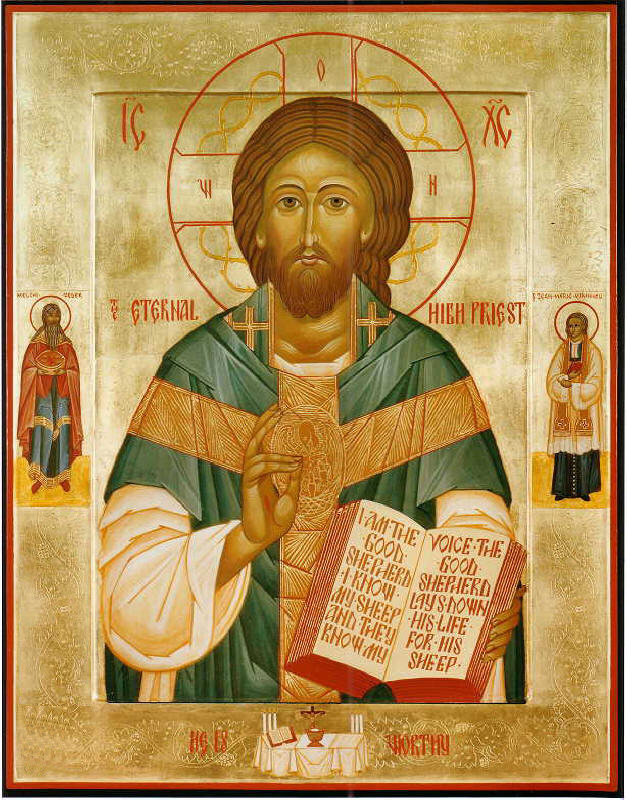
Jesus, High Priest
We thank you, God our Father, for those who have responded to your call to priestly ministry.
Accept this prayer we offer on their behalf: Fill your priests with the sure knowledge of your love.
Open their hearts to the power and consolation of the Holy Spirit.
Lead them to new depths of union with your Son.
Increase in them profound faith in the Sacraments they celebrate as they nourish, strengthen and heal us.
Lord Jesus Christ, grant that these, your priests, may inspire us to strive for holiness by the power of their example, as men of prayer who ponder your word and follow your will.
O Mary, Mother of Christ and our mother, guard with your maternal care these chosen ones, so dear to the Heart of your Son.
Intercede for our priests, that offering the Sacrifice of your Son, they may be conformed more each day to the image of your Son, our Lord and Savior, Jesus Christ. Amen.
Saint John Vianney, universal patron of priests, pray for us and our priests
This icon shows Jesus Christ, our eternal high priest.
The gold pelican over His heart represents self-sacrifice.
The border contains an altar and grapevines, representing the Mass, and icons of Melchizedek and St. Jean-Baptiste Vianney.
Melchizedek: king of righteousness (left icon) was priest and king of Jerusalem. He blessed Abraham and has been considered an ideal priest-king.
St. Jean-Baptiste Vianney is the patron saint of parish priests.
15
posted on
03/18/2017 7:55:34 PM PDT
by
Salvation
("With God all things are possible." Matthew 19:26)
To: All
Pray a Rosary each day for our nation.
1. Sign of the Cross: In the name of the Father, and of the Son, and of the Holy Spirit. Amen.
2. The Apostles Creed: I BELIEVE in God, the Father almighty, Creator of heaven and earth, and in Jesus Christ, His only Son, our Lord, who was conceived by the Holy Spirit, born of the Virgin Mary, suffered under Pontius Pilate, was crucified, died, and was buried. He descended into hell; on the third day he rose again from the dead; he ascended into heaven, and is seated at the right hand of God, the Father Almighty; from there He shall come to judge the living and the dead.
I believe in the Holy Spirit, the holy catholic Church, the communion of saints, the forgiveness of sins, the resurrection of the body, and the life everlasting. Amen.
3. The Lord's Prayer: OUR Father, who art in heaven, hallowed be Thy name. Thy kingdom come. Thy will be done on earth as it is in heaven. Give us this day our daily bread and forgive us our trespasses as we forgive those who trespass against us. And lead us not into temptation, but deliver us from evil. Amen.
4. (3) Hail Mary: HAIL Mary, full of grace, the Lord is with thee. Blessed art thou amongst women and blessed is the fruit of thy womb, Jesus. Holy Mary, Mother of God, pray for us sinners, now, and in the hour of our death. Amen. (Three times)
5. Glory Be: GLORY be to the Father, and to the Son, and to the Holy Spirit. As it was in the beginning, is now, and ever shall be, world without end. Amen.
6. Fatima Prayer: Oh, my Jesus, forgive us our sins, save us from the fires of hell, lead all souls to heaven, especially those in most need of your mercy.
Announce each mystery, then say 1 Our Father, 10 Hail Marys, 1 Glory Be and 1 Fatima prayer. Repeat the process with each mystery.
End with the Hail Holy Queen:
Hail, Holy Queen, Mother of Mercy, our life, our sweetness and our hope! To thee do we cry, poor banished children of Eve! To thee do we send up our sighs, mourning and weeping in this vale of tears! Turn then, most gracious advocate, thine eyes of mercy towards us; and after this, our exile, show unto us the blessed fruit of thy womb, Jesus!
O clement, O loving, O sweet Virgin Mary! Pray for us, O holy Mother of God, that we may be made worthy of the promises of Christ.
Final step -- The Sign of the Cross
The Mysteries of the Rosary By tradition, Catholics meditate on these Mysteries during prayers of the Rosary. The biblical references follow each of the Mysteries below.
The Glorious Mysteries
(Wednesdays and Sundays)
1.The Resurrection (Matthew 28:1-8, Mark 16:1-18, Luke 24:1-12, John 20:1-29) [Spiritual fruit - Faith]
2. The Ascension (Mark 16:19-20, Luke 24:50-53, Acts 1:6-11) [Spiritual fruit - Christian Hope]
3. The Descent of the Holy Spirit (Acts 2:1-13) [Spiritual fruit - Gifts of the Holy Spirit]
4. The Assumption [Spiritual fruit - To Jesus through Mary]
5. The Coronation [Spiritual fruit - Grace of Final Perseverance]
16
posted on
03/18/2017 7:56:37 PM PDT
by
Salvation
("With God all things are possible." Matthew 19:26)
To: All
OR:
Pray a Rosary each day for our nation.
1. Sign of the Cross: In the name of the Father, and of the Son, and of the Holy Spirit. Amen.
2. The Apostles Creed: I BELIEVE in God, the Father almighty, Creator of heaven and earth, and in Jesus Christ, His only Son, our Lord, who was conceived by the Holy Spirit, born of the Virgin Mary, suffered under Pontius Pilate, was crucified, died, and was buried. He descended into hell; on the third day he rose again from the dead; he ascended into heaven, and is seated at the right hand of God, the Father Almighty; from there He shall come to judge the living and the dead.
I believe in the Holy Spirit, the holy catholic Church, the communion of saints, the forgiveness of sins, the resurrection of the body, and the life everlasting. Amen.
3. The Lord's Prayer: OUR Father, who art in heaven, hallowed be Thy name. Thy kingdom come. Thy will be done on earth as it is in heaven. Give us this day our daily bread and forgive us our trespasses as we forgive those who trespass against us. And lead us not into temptation, but deliver us from evil. Amen.
4. (3) Hail Mary: HAIL Mary, full of grace, the Lord is with thee. Blessed art thou amongst women and blessed is the fruit of thy womb, Jesus. Holy Mary, Mother of God, pray for us sinners, now, and in the hour of our death. Amen. (Three times)
5. Glory Be: GLORY be to the Father, and to the Son, and to the Holy Spirit. As it was in the beginning, is now, and ever shall be, world without end. Amen.
6. Fatima Prayer: Oh, my Jesus, forgive us our sins, save us from the fires of hell, lead all souls to heaven, especially those in most need of your mercy.
Announce each mystery, then say 1 Our Father, 10 Hail Marys, 1 Glory Be and 1 Fatima prayer. Repeat the process with each mystery.
End with the Hail Holy Queen:
Hail, Holy Queen, Mother of Mercy, our life, our sweetness and our hope! To thee do we cry, poor banished children of Eve! To thee do we send up our sighs, mourning and weeping in this vale of tears! Turn then, most gracious advocate, thine eyes of mercy towards us; and after this, our exile, show unto us the blessed fruit of thy womb, Jesus!
O clement, O loving, O sweet Virgin Mary! Pray for us, O holy Mother of God, that we may be made worthy of the promises of Christ.
Final step -- The Sign of the Cross
The Mysteries of the Rosary By tradition, Catholics meditate on these Mysteries during prayers of the Rosary. The biblical references follow each of the Mysteries below.
The Sorrowful Mysteries
(Tuesdays and Fridays)
1. The Agony in the Garden (Matthew 26:36-46, Luke 22:39-46) [Spiritual fruit - God's will be done]
2. The Scourging at the Pillar (Matthew 27:26, Mark 15:15, John 19:1) [Spiritual fruit - Mortification of the senses]
3. The Crowning with Thorns (Matthew 27:27-30, Mark 15:16-20, John 19:2) [Spiritual fruit - Reign of Christ in our heart]
4. The Carrying of the Cross (Matthew 27:31-32, Mark 15:21, Luke 23:26-32, John 19:17) [Spiritual fruit - Patient bearing of trials]
5. The Crucifixion (Matthew 27:33-56, Mark 15:22-39, Luke 23:33-49, John 19:17-37) [Spiritual fruit - Pardoning of Injuries]
17
posted on
03/18/2017 7:57:26 PM PDT
by
Salvation
("With God all things are possible." Matthew 19:26)
To: All

St. Michael the Archangel
~ PRAYER ~
St. Michael, the Archangel, defend us in battle
Be our protection against the wickedness
and snares of the devil;
May God rebuke him, we humbly pray,
and do thou, O Prince of the heavenly host,
by the power of God,
Cast into hell Satan and all the evil spirits
who prowl through the world seeking the ruin of souls.
Amen
+
18
posted on
03/18/2017 7:58:02 PM PDT
by
Salvation
("With God all things are possible." Matthew 19:26)
To: All
March Devotion: Saint Joseph
Since the 16th century Catholic piety has assigned entire months to special devotions. Due to the solemnity of Saint Joseph on March 19, this month is devoted to this great saint, the foster father of Christ. "It greatly behooves Christians, while honoring the Virgin Mother of God, constantly to invoke with deep piety and confidence her most chaste spouse, Saint Joseph. We have a well grounded conviction that such is the special desire of the Blessed Virgin herself." --Pope Leo XIII FOR OUR WORK
Glorious Saint Joseph, pattern of all who are devoted to toil, obtain for me the grace to toil in the spirit of penance, in order thereby to atone for my many sins; to toil conscientiously, putting devotion to duty before my own inclinations; to labor with thankfulness and joy, deeming it an honor to employ and to develop, by my labor, the gifts I have received from Almighty God; to work with order, peace, moderation, and patience, without ever shrinking from weariness and difficulties; to work above all with a pure intention and with detachment from self, having always before my eyes the hour of death and the accounting which I must then render of time ill-spent, of talents unemployed, of good undone, and of my empty pride in success, which is so fatal to the work of God. All for Jesus, all through Mary, all in imitation of thee, 0 Patriarch Joseph! This shall be my motto in life and in death. Amen.
FOR THE INTERCESSION OF SAINT JOSEPH
O Joseph, virgin-father of Jesus, most pure spouse of the Virgin Mary, pray every day for us to the same Jesus, the Son of God, that we, being defended by the power of His grace and striving dutifully in life, may be crowned by Him at the hour of death.
Prayer Source: Prayer Book, The by Reverend John P. O'Connell, M.A., S.T.D. and Jex Martin, M.A., The Catholic Press, Inc., Chicago, Illinois, 1954
St. Joseph
St. Joseph was an ordinary manual laborer although descended from the royal house of David. In the designs of Providence he was destined to become the spouse of the Mother of God. His high privilege is expressed in a single phrase, "Foster-father of Jesus." About him Sacred Scripture has little more to say than that he was a just man-an expression which indicates how faithfully he fulfilled his high trust of protecting and guarding God's greatest treasures upon earth, Jesus and Mary.
The darkest hours of his life may well have been those when he first learned of Mary's pregnancy; but precisely in this time of trial Joseph showed himself great. His suffering, which likewise formed a part of the work of the redemption, was not without great providential import: Joseph was to be, for all times, the trustworthy witness of the Messiah's virgin birth. After this, he modestly retires into the background of holy Scripture.
Of St. Joseph's death the Bible tells us nothing. There are indications, however, that he died before the beginning of Christ's public life. His was the most beautiful death that one could have, in the arms of Jesus and Mary. Humbly and unknown, he passed his years at Nazareth, silent and almost forgotten he remained in the background through centuries of Church history. Only in more recent times has he been accorded greater honor. Liturgical veneration of St. Joseph began in the fifteenth century, fostered by Sts. Brigid of Sweden and Bernadine of Siena. St. Teresa, too, did much to further his cult.
At present there are two major feasts in his honor. On March 19 our veneration is directed to him personally and to his part in the work of redemption, while on May 1 we honor him as the patron of workmen throughout the world and as our guide in the difficult matter of establishing equitable norms regarding obligations and rights in the social order.
Excerpted from The Church's Year of Grace, Pius Parsch.
St. Joseph is invoked as patron for many causes. He is the patron of the Universal Church. He is the patron of the dying because Jesus and Mary were at his death-bed. He is also the patron of fathers, of carpenters, and of social justice. Many religious orders and communities are placed under his patronage.
Patron: Against doubt; against hesitation; Americas; Austria; Diocese of Baton Rouge, Louisiana; California; Belgium; Bohemia; bursars; cabinetmakers; Canada; Carinthia; carpenters; China; Church; confectioners; craftsmen; Croatian people (in 1687 by decree of the Croatian parliament) dying people; emigrants; engineers; expectant mothers; families; fathers; Florence, Italy; happy death; holy death; house hunters; immigrants; interior souls; Korea; laborers; Diocese of La Crosse, Wisconsin; Archdiocese of Louisville, Kentucky; Diocese of Manchester, New Hampshire; Mexico; Diocese of Nashville, Tennessee; New France; New World; Oblates of Saint Joseph; people in doubt; people who fight Communism; Peru; pioneers; pregnant women; protection of the Church; Diocese of San Jose, California; diocese of Sioux Falls, South Dakota; social justice; Styria, Austria; travelers; Turin Italy; Tyrol Austria; unborn children Universal Church; Vatican II; Viet Nam; Diocese of Wheeling-Charleston West Virginia; wheelwrights; workers; working people.
Symbols: Bible; branch; capenter's square; carpenter's tools; chalice; cross; hand tools; infant Jesus; ladder; lamb; lily; monstrance; old man holding a lily and a carpenter's tool such as a square; old man holding the infant Jesus; plane; rod.
Pope Pius X composed this prayer to St. Joseph, patron of working people, that expresses concisely the Christian attitude toward labor. It summarizes also for us the lessons of the Holy Family's work at Nazareth.
Glorious St. Joseph, model of all who devote their lives to labor, obtain for me the grace to work in the spirit of penance in order thereby to atone for my many sins; to work conscientiously, setting devotion to duty in preference to my own whims; to work with thankfulness and joy, deeming it an honor to employ and to develop by my labor the gifts I have received from God; to work with order, peace, moderation, and patience, without ever shrinking from weariness and difficulties; to work above all with a pure intention and with detachment from self, having always before my eyes the hour of death and the accounting which I must then render of time ill spent, of talents wasted, of good omitted, and of vain complacency in success, which is so fatal to the work of God.
All for Jesus, all through Mary, all in imitation of you, O Patriarch Joseph! This shall be my motto in life and in death, Amen.
Litany of Saint Joseph
Lord, have mercy on us.
Christ, have mercy on us.
Lord, have mercy on us.
Christ, hear us.
Christ, graciously hear us.
God, the Father of Heaven, have mercy on us.
God, the Son, Redeemer of the world, have mercy on us.
God, the Holy Ghost, have mercy on us.
Holy Trinity, One God, have mercy on us.
Holy Mary, pray for us.
Holy Joseph, pray for us.
Illustrious Son of David, pray for us.
Light of the Patriarchs, pray for us.
Spouse of the Mother of God, pray for us.
Chaste Guardian of the Virgin, pray for us.
Foster-Father of the Son of God, pray for us.
Faithful Protector of Christ, pray for us.
Head of the Holy Family, pray for us.
Joseph most just, pray for us.
Joseph most chaste, pray for us.
Joseph most prudent, pray for us.
Joseph most courageous, pray for us.
Joseph most obedient, pray for us.
Joseph most faithful, pray for us.
Mirror of patience, pray for us.
Lover of poverty, pray for us.
Model of working men, pray for us.
Ornament of the domestic life, pray for us.
Guardian of virgins, pray for us.
Pillar of the family, pray for us.
Consoler of the miserable, pray for us.
Hope of the sick, pray for us.
Patron of the dying, pray for us.
Terror of demons, pray for us.
Protector of the Holy Church, pray for us.
Lamb of God, who takest away the sins of the world, Spare us, O Lord.
Lamb of God, who takest away the sins of the world, Graciously hear us, O Lord.
Lamb of God, who takest away the sins of the world, Have mercy on us.
V. He hath made him master of His house.
R. And ruler of all His possessions.
Let us pray.
O God, who in Thy ineffable providence didst vouchsafe to choose blessed Joseph to be the Spouse of Thy most holy Mother: grant, we beseech Thee, that we may have him for our intercessor in Heaven, whom on earth we venerate as out most holy Protector. Who livest and reignest world without end. Amen.
Was St. Joseph a tzadik?
St. Joseph: Patron saint of three Popes [Catholic Caucus]
St. Joseph and the Staircase
St. Joseph, Foster Father, Novena [Catholic/Orthodox Caucus]
Patron of a “Happy Death” A Special Role for St. Joseph [Catholic/Orhtodox Caucus]
Lists Every Catholic Should be Familiar With: The 7 Sorrows and 7 Joys of St. Joseph
Catholic Group Blasts Pelosi For Invoking St. Joseph on Pro-Abortion Health Care Bill
THE SEVEN SORROWS AND SEVEN JOYS OF ST. JOSEPH
Joseph, Mary and Jesus: A Model Family
Season of Announcement - Revelation to Joseph
In hard times, don't forget about the humble carpenter Joseph
Saint Joseph: Complete submission to the will of God (Pope Benedict XVI) (Catholic/Orthodox Caucus)
St. Joseph as Head of the Holy Family (Catholic/Orthodox Caucus)
St. Joseph, Patron of a Peaceful Death [Catholic Caucus]
Octave: St. Joseph, A 'Man’s Man', Calling Men to Jesus
St. Teresa de Avila's Devotion to St. Joseph (Catholic Caucus)
Catholic Men's National Day of Prayer, MARCH 15, 2008, The Solemnity of St. Joseph (Catholic Caucus)
The Role and Responsibility of Fatherhood - St. Joseph as Model
St. Joseph - Foster Father of Jesus
Some divine intervention in real estate-[Bury St. Joseph Statues in Ground]
Many Turn To Higher Power For Home Sales
St. Joseph the Worker, Memorial, May 1
Catholic Devotions: St. Joseph the Worker
Nothing Will Be Denied Him (St. Joseph)
The Heart of a Father [St. Joseph]
St. Joseph's DAY
Quemadmodum Deus - Decree Under Blessed Pius IX, Making St. Joseph Patron of the Church
Father & Child (Preaching on St. Joseph)
March 19 - Feast of St. Joseph - Husband of Mary - Intercessor of civil leaders
St. Joseph's Spirit of Silence
St. Joseph's Humility (By St. Francis de Sales)
St. Joseph [Husband of the Blessed Virgin Mary], Solemnity, March 19
St Joseph’s Paternal Love
The Heart of St. Joseph
MORE THAN PATRON OF HOMES, IT'S TIME FOR ST. JOSEPH TO GAIN HIGHEST OF RECOGNITION [Fatherhood]
The Importance of Devotion to St. Joseph
St. Francis de Sales on St. Joseph (Some Excerpts for St. Joseph's Day 2004)
St. Joseph: REDEMPTORIS CUSTOS (Guardian Of The Redeemer)
(Saint) Joseph the Patriarch: A Reflection on the Solemnity of St. Joseph
How I Rediscovered a "Neglected" Saint: Work of Art Inspires Young Man to Rediscover St. Joseph
Novena to Saint Joseph
O Saint Joseph, whose protection is so great, so strong, so prompt before the throne of God, I place in you all my interests and desires.
O Saint Joseph, assist me by your powerful intercession and obtain for me from your Divine Son all spiritual blessings through Jesus Christ, Our Lord; so that having engaged here below your heavenly power, I may offer my thanksgiving and homage to the most loving of Fathers.
O Saint Joseph, I never weary contemplating you and Jesus asleep in your arms; I dare not approach while He reposes near your heart. Press Him in my name and kiss His fine head for me, and ask Him to return the Kiss when I draw my dying breath, Amen.
O Saint Joseph, hear my prayers and obtain my petitions. O Saint Joseph, pray for me. (mention your intention)
St. Joseph Novena
O good father Joseph! I beg you, by all your sufferings, sorrows and joys, to obtain for me what I ask.
(Here name your petition).
Obtain for all those who have asked my prayers, everything that is useful to them in the plan of God. Be near to me in my last moments, that I may eternally sing the praises of Jesus, Mary and Joseph. Amen.
(Our Father, Hail Mary, Glory Be)
19
posted on
03/18/2017 7:58:54 PM PDT
by
Salvation
("With God all things are possible." Matthew 19:26)
To: All
February, 2017
Pope's Intention
Support for Persecuted Christians: That persecuted Christians may be supported by the prayers and material help of the whole Church.
20
posted on
03/18/2017 7:59:27 PM PDT
by
Salvation
("With God all things are possible." Matthew 19:26)
Navigation: use the links below to view more comments.
first 1-20, 21-40, 41-49 next last
Disclaimer:
Opinions posted on Free Republic are those of the individual
posters and do not necessarily represent the opinion of Free Republic or its
management. All materials posted herein are protected by copyright law and the
exemption for fair use of copyrighted works.
FreeRepublic.com is powered by software copyright 2000-2008 John Robinson

