Skip to comments.
Catholic Caucus: Daily Mass Readings, 01-13-16, OM, St. Hilary, Bishop and Doctor of the Church
USCCB.org/RNAB ^
| 01-13-16
| Revised New American Bible
Posted on 01/12/2016 8:05:21 PM PST by Salvation
January 13, 2016
Wednesday of the First Week in Ordinary Time
During the time young Samuel was minister to the LORD under Eli,
a revelation of the LORD was uncommon and vision infrequent.
One day Eli was asleep in his usual place.
His eyes had lately grown so weak that he could not see.
The lamp of God was not yet extinguished,
and Samuel was sleeping in the temple of the LORD
where the ark of God was.
The LORD called to Samuel, who answered, "Here I am."
Samuel ran to Eli and said, "Here I am. You called me."
"I did not call you," Eli said. "Go back to sleep."
So he went back to sleep.
Again the LORD called Samuel, who rose and went to Eli.
"Here I am," he said. "You called me."
But Eli answered, "I did not call you, my son. Go back to sleep."
At that time Samuel was not familiar with the LORD,
because the LORD had not revealed anything to him as yet.
The LORD called Samuel again, for the third time.
Getting up and going to Eli, he said, "Here I am.
You called me."
Then Eli understood that the LORD was calling the youth.
So Eli said to Samuel, "Go to sleep, and if you are called, reply,
'Speak, LORD, for your servant is listening.'"
When Samuel went to sleep in his place,
the LORD came and revealed his presence,
calling out as before, "Samuel, Samuel!"
Samuel answered, "Speak, for your servant is listening."
Samuel grew up, and the LORD was with him,
not permitting any word of his to be without effect.
Thus all Israel from Dan to Beersheba
came to know that Samuel was an accredited prophet of the LORD.
R. (8a and 9a)
Here am I, Lord; I come to do your will.I have waited, waited for the LORD,
and he stooped toward me and heard my cry.
Blessed the man who makes the LORD his trust;
who turns not to idolatry
or to those who stray after falsehood.
R.
Here am I, Lord; I come to do your will.Sacrifice or oblation you wished not,
but ears open to obedience you gave me.
Burnt offerings or sin-offerings you sought not;
then said I, "Behold I come."
R.
Here am I, Lord; I come to do your will."In the written scroll it is prescribed for me.
To do your will, O my God, is my delight,
and your law is within my heart!"
R.
Here am I, Lord; I come to do your will.I announced your justice in the vast assembly;
I did not restrain my lips, as you, O LORD, know.
R.
Here am I, Lord; I come to do your will.
R.
Alleluia, alleluia.My sheep hear my voice, says the Lord.
I know them, and they follow me.
R.
Alleluia, alleluia.
On leaving the synagogue
Jesus entered the house of Simon and Andrew with James and John.
Simon's mother-in-law lay sick with a fever.
They immediately told him about her.
He approached, grasped her hand, and helped her up.
Then the fever left her and she waited on them.
When it was evening, after sunset,
they brought to him all who were ill or possessed by demons.
The whole town was gathered at the door.
He cured many who were sick with various diseases,
and he drove out many demons,
not permitting them to speak because they knew him.
Rising very early before dawn,
he left and went off to a deserted place, where he prayed.
Simon and those who were with him pursued him
and on finding him said, "Everyone is looking for you."
He told them, "Let us go on to the nearby villages
that I may preach there also.
For this purpose have I come."
So he went into their synagogues, preaching and driving out demons
throughout the whole of Galilee.
TOPICS: Catholic; General Discusssion; Prayer; Worship
KEYWORDS: catholic; mk1; ordinarytime; prayer
Navigation: use the links below to view more comments.
first 1-20, 21-38 next last
For your reading, reflection, faith-sharing, comments, questions, discussion.
1
posted on
01/12/2016 8:05:21 PM PST
by
Salvation
To: nickcarraway; NYer; ELS; Pyro7480; livius; ArrogantBustard; Catholicguy; RobbyS; marshmallow; ...
Alleluia PingPlease FReepmail me to get on/off the Alleluia Ping List.
2
posted on
01/12/2016 8:06:33 PM PST
by
Salvation
("With God all things are possible." Matthew 19:26)
To: All
From: 1 Samuel 3:1-10, 19-20
God Calls Samuel
[1] Now the boy Samuel was ministering to the LORD under Eli. And the word of
the LORD was rare in those days; there was no frequent vision.
[2] At that time Eli, whose eyesight had begun to grow dim, so that he could not
see, was lying down in his own place; [3] the lamp of God had not yet gone out,
and Samuel was lying down within the temple of the LORD, where the ark of God
was. [4] Then the LORD called, “Samuel! Samuel!” and he said, “Here I am!” [5]
and ran to Eli, and said, “Here I am, for you called me.” But he said, “I did not
call; lie down again.” So he went and lay down. [6] And the LORD called again,
“Samuel!” And Samuel arose and went to Eli, and said, “Here I am, for you
called me.” But he said, “I did not call, my son; lie down again.” [7] Now Samuel
did not yet know the LORD, and the word of the LORD had not yet been revealed
to him. [8] And the LORD called Samuel again the third time. And he arose and
went to Eli, and said, “Here I am, for you called me.” Then Eli perceived that the
LORD was calling the boy. [9] Therefore Eli said to Samuel, “Go, lie down; and
if he calls you, you shall say, ‘Speak, LORD, for thy servant hears.” So Samuel
went and lay down in his place. [10] And the LORD came and stood forth, calling
as at other times, “Samuel! Samuel!” And Samuel said “Speak for thy servant
hears.”
[19] And Samuel grew, and the LORD was with him and let none of his words fall
to the ground. [20] And all Israel from Dan to Beersheba knew that Samuel was
established as a prophet of the LORD.
*********************************************************************************************
Commentary:
3:1-21. The account of Samuel’s vocation is a good example of a divine calling
to perform a special mission: it shows both the attitudes that the person called
should have and the demands that the divine call implies. Firstly (vv. 1-3), we
are introduced to the protagonists (the Lord, Eli, Samuel) and the circumstances
in which the action occurs—night-time when everyone is asleep, the temple, the
ark, and the lamp of God still burning; all this shows that something exceptional
is going on and God is behind it.
The second scene (vv. 4-8) is a charming dialogue between the Lord and Samuel,
and between Samuel and Eli, at the end of which comes an unforgettable asser-
tion of readiness on Samuel’s part, “Here I am, for you have called me” (v. 8).
“This young boy gives us an example of the highest form of obedience. True obe-
dience does not question the meaning of what is commanded, nor does it judge,
since he who decides to practise perfect obedience renounces his own judgment”
(St Gregory the Great, “In Primum Regum”, 2, 4, 10-11).
In the third scene (vv. 9-14) we can see the dual role of every prophet from Sa-
muel onwards—listening carefully to God (vv. 9-10) and faithfully passing on the
message received, even if his listeners find it harsh (vv. 11-14; cf. v. 18). “Great-
ly blessed is he who hears the [voice of the] divine whispering in the silence and
who often repeats that phrase of Samuel’s: ‘Speak, Lord, your servant is listening’”
(St Bernard, “Sermones De Diversis”, 23, 7).
The last scene (3:19-4:1) is a summary of what will be Samuel’s future work as
a prophet. A new stage is beginning in the life of the people of God; now God will
make his will known through prophets who speak on God’s behalf to the people,
the priests and even the king himself.
3:9-10. “Speak, Lord, for thy servant hears.” This prayer marked the start of Sa-
muel’s life as a prophet called by God, and it epitomizes the way he acted: he
cultivated his relationship with God assiduously and pleaded with him on behalf
of the people. As the “Catechism of the Catholic Church”, 2578, suggests, he
learned all this from his mother from infancy onwards: “The prayer of the People
of God flourishes in the shadow of God’s dwelling place, first the ark of the cove-
nant and later the Temple. At first the leaders of the people—the shepherds and
the prophets—teach them to pray. The infant Samuel must have learned from his
mother Hannah how ‘to stand before the Lord’ (cf. 1 Sam 1:9-18) and from the
priest Eli how to listen to his word: ‘Speak, LORD, for your servant is listening’
(1 Sam 3:9-10). Later, he will also know the cost and consequence of interces-
sion: ‘Moreover, as for me, far be it from me that I should sin against the Lord by
ceasing to pray for you; and I will instruct you in the good and the right way’ (1
Sam 12:23).”
*********************************************************************************************
Source: “The Navarre Bible: Text and Commentaries”. Biblical text from the
Revised Standard Version and New Vulgate. Commentaries by members of
the Faculty of Theology, University of Navarre, Spain.
Published by Four Courts Press, Kill Lane, Blackrock, Co. Dublin, Ireland, and
by Scepter Publishers in the United States.
3
posted on
01/12/2016 8:09:29 PM PST
by
Salvation
("With God all things are possible." Matthew 19:26)
To: All
From: Mark 1:29-39
The Curing of Peter’s Mother-In-Law
[29] And immediately He (Jesus) left the synagogue, and entered the house of
Simon and Andrew, with James and John. [30] Now Simon’s mother-in-law lay
sick with a fever, and immediately they told Him of her. [31] And He came and
took her by the hand and lifted her up, and the fever left her; and she served
them.
Jesus Cures Many Sick People
[32] That evening, at sundown, they brought to Him all who were sick or posses-
sed with demons. [33] And the whole city was gathered together about the door.
[34] And He healed many who were sick with various diseases, and cast out ma-
ny demons; and He would not permit the demons to speak, because they knew
Him.
Jesus Goes To a Lonely Place To Pray
[35] And in the morning, a great while before day, He rose and went out to a lo-
nely place, and there He prayed. [36] And Simon and those who were with Him
followed Him, [37] and they found Him and said to Him, “Everyone is searching
for you.” [38] And He said to them, “Let us go on to the next towns, that I may
preach there also; for that is why I came out.” [39] And He went throughout all
Galilee, preaching in their synagogues and casting out demons.
*********************************************************************************************
Commentary:
34. Demons possess a supernatural type of knowledge and therefore they recog-
nize Jesus as the Messiah (Mark 1:24). Through the people they possess they
are able to publish this fact. But our Lord, using His divine powers, orders them
to be silent. On other occasions He also silences His disciples (Mark 8:30; 9:9),
and He instructs people whom He has cured not to talk about their cure (Mark 1:
4; 5:43; 7:36; 8:26). He may have acted in this way to educate the people away
from a too human and political idea of the Messiah (Matthew 9:30). Therefore,
He first awakens their interest by performing miracles and gradually, through His
preaching, gives them a clearer understanding of the kind of Messiah He is.
Some Fathers of the Church point out that Jesus does not want to accept, in
support of the truth, the testimony of him who is the father of lies.
35. Many passages of the New Testament make reference to Jesus praying.
The evangelists point to Him praying only on specially important occasions du-
ring His public ministry: Baptism (Luke 3:1), the choosing of the Twelve (Luke
6:12), the first multiplication of the loaves (Mark 6:46), the Transfiguration (Luke
9:29), in the garden of Gethsemane prior to His passion (Matthew 26:39), etc.
Mark for his part, refers to Jesus’ prayer at three solemn moments: at the begin-
ning of His public ministry (1:35), in the middle of it (6:46), and at the end, in
Gethsemane (14:32).
Jesus’ prayer is prayer of perfect praise to the Father; it is prayer of petition for
Himself and for us; and it also a model for His disciples. It is a prayer of perfect
praise and thanksgiving because He is God’s beloved Son in whom the Father
is well pleased (cf. Mark 1:11). It is a prayer of petition because the first spon-
taneous movement of a soul who recognizes God as Father is to ask Him for
things. Jesus’ prayer, as we see in very many passages (e.g. John 17:9ff) was
a continuous petition to the Father for the work of redemption which He, Jesus,
had to achieve through prayer and sacrifice.
Our Lord wants to give us an example of the kind of attitude a Christian should
have: he should make a habit of addressing God as son to Father in the midst
of and through his everyday activities—work, family life, personal relationships,
apostolate — so as to give his life a genuinely Christian meaning, for, as Jesus
will point out later on, “apart from Me you can do nothing” (John 15:5).
“You write: ‘To pray is to talk with God. But about what?’ About what? About
Him, about yourself: joys, sorrows, successes and failures, noble ambitions,
daily worries, weaknesses! And acts of thanksgiving and petitions: and love
and reparation. In a word: to get to know Him and to get to know yourself: ‘to
get acquainted!’” (St. J. Escriva, “The Way”).
38. Jesus tells us here that His mission is to preach, to spread the Good News.
He was sent for this purpose (Luke 4:43). The Apostles, in turn, were chosen by
Jesus to be preachers (Mark 3:14; 16:15). Preaching is the method selected by
God to effect salvation: “it pleased God through the folly of what we preach to
save those who believe” (1 Corinthians 1:21). This is why St. Paul says to Timo-
thy: “Preach the word, be urgent in season and out of season, convince, rebuke,
and exhort, be unfailing in patience and teaching” (2 Timothy 4:1-2). Faith
comes from hearing, we are told in Romans 10:17, where St. Paul enthusiasti-
cally quotes Isaiah: “How beautiful are the feet of those who preach good news!”
(Romans 10:15; Isaiah 52:7).
The Church identifies preaching the Gospel as one of the main tasks of bishops
and priests. St. Pius X went so far as saying that “for a priest there is no duty
more grave or obligation more binding (to dispel ignorance)” (”Acerbo Nimis”). In
this connection Vatican II states: “The people of God is formed into one in the
first place by the Word of the living God (cf. 1 Peter 1:23; Acts 6:7; 12:24), which
is quite rightly sought from the mouths of priests (2 Corinthians 11:7).
For since nobody can be saved who has not first believed (Mark 16:16), it is the
first task of priests as co-workers of the bishops to preach the Gospel of God to
all men (2 Corinthians 11:7). In this way they carry out the Lord’s command ‘Go
into all the world and preach the Gospel to every creature’ (Mark 16:15) (cf. Mala-
chi 2:7; 1 Timothy 4:11-13; etc.) and thus set up and increase the people of God”
(”Presbyterorum Ordinis”).
Jesus’ preaching is not just limited to words: He backs up His teaching with His
authority and with deeds. The Church also has been sent to preach salvation and
to effect the work of salvation which it proclaims—a work done through the Sacra-
ments and especially through the renewal of the sacrifice of Calvary in the Mass
(Vatican II, “Sacrosanctum Concilium”, 6).
In the Church of God all of us should listen devoutly to the preaching of the Gos-
pel and we all should feel a responsibility to spread the Gospel by our words and
actions. It is the responsibility of the hierarchy of the Church to teach the Gospel
authentically — on the authority of Christ.
*********************************************************************************************
Source: “The Navarre Bible: Text and Commentaries”. Biblical text from the
Revised Standard Version and New Vulgate. Commentaries by members of
the Faculty of Theology, University of Navarre, Spain.
Published by Four Courts Press, Kill Lane, Blackrock, Co. Dublin, Ireland, and
by Scepter Publishers in the United States.
4
posted on
01/12/2016 8:10:05 PM PST
by
Salvation
("With God all things are possible." Matthew 19:26)
To: Salvation
Scripture readings from the Jerusalem Bible are published and copyright © 1966, 1967 and 1968 by Darton, Longman &Todd
Readings at Mass
Liturgical Colour: Green.
| First reading |
| 1 Samuel 3:1-10,19-20 © |
The boy Samuel was ministering to the Lord in the presence of Eli; it was rare for the Lord to speak in those days; visions were uncommon. One day, it happened that Eli was lying down in his room. His eyes were beginning to grow dim; he could no longer see. The lamp of God had not yet gone out, and Samuel was lying in the sanctuary of the Lord where the ark of God was, when the Lord called, ‘Samuel! Samuel!’ He answered, ‘Here I am.’ Then he ran to Eli and said, ‘Here I am, since you called me.’ Eli said, ‘I did not call. Go back and lie down.’ So he went and lay down. Once again the Lord called, ‘Samuel! Samuel!’ Samuel got up and went to Eli and said, ‘Here I am, since you called me.’ He replied, ‘I did not call you, my son; go back and lie down.’ Samuel had as yet no knowledge of the Lord and the word of the Lord had not yet been revealed to him. Once again the Lord called, the third time. He got up and went to Eli and said, ‘Here I am, since you called me.’ Eli then understood that it was the Lord who was calling the boy, and he said to Samuel, ‘Go and lie down, and if someone calls say, “Speak, Lord, your servant is listening.”’ So Samuel went and lay down in his place.
The Lord then came and stood by, calling as he had done before, ‘Samuel! Samuel!’ Samuel answered, ‘Speak, Lord, your servant is listening.’
Samuel grew up and the Lord was with him and let no word of his fall to the ground. All Israel from Dan to Beersheba came to know that Samuel was accredited as a prophet of the Lord.
| Psalm |
| Psalm 39:2,5,7-10 © |
Here I am, Lord! I come to do your will.
I waited, I waited for the Lord
and he stooped down to me;
he heard my cry.
Happy the man who has placed
his trust in the Lord
and has not gone over to the rebels
who follow false gods.
Here I am, Lord! I come to do your will.
You do not ask for sacrifice and offerings,
but an open ear.
You do not ask for holocaust and victim.
Instead, here am I.
Here I am, Lord! I come to do your will.
In the scroll of the book it stands written
that I should do your will.
My God, I delight in your law
in the depth of my heart.
Here I am, Lord! I come to do your will.
Your justice I have proclaimed
in the great assembly.
My lips I have not sealed;
you know it, O Lord.
Here I am, Lord! I come to do your will.
| Gospel Acclamation |
cf.Col3:16a,17 |
Alleluia, alleluia!
Let the message of Christ, in all its richness,
find a home with you;
through him give thanks to God the Father.
Alleluia!
Alleluia, alleluia!
The sheep that belong to me listen to my voice,
says the Lord,
I know them and they follow me.
Alleluia!
On leaving the synagogue, Jesus went with James and John straight to the house of Simon and Andrew. Now Simon’s mother-in-law had gone to bed with fever, and they told him about her straightaway. He went to her, took her by the hand and helped her up. And the fever left her and she began to wait on them.
That evening, after sunset, they brought to him all who were sick and those who were possessed by devils. The whole town came crowding round the door, and he cured many who were suffering from diseases of one kind or another; he also cast out many devils, but he would not allow them to speak, because they knew who he was.
In the morning, long before dawn, he got up and left the house, and went off to a lonely place and prayed there. Simon and his companions set out in search of him, and when they found him they said, ‘Everybody is looking for you.’ He answered, ‘Let us go elsewhere, to the neighbouring country towns, so that I can preach there too, because that is why I came.’ And he went all through Galilee, preaching in their synagogues and casting out devils.
5
posted on
01/12/2016 8:12:30 PM PST
by
Salvation
("With God all things are possible." Matthew 19:26)
To: All
6
posted on
01/12/2016 8:12:57 PM PST
by
Salvation
("With God all things are possible." Matthew 19:26)
To: All
7
posted on
01/12/2016 8:13:23 PM PST
by
Salvation
("With God all things are possible." Matthew 19:26)
To: All
8
posted on
01/12/2016 8:13:48 PM PST
by
Salvation
("With God all things are possible." Matthew 19:26)
To: All
9
posted on
01/12/2016 8:14:12 PM PST
by
Salvation
("With God all things are possible." Matthew 19:26)
To: All
10
posted on
01/12/2016 8:14:37 PM PST
by
Salvation
("With God all things are possible." Matthew 19:26)
To: Salvation
11
posted on
01/12/2016 8:15:13 PM PST
by
Salvation
("With God all things are possible." Matthew 19:26)
To: All
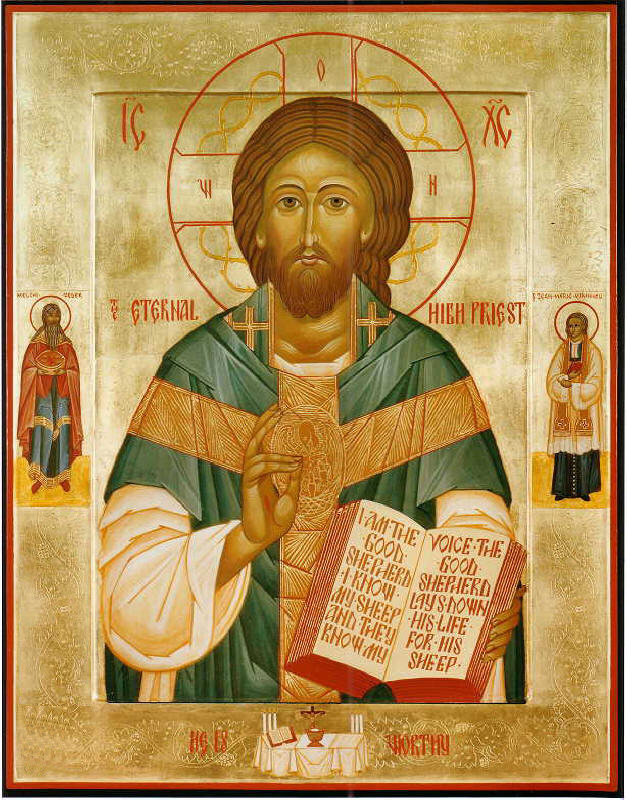
Jesus, High Priest
We thank you, God our Father, for those who have responded to your call to priestly ministry.
Accept this prayer we offer on their behalf: Fill your priests with the sure knowledge of your love.
Open their hearts to the power and consolation of the Holy Spirit.
Lead them to new depths of union with your Son.
Increase in them profound faith in the Sacraments they celebrate as they nourish, strengthen and heal us.
Lord Jesus Christ, grant that these, your priests, may inspire us to strive for holiness by the power of their example, as men of prayer who ponder your word and follow your will.
O Mary, Mother of Christ and our mother, guard with your maternal care these chosen ones, so dear to the Heart of your Son.
Intercede for our priests, that offering the Sacrifice of your Son, they may be conformed more each day to the image of your Son, our Lord and Savior, Jesus Christ. Amen.
Saint John Vianney, universal patron of priests, pray for us and our priests
This icon shows Jesus Christ, our eternal high priest.
The gold pelican over His heart represents self-sacrifice.
The border contains an altar and grapevines, representing the Mass, and icons of Melchizedek and St. Jean-Baptiste Vianney.
Melchizedek: king of righteousness (left icon) was priest and king of Jerusalem. He blessed Abraham and has been considered an ideal priest-king.
St. Jean-Baptiste Vianney is the patron saint of parish priests.
12
posted on
01/12/2016 8:22:43 PM PST
by
Salvation
("With God all things are possible." Matthew 19:26)
To: All
13
posted on
01/12/2016 8:23:42 PM PST
by
Salvation
("With God all things are possible." Matthew 19:26)
To: All
14
posted on
01/12/2016 8:24:09 PM PST
by
Salvation
("With God all things are possible." Matthew 19:26)
To: All
Pray a Rosary each day for our nation.
1. Sign of the Cross: In the name of the Father, and of the Son, and of the Holy Spirit. Amen.
2. The Apostles Creed: I BELIEVE in God, the Father almighty, Creator of heaven and earth, and in Jesus Christ, His only Son, our Lord, who was conceived by the Holy Spirit, born of the Virgin Mary, suffered under Pontius Pilate, was crucified, died, and was buried. He descended into hell; on the third day he rose again from the dead; he ascended into heaven, and is seated at the right hand of God, the Father Almighty; from there He shall come to judge the living and the dead.
I believe in the Holy Spirit, the holy catholic Church, the communion of saints, the forgiveness of sins, the resurrection of the body, and the life everlasting. Amen.
3. The Lord's Prayer: OUR Father, who art in heaven, hallowed be Thy name. Thy kingdom come. Thy will be done on earth as it is in heaven. Give us this day our daily bread and forgive us our trespasses as we forgive those who trespass against us. And lead us not into temptation, but deliver us from evil. Amen.
4. (3) Hail Mary: HAIL Mary, full of grace, the Lord is with thee. Blessed art thou amongst women and blessed is the fruit of thy womb, Jesus. Holy Mary, Mother of God, pray for us sinners, now, and in the hour of our death. Amen. (Three times)
5. Glory Be: GLORY be to the Father, and to the Son, and to the Holy Spirit. As it was in the beginning, is now, and ever shall be, world without end. Amen.
6. Fatima Prayer: Oh, my Jesus, forgive us our sins, save us from the fires of hell, lead all souls to heaven, especially those in most need of your mercy.
Announce each mystery, then say 1 Our Father, 10 Hail Marys, 1 Glory Be and 1 Fatima prayer. Repeat the process with each mystery.
End with the Hail Holy Queen:
Hail, Holy Queen, Mother of Mercy, our life, our sweetness and our hope! To thee do we cry, poor banished children of Eve! To thee do we send up our sighs, mourning and weeping in this vale of tears! Turn then, most gracious advocate, thine eyes of mercy towards us; and after this, our exile, show unto us the blessed fruit of thy womb, Jesus!
O clement, O loving, O sweet Virgin Mary! Pray for us, O holy Mother of God, that we may be made worthy of the promises of Christ.
Final step -- The Sign of the Cross
The Mysteries of the Rosary By tradition, Catholics meditate on these Mysteries during prayers of the Rosary. The biblical references follow each of the Mysteries below.
The Glorious Mysteries
(Wednesdays and Sundays)
1.The Resurrection (Matthew 28:1-8, Mark 16:1-18, Luke 24:1-12, John 20:1-29) [Spiritual fruit - Faith]
2. The Ascension (Mark 16:19-20, Luke 24:50-53, Acts 1:6-11) [Spiritual fruit - Christian Hope]
3. The Descent of the Holy Spirit (Acts 2:1-13) [Spiritual fruit - Gifts of the Holy Spirit]
4. The Assumption [Spiritual fruit - To Jesus through Mary]
5. The Coronation [Spiritual fruit - Grace of Final Perseverance]
15
posted on
01/12/2016 8:24:42 PM PST
by
Salvation
("With God all things are possible." Matthew 19:26)
To: All

St. Michael the Archangel
~ PRAYER ~
St. Michael, the Archangel, defend us in battle
Be our protection against the wickedness
and snares of the devil;
May God rebuke him, we humbly pray,
and do thou, O Prince of the heavenly host,
by the power of God,
Cast into hell Satan and all the evil spirits
who prowl through the world seeking the ruin of souls.
Amen
+
16
posted on
01/12/2016 8:25:12 PM PST
by
Salvation
("With God all things are possible." Matthew 19:26)
To: All
From an Obama bumper sticker on a car:
"Pray for Obama. Psalm 109:8"
PLEASE JOIN US - Evening Prayer
Someone has said that if people really understood the full extent of the power we have available through prayer, we might be speechless.
Did you know that during WWII there was an advisor to Churchill who organized a group of people who dropped what they were doing every day at a prescribed hour for one minute to collectively pray for the safety of England, its people and peace?
There is now a group of people organizing the same thing here in America. If you would like to participate: Every evening at 9:00 PM Eastern Time (8:00 PM Central) (7:00 PM Mountain) (6:00 PM Pacific), stop whatever you are doing and spend one minute praying for the safety of the United States, our troops, our citizens, and for a return to a Godly nation. If you know anyone else who would like to participate, please pass this along. Our prayers are the most powerful asset we have. Please forward this to your praying friends.
17
posted on
01/12/2016 8:26:05 PM PST
by
Salvation
("With God all things are possible." Matthew 19:26)
To: Salvation
Feast of
the Holy Name of Jesus

Luke 2:21 "...Et vocatum est Nomen eius IESUS"
("And His Name was called JESUS")
Psalm 90:14 "Because he hoped in me I will deliver him:
I will protect him because he hath known My Name."
Zacharias 10:12 "I will strengthen them in the Lord,
and they shall walk in His Name, saith the Lord."
Apocalypse 3:8 "I know thy works. Behold, I have given before thee a door opened, which no man can shut: because thou hast a little strength, and hast kept my word, and hast not denied My Name."
Apocalypse 15:4 "Who shall not fear Thee, O Lord, and magnify Thy Name?..."
Blessed be the most holy Name of Jesus without end!
January Devotion: The Holy Name of Jesus
The month of January is traditionally dedicated to the Holy Name of Jesus. This feast is also celebrated on January 3. Here is an explanation of the devotion.
Since the 16th century Catholic piety has associated entire months to special devotions. The devotion to the Holy Name of Jesus has been traditionally associated with the month of January, due to its celebration on January 3. The name Jesus was given to the Holy Child at God's command (Luke 1:31). The Holy Name is all-powerful because of the Person who bears it; we honor it because of the command of Christ, that we should pray in His Name and because it reminds us of all the blessings we receive through our Holy Redeemer. Hence St. Paul was able to write to the Philippians: ". . . at the name of Jesus every knee should bend of those in heaven, on earth, and under the earth" (Phil. 2:10). By means of this devotion we also make amends for improper use of the Holy Name.
Prayer Source: Prayer Book, The by Reverend John P. O'Connell, M.A., S.T.D. and Jex Martin, M.A., The Catholic Press, Inc., Chicago, Illinois, 1954
Prayer/Hymn in Honor of the Most Holy Name of Jesus - Iesu, Dulcis Memoria
Iesu, Dulcis Memoria is a celebrated 12th century hymn attributed to St. Bernard of Clairvaux (1090-1153), Doctor Mellifluus. The entire hymn has some 42 to 53 stanzas depending upon the manuscript. Parts of this hymn were used for the Feast of the Holy Name of Jesus, which was formerly celebrated on the Sunday between the Circumcision and Epiphany, or failing such a Sunday, on January 2. The part below was used at Vespers. In the liturgical revisions of Vatican II, the feast was deleted, though a votive Mass to the Holy Name of Jesus had been retained for devotional use. With the release of the revised Roman Missal in March 2002, the feast was restored as an optional memorial on January 3.
Jesus, the very thought of Thee
With sweetness fills the breast!
Yet sweeter far Thy face to see
And in Thy presence rest.
No voice can sing, no heart can frame,
Nor can the memory find,
A sweeter sound than Jesus' name,
The Savior of mankind.
O hope of every contrite heart!
0 joy of all the meek!
To those who fall, how kind Thou art!
How good to those who seek!
But what to those who find? Ah! this
Nor tongue nor pen can show
The love of Jesus, what it is,
None but His loved ones know.
Jesus! our only hope be Thou,
As Thou our prize shalt be;
In Thee be all our glory now,
And through eternity. Amen.
---Roman Breviary
Prayer Source: Prayer Book, The by Reverend John P. O'Connell, M.A., S.T.D. and Jex Martin, M.A., The Catholic Press, Inc., Chicago, Illinois, 1954
O Divine Jesus, Thou hast promised that anything we ask of the Eternal Father in Thy name shall be granted.
O Eternal Father. In the name of Jesus, for the love of Jesus, in fulfillment of this promise, and because Jesus has said it, grant us our petitions for the sake of Jesus, Thy Divine Son. Amen.
Prayer Source: Prayer Book, The by Reverend John P. O'Connell, M.A., S.T.D. and Jex Martin, M.A., The Catholic Press, Inc., Chicago, Illinois, 1954
That at the name of Jesus every knee should bend, of those that are in heaven, on earth, and under the earth, and every tongue confess that Jesus Christ is Lord, to the glory of God the Father.
Phil:2:10-11

The Most Holy Name
The Power of Jesus’ Name
What does IHS stand for? The meaning of the Holy Name of Jesus [Catholic Caucus]
Litany Of The Holy Name of Jesus
Feast of the Holy Name of Jesus
Jesus, The Name above all Names
Devotion to the Holy Name (of Jesus) [Catholic Caucus]
Lessons In Iconography : The Chi Rho - Christ
St. Francis de Sales on the Most Holy Name of Jesus (Excerpt from a Sermon) (Catholic Caucus)
St. Francis de Sales on the Most Holy Name of Jesus (Catholic/Orthodox Caucus)
St. Bernard on the Most Holy Name of Jesus [Ecumenical]
Saving the day in His Holy Name: St. Genevieve gets a reprieve [Catholic Caucus]
The Holy Name of Jesus
Holy Name of Jesus [San Bernadino of Siena] Ecumenical
The Holy Name of Jesus
Devotion to the Holy Name [of Jesus]
The Name of Jesus: Its Power in Our Lives
The Holy Name of Jesus
Devotion to the Holy Name of Jesus
The Holy Name of Jesus
Philippians 2
9 Therefore God has highly exalted him and bestowed on him the name which is above every name,
10 that at the name of Jesus every knee should bow, in heaven and on earth and under the earth,
11 and every tongue confess that Jesus Christ is Lord, to the glory of God the Father.
18
posted on
01/12/2016 8:28:53 PM PST
by
Salvation
("With God all things are possible." Matthew 19:26)
To: All
January 2016
Pope's Intentions
Universal: Interreligious Dialogue - That sincere dialogue among men and women of different faiths may produce the fruits of peace and justice.
Evangelization: Christian Unity- That by means of dialogue and fraternal charity and with the grace of the Holy Spirit, Christians may overcome divisions.
19
posted on
01/12/2016 8:35:28 PM PST
by
Salvation
("With God all things are possible." Matthew 19:26)
To: All
Daily Gospel Commentary
Wednesday of the First week in Ordinary Time
Commentary of the day Isaac the Syrian (7th century), monk near Mosul
Ascetical discourses"Rising very early before dawn, he left and went off to a deserted place"
Nothing renders the soul so pure and joyful, nor illumines and distances it from evil thoughts, so much as keeping vigil. For this reason our fathers all persevered in this work of keeping vigil and adopted the rule of remaining awake through the night throughout the course of their life of asceticism. In particular, they did this because they had heard our Savior call us to it urgently in various places through his living Word: "Be vigilant at all times and pray" (Lk 21,36); "Watch and pray that you may not undergo the test" (Mt 26,41); and again, "Pray without ceasing" (1Thes 5,17).
Nor was he satisfied with having warned us by his words. He also set us an example in his own person by favoring the practice of prayer above everything else. That is why he frequently went off alone to pray, and not arbitrarily but choosing night as his time and the desert as his place that we too, avoiding the crowds and the bustle, might become able to pray in solitude.
That is why our fathers received this high teaching concerning prayer as though it came from Christ himself. And they chose to watch in prayer following the command of the apostle Paul so that, above all, they might be able to remain close to God without interruption through continual prayer... Nothing external touches them nor moves the purity of their mind, which would trouble those vigils that fill them with joy and are the light of their souls.
20
posted on
01/12/2016 8:41:06 PM PST
by
Salvation
("With God all things are possible." Matthew 19:26)
Navigation: use the links below to view more comments.
first 1-20, 21-38 next last
Disclaimer:
Opinions posted on Free Republic are those of the individual
posters and do not necessarily represent the opinion of Free Republic or its
management. All materials posted herein are protected by copyright law and the
exemption for fair use of copyrighted works.
FreeRepublic.com is powered by software copyright 2000-2008 John Robinson