Skip to comments.
Catholic Caucus: Daily Mass Readings, 01-11-16
USCCB.org/RNAB ^
| 01-11-16
| Revised New American Bible
Posted on 01/10/2016 9:23:20 PM PST by Salvation
January 11, 2016
Monday of the First Week in Ordinary Time
There was a certain man from Ramathaim, Elkanah by name,
a Zuphite from the hill country of Ephraim.
He was the son of Jeroham, son of Elihu,
son of Tohu, son of Zuph, an Ephraimite.
He had two wives, one named Hannah, the other Peninnah;
Peninnah had children, but Hannah was childless.
This man regularly went on pilgrimage from his city
to worship the LORD of hosts and to sacrifice to him at Shiloh,
where the two sons of Eli, Hophni and Phinehas,
were ministering as priests of the LORD.
When the day came for Elkanah to offer sacrifice,
he used to give a portion each to his wife Peninnah
and to all her sons and daughters,
but a double portion to Hannah because he loved her,
though the LORD had made her barren.
Her rival, to upset her, turned it into a constant reproach to her
that the LORD had left her barren.
This went on year after year;
each time they made their pilgrimage to the sanctuary of the LORD,
Peninnah would approach her,
and Hannah would weep and refuse to eat.
Her husband Elkanah used to ask her:
"Hannah, why do you weep, and why do you refuse to eat?
Why do you grieve?
Am I not more to you than ten sons?"
R. (17a)
To you, Lord, I will offer a sacrifice of praise.or:
R.
Alleluia.How shall I make a return to the LORD
for all the good he has done for me?
The cup of salvation I will take up,
and I will call upon the name of the LORD.
R.
To you, Lord, I will offer a sacrifice of praise.or:
R.
Alleluia.My vows to the LORD I will pay
in the presence of all his people.
Precious in the eyes of the LORD
is the death of his faithful ones.
O LORD, I am your servant;
I am your servant, the son of your handmaid;
you have loosed my bonds.
R.
To you, Lord, I will offer a sacrifice of praise.or:
R.
Alleluia.My vows to the LORD I will pay
in the presence of all his people,
In the courts of the house of the LORD,
in your midst, O Jerusalem.
R.
To you, Lord, I will offer a sacrifice of praise.or:
R.
Alleluia.
R.
Alleluia, alleluia.The Kingdom of God is at hand;
repent and believe in the Gospel.
R.
Alleluia, alleluia.
After John had been arrested,
Jesus came to Galilee proclaiming the Gospel of God:
"This is the time of fulfillment.
The Kingdom of God is at hand.
Repent, and believe in the Gospel."
As he passed by the Sea of Galilee,
he saw Simon and his brother Andrew casting their nets into the sea;
they were fishermen.
Jesus said to them,
"Come after me, and I will make you fishers of men."
Then they left their nets and followed him.
He walked along a little farther
and saw James, the son of Zebedee, and his brother John.
They too were in a boat mending their nets.
Then he called them.
So they left their father Zebedee in the boat
along with the hired men and followed him.
TOPICS: Catholic; General Discusssion; Prayer; Worship
KEYWORDS: catholic; mk1; ordinarytime; prayer
Navigation: use the links below to view more comments.
first 1-20, 21-36 next last
For your reading, reflection, faith-sharing, comments, questions, discussion.
1
posted on
01/10/2016 9:23:20 PM PST
by
Salvation
To: nickcarraway; NYer; ELS; Pyro7480; livius; ArrogantBustard; Catholicguy; RobbyS; marshmallow; ...
Alleluia PingPlease FReepmail me to get on/off the Alleluia Ping List.
2
posted on
01/10/2016 9:24:25 PM PST
by
Salvation
("With God all things are possible." Matthew 19:26)
To: All
From: 1 Samuel 1:1-8
Birth of Samuel
[1] There was a certain man of Ramathaim-zophim of the hill country of Ephraim,
whose name was Elkanah the son of Jeroham, son of Elihu, son of Tohu, son of
Zuph, an Ephraimite. [2] He had two wives; the name of the one was Hannah,
and the name of the other Peninnah. And Peninnah had children, but Hannah
had no children.
[3] Now this man used to go up year by year from his city to worship and to sac-
rifice to the LORD of hosts at Shiloh, where the two sons of Eli, Hophni and Phi-
nehas, were priests of the LORD. [4] EIkanah sacrificed, he would give portions
to Peninnah his wife and to all her sons and daughters; [5] and, although he
loved Hannah, he would give Hannah only one portion, because the LORD had
closed her womb. [6] And her rival used to provoke her sorely, to irritate her, be-
cause the LORD had closed her womb. [7] So it went on year by year; as often
as she went up to the house of the LORD, she used to provoke her. Therefore
Hannah wept and would not eat. [8] And Elkanah, her husband, said to her,
“Hannah, why do you weep? And why do you not eat? And why is your heart
sad? Am I not more to you than ten sons?”
*********************************************************************************************
Commentary:
1:1-7:17. The books of Samuel begin with an account of the birth of the man
from whom they take their name, that is, Samuel, who will become a judge of
Israel and a prophet. The beginning is like the book of Exodus, which also be-
gins with a birth — that of Moses. In fact, many of Moses’ features apply to Sa-
muel: just as Moses inaugurated a new and very important stage in the history
of the people, so Samuel marks the start of the monarchical period, which will
forever leave its imprint on the religious profile of Israel.
The story of Samuel comprises only the first part of 1 Samuel, the first seven
chapters, which also contain the history of the ark. The narrative includes three
distinct accounts arranged in such a way that the first and last have the same
protagonist — the birth, calling and activity of Samuel as a prophet (chaps. 1-3),
the history of the ark (chaps. 4-6), and then Samuel’s activity as a judge (chap.
7). Although these narratives may have been independent originally, in the final
biblical text they form a perfect unity in doctrinal terms, from the point of view of
the setting of events (the shrine at Shiloh), and in the identity of their protago-
nists, Samuel and the priests, the sons of Eli. The shrine at Shiloh, which was
located between Bethel and Shechem and which was a main center of worship
in the era of the judges (Judg 21:19-21), acquires special importance at this
point: Shiloh will be where the monarchical power begins, and its splendor will
transfer to the temple of Jerusalem when the ark moves there.
The sons of Eli were the last priests of Shiloh. Whereas Samuel was perfectly
faithful to the will of God, the sons of Eli had gradually corrupted the practices
of their priestly function; with their death, the temple at Shiloh ceases to have
any importance.
The doctrinal thread moving through the three episodes is God’s active interven-
tion in all these important events in the life of the people: to him is due the pro-
digy of Samuel’s birth (1:1-20)—Samuel, the man chosen to open the way to the
monarchy; it is God who exposes the sin of the sons of Eli (chap. 2) and ini-
tiates the charming dialogue in which Samuel receives his calling (chap. 3). In
the episode of the ark, it is the Lord who punishes his people by taking away
the ark, the sign of his presence (chap. 4); it is he who visits countless misfor-
tunes on the Philistines who have taken possession of the ark (chap. 5) and it
is he who forces them to return it to Israel, which receives it with delight (chap.
6). Finally, the Lord makes Samuel a judge over his people (chap. 5), able to
exercise his function at all the shrines of Israel—in Bethel, Gilgal and Mizpah
(7:15).
From the very start, the book of Samuel is a sort of religious interpretation of his-
tory, in the sense that it puts more emphasis on the meaning of the events it nar-
rates than on their chronological order or their geographical situation. Samuel is
a figure of Christ who will initiate the final stage of salvation through his complete
obedience to the will of God (cf. Phil 2:8).
1:1-28. Samuel’s birth is described with all the elements denoting a miraculous
event, emphasizing divine intervention and the child’s importance. With no hope
of a human solution, a childless woman, humiliated by her husband’s (other) fer-
tile wife, seeks a way out of her anguish by asking God, her only hope, to give
her a son. Her husband loves her, but he cannot understand her (v. 8).
*********************************************************************************************
Source: “The Navarre Bible: Text and Commentaries”. Biblical text from the
Revised Standard Version and New Vulgate. Commentaries by members of
the Faculty of Theology, University of Navarre, Spain.
Published by Four Courts Press, Kill Lane, Blackrock, Co. Dublin, Ireland, and
by Scepter Publishers in the United States.
3
posted on
01/10/2016 9:26:40 PM PST
by
Salvation
("With God all things are possible." Matthew 19:26)
To: All
From: Mark 1:14-20
Jesus Begins to Preach and Calls His First Disciples
[14] Now after John was arrested, Jesus came into Galilee, preaching the gospel
of God, and saying, “The time is fulfilled, and the kingdom of God is at hand; re-
pent, and believe in the Gospel.”
[16] And passing along by the Sea of Galilee, he saw Simon and Andrew the bro-
ther of Simon casting a net in the sea; for they were fishermen. [17] And Jesus
said to them, “Follow me and I will make you become fishers of men.” [18] And
immediately they left their nets and followed him. [19] And going on a little farther,
he saw James the son of Zebedee and John his brother, who were in their boat
mending the nets. [20] And immediately he called them; and they left their father
Zebedee in the boat with the hired servants, and followed him.
*********************************************************************************************
Commentary:
14-15. “The gospel of God”: this expression is found in St Paul (Rom 1:1; 2 Cor
11:7; etc.) where it means the same as “the gospel of Jesus Christ” (2 Thess
1:8; etc.), thereby implying the divinity of Jesus Christ. The imminence of the
Kingdom requires a genuine conversion of man to God (Mt 4:17; Mk 6: 12; etc.).
The prophets had already spoken of the need for conversion and for Israel to aban-
don its evil ways (Jer 3:22; Is 30:15; Hos 14:2; etc.).
Both John the Baptist and Jesus and his Apostles insist on the need for conver-
sion, the need to change one’s attitude and conduct as a prerequisite for recei-
ving the Kingdom of God. Bl. John Paul II underlines the importance of conversion
for entry into the Kingdom of God: “Therefore, the Church professes and proclaims
conversion. Conversion to God always consists in discovering his mercy, that is,
in discovering that love which is patient and kind (cf. 1 Cor 13:4) as only the Crea-
tor and Father can be; the love to which the ‘God and Father of our Lord Jesus
Christ’ (2 Cor 1:3) is faithful to the uttermost consequences in the history of his
covenant with man: even to the Cross and to the death and resurrection of the
Son. Conversion to God is always the fruit of the ‘rediscovery’ of this Father, who
is rich in mercy.
“Authentic knowledge of the God of mercy, the God of tender love, is a constant
and inexhaustible source of conversion, not only as a momentary interior act but
also as a permanent attitude, as a state of mind. Those who come to know God
in this way, who ‘see’ him in this way, can live only in a state of being continually
converted to him. They live, therefore, “in statu conversionis” and it is this state
of conversion which marks out the most profound element of the pilgrimage of
every man and woman on earth “in statu viatoris” (Bl. John Paul II, “Dives In Mi-
sericordia”, 13).
16-20. In these verses the evangelist describes how Jesus called some of those
who would later form part of the Apostolic College (3:16ff). From the start of his
public ministry in Galilee the Messiah seeks co-workers to help him in his mis-
sion as Savior and Redeemer. He looks for them among people used to hard
work, people for whom life is a struggle and whose life-style is plain. In human
terms they are obviously at a disadvantage vis-a-vis many of those to whom they
will preach; but this in no way prevents their self-surrender from being generous
and free. The light lit in their hearts was enough to lead them to give up every-
thing. A simple invitation to follow the Master was enough for them to put them-
selves completely at his disposal.
It is Jesus who chooses them: he interfered in the lives of the Apostles just as
he interferes in ours, without seeking our permission: he is our Lord. Cf. note on
Mt 4:18-22.
*********************************************************************************************
Source: “The Navarre Bible: Text and Commentaries”. Biblical text from the
Revised Standard Version and New Vulgate. Commentaries by members of
the Faculty of Theology, University of Navarre, Spain.
Published by Four Courts Press, Kill Lane, Blackrock, Co. Dublin, Ireland, and
by Scepter Publishers in the United States.
4
posted on
01/10/2016 9:28:25 PM PST
by
Salvation
("With God all things are possible." Matthew 19:26)
To: All
Scripture readings from the Jerusalem Bible are published and copyright © 1966, 1967 and 1968 by Darton, Longman &Todd
Readings at Mass
Liturgical Colour: Green.
| First reading |
1 Samuel 1:1-8 © |
There was a man of Ramathaim, a Zuphite from the highlands of Ephraim whose name was Elkanah son of Jeroham, son of Elihu, son of Tohu, son of Zuph, an Ephraimite. He had two wives, one called Hannah, the other Peninnah; Peninnah had children but Hannah had none. Every year this man used to go up from his town to worship and to sacrifice to the Lord of Hosts in Shiloh. The two sons of Eli, Hophni and Phinehas, were there as priests of the Lord.
One day Elkanah offered sacrifice. He used to give portions to Penirinah and to all her sons and daughters; to Hannah, however, he would give only one portion, although he loved her more, since the Lord had made her barren. Her rival would taunt her to annoy her, because the Lord had made her barren. And this went on year after year; every time they went up to the temple of the Lord she used to taunt her. And so Hannah wept and would not eat. Then Elkanah her husband said to her, ‘Hannah, why are you crying and why are you not eating? Why so sad? Am I not more to you than ten sons?’
A thanksgiving sacrifice I make to you, O Lord.
or
Alleluia!
How can I repay the Lord
for his goodness to me?
The cup of salvation I will raise;
I will call on the Lord’s name.
A thanksgiving sacrifice I make to you, O Lord.
or
Alleluia!
My vows to the Lord I will fulfil
before all his people.
O precious in the eyes of the Lord
is the death of his faithful.
A thanksgiving sacrifice I make to you, O Lord.
or
Alleluia!
Your servant, Lord, your servant am I;
you have loosened my bonds.
A thanksgiving sacrifice I make;
I will call on the Lord’s name.
A thanksgiving sacrifice I make to you, O Lord.
or
Alleluia!
My vows to the Lord I will fulfil
before all his people,
in the courts of the house of the Lord,
in your midst, O Jerusalem.
A thanksgiving sacrifice I make to you, O Lord.
or
Alleluia!
| Gospel Acclamation |
cf.Ac16:14 |
Alleluia, alleluia!
Open our heart, O Lord,
to accept the words of your Son.
Alleluia!
Alleluia, alleluia!
The kingdom of God is close at hand:
repent and believe the Good News.
Alleluia!
After John had been arrested, Jesus went into Galilee. There he proclaimed the Good News from God. ‘The time has come’ he said ‘and the kingdom of God is close at hand. Repent, and believe the Good News.’
As he was walking along by the Sea of Galilee he saw Simon and his brother Andrew casting a net in the lake – for they were fishermen. And Jesus said to them, ‘Follow me and I will make you into fishers of men.’ And at once they left their nets and followed him.
Going on a little further, he saw James son of Zebedee and his brother John; they too were in their boat, mending their nets. He called them at once and, leaving their father Zebedee in the boat with the men he employed, they went after him.
5
posted on
01/10/2016 9:30:52 PM PST
by
Salvation
("With God all things are possible." Matthew 19:26)
To: All
6
posted on
01/10/2016 9:32:01 PM PST
by
Salvation
("With God all things are possible." Matthew 19:26)
To: All
7
posted on
01/10/2016 9:32:15 PM PST
by
Salvation
("With God all things are possible." Matthew 19:26)
To: All
8
posted on
01/10/2016 9:32:42 PM PST
by
Salvation
("With God all things are possible." Matthew 19:26)
To: All
9
posted on
01/10/2016 9:33:12 PM PST
by
Salvation
("With God all things are possible." Matthew 19:26)
To: All
10
posted on
01/10/2016 9:34:21 PM PST
by
Salvation
("With God all things are possible." Matthew 19:26)
To: All
11
posted on
01/10/2016 9:34:58 PM PST
by
Salvation
("With God all things are possible." Matthew 19:26)
To: All
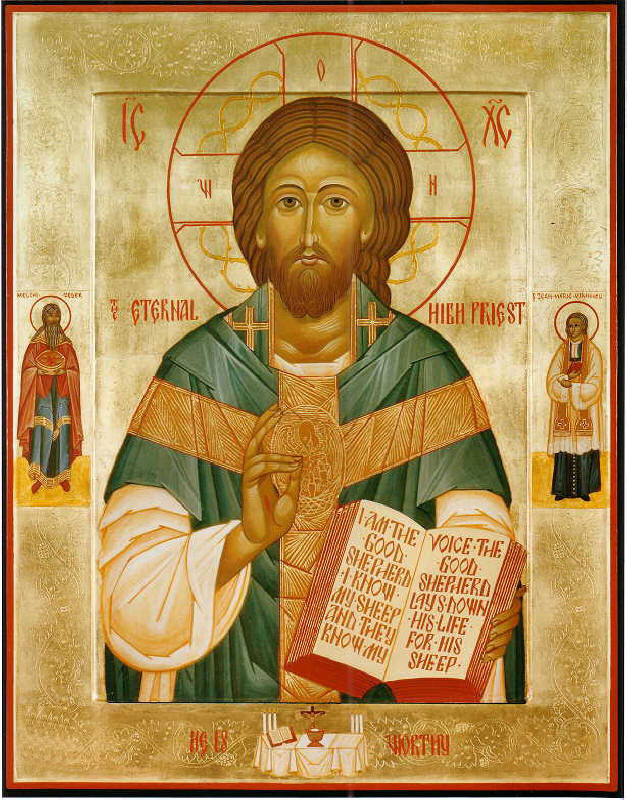
Jesus, High Priest
We thank you, God our Father, for those who have responded to your call to priestly ministry.
Accept this prayer we offer on their behalf: Fill your priests with the sure knowledge of your love.
Open their hearts to the power and consolation of the Holy Spirit.
Lead them to new depths of union with your Son.
Increase in them profound faith in the Sacraments they celebrate as they nourish, strengthen and heal us.
Lord Jesus Christ, grant that these, your priests, may inspire us to strive for holiness by the power of their example, as men of prayer who ponder your word and follow your will.
O Mary, Mother of Christ and our mother, guard with your maternal care these chosen ones, so dear to the Heart of your Son.
Intercede for our priests, that offering the Sacrifice of your Son, they may be conformed more each day to the image of your Son, our Lord and Savior, Jesus Christ. Amen.
Saint John Vianney, universal patron of priests, pray for us and our priests
This icon shows Jesus Christ, our eternal high priest.
The gold pelican over His heart represents self-sacrifice.
The border contains an altar and grapevines, representing the Mass, and icons of Melchizedek and St. Jean-Baptiste Vianney.
Melchizedek: king of righteousness (left icon) was priest and king of Jerusalem. He blessed Abraham and has been considered an ideal priest-king.
St. Jean-Baptiste Vianney is the patron saint of parish priests.
12
posted on
01/10/2016 9:36:02 PM PST
by
Salvation
("With God all things are possible." Matthew 19:26)
To: All
13
posted on
01/10/2016 9:36:30 PM PST
by
Salvation
("With God all things are possible." Matthew 19:26)
To: All
14
posted on
01/10/2016 9:37:00 PM PST
by
Salvation
("With God all things are possible." Matthew 19:26)
To: All
Pray a Rosary each day for our nation.
1. Sign of the Cross: In the name of the Father, and of the Son, and of the Holy Spirit. Amen.
2. The Apostles Creed: I BELIEVE in God, the Father almighty, Creator of heaven and earth, and in Jesus Christ, His only Son, our Lord, who was conceived by the Holy Spirit, born of the Virgin Mary, suffered under Pontius Pilate, was crucified, died, and was buried. He descended into hell; on the third day he rose again from the dead; he ascended into heaven, and is seated at the right hand of God, the Father Almighty; from there He shall come to judge the living and the dead.
I believe in the Holy Spirit, the holy catholic Church, the communion of saints, the forgiveness of sins, the resurrection of the body, and the life everlasting. Amen.
3. The Lord's Prayer: OUR Father, who art in heaven, hallowed be Thy name. Thy kingdom come. Thy will be done on earth as it is in heaven. Give us this day our daily bread and forgive us our trespasses as we forgive those who trespass against us. And lead us not into temptation, but deliver us from evil. Amen.
4. (3) Hail Mary: HAIL Mary, full of grace, the Lord is with thee. Blessed art thou amongst women and blessed is the fruit of thy womb, Jesus. Holy Mary, Mother of God, pray for us sinners, now, and in the hour of our death. Amen. (Three times)
5. Glory Be: GLORY be to the Father, and to the Son, and to the Holy Spirit. As it was in the beginning, is now, and ever shall be, world without end. Amen.
6. Fatima Prayer: Oh, my Jesus, forgive us our sins, save us from the fires of hell, lead all souls to heaven, especially those in most need of your mercy.
Announce each mystery, then say 1 Our Father, 10 Hail Marys, 1 Glory Be and 1 Fatima prayer. Repeat the process with each mystery.
End with the Hail Holy Queen:
Hail, Holy Queen, Mother of Mercy, our life, our sweetness and our hope! To thee do we cry, poor banished children of Eve! To thee do we send up our sighs, mourning and weeping in this vale of tears! Turn then, most gracious advocate, thine eyes of mercy towards us; and after this, our exile, show unto us the blessed fruit of thy womb, Jesus!
O clement, O loving, O sweet Virgin Mary! Pray for us, O holy Mother of God, that we may be made worthy of the promises of Christ.
Final step -- The Sign of the Cross
The Mysteries of the Rosary By tradition, Catholics meditate on these Mysteries during prayers of the Rosary. The biblical references follow each of the Mysteries below.
The Joyful Mysteries
(Mondays and Saturdays)
1. The Annunciation (Luke 1:26-38) [Spiritual fruit - Humility] 2. The Visitation (Luke 1: 39-56) [Spiritual fruit - Love of Neighbor]
3. The Nativity (Luke 2:1-20) [Spiritual fruit - Poverty of Spirit]
4. The Presentation (Luke 2:21-38) [Spiritual fruit - Purity of mind & body]
5. The Finding of Jesus in the Temple (Luke 2:41-52) [Spiritual fruit - Obedience ]
15
posted on
01/10/2016 9:37:42 PM PST
by
Salvation
("With God all things are possible." Matthew 19:26)
To: All

St. Michael the Archangel
~ PRAYER ~
St. Michael, the Archangel, defend us in battle
Be our protection against the wickedness
and snares of the devil;
May God rebuke him, we humbly pray,
and do thou, O Prince of the heavenly host,
by the power of God,
Cast into hell Satan and all the evil spirits
who prowl through the world seeking the ruin of souls.
Amen
+
16
posted on
01/10/2016 9:38:18 PM PST
by
Salvation
("With God all things are possible." Matthew 19:26)
To: All
From an Obama bumper sticker on a car:
"Pray for Obama. Psalm 109:8"
PLEASE JOIN US - Evening Prayer
Someone has said that if people really understood the full extent of the power we have available through prayer, we might be speechless.
Did you know that during WWII there was an advisor to Churchill who organized a group of people who dropped what they were doing every day at a prescribed hour for one minute to collectively pray for the safety of England, its people and peace?
There is now a group of people organizing the same thing here in America. If you would like to participate: Every evening at 9:00 PM Eastern Time (8:00 PM Central) (7:00 PM Mountain) (6:00 PM Pacific), stop whatever you are doing and spend one minute praying for the safety of the United States, our troops, our citizens, and for a return to a Godly nation. If you know anyone else who would like to participate, please pass this along. Our prayers are the most powerful asset we have. Please forward this to your praying friends.
17
posted on
01/10/2016 9:38:41 PM PST
by
Salvation
("With God all things are possible." Matthew 19:26)
To: Salvation
Feast of
the Holy Name of Jesus

Luke 2:21 "...Et vocatum est Nomen eius IESUS"
("And His Name was called JESUS")
Psalm 90:14 "Because he hoped in me I will deliver him:
I will protect him because he hath known My Name."
Zacharias 10:12 "I will strengthen them in the Lord,
and they shall walk in His Name, saith the Lord."
Apocalypse 3:8 "I know thy works. Behold, I have given before thee a door opened, which no man can shut: because thou hast a little strength, and hast kept my word, and hast not denied My Name."
Apocalypse 15:4 "Who shall not fear Thee, O Lord, and magnify Thy Name?..."
Blessed be the most holy Name of Jesus without end!
January Devotion: The Holy Name of Jesus
The month of January is traditionally dedicated to the Holy Name of Jesus. This feast is also celebrated on January 3. Here is an explanation of the devotion.
Since the 16th century Catholic piety has associated entire months to special devotions. The devotion to the Holy Name of Jesus has been traditionally associated with the month of January, due to its celebration on January 3. The name Jesus was given to the Holy Child at God's command (Luke 1:31). The Holy Name is all-powerful because of the Person who bears it; we honor it because of the command of Christ, that we should pray in His Name and because it reminds us of all the blessings we receive through our Holy Redeemer. Hence St. Paul was able to write to the Philippians: ". . . at the name of Jesus every knee should bend of those in heaven, on earth, and under the earth" (Phil. 2:10). By means of this devotion we also make amends for improper use of the Holy Name.
Prayer Source: Prayer Book, The by Reverend John P. O'Connell, M.A., S.T.D. and Jex Martin, M.A., The Catholic Press, Inc., Chicago, Illinois, 1954
Prayer/Hymn in Honor of the Most Holy Name of Jesus - Iesu, Dulcis Memoria
Iesu, Dulcis Memoria is a celebrated 12th century hymn attributed to St. Bernard of Clairvaux (1090-1153), Doctor Mellifluus. The entire hymn has some 42 to 53 stanzas depending upon the manuscript. Parts of this hymn were used for the Feast of the Holy Name of Jesus, which was formerly celebrated on the Sunday between the Circumcision and Epiphany, or failing such a Sunday, on January 2. The part below was used at Vespers. In the liturgical revisions of Vatican II, the feast was deleted, though a votive Mass to the Holy Name of Jesus had been retained for devotional use. With the release of the revised Roman Missal in March 2002, the feast was restored as an optional memorial on January 3.
Jesus, the very thought of Thee
With sweetness fills the breast!
Yet sweeter far Thy face to see
And in Thy presence rest.
No voice can sing, no heart can frame,
Nor can the memory find,
A sweeter sound than Jesus' name,
The Savior of mankind.
O hope of every contrite heart!
0 joy of all the meek!
To those who fall, how kind Thou art!
How good to those who seek!
But what to those who find? Ah! this
Nor tongue nor pen can show
The love of Jesus, what it is,
None but His loved ones know.
Jesus! our only hope be Thou,
As Thou our prize shalt be;
In Thee be all our glory now,
And through eternity. Amen.
---Roman Breviary
Prayer Source: Prayer Book, The by Reverend John P. O'Connell, M.A., S.T.D. and Jex Martin, M.A., The Catholic Press, Inc., Chicago, Illinois, 1954
O Divine Jesus, Thou hast promised that anything we ask of the Eternal Father in Thy name shall be granted.
O Eternal Father. In the name of Jesus, for the love of Jesus, in fulfillment of this promise, and because Jesus has said it, grant us our petitions for the sake of Jesus, Thy Divine Son. Amen.
Prayer Source: Prayer Book, The by Reverend John P. O'Connell, M.A., S.T.D. and Jex Martin, M.A., The Catholic Press, Inc., Chicago, Illinois, 1954
That at the name of Jesus every knee should bend, of those that are in heaven, on earth, and under the earth, and every tongue confess that Jesus Christ is Lord, to the glory of God the Father.
Phil:2:10-11

The Most Holy Name
The Power of Jesus’ Name
What does IHS stand for? The meaning of the Holy Name of Jesus [Catholic Caucus]
Litany Of The Holy Name of Jesus
Feast of the Holy Name of Jesus
Jesus, The Name above all Names
Devotion to the Holy Name (of Jesus) [Catholic Caucus]
Lessons In Iconography : The Chi Rho - Christ
St. Francis de Sales on the Most Holy Name of Jesus (Excerpt from a Sermon) (Catholic Caucus)
St. Francis de Sales on the Most Holy Name of Jesus (Catholic/Orthodox Caucus)
St. Bernard on the Most Holy Name of Jesus [Ecumenical]
Saving the day in His Holy Name: St. Genevieve gets a reprieve [Catholic Caucus]
The Holy Name of Jesus
Holy Name of Jesus [San Bernadino of Siena] Ecumenical
The Holy Name of Jesus
Devotion to the Holy Name [of Jesus]
The Name of Jesus: Its Power in Our Lives
The Holy Name of Jesus
Devotion to the Holy Name of Jesus
The Holy Name of Jesus
Philippians 2
9 Therefore God has highly exalted him and bestowed on him the name which is above every name,
10 that at the name of Jesus every knee should bow, in heaven and on earth and under the earth,
11 and every tongue confess that Jesus Christ is Lord, to the glory of God the Father.
18
posted on
01/10/2016 9:40:18 PM PST
by
Salvation
("With God all things are possible." Matthew 19:26)
To: Salvation
January 2016
Pope's Intentions
Universal: Interreligious Dialogue - That sincere dialogue among men and women of different faiths may produce the fruits of peace and justice.
Evangelization: Christian Unity- That by means of dialogue and fraternal charity and with the grace of the Holy Spirit, Christians may overcome divisions.
19
posted on
01/10/2016 9:58:01 PM PST
by
Salvation
("With God all things are possible." Matthew 19:26)
To: Salvation
Daily Gospel Commentary
Monday of the First week in Ordinary Time
Commentary of the day Vatican Council II
Dogmatic Constitution on the Church in the Modern World "Gaudium et Spes", §41,45"This is the time of fulfillment. The kingdom of God is at hand"
Modern man is on the road to a more thorough development of his own personality, and to a growing discovery and vindication of his own rights. Since it has been entrusted to the Church to reveal the mystery of God, Who is the ultimate goal of man, she opens up to man at the same time the meaning of his own existence, that is, the innermost truth about himself.
The Church truly knows that only God, Whom she serves, meets the deepest longings of the human heart, which is never fully satisfied by what this world has to offer. She also knows that man is constantly worked upon by God's spirit, and hence can never be altogether indifferent to the problems of religion. The experience of past ages proves this, as do numerous indications in our own times.
For man will always yearn to know, at least in an obscure way, what is the meaning of his life, of his activity, of his death. The very presence of the Church recalls these problems to his mind. But only God, Who created man to His own image and ransomed him from sin, provides the most adequate answer to the questions, and this Ho does through what He has revealed in Christ His Son, Who became man. Whoever follows after Christ, the perfect man, becomes himself more of a man...
For God's Word, by whom all things were made, was Himself made flesh so that as perfect man He might save all men and sum up all things in Himself. The Lord is the goal of human history, the focal point of the longings of history and of civilization, the center of the human race, the joy of every heart and the answer to all its yearnings.
20
posted on
01/10/2016 10:01:55 PM PST
by
Salvation
("With God all things are possible." Matthew 19:26)
Navigation: use the links below to view more comments.
first 1-20, 21-36 next last
Disclaimer:
Opinions posted on Free Republic are those of the individual
posters and do not necessarily represent the opinion of Free Republic or its
management. All materials posted herein are protected by copyright law and the
exemption for fair use of copyrighted works.
FreeRepublic.com is powered by software copyright 2000-2008 John Robinson