Skip to comments.
Catholic Caucus: Sunday Mass Readings, 08-23-15, Twenty-first Sunday in Ordinary Time
USCCB.org/RNAB ^
| 08-23-15
| Revised New American Bible
Posted on 08/22/2015 7:47:44 PM PDT by Salvation
August 23, 2015
Twenty-first Sunday in Ordinary Time
Joshua gathered together all the tribes of Israel at Shechem,
summoning their elders, their leaders,
their judges, and their officers.
When they stood in ranks before God,
Joshua addressed all the people:
“If it does not please you to serve the LORD,
decide today whom you will serve,
the gods your fathers served beyond the River
or the gods of the Amorites in whose country you are now dwelling.
As for me and my household, we will serve the LORD.”
But the people answered,
“Far be it from us to forsake the LORD
for the service of other gods.
For it was the LORD, our God,
who brought us and our fathers up out of the land of Egypt,
out of a state of slavery.
He performed those great miracles before our very eyes
and protected us along our entire journey
and among the peoples through whom we passed.
Therefore we also will serve the LORD, for he is our God.”
R. (9a) Taste and see the goodness of the Lord.
I will bless the LORD at all times;
his praise shall be ever in my mouth.
Let my soul glory in the LORD;
the lowly will hear me and be glad.
R. Taste and see the goodness of the Lord.
The LORD has eyes for the just,
and ears for their cry.
The LORD confronts the evildoers,
to destroy remembrance of them from the earth.
R. Taste and see the goodness of the Lord.
When the just cry out, the LORD hears them,
and from all their distress he rescues them.
The LORD is close to the brokenhearted;
and those who are crushed in spirit he saves.
R. Taste and see the goodness of the Lord.
Many are the troubles of the just one,
but out of them all the LORD delivers him;
he watches over all his bones;
not one of them shall be broken.
R. Taste and see the goodness of the Lord.
Brothers and sisters:
Be subordinate to one another out of reverence for Christ.
Wives should be subordinate to their husbands as to the Lord.
For the husband is head of his wife
just as Christ is head of the church,
he himself the savior of the body.
As the church is subordinate to Christ,
so wives should be subordinate to their husbands in everything.
Husbands, love your wives,
even as Christ loved the church
and handed himself over for her to sanctify her,
cleansing her by the bath of water with the word,
that he might present to himself the church in splendor,
without spot or wrinkle or any such thing,
that she might be holy and without blemish.
So also husbands should love their wives as their own bodies.
He who loves his wife loves himself.
For no one hates his own flesh
but rather nourishes and cherishes it,
even as Christ does the church,
because we are members of his body.
For this reason a man shall leave his father and his mother
and be joined to his wife,
and the two shall become one flesh.
This is a great mystery,
but I speak in reference to Christ and the church.
Brothers and sisters:
Live in love, as Christ loved us.
Husbands, love your wives,
even as Christ loved the church
and handed himself over for her to sanctify her,
cleansing her by the bath of water with the word,
that he might present to himself the church in splendor,
without spot or wrinkle or any such thing,
that she might be holy and without blemish.
So also husbands should love their wives as their own bodies.
He who loves his wife loves himself.
For no one hates his own flesh
but rather nourishes and cherishes it,
even as Christ does the church,
because we are members of his body.
For this reason a man shall leave his father and his mother
and be joined to his wife,
and the two shall become one flesh.
This is a great mystery,
but I speak in reference to Christ and the church.
R.
Alleluia, alleluia.Your words, Lord, are Spirit and life;
you have the words of everlasting life.
R.
Alleluia, alleluia.
Many of Jesus’disciples who were listening said,
“This saying is hard; who can accept it?”
Since Jesus knew that his disciples were murmuring about this,
he said to them, “Does this shock you?
What if you were to see the Son of Man ascending
to where he was before?
It is the spirit that gives life,
while the flesh is of no avail.
The words I have spoken to you are Spirit and life.
But there are some of you who do not believe.”
Jesus knew from the beginning the ones who would not believe
and the one who would betray him.
And he said,
“For this reason I have told you that no one can come to me
unless it is granted him by my Father.”
As a result of this,
many of his disciples returned to their former way of life
and no longer accompanied him.
Jesus then said to the Twelve, “Do you also want to leave?”
Simon Peter answered him, “Master, to whom shall we go?
You have the words of eternal life.
We have come to believe
and are convinced that you are the Holy One of God.”
TOPICS: Catholic; General Discusssion; Prayer; Worship
KEYWORDS: 21stsunday; 21stsundayoftheyear; catholic; jn6; msgrcharlespope; ordinarytime; prayer; twentyfirstsunday
Navigation: use the links below to view more comments.
first 1-20, 21-40, 41-49 next last
For your reading, reflection, faith-sharing, comments, questions, discussion.
1
posted on
08/22/2015 7:47:44 PM PDT
by
Salvation
To: nickcarraway; NYer; ELS; Pyro7480; livius; ArrogantBustard; Catholicguy; RobbyS; marshmallow; ...
Alleluia PingPlease FReepmail me to get on/off the Alleluia Ping List.
2
posted on
08/22/2015 7:48:36 PM PDT
by
Salvation
("With God all things are possible." Matthew 19:26)
To: All
From: Joshua 24:1-2a, 15-17, 18b
Joshua and the renewal of the Covenant
[1] Then Joshua gathered all the tribes of Israel at Shechem, and summoned
the elders, the heads, the judges and the officers of Israel; and they presented
themselves before God. [2a] Joshua said to all the people,
[15] If it you be unwilling to serve the LORD, this day whom you will serve, whe-
ther the gods your fathers served in the region beyond the River, or the gods of
the Amorites in whose land you dwell; but as for me and my house, we will
serve the LORD.”
[16] Then the people answered, “Far be it from us that we should forsake the
LORD, to serve other gods; [17] for it was the LORD our God who brought us
and our fathers up from the land of Egypt, out of the house of bondage, and who
did those great signs in our sight, and preserved us in all the way that we went,
and among all the peoples through whom we passed; [18b] therefore we also
will serve the LORD, for he is our God.”
*********************************************************************************************
Commentary:
24:1-28 The book of Joshua is not so much a report about a military campaign
as a vivid lesson in theology about how faithfully God keeps his promises, and
a call to respond to that faithfulness. This is borne out by the fact that the book
ends with a ratification of the Covenant: the nation that has taken possession of
the promised land renews the undertakings given by their fathers at Sinai. This
ceremony takes place at Shechem. After an historical introduction recalling what
God has done for the Israelites (vv. 2-13), Joshua asks the people about their de-
termination to stay faithful to the Lord (vv. 14-24). Once they have all made a
commitment to serve the Lord and obey him in everything, the Covenant is cere-
monially ratified (vv. 25-27). Elements of this rite are to be found in Hittite rites of
vassalage of the second millennium BC. So, the Covenant is not only a religious
act; it also has the force of secular law.
The Covenant lies at the basis of Christian morality, because it implies the con-
viction that God directs the course of history and he chooses people who are to
make a specific commitment of fidelity: “There is no doubt that Christian moral
teaching, even in its Biblical roots, acknowledges the specific importance of a
fundamental choice which qualifies the moral life and engages freedom on a ra-
dical level before God. It is a question of the decision of faith, of the obedience
of faith (cf. Rom 16:26) ‘by which man makes a total and free self-commitment
to God, offering “the full submission of intellect and will to God as he reveals”
(Dei Verbum, 5). […] In the Decalogue one finds, as an introduction to the va-
rious commandments, the basic clause: ‘I am the Lord your God . . . ‘ (Ex 20:2),
which, by impressing upon the numerous and varied particular prescriptions their
primordial meaning, gives the morality of the Covenant its aspect of complete-
ness, unity and profundity. Israel’s fundamental decision, then, is about the fun-
damental commandment (cf. Jos 24:14-25; Ex 19:3-8; Mic 6:8)” (St John Paul II,
Veritatis splendor, 66).
*********************************************************************************************
Source: “The Navarre Bible: Text and Commentaries”. Biblical text from the
Revised Standard Version and New Vulgate. Commentaries by members of
the Faculty of Theology, University of Navarre, Spain.
Published by Four Courts Press, Kill Lane, Blackrock, Co. Dublin, Ireland, and
by Scepter Publishers in the United States.
3
posted on
08/22/2015 7:52:46 PM PDT
by
Salvation
("With God all things are possible." Matthew 19:26)
To: All
From: Ephesians 5:21-32
Duties of Husband and Wife
[21] Be subject to one another out of reverence for Christ. [22] Wives, be subject
to your husbands, as to the Lord. [23] For the husband is the head of the wife as
Christ is the head of the church, his body, and is himself its Savior. [24] As the
church is subject to Christ, so let wives also be subject in everything to their hus-
bands. [25] Husbands, love your wives, as Christ loved the church and gave him-
self up for her, [26] that he might sanctify her, having cleansed her by the wa-
shing of water with the word, [27] that he might present the church to himself in
splendor, without spot or wrinkle or any such thing, that she might be holy and
without blemish. [28] Even so husbands should love their wives as their own bo-
dies. He who loves his wife loves himself. [29] For no man ever hates his own
flesh, but nourishes and cherishes it, as Christ does the church, [30] because
we are members of his body. [31] ‘’For this reason a man shall leave his father
and mother and be joined to his wife, and the two shall become one.” [32] This
is a great mystery, and I mean in reference to Christ and the church.
*********************************************************************************************
Commentary:
21. St Paul here provides a general principle which should govern relationships
among members of the Church: they should submit to one another, knowing
that Christ is their true judge. At the same time, the Apostle uses this principle
to say something about relationships in society, specifically family relationships;
in these there is an element of natural dependence — of wife on husband (5:22-
24), of children on parents (6:1-4), and of servants on masters (6:5-9). However,
although there is an inbuilt natural element of authority in these situations, the
Apostle sees it as having a new dimension in the Christian context, for he is
acutely conscious of the dignity that belongs to each, and of Christ’s lordship
over all.
22-24. The basis of the supernatural grandeur and dignity of Christian marriage
lies in the fact that it is an extension of the union between Christ and his Church.
To exhort Christian married couples to live in accordance with their membership
of the Church, the Apostle establishes an analogy whereby the husband repre-
sents Christ and the wife the Church. This teaching has its roots in the Old Tes-
tament, where the relationships between Yahweh and his people are expressed,
in the preaching of the prophets, in terms of the relationships between husband
and wife. The husband loves his wife truly, he is completely faithful to her (Hos
1:3; Jer 2:20; Ezek 16: 1-34). God is forever faithful to the love he has shown Is-
rael, and he is ever ready to pardon her (cf. Is 54:5-8; 62:4-5; Jer 31:21-22) and
to re-establish his Covenant with the people (cf. Is 16:5-63). Jesus also describes
himself as the bridegroom (cf. Mt 9:15; Jn 3:29) and he uses the image of the
wedding banquet to explain the significance of his coming (cf. Mt 22:1-14; 25:1-
13). He brings into being the New Covenant, which gives rise to the new people
of God, the Church (cf. Mt 26:26-29 and par.); and so the relationship between
Christ and the Church appears in the New Testament in terms of husband-wife;
as the Second Vatican Council put it, “The Church is also [...] described as the
spotless spouse of the spotless Lamb (Rev 19:7; 21:2, 9; 22:17). It is she whom
Christ ‘loved and for whom he delivered himself up that he might sanctify her’
(Eph 5:26). It is she whom he unites to himself by an unbreakable alliance, and
whom he constantly ‘nourishes and cherishes’ (Eph 5:29). It is she whom, once
purified, he willed to be joined to himself, subject in love and fidelity (cf. Eph 5:
24)” (”Lumen Gentium”,6).
St Paul is not just using Christian marriage as a comparison to explain Christ’s
relationship with the Church: he is saying that relationship is actually symbo-
lized and verified between Christian husband and wife. This means that marriage
between baptized people is a true sacrament, as the Church has always taught
and as Vatican II has repeated: “Christ our Lord has abundantly blessed this
love, which is rich in its various features, coming as it does from the spring of
divine love and modeled on Christ’s own union with the Church. Just as of old
God encountered his people with a covenant of love and fidelity, so our Savior,
the spouse of the Church, now encounters Christian spouses through the sa-
crament of marriage. He abides with them in order that by their mutual self-gi-
ving spouses will love each other with enduring fidelity, as he loved the Church
and delivered himself for it. Authentic married love is caught up into divine love
and is directed and enriched by the redemptive power of Christ and the salvific
action of the Church, with the result that the spouses are effectively led to God
and are helped and strengthened in their lofty role as fathers and mothers”
(”Gaudium Et Spes”, 48).
When St Paul exhorts wives to be “subject” to their husbands, he is not only ta-
king into account the social position of women at the time but also the fact that
a Christian wife, by the way she relates to her husband, should reflect the Church
itself, in its obedience to Christ. The husband, for his part, is asked to be similar-
ly submissive to his wife, for he is a reflection of Jesus Christ, who gave himself
up even to death out of love for the Church (cf. v. 25). In 1930 Pope Pius XI taught
that “the submission of the wife neither ignores nor suppresses the liberty to
which her dignity as a human person and her noble functions as wife, mother,
and companion give her the full right. It does not oblige her to yield indiscrimina-
tely to all the desires of her husband, which may be unreasonable or incompa-
tible with her wifely dignity. Nor does it mean that she is on a level with persons
who in law are called minors, and who are ordinarily denied the unrestricted ex-
ercise of their rights on the ground of their immature judgment and inexperience.
But it does forbid such abuse of freedom as would neglect the welfare of the fa-
mily; it refuses, in this body which is the family, to allow the heart to be separa-
ted from the head, with great detriment to the body itself and even with risk of di-
saster. If the husband is the head of the domestic body, then the wife is its heart;
and as the first holds the primacy of authority, so the second can and ought to
claim the primacy of love” (”Casti Connubii”, 10).
Thus, in contrast with the low regard in which women were held in the East in
ancient times (when they were in general seen as lesser mortals), Christian tea-
ching recognizes the essential equality of man and woman: “Above all it is im-
portant to underline the equal dignity and responsibility of women with men. This
equality is realized in a unique manner in that reciprocal self-giving by each one
to the other and by both to the children which is proper to marriage and the fami-
ly. What human reason intuitively perceives and acknowledges is fully revealed
by the word of God: the history of salvation, in fact, is a continuous and luminous
testimony to the dignity of women.
“In creating the human race ‘male and female’ (Gen 1:27), God gives man and
woman an equal personal dignity, endowing them with the inalienable rights and
responsibilities proper to the human person. God then manifests the dignity of
women in the highest form possible, by assuming human flesh from the Virgin
Mary, whom the Church honors as the Mother of God, calling her the new Eve
and presenting her as the model of redeemed woman. The sensitive respect of
Jesus towards the women whom he called to his following and his friendship, his
appearing on Easter morning to a woman before the other disciples, the mission
entrusted to women to carry the good news of the Resurrection to the Apostles
these are all signs that confirm the special esteem of the Lord Jesus for women”
(Bl. John Paul II, “Familiaris Consortio”, 22).
St. Escriva provides another summary of this teaching: “Women, like men, pos-
sess the dignity of being persons and children of God. Nevertheless, on this ba-
sis of fundamental equality, each must achieve what is appropriate to him or her
[...]. Women are called to bring to the family, to society and to the Church cha-
racteristics which are their own and which they alone can give — their gentle
warmth and untiring generosity, their love for detail, their quick-wittedness and
intuition, their simple and deep piety, their constancy ...” (”Conversations”, 87).
25-27. Love between husband and wife is also founded on Christ’s love for his
Church. New Testament revelation fixes this high standard for a husband’s love
for his wife because the model for this life is nothing less than Christ’s love for
the Church. St Paul, in fact, expresses this in terms of a betrothed couple, with
the bride all dressed up to be presented to the bridegroom: Christ similarly sanc-
tifies and purifies, through Baptism, those who are going to become members
of his Church. The sacrament of Baptism, reflected in the words “by the washing
of water with the word”, applies that redemption which Jesus has brought about
through his sacrifice on the cross.
27. ‘The Church”, Vatican II teaches, “[...] is held, as a matter of faith, to be un-
failingly holy. This is because Christ, the Son of God, who with the Father and
the Spirit is hailed as ‘alone holy,’ loved the Church as his Bride, giving himself
up for her so as to sanctify her (cf. Eph 5:25-26); he joined her to himself as his
body and endowed her with the gift of the Holy Spirit for the glory of God. There-
fore all in the Church, whether they belong to the hierarchy or are cared for by it,
are called to holiness, according to the Apostle’s saying: ‘For this is the will of
God, your sanctification’ (1 Thess 4:3; cf. Eph 1:4). This holiness of the Church
is constantly shown forth in the fruits of grace which the Spirit produces in the
faithful and so it must be; it is expressed in many ways by the individuals who,
each in his own state of life, tend to the perfection of love, thus sanctifying others”
(”Lumen Gentium”, 39).
28-32. St Paul alludes to the text of Genesis 2:24 which has to do with marriage
as an institution and applies it to Christ and the Church. He thereby teaches that
marriage, as established by God from the beginning, is already in some way
saved, because it is a kind of reflection and symbol of God’s love for mankind.
“Receiving and meditating faithfully on the word of God, the Church has solemnly
taught and continues to teach that the marriage of the baptized is one of the se-
ven sacraments of the New Covenant [...].
“By virtue of the sacramentality of their marriage, spouses are bound to one ano-
ther in the most profoundly indissoluble manner. Their belonging to each other is
the real representation, by means of the sacramental sign, of the very relation-
ship of Christ with the Church.
“Spouses are therefore the permanent reminder to the Church of what happened
on the Cross; they are for one another and for the children witnesses to the sal-
vation in which the sacrament makes them sharers” (Bl. John Paul II, “Familiaris
Consortio”, 13).
The vocation of marriage is, then, a true way of holiness. The founder of Opus Dei
was always very emphatic about this: “For a Christian, marriage is not just a so-
cial institution, much less a mere remedy for human weakness. It is a genuine su-
pernatural calling. A great sacrament, in Christ and in the Church, says St Paul
(Eph 5:32). At the same time, it is a permanent contract between a man and a
woman. Whether we like it or not, marriage instituted by Christ cannot be dissol-
ved. It is a sacred sign that sanctifies an action of Jesus whereby he helps the
souls of those who marry and invites them to follow him transforming their whole
married life into an occasion for God’s presence on earth” (”Christ Is Passing By”,
23).
The holiness of their family and of those connected with it is very much a function
of the holiness of the married couple: “But they must not forget that the secret of
married happiness lies in everyday things, not in daydreams. It lies in discovering
the hidden joy of coming home in the evening; in affectionate relations with their
children; in everyday work in which the whole family cooperates; in good humor in
the face of difficulties that should be met with a sporting spirit; in making the best
use of all the advances that civilization offers to help us bring up children, to make
the house pleasant and life more simple” (St. J. Escriva, “Conversations”, 91).
See the note on Col 3:18-19.
31. On the indissolubility of marriage see the notes on Mt 5:31-32; Mk 10:1-12;
10:5-9; Lk 16:18; 1 Cor7:10-11.
*********************************************************************************************
Source: “The Navarre Bible: Text and Commentaries”. Biblical text from the
Revised Standard Version and New Vulgate. Commentaries by members of
the Faculty of Theology, University of Navarre, Spain.
Published by Four Courts Press, Kill Lane, Blackrock, Co. Dublin, Ireland, and
by Scepter Publishers in the United States.
4
posted on
08/22/2015 7:53:26 PM PDT
by
Salvation
("With God all things are possible." Matthew 19:26)
To: All
From: John 6:60-69
The Disciples’ Reaction
[60] Many of His (Jesus’) disciples, when they heard of it, said, “This is a hard
saying; who can listen to it?” [61] But Jesus, knowing in Himself that His disci-
ples murmured at it, said to them, “Do you take offense at this? [62] Then what
if you were to see the Son of Man ascending where He was before? [63] It is the
Spirit that gives life, the flesh is of no avail; the words that I have spoken to you
are spirit and life. [64] But there are some of you that do not believe.” For Jesus
knew from the first who those were that did not believe, and who it was that
should betray Him. [65] And He said, “This is why I told you that no one can
come to Me unless it is granted him by the Father.”
[66] After this many of the disciples drew back and no longer went with Him.
[67] Jesus said to the Twelve, “Will you also go away?” [68] Simon Peter an-
swered Him, “Lord, to whom shall we go? You have the words of eternal life;
[69] and we have believed, and have come to know, that You are the Holy One
of God.”
*********************************************************************************************
Commentary:
60-62. Many of His listeners find the Eucharistic mystery completely incompre-
hensible. Jesus Christ requires His disciples to accept His words because it is
He who has spoken them. That is what the supernatural act of faith involves –
that act “whereby, inspired and assisted by the grace of God, we believe that
the things which He has revealed are true; not because of the intrinsic truth of
the things, viewed by the natural light of reason, but because of the authority of
God Himself who reveals them, and who can neither be deceived nor deceive”
(Vatican I, “Dei Filius”, Chapter 3).
As on other occasions, Jesus speaks about future events to help His disciples
believe: “I have told you before it takes place, so that when it does take place,
you may believe” (John 14:29).
63. Jesus says that we cannot accept this mystery if we think of it in too human
a way, in other words, by just seeking to indulge our senses or having too earth-
bound a view of things. Only someone who listens to His words and receives
them as God’s revelation, which is “spirit and life”, is in a position to accept
them.
66. The promise of the Eucharist, which caused arguments (verse 52) among
Christ’s hearers at Capernaum and scandalized some of them (verse 61), led
many people to give up following Him. Jesus had outlined a wonderful and sal-
vific truth, but those disciples closed themselves to divine grace; they were not
ready to accept anything which went beyond their very limited horizons. The
mystery of the Eucharist does call for a special act of faith. St. John Chrysos-
tom therefore advised Christians: “Let us in everything believe God, and gainsay
Him in nothing, though what it said be contrary to our thoughts and senses. [...]
Let us act likewise in respect to the [Eucharistic] mysteries, not looking at the
things set before us, but keeping in mind His words. For His words cannot de-
ceive” (St. John Chrysostom, “Hom. on St. Matthew”, 82).
67-71. This passage is similar to that at Capernaum where Peter again, in the
name of the Twelve, takes the initiative in expressing his faith in Jesus as Mes-
siah (cf. Matthew 16:13-20; Mark 8:27-30). Other people present may have been
unbelieving, but the Apostles are not scandalized by our Lord’s words: they say
that they have already a deep-rooted confidence in Him; they do not want to
leave Him. What St. Peter says (verse 68) is not just a statement of human soli-
darity but an expression of genuine supernatural faith — as yet imperfect — which
is the result of the influence of divine grace on his soul (cf. Matthew 16:17).
Although the Twelve stay with Him at this point, Judas will later betray the Master.
Jesus’ foreknowledge of this future infidelity throws a shadow over His joy at the
loyalty of the Twelve. We Christians should be humble enough to realize that we
are capable of betraying our Lord if we give up using the means He has left us to
cleave to Him. St. Peter’s words (verse 68) are a beautiful aspiration we can use
whenever we feel tempted.
68. Simon Peter expresses the feelings of the Apostles who, through staying
loyal to Jesus, are getting to know Him much better and becoming more closely
involved with Him: “Seek Jesus; endeavoring to acquire a deep personal faith that
will inform and direct your whole life. But, above all, let it be your commitment
and your program to love Jesus, with a sincere, authentic and personal love. He
must be your friend and your support along the path of life. He alone has words
of eternal life” (St. John Paul II, “Address to Students in Guadalajara”, 30 Janua-
ry 1979).
69. “The Holy One of God”: this is what the original text must have said, accor-
ding to most of the Greek codices and the most important early translations.
“The Holy One” is one of the expressions which designate the Messiah (cf.
Mark 1:24; Luke 1:35; 4:34; Acts 2:27; Psalm 16:10), or God Himself (cf. Isaiah
6:3; 43:15; 1 Peter 1:15; 1 John 2:20; etc.). The rendering “the Christ, the Son
of God” found in some translations, including the Vulgate, is supported by less
important Greek manuscripts, and would seem to be an explanation of the mes-
sianic significance of the original phrase.
*********************************************************************************************
Source: “The Navarre Bible: Text and Commentaries”. Biblical text from the
Revised Standard Version and New Vulgate. Commentaries by members of
the Faculty of Theology, University of Navarre, Spain.
Published by Four Courts Press, Kill Lane, Blackrock, Co. Dublin, Ireland, and
by Scepter Publishers in the United States.
5
posted on
08/22/2015 7:53:58 PM PDT
by
Salvation
("With God all things are possible." Matthew 19:26)
To: Salvation
Scripture readings from the Jerusalem Bible are published and copyright © 1966, 1967 and 1968 by Darton, Longman &Todd
Readings at Mass
| First reading |
| Joshua 24:1-2,15-18 © |
Joshua gathered all the tribes of Israel together at Shechem; then he called the elders, leaders, judges and scribes of Israel, and they presented themselves before God. Then Joshua said to all the people, ‘If you will not serve the Lord, choose today whom you wish to serve, whether the gods that your ancestors served beyond the River, or the gods of the Amorites in whose land you are now living. As for me and my House, we will serve the Lord.’
The people answered, ‘We have no intention of deserting the Lord and serving other gods! Was it not the Lord our God who brought us and our ancestors out of the land of Egypt, the house of slavery, who worked those great wonders before our eyes and preserved us all along the way we travelled and among all the peoples through whom we journeyed? What is more, the Lord drove all those peoples out before us, as well as the Amorites who used to live in this country. We too will serve the Lord, for he is our God.’
| Psalm |
| Psalm 33:2-3,16-23 © |
Taste and see that the Lord is good.
I will bless the Lord at all times,
his praise always on my lips;
in the Lord my soul shall make its boast.
The humble shall hear and be glad.
Taste and see that the Lord is good.
The Lord turns his face against the wicked
to destroy their remembrance from the earth.
The Lord turns his eyes to the just
and his ears to their appeal.
Taste and see that the Lord is good.
They call and the Lord hears
and rescues them in all their distress.
The Lord is close to the broken-hearted;
those whose spirit is crushed he will save.
Taste and see that the Lord is good.
Many are the trials of the just man
but from them all the Lord will rescue him.
He will keep guard over all his bones,
not one of his bones shall be broken.
Taste and see that the Lord is good.
Evil brings death to the wicked;
those who hate the good are doomed.
The Lord ransoms the souls of his servants.
Those who hide in him shall not be condemned.
Taste and see that the Lord is good.
EITHER:
| Second reading |
| Ephesians 5:21-32 © |
Give way to one another in obedience to Christ. Wives should regard their husbands as they regard the Lord, since as Christ is head of the Church and saves the whole body, so is a husband the head of his wife; and as the Church submits to Christ, so should wives to their husbands, in everything. Husbands should love their wives just as Christ loved the Church and sacrificed himself for her to make her holy. He made her clean by washing her in water with a form of words, so that when he took her to himself she would be glorious, with no speck or wrinkle or anything like that, but holy and faultless. In the same way, husbands must love their wives as they love their own bodies; for a man to love his wife is for him to love himself. A man never hates his own body, but he feeds it and looks after it; and that is the way Christ treats the Church, because it is his body – and we are its living parts. For this reason, a man must leave his father and mother and be joined to his wife, and the two will become one body. This mystery has many implications; but I am saying it applies to Christ and the Church.
OR:
| Alternative Second reading |
| Ephesians 5:2,25-32 © |
Follow Christ by loving as he loved you. Husbands should love their wives just as Christ loved the Church and sacrificed himself for her to make her holy. He made her clean by washing her in water with a form of words, so that when he took her to himself she would be glorious, with no speck or wrinkle or anything like that, but holy and faultless. In the same way, husbands must love their wives as they love their own bodies; for a man to love his wife is for him to love himself. A man never hates his own body, but he feeds it and looks after it; and that is the way Christ treats the Church, because it is his body – and we are its living parts. For this reason, a man must leave his father and mother and be joined to his wife, and the two will become one body. This mystery has many implications; but I am saying it applies to Christ and the Church.
| Gospel Acclamation |
cf.Jn6:63,68 |
Alleluia, alleluia!
Your words are spirit, Lord, and they are life;
you have the message of eternal life.
Alleluia!
After hearing his doctrine many of the followers of Jesus said, ‘This is intolerable language. How could anyone accept it?’ Jesus was aware that his followers were complaining about it and said, ‘Does this upset you? What if you should see the Son of Man ascend to where he was before?
‘It is the spirit that gives life,
the flesh has nothing to offer.
The words I have spoken to you are spirit
and they are life.
‘But there are some of you who do not believe.’ For Jesus knew from the outset those who did not believe, and who it was that would betray him. He went on, ‘This is why I told you that no one could come to me unless the Father allows him.’ After this, many of his disciples left him and stopped going with him.
Then Jesus said to the Twelve, ‘What about you, do you want to go away too?’ Simon Peter answered, ‘Lord, who shall we go to? You have the message of eternal life, and we believe; we know that you are the Holy One of God.’
6
posted on
08/22/2015 8:12:27 PM PDT
by
Salvation
("With God all things are possible." Matthew 19:26)
To: All
7
posted on
08/22/2015 8:13:18 PM PDT
by
Salvation
("With God all things are possible." Matthew 19:26)
To: All
8
posted on
08/22/2015 8:13:57 PM PDT
by
Salvation
("With God all things are possible." Matthew 19:26)
To: All
9
posted on
08/22/2015 8:14:25 PM PDT
by
Salvation
("With God all things are possible." Matthew 19:26)
To: All
10
posted on
08/22/2015 8:14:54 PM PDT
by
Salvation
("With God all things are possible." Matthew 19:26)
To: All
11
posted on
08/22/2015 8:15:20 PM PDT
by
Salvation
("With God all things are possible." Matthew 19:26)
To: All
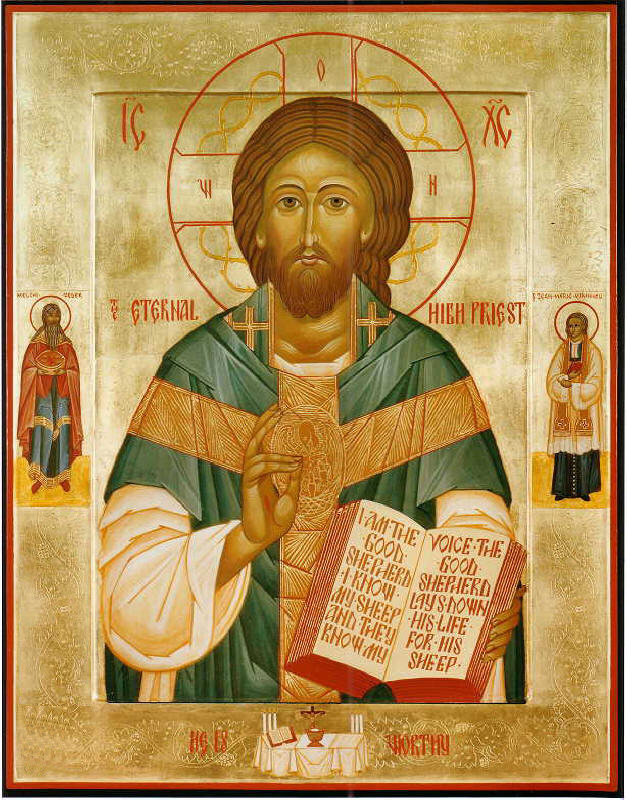
Jesus, High Priest
We thank you, God our Father, for those who have responded to your call to priestly ministry.
Accept this prayer we offer on their behalf: Fill your priests with the sure knowledge of your love.
Open their hearts to the power and consolation of the Holy Spirit.
Lead them to new depths of union with your Son.
Increase in them profound faith in the Sacraments they celebrate as they nourish, strengthen and heal us.
Lord Jesus Christ, grant that these, your priests, may inspire us to strive for holiness by the power of their example, as men of prayer who ponder your word and follow your will.
O Mary, Mother of Christ and our mother, guard with your maternal care these chosen ones, so dear to the Heart of your Son.
Intercede for our priests, that offering the Sacrifice of your Son, they may be conformed more each day to the image of your Son, our Lord and Savior, Jesus Christ. Amen.
Saint John Vianney, universal patron of priests, pray for us and our priests
This icon shows Jesus Christ, our eternal high priest.
The gold pelican over His heart represents self-sacrifice.
The border contains an altar and grapevines, representing the Mass, and icons of Melchizedek and St. Jean-Baptiste Vianney.
Melchizedek: king of righteousness (left icon) was priest and king of Jerusalem. He blessed Abraham and has been considered an ideal priest-king.
St. Jean-Baptiste Vianney is the patron saint of parish priests.
12
posted on
08/22/2015 8:18:24 PM PDT
by
Salvation
("With God all things are possible." Matthew 19:26)
To: All
13
posted on
08/22/2015 8:18:50 PM PDT
by
Salvation
("With God all things are possible." Matthew 19:26)
To: All
Pray a Rosary each day for our nation.
1. Sign of the Cross: In the name of the Father, and of the Son, and of the Holy Spirit. Amen.
2. The Apostles Creed: I BELIEVE in God, the Father almighty, Creator of heaven and earth, and in Jesus Christ, His only Son, our Lord, who was conceived by the Holy Spirit, born of the Virgin Mary, suffered under Pontius Pilate, was crucified, died, and was buried. He descended into hell; on the third day he rose again from the dead; he ascended into heaven, and is seated at the right hand of God, the Father Almighty; from there He shall come to judge the living and the dead.
I believe in the Holy Spirit, the holy catholic Church, the communion of saints, the forgiveness of sins, the resurrection of the body, and the life everlasting. Amen.
3. The Lord's Prayer: OUR Father, who art in heaven, hallowed be Thy name. Thy kingdom come. Thy will be done on earth as it is in heaven. Give us this day our daily bread and forgive us our trespasses as we forgive those who trespass against us. And lead us not into temptation, but deliver us from evil. Amen.
4. (3) Hail Mary: HAIL Mary, full of grace, the Lord is with thee. Blessed art thou amongst women and blessed is the fruit of thy womb, Jesus. Holy Mary, Mother of God, pray for us sinners, now, and in the hour of our death. Amen. (Three times)
5. Glory Be: GLORY be to the Father, and to the Son, and to the Holy Spirit. As it was in the beginning, is now, and ever shall be, world without end. Amen.
6. Fatima Prayer: Oh, my Jesus, forgive us our sins, save us from the fires of hell, lead all souls to heaven, especially those in most need of your mercy.
Announce each mystery, then say 1 Our Father, 10 Hail Marys, 1 Glory Be and 1 Fatima prayer. Repeat the process with each mystery.
End with the Hail Holy Queen:
Hail, Holy Queen, Mother of Mercy, our life, our sweetness and our hope! To thee do we cry, poor banished children of Eve! To thee do we send up our sighs, mourning and weeping in this vale of tears! Turn then, most gracious advocate, thine eyes of mercy towards us; and after this, our exile, show unto us the blessed fruit of thy womb, Jesus!
O clement, O loving, O sweet Virgin Mary! Pray for us, O holy Mother of God, that we may be made worthy of the promises of Christ.
Final step -- The Sign of the Cross
The Mysteries of the Rosary By tradition, Catholics meditate on these Mysteries during prayers of the Rosary. The biblical references follow each of the Mysteries below.
The Glorious Mysteries
(Wednesdays and Sundays)
1.The Resurrection (Matthew 28:1-8, Mark 16:1-18, Luke 24:1-12, John 20:1-29) [Spiritual fruit - Faith]
2. The Ascension (Mark 16:19-20, Luke 24:50-53, Acts 1:6-11) [Spiritual fruit - Christian Hope]
3. The Descent of the Holy Spirit (Acts 2:1-13) [Spiritual fruit - Gifts of the Holy Spirit]
4. The Assumption [Spiritual fruit - To Jesus through Mary]
5. The Coronation [Spiritual fruit - Grace of Final Perseverance]
14
posted on
08/22/2015 8:19:23 PM PDT
by
Salvation
("With God all things are possible." Matthew 19:26)
To: All

St. Michael the Archangel
~ PRAYER ~
St. Michael, the Archangel, defend us in battle
Be our protection against the wickedness
and snares of the devil;
May God rebuke him, we humbly pray,
and do thou, O Prince of the heavenly host,
by the power of God,
Cast into hell Satan and all the evil spirits
who prowl through the world seeking the ruin of souls.
Amen
+
15
posted on
08/22/2015 8:19:46 PM PDT
by
Salvation
("With God all things are possible." Matthew 19:26)
To: All
From an Obama bumper sticker on a car:
"Pray for Obama. Psalm 109:8"
PLEASE JOIN US - Evening Prayer
Someone has said that if people really understood the full extent of the power we have available through prayer, we might be speechless.
Did you know that during WWII there was an advisor to Churchill who organized a group of people who dropped what they were doing every day at a prescribed hour for one minute to collectively pray for the safety of England, its people and peace?
There is now a group of people organizing the same thing here in America. If you would like to participate: Every evening at 9:00 PM Eastern Time (8:00 PM Central) (7:00 PM Mountain) (6:00 PM Pacific), stop whatever you are doing and spend one minute praying for the safety of the United States, our troops, our citizens, and for a return to a Godly nation. If you know anyone else who would like to participate, please pass this along. Our prayers are the most powerful asset we have. Please forward this to your praying friends.
16
posted on
08/22/2015 8:20:41 PM PDT
by
Salvation
("With God all things are possible." Matthew 19:26)
To: All
August Devotion -- The Immaculate Heart [of Mary]
Since the 16th century Catholic piety has assigned entire months to special devotions. The month of August is traditionally dedicated to the Immaculate Heart of Mary. The physical heart of Mary is venerated (and not adored as the Sacred Heart of Jesus is) because it is united to her person: and as the seat of her love (especially for her divine Son), virtue, and inner life. Such devotion is an incentive to a similar love and virtue.
This devotion has received new emphasis in this century from the visions given to Lucy Dos Santos, oldest of the visionaries of Fatima, in her convent in Tuy, in Spain, in 1925 and 1926. In the visions Our Lady asked for the practice of the Five First Saturdays to help make amends for the offenses given to her heart by the blasphemies and ingratitude of men. The practice parallels the devotion of the Nine First Fridays in honor of the Sacred Heart.
On October 31, 1942, Pope Pius XII made a solemn Act of Consecration of the Church and the whole world to the Immaculate Heart. Let us remember this devotion year-round, but particularly through the month of August.
INVOCATIONS
O heart most pure of the Blessed Virgin Mary, obtain for me from Jesus a pure and humble heart.
Sweet heart of Mary, be my salvation.
ACT OF CONSECRATION
Queen of the most holy Rosary, help of Christians, refuge of the human race, victorious in all the battles of God, we prostrate ourselves in supplication before thy throne, in the sure hope of obtaining mercy and of receiving grace and timely aid in our present calamities, not through any merits of our own, on which we do not rely, but only through the immense goodness of thy mother's heart. In thee and in thy Immaculate Heart, at this grave hour of human history, do we put our trust; to thee we consecrate ourselves, not only with all of Holy Church, which is the mystical body of thy Son Jesus, and which is suffering in so many of her members, being subjected to manifold tribulations and persecutions, but also with the whole world, torn by discords, agitated with hatred, the victim of its own iniquities. Be thou moved by the sight of such material and moral degradation, such sorrows, such anguish, so many tormented souls in danger of eternal loss! Do thou, O Mother of mercy, obtain for us from God a Christ-like reconciliation of the nations, as well as those graces which can convert the souls of men in an instant, those graces which prepare the way and make certain the long desired coming of peace on earth. O Queen of peace, pray for us, and grant peace unto the world in the truth, the justice, and the charity of Christ.
Above all, give us peace in our hearts, so that the kingdom of God may spread its borders in the tranquillity of order. Accord thy protection to unbelievers and to all those who lie within the shadow of death; cause the Sun of Truth to rise upon them; may they be enabled to join with us in repeating before the Savior of the world: "Glory to God in the highest, and on earth peace to men of good will."
Give peace to the nations that are separated from us by error or discord, and in a special manner to those peoples who profess a singular devotion toward thee; bring them back to Christ's one fold, under the one true Shepherd. Obtain full freedom for the holy Church of God; defend her from her enemies; check the ever-increasing torrent of immorality; arouse in the faithful a love of purity, a practical Christian life, and an apostolic zeal, so that the multitude of those who serve God may increase in merit and in number.
Finally, even as the Church and all mankind were once consecrated to the Heart of thy Son Jesus, because He was for all those who put their hope in Him an inexhaustible source of victory and salvation, so in like manner do we consecrate ourselves forever to thee also and to thy Immaculate Heart, O Mother of us and Queen of the world; may thy love and patronage hasten the day when the kingdom of God shall be victorious and all the nations, at peace with God .and with one another, shall call thee blessed and intone with thee, from the rising of the sun to its going down, the everlasting "Magnificat" of glory, of love, of gratitude to the Heart of Jesus, in which alone we can find truth, life, and peace. — Pope Pius XII
IN HONOR OF THE IMMACULATE HEART
O heart of Mary, mother of God, and our mother; heart most worthy of love, in which the adorable Trinity is ever well-pleased, worthy of the veneration and love of all the angels and of all men; heart most like to the Heart of Jesus, of which thou art the perfect image; heart, full of goodness, ever compassionate toward our miseries; deign to melt our icy hearts and grant that they may be wholly changed into the likeness of the Heart of Jesus, our divine Savior. Pour into them the love of thy virtues, enkindle in them that divine fire with which thou thyself dost ever burn. In thee let Holy Church find a safe shelter; protect her and be her dearest refuge, her tower of strength, impregnable against every assault of her enemies. Be thou the way which leads to Jesus, and the channel, through which we receive all the graces needful for our salvation. Be our refuge in time of trouble, our solace in the midst of trial, our strength against temptation, our haven in persecution, our present help in every danger, and especially) at the hour of death, when all hell shall let loose against u its legions to snatch away our souls, at that dread moment; that hour so full of fear, whereon our eternity depends. An,; then most tender virgin, make us to feel the sweetness of thy motherly heart, and the might of thine intercession with Jesus, and open to us a safe refuge in that very fountain of mercy, whence we may come to praise Him with thee in paradise, world without end. Amen.
Prayer Source: Prayer Book, The by Reverend John P. O'Connell, M.A., S.T.D. and Jex Martin, M.A., The Catholic Press, Inc., Chicago, Illinois, 1954
|
Sacred Heart Of Jesus
 |
|
Immaculate Heart of Mary
 |
The Holy Heart of Mary Is, After the Heart of Jesus, the Most Exalted Throne of Divine Love
Let us recollect that God has given us the feast of the most pure Heart of the Blessed Virgin so that we may render on that day all the respect, honor and praise that we possibly can. To enkindle this spirit within us let us consider our motivating obligations.
The first is that we ought to love and honor whatever God loves and honors, and that by which He is loved and glorified. Now, after the adorable Heart of Jesus there has never been either in heaven or on earth, nor ever will be, a heart which has been so loved and honored by God, or which has given Him so much glory as that of Mary, the Mother of Jesus. Never has there been, nor will there ever be a more exalted throne of divine love. In that Heart divine love possesses its fullest empire, for it ever reigns without hindrance or interruption, and with it reign likewise all the laws of God, all the Gospel maxims and every Christian virtue.
This incomparable Heart of the Mother of our Redeemer is a glorious heaven, a Paradise of delights for the Most Holy Trinity. According to St. Paul, the hearts of the faithful are the dwelling place of our Lord Jesus Christ, and Jesus Christ Himself assures us that the Father, the Son and the Holy Ghost take up Their abode in the hearts of those who love God. Who, therefore, can doubt that the Most Holy Trinity has always made His home and established the reign of His glory in an admirable and ineffable manner in the virginal Heart of her who is the Daughter of the Father, the Mother of the Son, the Spouse of the Holy Ghost, who herself loves God more than all other creatures together?
How much then are we not obliged to love this exalted and most lovable Heart?
— St. John Eudes
Today: Immaculate Heart of Mary [DEVOTIONAL]
The Immaculate Heart of Mary [Devotional] Catholic/Orthodox Caucus
Devotion to the Immaculate Heart of Mary [Catholic/Orthodox Caucus]
Saturdays and the Immaculate Heart of Mary [Catholic/Orthodox Caucus]
The Brown Scapular (Catholic Caucus)
The History of Consecration to the Immaculate Heart of Mary (Catholic Caucus)
Homilies preached by Father Robert Altier on the Feast of the Immaculate Heart of Mary
Marian Associations Unite to Celebrate Immaculate Heart
Solemnity Most Sacred Heart of Jesus and Immaculate Heart of Mary
FEAST OF THE IMMACULATE HEART OF MARY, AUGUST 22ND
Devotion to the Immaculate Heart of Mary
17
posted on
08/22/2015 8:21:13 PM PDT
by
Salvation
("With God all things are possible." Matthew 19:26)
To: All
August 2015
Pope's Intentions
Universal: Volunteers
That volunteers may give themselves generously to the service of the needy.
Evangelization: Outreach to the marginalized
That setting aside our very selves we may learn to be neighbors to those who find themselves on the margins of human life and society.
18
posted on
08/22/2015 8:22:59 PM PDT
by
Salvation
("With God all things are possible." Matthew 19:26)
To: All
Daily Gospel Commentary
Twenty-first Sunday in Ordinary Time - Year B
Commentary of the day Saint John-Paul II, Pope from 1978 to 2005
Encyclical « Ecclesia de Eucharistia », 18-19 (trans. © copyright Libreria Editrice Vaticana)“Whoever eats my flesh and drinks my blood has eternal life” (Jn 6,54)
Those who feed on Christ in the Eucharist need not wait until the hereafter to receive eternal life: they already possess it on earth, as the first-fruits of a future fullness which will embrace man in his totality. For in the Eucharist we also receive the pledge of our bodily resurrection at the end of the world: “He who eats my flesh and drinks my blood has eternal life, and I will raise him up at the last day” (Jn 6:54). This pledge of the future resurrection comes from the fact that the flesh of the Son of Man, given as food, is his body in its glorious state after the resurrection. With the Eucharist we digest, as it were, the “secret” of the resurrection. For this reason Saint Ignatius of Antioch rightly defined the Eucharistic Bread as “a medicine of immortality, an antidote to death”.
The eschatological tension kindled by the Eucharist expresses and reinforces our communion with the Church in heaven. It is not by chance that the Eastern Anaphoras and the Latin Eucharistic Prayers honour Mary, the ever-Virgin Mother of Jesus Christ our Lord and God, the angels, the holy apostles, the glorious martyrs and all the saints. This is an aspect of the Eucharist which merits greater attention: in celebrating the sacrifice of the Lamb, we are united to the heavenly “liturgy” and become part of that great multitude which cries out: “Salvation belongs to our God who sits upon the throne, and to the Lamb!” (Rev 7:10). The Eucharist is truly a glimpse of heaven appearing on earth. It is a glorious ray of the heavenly Jerusalem which pierces the clouds of our history and lights up our journey.
19
posted on
08/22/2015 8:24:50 PM PDT
by
Salvation
("With God all things are possible." Matthew 19:26)
To: All
Arlington Catholic Herald
GOSPEL COMMENTARY JN 6: 60-69
When it’s hard to follow Jesus
Fr. Robert J. Wagner
Over the past month, the Sunday Gospels have recounted the “Bread of Life Discourse” from the sixth chapter of St. John’s Gospel where Jesus revealed that He offers His Body and Blood — the Bread of Life — to His church, that all who believe in Him and eat His flesh might have eternal life. This truth is remarkable and glorious but also must have been unimaginable to some, and thus, Jesus found opposition among His disciples. They argued that He could not offer Himself as food. When Jesus replied that His flesh is real food and His blood is real drink, some could only respond by saying, “This saying is hard; who can accept it?” Even after Jesus assured them that He was speaking the truth, we hear with heavy hearts that, faced with the “hard” teaching of Jesus, “many of His disciples returned to their former way of life and no longer accompanied Him.”
Seen through the eyes of faith, this abandonment is tragic. These disciples walked with Jesus, saw His works and heard Him preach. How could they turn from Him? Were they confused with what He proposed regarding His Flesh and Blood? Were they indignant that Jesus, the Son of God, acted in a way they found less than divine? Why was their faith lacking to the point that they could not believe His words? We cannot know. We just know that many disciples chose this point to walk away from Our Lord and the salvation and eternal life He promised.
There comes a point in every Catholic's life when they realize the challenges of Christianity and ask themselves whether it is worth it to continue to follow Jesus. Usually this occurs after we leave our homes and are free to make life decisions on our own. It is then that many abandon Christianity because we think it is easier not to go to Mass and pray, easier not to live the moral life required by our faith, easier to go with the flow of our culture and not fight against it. This is not a new phenomenon. More than a century ago, G. K. Chesterton wrote, “The Christian ideal has not been tried and found wanting. It has been found difficult; and left untried” (What's Wrong with the World, 1, V).
For many, the temptation to abandon Jesus is the result of one of His teachings. For the disciples in today's Gospel, it was the Real Presence of Jesus in the Eucharist, but it may be one of many that are upheld by the Catholic Church. Today, many view Catholic teaching as irrational, old-fashioned, restrictive and even hateful when it comes to issues such as contraception, same-sex marriage, abortion, euthanasia, capital punishment and stewardship of God's creation (just to name a few). Because of this, it is hard to follow Jesus Christ and live His truth because doing so may bring the “sword,” causing division within families, between friends and neighbors, and in society in which we live (cf. Mt 10:35). But we know that we gain nothing by dismissing Jesus and His truth for a fleeting worldly peace founded on sand. It is better to build on the solid rock of faith.
Others choose to remain with Jesus and His church, but prefer to choose which of His teachings to follow. In the 4th century, St. Augustine wrote, “For to believe what you please, and not to believe what you please, is to believe yourselves, and not the Gospel” (Contra Faustum, XVII, 3). We can see the dangerous inconsistency of following Jesus but not trusting the church He established to lead and feed His flock. No doubt each of us has struggled to understand some aspect of the Christian teaching on morals and doctrine, and perhaps some of us still do. When facing this doubt, we must do our best first to understand exactly what the church teaches and why. This requires us to read what has been taught, to engage in dialogue with priests and laity who are faithful to the church and knowledgeable about its teaching and to pray to understand the divine truths we struggle to comprehend, as well as the faith to follow these truths while still we are in the process of understanding.
In the Scriptures and through His church, Jesus reveals the beauty of all creation and the truth that leads us to eternal life. Let us pray that we remain faithful to Him, His truth and His promises, even in the difficult times when we are tempted to stray.
Lord Jesus, through your grace, enlighten our minds and hold our hearts firm in faith and love of you.
Fr. Wagner is Arlington Bishop Paul S. Loverde’s secretary.
20
posted on
08/22/2015 8:38:06 PM PDT
by
Salvation
("With God all things are possible." Matthew 19:26)
Navigation: use the links below to view more comments.
first 1-20, 21-40, 41-49 next last
Disclaimer:
Opinions posted on Free Republic are those of the individual
posters and do not necessarily represent the opinion of Free Republic or its
management. All materials posted herein are protected by copyright law and the
exemption for fair use of copyrighted works.
FreeRepublic.com is powered by software copyright 2000-2008 John Robinson