Skip to comments.
Catholic Caucus: Sunday Mass Readings, 10-16-11, Twenty-Ninth Sunday in Ordinary Time
USCCB.org/New American Bible ^
| 10-16-11
| New American Bible
Posted on 10/15/2011 8:14:13 PM PDT by Salvation
October 16, 2011
Twenty-Ninth Sunday in Ordinary Time
Thus says the LORD to his anointed, Cyrus,
whose right hand I grasp,
subduing nations before him,
and making kings run in his service,
opening doors before him
and leaving the gates unbarred:
For the sake of Jacob, my servant,
of Israel, my chosen one,
I have called you by your name,
giving you a title, though you knew me not.
I am the LORD and there is no other,
there is no God besides me.
It is I who arm you, though you know me not,
so that toward the rising and the setting of the sun
people may know that there is none besides me.
I am the LORD, there is no other.
R. (7b) Give the Lord glory and honor.
Sing to the LORD a new song;
sing to the LORD, all you lands.
Tell his glory among the nations;
among all peoples, his wondrous deeds.
R. Give the Lord glory and honor.
For great is the LORD and highly to be praised;
awesome is he, beyond all gods.
For all the gods of the nations are things of nought,
but the LORD made the heavens.
R. Give the Lord glory and honor.
Give to the LORD, you families of nations,
give to the LORD glory and praise;
give to the LORD the glory due his name!
Bring gifts, and enter his courts.
R. Give the Lord glory and honor.
Worship the LORD, in holy attire;
tremble before him, all the earth;
say among the nations: The LORD is king,
he governs the peoples with equity.
R. Give the Lord glory and honor.
Paul, Silvanus, and Timothy to the church of the Thessalonians
in God the Father and the Lord Jesus Christ:
grace to you and peace.
We give thanks to God always for all of you,
remembering you in our prayers,
unceasingly calling to mind your work of faith and labor of love
and endurance in hope of our Lord Jesus Christ,
before our God and Father,
knowing, brothers and sisters loved by God,
how you were chosen.
For our gospel did not come to you in word alone,
but also in power and in the Holy Spirit and with much conviction.
The Pharisees went off
and plotted how they might entrap Jesus in speech.
They sent their disciples to him, with the Herodians, saying,
"Teacher, we know that you are a truthful man
and that you teach the way of God in accordance with the truth.
And you are not concerned with anyone's opinion,
for you do not regard a person's status.
Tell us, then, what is your opinion:
Is it lawful to pay the census tax to Caesar or not?"
Knowing their malice, Jesus said,
"Why are you testing me, you hypocrites?
Show me the coin that pays the census tax."
Then they handed him the Roman coin.
He said to them, "Whose image is this and whose inscription?"
They replied, "Caesar's."
At that he said to them,
"Then repay to Caesar what belongs to Caesar
and to God what belongs to God."
TOPICS: Catholic; General Discusssion; Prayer; Worship
KEYWORDS: catholic; ordinarytime; parables; prayer
Navigation: use the links below to view more comments.
first 1-20, 21-40, 41-56 next last
For your reading, reflection, faith-sharing, comments, questions, discussion.
1
posted on
10/15/2011 8:14:20 PM PDT
by
Salvation
To: nickcarraway; NYer; ELS; Pyro7480; livius; ArrogantBustard; Catholicguy; RobbyS; marshmallow; ...
Alleluia Ping!
If you aren’t on this ping list NOW and would like to be,
please Freepmail me.
2
posted on
10/15/2011 8:17:41 PM PDT
by
Salvation
("With God all things are possible." Matthew 19:26)
To: All
From: Isaiah 45:1, 4-6
Cyrus’ mission
[1] Thus says the Lord to his anointed, to Cyrus,
whose right hand I have grasped,
to subdue nations before him
and ungird the loins of kings,
to open doors before him
that gates may not be closed:
[4] For the sake of my servant Jacob,
and Israel my chosen,
I call you by your name.
I surname you, though you do not know me.
[5] I am the Lord, and there is no other,
besides me there is no God;
I gird you, though you do not know me,
[6] that men may know, from the rising of the sun
and from the west, that there is none besides me;
I am the Lord, and there is no other.
*********************************************************************************************
Commentary:
45:1-13. This poetic statement is a message designed to raise the spirits of the
exiles by announcing the sending of a liberator. Cyrus of Persia, whom God will
use to implement his plans of salvation for Israel. The formal, very considered,
mention of Cyrus, a foreign king, reveals the universal scope of God’s salvific
plans — which did not at all fit in with the people’s own exclusive, nationalistic
mentality. The prophecy can be read as an investiture oracle that maybe never
reached the ears of Cyrus yet filled the exiles with hope. St Thomas comments:
“Having raised the hope of the people in the divine promises (chaps. 40-44), he
lists and details the promises in order to console them: first he promises free-
dom from all ills (chaps. 45-55), and then the restoration of all goods (chaps.
56-66)” (Expositio super Isaiam, 59).
Cyrus was a foreign king who did not know the God of the chosen people, and
yet, surprisingly, has been given the title of “anointed”, a title reserved to the
kings of Israel. Moreover, the oracle says that the mission and conquest of this
Persian king are attributable to special divine providence: God has chosen this
man to deliver Israel from oppression by other nations (vv. 1-5). This message
must have truly amazed those who heard the oracle. Even many centuries later
it makes us realize that Gods plans can involve historical events that at first
sight can seem disconcerting or at odds with those plans.
The expression “ungird the loins of kings” means disarming them, for the sword
was slung from the belt.
45:6-7. ‘When these verses were written they may have been designed to coun-
ter dualism (very prevalent among the Persians and their neighbours), which held
that two counterposed principles existed — good and evil; hence the emphasis on
the fact that the Lord is the only God, the creator of all things, of light and of dark-
ness. That would explain why God is described as the maker of “weal” and “woe”,
whereas because God is infinite goodness he cannot properly be called the au-
thor of evil. However, because Christian readers could find the statement (in v. 2
disconcerting, exegetes have commented on it. Origen, quite early on, gave this
explanation: “Evil, in the absolute sense of the word, was not created by God
[...].
If we speak of evil in a loose sense, meaning physical and natural evils, then we
can say that God created it in order to convert men by their suffering. What is
strange about this teaching? We refer to the punishments meted out by parents
and teachers, and even the prescriptions and operations carried out by doctors
and surgeons, as evils and sufferings, without blaming or condemning them. And
that is how we should read the verse: I form light and create darkness. I make
weal and woe (Is 45:7)” (Contra Celsum, 6, 55-56). And St Gregory the Great
comments: “I make weal and woe: the peace of God is offered to us precisely
in the moment when created things, which are good in themselves, though not
always desired or sought with rectitude of heart, become the source of suffering
and disgrace. Our union with God is broken by sin; it is fitting, therefore, that
we return to him along the path of suffering. When any created thing, which is
good in itself, causes us to suffer, it is an instrument for our conversion, so that
we will return humbly to the source of peace” (Moralia in Job, 3, 9, 15).
*********************************************************************************************
Source: “The Navarre Bible: Text and Commentaries”. Biblical text from the
Revised Standard Version and New Vulgate. Commentaries by members of
the Faculty of Theology, University of Navarre, Spain.
Published by Four Courts Press, Kill Lane, Blackrock, Co. Dublin, Ireland, and
by Scepter Publishers in the United States.
3
posted on
10/15/2011 8:29:38 PM PDT
by
Salvation
("With God all things are possible." Matthew 19:26)
To: All
From: 1 Thessalonians 1:1-5b
Greetings
[1] Paul, Silvanus, and Timothy, To the church of the Thessalonians in God the
Father and the Lord Jesus Christ: Grace to you and peace.
Thanksgiving for the Thessalonians’ Fidelity
[2] We give thanks to God always for you all, constantly mentioning you in our
prayers, [3] remembering before our God and Father your work of faith and labor
of love and steadfastness of hope in our Lord Jesus Christ. [4] For we know bre-
thren beloved by God, that he has chosen you; [5] for our gospel came to you
not only in word, but also in power and in the Holy Spirit and with full conviction.
*********************************************************************************************
Commentary:
1. The heading is in keeping with the style of the period: it identifies the writer
and the addressees and contains a greeting. The names of Silvanus and Timo-
thy, co-workers of St Paul, appears alongside his own. The heading is affectio-
nate in tone but it is not the kind of opening typical of a simple family letter. This
is an official letter, which is why two witnesses vouch for its content (in line with
legal requirements: cf. Deut 17:6).
As in certain other letters (cf. 2 Thess, Phil, Philem), St Paul does not describe
himself as an Apostle; the mention of his name is enough to convey his authority.
Silvanus is the same person as Silas whom Acts describes as “prophet” and one
of the “leading men among the brethren” in Jerusalem (cf. Acts 15:22, 32); here
the Latin transcription of his name is used. He had worked alongside St Paul in
the evangelization of Thessalonica, so he would have been well known to the be-
lievers in that city (cf. Acts 17:4). Timothy was son of Gentile father and a Jewish
mother (his mother was a Christian convert); Paul gave him instruction in the faith
when he passed through Lystra during his second missionary journey, and ever
since then he had always been a faithful helper of the Apostle. When St Paul
was writing this letter, Timothy had just arrived in Corinth from Thessalonica with
good reports of the spiritual health of that church (cf. 1 Thess 3:6).
The letter is addressed to “the church of the Thessalonians”. The Greek word
“ekklesia”, meaning “assembly, gathering of the people”, was used from the apo-
stolic age onwards to describe the Church, the new people of God. St Thomas
Aquinas used this verse for his definition of the Church as “the assembly of the
faithful brought together in God the Father and in the Lord Jesus Christ, through
faith in the Trinity and in the divinity and humanity of Christ” (”Commentary on 1
Thess, ad loc.”). “All those, who in faith look toward Jesus, the author of salva-
tion and the principle of unity and peace, God had gathered together and esta-
blished as the Church, that it may be for each and everyone the visible sacra-
ment of this saving unity” (Vatican II, “Lumen Gentium”, 9).
“Grace to you and peace”: a favorite greeting of St Paul’s, expressing the wish
that they will attain the fullness of heavenly good things. See the note on Rom
1:7).
3. The spiritual life of the Christian is based on the practice of the theological vir-
tues, for “faith encourages men to do good, charity to bear pain and effort, and
hope to resist patiently” (Severian of Gabala, “Commentary on 1 Thess, ad loc.”).
Faith needs to be reflected in one’s conduct, for “faith apart from works is dead”
(Jas 2:26). As St John Chrysostom teaches, “belief and faith are proved by works
— not by simply saying that one believes, but by real actions, which are kept up,
and by a heart burning with love” (”Hom. on 1 Thess, ad loc.”).
The service of others for God’s sake is a proof of charity. A person who practices
this virtue always rises to the occasion and does not try to dodge sacrifice or
effort.
Hope is a virtue which “enables one to endure adversity” (St Thomas, “Commen-
tary on 1 Thess, ad loc.”). St Paul encourages us to rejoice in hope and be pa-
tient in tribulation (cf. Rom 12:12), for hope fills the soul with joy and gives it the
strength to bear every difficulty for love of God.
4. All men are “beloved by God” and, as St Thomas points out, this is the case
“not just in the ordinary sense of having received natural existence from him, but
particularly because he has called them to eternal good things” (”Commentary
on I Thess, ad loc.”). Man’s last end is happiness, and happiness cannot be
found (other than in a relative sense) in wealth, honors, health or sensual satis-
faction; it can only be found in knowing and loving God. By raising man to the
supernatural order, God gave him a supernatural goal or end, which consists in
“seeing God himself, triune and one, as he is, clearly” (Council of Florence
“Laetentur Coeli”).
Deprived as he was of sanctifying grace on account of original sin and his per-
sonal sins, man was unable to attain any end exceeding his natural powers. But
God loved us so much that he deigned to enable us “to share in the inheritance
of the saints in light. He has delivered us from the dominion of darkness and
transferred us to the kingdom of his beloved Son” (Col 1:12-13). Therefore, those
who have been given the preaching of the Gospel and the fruits of Redemption
through Baptism and the other sacraments are the object of a special divine
“choice”. This “choice” or election is not the same as “salvation”; it is an initia-
tive on God’s part prior to the attainment of salvation. To be saved one must se-
cond this action of God by responding freely to grace.
5. St Paul reminds them that what he preached was the “gospel” foretold by the
prophets (cf. Is 40:9; 52:7; 60:6; 61:1) and fulfilled by the Incarnation of the Word
and by his work of salvation. The Apostle was pressed into service by the Holy
Spirit to forward his work of sanctification. The Thessalonians were not won over
by mere human words but by the “power” of God, who made those words effec-
tive. The term “power” refers not only to miraculous actions but also to the Holy
Spirit moving the souls of those who heard Paul’s preaching.
It is true that this activity, like all actions of God outside himself, is something
done by all three Persons of the Blessed Trinity; but in the language of Scripture
and of the Church it is customary “to attribute to the Father those works of the
Divinity in which power excels; to attribute to the Son, those in which wisdom
excels; and to the Holy Spirit, those in which love excels” (Leo XIII, “Divinum Il-
lud Munus”, 5).
In the early years of the Church the proclamation of the Gospel was often marked
by special graces of the Holy Spirit, such as prophecy, miracles, or the gift of
tongues (cf. Acts 2:8). This profusion of gifts made it clear that the messianic era
had begun (cf. Acts 2:16), for it meant the fulfillment of the ancient prophecies: “I
will pour out my spirit on all flesh; your sons and your daughters shall prophesy,
your old men shall dream dreams, and your young men shall see visions. Even
upon the menservants and maidservants in those days, I will pour out my spirit”
(Joel 3:1-3).
“In power and in the Holy Spirit”: in line with the divine plan of salvation, the time
of the Old Testament, which prepared the way for the coming of the Messiah,
has reached its end, and a new era has begun, the Christian era, the key feature
of which is the activity of the Spirit of God: “It must be said that the Holy Spirit is
the principal agent of evangelization: it is he who impels each individual to pro-
claim the Gospel, and it is he who in the depths of consciences causes the word
of salvation to be accepted and understood” (Paul VI, “Evangelii Nuntiandi”, 75).
*********************************************************************************************
Source: “The Navarre Bible: Text and Commentaries”. Biblical text from the
Revised Standard Version and New Vulgate. Commentaries by members of
the Faculty of Theology, University of Navarre, Spain.
Published by Four Courts Press, Kill Lane, Blackrock, Co. Dublin, Ireland, and
by Scepter Publishers in the United States.
4
posted on
10/15/2011 8:30:19 PM PDT
by
Salvation
("With God all things are possible." Matthew 19:26)
To: All
From: Matthew 22:15-21
On Tribute to Caesar
[15] Then the Pharisees went and took counsel how to entangle him in his talk.
[16] And they sent their disciples to him, along with the Herodians, saying, “Tea-
cher, we know that you are true, and teach the way of God truthfully, and care
for no man; for you do not regard the position of men. [17] Tell us, then, what
you think. Is it lawful to pay taxes to Caesar, or not?” [18] But Jesus, aware of
their malice, said, “Why put me to the test, you hypocrites? [19] Show me the
money for the tax.” And they brought him a coin. [20] And Jesus said to them,
“Whose likeness and inscription is this?” [21] They said, “Caesar’s.” Then he
said to them, “Render therefore to Caesar the things that are Caesar’s, and to
God the things that are God’s.”
*********************************************************************************************
Commentary:
15-21. The Pharisees and Herodians join forces to plot against Jesus. The Hero-
dians were supporters of the regime of Herod and his dynasty. They were quite
well disposed to Roman rule and, as far as religious matters were concerned,
they held the same kind of materialistic ideas as the Sadducees. The Pharisees
were zealous keepers of the Law; they were anti-Roman and regarded the Hero-
dians as usurpers. It is difficult to imagine any two groups more at odds with
each other: their amazing pact shows how much they hated Jesus.
Had Jesus replied that it was lawful to pay taxes to Caesar, the Pharisees could
have discredited him in the eyes of the people, who were very nationalistic; if he
said it was unlawful, the Herodians would have been able to denounce him to the
Roman authorities.
Our Lord’s answer is at once so profound that they fail to grasp its meaning, and
it is also faithful to his preaching about the Kingdom of God: give Caesar what is
his due, but no more, because God must assuredly be given what he has a right
to (the other side of the question, which they omitted to put). God and Caesar are
on two quite different levels, because for an Israelite God transcends all human
categories. What has Caesar a right to receive? Taxes, which are necessary for
legitimate state expenses. What must God be given? Obviously, obedience to
all his commandments—which implies personal love and commitment. Jesus’
reply goes beyond the human horizons of these tempters, far beyond the simple
yes or no they wanted to draw out of him.
The teaching of Jesus transcends any kind of political approach, and if the faithful,
using the freedom that is theirs, chose one particular method of solving temporal
questions, they “ought to remember that in those cases no one is permitted to
identify the authority of the Church exclusively with his own opinion” (Vatican II,
“Gaudium Et Spes”, 43).
Jesus’ words show that he recognized civil authority and its rights, but he made
it quite clear that the superior rights of God must be respected (cf. Vatican II,
“Dignitatis Humanae”, 11 ), and pointed out that it is part of God’s will that we
faithfully fulfill our civic duties (cf. Rom 13:1-7).
*********************************************************************************************
Source: “The Navarre Bible: Text and Commentaries”. Biblical text from the
Revised Standard Version and New Vulgate. Commentaries by members of
the Faculty of Theology, University of Navarre, Spain.
Published by Four Courts Press, Kill Lane, Blackrock, Co. Dublin, Ireland, and
by Scepter Publishers in the United States.
5
posted on
10/15/2011 8:30:51 PM PDT
by
Salvation
("With God all things are possible." Matthew 19:26)
To: All
Scripture readings taken from the Jerusalem Bible, published and copyright © 1966, 1967 and 1968 by Darton, Longman & Todd
Mass Readings
| First reading |
Isaiah 45:1,4-6 © |
Thus says the Lord to his anointed, to Cyrus,
whom he has taken by his right hand
to subdue nations before him
and strip the loins of kings,
to force gateways before him
that their gates be closed no more:
‘It is for the sake of my servant Jacob,
of Israel my chosen one,
that I have called you by your name,
conferring a title though you do not know me.
I am the Lord, unrivalled;
there is no other God besides me.
Though you do not know me, I arm you
that men may know from the rising to the setting of the sun
that, apart from me, all is nothing.’
| Psalm |
Psalm 95:1,3-5,7-10 |
| Second reading |
1 Thessalonians 1:1-5 © |
From Paul, Silvanus and Timothy, to the Church in Thessalonika which is in God the Father and the Lord Jesus Christ; wishing you grace and peace.
We always mention you in our prayers and thank God for you all, and constantly remember before God our Father how you have shown your faith in action, worked for love and persevered through hope, in our Lord Jesus Christ.
We know, brothers, that God loves you and that you have been chosen, because when we brought the Good News to you, it came to you not only as words, but as power and as the Holy Spirit and as utter conviction.
| Gospel |
Matthew 22:15-21 © |
The Pharisees went away to work out between them how to trap Jesus in what he said. And they sent their disciples to him, together with the Herodians, to say, ‘Master, we know that you are an honest man and teach the way of God in an honest way, and that you are not afraid of anyone, because a man’s rank means nothing to you. Tell us your opinion, then. Is it permissible to pay taxes to Caesar or not?’ But Jesus was aware of their malice and replied, ‘You hypocrites! Why do you set this trap for me? Let me see the money you pay the tax with.’ They handed him a denarius, and he said, ‘Whose head is this? Whose name?’ ‘Caesar’s’ they replied. He then said to them, ‘Very well, give back to Caesar what belongs to Caesar – and to God what belongs to God.’
6
posted on
10/15/2011 8:34:11 PM PDT
by
Salvation
("With God all things are possible." Matthew 19:26)
To: All
7
posted on
10/15/2011 8:35:24 PM PDT
by
Salvation
("With God all things are possible." Matthew 19:26)
To: All
8
posted on
10/15/2011 8:47:27 PM PDT
by
Salvation
("With God all things are possible." Matthew 19:26)
To: All
9
posted on
10/15/2011 8:47:57 PM PDT
by
Salvation
("With God all things are possible." Matthew 19:26)
To: All
Jesus, High Priest
We thank you, God our Father, for those who have responded to your call to priestly ministry.
Accept this prayer we offer on their behalf: Fill your priests with the sure knowledge of your love.
Open their hearts to the power and consolation of the Holy Spirit.
Lead them to new depths of union with your Son.
Increase in them profound faith in the Sacraments they celebrate as they nourish, strengthen and heal us.
Lord Jesus Christ, grant that these, your priests, may inspire us to strive for holiness by the power of their example, as men of prayer who ponder your word and follow your will.
O Mary, Mother of Christ and our mother, guard with your maternal care these chosen ones, so dear to the Heart of your Son.
Intercede for our priests, that offering the Sacrifice of your Son, they may be conformed more each day to the image of your Son, our Lord and Savior, Jesus Christ. Amen.
Saint John Vianney, universal patron of priests, pray for us and our priests
This icon shows Jesus Christ, our eternal high priest.The gold pelican over His heart represents self-sacrifice.
The border contains an altar and grapevines, representing the Mass, and icons of Melchizedek and St. Jean-Baptiste Vianney.
Melchizedek: king of righteousness (left icon) was priest and king of Jerusalem. He blessed Abraham and has been considered an ideal priest-king.
St. Jean-Baptiste Vianney is the patron saint of parish priests.
10
posted on
10/15/2011 8:49:05 PM PDT
by
Salvation
("With God all things are possible." Matthew 19:26)
To: All
Pray a Rosary each day for our nation.

1. Sign of the Cross: In the name of the Father, and of the Son, and of the Holy Spirit. Amen.
2. The Apostles Creed: I BELIEVE in God, the Father almighty, Creator of heaven and earth. I believe in Jesus Christ, His only Son, our Lord. He was conceived by the power of the Holy Spirit and born of the Virgin Mary. He suffered under Pontius Pilate, was crucified, died, and was buried. He descended to the dead. On the third day He rose again. He ascended into heaven and sits at the right hand of God, the Father Almighty. From thence He shall come to judge the living and the dead. I believe in the Holy Spirit, the holy catholic Church, the communion of saints, the forgiveness of sins, the resurrection of the body, and the life everlasting. Amen.
3. The Lord's Prayer: OUR Father, who art in heaven, hallowed be Thy name. Thy kingdom come. Thy will be done on earth as it is in heaven. Give us this day our daily bread and forgive us our trespasses as we forgive those who trespass against us. And lead us not into temptation, but deliver us from evil. Amen.
4. (3) Hail Mary: HAIL Mary, full of grace, the Lord is with thee. Blessed art thou amongst women and blessed is the fruit of thy womb, Jesus. Holy Mary, Mother of God, pray for us sinners, now, and in the hour of our death. Amen. (Three times)
5. Glory Be: GLORY be to the Father, and to the Son, and to the Holy Spirit. As it was in the beginning, is now, and ever shall be, world without end. Amen.
Fatima Prayer: Oh, my Jesus, forgive us our sins, save us from the fires of hell, lead all souls to heaven, especially those in most need of your mercy.
Announce each mystery, then say 1 Our Father, 10 Hail Marys, 1 Glory Be and 1 Fatima prayer. Repeat the process with each mystery.
End with the Hail Holy Queen:
Hail, Holy Queen, Mother of Mercy, our life, our sweetness and our hope! To thee do we cry, poor banished children of Eve! To thee do we send up our sighs, mourning and weeping in this vale of tears! Turn then, most gracious advocate, thine eyes of mercy towards us; and after this, our exile, show unto us the blessed fruit of thy womb, Jesus!
O clement, O loving, O sweet Virgin Mary! Pray for us, O holy Mother of God, that we may be made worthy of the promises of Christ.
Final step -- The Sign of the Cross
The Mysteries of the Rosary
By tradition, Catholics meditate on these Mysteries during prayers of the Rosary.
The biblical references follow each of the Mysteries below.
The Glorious Mysteries
(Wednesdays and Sundays)
1.The Resurrection (Matthew 28:1-8, Mark 16:1-18, Luke 24:1-12, John 20:1-29) [Spiritual fruit - Faith]
2. The Ascension (Mark 16:19-20, Luke 24:50-53, Acts 1:6-11) [Spiritual fruit - Christian Hope]
3. The Descent of the Holy Ghost (Acts 2:1-13) [Spiritual fruit - Gifts of the Holy Spirit]
4. The Assumption [Spiritual fruit - To Jesus through Mary]
5. The Coronation [Spiritual fruit - Grace of Final Perseverance]
11
posted on
10/15/2011 8:50:45 PM PDT
by
Salvation
("With God all things are possible." Matthew 19:26)
To: All

~ PRAYER ~

St. Michael, the Archangel, defend us in battle
Be our protection against the wickedness
and snares of the devil;
May God rebuke him, we humbly pray,
and do thou, O Prince of the heavenly host,
by the power of God,
Cast into hell Satan and all the evil spirits
who prowl through the world seeking the ruin of souls.
Amen
+
12
posted on
10/15/2011 8:51:20 PM PDT
by
Salvation
("With God all things are possible." Matthew 19:26)
To: All
13
posted on
10/15/2011 8:51:50 PM PDT
by
Salvation
("With God all things are possible." Matthew 19:26)
To: All
|
|
|
October Devotion: The Holy Rosary
Since the 16th century Catholic piety has assigned entire months to special devotions. Pope Leo XIII personally started the practice of devoting October to the Rosary devotion. In a letter of September 1, 1883, mindful of the Rosary's power to strengthen faith and foster a life of virtue, he outlined the triumphs of the Rosary in past times and admonished the faithful to dedicate the month of October to the Blessed Virgin through the daily recitation of her Rosary in the presence of the Blessed Sacrament, in order to obtain through her intercession the grace that God would console and defend His Church in her sufferings. We highly recommend that you read Pope John Paul II's Apostolic Letter Rosarium Virginis Mariae, or "On the Most Holy Rosary." It explains even further this wonderful devotion, and introduces the optional mysteries of light, or Luminous mysteries.
|
INVOCATION
Queen of the most holy Rosary, pray for us.
TO THE QUEEN OF THE HOLY ROSARY
Queen of the most holy Rosary, in these times of such brazen impiety, manifest thy power with the signs of thine ancient victories, and from thy throne, whence thou dost dispense pardon and graces, mercifully regard the Church of thy Son, His Vicar on earth, and every order of clergy and laity, who are sore oppressed in the mighty conflict. Do thou, who art the powerful vanquisher of all heresies, hasten the hour of mercy, even though the hour of God's justice is every day provoked by the countless sins of men. For me who am the least of men, kneeling before thee in supplication, do thou obtain the grace I need to live righteously upon earth and to reign among the just in heaven, the while in company with all faithful Christians throughout the world, I salute thee and acclaim thee as Queen of the most holy Rosary:
Queen of the most holy Rosary, pray for us.
TO OUR LADY OF THE ROSARY
O Virgin Mary, grant that the recitation of thy Rosary may be for me each day, in the midst of my manifold duties, a bond of unity in my actions, a tribute of filial piety, a sweet refreshment, an encouragement to walk joyfully along the path of duty. Grant, above all, O Virgin Mary, that the study of thy fifteen mysteries may form in my soul, little by little, a luminous atmosphere, pure, strengthening, and fragrant, which may penetrate my understanding, my will, my heart, my memory, my imagination, my whole being. So shall I acquire the habit of praying while I work, without the aid of formal prayers, by interior acts of admiration and of supplication, or by aspirations of love. I ask this of thee, O Queen of the holy Rosary, through Saint Dominic, thy son of predilection, the renowned preacher of thy mysteries, and the faithful imitator of thy virtues. Amen.
FOR THE CRUSADE OF THE FAMILY ROSARY
The Family Rosary Crusade, organized and directed by Father Patrick Peyton, C.S.C., sought to revive the practice of families reciting the Rosary daily within their homes. The Crusade has the encouragement and support of Pope Pius XII and it is succeeding admirably in realizing the desire of the Pope that no family would allow a day to pass without the recitation of the Rosary. This prayer was composed by Cardinal Spellman when the Crusade visited his Archdiocese.
O Queen of the most holy Rosary: with hearts full of confidence we earnestly beseech you to bless the Crusade of the Family Rosary. From you came the grace to begin it. >From you must come the grace to win souls to it. We beg you to bless this Crusade so that from every home the incense of this prayer will daily rise before you, O admirable Mother.
O Queen of Homes: by the power of the Rosary we beseech you to embrace all the members of our family in the love of your Immaculate Heart. May you abide with us and we with you, praying to you while you pray for us. May you preside in our homes as once you did at Nazareth with Jesus and Joseph, filling them with the holiness of your presence and inspiration.
O Queen of Peace: it is you who have placed the Rosary in our hands. It is you who bid us to recite it daily. By the power of the Family Rosary we beseech you to obtain peace for uspeace within our hearts, our homes, our country and throughout the world. Through the daily recitation of the Family Rosary we beg you to keep sin from our souls, enmities from our hearts and war from our shores. By the graces received from the devotion of the Family Rosary we pray to be made helpful to one another in following the paths of virtue so that we may be found worthy to be called children of your family, children of your home. Amen.
Cardinal Spellman
Prayer Source: Prayer Book, The by Reverend John P. O'Connell, M.A., S.T.D. and Jex Martin, M.A., The Catholic Press, Inc., Chicago, Illinois, 1954
1. Sign of the Cross: In the name of the Father, and of the Son, and of the Holy Spirit. Amen.
2. The Apostles Creed: I BELIEVE in God, the Father almighty, Creator of heaven and earth. I believe in Jesus Christ, His only Son, our Lord. He was conceived by the power of the Holy Spirit and born of the Virgin Mary. He suffered under Pontius Pilate, was crucified, died, and was buried. He descended to the dead. On the third day He rose again. He ascended into heaven and sits at the right hand of God, the Father Almighty. From thence He shall come to judge the living and the dead. I believe in the Holy Spirit, the holy catholic Church, the communion of saints, the forgiveness of sins, the resurrection of the body, and the life everlasting. Amen.
3. The Lord's Prayer: OUR Father, who art in heaven, hallowed be Thy name. Thy kingdom come. Thy will be done on earth as it is in heaven. Give us this day our daily bread and forgive us our trespasses as we forgive those who trespass against us. And lead us not into temptation, but deliver us from evil. Amen.
4. (3) Hail Mary: HAIL Mary, full of grace, the Lord is with thee. Blessed art thou amongst women and blessed is the fruit of thy womb, Jesus. Holy Mary, Mother of God, pray for us sinners, now, and in the hour of our death. Amen. (Three times)
5. Glory Be: GLORY be to the Father, and to the Son, and to the Holy Spirit. As it was in the beginning, is now, and will be forever. Amen.
Fatima Prayer: Oh, my Jesus, forgive us our sins, save us from the fires of hell, lead all souls to heaven, especially those in most need of your mercy.
Announce each mystery, then say 1 Our Father, 10 Hail Marys, 1 Glory Be and 1 Fatima prayer. Repeat the process with each mystery.
End with the Hail Holy Queen:
Hail, Holy Queen, Mother of Mercy, our life, our sweetness and our hope! To thee do we cry, poor banished children of Eve! To thee do we send up our sighs, mourning and weeping in this vale of tears! Turn then, most gracious advocate, thine eyes of mercy towards us; and after this, our exile, show unto us the blessed fruit of thy womb, Jesus!
O clement, O loving, O sweet Virgin Mary! Pray for us, O holy Mother of God, that we may be made worthy of the promises of Christ.
Final step -- The Sign of the Cross
The Mysteries of the Rosary
By tradition, Catholics meditate on these Mysteries during prayers of the Rosary.
The biblical references follow each of the Mysteries below.
The Joyful Mysteries
(Mondays and Saturdays)
1. The Annunciation (Luke 1:26-38) [Spiritual fruit - Humility]
2. The Visitation (Luke 1: 39-56) [Spiritual fruit - Love of Neighbor]
3. The Nativity (Luke 2:1-20) [Spiritual fruit - Poverty of Spirit]
4. The Presentation (Luke 2:21-38) [Spiritual fruit - Purity of mind & body]
5. The Finding of Jesus in the Temple (Luke 2:41-52) [Spiritual fruit - Obedience ]
The Luminous Mysteries or Mysteries of Light
(Thursdays) see Rosarium Virginis Mariae
1. Jesus' Baptism in the Jordan (II Corinthians 5:21, Matthew 3:17 and parallels) [Spiritual fruit - Gratitude for the gift of Faith]
2. Jesus' self-manifestation at the wedding of Cana (John 2:1- 12) [Spiritual fruit - Fidelity]
3. Jesus' proclamation of the Kingdom of God, with His call to conversion (Mark 1:15, Mark 2:3-13; Luke 7:47- 48, John 20:22-23) [Spiritual fruit - Desire for Holiness]
4. Jesus' Transfiguration (Luke 9:35 and parallels) [Spiritual fruit - Spiritual Courage]
5. Jesus' institution of the Eucharist, as the sacramental expression of the Paschal Mystery. (Luke 24:13-35 and parallels, 1 Corinthians 11:24-25) [Spiritual fruit - Love of our Eucharistic Lord]
The Sorrowful Mysteries
(Tuesdays and Fridays)
1. The Agony in the Garden (Matthew 26:36-46, Luke 22:39-46) [Spiritual fruit - God's will be done]
2. The Scourging at the Pillar (Matthew 27:26, Mark 15:15, John 19:1) [Spiritual fruit - Mortification of the senses]
3. The Crowning with Thorns (Matthew 27:27-30, Mark 15:16-20, John 19:2) [Spiritual fruit - Reign of Christ in our heart]
4. The Carrying of the Cross (Matthew 27:31-32, Mark 15:21, Luke 23:26-32, John 19:17) [Spiritual fruit - Patient bearing of trials]
5. The Crucifixion (Matthew 27:33-56, Mark 15:22-39, Luke 23:33-49, John 19:17-37) [Spiritual fruit - Pardoning of Injuries]
The Glorious Mysteries
(Wednesdays and Sundays)
1.The Resurrection (Matthew 28:1-8, Mark 16:1-18, Luke 24:1-12, John 20:1-29) [Spiritual fruit - Faith]
2. The Ascension (Mark 16:19-20, Luke 24:50-53, Acts 1:6-11) [Spiritual fruit - Christian Hope]
3. The Descent of the Holy Ghost (Acts 2:1-13) [Spiritual fruit - Gifts of the Holy Spirit]
4. The Assumption [Spiritual fruit - To Jesus through Mary]
5. The Coronation [Spiritual fruit - Grace of Final Perseverance]
The Rosary-a tool for evangelization [Catholic Caucus] OUR LADY AND ISLAM: HEAVEN’S PEACE PLAN (Say the Rosary) [Ecumenical]Praying the Holy Rosary in October[[CATHOLIC CAUCUS] On the RosaryLists Every Catholic Should be Familiar With: 15 [20] Mysteries of the Holy Rosary & When They Are PrayedIt Was the Rosary: Mainz Priest Talks About His Vocation Rosary to Halt Construction of NYC Mosque (Catholic Caucus)
British Soldier Shot in Afghanistan is Saved by His ROSARY...Like His Great-Grandfather in WWII
Catholic Caucus: Rosary Beads Saved My Life, British Soldier Says
British soldier shot in Afghanistan is saved my his ROSARY
Rosary returned to Vietnam vet as pledged 44 years ago
Rosary for the Bishop celebrates six months of prayer, global expansion
Rosary Rallies for Priests Give Final Flourish to Their Special Year (ECUMENICAL)
The Unseen Power of the Rosary
Worldwide Rosary Relay to Offer Prayer for Priests
Boy Suspended For Rosary -- Reinstated
No-contact order over a student's rosary
After rosary campaign, Florida sheriff abruptly shuts down abortion clinic on Marian feast
Public Rosary in San Francisco to draw thousands [Catholic Caucus]
Chicago's Incredible Floating Rosary
Enourmous Rosary floats over Chicago
Surprised by the Joyful Mysteries (of the Rosary) [Catholic Caucus]
HISTORY OF THE ROSARY [Catholic/Orthodox Caucus]
[CATHOLIC/ORTHODOX CAUCUS] 5th Joyful Mystery: The Finding in the Temple (Patristic Rosary)
[CATHOLIC/ORTHODOX CAUCUS] 4th Joyful Mystery: The Presentation (Patristic Rosary)
[CATHOLIC/ORTHODOX CAUCUS] 3rd Joyful Mystery: The Nativity (Patristic Rosary)
Praying the Holy Rosary in October
[CATHOLIC/ORTHODOX CAUCUS] 2nd Joyful Mystery: The Visitation (Patristic Rosary)
[CATHOLIC/ORTHODOX CAUCUS] 1st Joyful Mystery: The Annuniciation (Patristic Rosary)
[CATHOLIC CAUCUS] On the Rosary
Lists Every Catholic Should be Familiar With: 15 [20] Mysteries of the Holy Rosary & When They Are Prayed
It Was the Rosary: Mainz Priest Talks About His Vocation
Rosary to Halt Construction of NYC Mosque (Catholic Caucus)
British Soldier Shot in Afghanistan is Saved by His ROSARY...Like His Great-Grandfather in WWII
Catholic Caucus: Rosary Beads Saved My Life, British Soldier Says
British soldier shot in Afghanistan is saved my his ROSARY
Rosary returned to Vietnam vet as pledged 44 years ago
Rosary for the Bishop celebrates six months of prayer, global expansion
Rosary Rallies for Priests Give Final Flourish to Their Special Year (ECUMENICAL)
The Unseen Power of the Rosary
Worldwide Rosary Relay to Offer Prayer for Priests
Boy Suspended For Rosary -- Reinstated
NY school sued after teen suspended over rosary
Student Suspended for Wearing Rosary Beads
[CATHOLIC CAUCUS] The 3:30 Beads!
Catholic Biblical Apologetics: Private Devotions to Mary: The Rosary
Benedict XVI Promotes Rosary in Fatima [Catholic Caucus]
Archbishop Naumann, Bishop Finn Lead Mother's Day Rosary at Planned Parenthood
Did the Apostles Pray the Rosary? (First Novena to the Holy Spirit?) [Catholic Caucus]
The Importance of the Meditated Holy Rosary -- What the Popes have to say [Catholic Caucus]
A Ladder from Earth to Heaven: The Rosary for All Christians
Jesus is in the Holy Rosary
The Rosary, a powerful weapon against the devil
History of The Scriptural Rosary [Ecumenical]
The Lord Is with Thee
Rosary of Our Lady's Tears(Catholic Prayer Thread)
The Rosary and Me - Catholic/Orthodox Caucus
Rosary promoted as path to Christ and peace [at third annual Rosary Bowl NW]
The Efficacy and Power of One Hail Mary [Ecumenical]
“ Let Us Do It!“ (Sunday: Rosary to be simultaneously prayed on five continents)
The Fruits of the Mysteries of the Rosary
[Catholic Caucus] One Million Rosaries
The Family Rosary [Try it for Lent!] (Catholic Caucus)
History of the Scriptural Rosary - Meditating on The Word
Rosary Resurgence [Ecumenical]
Beginning Catholic: How to Pray the Rosary: Contemplating Christ With Mary [Ecumenical]
[Oregon] Rosary Bowl focuses on links between prayer, evangelization
Praying the Rosary By Bishop Fulton J. Sheen(Catholic Caucus)
Rosary-Prayers Aiming to Break Record [Catholic Caucus]
Rosary vs. Repetitious Prayer [Ecumenical]
The Luminous Mysteries [of the Rosary]: Knowing Jesus in His Public Ministry Rosary Is a School of Mary, Says Pope: Encourages Recitation [Catholic/Orthodox Caucus]
New campaign launched to promote family rosary
The Rosary and the Republic
Chant the Rosary... in Latin!
Protestants and the rosary
Estimated 50,000 recite rosary in event at Rose Bowl
Our Lady of Victory (HLI Page)
Rosary to Mark St. Martha's Feast
Pray the Rosary
Rosary Aids Spiritual Growth, Says Pope
Sri LANKA CATHOLICS START ROSARY CHAIN FOR PEACE
Tips on Praying a Family Rosary
October: Month of the Holy Rosary
THE ORIGIN OF THE ROSARY
Very simple guide to praying/learning the Rosary
The Rosary and Orthodoxy
Father Benedict Groeschel on the Rosary
THE HOLY ROSARY
Catholic Caucus: The Holy Rosary
The Power of the Rosary - A Weapon Against Terrorism
Rosary May Contribute to Unity Says Protestant Theologian
Papal Address on the Rosary as a Weapon of Peace
____________________________________________________________
Pray the Rosary.
Pray without ceasing.
Remembering Lepanto
How Europe Escaped Speaking Arabic
The Battle of Lepanto
Civilization in the Balance: The Battle of Lepanto and Election ‘08
LEPANTO
A Call To Prayer: This Lepanto Moment [Repost]
Lepanto, 1571: The Battle That Saved Europe
Celebrating the Battle of Lepanto
Clash of civilizations: Battle of Lepanto revisited
Lepanto, Bertone e Battesimo, Oh My!
Lepanto Sunday
Our Lady of the Rosary of La Naval (A Mini-Lepanto in the Philippines)
Swiss Guards at the Battle of Lepanto, 7 October 1571
Battle of Lepanto
LEPANTO, 7 OCTOBER 1571: The Defense of Europe
Battle of Lepanto
Remember Lepanto!
The Battle of Lepanto
On This Day In History, The Battle of Lepanto
The Battle of Lepanto
Chesterton's Lepanto
The Miracle At Lepanto...
Lepanto
The Naval Battle of Lepanto
The Battle of Lepanto
14
posted on
10/15/2011 8:53:16 PM PDT
by
Salvation
("With God all things are possible." Matthew 19:26)
To: All
October 2011
Pope Benedict XVI's Intentions
General Intention: For the terminally ill, that in their sufferings they may be sustained by faith in God and by the love of others.
Missionary Intention: That the celebration of World Mission Sunday may increase in the People of God the passion for evangelization and the support of missionary activity through prayer and economic aid for the poorest Churches.
15
posted on
10/15/2011 8:53:55 PM PDT
by
Salvation
("With God all things are possible." Matthew 19:26)
To: Salvation
| Matthew |
| |
English: Douay-Rheims |
Latin: Vulgata Clementina |
Greek NT: Byzantine/Majority Text (2000) |
| |
Matthew 22
|
| 15. |
Then the Pharisees going, consulted among themselves how to insnare him in his speech. |
Tunc abeuntes pharisæi, consilium inierunt ut caperent eum in sermone. |
τοτε πορευθεντες οι φαρισαιοι συμβουλιον ελαβον οπως αυτον παγιδευσωσιν εν λογω |
| 16. |
And they sent to him their disciples with the Herodians, saying: Master, we know that thou art a true speaker, and teachest the way of God in truth, neither carest thou for any man: for thou dost not regard the person of men. |
Et mittunt ei discipulos suos cum Herodianis, dicentes : Magister, scimus quia verax es, et viam Dei in veritate doces, et non est tibi cura de aliquo : non enim respicis personam hominum : |
και αποστελλουσιν αυτω τους μαθητας αυτων μετα των ηρωδιανων λεγοντες διδασκαλε οιδαμεν οτι αληθης ει και την οδον του θεου εν αληθεια διδασκεις και ου μελει σοι περι ουδενος ου γαρ βλεπεις εις προσωπον ανθρωπων |
| 17. |
Tell us therefore what dost thou think, is it lawful to give tribute to Caesar, or not? |
dic ergo nobis quid tibi videtur, licet censum dare Cæsari, an non ? |
ειπε ουν ημιν τι σοι δοκει εξεστιν δουναι κηνσον καισαρι η ου |
| 18. |
But Jesus knowing their wickedness, said: Why do you tempt me, ye hypocrites? |
Cognita autem Jesus nequitia eorum, ait : Quid me tentatis hypocritæ ? |
γνους δε ο ιησους την πονηριαν αυτων ειπεν τι με πειραζετε υποκριται |
| 19. |
Shew me the coin of the tribute. And they offered him a penny. |
Ostendite mihi numisma census. At illi obtulerunt ei denarium. |
επιδειξατε μοι το νομισμα του κηνσου οι δε προσηνεγκαν αυτω δηναριον |
| 20. |
And Jesus saith to them: Whose image and inscription is this? |
Et ait illis Jesus : Cujus est imago hæc, et superscriptio ? |
και λεγει αυτοις τινος η εικων αυτη και η επιγραφη |
| 21. |
They say to him: Caesar's. Then he saith to them: Render therefore to Caesar the things that are Caesar's; and to God, the things that are God's. |
Dicunt ei : Cæsaris. Tunc ait illis : Reddite ergo quæ sunt Cæsaris, Cæsari : et quæ sunt Dei, Deo. |
λεγουσιν αυτω καισαρος τοτε λεγει αυτοις αποδοτε ουν τα καισαρος καισαρι και τα του θεου τω θεω |
16
posted on
10/15/2011 8:55:02 PM PDT
by
annalex
(http://www.catecheticsonline.com/CatenaAurea.php)
To: annalex
15. Then went the Pharisees, and took counsel how they might entangle him in his talk.
16. And they sent out to him their disciples with the Herodians, saying, Master, we know that you are true, and teaches the way of God in truth, neither care you for any man: for you regard not the person of men.
17. Tell us therefore, What think you? Is it lawful to give tribute to Caesar, or not?
18. But Jesus perceived their wickedness, and said, Why tempt me, you hypocrites?
19. Show me the tribute money. And they brought to him a penny.
20. And he said to them, Whose is this image and superscription?
21. They say to him, Caesar's. Then said he to them, Render therefore to Caesar the things which are Caesar's; and to God the things that are God's.
22. When they had heard these words, they marveled, and left him, and went their way.
PSEUDO-CHRYS. As when one seeks to dam a stream of running water, as soon as one outlet is stopped up it makes another channel for itself; so the malevolence of the Jews, foiled on one hand, seeks itself out another course. Then went the Pharisees; to the Herodians. Such as the plan was, such were the planners; They send to Him their disciples with the Herodians.
GLOSS. Who as unknown to Him, were more likely to ensnare Him, and so through them they might take Him, which they feared to do of themselves because of the populace.
JEROME; Lately under Caesar Augustus, Judea, which was subject to the Romans, had been made tributary when the census was held of the whole world; and there was a great division among the people, some saying that tribute ought to be paid to the Romans in return for the security and quiet which their arms maintained for all. The Pharisees on the other hand, self-satisfied in their own righteousness, contended that the people of God who paid tithes and gave first-fruits, and did all the other things which are written in the Law, ought not to be subject to human laws. But Augustus had given the Jews as king, Herod, son of Antipater, a foreigner and proselyte; he was to exact the tribute, yet to be subject to the Roman dominion. The Pharisees therefore send their disciples with the Herodians, that is, with Herod's soldiers, or those whom the Pharisees in mockery called Herodians, because they paid tribute to the Romans, and were not devoted to the worship of God.
CHRYS. They send their disciples and Herod's soldiers together, that whatever opinion He might give might be found fault with. Yet would they rather have had Him say somewhat against the Herodians; for being themselves afraid to lay hands on Him because of the populace, they sought to bring Him into danger through His liability to pay tribute.
PSEUDO-CHRYS. This is the commonest act of hypocrites, to commend those they would ruin. Thus, these break out into praises of Him, saying, Master, we know that You are true. They call Him Master, that, deceived by this show of honor and respect, He might in simplicity open all His heart to them, as seeking to gain them for disciples.
GLOSS. There are three ways in which it is possible for one not to teach the truth. First, on the side of the teacher, who may either not know, or not love the truth; guarding against this, they say, We know that You are true. Secondly, on the side of God, there are some who, putting aside all fear of Him, do not utter honestly the truth which they know respecting Him; to exclude this they say, And teaches the way of God in truth. Thirdly, on the side of our neighbor, when through fear or affection any one withholds the truth; to exclude this they say, And cares for no man, for You regard not the person of man.
CHRYS. This was a covert allusion to Herod and Caesar.
JEROME. This smooth and treacherous inquiry was as a kind of challenge to the answerer to fear God rather than Caesar, and immediately they say, Tell us therefore, what You think? Is it lawful to give tribute to Caesar or not? Should He say tribute should not be paid, the Herodians would immediately accuse Him as a person disaffected to the Emperor.
CHRYS. They knew that certain had before suffered death for this very thing, as plotting a rebellion against the Romans, therefore they sought by such discourse to bring Him into the same suspicion.
PSEUDO-CHRYS. He makes an answer not corresponding to the smooth tone of their address, but harsh, suitable to their cruel thoughts; for God answers men's hearts, and not their words.
JEROME; This is the first excellence of the answerer, that He discerns the thoughts of His examiners, and calls them not disciples but tempters. A hypocrite is he who is one thing, and feigns himself another.
PSEUDO-CHRYS. He therefore calls them hypocrites, that seeing Him to be a discerner of human hearts, they might not be hardy enough to carry through their design. Observe thus how the Pharisees spoke fair that they might destroy Him, but Jesus put them to shame that He might save them; for God's wrath is more profitable to man, than man's favor.
JEROME; Wisdom does ever wisely, and so the tempters are best confuted out of their own words; therefore it follows, Show me the tribute money; and they brought to Him a denarius.
This was a coin reckoned equivalent to ten sesterces, and bore the image of Caesar. Let those who think that the Savior asks because He is ignorant, learn from the present place that it is not so, for at all events Jesus must have known whose image was on the coin.
They say to Him, Caesar's; not Augustus, but Tiberius, under whom also the Lord suffered. All the Roman Emperors were called Caesar, from Caius Caesar who first seized the chief power. Render therefore to Caesar the things which are Caesar's; i.e. the coin, tribute, or money.
HILARY; For if there remain with us nothing that is Caesar's, we shall not be bound by the condition of rendering to him the things that are his; but if we lean upon what is his, if we avail ourselves of the lawful protection of his power, we cannot complain of it as any wrong if we are required to render to Caesar the things of Caesar.
CHRYS. But when you hear this command to render to Caesar the things of Caesar, know that such things only are intended which in nothing are opposed to religion; if such there be, it is no longer Caesar's but the Devil's tribute. And moreover, that they might not say that He was subjecting them to man, He adds, And to God the things that are God's.
JEROME; That is, tithes, first-fruits, oblation, and victims; as the Lord Himself rendered to Caesar tribute, both for Himself and for Peter; and also rendered to God the things that are God's in doing the will of His Father.
HILARY; It is necessary for us also to render to God the things that are His, namely, body, soul, and will. For Caesar's coin is in the gold, in which His image was portrayed, that is, God's coin, on which the Divine image is stamped; give therefore your money to Caesar, but preserve a conscience void of offense for God.
ORIGEN; From this place we learn by the Savior's example not to be allured by those things which have many voices for them, and thence seem famous, but to incline rather to those things which are spoken according to some method of reason. But we may also understand this place morally, that we ought to give some things to the body as a tribute to Caesar, that is to say, necessaries. And such things as are congenial to our souls' nature, that is, such things as lead to virtue, those we ought to offer to God.
They then who without any moderation inculcate the law of God, and command us to have no care for the things required by the body, are the Pharisees, who forbade to give tribute to Caesar, forbidding to marry, and commanding to abstain from meats, which God has created. They, on the other hand, who allow too much indulgence to the body are the Herodians. But our Savior would neither that virtue should be enfeebled by immoderate devotedness to the flesh; nor that our fleshly nature should be oppressed by our unremitting efforts after virtue.
Or the prince of this world, that is, the Devil, is called Caesar; and we cannot render to God the things that are God's, unless we have first rendered to this prince all that is his, that is, have cast off all wickedness. This moreover let us learn from this place, that to those who tempt us we should neither be totally silent, nor yet answer openly, but with caution, to cut off all occasion from those who seek occasion in us, and teach without blame the things which may save those who are willing to be saved.
JEROME; They who ought to have believed did but wonder at His great wisdom, that their craft had found no means for ensnaring Him: whence it follows, When they had heard these words, they marveled, and left Him, and went their way, carrying away their unbelief and wonder together.
Catena Aurea Matthew 22
17
posted on
10/15/2011 8:55:28 PM PDT
by
annalex
(http://www.catecheticsonline.com/CatenaAurea.php)
To: All
We Are Marked and Sent Into the World, Biblical Reflection for the 29th Sunday in Ordinary Time A by Father Thomas Rosica, CSB
We Are Marked and Sent Into the World
Biblical Reflection for the 29th Sunday in Ordinary Time A
By Father Thomas Rosica, CSB
TORONTO, OCT. 11, 2011 (Zenit.org).- In today's Gospel (Matthew 22:15), the Pharisees try once again to entrap Jesus in his speech. They realize that they are being portrayed by Jesus as having refused an invitation to conversion of heart (last Sunday's banquet story 22:1-14). Therefore they begin to plot against Jesus by launching an attack. They begin their questioning by flattering Jesus, attempting to take him off guard. A Pharisee compliments Jesus for being honest, teaching the way of God authentically, and taking no account of any person's status or opinion.
In asking Jesus the question "Is it lawful to pay the census tax to Caesar or not?" they acknowledged that Jesus is qualified to explain the Torah. Jesus was certainly aware of the hidden agenda behind this question, and he understood the challenge before him. The Pharisees intended to force him to take either a position contrary to that held by the majority of the people or one that would bring him into conflict with the Roman authorities.
The significance of the poll tax
The specific tax described in today's Gospel is a head or poll tax required of every man, woman and slave between the ages of 12 and 65. It amounted to a denarius, that is, a day's wages. This hated poll tax, instituted in 6 A.D. when Judea had become a Roman province, was fuel on the flames of nationalist opposition to the occupying power. From such sentiments emerged the Zealot movement, which fomented the disastrous Jewish War of 66-70. The Pharisees resisted the poll tax, while the Herodians openly supported the Romans and favored payment of the tax.
If Jesus supported paying tribute to Caesar, he would be discredited as a prophet. If however, he argued against paying this tax, it could be used later to portray him to the Romans as a dangerous revolutionary. Jesus saw through their trap and asked for the coin used to pay the tax. The Pharisees handed Jesus the Roman coin (19). The mere fact of producing this currency indicated their use of it and their acceptance of the financial advantages of the Roman occupation in Palestine.
Jesus inquired about the image and inscription found on the coin. Most Jews considered the coin blasphemous because it had a human representation and violated the commandment against graven images. Its inscription "Tiberius Caesar, august son of the Divine Augustus, high priest" made a claim that rivaled God's exclusive sovereignty over Israel. The coin was therefore rightly despised by the Jews.
Give to Caesar …
Jesus' response, "Give therefore to Caesar the things that are Caesar's, and to God the things that are God's," implies that neither the Pharisees nor the Herodians are doing that. This is a serious charge. Those who willingly use the coin that is Caesar's should repay him in kind. Jesus' answer avoids taking sides in the question of the lawfulness of the tax.
Jesus is fully aware of the hypocrisy of his opponents, and he does get the better of them, but he does so with the simple truth. Jesus raises the debate to a new level and he does not compromise his integrity and honesty. Those who have hypocritically asked about tax in respect to its relation to the law of God should be concerned, rather, with repaying God with the good deeds that are his due.
Service to God and to Caesar
Two images are before us: that of Caesar and that of God. To the first image, Jesus asks a simple question: "Whose picture is on the coin?" And the answer is simple, "Caesar." Therefore, give to Caesar what belongs to him, i.e. the part of your possession that belongs to him. But Jesus also has a second, penetrating question: Whose image and blessing is on every human being? And the answer is simple, "God's." Therefore, give to God what belongs to him, i.e. your entire being, whole and undivided.
From whom do we receive the blessings of life and to whom do we owe thanksgiving and allegiance? Is it God? Are service to God and to Caesar compatible? Or are they competing loyalties that carry with them divergent senses of blessing? The Lord commands not only to give to God what is God's (that is, everything), but also to give to Caesar what is Caesar's, that is to say, to live completely the requirements of justice and peace in social relationships, and to work for the common good.
Cyrus was an instrument in God's hands
In today's first reading from Isaiah 45:1, 4-6, we encounter Cyrus, king of Persia. Isaiah tells us that he was "anointed," a word which originally referred only to those of Israel, but it is applied here to Cyrus because he is the agent of the Lord (45:1). Israel's period of slavery ended when Cyrus, king of Persia, permitted the Israelites to return to their land and rebuild the temple that had been torn down in Jerusalem. Cyrus represents the Messiah awaited by Israel. He is an image of the promised Redeemer who was to set the People of God free from the slavery of sin and bring them into the kingdom of true freedom. Though he was raised as a pagan, he was anointed of God to be the deliverer of his people. Though he did not know God, he came to know that he was called by God. The Lord God gave everything into Cyrus' hands for the accomplishment of his purpose. God raised him up specifically for the purpose of delivering the Jews out of Babylon.
Remembering "Gaudium et Spes"
In light of today's Gospel, let us recall one of the most important Church documents that speaks about the Church's mission to and involvement in the modern world. The Second Vatican Council's Pastoral Constitution on the Church, "Gaudium et Spes" offered the Church a new strategy that emphasized neither withdrawal, triumphalism, nor assimilation, but critical conversation (listening and speaking) along with principled cooperation with other social institutions and communities of people. The mission of the Church must be expressed in social categories and has to take seriously the realities of secularization and pluralism. It is good to remember some of the key points of "Gaudium et Spes."
The Church's Pastoral Constitution on the Church in the Modern World promoted an attitude of openness to the reality of the presence of the sacred in dimensions of temporal existence too often understood simply as secular, bereft of religious significance.
"Gaudium et Spes" developed a Christian humanism which has shaped the social teaching of both Paul VI and John Paul II, and certainly the mind and work of Joseph Ratzinger, now Benedict XVI. The document provided an understanding of the human person that took into account the contemporary concern for human freedom, equality and solidarity. It helped to redefine the mission of the Church as the sign and safeguard of human dignity. The Pastoral Constitution thus provided a theological basis for the Church's social mission.
Finally, it suggested an ecclesial strategy for how the Church might engage the world with an attitude of respect and reverence for the activity of the Spirit working through the many events, institutions and communities of our world. The work of "Gaudium et Spes" is far from complete or over. We need further integration of social mission into the center of Catholic life. We need to insist that social ministry is the work of the whole Church, not a task for a few people or an elite group of experts.
Ultimate evaluation of Vatican II
The ultimate evaluation of Vatican II, "Gaudium et Spes," of all of our pastoral and theological efforts, lies in this key point: If we truly believe that Jesus Christ is the Lord of history, and that our world and our times belong to him, should we not judge our efforts according to the mind and heart of Christ? Should we not evaluate everything we are and do in terms of how well we have opened our eyes and the eyes of others to the radiant and saving beauty of Christ? Should we not ask ourselves if our efforts have deepened our commitment and trust in the kingship, presence and power of Jesus Christ in human history?
If the image of Caesar was stamped on Roman coins that were to be rendered to him, the human heart bears the imprint of the Creator, the one Lord of our life. He has marked us for his own and sent us on mission to the world. Do our human projects make us better prophets, servants and agents of the Kingdom of Jesus? Let us never be ashamed of working publicly for Jesus' kingdom, and telling people about him. He alone guarantees us authentic joy and deep hope, a real "gaudium et spes" for the people "in our time." His kingdom will have no end.
Let us pray this week for the courage and wisdom to give simple, truthful answers when we find ourselves in ambiguous and compromising situations. We are marked and blessed with God's image. Let us never forget to whom we really belong, and why we really do the things we do. We are not called for ourselves, but we are summoned by the Lord and sent to the world, to proclaim his name and his saving works. It is a daunting mission. But it is also cause for rejoicing.
[The readings for this Sunday are Isaiah 45:1, 4-6; Psalm 96:1, 3, 4-5, 7-8, 9-10; 1 Thessalonians 1:1-5B; Matthew 22:15-21]
* * *
Basilian Father Thomas Rosica, chief executive officer of the Salt and Light Catholic Media Foundation and Television Network in Canada, is a consultor to the Pontifical Council for Social Communications.
18
posted on
10/15/2011 8:55:37 PM PDT
by
Salvation
("With God all things are possible." Matthew 19:26)
To: annalex
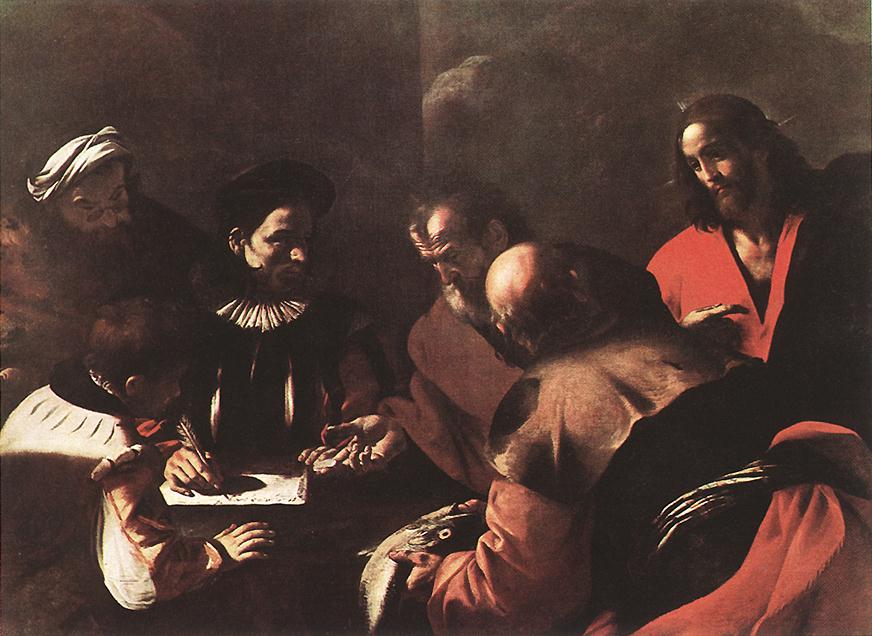
Tribute Money
Mattia Preti
c. 1640
Oil on canvas, 193 x 143 cm
Pinacoteca di Brera, Milan
19
posted on
10/15/2011 8:56:09 PM PDT
by
annalex
(http://www.catecheticsonline.com/CatenaAurea.php)
To: All
Arlington Catholic Herald
GOSPEL COMMENTARY MT 22:15-21
‘Fortiter’ … ‘suaviter’
By Fr. Paul Scalia
In setting their trap for Jesus, the Pharisees and Herodians begin with flattery: “Teacher, we know that you are a truthful man and that you teach the way of God in accordance with the truth. And you are not concerned with anyone's opinion, for you do not regard a person's status” (Mt 22:16). Now, that last sentence may not seem particularly flattering. It makes Our Lord sound insensitive and callous. Other translations bring this out even more. In one they say, “neither carest thou for any (man): for thou regardest not the person of men.” Odd flattery, that. So what does it mean?
On one hand, the Pharisees and Herodians — flatterers that they are — have seized on a truth: Our Lord does not change or dilute His teaching to please His listeners. On many occasions Our Lord’s words disappoint and/or infuriate people. But their anger does not prompt Him to change His teaching. He came to testify to the truth (cf. Jn 18:37), and that cannot be done by a man who says only what people want to hear. In short, Our Lord is not a slave to human respect. He does not allow ridicule, rejection and persecution to deter Him from the truth.
On the other hand, we should be suspicious of the words of praise from Our Lord’s enemies. They drip with insincerity. In a certain way indeed their words are manifestly false: Our Lord’s incarnation considers our situation and status most graciously. He Who is beyond our capacity to comprehend or know comes to us in our human nature and speaks to us in human words and actions. He does indeed regard our status. He does in fact respect our status — in the sense that He proportions His manner of teaching to our human weakness. He does not run roughshod over us or place His truth beyond our reach. He comes to us in our weakness.
In short, Jesus is firm in the content of His teaching but gracious in the communication of it. Fortiter in re, suaviter in modo. So goes the old Latin adage: Strong in matter, gentle in manner. In this He sets the standard. We should be strong about what we believe, but peaceful, gracious and courteous in the living out of it. Catholic dogma is, in the end, for the salvation of souls — to bring each soul the peace of God. We should live our faith in a way consonant with the peace it is meant to bring.
This principle holds tenfold for our efforts in evangelization: We must communicate the truth in a gracious manner. Strong in truth, gentle in communication. We should neither wilt at disagreement or even persecution, nor should we clobber people over the head at the first sign of resistance. It is not enough for us to communicate the truth. It is not enough for the content to be correct. We must also communicate in a manner that our listeners can receive, that is proportioned to their situation. The truth of God’s grace ought to be communicated graciously.
Fr. Scalia is pastor of St. John the Beloved Parish in McLean.
20
posted on
10/15/2011 9:07:08 PM PDT
by
Salvation
("With God all things are possible." Matthew 19:26)
Navigation: use the links below to view more comments.
first 1-20, 21-40, 41-56 next last
Disclaimer:
Opinions posted on Free Republic are those of the individual
posters and do not necessarily represent the opinion of Free Republic or its
management. All materials posted herein are protected by copyright law and the
exemption for fair use of copyrighted works.
FreeRepublic.com is powered by software copyright 2000-2008 John Robinson


