
Information: St. Anselm
| Feast Day: | April 21 |
| Born: | 1033 at Aosta, Piedmont, Italy |
| Died: | 21 April 1109 at Canterbury, England |
| Canonized: | 1492 by Pope Alexander IV |
| Major Shrine: | Canterbury Cathedral |
Posted on 04/20/2011 11:30:38 PM PDT by Salvation
April 21, 2011
Holy Thursday
Chrism Mass
Reading 1
Responsorial Psalm
Reading 2
Gospel
Reading 1
The Spirit of the Lord GOD is upon me,
because the LORD has anointed me;
He has sent me to bring glad tidings to the lowly,
to heal the brokenhearted,
To proclaim liberty to the captives
and release to the prisoners,
To announce a year of favor from the LORD
and a day of vindication by our God,
to comfort all who mourn;
To place on those who mourn in Zion
a diadem instead of ashes,
To give them oil of gladness in place of mourning,
a glorious mantle instead of a listless spirit.
You yourselves shall be named priests of the LORD,
ministers of our God shall you be called.
I will give them their recompense faithfully,
a lasting covenant I will make with them.
Their descendants shall be renowned among the nations,
and their offspring among the peoples;
All who see them shall acknowledge them
as a race the LORD has blessed.
R. (2) For ever I will sing the goodness of the Lord.
“I have found David, my servant;
with my holy oil I have anointed him.
That my hand may always be with him;
and that my arm may make him strong.”
R. For ever I will sing the goodness of the Lord.
“My faithfulness and my mercy shall be with him;
and through my name shall his horn be exalted.
He shall say of me, ‘You are my father,
my God, the Rock, my savior!’“
R. For ever I will sing the goodness of the Lord.
[Grace to you and peace] from Jesus Christ, who is the faithful witness,
the firstborn of the dead and ruler of the kings of the earth.
To him who loves us and has freed us from our sins by his Blood,
who has made us into a Kingdom, priests for his God and Father,
to him be glory and power forever and ever. Amen.
Behold, he is coming amid the clouds,
and every eye will see him,
even those who pierced him.
All the peoples of the earth will lament him.
Yes. Amen.
“I am the Alpha and the Omega,” says the Lord God,
“the one who is and who was and who is to come, the Almighty.”
Jesus came to Nazareth, where he had grown up,
and went according to his custom
into the synagogue on the sabbath day.
He stood up to read and was handed a scroll of the prophet Isaiah.
He unrolled the scroll and found the passage where it was written:
The Spirit of the Lord is upon me,
because he has anointed me
to bring glad tidings to the poor.
He has sent me to proclaim liberty to captives
and recovery of sight to the blind,
to let the oppressed go free,
and to proclaim a year acceptable to the Lord.
Rolling up the scroll, he handed it back to the attendant and sat down,
and the eyes of all in the synagogue looked intently at him.
He said to them,
“Today this Scripture passage is fulfilled in your hearing.”
If you aren’t on this ping list NOW and would like to be on it, please Freepmail me.
The Sacred Triduum: Holy Thursday, Good Friday and Easter. The Mystery of Faith
The Easter Triduum in General
On the Holy Triduum
Celebrating the Lord’s Passover (The Triduum): Suggestions for Personal and Family Prayer
Holy Week and the Triduum
The Triduum and 40 Days
We Will Relive the Passion, Death and Resurrection
Spiritual Reading for the Sacred Triduum and Easter
The Easter Triduum
THE EASTER TRIDUUM: With Fr. John Corapi
| Feast Day: | April 21 |
| Born: | 1033 at Aosta, Piedmont, Italy |
| Died: | 21 April 1109 at Canterbury, England |
| Canonized: | 1492 by Pope Alexander IV |
| Major Shrine: | Canterbury Cathedral |
Then Anselm became sick. Soon after he got better, his mother died. He was still young and rich and clever and began to think only of having good times. He had forgotten God. But soon Anselm became bored and wanted something better, something more important.
He argued with his father and ran away to France. There he visited the holy Abbot Lanfranc of the famous monastery of Bec. Anselm became Lanfranc's very close friend and the abbot brought him to God. Then at the age of twenty-seven, Anselm decided to become a Benedictine monk.
Anselm was a warm-hearted man who loved his brother monks dearly. Even those who first disliked him soon became his friends. When he was forty-five years old he was made the abbot of Bec.
He finally had to leave Bec to become archbishop of Canterbury in England, but he told the monks that they would always live in his heart. The people of England loved and respected Anselm. But King William II treated him badly.
Anselm had to leave the country and flee into exile in 1097 and again in 1103. King William even refused to let Anselm go to Rome to see the pope for advice. But Anselm went anyway. He stayed with the pope until the king died. Then he went back to his parish in England.
Even though he had many duties that kept him very busy, St. Anselm always found time to write important books of philosophy and theology. He also wrote down the many wonderful instructions he had given the monks about God.
They were very happy about that. He used to say: "Would you like to know the secret of being happy in the monastery? Forget the world and be happy to forget it. The monastery is a real heaven on earth for those who live only for Jesus."
St. Anselm died on April 21, 1109. He was declared a great teacher or Doctor of the Church.

We thank you, God our Father, for those who have responded to your call to priestly ministry.
Accept this prayer we offer on their behalf: Fill your priests with the sure knowledge of your love.
Open their hearts to the power and consolation of the Holy Spirit.
Lead them to new depths of union with your Son.
Increase in them profound faith in the Sacraments they celebrate as they nourish, strengthen and heal us.
Lord Jesus Christ, grant that these, your priests, may inspire us to strive for holiness by the power of their example, as men of prayer who ponder your word and follow your will.
O Mary, Mother of Christ and our mother, guard with your maternal care these chosen ones, so dear to the Heart of your Son.
Intercede for our priests, that offering the Sacrifice of your Son, they may be conformed more each day to the image of your Son, our Lord and Savior, Jesus Christ. Amen.
Saint John Vianney, universal patron of priests, pray for us and our priests
This icon shows Jesus Christ, our eternal high priest.The gold pelican over His heart represents self-sacrifice.
The border contains an altar and grapevines, representing the Mass, and icons of Melchizedek and St. Jean-Baptiste Vianney.
Melchizedek: king of righteousness (left icon) was priest and king of Jerusalem. He blessed Abraham and has been considered an ideal priest-king.
St. Jean-Baptiste Vianney is the patron saint of parish priests.
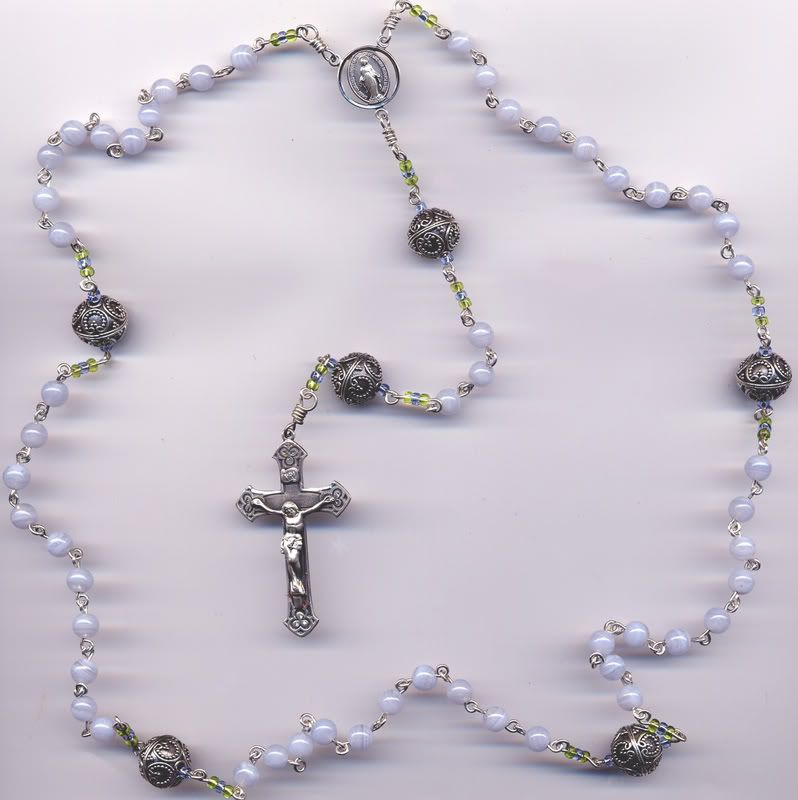
1. Sign of the Cross: In the name of the Father, and of the Son, and of the Holy Spirit. Amen.
2. The Apostles Creed: I BELIEVE in God, the Father almighty, Creator of heaven and earth. I believe in Jesus Christ, His only Son, our Lord. He was conceived by the power of the Holy Spirit and born of the Virgin Mary. He suffered under Pontius Pilate, was crucified, died, and was buried. He descended to the dead. On the third day He rose again. He ascended into heaven and sits at the right hand of God, the Father Almighty. From thence He shall come to judge the living and the dead. I believe in the Holy Spirit, the holy catholic Church, the communion of saints, the forgiveness of sins, the resurrection of the body, and the life everlasting. Amen.
3. The Lord's Prayer: OUR Father, who art in heaven, hallowed be Thy name. Thy kingdom come. Thy will be done on earth as it is in heaven. Give us this day our daily bread and forgive us our trespasses as we forgive those who trespass against us. And lead us not into temptation, but deliver us from evil. Amen.
4. (3) Hail Mary: HAIL Mary, full of grace, the Lord is with thee. Blessed art thou amongst women and blessed is the fruit of thy womb, Jesus. Holy Mary, Mother of God, pray for us sinners, now, and in the hour of our death. Amen. (Three times)
5. Glory Be: GLORY be to the Father, and to the Son, and to the Holy Spirit. As it was in the beginning, is now, and ever shall be, world without end. Amen.
Fatima Prayer: Oh, my Jesus, forgive us our sins, save us from the fires of hell, lead all souls to heaven, especially those in most need of your mercy.
Announce each mystery, then say 1 Our Father, 10 Hail Marys, 1 Glory Be and 1 Fatima prayer. Repeat the process with each mystery.
End with the Hail Holy Queen:
Hail, Holy Queen, Mother of Mercy, our life, our sweetness and our hope! To thee do we cry, poor banished children of Eve! To thee do we send up our sighs, mourning and weeping in this vale of tears! Turn then, most gracious advocate, thine eyes of mercy towards us; and after this, our exile, show unto us the blessed fruit of thy womb, Jesus!
O clement, O loving, O sweet Virgin Mary! Pray for us, O holy Mother of God, that we may be made worthy of the promises of Christ.
Final step -- The Sign of the Cross
The Mysteries of the Rosary
By tradition, Catholics meditate on these Mysteries during prayers of the Rosary.
The biblical references follow each of the Mysteries below.
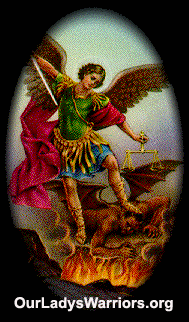
St. Michael, the Archangel, defend us in battle
Be our protection against the wickedness
and snares of the devil;
May God rebuke him, we humbly pray,
and do thou, O Prince of the heavenly host,
by the power of God,
Cast into hell Satan and all evil spirits
who prowl through the world seeking the ruin of souls.
Amen
+
From an Obama bumper sticker on a car:
"Pray for Obama. Psalm 109:8"
Psalm 109:8
"Let his days be few; and let another take his place of leadership."
PLEASE JOIN US -
|
ACT OF ADORATION
I adore Thee, 0 Jesus, true God and true Man, here present in the Holy Eucharist, humbly kneeling before Thee and united in spirit with all the faithful on earth and all the blessed in heaven. In deepest gratitude for so great a blessing, I love Thee, my Jesus, with my whole heart, for Thou art all perfect and all worthy of love.
Give me grace nevermore in any way to offend Thee, and grant that I, being refreshed by Thy Eucharistic presence here on earth, may be found worthy to come to the enjoyment with Mary of Thine eternal and everblessed presence in heaven. Amen.
FAITH IN THE EUCHARIST
O my God, I firmly believe that Thou art really and corporally present in the Blessed Sacrament of the altar. I adore Thee here present from the very depths of my heart, and I worship Thy sacred presence with all possible humility. O my soul, what joy to have Jesus Christ always with us, and to be able to speak to Him, heart to heart, with all confidence. Grant, O Lord, that I, having adored Thy divine Majesty here on earth in this wonderful Sacrament, may be able to adore it eternally in Heaven. Amen.
PETITION
Believing that Thou, my God, hast in any way revealed to us--grieving for all my sins, offenses and negligences--hoping in Thee, O Lord, who wilt never let me be confounded--thanking Thee for this supreme gift, and for all the gifts of Thy goodness--loving Thee, above all in this sacrament of Thy love--adoring Thee in this deepest mystery of Thy condescension: I lay before Thee all the wounds and wants of my poor soul, and ask for all that I need and desire. But I need only Thyself, O Lord; I desire none but Thee--Thy grace, and the grace to use well Thy graces, the possession of Thee by grace in this life, and the possession of Thee forever in the eternal kingdom of Thy glory.
FOR THE PEACE OF CHRIST
O most sacred, most loving heart of Jesus, Thou art concealed in the Holy Eucharist, and Thou beatest for us still. Now as then Thou sayest, "With desire I have desired." I worship Thee, then, with all my best love and awe, with my fervent affection, with my most subdued, most resolved will. O make my heart beat with Thy heart. Purify it of all that is earthly, all that is proud and sensual, all that is hard and cruel, of all perversity, of all disorder, of all deadness. So fill it with Thee, that neither the events of the day nor the circumstances of the time may have power to ruffle it; but that in Thy love and Thy fear it may have peace. --Cardinal Newman
ACT OF LOVE
I believe Thou art present in the Blessed Sacrament, O Jesus. I love Thee and desire Thee. Come into my heart. I embrace Thee, O never leave me. I beseech Thee, O Lord Jesus, may the burning and most sweet power of Thy love absorb my mind, that I may die through love of Thy love, who wast graciously pleased to die through love of my love. --St. Francis of Assisi
ACT OF REPARATION
Saint Margaret Mary Alacoque, well known in connection with devotion to the Sacred Herat of Jesus, led the way in making reparation to Jesus in the Blessed Sacrament for the coldness and ingratitude of men. This prayer of hers can become our own as we attempt to make amends for our own and others' neglect of the great Sacrament of His love, the Eucharist.
O kind and merciful savior, from my heart I earnestly desire to return Thee love for love. My greatest sorrow is that Thou art not loved by men, and, in particular, that my own heart is so cold, so selfish, so ungrateful. Keenly aware of my own weakness and poverty, I trust that Thy own grace will enable me to offer Thee an act of pure love. And I wish to offer Thee this act of love in reparation for the coldness and neglect that are shown to Thee in the sacrament of Thy love by Thy creatures. O Jesus, my supreme good, I love Thee, not for the sake of the reward which Thou hast promised to those who love Thee, but purely for Thyself. I love Thee above all things that can be loved, above all pleasures, and above myself and all that is not Thee, promising in the presence of heaven and earth that I will live and die purely and simply in Thy holy love, and that if to love Thee thus I must endure persecution and suffering I am completely satisfied, and I will ever say with Saint Paul: Nothing "will be able to separate us from the love of God." 0 Jesus, supreme master of all hearts, I love Thee, I adore Thee, I praise Thee, I thank Thee, because I am now all Thine own. Rule over me, and transform my soul into the likeness of Thyself, so that it may bless and glorify Thee forever in the abode of the saints.
--Saint Margaret Mary Alacoque
OFFERING
My Lord, I offer Thee myself in turn as a sacrifice of thanksgiving. Thou hast died for me, and I in turn make myself over to Thee. I am not my own. Thou hast bought me; I will by my own act and deed complete the purchase. My wish is to be separated from everything of this world; to cleanse myself simply from sin; to put away from me even what is innocent, if used for its own sake, and not for Thine. I put away reputation and honor, and influence, and power, for my praise and strength shall be in Thee. Enable me to carry out what I profess. Amen. --Cardinal Newman
Prayer Source: Prayer Book, The by Reverend John P. O'Connell, M.A., S.T.D. and Jex Martin, M.A., The Catholic Press, Inc., Chicago, Illinois, 1954

The best, the surest , and the most effective way of establishing everlasting peace on the face of the earth is through the great power of perpetual adoration of the Blessed Sacrament." -- Pope John Paul II
The Institution of the Eucharist in Scripture [Catholic Caucus]
How the Mass is a sacrifice, and why so many deny this doctrine (Catholic/Orthodox Caucus)
New book connects the Eucharist with its Jewish roots
THE SACRAMENT OF THE EUCHARIST (sections 3 only) {Ecumenical Thread}
THE SACRAMENT OF THE EUCHARIST (sections 1&2 only) {Ecumenical Thread}
The Perfect Sacrifice: When Heaven Comes to Earth [Catholic Caucus]
The Real Presence [Church Fathers on the Holy Eucharist, cont'd ]
Is the Mass a Sacrifice? (Once and for all, Heb 9-10) {Catholic/Orthodox Caucus}
Radio Replies Second Volume - Holy Communion
The Real presence of Christ in the Eucharist {Catholic/Orthodox Caucus}
Radio Replies Second Volume - The Sacrifice of the Mass
Radio Replies Second Volume - Holy Eucharist
Thanksgiving, the Prophets and the Eucharist
Lex Orandi, Lex Credendi, Lex Vivendi. As we Worship, So we Believe, So we Live
[CATHOLIC/ORTHODOX CAUCUS] 5th Luminous Mystery: Institution of the Eucharist (Patristic Rosary)
Wounded in the house of them that loved Me
[CATHOLIC / ORTHODOX CAUCUS] Eucharist is Jesus' greatest gift to us, teaches Pope Benedict XVI
[CATHOLIC CAUCUS] What makes Jesus present in the Eucharist: broadening one's view.
Pope's Q--A at End of Priestly Year Pt 4 "We Celebrate,..Meditate..on Eucharist" [Catholic Caucus]
Sacrifice, Transubstantiation, and Real Presence (Pope Benedict XVI) [Catholic Caucus]
Catholic Caucus: Eucharist is the Heart of God
[CATHOLIC CAUCUS]'Body, Blood, Soul and Divinity': The Miracle and Gift of the Most Holy Eucharist
A Secular Eucharist
Paul and the Eucharist
Centered in the Eucharist
Who Can Receive Communion? (Catholic Caucus)
Respect For Christ In The Eucharist – One Priest’s Perspective
Catholic Biblical Apologetics: Opportunities of Grace: The Eucharist: The Lord's Supper
THE PRIEST IN THE COMMUNION RITES - Liturgy Prepares for Reception of the Eucharist
Novena with Saint Peter Julian Eymard for Prayer in the Presence of the Blessed Sacrament [Prayer]
THE PRIEST IN THE COMMUNION RITES - Liturgy Prepares for Reception of the Eucharist
Boston Cardinal: Church Needs 'Clear' Injunction Denying Pro-Abortion Pols Communion
Benedict XVI calls priests to protect communion between God and man
Eucharist: Holy Sacrifice
Fr. Men: The Eucharist [Cath-Orth caucus]
Catholics in Costa Rica outraged by disrespect toward Eucharist [Catholic Caucus]
The Institution of the Eucharist in Scripture
St Anthony and the Real Presence
The Essentials of the Catholic Faith, Part Two: Channels of Grace: The Eucharist
EWTN - October 29 - 8PM - Fr. Antoine and the Eucharist
The Role of the Bishop of Rome in the Communion of the Church in the First Millennium
Radio Replies First Volume - Holy Eucharist
The Institution of the Eucharist in Scripture
Catholic Caucus: The Spiritual Combat Ch 54. MANNER IN WHICH WE OUGHT TO RECEIVE...BLESSED SACRAMENT
Catholic Caucus: The Spiritual Combat: Ch 53. CONCERNING THE MOST HOLY SACRAMENT OF THE EUCHARIST
A Few Texts From Saint Cyril of Jerusalem on the Eucharist
Catholic Devotional: On Visiting Jesus Christ In the Blessed Sacrament
The Early Christians Believed in the Real Presence of Christ in the Eucharist
Focus on the Real Presence
A Chinese Girl-True Story That Inspired Bishop Fulton Sheen- Eucharist Adoration (Catholic Caucus)
Doubting Thomases(Eucharist); the Pitfalls of Folly(Catholic Caucus)
Rainbow sash-wearers prohibited from receiving [the Eucharist at Cathedral of St. Paul]
The significance of Holy Thursday (institution of the Eucharist and priesthood)
Our Lady of the Most Blessed Sacrament [Catholic Caucus]
The Catechism of St. Thomas Aquinas THE HOLY EUCHARIST
Holy Communion and Non-Catholics (with a Quiz!)
Beginning Catholic: The Eucharist: In the Presence of the Lord Himself [Ecumenical]
Beginning Catholic: Receiving the Lord in Holy Communion [Ecumenical]
Faithful Invited to Follow Pope, Adore Eucharist [Catholic Caucus]
Christmas and the Eucharist(Catholic/Orthodox Caucus)
Eucharist kneeling request sparks controversy [Catholic Caucus]
Eucharist vs. the Word (which is more important in the Catholic Church)
Christ the Miracle Worker in the Eucharist(Catholic Caucus)
Imitating Christ in the Eucharist(Catholic Caucus)
The Eucharist - the Lord's Sacrifice, Banquet and Presence (OPEN)
Pope Calls Eucharist History's Greatest Revolution [OPEN]
A Brief Catechism for Adults - Lesson 22: The Sacrament of the Holy Eucharist (Holy Communion)
A series of reflections from St. Peter Julian Eymard Blessed Sacrament(Catholic Caucus)
Eucharist, Holy Meal
Imitating Christ in the Eucharist
Christmas and the Eucharist
Prayer Before the Blessed Sacrament
This is My Body, This is My Blood
THE HOLY EUCHARIST IS THE WHOLE CHRIST
Gift Of Life, Gift Eternal: The Most Holy Eucharist and the Holy Sacrifice of the Mass
Area worshipers march to celebrate Holy Eucharist
Grace of the Eucharist is secret to holy priests, says Pope
The Disposition of Priests [Valid Mass, Valid Holy Eucharist?]
The Body of Christ?
Holy Sacrifice, Living Sacrament
Knights of the Eucharist
The Banquet of Corpus Christi - "Why did Jesus give us His Body and Blood?"
The Eucharist: Eternity and Time Together
Restored Order of the Sacraments of Initiation? Confirmation and First Eucharist together? (Vanity)
Reflections of Cardinal Ratzinger on the Eucharist
THE HOLY EUCHARIST: NOURISHMENT TO FINISH OUR COURSE
The Eucharist in Scripture - Part 1 - Old Testament
LITANY OF REPARATION TO OUR LORD IN THE BLESSED SACRAMENT
Benediction of the Blessed Sacrament
POPE GRANTS PLENARY INDULGENCE FOR YEAR OF THE EUCHARIST
New Plenary Indulgence to Mark Year of the Eucharist
Kneeling and Faith in the Eucharist
The Immaculate Conception and the Eucharist, a course in Christian culture in Tashkent
The Year of the Eucharist by Bishop Donald Wuerl
"While We're At It": What can we do to show that the Eucharist is a communal activity?
CATHOLICS AND BAPTISTS WITNESSED UNUSUAL IMAGES IN BLESSED SACRAMENT
The Discipline of the Eucharist Holy See Releases Redemptionis Sacramentum...
Vatican: Matters to be observed or to be avoided regarding the Most Holy Eucharist (April 23, 2004)
Devotion to the Holy Eucharist Advances Devotion to Jesus' Person
New rules on the Holy Eucharist on Holy Thursday
The Reverence due to the Holy Eucharist
The Holy Face of Jesus Christ as appeared on the Holy Eucharist
The Fourth Cup: The Sacrament of the Eucharist [Holy Thursday] [Passover]
Holy Father stresses Need of Devotion to Holy Eucharist outside of Mass: Pope Paul VI
April 2011
Pope Benedict XVI's Intentions
General Intention: That the Church may offer new generations, through the believable proclamation of the Gospel, ever-new reasons of life and hope.
Missionary Intention: That missionaries, with the proclamation of the Gospel and their witness of life, may bring Christ to all those who do not yet know Him.
Isaiah 61:1-3a, 6a, 8b-9
The herald of good tidings
[6] [B]ut you shall be called the priests of the Lord,
men shall speak of you as the ministers of our God;
[8] I will faithfully give them their recompense,
and I will make an everlasting covenant with them.
[9] Their descendants shall be known among the nations,
and their offspring in the midst of the peoples;
all who see them shall acknowledge them,
that they are a people whom the Lord has blessed.
*******************************************************************************************
Commentary:
1-11. Into the air of great joy reflected in the previous hymn, the prophet inserts
this very important oracle about the new messenger (vv. 1-3). The rest of the
chapter is made up of three stanzas that celebrate the wonders of the holy city.
These can be seen in profound, spiritual renewal (vv. 4-7), perfect fulfillment of
the promises made to the ancient patriarchs (vv. 8-9), and joy-in-worship, com-
parable to that of a bridegroom and bride, or that of the farmer on seeing a rich
harvest (vv. 10-11).
The remarkable events and features of the city point to the time of the End, the
time of the Lord’s definitive, salvific intervention. In this context, these new
things are ultimate and definitive. Because in the New Testament the Church is
called “God’s building” (1 Cor 3:9), erected on the foundation of the apostles (1
Cor 3:11), Christian tradition has seen the new, glorious Jerusalem as a symbol
of the Church that makes its way through this world and will be made manifest
at the end of time (cf. Catechism of the Catholic Church, 756-757).
61:1-3 This very compact oracle depicts the eschatological messenger speaking
a soliloquy. It is one of the key passages in the book of Isaiah. It clearly has con-
nections with the songs of the Servant, especially the second song (49:1-6). The
pouring out of the Spirit involves anointing, as in the case of the king (cf. 11:2)
and in that of the Servant of the Lord (42:1). But the messenger is more than a
king, more than a prophet, more than the community dwelling in the holy city in
the latter days. His mission is a dual one – to be a messenger and a comforter.
As a messenger, like a king’s ambassador in times of war, he brings good ti-
dings: he announces redemption for slaves, release for prisoners (cf. Jer 34:8,
17). His message proclaims a new order of things where there will be no need for
repression, and where concord and well-being will prevail. The “year of the Lord’s
favour” (v. 2) is similar to the jubilee year (cf. Lev 25:9-19) or the sabbatical year
(cf. Ex 21:2-11; Jer 34:14; Ezek 46:17) in the sense that it is a day chosen by
the Lord, and different from any other; but here it means the point at which God
shows himself to be most gracious and bestows definitive salvation (cf. 49:8). It
is also called the day of vengeance (v. 2) because on that day, essentially a day
of good news, the wicked, too, will receive their just deserts.
As a comforter he will bind up hearts broken by illness or misfortune, and give
encouragement to those who weep and revive those who mourn in Zion. When
the comforter is the Lord or a messenger of his (cf. 40:1), one can expect him
to re-establish his people, to set things right, (the way they were at the begin-
ning), to renew the broken Covenant and re-establish institutions that had been
dismantled, that is, bring about a situation where everything is in plentiful supply.
People who have reached rock bottom (the poor, prisoners, etc.) will be given a
place of honour on that day, and a wreath, perfume and a mantle of praise (v. 3).
In sacred texts of the post-exilic period, the concept of the “poor” (or “afflicted”:
cf. note m) already went beyond the social category of those least well off: it
had a religious connotation, meaning “the humble”, those who saw themselves
as having no value before God and who simply put their faith in his divine mercy.
The final definition of the “poor” will emerge in the Beatitudes (Mt 5:3-12).
In Jesus’ time, Jewish tradition, found in the targum or Aramaic translation of the
Bible, considered the messenger described here to be a prophet (and for that rea-
son it introduced this oracle with the words “Thus says the prophet”). So, when
Jesus reads this passage in the synagogue of Nazareth he points out that “today
the scripture has been fulfilled” (Lk 4:21) and that he is the prophet of whom Isai-
ah spoke. By doing so, he is saying that he is the Messiah, the Christ, the one
anointed by the Holy Spirit (cf. Is 11:2), not so much as a king but as a prophet
who proclaims salvation. Ever since then, Christian teaching sees Jesus as the
last messenger sent by the Holy Spirit: “The prophet presents the Messiah as
the one who comes in the Holy Spirit, the one who possesses the fullness of this
Spirit in himself and at the same time for others, for Israel, for all the nations, for
all humanity. The fullness of the Spirit of God is accompanied by many different
gifts, the treasures of salvation, destined in a particular way for the poor and suf-
fering, for all those who open their hearts to these gifts — sometimes through the
painful experience of their own existence — but first of all through that interior avai-
lability which comes from faith. The aged Simeon, the ‘righteous and devout man’
upon whom ‘rested the Holy Spirit’, sensed this at the moment of Jesus’ presenta-
tion in the Temple, when he perceived in him the ‘salvation … prepared in the pre-
sence of all peoples’ at the price of the great suffering – the Cross – which he
would have to embrace together with his Mother. The Virgin Mary, who “had con-
ceived by the Holy Spirit’, sensed this even more clearly, when she pondered in
her heart the “mysteries” of the Messiah, with whom she was associated” (Domi-
num et Vivficantem, 16).
*********************************************************************************************
Source: “The Navarre Bible: Text and Commentaries”. Biblical text from the
Revised Standard Version and New Vulgate. Commentaries by members of
the Faculty of Theology, University of Navarre, Spain.
Published by Four Courts Press, Kill Lane, Blackrock, Co. Dublin, Ireland, and
by Scepter Publishers in the United States
From: Revelation 1:5-8
Address and Greeting
To him who loves us and has freed us from our sins by his blood [6] and made
us a kingdom, priests to his God and Father, to him be glory and dominion for
ever and ever. Amen. [7] Behold, he is coming with the clouds, and every eye
will see him, every one who pierced him; and all tribes of the earth will wail on
account of him. Even so. Amen.
[8] “I am the Alpha and the Omega,” says the Lord God, who is and who was
and who is to come, the Almighty.”
*********************************************************************************************
Commentary:
5-6. Three messianic titles taken from Psalm 89:28-38 are given a new meaning
in the light of fulfillment of Christian faith and applied to Jesus Christ. He is “the
faithful witness” of the fulfillment of God’s Old Testament promises of a Savior,
a son of David (cf. 2 Sam 7:14; Rev 5:5;), for it is Christ who has in fact brought
about salvation. That is why, later on in the book, St John calls Jesus Christ “the
Amen” (Rev 3:4) — which is like saying that through what Christ did God has rati-
fied and kept his word; St John also calls him “Faithful and True” (Rev 19:11), be-
cause God’s fidelity and the truth of his promises have been manifested in Jesus.
This is to be seen in the Resurrection, which made Jesus “the first-born from the
dead”, in the sense that the Resurrection constituted a victory in which all who
abide in him share (cf. Col 1:18). Christ is also “the ruler of kings on earth” be-
cause he is Lord of the world: this will be clearly seen when he comes a second
time, but his dominion is already making itself felt because he has begun to con-
quer the power of sin and death.
The second part of v. 5 and all v. 6 are a kind of paean in praise of Christ recal-
ling his great love for us as expressed in his words, “Greater love has no man
than this, that a man lay down his life for his friends” (Jn 15:13). Christ’s love for
us knows no bounds: his generosity led him to sacrifice his life by the shedding
of his blood, which redeemed us from our sins. There was nothing we could have
done to redeem ourselves. “All were held captive by the devil”, St Augustine com-
ments, “and were in the thrall of demons; but they have been rescued from that
captivity. The Redeemer came and paid the ransom: he shed his blood and with
it purchased the entire orb of the earth” (”Enarrationes in Psalmos”, 95, 5).
Not content with setting us free from our sins, our Lord gave us a share in his
kingship and priesthood. “Christ the Lord, high priest taken from among men (cf.
Heb 5:1-5), made the new people ‘a kingdom of priests to his God and Father’
(Rev 1:6; cf. 5:9-10). The baptized, by regeneration and the anointing of the Holy
Spirit, are consecrated to be a spiritual house and a holy priesthood, that through
all the works of Christian men and women they may offer spiritual sacrifices and
proclaim the perfection of him who has called them out of darkness into his mar-
velous light (cf. 1 Pet 2:4-10)” (Vatican II, “Lumen Gentium”, 10).
7. Christ’s work is not finished. He has assembled his holy people on earth to
bring them enduring salvation, and he will be revealed in all his glory to the whole
world at the end of time. Although the text speaks in the present tense—”he is
coming with the clouds”—this should be understood as referring to the future: the
prophet was seeing future events as if they were actually happening (cf. Dan 7:
13). This will be the day of final victory, when those who crucified Jesus, “every
one who pierced him” (cf. Zech 12:10; Jn 19:37), will be astonished by the gran-
deur and glory of the crucified One. “The Sacred Scriptures inform us that there
are two comings of the Son of God—one when he assumed human flesh for our
salvation in the womb of a virgin; the other when he shall come at the end of the
world to judge all mankind [...]; and if, from the beginning of the world that day
of the Lord, on which he was clothed with our flesh, was sighed for by all as the
foundation of their hope of deliverance; so also, after the death and ascension
of the Son of God, we should make that other day of the Lord the object of our
most earnest desires, ‘awaiting our blessed hope, the appearing of the glory of
our great God’ (Titus 2:13)” (”St Pius V Catechism”, I, 8, 2).
Commenting on this passage of the Apocalypse, St Bede says: “He who at his
first coming came in a hidden way and in order to be judged (by men) will then
come in a manifest way. (John) recalls these truths in order to help the Church
bear its suffering: now it is being persecuted by its enemies, later it will reign at
Christ’s side” (”Explanatio Apocalypsis”, 1, 1).
The joy of those who put their hope in this glorious manifestation of Christ will
contrast with the pains of those who reject God’s love and mercy to the very end.
“Then all the tribes of the earth will mourn, and they will see the Son of man co-
ming in the clouds of heaven with power and great glory” (Mt 24:30).
8. The coming of the Lord in glory, the climax of his dominion, is guaranteed by
the power of God, the absolute master of the world and its destiny. Alpha and
Omega are the first and last letters of the Greek alphabet; here they are used
to proclaim that God is the beginning and end of all things, of the world and of
history; he is present at all times — times past, present and future.
*********************************************************************************************
Source: “The Navarre Bible: Text and Commentaries”. Biblical text from the
Revised Standard Version and New Vulgate. Commentaries by members of
the Faculty of Theology, University of Navarre, Spain.
Published by Four Courts Press, Kill Lane, Blackrock, Co. Dublin, Ireland, and
by Scepter Publishers in the United States.
From: Luke 4:16-21
Jesus Preaches in Nazareth
[18] The Spirit of the Lord is upon Me,
because He has anointed Me to preach good news to the poor.
He has sent Me to proclaim release to the captives
and recovering of sight to the blind,
to set at liberty those who are oppressed,
[19] to proclaim the acceptable year of the Lord.”
[20] And He closed the book, and gave it back to the attendant, and sat down;
and the eyes of all in the synagogue were fixed on Him. [21] And He began to
say to them, “Today this scripture has been fulfilled in your hearing. [22] And all
spoke well of Him, and wondered at the gracious words which proceeded out of
His mouth; and they said, “Is this not Joseph’s son?”
*********************************************************************************************
Commentary:
16-30. For the Jews the Sabbath was a day of rest and prayer, as God comman-
ded (Exodus 20:8-11). On that day they would gather together to be instructed
in Sacred Scripture. At the beginning of this meeting they all recited the “Shema”,
a summary of the precepts of the Lord, and the “eighteen blessings”. Then a pas-
sage was read from the Book of the Law—the Pentateuch—and another from the
Prophets. The president invited one of those present who was well versed in the
Scriptures to address the gathering. Sometimes someone would volunteer and
request the honor of being allowed to give this address—as must have happened
on this occasion. Jesus avails Himself of this opportunity to instruct the people
(cf. Luke 4:16ff), as will His Apostles later on (cf. Acts 13:5, 14, 42, 44; 14:1;
etc.). The Sabbath meeting concluded with the priestly blessing, recited by the
president or by a priest if there was one present, to which the people answered
“Amen” (cf. Numbers 6:22ff).
18-21. Jesus read the passage from Isaiah 61:1-2 where the prophet announces
the coming of the Lord, who will free His people of their afflictions. In Christ this
prophecy finds its fulfillment, for He is the Anointed, the Messiah whom God has
sent to His people in their tribulation. Jesus has been anointed by the Holy Spirit
for the mission the Father has entrusted to Him. “These phrases, according to
Luke (verses 18-19), are His first messianic declaration. They are followed by the
actions and words known through the Gospel. By these actions and words Christ
makes the Father present among men” (John Paul II, “Dives In Misericordia”, 3).
The promises proclaimed in verses 18 and 19 are the blessings God will send
His people through the Messiah. According to Old Testament tradition and Jesus’
own preaching (cf. note on Matthew 5:3), “the poor” refers not so much to a parti-
cular social condition as to a very religious attitude of indigence and humility to-
wards God, which is to be found in those who, instead of relying on their posses-
sions and merits, trust in God’s goodness and mercy. Thus, preaching good
news to the poor means bringing them the “good news” that God has taken pity
on them. Similarly, the Redemption, the release, which the text mentions, is to
be understood mainly in a spiritual, transcendental sense: Christ has come to
free us from the blindness and oppression of sin, which, in the last analysis, is
slavery imposed on us by the devil. “Captivity can be felt”, St. John Chrysostom
teaches in a commentary on Psalm 126, “when it proceeds from physical ene-
mies, but the spiritual captivity referred to here is worse; sin exerts a more severe
tyranny, evil takes control and blinds those who lend it obedience; from this spiri-
tual prison Jesus Christ rescued us” (”Catena Aurea”). However, this passage is
also in line with Jesus’ special concern for those most in need. “Similarly, the
Church encompasses with her love all those who are afflicted by human misery
and she recognizes in those who are poor and who suffer the image of her poor
and suffering Founder. She does all in her power to relieve their need and in them
she strives to serve Christ” (Vatican II, “Lumen Gentium”, 8).
18-19. The words of Isaiah which Christ read out on this occasion describe very
graphically the reason why God has sent His Son into the world—to redeem men
from sin, to liberate them from slavery to the devil and from eternal death. It is
true that in the course of His public ministry Christ, in His mercy, worked many
cures, cast out devils, etc. But He did not cure all the sick people in the world,
nor did He eliminate all forms of distress in this life, because pain, which entered
the world through sin, has a permanent redemptive value when associated with
the sufferings of Christ. Therefore, Christ worked miracles not so much to re-
lease the people concerned from suffering, as to demonstrate that He had a
God-given mission to bring everyone to eternal salvation.
The Church carries on this mission of Christ: “Go therefore and make disciples
of all nations, baptizing them in the name of the Father and of the Son and of the
Holy Spirit, teaching them to observe all that I have commanded you; and lo, I
am with you always, to the close of the age” (Matthew 28:19-20). These simple
and sublime words, which conclude the Gospel of St. Matthew, point out “the ob-
ligation to preach the truths of faith, the need for sacramental life, the promise of
Christ’s continual assistance to His Church. You cannot be faithful to our Lord if
you neglect these supernatural demands—to receive instruction in Christian faith
and morality and to frequent the Sacraments. It is with this mandate that Christ
founded His Church [...]. And the Church can bring salvation to souls only if she
remains faithful to Christ in her constitution and teaching, both dogmatic and
moral.
“Let us reject, therefore, the suggestion that the Church, ignoring the Sermon on
the Mount, seeks a purely human happiness on earth, since we know that her on-
ly task is to bring men to eternal glory in Heaven. Let us reject any purely natura-
listic view that fails to value the supernatural role of divine grace. Let us reject ma-
terialistic opinions that exclude spiritual values from human life. Let us equally re-
ject any secularizing theory which attempts to equate the aims of the Church
with those of earthly states, distorting its essence, institutions and activities into
something similar to those of temporal society” (St. J. Escriva, “In Love with the
Church”, 23 and 31).
18. The Fathers of the Church see in this verse a reference to the three persons
of the Holy Trinity: the Spirit (the Holy Spirit) of the Lord (the Father) is upon Me
(the Son); cf. Origen, “Homily 32”. The Holy Spirit dwelt in Christ’s soul from the
very moment of the Incarnation and descended visibly upon Him in the form of a
dove when He was baptized by John (cf. Luke 3:21-22).
“Because He has anointed Me”: this is a reference to the anointing Jesus re-
ceived at the moment of His Incarnation, principally through the grace of the hy-
postatic union. “This anointing of Jesus Christ was not an anointing of the body
as in the case of the ancient kings, priests and prophets; rather it was entirely
spiritual and divine, because the fullness of the Godhead dwells in Him substan-
tially” (”St. Pius X Catechism”, 77). From this hypostatic union the fullness of all
graces derives. To show this, Jesus Christ is said to have been anointed by the
Holy Spirit Himself — not just to have received the graces and gifts of the Spirit,
like the saints.
19. “The acceptable year”: this is a reference to the jubilee year of the Jews,
which the Law of God (Leviticus 25:8) lays down as occurring every fifty years,
symbolizing the era of redemption and liberation which the Messiah would usher
in. The era inaugurated by Christ, the era of the New Law extending to the end
of the world, is “the acceptable year”, the time of mercy and redemption, which
will be obtained definitively in Heaven.
The Catholic Church’s custom of the “Holy Year” is also designed to proclaim
and remind people of the redemption brought by Christ, and of the full form it will
take in the future life.
20-22. Christ’s words in verse 21 show us the authenticity with which He
preached and explained the Scriptures: “Today this scripture has been fulfilled
in your hearing.” Jesus teaches that this prophecy, like the other main prophe-
cies in the Old Testament, refers to Him and finds its fulfillment in Him (cf. Luke
24:44 ff). Thus, the Old Testament can be rightly understood only in the light of
the New — as the risen Christ showed the Apostles when He opened their minds
to understand the Scriptures (cf. Luke 24:45), an understanding which the Holy
Spirit perfected on the day of Pentecost (cf. Acts 2:4).
22-29. At first the people of Nazareth listened readily to the wisdom of Jesus’s
words. But they were very superficial; in their narrow-minded pride they felt hurt
that Jesus, their fellow-townsman, had not worked in Nazareth the wonders He
had worked elsewhere. They presume they have a special entitlement and they
insolently demand that He perform miracles to satisfy their vanity, not to change
their hearts. In view of their attitude, Jesus performs no miracle (His normal res-
ponse to lack of faith: cf., for example, His meeting with Herod in Luke 23:7-11);
He actually reproaches them, using two examples taken from the Old Testament
(cf. 1 Kings 17:9 and 2 Kings 5:14), which show that one needs to be well-dis-
posed if miracles are to lead to faith. His attitude so wounds their pride that they
are ready to kill Him. This whole episode is a good lesson about understanding
Jesus. We can understand Him only if we are humble and are genuinely resolved
to make ourselves available to Him.
*********************************************************************************************
Source: “The Navarre Bible: Text and Commentaries”. Biblical text from the
Revised Standard Version and New Vulgate. Commentaries by members of
the Faculty of Theology, University of Navarre, Spain.
Published by Four Courts Press, Kill Lane, Blackrock, Co. Dublin, Ireland, and
by Scepter Publishers in the United States.
| Thursday, April 21, 2011 Holy Thursday Evening – Mass of the Lord's Supper |
||
|
|
|
|
The Angel of the Lord declared to Mary:
Behold the handmaid of the Lord: Be it done unto me according to Thy word.
And the Word was made Flesh: And dwelt among us.
Amen. |
Disclaimer: Opinions posted on Free Republic are those of the individual posters and do not necessarily represent the opinion of Free Republic or its management. All materials posted herein are protected by copyright law and the exemption for fair use of copyrighted works.


