
Posted on 11/17/2009 7:34:58 AM PST by NYer
Not in a concert, but in a Mass. It will be conducted by Domenico Bartolucci, the most brilliant interpreter of Palestrina's music alive today. He was removed as head of the Sistine Chapel choir twelve years ago, but now, with Pope Benedict, has finally been rehabilitated. (he probably means 'restored')
ROME, November 16, 2009 – Among the arts to be represented in the Sistine Chapel next Saturday, November 21, at the highly anticipated meeting with Pope Benedict XVI, music is perhaps the one that has suffered the most from the divorce that has taken place between artists and the Church.
The distress in music has been the first to afflict the Church. Because while the masterpieces of Christian painting, sculpture, and architecture still remain accessible to all, even if they are ignored and misunderstood, great music literally disappears from the churches if no one performs it anymore.
And one can effectively speak of an almost generalized disappearance when it comes to those treasures of Latin liturgical music that are Gregorian chant, polyphony, the organ.
Fortunately, however, during the same days when pope Joseph Ratzinger will be seeking to reestablish a fruitful relationship with art, the organ and great polyphonic music will return to give the best of themselves in the basilicas of Rome.
They will again be heard not only in the form of a concert, but also in the living environment of liturgical action.
The culmination will be on Thursday, November 19, at the hour of evening when the setting sun blazes through the apse of Saint Peter's. That evening, making his solemn return to the basilica to conduct a sung Mass, will be the greatest living interpreter of the Roman school of polyphony, the one that has come down from Giovanni Pierluigi of Palestrina – whom Giuseppe Verdi called the "everlasting father" of Western music – to our own day.
This interpreter of undisputed greatness is Domenico Bartolucci, for decades the "permanent maestro" of the Sistine Chapel choir, the pope's choir, and now, at age 93, still a miraculously adept director of Palestrina.
Bartolucci is a living witness of the elimination of liturgical music from the West, but also of its possible rebirth. The last time he conducted a complete Mass by Palestrina at Saint Peter's was all the way back in 1963. The last time he conducted the Sistine Chapel choir was in 1997. That year he was brutally dismissed, and without him the choir fell into a modest state.
But now comes its return – powerfully symbolic – to the basilica built over the tomb of the prince of the apostles.
At the Mass on November 19 at Saint Peter's, Bartolucci will not conduct Palestrina, but his own polyphonic compositions, in alternation with Gregorian chants from the Mass "De Angelis." And with that, he will show how it is possible to cherish the best of the Latin musical tradition even within the canons of the modern post-conciliar liturgy: just what Pope Benedict wants, as a profound theologian of the liturgy and a music connoisseur. Naturally, Bartolucci's secret dream is to return at last to conduct the emblematic "Pope Marcellus Mass" by Palestrina, as a Mass celebrated by Benedict XVI at Saint Peter's.
The anticipation that these signs will soon be followed by a change of the conductor of the Sistine Chapel choir will become more impatient from this point forward.
***
The context within which Bartolucci will return to conduct a Mass at Saint Peter's is that of the International Festival of Sacred Music and Art, which is held each fall in the basilicas of Rome, and is marking its eighth edition this year.
The program this year has two focal points: Roman polyphony, and organ music.
The inauguration will be on Wednesday, November 18, in the basilica of Saint John Lateran, with a concert in the spirit of Palestrina, conducted by Bartolucci himself.
Another event in the spirit of the Roman school of polyphony, in a modern reinterpretation, will be the oratory "Paolo e Fruttuoso," composed and conducted by Valentino Miserachs Grau, conductor of the choir of the basilica of Saint Mary Major and head of the Pontifical Institute of Sacred Music, the Vatican's "conservatory."
The second focal point will be the organ. The Fondazione Pro Musica e Arte Sacra has completed the restoration of the huge Tamburini organ of the Roman basilica of Saint Ignatius of Loyola. Its inauguration will involve a series of four concerts performed by the organists who supervised the restoration – Goettsche, Paradell, and Piermarini – and by other world famous organ virtuosos like Leo Krämer and Johannes Skudlik.
The organ is the main instrument of liturgical music, which unforgivably has been overlooked despite the fact that it is present in countless churches. But non-liturgical music will also be included in the program, with works by Mendelssohn, Mozart, Schubert. On November 20, the octet of strings and woodwinds of the Wiener Philarmoniker will perform Schubert's sublime Octet in F Major in the basilica of Saint Mary Major.
The Wiener Philarmoniker is a constant presence at the Festival of Sacred Art and Music. Of all the major orchestras of the world, it is the one in which sacred and profane music are most closely intertwined.
For the next edition of the festival, the Wiener Philarmoniker has already agreed to perform Bruckner's ninth symphony and a selection from Wagner's "Tristan und Isolde" in the Roman basilica of Saint Paul's Outside the Walls, on October 26, 2010.
__________
The detailed program of the concerts at the basilicas of Rome:
> VIII International Festival of Sacred Music and Art, November 18-22, 2009
__________
A newly published book with critical essays, interviews, and documents concerning Maestro Bartolucci:
"Domenico Bartolucci e la musica sacra del Novecento", a cura di Enzo Fagiolo, Armelin Musica, Padova, 2009, pp. 248, euro 29,00.
The three most recent CD's he has recorded (the third is about to be released), with a cappella music for choir by Palestrina, Victoria, Lasso, Morales, and Bartolucci himself:
> La polifonia della scuola romana, prima edizione
> La polifonia della scuola romana, seconda edizione
> La polifonia della scuola romana, terza edizione
It is instructive to reread the interview that Maestro Domenico Bartolucci gave to "L'espresso," no. 29, 2006.
> I Had a Dream: The Music of Palestrina and Gregory the Great Had Come Back (21.7.2006)
__________
All the articles from www.chiesa on this topic:
> Focus on ART AND MUSIC
__________
PAPAL MEETING WITH ARTISTS - LIVE (90 mins)
Pope Benedict XVI will meet with artists in the Sistine Chapel.
Sat 11/21/09 5:00 AM ET / 2 AM PT - LIVE
Sat 11/21/09 6:30 AM ET / 3:30 AM PT - ENCORE
We Episcopalians/Anglicans have always appreciated and cherished this music. We still use it in our liturgy. I love singing Palestrina. I tell the Catholics in the chamber choir that I sing in that “We stole the best of your music.”
I’ve also noticed that when I’m at a Catholic Mass and hymns are being sung that very few of the people present are singing the hymn - to the point that I stand out even in a crowd of 200 or 300 people. Why?
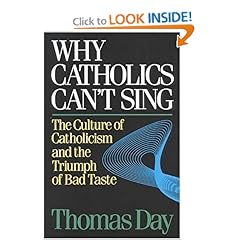
This is just hypothesis based on personal experience. I still have good memories of the Mass before VCII opened a window and invited change to the liturgy. Back then, the Mass was in Latin. The altar boys said the responses in Latin and the choir sang the hymns. The folks in the pews - prayed silently. VCII changed all that. Now the Mass was in English and the congregation was encouraged to respond orally. They were also expected to learn hymns and sing in Church. Naturally, there was much hesitancy at first because it was such a strange experience. With great encouragement, verbal responses and singing (not chanting) caught on. In the process, a great musical heritage was shelves. Now that the Latin Mass is coming back, albeit slowly, choral groups are being formed and the old hymnals dusted off. Ultimately, it takes a good voice to sing Palestrina.
At least our parish has reclaimed it . . . . We sing a LOT of Palestrina, also a lot of Byrd, Tallis, Farrant, Batten, Weelkes and other fun English composers . . . . but we are fortunate in our music program.
It doesn’t take a good voice so much as (1) counting (2) PAYING ATTENTION! If you have a mediocre voice but you can count and read music, and you learn your part, there isn’t a choir director on earth who will care about your voice. I’m living proof.
After VatII, although the Church in America began to officially encourage the congregation to participate visibly in the Mass (by, among other things, singing) ... the Church in America presented musical dreck for us to sing. A modern hymnal in which "Eagles' Wings" is among the better (least bad?) options is a pathetic hymnal indeed.
The Irish thing actually leads to the problem you describe. If your priest doesn't know and understand liturgical music, then almost anything can happen in the music department. And I think that's what happened in a lot of parishes with musically uneducated rectors.
Analogous example: one of my former Episcopal rectors invited some idiot "liturgical" "dancer" to perform during Mass one time. He would NEVER have invited an unqualified musician to play, because any Episcopal minister worth his salt understands good music . . . but he knew absolutely nothing about dance and this woman couldn't have danced her way out of a paper bag. I ripped our poor rector up one side and down the other and ridiculed him to boot. Since I have actual qualifications in dance (minor in college, instructor's certificate, auditioned performance team) he knew I was right -- and he had no answer to my question "Why didn't you ASK somebody who knows something about dance?"
I think the same thing goes on in Catholic churches - the folks in charge know little about music, so they put anybody who CALLS himself (or herself) a musician in charge and don't have the education to see how awful the results are.
There's also a "St, Michael Hymnal", which seems decent.
Unfortunately, the vast majority of parishes are saddled with either the repugnant "Glory and Praise" or the egregious "Music Issue" from OCP.
If I had my way, every copy of "Glory and Praise" (and "Gather", while we're at it) would be stuffed into a spare ballistic missile and sent into deep space. I don't even want the ashes contaminating the planet.
I don’t cringe ... I stand (or sit) in stone-cold silence.
or,
See the Blessed Sacrament
where the tabernacle went
in that little alcove there off to the side.
When folks come into the nave,
they don't know how to behave:
should they genuflect or not?
They can't decide.
Here I am, Lord. Where are You, Lord?
Are You in that niche way over there?
Once You were, Lord, front and center.
Now I cannot see You anywhere.
Thanks to the (now sadly defunct) Society for a Moratorium on the Music of Marty Haugen and David Haas.
It’s not a hypothesis. I’m making no proposal as to WHY I didn’t hear much singing. It’s an observation based on a my attendance at a few Catholic masses (christenings, weddings and funerals).
Having said that; in the Anglican liturgical tradition as it has developed, and especially in the Anglo-Catholic (”high church”) part that my congregation (heck, my Diocese) is a part of, it’s common that the congregation sings a processional hymn as the choir, servers and priest enter the church, sings the Gloria, chants the Psalm between the Old and New Testament readings, sings a gradual before and after the Gospel, sings the Sursum Corda at the start of the Eucharist, sings a hymn right after Communion, sings “Holy, Holy Holy Lord, God of power and might” (I forget what the title of that is), sings the acclamation (”Christ has died, Christ is risen, Christ will come again”) and sings a recessional hymn as we all file out.
The choir (I sing first tenor) also sings all of this leading the congregation and also sings an Offertory Anthem, which is where I’ve gotten my exposure to Palestrina, Tallis, and a good many others. Depending on the occasion (say, Easter, All Saints Day, etc.) the Priest may sing part of the service. The Episcopal Hymnal has setting to sing just about the entire service, including the Lord’s Prayer, the Nicene Creed, etc., etc. That’s less common, however.
I imagine that when the Church of England started out that it’s services followed the same course as Catholic services of the time did. But Queen Elizabeth I loved singing, apparently, and changes were made. In any case, congregational singing has always been a part of Episcopal services my whole life.
After having attended a number of funerals where “Eagle’s Wings” was presented (I’m often asked to be a pall bearer for my wife’s relatives) I’ve instructed my wife that when I die she is to place a baseball bat in my coffin. Should the music director start in on Eagle’s Wings, she is to open my casket, remove the bat and use it to assault the offending musician(s) until they stop.
I have also left instructions with my daughter as to the brand and type of whiskey that is to be provided at my wake.
All other details of my wake and funeral are left to their discretion. I figured I’ve covered the important parts.
Good news.
Of course, we do that now too.
We've also started singing the Psalm in 4 part Anglican chant, which confused the congregation at first, but I think they're getting into it.
Trust me on this one. Pew Catholics will RARELY join in singing when there is a choir. This notion was corroborated when I began attending Divine Liturgy at a Maronite Catholic Church. The entire liturgy is chanted back and forth between the celebrant and the congregation. Our organist will soon turn 70 and purchased an apartment in Florida last year where he spends the winter months. We have no backup organist. I don't know about other parts of the country but here in the northeast, organists are remunerated. We do not have those funds. Our organist serves out of love. Being retired, he can make himself available for midweek funerals or weekend weddings because these are sparse. When the organist is away, as he has been for the past 2 weeks, it is a struggle for the priest to get the congregation to chant the responses. When the organist is present, they rely totally upon him. Last year, we went 4 months without his services. Father reminded us that the monks sing without an organist :-). It's a constant struggle to get participation from Catholics, be it in the Latin or Eastern Rite Churches.
Disclaimer: Opinions posted on Free Republic are those of the individual posters and do not necessarily represent the opinion of Free Republic or its management. All materials posted herein are protected by copyright law and the exemption for fair use of copyrighted works.