Skip to comments.
Catholic Caucus: Daily Mass Readings, 07-08-09
USCCB.org/New American Bible ^
| 07-08-09
| New American Bible
Posted on 07/07/2009 11:57:46 PM PDT by Salvation
July 8, 2009
Gn 41:55-57; 42:5-7a, 17-24a
When hunger came to be felt throughout the land of Egypt
and the people cried to Pharaoh for bread,
Pharaoh directed all the Egyptians to go to Joseph
and do whatever he told them.
When the famine had spread throughout the land,
Joseph opened all the cities that had grain
and rationed it to the Egyptians,
since the famine had gripped the land of Egypt.
In fact, all the world came to Joseph to obtain rations of grain,
for famine had gripped the whole world.
The sons of Israel were among those
who came to procure rations.
It was Joseph, as governor of the country,
who dispensed the rations to all the people.
When Joseph's brothers came and knelt down before him
with their faces to the ground,
he recognized them as soon as he saw them.
But Joseph concealed his own identity from them
and spoke sternly to them.
With that, he locked them up in the guardhouse for three days.
On the third day Joseph said to his brothers:
"Do this, and you shall live; for I am a God-fearing man.
If you have been honest,
only one of your brothers need be confined in this prison,
while the rest of you may go
and take home provisions for your starving families.
But you must come back to me with your youngest brother.
Your words will thus be verified, and you will not die."
To this they agreed.
To one another, however, they said:
"Alas, we are being punished because of our brother.
We saw the anguish of his heart when he pleaded with us,
yet we paid no heed;
that is why this anguish has now come upon us."
Reuben broke in,
"Did I not tell you not to do wrong to the boy?
But you would not listen!
Now comes the reckoning for his blood."
The brothers did not know, of course,
that Joseph understood what they said,
since he spoke with them through an interpreter.
But turning away from them, he wept.
Ps 33:2-3, 10-11, 18-19
R. (22) Lord, let your mercy be on us, as we place our trust in you.
Give thanks to the LORD on the harp;
with the ten-stringed lyre chant his praises.
Sing to him a new song;
pluck the strings skillfully, with shouts of gladness.
R. Lord, let your mercy be on us, as we place our trust in you.
The LORD brings to nought the plans of nations;
he foils the designs of peoples.
But the plan of the LORD stands forever;
the design of his heart, through all generations.
R. Lord, let your mercy be on us, as we place our trust in you.
But see, the eyes of the LORD are upon those who fear him,
upon those who hope for his kindness,
To deliver them from death
and preserve them in spite of famine.
R. Lord, let your mercy be on us, as we place our trust in you.
Mt 10:1-7
Jesus summoned his Twelve disciples
and gave them authority over unclean spirits to drive them out
and to cure every disease and every illness.
The names of the Twelve Apostles are these:
first, Simon called Peter, and his brother Andrew;
James, the son of Zebedee, and his brother John;
Philip and Bartholomew,
Thomas and Matthew the tax collector;
James, the son of Alphaeus, and Thaddeus;
Simon the Cananean, and Judas Iscariot
who betrayed Jesus.
Jesus sent out these Twelve after instructing them thus,
"Do not go into pagan territory or enter a Samaritan town.
Go rather to the lost sheep of the house of Israel.
As you go, make this proclamation: 'The Kingdom of heaven is at hand.'"
TOPICS: Catholic; General Discusssion; Prayer; Worship
KEYWORDS: catholic; catholiclist; ordinarytime
Navigation: use the links below to view more comments.
first 1-20, 21-32 next last
For your reading, reflection, faith-sharing, comments, questions, discussion.
1
posted on
07/07/2009 11:57:46 PM PDT
by
Salvation
To: nickcarraway; Lady In Blue; NYer; ELS; Pyro7480; livius; Catholicguy; RobbyS; markomalley; ...
Alleluia Ping!
Please notify me via FReepmail if you would like to be added to or taken off the Alleluia Ping List.
2
posted on
07/08/2009 12:00:36 AM PDT
by
Salvation
(With God all things are possible.)
To: All
3
posted on
07/08/2009 12:01:58 AM PDT
by
Salvation
(With God all things are possible.)
To: All
Pray a Rosary each day for our nation.
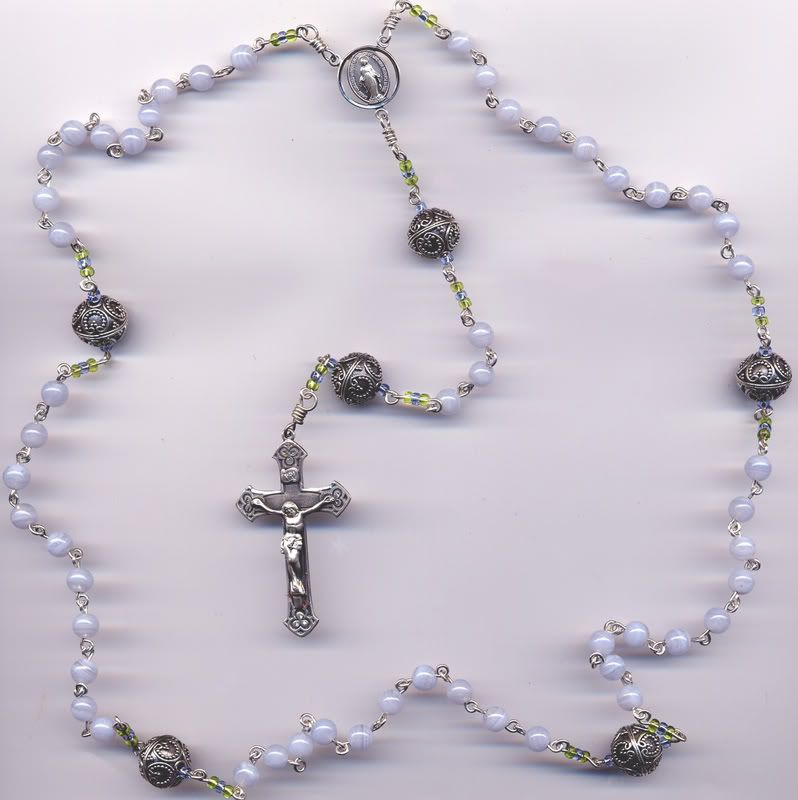
1. Sign of the Cross: In the name of the Father, and of the Son, and of the Holy Spirit. Amen.
2. The Apostles Creed: I BELIEVE in God, the Father almighty, Creator of heaven and earth. I believe in Jesus Christ, His only Son, our Lord. He was conceived by the power of the Holy Spirit and born of the Virgin Mary. He suffered under Pontius Pilate, was crucified, died, and was buried. He descended to the dead. On the third day He rose again. He ascended into heaven and sits at the right hand of God, the Father Almighty. From thence He shall come to judge the living and the dead. I believe in the Holy Spirit, the holy catholic Church, the communion of saints, the forgiveness of sins, the resurrection of the body, and the life everlasting. Amen.
3. The Lord's Prayer: OUR Father, who art in heaven, hallowed be Thy name. Thy kingdom come. Thy will be done on earth as it is in heaven. Give us this day our daily bread and forgive us our trespasses as we forgive those who trespass against us. And lead us not into temptation, but deliver us from evil. Amen.
4. (3) Hail Mary: HAIL Mary, full of grace, the Lord is with thee. Blessed art thou amongst women and blessed is the fruit of thy womb, Jesus. Holy Mary, Mother of God, pray for us sinners, now, and in the hour of our death. Amen. (Three times)
5. Glory Be: GLORY be to the Father, and to the Son, and to the Holy Spirit. As it was in the beginning, is now, and will be forever. Amen.
Fatima Prayer: Oh, my Jesus, forgive us our sins, save us from the fires of hell, lead all souls to heaven, especially those in most need of your mercy.
Announce each mystery, then say 1 Our Father, 10 Hail Marys, 1 Glory Be and 1 Fatima prayer. Repeat the process with each mystery.
End with the Hail Holy Queen:
Hail, Holy Queen, Mother of Mercy, our life, our sweetness and our hope! To thee do we cry, poor banished children of Eve! To thee do we send up our sighs, mourning and weeping in this vale of tears! Turn then, most gracious advocate, thine eyes of mercy towards us; and after this, our exile, show unto us the blessed fruit of thy womb, Jesus!
O clement, O loving, O sweet Virgin Mary! Pray for us, O holy Mother of God, that we may be made worthy of the promises of Christ.
Final step -- The Sign of the Cross
The Mysteries of the Rosary
By tradition, Catholics meditate on these Mysteries during prayers of the Rosary.
The biblical references follow each of the Mysteries below.
The Glorious Mysteries
(Wednesdays and Sundays)
1.The Resurrection (Matthew 28:1-8, Mark 16:1-18, Luke 24:1-12, John 20:1-29) [Spiritual fruit - Faith]
2. The Ascension (Mark 16:19-20, Luke 24:50-53, Acts 1:6-11) [Spiritual fruit - Christian Hope]
3. The Descent of the Holy Ghost (Acts 2:1-13) [Spiritual fruit - Gifts of the Holy Spirit]
4. The Assumption [Spiritual fruit - To Jesus through Mary]
5. The Coronation [Spiritual fruit - Grace of Final Perseverance]
4
posted on
07/08/2009 12:03:47 AM PDT
by
Salvation
(With God all things are possible.)
To: All
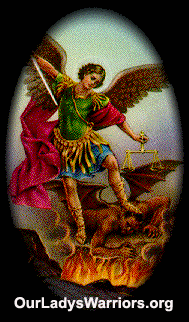
~ PRAYER ~

St. Michael, the Archangel, defend us in battle
Be our protection against the wickedness
and snares of the devil;
May God rebuke him, we humbly pray,
and do thou, O Prince of the heavenly host,
by the power of God,
Cast into hell Satan and all evil spirits
who prowl through the world seeking the ruin of souls.
Amen
+
5
posted on
07/08/2009 12:04:36 AM PDT
by
Salvation
(With God all things are possible.)
To: All
6
posted on
07/08/2009 12:05:29 AM PDT
by
Salvation
(With God all things are possible.)
To: All
July Devotion: The Precious Blood
July Devotion: The Precious Blood
Like the Sacred Wounds of Jesus, His Precious Blood deserves special honor because of its close relation to the Sacred Passion. That honor was given to it from the beginning by the Apostles who praised its redeeming power. (Rom. 5:9 "we are justified by His blood"; Heb. 13:12 "and so Jesus also, that He might sanctify the people by His blood, suffered outside the gate"; 1 John 1:7 "and the blood of Jesus Christ, His Son, cleanses us from all sin.")
The Church has always held devotion to the Precious Blood in high esteem. We continue to recognize and publicly acknowledge the profound indebtedness of the whole human race to Christ, Priest and Victim.
Standing at the foot of the cross, we see Jesus' head, hands, feet, and side pouring out streams of precious blood. It is precious because it:
· Redeems us and atones for our sins. Through His precious blood we are reconciled to God, made one with Him. Death ceases to be death and heaven's gates are opened to us.
· Cleanses us from all sin.
· Preserves us and keeps us safe from the grasp of evil. When the Father sees us washed in the Blood of the Lamb we are spared.
· Comforts us. It is the constant reminder that Jesus - true God and true man suffered and died to save us and to open heaven to us because He loves us.
· Sanctifies us. The same blood that justifies by taking away sin, continues to work within us. Its action gives us the grace to continue on the path toward the Kingdom of God. It assists us in achieving our new nature, leading us onward in subduing sin and in following the commands of God.
Jesus shed His precious blood seven times during His life on earth. They events were:
· Jesus shed His Blood in the Circumcision
· Jesus shed His Blood whilst praying in the Garden of Olives
· Jesus shed His Blood in the scourging
· Jesus shed His Blood in the crowning with thorns
· Jesus shed His Blood while carrying His cross
· Jesus shed His Blood in the crucifixion
· Jesus shed His Blood and water when His side was pierced
The Power of the Precious Blood
"I adore You, O Precious Blood of Jesus, flower of creation, fruit of virginity, ineffable instrument of the Holy Spirit, and I rejoice at the thought that You came from the drop of virginal blood on which eternal Love impressed its movement; You were assumed by the Word and deified in His person. I am overcome with emotion when I think of Your passing from the Blessed Virgin's heart into the heart of the Word, and, being vivified by the breath of the Divinity, becoming adorable because You became the Blood of God." (St. Albert the Great)
At their recent meeting, the U.S. Conference of Catholic Bishops had continuous Adoration of the Blessed Sacrament for "healing and peace." They encouraged parishes and communities to have ongoing Adoration of the Blessed Sacrament. In these dark months of woundedness, pain and violence we need to turn to the Precious Blood of Jesus in the Eucharist, for healing, peace, and light.
"What power we have in the Precious Blood of Jesus in the Holy Eucharist! He is there to protect us, to be our refuge and our redemption. (In Exodus 12, God told Moses to have His chosen people mark their door posts with the blood of an unblemished lamb, during the first Passover. Those who did this were spared when the Angel of the death passed by). This is why Archbishop Sheen said that we must call down the Blood of the Lamb, Jesus in the Most Blessed Sacrament. For, he warned, when we stop calling down the Blood of the Lamb, we start calling down the blood of each other." (From our book Bread of Life)
"And the Lamb on the throne will shepherd them. He will lead them to springs of life-giving water" (Rev 7:17).
"In the tumultuous events of our time, it is important to look to the Eucharist: it must be at the heart of the life of priests and consecrated people; the light and strength of spouses in putting into practice their commitment to fidelity, chastity and the apostolate; the ideal in education and in training children, adolescents and young people; the comfort and support of those who are troubled, of the sick and all who are weeping in the Gethsemane of life." (Pope John Paul II)
Precious Blood of Jesus, save us!
"The only time our Lord asked the Apostles for anything was the night when He went into His agony. But as often in the history of the church since that time, evil was awake, but the disciples were asleep. That is why there came out of His anguished and lonely Heart a sigh: 'Could you not watch one hour with Me?'" (Mt 26:40). Not for an hour of activity did he plead, but for an hour of friendship (Archbishop Fulton J. Sheen).
St. Maria Goretti, Patroness of Youth & Children of Mary, Feast-July 6 St. Maria of Italy (1890-1902), couldn't wait to make her First Communion. She wanted to receive Jesus in the Holy Eucharist so that she could become more beautiful and pure like Him; she wanted Him to live in her, close to her heart. After she received Jesus in the Blessed Sacrament for the first time, she stayed in Church for a long time after Mass to talk to Him. Maria's family lived with and worked for a farmer. His son Alessandro kept trying to make Maria sin against purity. One day, when everyone else was working, Alessandro grabbed Maria and tried to make her sin. Maria kept crying out for him to stop, and each time she did, he stabbed her. Courageously, Maria resisted him and was stabbed fourteen times. St. Maria died the next day.
"Look at Maria Goretti.... Like her, be capable of defending your purity of heart and body. Be committed to the struggle against evil and sin. Always esteem and love, purity and virginity." (Pope John Paul II, 1990) A Prayer for Priests
O my God, help those priests who are faithful to remain faithful; to those who are falling, stretch forth Your Divine Hand that they may grasp it as their support. In the great ocean of Your mercy, lift those poor unfortunate ones who have fallen, that being engulfed therein they may receive the grace to return to Your Great Loving Heart. Amen. Precious Blood of Jesus, protect them!A
menHe
"Amen, amen, I say to you, unless you eat the flesh of the Son of Man and drink his blood, you do not have life within you" (Jn 6:53). The Eucharist is the fruit of our Lords Passion. Jesus gave up His Body on the cross so that He may give you His Body in the Holy Eucharist. Jesus poured out His very last drop of Blood on the cross so that He may fill you with His Divine Love each time that you receive Him in Holy Communion and visit Him in Eucharistic Adoration!
"The Eucharist, in the Mass and outside of the Mass, is the Body and Blood of Jesus Christ, and is therefore deserving of the worship that is given to the living God, and to Him alone" (Pope John Paul II, September 29, 1979, Phoenix Park, Ireland)
"The bread and wine, fruit of human hands, transformed through the power of the Holy Spirit into the body and blood of Christ, become a pledge of the 'new heaven and new earth,' announced by the Church in her daily mission." "In Christ, whom we adore present in the mystery of the Eucharist, the father uttered his final word with regard to humanity and human history." "To live the Eucharist, it is necessary, as well, to spend much time in adoration in front of the Blessed Sacrament, something which I myself experience every day drawing from it strength, consolation and assistance." "How could the Church fulfill her vocation without cultivating a constant relationship with the Eucharist, without nourishing herself with this food which sanctifies, without founding her missionary activity on this indispensable support?" "To evangelize the world there is need of apostles who are 'experts' in the celebration, adoration and contemplation of the Eucharist" (Pope John Paul II, World Mission Message 2004).
The Power of the Precious Blood of Jesus in the Holy Eucharist
"The Precious Blood belongs in an especial manner to men. Much more, therefore, does God invite them to come to its heavenly baths, and receive therein, not only the cleansing of their souls, but the power of a new and amazing life. Every doctrine in theology is a call to the Precious Blood. Every ceremony in the Church tells of it . . . . Every supernatural act is a growth of it. Everything that is holy on earth is either a leaf, bud, blossom or fruit of the Blood of Jesus. To its fountains God calls the sinner, that he may be lightened of his burdens. There is no remission of him in anything else. Only there is his lost sonship to be found. The saints are no less called by God to these invigorating streams. It is out of the Precious Blood that men draw martyrdoms, vocations, celebacies, austerities, heroic charities, and all the magnificent graces of high sanctity. The secret nourishment of prayer is from those fountains" (Father Faber, The Precious Blood).
Chaplet of the Most Precious Blood
The Traditional Feast of the Most Precious Blood of Our Lord Jesus Christ (Catholic Caucus)
Devotion to the Precious Blood
DOCTRINE OF THE BLOOD OF CHRIST
,,,,,,,,,,,,,,,,,,,,And More on the Precious Blood
Litany of the Most Precious Blood of Our Lord Jesus Christ
NOTHING IS MORE POTENT AGAINST EVIL THAN PLEADING THE PRECIOUS BLOOD OF CHRIST
FORMER PENTECOSTAL RELATES MIRACLE THAT OCCURRED WITH THE PRECIOUS BLOOD
Litany of the Most Precious Blood of Jesus
St.Gaspar:Founder of the Society of the Precious Blood[AKA The Hammer of Freemasons]
Most Precious Blood of Our Lord Jesus Christ

7
posted on
07/08/2009 12:06:30 AM PDT
by
Salvation
(With God all things are possible.)
To: All
Holy Father's Prayer Intentions For July 2009
General: That the Christians of the Middle East may live their faith in full freedom and be an instrument of peace and reconciliation.
Mission: That the Church may be the seed and nucleus of a humanity reconciled and reunited in God's one and only family, thanks to the testimony of all the faithful in every country in the world.
8
posted on
07/08/2009 12:07:35 AM PDT
by
Salvation
(With God all things are possible.)
To: All
From: Genesis 41:55-57; 42:5-7a, 17-24a
Joseph, the Pharaoh’s Administrator (Continuation)
[55] When all the land of Egypt was famished, the people cried to Pharaoh for
bread; and Pharaoh said to all the Egyptians, “Go to Joseph; what he says to
you, do.” [56] So when the famine had spread over all the land, Joseph opened
all the storehouses, and sold to the Egyptians, for the famine was severe in the
land of Egypt. [57] “Moreover, all the earth came to Egypt to Joseph to buy
grain, because the famine was severe over all the earth.
The Sons of Jacob Go Down to Egypt (Continuation)
[5] Thus the Sons of Israel came to buy among the others who came, for the
famine was in the land of Canaan. [6] Now Joseph was governor over the land;
he it was who sold to all the people of the land. And Joseph’s brothers came,
and bowed themselves before him with their faces to the ground. [7a] Joseph
saw his brothers, and knew them, but he treated them like strangers and
spoke roughly to them.
Joseph Tests His Brothers by Keeping Simeon in Egypt (Continuation)
[17] And he put them all together in prison for three days. [18] 0n the third day
Joseph said to them, “Do this and you will live, for I fear God: [19] if you are ho-
nest men, let one of your brothers remain confined in your prison, and let the
rest go and carry grain for the famine of your households, [20] and bring your
youngest brother to me; so your words will be verified, and you shall not die.”
And they did so. [21] Then they said to one another, “In truth we are guilty con-
cerning our brother, in that we saw the distress of his soul, when he besought
us and we would not listen; therefore is this distress come upon us.” [22] And
Reuben answered them, “Did I not tell you not to sin against the lad? But you
would not listen. So now there comes a reckoning for his blood.” [23] They did
not know that Joseph understood them, for there was an interpreter between
them. [24a] Then he turned away from them and wept.
*********************************************************************************************
Commentary:
41:5357. Egypt had an elaborate irrigation system, which allowed it to protect its
food supply in periods of famine caused, no doubt, by periodic droughts in the
Middle East. Thanks to Joseph’s management at that time, the country was able
not only to relieve famine at home when the need arose but also to relieve “all the
earth” scourged by that plague. Here we see how divine providence came to the
rescue of all nations through a descendant of Abraham (cf. 12:3). Yet, despite all
the progress mankind has made, the plague of hunger continues to ravage areas
of the world even In our own time. And so, “faced with a world today where so
many people are suffering from want, the [Second Vatican] Council asks indivi-
duals and governments to remember the saying of the Fathers: ‘Feed the man
dying of hunger, because if you do not feed him you are killing him,’ and it urges
them according to their ability to share and dispose of their goods to help others,
above all by giving them aid which will enable them to help and develop them-
selves” (Vatican II, “Gaudium Et Spes”, 69).
The pharaoh himself tells the Egyptians where to find food—by having recourse
to Joseph. He is the one providentially placed by God at that time not only to
save the Egyptians but also to help Jacob and his sons, the ancestors of the
chosen people of the Old Testament. There is a profound analogy between this
Joseph who provides nourishment to Egypt and Israel, and that other Joseph, the
husband of Mary, whom God chose to care for and nourish the Holy Family, who
also hadto move to Egypt (cf. the note on 39:21-23). So the words spoken by the
pharaoh. “Go to Joseph.” can also be applied to recourse to St Joseph as an in-
tercessor to bring us to Jesus: “Who could be a better teacher for us? If you
want my advice, which I have never tired of repeating these many years, “Ite ad
Ioseph”: ‘Go to Joseph.’ He will show us definite ways, both human and divine,
to approach Jesus” (St. J. Escrivá, “Christ Is Passing By”, 38).
42:1-47:12. Here begins what we might call the second part of the history of Jo-
seph. This does not end with his own prosperity and happiness after his many
trials; it opens the way to the salvation of all his people, thereby giving effect to
God’s design. This part reaches its climax with the descent of Jacob and his
whole family into Egypt, and their settling there. The sons of Jacob travel into E-
gypt twice to buy grain (cf. chap. 42 and chaps 44-45). It may be that the writer
has drawn on two separate traditions, but still the narrative has an extraordinary
unity about it, evidencing the literary skill of the editor. It is a stirring account,
with events and emotions building up to a climax at the end, when all Jacob’s
Sons are gathered around him in Egypt.
As the story develops, we see come true the dreams Joseph had in Canaan
about his brothers and his father; initially some and eventually all of them bow
down before him. Meanwhile, due to the strategies Joseph uses, his brothers
(though not realizing what is happening) come to acknowledge and gradually con-
fess the sin they committed against him, to the point where they sincerely repent
it. We also see a sense of brotherhood and solidarity develop among them all, to
the point where they are all ready to become slaves rather than abandon Benja-
min (cf. 44: 16); and one of them, Judah, is ready to give himself up on Benjamin’s
behalf. It is only then, at this point of brotherly union, that they are able to find
again their lost brother, Joseph, and reconstitute the family of Jacob.
42:1-7. Jacob acts as a responsible family man concerned about his children’s
welfare. He is not resigned to see his family die of hunger; he thinks hard about
the situation and decides to take a risky but necessary course of action—to send
his sons to Egypt in search of food. Jacob’s sons probably joined some caravan
travelling there for the same reason. The account starts with this action on Ja-
cob’s part to explain why the Israelites went down into Egypt, leaving the land
God had promised to Abraham. It rounds off this explanation when it tells how
Jacob himself and all his family travelled to Egypt at God’s bidding (cf. 46:1-5).
The dreams Joseph told his brothers about (cf. 37:5-9) now begin to come true.
Joseph’s harshness towards them does not stem from a spirit of vengeance, it
is designed to give more dramatic interest to the story and to prepare for the
eventual reunion, once all his brothers have admitted their fault.
42:8-24. Joseph’s accusation against his brothers looks like a ruse to get them
to identify what family they belong to. It is plain to see that for them Joseph
“does not exist”. It is possible that Joseph fears for what will happen to his mo-
ther’s son, his brother Benjamin, and that that is why he insists that they bring
him to him. Maybe Joseph is conscious of his father’s pain and for that reason
keeps Simeon rather than Reuben; or, now that he knows what Reuben did
when the others wanted to kill him (cf. 37:21), maybe his decision not to detain
Reuben is a form of recognition for that action. In any event, the whole story is
told in a masterly way, and the reader’s interest is unabated. When they see
one of their brothers being taken from them by force, they begin to reflect on
what they themselves did long before—consciously disposing of a brother (they
thought that he was dead). They admit their fault and that it merits this sort of
punishment from God. Their process of conversion has started: their conscience
is beginning to accuse them. “Just as a drunkard who once he has drunk a lot
of wine is not conscious of doing damage, but later on realizes how much evil
he has done, so, too, sin, when it is being committed, darkens the mind and is
like a dense cloud that corrupts it; but, later, one’s conscience beings to wake
up and it accuses one’s mind vigorously, showing it how stupidly one has acted”
(St John Chrysostom, “Homiliae in Genesim”, 54, 2).
*********************************************************************************************
Source: “The Navarre Bible: Text and Commentaries”. Biblical text from the
Revised Standard Version and New Vulgate. Commentaries by members of
the Faculty of Theology, University of Navarre, Spain.
Published by Four Courts Press, Kill Lane, Blackrock, Co. Dublin, Ireland, and
by Scepter Publishers in the United States.
9
posted on
07/08/2009 12:08:53 AM PDT
by
Salvation
(With God all things are possible.)
To: All
From: Matthew 10:1-7
The Calling and First Mission of the Apostles
[1] And He (Jesus) called to Him His twelve disciples and gave them authority
over unclean spirits, to cast them out, and to heal every disease and every infir-
mity. [2] The names of the twelve apostles are these: first, Simon, who is called
Peter, and Andrew, his brother; James the son of Zebedee, and John his brother;
[3] Philip and Bartholomew; Thomas and Matthew the tax collector; James the
son of Alphaeus, and Thaddaeus; [4] Simon the Cananaean, and Judas Iscariot,
who betrayed Him.
[5] These twelve Jesus sent out, charging them, “Go nowhere among the Gen-
tiles, and enter no town of the Samaritans, [6] but go rather to the lost sheep of
the house of Israel. [7] And preach as you go, saying, ‘The Kingdom of Heaven
is at hand.’”
*********************************************************************************************
Commentary:
1-4. Jesus calls His twelve Apostles after recommending to them to pray to the
Lord to send laborers into His harvest (cf. Matthew 9:38). Christians’ apostolic
action should always, then, be preceded and accompanied by a life of constant
prayer: apostolate is a divine affair, not a merely human one. Our Lord starts His
Church by calling twelve men to be, as it were, twelve patriarchs of the new peo-
ple of God, the Church. This new people is established not by physical but by
spiritual generation. The names of those Apostles are specifically mentioned
here. They were not scholarly, powerful or important people: they were average,
ordinary people who responded faithfully to the grace of their calling—all of them,
that is, except Judas Iscariot. Even before His death and resurrection Jesus con-
fers on them the power to cast out unclean spirits and cure illnesses—as an
earnest of and as training for the saving mission which He will entrust to them.
The Church reveres these first Christians in a very special way and is proud to
carry on their supernatural mission, and to be faithful to the witness they bore to
the teaching of Christ. The true Church is absent unless there is uninterrupted
apostolic succession and identification with the spirit which the Apostles made
their own.
“Apostle”: this word means “sent”; Jesus sent them out to preach His Kingdom
and pass on His teaching.
The Second Vatican Council, in line with Vatican I, “confesses” and “declares”
that the Church has a hierarchical structure: “The Lord Jesus, having prayed at
length to the Father, called to Himself those whom He willed and appointed
twelve to be with Him, whom He might send to preach the Kingdom of God (cf.
Mark 3:13-19: Matthew 10:1-10). These Apostles (cf. Luke 6:13) He constituted
in the form of a college or permanent assembly, at the head of which He placed
Peter, chosen from among them (cf. John 21:15-17). He sent them first of all to
the children of Israel and then to all peoples (cf. Romans 1:16), so that, sharing
in His power, they might make all peoples His disciples and sanctify and govern
them (cf. Matthew 28:16-20; Mark 16:15; Luke 24:45-48; John 20:21-23) and thus
spread the Church and, administering it under the guidance of the Lord, shepherd
it all days until the end of the world (cf. Matthew 28:28)” (”Lumen Gentium”, 19).
1. In this chapter St. Matthew describes how Jesus, with a view to the spreading
of the Kingdom of God which He inaugurates, decides to establish a Church,
which He does by giving special powers and training to these twelve men who are
its seed.
5-15. After revealing His intention to found the Church by choosing the Twelve
(verses 1-4), in the present passage He shows that He intends to start training
these first Apostles. In other words, from early on in His public ministry He be-
gan to lay the foundations of His Church.
Everyone needs doctrinal and apostolic training to follow his Christian calling.
The Church has a duty to teach, and the faithful have a parallel duty to make
that teaching their own. Therefore, every Christian should avail of the facilities
for training which the Church offers him—which will vary according to each per-
son’s circumstances.
5-6. In His plan of salvation God gave certain promises (to Abraham and the pa-
triarchs), a Covenant and a Law (the Law of Moses), and sent the prophets. The
Messiah would be born into this chosen people, which explains why the Messiah
and the Kingdom of God were to be preached to the house of Israel before being
preached to the Gentiles. Therefore, in their early apprenticeship, Jesus restricts
the Apostles’ area of activity to the Jews, without this taking from the world-wide
scope of the Church’s mission. As we will see, much later on He charges them
to “go and make disciples of all nations” (Matthew 28:19); “Go into all the world
and preach the Gospel to the whole creation” (Mark 16:16). The Apostles also,
in the early days of the spread of the Church, usually sought out the Jewish com-
munity in any new city they entered, and preached first to them (cf. Acts 13:46).
*********************************************************************************************
Source: “The Navarre Bible: Text and Commentaries”. Biblical text from the
Revised Standard Version and New Vulgate. Commentaries by members of
the Faculty of Theology, University of Navarre, Spain.
Published by Four Courts Press, Kill Lane, Blackrock, Co. Dublin, Ireland, and
by Scepter Publishers in the United States.
10
posted on
07/08/2009 12:10:21 AM PDT
by
Salvation
(With God all things are possible.)
To: All
Scripture readings taken from the Jerusalem Bible, published and copyright © 1966, 1967 and 1968 by Darton, Longman & Todd
Mass Readings
| First reading |
Genesis 41:55-57,42:5-7,17-24 © |
|
When the whole country of Egypt began to feel the famine, the people cried out to Pharaoh for bread. But Pharaoh told all the Egyptians, ‘Go to Joseph and do what he tells you.’ There was famine all over the world. Then Joseph opened all the granaries and sold grain to the Egyptians. The famine grew worse in the land of Egypt. People came to Egypt from all over the world to buy grain from Joseph, for the famine had grown severe throughout the world.
Israel’s sons with others making the same journey went to buy grain, for there was famine in the land of Canaan. It was Joseph, as the man in authority over the country, who sold the grain to all comers. So Joseph’s brothers went and bowed down before him, their faces touching the ground. When Joseph saw his brothers he recognised them. But he did not make himself known to them, and he spoke harshly to them. Then he kept them all in custody for three days.
On the third day Joseph said to them, ‘Do this and you shall keep your lives, for I am a man who fears God. If you are honest men let one of your brothers be kept in the place of your detention; as for you, go and take grain to relieve the famine of your families. You shall bring me your youngest brother; this way your words will be proved true, and you will not have to die!’ This they did. They said to one another, ‘Truly we are being called to account for our brother. We saw his misery of soul when he begged our mercy, but we did not listen to him and now this misery has come home to us.’ Reuben answered them, ‘Did I not tell you not to wrong the boy? But you did not listen, and now we are brought to account for his blood.’ They did not know that Joseph understood, because there was an interpreter between them. He left them and wept.
|
| Psalm or canticle: Psalm 32:2-3,10-11,18-19 |
| Gospel |
Matthew 10:1-7 © |
|
Jesus summoned his twelve disciples, and gave them authority over unclean spirits with power to cast them out and to cure all kinds of diseases and sickness.
These are the names of the twelve apostles: first, Simon who is called Peter, and his brother Andrew; James the son of Zebedee, and his brother John; Philip and Bartholomew; Thomas, and Matthew the tax collector; James the son of Alphaeus, and Thaddaeus; Simon the Zealot and Judas Iscariot, the one who was to betray him. These twelve Jesus sent out, instructing them as follows:
‘Do not turn your steps to pagan territory, and do not enter any Samaritan town; go rather to the lost sheep of the House of Israel. And as you go, proclaim that the kingdom of heaven is close at hand.’
|
11
posted on
07/08/2009 12:12:56 AM PDT
by
Salvation
(With God all things are possible.)
To: All
Wednesday, July 8, 2009
Weekday |
First Reading:
Psalm:
Gospel:
|
Genesis 41:55-57; 42:5-7, 17-24
Psalm 33:2-3, 10-11, 18-19
Matthew 10:1-7
The faith of those who live their faith is a serene faith. What you long for will be given you; what you love will be yours for ever. Since it is by giving alms that everything is pure for you, you will also receive that blessing which is promised next by the Lord: the Godhead that no man has been able to see. In the inexpressible joy of this eternal vision, human nature will possess what eye has not seen or ear heard, what man's heart has never conceived. -- Pope St. Leo the Great |
|
12
posted on
07/08/2009 12:17:07 AM PDT
by
Salvation
(With God all things are possible.)
To: All
|

The Angelus
|
|
The Angel of the Lord declared to Mary:
And she conceived of the Holy Spirit.
Hail Mary, full of grace, the Lord is with thee; blessed art thou among women and blessed is the fruit of thy womb, Jesus. Holy Mary, Mother of God, pray for us sinners, now and at the hour of
our death. Amen.
Behold the handmaid of the Lord: Be it done unto me according to Thy word.
Hail Mary . . .
And the Word was made Flesh: And dwelt among us.
Hail Mary . . .
Pray for us, O Holy Mother of God, that we may be made worthy of the promises of Christ.
Let us pray:
Pour forth, we beseech Thee, O Lord, Thy grace into our hearts; that we, to whom the incarnation of Christ, Thy Son, was made known by the message of an angel, may by His Passion and Cross be brought to the glory of His Resurrection, through the same Christ Our Lord.
Amen.
|
13
posted on
07/08/2009 12:19:02 AM PDT
by
Salvation
(With God all things are possible.)
To: All
14
posted on
07/08/2009 12:21:14 AM PDT
by
Salvation
(With God all things are possible.)
To: Salvation
...Here begins what we might call the second part of the history of Joseph. This does not end with his own prosperity and happiness after his many trials; it opens the way to the salvation of all his people, thereby giving effect to God’s design...Have a great day, Salvation! Thank you for everything that you do.
15
posted on
07/08/2009 5:45:15 AM PDT
by
MaggieCarta
(We're all Detroiters now.)
To: MaggieCarta
You’re so welcome. Thanks for reposting that comment!
16
posted on
07/08/2009 11:09:19 AM PDT
by
Salvation
(With God all things are possible.)
To: All
Office of Readings and Invitatory Psalm
Office of Readings
If this is the first Hour that you are reciting today, you should precede it with the Invitatory Psalm.
O God, come to my aid.
– O Lord, make haste to help me.
Glory be to the Father and to the Son and to the Holy Spirit,
as it was in the beginning, is now, and ever shall be,
world without end.
Amen. Alleluia.
A suitable hymn may be inserted at this point.
| Psalm 38 (39) |
| A prayer in sickness |
|
We groan inwardly as we wait for our bodies to be set free.
|
|
I said, “I will watch my ways,
I will try not to sin in my speech.
I will set a guard on my mouth,
for as long as my enemies are standing against me.”
I stayed quiet and dumb, spoke neither evil nor good,
but my pain was renewed.
My heart grew hot within me,
and fire blazed in my thoughts.
Then I spoke out loud:
“Lord, make me know my end.
Let me know the number of my days,
so that I know how short my life is to be.”
All the length of my days is a handsbreadth or two,
the expanse of my life is as nothing before you.
For in your sight all men are nothingness:
man passes away, like a shadow.
Nothingness, although he is busy:
he builds up treasure, but who will collect it?
Glory be to the Father and to the Son and to the Holy Spirit,
as it was in the beginning, is now, and ever shall be,
world without end.
Amen.
|
|
We groan inwardly as we wait for our bodies to be set free.
|
| Psalm 38 (39) |
|
Listen, Lord, to my prayer: see my tears.
|
|
What, now, can I look forward to, Lord?
My hope is in you.
Rescue me from all my sins,
do not make me a thing for fools to laugh at.
I have sworn to be dumb, I will not open my mouth:
for it is at your hands that I am suffering.
Aim your blows away from me,
for I am crushed by the weight of your hand.
You rebuke and chastise us for our sins.
Like the moth you consume all we desire
– for all men are nothingness.
Listen, Lord, to my prayer:
turn your ear to my cries.
Do not be deaf to my weeping,
for I come as a stranger before you,
a wanderer like my fathers before me.
Turn away from me, give me respite,
before I leave this world,
before I am no more.
Glory be to the Father and to the Son and to the Holy Spirit,
as it was in the beginning, is now, and ever shall be,
world without end.
Amen.
|
|
Listen, Lord, to my prayer: see my tears.
|
| Psalm 51 (52) |
| Against calumny |
|
But I hope in the kindness of God forever.
|
|
Why do you take pride in your malice,
you expert in evil-doing?
All day long you plan your traps,
your tongue is sharp as a razor –
you master of deceit!
You have chosen malice over kindness;
you speak lies rather than the truth;
your tongue is in love with every deceit.
For all this, in the end God will destroy you.
He will tear you out and expel you from your dwelling,
uproot you from the land of the living.
The upright will see and be struck with awe:
they will deride the evil-doer.
“Here is the man who did not make God his refuge,
but put his hope in the abundance of his riches
and in the power of his stratagems.”
But I flourish like an olive in the palace of God.
I hope in the kindness of God,
for ever, and through all ages.
I shall praise you for all time for what you have done.
I shall put my hope in your name and in its goodness
in the sight of your chosen ones.
Glory be to the Father and to the Son and to the Holy Spirit,
as it was in the beginning, is now, and ever shall be,
world without end.
Amen.
|
|
But I hope in the kindness of God forever.
|
|
My soul waits for his word;
– my soul puts its hope in the Lord.
|
| Reading |
2 Samuel 24:1-4,10-18,24-25 © |
|
The anger of the Lord once again blazed out against the Israelites and he incited David against them. ‘Go,’ he said ‘take a census of Israel and Judah.’ The king said to Joab and to the senior army officers who were with him, ‘Now go throughout the tribes of Israel from Dan to Beersheba and take a census of the people; I wish to know the size of the population.’ Joab said to the king, ‘May the Lord your God multiply the people a hundred times while my lord the king still has eyes to see it, but why should my lord the king be so set on this?’ But the king enforced his order on Joab and the senior officers, and Joab and the senior officers went from the king’s presence to take a census of the people of Israel.
But afterwards David’s heart misgave him for having taken a census of the people. ‘I have committed a grave sin’ David said to the Lord. ‘But now, Lord, I beg you to forgive your servant for this fault. I have been very foolish.’ But when David got up next morning, the following message had come from the Lord to the prophet Gad, David’s seer, ‘Go and say to David, “the Lord says this: I offer you three things; choose one of them for me to do to you.”’
So Gad went to David and told him. ‘Are three years of famine to come on you in your country’ he said ‘or will you flee for three months before your pursuing enemy, or would you rather have three days’ pestilence in your country? Now think, and decide how I am to answer him who sends me.’ David said to Gad, This is a hard choice. But let us rather fall into the power of the Lord, since his mercy is great, and not into the power of men.’ So David chose pestilence.
It was the time of the wheat harvest. The Lord sent a pestilence on Israel from the morning till the time appointed and plague ravaged the people, and from Dan to Beersheba seventy thousand men of them died. The angel stretched out his hand towards Jerusalem to destroy it, but the Lord thought better of this evil, and he said to the angel who was destroying the people, ‘Enough! Now withdraw your hand.’ The angel of the Lord was beside the threshing-floor of Araunah the Jebusite. When David saw the angel who was ravaging the people, he spoke to the Lord. ‘It was I who sinned;’ he said ‘I who did this wicked thing. But these, this flock, what have they done? Let your hand lie heavy on me then, and on my family.’
Gad went to David that day and said, ‘Go up and erect an altar to the Lord on the threshing-floor of Araunah the Jebusite.’ David paid fifty shekels in silver for the threshing-floor and oxen. David built an altar to the Lord there and offered holocausts and communion sacrifices. Then the Lord took pity on the country and the plague was turned away from Israel.
|
| Reading |
From the ancient document entitled "The Teaching of the Twelve Apostles" |
| The Eucharist |
|
Celebrate the Eucharist as follows: Say over the cup: “we give you thanks, Father, for the holy vine of David, your servant, which you made known to us through Jesus your servant. To you be glory for ever.”
Over the broken bread say: “we give you thanks, Father, for the life and the knowledge which you have revealed to us through Jesus your servant. To you be glory for ever. As this broken bread scattered on the mountains was gathered and became one, so too, may your Church be gathered together from the ends of the earth into your kingdom. For glory and power are yours through Jesus Christ for ever.”
Do not let anyone eat or drink of your eucharist except those who have been baptised in the name of the Lord. For the statement of the Lord applies here also: Do not give to dogs what is holy.
When you finish the meal, offer thanks in this manner: “We thank you, holy Father, for your name which you enshrined in our hearts. We thank you for the knowledge and faith and immortality which you revealed to us through your servant Jesus. To you be glory for ever. Almighty ruler, you created all things for the sake of your name; you gave men food and drink to enjoy so that they might give you thanks. Now you have favoured us through Jesus your servant with spiritual food and drink as well as with eternal life. Above all we thank you because you are mighty. To you be glory for ever.
“Remember, Lord, your Church and deliver her from all evil. Perfect her in your love; and, once she has been sanctified, gather her together from the four winds into the kingdom which you have prepared for her. For power and glory are yours for ever.
“May grace come and this world pass away! Hosanna to the God of David. If anyone is holy, let him come. If anyone is not, let him repent. Maranatha. Amen.”
On the Lord’s day, when you have been gathered together, break bread and celebrate the Eucharist. But first confess your sins so that your offering may be pure. If anyone has a quarrel with his neighbour, that person should not join you until he has been reconciled. Your sacrifice must not be defiled. In this regard, the Lord has said: In every place and time offer me a pure sacrifice. I am a great king, says the Lord, and my name is great among the nations.
|
| Concluding Prayer |
|
O God, the world had fallen flat in the dust but your Son’s humility stood it upright once more.
Fill your faithful people with a holy joy:
take those whom you have torn away from slavery to sin
and make them rejoice eternally.
Through our Lord Jesus Christ, your Son,
who lives and reigns with you in the unity of the Holy Spirit,
God for ever and ever.
Amen.
|
17
posted on
07/08/2009 11:33:21 AM PDT
by
Salvation
(With God all things are possible.)
To: All
Catholic Culture
Daily Readings (on USCCB site):»
July 08, 2009(will open a new window)
Collect: Father, through the obedience of Jesus, your servant and your Son, you raised a fallen world. Free us from sin and bring us the joy that lasts for ever. We ask this through our Lord Jesus Christ, your Son, who lives and reigns with you and the Holy Spirit, one God, for ever and ever. Amen.
« July 08, 2009 »
Bl. Peter Vigne, a French priest, was beatified on October 3, 2004 by Pope John Paul II and proposed to the universal Church as an example of a tireless missioanry and apostle of the Most Holy Sacrament.
According to the 1962 Missal of Bl. John XXIII the Extraordinary Form of the Roman Rite, today is the feast of St. Elizabeth of Portugal. Her optional memorial in the Ordinary Form of the Roman Rite is celebrated on July 4.
Bl. Peter VignePeter Vigne was born August 20 1670 in Privas (France), a small town still feeling the effects of the Wars of Religion from the previous century. His father (Peter Vigne), an honest textile merchant, and his mother (Frances Gautier) married in the Catholic Church, and had their five children baptised in the Catholic parish of Saint Thomas, Privas. Two daughters died in infancy. Peter and his two older siblings, John-Francis and Eleonore, lived with their parents in relative comfort.
When he was 11 years of age, Peter was chosen by the Parish Priest to act as a witness, signing the parish register for Baptisms, Marriages or Deaths.
After receiving a good level of education and instruction, towards the end of his teenage years, his life was suddenly transformed by a new awareness of the presence of Jesus Christ in the Eucharist. This experience led him to centre his life on Jesus, who offered himself on the Cross for love of us, and in the Eucharist, never ceases to give himself to all men. In 1690, he entered the Sulpician Seminary in Viviers. He was ordained a priest on September 18, 1694 in Bourg Saint Andeol by the Bishop of Viviers. He was sent as curate to Saint-Agreve where, for six years he exercised his priestly ministry, in friendship with his Parish Priest and beloved by his parishioners.
He was always attentive to discern in life's events what the Lord was asking of him, and he felt called elsewhere. With understandable hesitancy in the beginning and then with increasing certitude, he pursued his spiritual itinerary along new paths. His desire to work as a missionary among the poor was central to his decision to join the Vincentians in Lyon, in 1700. There, he received a solid formation in poverty and in conducting "popular missions" and with his fellow priests began visiting towns and villages in the work of evangelisation. In 1706, he left the Vincentians of "his own free will." Now more than ever he was passionate for the salvation of souls, especially for the poor people living in the countryside. After a period of searching, his vocation took shape with increasing clarity. He became an "itinerant missionary" applying his own pastoral methods, whilst submitting his ministry to the authorization of his hierarchical superiors.
For more than thirty years he tirelessly travelled on foot or on horseback the ways of Vivarais and Dauphiné, and even further ahead. He faced the fatigue of being constantly on the move, as well as severe weather conditions, in order to make Jesus known, loved and served. He preached, visited the sick, catechised the children, administered the sacraments, even going as far as carrying “his” confessional on his back, ready at all times to celebrate and bestow the Mercy of God. He celebrated Mass, exposed the Blessed Sacrament, and taught the faithful the prayer of Adoration. Mary, "Beautiful Tabernacle of God among men" was also given a place of honour in his prayer and his teaching.
In 1712, he came to Boucieu-le-Roi, where the terrain favoured the erection of a Way of the Cross. With the help of parishioners he constructed 39 stations throughout the village and countryside, teaching the faithful to follow Jesus from the Upper Room to Easter and Pentecost. Boucieu became his place of residence. There, he gathered together a few women, charging them to "accompany the pilgrims" on the Way of the Cross and help them to pray and meditate.
It was there that he founded the Congregation of the Sisters of the Blessed Sacrament. On November 30, 1715, in the church at Boucieu, he gave them the cross and the religious habit. He invited them to assure continuous adoration of Jesus present in the Eucharist and to live together in fellowship. Anxious to give the youth access to instruction, thus helping them grow in their faith and Christian values, Peter Vigne opened schools and also established a "Training School" for teachers.
Such a challenging and busy lifestyle needed some support. For that reason, whenever Peter Vigne was in Lyon on business, he never failed to call on his former seminary tutors, the priests of Saint Sulpice, to meet his confessor and spiritual director. Drawn by the eucharistic spirituality of the Priests of the Blessed Sacrament, founded by Monsignor d'Authier de Sisgaud, he was accepted as an associate member of this society of priests, January 25, 1724, in Valence, and benefited by their spiritual and temporal help.
Whilst continuing to accompany his young Congregation, Peter Vigne persisted with his apostolic works, and to make the fruits of his missions more available, he found time to write books: rules to live by, works of spirituality, especially the one entitled, "meditations on the most beautiful book, Jesus Christ suffering and dying on the Cross".
The physical strength of our pilgrim for God, the demands of his apostolic activities, the long hours he spent in adoration and his life of poverty, bear witness not only to a fairly robust physique, but above all to a passionate love of Jesus Christ who loved his own to the end (cf. John 13:1).
At the age of 70, the effects of exhaustion began to show. During a mission at Rencurel, in the Vercors mountains, he was taken ill and had to interrupt his preaching. Despite all his efforts to celebrate the Eucharist one more time and encourage the faithful to love Jesus, feeling his end was near, he expressed once again his missionary zeal, then withdrew in quiet prayer and reflection. A priest and two Sisters came in haste to accompany him in his final moments. On July 8, 1740, he went to join the One he had so loved, adored and served. His body was taken back to its final resting place in the little church in Boucieu where it remains to this day.
Taken from the Vatican Website.
18
posted on
07/08/2009 11:39:00 AM PDT
by
Salvation
(With God all things are possible.)
To: Salvation
Thanks for reposting that comment!I don't thank you often enough. But, that doesn't mean I don't very much appreciate your dedication to these posts.
19
posted on
07/08/2009 11:52:34 AM PDT
by
MaggieCarta
(We're all Detroiters now.)
To: MaggieCarta
20
posted on
07/08/2009 2:17:14 PM PDT
by
Salvation
(With God all things are possible.)
Navigation: use the links below to view more comments.
first 1-20, 21-32 next last
Disclaimer:
Opinions posted on Free Republic are those of the individual
posters and do not necessarily represent the opinion of Free Republic or its
management. All materials posted herein are protected by copyright law and the
exemption for fair use of copyrighted works.
FreeRepublic.com is powered by software copyright 2000-2008 John Robinson