
Posted on 06/28/2009 4:47:25 PM PDT by Salvation
|
Solemnity of Saints Peter and Paul,
Apostles - Vigil
|
|
Reading 1
Acts 3:1-10
Peter and John were going up to the temple area
for the three o'clock hour of prayer.
And a man crippled from birth was carried
and placed at the gate of the temple called "the Beautiful Gate"
every day to beg for alms from the people who entered the temple.
When he saw Peter and John about to go into the temple,
he asked for alms.
But Peter looked intently at him, as did John,
and said, "Look at us."
He paid attention to them, expecting to receive something from them.
Peter said, "I have neither silver nor gold,
but what I do have I give you:
in the name of Jesus Christ the Nazorean, rise and walk."
Then Peter took him by the right hand and raised him up,
and immediately his feet and ankles grew strong.
He leaped up, stood, and walked around,
and went into the temple with them,
walking and jumping and praising God.
When all the people saw the man walking and praising God,
they recognized him as the one who used to sit begging
at the Beautiful Gate of the temple,
and they were filled with amazement and astonishment
at what had happened to him.
Responsorial Psalm
Ps 19:2-3, 4-5
R. (5) Their message goes out through all the earth.
The heavens declare the glory of God;
and the firmament proclaims his handiwork.
Day pours out the word to day;
and night to night imparts knowledge.
R. Their message goes out through all the earth.
Not a word nor a discourse
whose voice is not heard;
through all the earth their voice resounds,
and to the ends of the world, their message.
R. Their message goes out through all the earth.
I want you to know, brothers and sisters,
that the Gospel preached by me is not of human origin.
For I did not receive it from a human being, nor was I taught it,
but it came through a revelation of Jesus Christ.
For you heard of my former way of life in Judaism,
how I persecuted the Church of God beyond measure
and tried to destroy it, and progressed in Judaism
beyond many of my contemporaries among my race,
since I was even more a zealot for my ancestral traditions.
But when God, who from my mother's womb had set me apart
and called me through his grace,
was pleased to reveal his Son to me,
so that I might proclaim him to the Gentiles,
I did not immediately consult flesh and blood,
nor did I go up to Jerusalem
to those who were Apostles before me;
rather, I went into Arabia and then returned to Damascus.
Then after three years I went up to Jerusalem
to confer with Cephas and remained with him for fifteen days.
But I did not see any other of the Apostles,
only James the brother of the Lord.
--As to what I am writing to you, behold,
before God, I am not lying.
Gospel
Jn 21:15-19
Jesus had revealed himself to his disciples
and, when they had finished breakfast, said to Simon Peter,
"Simon, son of John, do you love me more than these?"
Simon Peter answered him, "Yes, Lord, you know that I love you."
Jesus said to him, "Feed my lambs."
He then said to Simon Peter a second time,
"Simon, son of John, do you love me?"
Simon Peter answered him, "Yes, Lord, you know that I love you."
He said to him, "Tend my sheep."
He said to him the third time,
"Simon, son of John, do you love me?"
Peter was distressed that he had said to him a third time,
"Do you love me?" and he said to him,
"Lord, you know everything; you know that I love you."
Jesus said to him, "Feed my sheep.
Amen, amen, I say to you, when you were younger,
you used to dress yourself and go where you wanted;
but when you grow old, you will stretch out your hands,
and someone else will dress you
and lead you where you do not want to go."
He said this signifying by what kind of death he would glorify God.
And when he had said this, he said to him, "Follow me."
Please notify me via FReepmail if you would like to be added to or taken off the Alleluia Ping List.
33 Archbishops to Receive Pallium at Vatican On Solemnity of Sts. Peter and Paul
Looking Ahead to Solemnity of Sts. Peter and Paul - Address of Pope Benedict XVI
Solemnity of Sts. Peter and Paul, apostles
John Paul II's Homily on Solemnity of Sts. Peter and Paul
WAS ST. PETER IN ROME?
St. Peter and Rome
Did the Apostle Peter Ever Visit Rome?
Occasionally Naive and Fearful, Yet Honest and Capable of Repentance (Profile of St. Peter)
Saint Peter As Seen by His Successor (extraordinary document from B16 on his preaching and papacy)
HOMILIES PREACHED BY FATHER ALTIER ON THE FEAST OF SAINTS PETER AND PAU>
Peter, Witness of the Resurrection (Papal preparations for Easter 2006)
The Fraternal Society of St. Peter on EWTN Saint Peter and the Vatican, the Legacy of the Popes
Saint Peter and The Vatican - Legacy of the Popes
On St. Paul and the Resurrection
On St. Paul and the Cross
On Paul's Christology
On How St. Paul Knew Christ
St. Paul's Teaching on the Church
On Paul's Dealings With Peter
On Paul and the Other Apostles
On Paul, an Apostle of Christ
St. Paul's Faith Based Not on Conversion of Thought, but Personal Meeting With Christ, Pope Says
Paul's Conversion
[St.] Paul's Biography
On Paul's World and Time Period
Pope Benedict said to plan examination of St. Paul
The Conversion of St. Paul
Remains of St. Paul may have been found
Paul's Teaching on the Church
Vatican archaeologists unearth St. Paul's tomb
Paul's Teaching on the Holy Spirit
Paul of Tarsus, Continued: He Lives From Christ and With Christ
Paul of Tarsus: Be Imitators of Me, As I Am of Christ
HOMILIES PREACHED BY FATHER ALTIER ON THE FEAST OF SAINTS PETER AND PAUL
St. Paul's Vision
Feast of the Conversion of St. Paul -- January 25
Original Sin According to Saint Paul
St. Paul the Eccentric
Chairman of the Barque - Feast of the Chair of St. Peter
Today's the Feast of the Chair of St. Peter
Harry Potter and the Chair of Peter (Lead us not into temptation has meaning to Benedict XVI)
St. Peter's Chair at Rome
FEBRUARY 22, CHAIR OF PETER, APOSTLE
Pope Notes His Goal for Year for Priests
On the Year for Priests
WHY A YEAR FOR PRIESTS?
Curé d'Ars: Model Priest [Year of the Priest]
ZENIT Launches Column on Priesthood
[Justin] Cardinal Rigali on the Year for Priests
Church Being Given Chance to Rediscover Priesthood [Year of the Priest]
Celebrating the Year of the Priesthood
St. John Vianney's Pastoral Plan
LETTER OF HIS HOLINESS POPE BENEDICT XVI PROCLAIMING A YEAR FOR PRIESTS [Catholic Caucus]
Year of the Priest Letter (Media immediately scrutinize its contents for controversy)
Year of the Priest [Catholic Caucus]
The Year for Priests [Catholic Caucus]
Year of the Priest Begins Friday
U.S. bishops launch website for Year for Priests
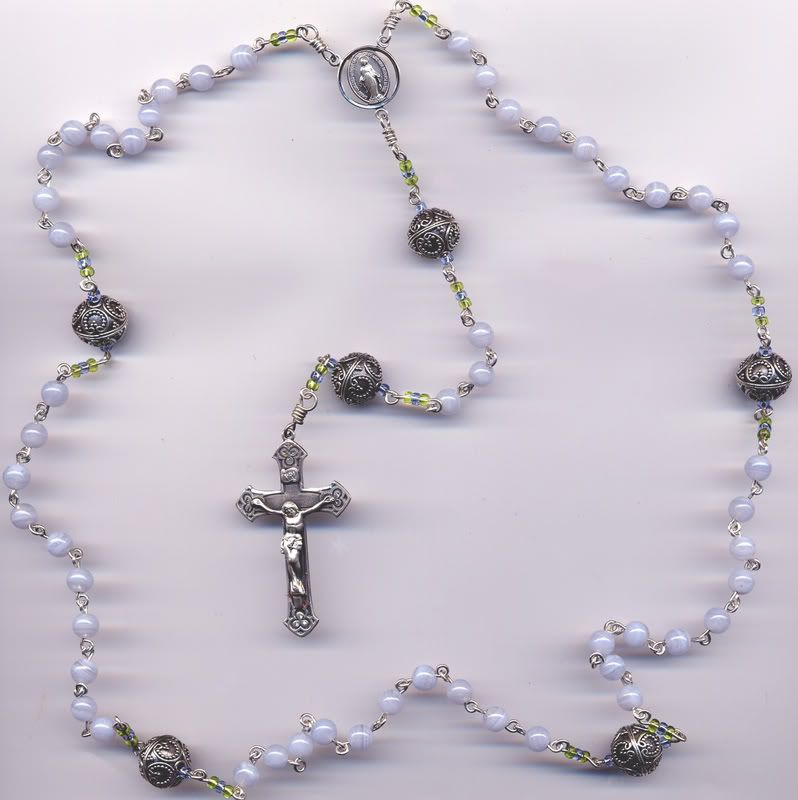
1. Sign of the Cross: In the name of the Father, and of the Son, and of the Holy Spirit. Amen.
2. The Apostles Creed: I BELIEVE in God, the Father almighty, Creator of heaven and earth. I believe in Jesus Christ, His only Son, our Lord. He was conceived by the power of the Holy Spirit and born of the Virgin Mary. He suffered under Pontius Pilate, was crucified, died, and was buried. He descended to the dead. On the third day He rose again. He ascended into heaven and sits at the right hand of God, the Father Almighty. From thence He shall come to judge the living and the dead. I believe in the Holy Spirit, the holy catholic Church, the communion of saints, the forgiveness of sins, the resurrection of the body, and the life everlasting. Amen.
3. The Lord's Prayer: OUR Father, who art in heaven, hallowed be Thy name. Thy kingdom come. Thy will be done on earth as it is in heaven. Give us this day our daily bread and forgive us our trespasses as we forgive those who trespass against us. And lead us not into temptation, but deliver us from evil. Amen.
4. (3) Hail Mary: HAIL Mary, full of grace, the Lord is with thee. Blessed art thou amongst women and blessed is the fruit of thy womb, Jesus. Holy Mary, Mother of God, pray for us sinners, now, and in the hour of our death. Amen. (Three times)
5. Glory Be: GLORY be to the Father, and to the Son, and to the Holy Spirit. As it was in the beginning, is now, and will be forever. Amen.
Fatima Prayer: Oh, my Jesus, forgive us our sins, save us from the fires of hell, lead all souls to heaven, especially those in most need of your mercy.
Announce each mystery, then say 1 Our Father, 10 Hail Marys, 1 Glory Be and 1 Fatima prayer. Repeat the process with each mystery.
End with the Hail Holy Queen:
Hail, Holy Queen, Mother of Mercy, our life, our sweetness and our hope! To thee do we cry, poor banished children of Eve! To thee do we send up our sighs, mourning and weeping in this vale of tears! Turn then, most gracious advocate, thine eyes of mercy towards us; and after this, our exile, show unto us the blessed fruit of thy womb, Jesus!
O clement, O loving, O sweet Virgin Mary! Pray for us, O holy Mother of God, that we may be made worthy of the promises of Christ.
Final step -- The Sign of the Cross
The Mysteries of the Rosary
By tradition, Catholics meditate on these Mysteries during prayers of the Rosary.
The biblical references follow each of the Mysteries below.
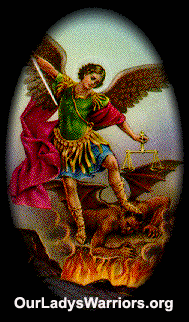
St. Michael, the Archangel, defend us in battle
Be our protection against the wickedness
and snares of the devil;
May God rebuke him, we humbly pray,
and do thou, O Prince of the heavenly host,
by the power of God,
Cast into hell Satan and all evil spirits
who prowl through the world seeking the ruin of souls.
Amen
+

The devotion consists in the divine worship of the human heart of Christ, which is united to His divinity and which is a symbol of His love for us. The aim of the devotion is to make our Lord king over our hearts by prompting them to return love to Him (especially through an act of consecration by which we offer to the Heart of Jesus both ourselves and all that belongs to us) and to make reparation for our ingratitude to God.
INVOCATION
O Heart of love, I put all my trust in Thee; for I fear all things from my own weakness, but I hope for all things from Thy goodness.
Saint Margaret Mary Alacoque
PRAYER TO THE SACRED HEART
Devotion to the Sacred Heart was the characteristic note of the piety of Saint Gertrude the Great (1256-1302), Benedictine nun and renowned mystic. She was, in fact, the first great exponent of devotion to the Sacred Heart. In our efforts to honor the Heart of Jesus we have this prayer as a model for our own:
Hail! O Sacred Heart of Jesus, living and quickening source of eternal life, infinite treasure of the Divinity, and burning furnace of divine love. Thou art my refuge and my sanctuary, 0 my amiable Savior. Consume my heart with that burning fire with which Thine is ever inflamed. Pour down on my soul those graces which flow from Thy love, and let my heart be so united with Thine, that our wills may be one, and mine in all things be conformed to Thine. May Thy divine will be equally the standard and rule of all my desires and of all my actions. Amen.
Saint Gertrude
FOR THE CHURCH
O most holy Heart of Jesus, shower Thy blessings in abundant measure upon Thy holy Church, upon the Supreme Pontiff and upon all the clergy; to the just grant perseverance; convert sinners; enlighten unbelievers; bless our relations, friends and benefactors; assist the dying; deliver the holy souls in purgatory; and extend over all hearts the sweet empire of Thy love. Amen.
A PRAYER OF TRUST
O God, who didst in wondrous manner reveal to the virgin, Margaret Mary, the unsearchable riches of Thy Heart, grant that loving Thee, after her example, in all things and above all things, we may in Thy Heart find our abiding home.
Roman Missal
ACT OF LOVE
Reveal Thy Sacred Heart to me, O Jesus, and show me Its attractions. Unite me to It for ever. Grant that all my aspirations and all the beats of my heart, which cease not even while I sleep, may be a testimonial to Thee of my love for Thee and may say to Thee: Yes, Lord, I am all Thine;
pledge of my allegiance to Thee rests ever in my heart will never cease to be there. Do Thou accept the slight amount of good that I do and be graciously pleased to repair all m] wrong-doing; so that I may be able to bless Thee in time and in eternity. Amen.
Cardinal Merry del Val
MEMORARE TO THE SACRED HEART
Remember, O most sweet Jesus, that no one who has had recourse to Thy Sacred Heart, implored its help, or sought it mercy was ever abandoned. Encouraged with confidence, O tenderest of hearts, we present ourselves before Thee, crushes beneath the weight of our sins. In our misery, O Sacred Hear. of Jesus, despise not our simple prayers, but mercifully grant our requests.
Prayer Source: Prayer Book, The by Reverend John P. O'Connell, M.A., S.T.D. and Jex Martin, M.A., The Catholic Press, Inc., Chicago, Illinois, 1954
Devotion to the Sacred Heart of Jesus
Devotion to the Sacred Heart Today
The Biblical Foundation of Devotion to the Sacred Heart of Jesus [Ecumenical]
Heart to Heart (Sacred Heart of Jesus Devotion) [St. Margaret Mary Alacoque]
(June) The Month of the Sacred Heart {Catholic/Orthodox Caucus]
First Friday Devotion to the Sacred Heart of Jesus [St. Margaret Mary Alacoque]
The Heart of the World (On the Sacred Heart of Jesus) (Catholic Caucus)
The Sacred Heart Is The Holy Eucharist(Catholic Caucus)
The Origin of the Sacred Heart Badge
Importance of Devotion to the Sacred Heart
An Awesome Homily on the Solemnity of the Sacred Heart of Jesus by Father Edmond Kline
Catholic Prayer and Devotion: June the Month of the Sacred Heart
Catholic Devotions: Sacred Heart of Jesus
Pope Urges Jesuits to Spread Sacred Heart Devotion
Homilies preached by Father Altier on the Feast of the Sacred Heart
Catholic Meditation and Devotion: The Sacred Heart of Jesus
Daily Recomendation to the Sacred Heart of Jesus powerful prayer!
The Sacred Heart and the Eucharist
The Love of the Sacred Heart
On the Sacred Heart - "We Adore God's Love of Humanity"
HAURIETIS AQUAS (On Devotion To The Sacred Heart) - Encyclical by Pope Pius XII
Solemnity Most Sacred Heart of Jesus and Immaculate Heart of Mary
Sacred Heart a Feast of God's Love, Says John Paul II
The Sacred Heart of Jesus: Symbol of Combativity and the Restoration of Christendom
Devotion to the Sacred Heart of Jesus-The Early Church, Middle Ages up to St. Margaret Mary
See this Heart
‘God Will Act and Will Reign’
About Devotion To The Sacred Heart:The Story Of Saint Margaret Mary Alacoque
Rediscover Feast of Sacred Heart, John Paul II Tells Youth
Holy Father's Prayer Intentions For June 2009
General: That international attention towards the poorer countries may give rise to more concrete help, in particular to relieve them of the crushing burden of foreign debt.
Mission: That the particular Churches operating in regions marked by violence may be sustained by the love and concrete closeness of all the Catholics in the world.
From: Acts 3:1-10
Cure of a Man Lame from Birth
*********************************************************************************************
Commentary:
1. This was the hour of the evening sacrifice, which began around three o’clock
and was attended by a large number of devout Jews. The ritual, which went on
until dusk, was the second sacrifice of the day. The earlier one, on similar
lines, began at dawn and lasted until nine in the morning.
2. None of the documents that have come down to us which describe the
Temple mentions a gate of this name. It was probably the Gate of Nicanor (or
Corinthian Gate), which linked the court of the Gentiles with the court of the
women which led on to the court of the Israelites. It was architecturally a very
fine structure and because of its location it was a very busy place, which would
have made it a very good place for begging.
3-8. The cure of this cripple was the first miracle worked by the Apostles. “This
cure”, says St. John Chrysostom, “testifies to the resurrection of Christ, of which
it is an image. [...] Observe that they do not go up to the temple with the inten-
tion of performing the miracle, so clear were they of ambition, so closely did they
imitate their Master” (”Hom. on Acts”, 8).
However, the Apostles decide that the time has come to use the supernatural
power given them by God. What Christ did in the Gospel using His own divine
power, the Apostles now do in His name, using His power. “The blind receive
their sight, the lame walk, lepers are cleansed, and the deaf hear, the dead are
raised up” (Luke 7:22). Our Lord now keeps His promise to empower His
disciples to work miracles—visible signs of the coming of the Kingdom of God.
These miracles are not extraordinary actions done casually or suddenly, with-
out His disciples’ involvement: they occur because our Lord is moved to perform
them by the Apostles’ faith (faith is an essential pre-condition). The disciples
are conscious of having received a gift and they act on foot of it.
These miracles in the New Testament obviously occur in situations where grace
is intensely concentrated. However, that is not to say that miracles do not con-
tinue to occur in the Christian economy of salvation—miracles of different kinds,
performed because God is attracted to men and women of faith. “The same is
true of us. If we struggle daily to become saints, each of us in his own situation
in the world and through his own job or profession, in our ordinary lives, then I
assure you that God will make us into instruments that can work miracles and,
if necessary, miracles of the most extraordinary kind. We will give sight to the
blind. Who could not relate thousands of cases of people, blind almost from
the day they were born, recovering their sight and receiving all the splendor of
Christ’s light? And others who were deaf, or dumb, who could not hear or pro-
nounce words fitting to God’s children.... Their senses have been purified and
now they hear and speak as men, not animals. “In nomine Iesu!” In the name
of Jesus His Apostles enable the cripple to move and walk, when previously he
had been incapable of doing anything useful; and that other lazy character, who
knew his duties but didn’t fulfill them. [...] In the Lord’s name, “surge et ambula!”,
rise up and walk.
“Another man was dead, rotting, smelling like a corpse: he hears God’s voice,
as in the miracle of the son of the widow at Naim: ‘Young man, I say to you,
rise up’. We will work miracles like Christ did, like the first Apostles did” (St.
J. Escriva, “Friends of God”, 262).
Miracles call for cooperation—faith—on the part of those who wish to be cured.
The lame man does his bit, even if it is only the simple gesture of obeying
Peter and looking at the Apostles.
*********************************************************************************************
Source: “The Navarre Bible: Text and Commentaries”. Biblical text from the
Revised Standard Version and New Vulgate. Commentaries by members of
the Faculty of Theology, University of Navarre, Spain.
Published by Four Courts Press, Kill Lane, Blackrock, Co. Dublin, Ireland, and
by Scepter Publishers in the United States.
From: Galatians 1:11-20
God’s Call
[13] For you have heard of my former life in Judaism, how I persecuted the church
of God violently and tried to destroy it; [14] and I advanced in Judaism beyond
many of my own age among my people, so extremely zealous was I for the tradi-
tions of my fathers. [15] But when he who had set me apart before I was born,
and had called me through his grace, [16] was pleased to reveal his Son to me,
in order that I might preach him among the Gentiles, I did not confer with flesh
and blood, [17] nor did I go up to Jerusalem to those who were apostles before
me, but I went away into Arabia; and again I returned to Damascus.
[18] Then after three years I went up to Jerusalem to visit Cephas, and remained
with him fifteen days. [19] But I saw none of the other apostles except James the
Lord’s brother. [20] (In what I am writing to you, before God, I do not lie!)
*********************************************************************************************
Commentary:
11-12. “What shall I do, Lord?” (Acts 22:10), Paul asked at the moment of his
conversion. Jesus replied, ‘Rise, and go into Damascus, and there you will be
told all that is appointed for you to do” (ibid.). The former persecutor, now under
the influence of grace, will receive instruction and Baptism through the ordinary
course of divine Providence—from a man, Ananias. Thereby Jesus led him to hu-
mility, obedience and abandonment. The Gospel which St Paul preached was
identical with that preached by the other Apostles, and already had the character
of “tradition” in the nascent Church (cf. 1 Cor 15:3; Gal 2:2). This is compatible
with Paul’s claim—made in this passage—that his Gospel does not come from
any man but through a revelation from Jesus Christ. Firstly, because on seeing
the risen Christ he was given supernatural light to understand that Jesus was not
only the Messiah but also the Son of God; and also because this first revelation
was followed by many others to which he refers in his epistles (cf. 1 Cor 11:23;
13:3-8 and especially 2 Cor 12:1-4).
St Paul’s was a unique case, because normally a person came to know the Gos-
pel of Christ by receiving it or learning it from those who had seen Christ during
his life on earth and listened to his teachings. This was what happened in St
Luke’s case, for example (cf. Lk 1:2). St Paul still felt the need to go to Jerusa-
lem to hear the Apostles’ preaching (cf. below 1:16-18), especially that of St
Peter.
13-14. The Acts of the Apostles tell us about Paul’s religious zeal; a Pharisee,
he had studied under Gamaliel (cf. Acts 22:3; Phil 3:5) and had consented to
and been present at the martyrdom of Stephen (cf. Acts 7:58; 8:1). Saul had
stood out as a persecutor of Christians, so keen was he to seek them out and
imprison them, even going beyond Judea to do so (cf. Acts 9:1-2). Clearly he had
been a man convinced of his Jewish faith, a zealous keeper of the Law, and proud
to be a Jew (cf. Rom 11:1 ; 2 Cor 11:22). Such was the fear the early Christians
had of him that they could not bring themselves to believe in his conversion (cf.
Acts 9:26). However, this same fervor and passion, to use St Augustine’s compa-
rison (cf. “Contra Faustum”, XXII, 70) was like a dense jungle—a serious obstacle
and yet an indication of immensely fertile soil. Our Lord sowed the seed of the
Gospel in that soil and it produced a very rich crop.
Everyone, no matter how irregular his life may have been, can produce good
results like this—with the help of grace, which does not displace nature but heals
and purifies it, and then raises and perfects it: Courage! You...can! Don’t you see
what God’s grace did with sleepy-headed Peter, the coward who had denied him
..., and with Paul, his fierce and relentless persecutor?” (St. J. Escriva, “The Way”,
483).
15-16. More than once in Scripture we read about God choosing certain people
for special missions even when they were still in their mother’s womb (cf. Jer 1:5;
Is 49:1-5; Lk 1:15; etc.). This emphasizes the fact that God makes a gratuitous
choice: there is no question of the person’s previous merits contributing to God’s
decision. Vocation is a supernatural divine gift, which God has planned from all
eternity. When God made his will known on the road to Damascus (cf. Acts 9:
3-6), St Paul “did not confer with flesh and blood”, that is, did not seek advice
from anyone, because he was absolutely sure that God himself had called him.
Nor did he consent to the prudence of the flesh, seeking to “play safe”: his self-
surrender was immediate, total and unconditional. When the Apostles heard
Jesus inviting them to follow him, they “immediately left their nets” (Mt 4:20, 22;
Mk 1:18) and followed the Master, leaving everything behind (cf. Lk 5:11). We
see the same thing happening in Saul’s case: he responds immediately. If he
makes his way to Ananias, he does so on the explicit instructions of Jesus—in
order to receive instruction and Baptism and to discover what his mission is to
be (Acts 9:15-16).
God’s call, therefore, should receive an immediate response. “Consider the faith
and obedience of the Apostles”, St John Chrysostom says. “They are in the
midst of their work (and you know how attractive fishing is!). When they hear his
command, they do not vacillate or lose any time: they do not say, ‘Let’s go home
and say goodbye to our parents.’ No, they leave everything and follow him [...].
That is the kind of obedience Christ asks of us — not to delay even a minute, no
matter how important the things that might keep us” (”Hom. on St Matthew”,
14, 2). And St Cyril of Alexandria comments: “For Jesus also said, ‘No one who
puts his hand to the plough and looks back is fit for the Kingdom of God’, and he
looked back who asked permission to return home and speak to his parents. But
we see that the holy Apostles did not act in that way; rather they followed Jesus,
immediately leaving the boat and their parents behind. Paul also acted imme-
diately. He ‘did not confer with flesh and blood’. That is how those who want to\
follow Christ must act” (”Commentarium in Lucam”, 9).
A person has a duty to follow Christ even if his relatives are opposed to his doing
so or want him to delay making a final decision, perhaps because they feel that
would be the more (humanly) prudent course: “A person should honor his parents,
but God he should obey. We should love the one who has begotten us, but the
first place should be given to him who created us”, St Augustine says, not min-
cing words (”Sermon 100”).
Even if we are unsure as to whether we are strong enough to persevere, this
should not delay us or concern us: it should simply lead us to pray confidently
for God’s help, because, as Vatican II teaches, when God calls a person, he
“must reply without taking counsel with flesh and blood and must give himself
fully to the work of the Gospel. However, such an answer can only be given with
the encouragement and help of the Holy Spirit [...]. Therefore, he must be pre-
pared to remainfaithful to his vocation for life, to renounce himself and everything
that up to this he possessed as his own, and to make himself ‘all things to all
men’ (1 Cor 9:22)” (”Ad Gentes”, 24).
17-20. After a period of time devoted to penance and prayer, St Paul made his
way to Jerusalem (cf. Acts 9:26-30) to see Cephas, that is, Peter. His stay of
two weeks is an important indication of Paul’s recognition of and veneration for
Peter, chosen as he had been as the foundation stone of the Church.
In subsequent generations, right down the centuries, Christians have shown their
love for Peter and his successors, traveling to Rome often at great personal effort
and sometimes, even, risk. “Catholic, apostolic, “Roman”! I want you to be very
Roman. And to be anxious to make your ‘path to Rome’, “videre Petrum”—to see
Peter (St. J. Escriva, “The Way”, 520). Solidarity with and veneration for the Pope
is, then, a clear, practical sign of good Christian spirit.
“James the Lord’s brother” (cf. notes on Mt 12:46-47 and 13:55) is, most com-
mentators think, James the Less (cf. Mk 15:40), also called the son of Alphaeus
(cf. Lk 6:15) and author of the letter which bears his name (cf. Jas 1:1).
*********************************************************************************************
Source: “The Navarre Bible: Text and Commentaries”. Biblical text from the
Revised Standard Version and New Vulgate. Commentaries by members of
the Faculty of Theology, University of Navarre, Spain.
Published by Four Courts Press, Kill Lane, Blackrock, Co. Dublin, Ireland, and
by Scepter Publishers in the United States.
From: John 21:15-19
Peter’s Primacy
*********************************************************************************************
Commentary:
15-17. Jesus Christ had promised Peter that he would be the primate of the
Church (cf. Matthew 16:16-19 and note on the same). Despite his three denials
during our Lord’s passion, Christ now confers on him the primacy He promised.
“Jesus questions Peter, three times, as if to give him a triple chance to atone for
his triple denial. Peter has learned his lesson from the bitter experience of his
wretchedness. Aware of his weakness, he is deeply convinced that rash claims
are pointless. Instead he puts everything in Christ’s hands. ‘Lord, You know well
that I love You” (St. J. Escriva, “Friends of God”, 267). The primacy was given to
Peter directly and immediately. So the Church has always understood—and so
Vatican I defined: “We therefore teach and declare that, according to the testi-
mony of the Gospel, the primacy of jurisdiction over the universal Church of God
was immediately an directly promised and given to Blessed Peter the Apostle
by Christ our Lord. [...] And it was upon Simon Peter alone that Jesus after His
resurrection bestowed the jurisdiction of chief pastor and ruler over all His fold in
the words: “Feed My lambs; feed My sheep” (”Pastor Aeternus”, Chapter 1).
The primacy is a grace conferred on Peter and his successors, the popes; it is
one of the basic elements in the Church, designed to guard and protect its unity:
“In order that the episcopate also might be one and undivided, and that [...] the
multitude of the faithful might be kept secure in the oneness of faith and com-
munion, He set Blessed Peter over the rest of the Apostles, and fixed in him the
abiding principleof this twofold unity, and its visible foundation” (”Pastor Aeternus,
Dz-Sch 3051”; cf. Vatican II, “Lumen Gentium”, 18). Therefore, the primacy of
Peter is perpetuated in each of his successors: this is something which Christ
disposed; it is not based on human legislation or custom.
By virtue of the primacy, Peter, and each of his successors, is the shepherd of
the whole Church and vicar of Christ on earth, because he exercises vicariously
Christ’s own authority. Love for the Pope, whom St. Catherine of Siena used to
call “the sweet Christ on earth”, should express itself in prayer, sacrifice and
obedience.
18-19. According to Tradition, St. Peter followed his Master to the point of dying
by crucifixion, head downwards, “Peter and Paul suffered martyrdom in Rome
during Nero’s persecution of Christians, which took place between the years 64
and 68. St. Clement, the successor of the same Peter in the See of the Church
of Rome, recalls this when, writing to the Corinthians, he puts before them ‘the
generous example of these two athletes’: ‘due to jealousy and envy, those who
were the principal and holiest columns suffered persecution and fought the fight
unto death’” (Paul VI, “Petrum Et Paulum”).
“Follow Me!”: these words would have reminded the Apostle of the first call he
received (cf. Matthew 4:19) and of the fact that Christ requires of His disciples
complete self-surrender: “If any man would come after Me, let him deny himself
and take up the Cross daily and follow Me” (Luke 9:23). St. Peter himself, in
one of his letters, also testifies to the Cross being something all Christians must
carry: “For to this you have been called, because Christ also suffered for you,
leaving you an example, that you should follow in His steps” (1 Peter 2:21).
*********************************************************************************************
Source: “The Navarre Bible: Text and Commentaries”. Biblical text from the
Revised Standard Version and New Vulgate. Commentaries by members of
the Faculty of Theology, University of Navarre, Spain.
Published by Four Courts Press, Kill Lane, Blackrock, Co. Dublin, Ireland, and
by Scepter Publishers in the United States.
These readings are for the Vigil Mass on the evening before the feast:
| First reading | Acts 3:1-10 © |
|---|---|
|
Once, when Peter and John were going up to the Temple for the prayers at the ninth hour, it happened that there was a man being carried past. He was a cripple from birth; and they used to put him down every day near the Temple entrance called the Beautiful Gate so that he could beg from the people going in. When this man saw Peter and John on their way into the Temple he begged from them. Both Peter and John looked straight at him and said, ‘Look at us.’ He turned to them expectantly, hoping to get something from them, but Peter said, ‘I have neither silver nor gold, but I will give you what I have: in the name of Jesus Christ the Nazarene, walk!’ Peter then took him by the hand and helped him to stand up. Instantly his feet and ankles became firm, he jumped up, stood, and began to walk, and he went with them into the Temple, walking and jumping and praising God. Everyone could see him walking and praising God, and they recognised him as the man who used to sit begging at the Beautiful Gate of the Temple. They were all astonished and unable to explain what had happened to him.
|
|
| Psalm or canticle: Psalm 18:2-5 |
| Second reading | Galatians 1:11-20 © |
|---|---|
|
The Good News I preached is not a human message that I was given by men, it is something I learnt only through a revelation of Jesus Christ. You must have heard of my career as a practising Jew, how merciless I was in persecuting the Church of God, how much damage I did to it, how I stood out among other Jews of my generation, and how enthusiastic I was for the traditions of my ancestors.
Then God, who had specially chosen me while I was still in my mother’s womb, called me through his grace and chose to reveal his Son in me, so that I might preach the Good News about him to the pagans. I did not stop to discuss this with any human being, nor did I go up to Jerusalem to see those who were already apostles before me, but I went off to Arabia at once and later went straight back from there to Damascus. Even when after three years I went up to Jerusalem to visit Cephas and stayed with him for fifteen days, I did not see any of the other apostles; I only saw James, the brother of the Lord, and I swear before God that what I have written is the literal truth.
|
|
| Gospel | John 21:15-19 © |
|---|---|
|
Jesus showed himself to his disciples, and after they had eaten he said to Simon Peter, ‘Simon son of John, do you love me more than these others do?’ He answered, ‘Yes Lord, you know I love you.’ Jesus said to him, ‘Feed my lambs.’ A second time he said to him, ‘Simon son of John, do you love me?’ He replied, ‘Yes, Lord, you know I love you.’ Jesus said to him, ‘Look after my sheep.’ Then he said to him a third time, ‘Simon son of John, do you love me?’ Peter was upset that he asked him the third time, ‘Do you love me?’ and said, ‘Lord, you know everything; you know I love you.’ Jesus said to him, ‘Feed my sheep.
‘I tell you most solemnly,
when you were young
you put on your own belt
and walked where you liked;
but when you grow old
you will stretch out your hands,
and somebody else will put a belt round you
and take you where you would rather not go.’
In these words he indicated the kind of death by which Peter would give glory to God. After this he said, ‘Follow me.’
|
|
|
|
|
The Angel of the Lord declared to Mary:
Behold the handmaid of the Lord: Be it done unto me according to Thy word.
And the Word was made Flesh: And dwelt among us.
Amen. |

Year of Saint Paul
June 28, 2008-June 29, 2009

Saints Peter and Paul and Apostles - Master Be - 1490
Tavola no. 9, Christian Museum of Esztergom, Esztergom, Hungary
from The Book of Gospels, Midwest Theological Forum (see links page)
Saints Peter and Paul are the principle pillars of the Church founded by Christ. Saint Peter was chosen by Christ to be his first Vicar on earth; he was endowed with powers ofthe keys of the kingdom of heaven (Mt 16:13-19) and charged with the role of Shepherd of Christ's flock (Jn 21:15-17). In St. Peter and his sucessors, we have a visible sign of unity and communion in faith and charity. Divine grace led St. Peter to profess Christ's divinity. Source: Daily Roman Missal, Edited by Rev. James Socías, Midwest Theological Forum, Chicago, Illinois ©2003 Readings Collect: First Reading: Acts of the Apostles 12:1-11
St. Peter suffered martyrdom under Nero, in about the year 64 AD. He was buried at the hill of the Vatican; recent excavations have revealed his tomb on the very site of St. Peter's Basilica.
Saint Paul was chosen to form part of the apostolic college by Christ himself on the road to Damascus (Acts 9:1-16). Selected to bring Christ's name to all peoples (Acts 9:15), he is the greatest missionary of all time, the advocate of pagans, the Apostle of the Gentiles. St. Paul was beheadedd in the Tre Fontane along the Via Ostiense and buried nearby, on the site where the basilica bearing his name now stands.
God our Father,
today you give us the joy
of celebrating the feast of the apostles Peter and Paul.
Through them your Church first received the faith.
Keep us true to their teachings.
Grant this through our Lord Jesus Christ, your Son,
who lives and reigns with you and the Holy Spirit,
one God, for ever and ever. Amen.
About that time Herod the king laid violent hands upon some who belonged to the church. He killed James the brother of John with the sword; and when he saw that it pleased the Jews, he proceeded to arrest Peter also. This was during the days of Unleavened Bread. And when he had seized him, he put him in prison, and delivered him to four squads of soldiers to guard him, intending after the Passover to bring him out to the people. So Peter was kept in prison; but earnest prayer for him was made to God by the church.
The very night when Herod was about to bring him out, Peter was sleeping between two soldiers, bound with two chains, and sentries before the door were guarding the prison; and behold, an angel of the Lord appeared, and a light shone in the cell; and he struck Peter on the side and woke him, saying, "Get up quickly." And the chains fell off his hands. And the angel said to him, "Dress yourself and put on your sandals." And he did so. And he said to him, "Wrap your mantle around you and follow me." And he went out and followed him; he did not know that what was done by the angel was real, but thought he was seeing a vision. When they had passed the first and the second guard, they came to the iron gate leading into the city. It opened to them of its own accord, and they went out and passed on through one street; and immediately the angel left him. And Peter came to himself, and said, "Now I am sure that the Lord has sent his angel and rescued me from the hand of Herod and from all that the Jewish people were expecting."
Second Reading: 2 Timothy 4:6-8, 17-18
For I am already on the point of being sacrificed; the time of my departure has come. I have fought the good fight, I have finished the race, I have kept the faith. Henceforth there is laid up for me the crown of righteousness, which the Lord, the righteous judge, will award to me on that Day, and not only to me but also to all who have loved his appearing.
But the Lord stood by me and gave me strength to proclaim the message fully, that all the Gentiles might hear it. So I was rescued from the lion's mouth. The Lord will rescue me from every evil and save me for his heavenly kingdom. To him be the glory for ever and ever. Amen.
Gospel Reading: Matthew 16:13-19
Now when Jesus came into the district of Caesarea Philippi, He asked His disciples, "Who do men say that the Son of man is?" And they said, "Some say John the Baptist, others say Elijah, and others Jeremiah or one of the prophets." He said to them, "But who do you say that I am?" Simon Peter replied, "You are the Christ, the Son of the living God." And Jesus answered him, "Blessed are you, Simon Bar-Jona! For flesh and blood has not revealed this to you, but My Father who is in heaven. And I tell you, you are Peter, and on this rock I will build My church, and the powers of death shall not prevail against it. I will give you the keys of the kingdom of heaven, and whatever you bind on earth shall be bound in heaven, and whatever you loose on earth shall be loosed in heaven."
Vigil Mass Readings:
First Reading: Acts 3:1-10
Now Peter and John were going up to the temple at the hour of prayer, the ninth hour. And a man lame from birth was being carried, whom they laid daily at that gate of the temple which is called Beautiful to ask alms of those who entered the temple. Seeing Peter and John about to go into the temple, he asked for alms. And Peter directed his gaze at him, with John, and said, "Look at us." And he fixed his attention upon them, expecting to receive something from them. But Peter said, "I have no silver and gold, but I give you what I have; in the name of Jesus Christ of Nazareth, walk." And he took him by the right hand and raised him up; and immediately his feet and ankles were made strong. And leaping up he stood and walked and entered the temple with them, walking and leaping and praising God. And all the people saw him walking and praising God, and recognized him as the one who sat for alms at the Beautiful Gate of the temple; and they were filled with wonder and amazement at what had happened to him.
Second Reading: Galatians 1:11-20
For I would have you know, brethren, that the gospel which was preached by me is not man's gospel. For I did not receive it from man, nor was I taught it, but it came through a revelation of Jesus Christ. For you have heard of my former life in Judaism, how I persecuted the church of God violently and tried to destroy it; and I advanced in Judaism beyond many of my own age among my people, so extremely zealous was I for the traditions of my fathers. But when he who had set me apart before I was born, and had called me through his grace, was pleased to reveal his Son to me, in order that I might preach him among the Gentiles, I did not confer with flesh and blood, nor did I go up to Jerusalem to those who were apostles before me, but I went away into Arabia; and again I returned to Damascus.
Then after three years I went up to Jerusalem to visit Cephas, and remained with him fifteen days. But I saw none of the other apostles except James the Lord's brother. (In what I am writing to you, before God, I do not lie!)
Gospel Reading: John 21:15-19
When they had finished breakfast, Jesus said to Simon Peter, "Simon, son of John, do you love me more than these?" He said to him, "Yes, Lord; you know that I love you." He said to him, "Feed my lambs." A second time he said to him, "Simon, son of John, do you love me?" He said to him, "Yes, Lord; you know that I love you." He said to him, "Tend my sheep." He said to him the third time, "Simon, son of John, do you love me?" Peter was grieved because he said to him the third time, "Do you love me?" And he said to him, "Lord, you know everything; you know that I love you." Jesus said to him, "Feed my sheep. Truly, truly, I say to you, when you were young, you girded yourself and walked where you would; but when you are old, you will stretch out your hands, and another will gird you and carry you where you do not wish to go." (This he said to show by what death he was to glorify God.) And after this he said to him, "Follow me."
Disclaimer: Opinions posted on Free Republic are those of the individual posters and do not necessarily represent the opinion of Free Republic or its management. All materials posted herein are protected by copyright law and the exemption for fair use of copyrighted works.

