
Posted on 04/04/2008 7:28:13 AM PDT by Salvation
|
Friday of the Second Week of Easter
|
|
Reading 1
Acts 5:34-42
A Pharisee in the Sanhedrin named Gamaliel,
a teacher of the law, respected by all the people,
stood up, ordered the Apostles to be put outside for a short time,
and said to the Sanhedrin, “Fellow children of Israel,
be careful what you are about to do to these men.
Some time ago, Theudas appeared, claiming to be someone important,
and about four hundred men joined him, but he was killed,
and all those who were loyal to him
were disbanded and came to nothing.
After him came Judas the Galilean at the time of the census.
He also drew people after him,
but he too perished and all who were loyal to him were scattered.
So now I tell you,
have nothing to do with these men, and let them go.
For if this endeavor or this activity is of human origin,
it will destroy itself.
But if it comes from God, you will not be able to destroy them;
you may even find yourselves fighting against God.”
They were persuaded by him.
After recalling the Apostles, they had them flogged,
ordered them to stop speaking in the name of Jesus,
and dismissed them.
So they left the presence of the Sanhedrin,
rejoicing that they had been found worthy
to suffer dishonor for the sake of the name.
And all day long, both at the temple and in their homes,
they did not stop teaching and proclaiming the Christ, Jesus.
Responsorial Psalm
27:1, 4, 13-14
R. (see 4abc) One thing I seek: to dwell in the house of the Lord.
or:
R. Alleluia.
The LORD is my light and my salvation;
whom should I fear?
The LORD is my life’s refuge;
of whom should I be afraid?
R. One thing I seek: to dwell in the house of the Lord.
or:
R. Alleluia.
One thing I ask of the LORD
this I seek:
To dwell in the house of the LORD
all the days of my life,
That I may gaze on the loveliness of the LORD
and contemplate his temple.
R. One thing I seek: to dwell in the house of the Lord.
or:
R. Alleluia.
I believe that I shall see the bounty of the LORD
in the land of the living.
Wait for the LORD with courage;
be stouthearted, and wait for the LORD.
R. One thing I seek: to dwell in the house of the Lord.
or:
R. Alleluia.
Gospel
Jn 6:1-15
Jesus went across the Sea of Galilee.
A large crowd followed him,
because they saw the signs he was performing on the sick.
Jesus went up on the mountain,
and there he sat down with his disciples.
The Jewish feast of Passover was near.
When Jesus raised his eyes and saw that a large crowd was coming to him,
he said to Philip, “Where can we buy enough food for them to eat?”
He said this to test him,
because he himself knew what he was going to do.
Philip answered him,
“Two hundred days’ wages worth of food would not be enough
for each of them to have a little.”
One of his disciples,
Andrew, the brother of Simon Peter, said to him,
“There is a boy here who has five barley loaves and two fish;
but what good are these for so many?”
Jesus said, “Have the people recline.”
Now there was a great deal of grass in that place.
So the men reclined, about five thousand in number.
Then Jesus took the loaves, gave thanks,
and distributed them to those who were reclining,
and also as much of the fish as they wanted.
When they had had their fill, he said to his disciples,
“Gather the fragments left over,
so that nothing will be wasted.”
So they collected them,
and filled twelve wicker baskets with fragments
from the five barley loaves that had been more than they could eat.
When the people saw the sign he had done, they said,
“This is truly the Prophet, the one who is to come into the world.”
Since Jesus knew that they were going to come and carry him off
to make him king,
he withdrew again to the mountain alone.
Please notify me via FReepmail if you would like to be added to or taken off the Alleluia Ping List.
As a New Year Begins Chance to Start 2006 with 'First Friday' Devotions

The best, the surest , and the most effective way of establishing everlasting peace on the face of the earth is through the great power of perpetual adoration of the Blessed Sacrament." -- Pope John Paul II
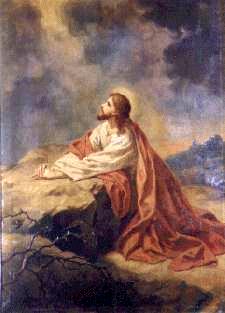

Adoration for Vocations to be Promoted Worldwide
New Plenary Indulgence to Mark Year of the Eucharist
POPE GRANTS PLENARY INDULGENCE FOR YEAR OF THE EUCHARIST
2.2 Million hours of prayer, and counting
The Adoration of the Name of Jesus (El Greco)
Adoration Tally Presented to Pope by Vocation.com
Eucharistic Adoration or Abortion?
Bishop Calls for Perpetual Adoration of Eucharist
What I learned From a Muslim about Eucharistic Adoration
The Gaze [Adoration of the Blessed Sacrament]
Eucharistic adoration: Intimacy with Christ
Eucharistic adoration is key, but also has drawbacks, bishops say
Pope Backs Perpetual Eucharistic Adoration
The Eucharistic Mystery Calls For Our Response
Spend Some Time With Jesus Tonight...
Catholic Meditation and Devotion: The Holy Hour
Perpetual Eucharistic Adoration: a Parish's Fuel
The History of Eucharistic Adoration Development of Doctrine in the Catholic Church
The Core of Monasticism Is Adoration [Catholic Caucus](Homily of Pope Benedict XVI on Sunday
The prayer was composed by the famous Catholic blogger Fr. Z.
http://wdtprs.com/blog/a-prayer-before-connecting-to-the-internet/
So perhaps it is not appropriate?
I’ll look for something else for St. Isidore.
No, it’s perfectly appropriate. I was just telling you the origin of the prayer. :-)
Saint Isidore of Seville, Doctor of the Church, Feast Day: April 4
Happy Easter: The Tomb is Empty! The Warrior of Love has conquered!
Homily Of His Holiness Benedict XVI (Holy Saturday Easter Vigil, Saint Peter's Basilica)
Pope to Baptize Prominent Muslim
Easter and the Holy Eucharist(Catholic/Orthodox Caucus)
Holy Saturday and the Easter Vigil
THE EASTER LITURGY [Easter Vigil] (Anglican and Catholic Rites)
Holy Saturday and the Easter Vigil
Poles visit symbolic Christ's Graves on Holy Saturday
HOMILIES PREACHED BY FATHER ALTIER FOR EASTER VIGIL FROM 2002-2005
2 Paschal Candles; Lights On at Vigil And More on Washing of the Feet
The Time Of Easter or Eastertide -- Easter Seasosn
ACT OF ADORATION
I adore Thee, 0 Jesus, true God and true Man, here present in the Holy Eucharist, humbly kneeling before Thee and united in spirit with all the faithful on earth and all the blessed in heaven. In deepest gratitude for so great a blessing, I love Thee, my Jesus, with my whole heart, for Thou art all perfect and all worthy of love.
Give me grace nevermore in any way to offend Thee, and grant that I, being refreshed by Thy Eucharistic presence here on earth, may be found worthy to come to the enjoyment with Mary of Thine eternal and everblessed presence in heaven. Amen.
FAITH IN THE EUCHARIST
O my God, I firmly believe that Thou art really and corporally present in the Blessed Sacrament of the altar. I adore Thee here present from the very depths of my heart, and I worship Thy sacred presence with all possible humility. O my soul, what joy to have Jesus Christ always with us, and to be able to speak to Him, heart to heart, with all confidence. Grant, O Lord, that I, having adored Thy divine Majesty here on earth in this wonderful Sacrament, may be able to adore it eternally in Heaven. Amen.
PETITION
Believing that Thou, my God, hast in any way revealed to us--grieving for all my sins, offenses and negligences--hoping in Thee, O Lord, who wilt never let me be confounded--thanking Thee for this supreme gift, and for all the gifts of Thy goodness--loving Thee, above all in this sacrament of Thy love--adoring Thee in this deepest mystery of Thy condescension: I lay before Thee all the wounds and wants of my poor soul, and ask for all that I need and desire. But I need only Thyself, O Lord; I desire none but Thee--Thy grace, and the grace to use well Thy graces, the possession of Thee by grace in this life, and the possession of Thee forever in the eternal kingdom of Thy glory.
FOR THE PEACE OF CHRIST
O most sacred, most loving heart of Jesus, Thou art concealed in the Holy Eucharist, and Thou beatest for us still. Now as then Thou sayest, "With desire I have desired." I worship Thee, then, with all my best love and awe, with my fervent affection, with my most subdued, most resolved will. O make my heart beat with Thy heart. Purify it of all that is earthly, all that is proud and sensual, all that is hard and cruel, of all perversity, of all disorder, of all deadness. So fill it with Thee, that neither the events of the day nor the circumstances of the time may have power to ruffle it; but that in Thy love and Thy fear it may have peace. --Cardinal Newman
ACT OF LOVE
I believe Thou art present in the Blessed Sacrament, O Jesus. I love Thee and desire Thee. Come into my heart. I embrace Thee, O never leave me. I beseech Thee, O Lord Jesus, may the burning and most sweet power of Thy love absorb my mind, that I may die through love of Thy love, who wast graciously pleased to die through love of my love. --St. Francis of Assisi
ACT OF REPARATION
Saint Margaret Mary Alacoque, well known in connection with devotion to the Sacred Herat of Jesus, led the way in making reparation to Jesus in the Blessed Sacrament for the coldness and ingratitude of men. This prayer of hers can become our own as we attempt to make amends for our own and others' neglect of the great Sacrament of His love, the Eucharist.
O kind and merciful savior, from my heart I earnestly desire to return Thee love for love. My greatest sorrow is that Thou art not loved by men, and, in particular, that my own heart is so cold, so selfish, so ungrateful. Keenly aware of my own weakness and poverty, I trust that Thy own grace will enable me to offer Thee an act of pure love. And I wish to offer Thee this act of love in reparation for the coldness and neglect that are shown to Thee in the sacrament of Thy love by Thy creatures. O Jesus, my supreme good, I love Thee, not for the sake of the reward which Thou hast promised to those who love Thee, but purely for Thyself. I love Thee above all things that can be loved, above all pleasures, and above myself and all that is not Thee, promising in the presence of heaven and earth that I will live and die purely and simply in Thy holy love, and that if to love Thee thus I must endure persecution and suffering I am completely satisfied, and I will ever say with Saint Paul: Nothing "will be able to separate us from the love of God." 0 Jesus, supreme master of all hearts, I love Thee, I adore Thee, I praise Thee, I thank Thee, because I am now all Thine own. Rule over me, and transform my soul into the likeness of Thyself, so that it may bless and glorify Thee forever in the abode of the saints.
--Saint Margaret Mary Alacoque
OFFERING
My Lord, I offer Thee myself in turn as a sacrifice of thanksgiving. Thou hast died for me, and I in turn make myself over to Thee. I am not my own. Thou hast bought me; I will by my own act and deed complete the purchase. My wish is to be separated from everything of this world; to cleanse myself simply from sin; to put away from me even what is innocent, if used for its own sake, and not for Thine. I put away reputation and honor, and influence, and power, for my praise and strength shall be in Thee. Enable me to carry out what I profess. Amen. --Cardinal Newman
Prayer Source: Prayer Book, The by Reverend John P. O'Connell, M.A., S.T.D. and Jex Martin, M.A., The Catholic Press, Inc., Chicago, Illinois, 1954
The best, the surest , and the most effective way of establishing everlasting peace on the face of the earth is through the great power of perpetual adoration of the Blessed Sacrament." -- Pope John Paul II
Early Christians on the Holy Eucharist
Holy Father stresses Need of Devotion to Holy Eucharist outside of Mass: Pope Paul VI
The Fourth Cup: The Sacrament of the Eucharist [Holy Thursday] [Passover]
The Holy Face of Jesus Christ as appeared on the Holy Eucharist
The Reverence due to the Holy Eucharist
New rules on the Holy Eucharist on Holy Thursday
Devotion to the Holy Eucharist Advances Devotion to Jesus' Person
Vatican: Matters to be observed or to be avoided regarding the Most Holy Eucharist (April 23, 2004)
CATHOLICS AND BAPTISTS WITNESSED UNUSUAL IMAGES IN BLESSED SACRAMENT
The Discipline of the Eucharist Holy See Releases Redemptionis Sacramentum...
Benediction of the Blessed Sacrament
THE HOLY EUCHARIST: NOURISHMENT TO FINISH OUR COURSE
LITANY OF REPARATION TO OUR LORD IN THE BLESSED SACRAMENT
The Disposition of Priests [Valid Mass, Valid Holy Eucharist?]
Grace of the Eucharist is secret to holy priests, says Pope
Area worshipers march to celebrate Holy Eucharist
Custody of Holy Land Concludes Year of Eucharist - In Capernaum, Site of a Key Discourse
Gift Of Life, Gift Eternal: The Most Holy Eucharist and the Holy Sacrifice of the Mass
THE HOLY EUCHARIST IS THE WHOLE CHRIST
This is My Body, This is My Blood
Prayer Before the Blessed Sacrament
A series of reflections from St. Peter Julian Eymard Blessed Sacrament(Catholic Caucus)
From: Acts 5:34-42
Gamaliel’s Intervention
The Apostles Are Flogged
*********************************************************************************************
Commentary:
34-39. Gamaliel had been St. Paul’s teacher (cf. 22:3). He belonged to a
moderate grouping among the Pharisees. He was a prudent man, impartial and
religiously minded. The Fathers of the Church often propose him as an example
of an upright man who is awaiting the Kingdom of God and dares to defend the
Apostles.
“Gamaliel does not say that the undertaking is of man or of God; he recommends
that they let time decide. [...] By speaking in the absence of the Apostles he was
better able to win over the judges. The gentleness of his word and arguments,
based on justice, convinced them. He was almost preaching the Gospel. Indeed,
his language is so correct that he seemed to be saying: Be convinced of it: you
cannot destroy this undertaking. how is it that you do not believe? The Christian
message is so impressive that even its adversaries bear witness to it” (St. John
Chrysostom, “Hom. on Acts”, 14).
This commentary seems to be recalling our Lord’s words, “He that is not against
us is for us” (Mark 9:40). Certainly, Gamaliel’s intervention shows that a person
with good will can discern God’s action in events or at least investigate objectively
without prejudging the issue.
The revolts of Theudas and Judas are referred to by Flavius Josephus (cf.
“Jewish Antiquities”, XVIII, 4-10; XX, 169-172), but the dates he gives are vague;
apparently these events occurred around the time of Jesus’ birth. Both Theudas
and Judas had considerable following; they revolted against the chosen people
having to pay tribute to foreigners such as Herod and Imperial Rome.
40-41. Most members of the Sanhedrin are unimpressed by Gamaliel’s argu-
ments; they simply decide to go as far as they safely can: they do not dare to
condemn the Apostles to death; but, in their stubborn opposition to the Gospel
message, they decree that they by put under the lash in the hope that this will
keep them quiet. However, it has just the opposite effect.
“It is true that Jeremiah was scourged for the word of God, and the Elijah and
other prophets were also threatened, but in this case the Apostles, as they
did earlier by their miracles, showed forth the power of God. He does not say
that they did not suffer, but that they rejoiced over having to suffer. This we
can see from the boldness afterwards: immediately after being beaten they
went back to preaching” (Chrysostom, “Hom. on Acts”, 14).
The Apostles must have remembered our Lord’s words, “Blessed are you when
men revile you and persecute you and utter all kinds of evil against you falsely
on My account. Rejoice and be glad, for so men persecuted the prophets who
were before you” (Matthew 5:11-12).
42. The Apostles and the first disciples of Jesus were forever preaching, with the
result that very soon all Jerusalem was filled with their teaching (cf. verse 28).
These early brethren are an example to Christians in every age: zeal to attract
others to the faith is a characteristic of every true disciple of Jesus and a conse-
quence of love of God and love of others: “You have but little love if you are not
zealous for the salvation of all souls. You have but poor love if you are not eager
to inspire other apostles with your craziness” ([St] J. Escriva, “The Way”, 796).
*********************************************************************************************
Source: “The Navarre Bible: Text and Commentaries”. Biblical text from the
Revised Standard Version and New Vulgate. Commentaries by members of
the Faculty of Theology, University of Navarre, Spain.
Published by Four Courts Press, Kill Lane, Blackrock, Co. Dublin, Ireland, and
by Scepter Publishers in the United States.
From: John 6:1-15
The Miracle of the Loaves and Fish
[15] Perceiving then that they were about to come and take Him by force to
make Him king, Jesus withdrew again to the hills by Himself.
*********************************************************************************************
Commentary:
1. This is the second lake formed by the river Jordan. It is sometimes described
in the Gospels as the “Lake of Gennesaret” (Luke 5:1), because that is the
name of the area on the north-eastern bank of the lake, and sometimes as the
“Sea of Galilee” (Matthew 4:18; 15:29; Mark 1:16; 7:31), after the region in which
it is located. St. John also calls it the “Sea of Tiberias” (cf. 21:1), after the city
of that name which Herod Antipas founded and named after the Emperor Tiberius.
In Jesus’ time there were a number of towns on the shore of this lake—Tiberias,
Magdala, Capernaum, Bethsaida, etc.—and the shore was often the setting for
His preaching.
2. Although St. John refers to only seven miracles and does not mention others
which are reported in the Synoptics, in this verse and more expressly at the end
of the Gospel (20:30; 21:25) he says that the Lord worked many miracles; the
reason why the evangelist, under God’s inspiration, chose these seven must
surely be because they best suited His purpose—to highlight certain facets of
the mystery of Christ. He now goes on to recount the miracle of the multiplica-
tion of the loaves and the fish, a miracle directly connected with the discourses
at Capernaum in which Jesus presents Himself as “the bread of life” (6:35, 48).
4. St. John’s Gospel often mentions Jewish feasts when referring to events in
our Lord’s public ministry—as in the case here (cf. “The Dates of the Life of our
Lord Jesus Christ”, in the “The Navarre Bible: St. Mark”, pp. 49ff, and “Introduc-
tion to the Gospel according to St. John”, pp. 13ff above).
Shortly before this Passover Jesus works the miracle of the multiplication of
the loaves and the fish, which prefigures the Christian Easter and the mystery
of the Blessed Eucharist, as He Himself explains in the discourse, beginning
at verse 26 in which He promises Himself as nourishment for our souls.
5-9. Jesus is sensitive to people’s material and spiritual needs. Here we see
Him take the initiative to satisfy the hunger of the crowd of people who have
been following Him.
Through these conversations and the miracle He is going to work, Jesus also
teaches His disciples to trust in Him whenever they meet up with difficulties in
their apostolic endeavors in the future: they should engage in them using what-
ever resources they have—even if they are plainly inadequate, as was the case
with the five loaves and two fish. He will supply what is lacking. In the Christian
life we must put what we have at the service of our Lord, even if we do not think
it amounts to very much. He can make meager resources productive.
“We must, then, have faith and not be dispirited. We must not be stopped by
any kind of human calculation. To overcome the obstacles we have to throw
ourselves into the task so that the very effort we make will open up new paths”
([St] J. Escriva, “Christ Is Passing By”, 160).
10. The evangelist gives us an apparently unimportant piece of information:
“there was much grass in the place.” This indicates that the miracle took place
in the height of the Palestinian spring, very near the Passover, as mentioned in
verse 4. There are very few big meadows in Palestine; even today there is one
on the eastern bank of the Lake of Gennesaret, called El-Batihah, where five
thousand people could fit seated: it may have been the site of this miracle.
11. The account of the miracle begins with almost the very same words as
those which the Synoptics and St. Paul use to describe the institution of the
Eucharist (cf. Matthew 26:26; Mark 14:22; Luke 22:19; 1 Corinthians 11:25).
This indicates that the miracle, in addition to being an expression of Jesus’
mercy towards the needy, is a symbol of the Blessed Eucharist, about which
our Lord will speak a little later on (cf. John 6:26-59).
12-13. The profusion of detail shows how accurate this narrative is—the names
of the Apostles who address our Lord (verses 5,8), the fact that they were barley
loaves (verse 9), the boy who provided the wherewithal (verse 9) and, finally,
Jesus telling them to gather up the leftovers.
This miracle shows Jesus’ divine power over matter, and His largesse recalls the
abundance of messianic benefits which the prophets had foretold (cf. Jeremiah
31:14).
Christ’s instruction to pick up the leftovers teaches us that material resources are
gifts of God and should not be wasted: they should be used in a spirit of poverty
(cf. note on Mark 6:42). In this connection Paul VI pointed out that “after liberally
feeding the crowds, the Lord told His disciples to gather up what was left over,
lest anything should be lost (cf. John 6:12). What an excellent lesson in thrift —
in the finest and fullest meaning of the term—for our age, given as it is to waste-
fulness! It carries with it the condemnation of a whole concept of society wherein
consumption tends to become an end in itself, with contempt for the needy, and
to the detriment, ultimately, of those very people who believed themselves to be
its beneficiaries, having become incapable of perceiving that man is called to a
higher destiny” ([Pope] Paul VI, “Address to Participants at the World Food
Conference”, 9 November 1974).
14-15. The faith which the miracle causes in the hearts of these people is still
very imperfect: they recognize Him as the Messiah promised in the Old Testa-
ment (cf. Deuteronomy 18:15), but they are thinking in terms of an earthly,
political messianism; they want to make Him king because they think the
Messiah’s function is to free them from Roman domination.
Our Lord, who later on (verses 26-27) will explain the true meaning of the multi-
plication of the loaves and the fish, simply goes away, to avoid the people pro-
claiming Him for what He is not. In His dialogue with Pilate (cf. John 18:36) He
will explain that His kingship “is not of this world”: “The Gospels clearly show
that for Jesus anything that would alter His mission as the Servant of Yahweh
was a temptation (cf. Matthew 4:8: Luke 4:5). He does not accept the position
of those who mixed the things of God with merely political attitudes (cf. Matthew
22:21; Mark 12:17; John 18:36). [...] The perspective of His mission is much
deeper. It consists in complete salvation through transforming, peacemaking,
pardoning, and reconciling love. There is no doubt, moreover, that all this makes
many demands on the Christian who wishes truly to serve his least brethren, the
poor, the needy, the outcast; in a word, all those who in their lives reflect the
sorrowing face of the Lord (cf. “Lumen Gentium”, 8)” ([Pope] John Paul II,
“Opening Address to the Third General Conference of Latin American Bishops”,
28 January 1979).
Christianity, therefore, must not be confused with any social or political ideology,
however excellent. “I do not approve of committed Christians in the world forming
a political-religious movement. That would be madness, even if it were motivated
by a desire to spread the spirit of Christ in all the activities of men. What we have
to do is put God in the heart of every single person, no matter who he is. Let us
try to speak then in such a way that every Christian is able to bear witness to the
faith he professes by example and word in his own circumstances, which are de-
termined alike by his place in the Church and in civil life, as well as by ongoing
events.
“By the very fact of being a man, a Christian has a full right to live in the world. If
he lets Christ live and reign in his heart, he will feel—quite noticeably—the saving
effectiveness of our Lord in everything he does” ([St] J. Escriva, “Christ Is Passing
By”, 183).
*********************************************************************************************
Source: “The Navarre Bible: Text and Commentaries”. Biblical text from the
Revised Standard Version and New Vulgate. Commentaries by members of
the Faculty of Theology, University of Navarre, Spain.
Published by Four Courts Press, Kill Lane, Blackrock, Co. Dublin, Ireland, and
by Scepter Publishers in the United States.
| Jn 6:1-15 | ||
|---|---|---|
| # | Douay-Rheims | Vulgate |
| 1 | After these things Jesus went over the sea of Galilee, which is that of Tiberias. | post haec abiit Iesus trans mare Galilaeae quod est Tiberiadis |
| 2 | And a great multitude followed him, because they saw the miracles which he did on them that were diseased. | et sequebatur eum multitudo magna quia videbant signa quae faciebat super his qui infirmabantur |
| 3 | Jesus therefore went up into a mountain: and there he sat with his disciples. | subiit ergo in montem Iesus et ibi sedebat cum discipulis suis |
| 4 | Now the pasch, the festival day of the Jews, was near at hand. | erat autem proximum pascha dies festus Iudaeorum |
| 5 | When Jesus therefore had lifted up his eyes and seen that a very great multitude cometh to him, he said to Philip: Whence shall we buy bread, that these may eat? | cum sublevasset ergo oculos Iesus et vidisset quia multitudo maxima venit ad eum dicit ad Philippum unde ememus panes ut manducent hii |
| 6 | And this he said to try him: for he himself knew what he would do. | hoc autem dicebat temptans eum ipse enim sciebat quid esset facturus |
| 7 | Philip answered him: Two hundred pennyworth of bread is not sufficient for them that every one may take a little. | respondit ei Philippus ducentorum denariorum panes non sufficiunt eis ut unusquisque modicum quid accipiat |
| 8 | One of his disciples, Andrew, the brother of Simon Peter, saith to him: | dicit ei unus ex discipulis eius Andreas frater Simonis Petri |
| 9 | There is a boy here that hath five barley loaves and two fishes. But what are these among so many? | est puer unus hic qui habet quinque panes hordiacios et duos pisces sed haec quid sunt inter tantos |
| 10 | Then Jesus said: Make the men sit down. Now, there was much grass in the place. The men therefore sat down, in number about five thousand. | dixit ergo Iesus facite homines discumbere erat autem faenum multum in loco discubuerunt ergo viri numero quasi quinque milia |
| 11 | And Jesus took the loaves: and when he had given thanks, he distributed to them that were set down. In like manner also of the fishes, as much as they would. | accepit ergo panes Iesus et cum gratias egisset distribuit discumbentibus similiter et ex piscibus quantum volebant |
| 12 | And when they were filled, he said to his disciples: gather up the fragments that remain, lest they be lost. | ut autem impleti sunt dixit discipulis suis colligite quae superaverunt fragmenta ne pereant |
| 13 | They gathered up therefore and filled twelve baskets with the fragments of the five barley loaves which remained over and above to them that had eaten. | collegerunt ergo et impleverunt duodecim cofinos fragmentorum ex quinque panibus hordiaciis quae superfuerunt his qui manducaverunt |
| 14 | Now those men, when they had seen what a miracle Jesus had done, said: This is of a truth the prophet that is to come into the world. | illi ergo homines cum vidissent quod fecerat signum dicebant quia hic est vere propheta qui venturus est in mundum |
| 15 | Jesus therefore, when he knew that they would come to take him by force and make him king, fled again into the mountains, himself alone. | Iesus ergo cum cognovisset quia venturi essent ut raperent eum et facerent eum regem fugit iterum in montem ipse solus |

Trying to figure out if the boy with the loaves and fishes is on the lower left or being taken away on the lower right. LOL!
| First reading | Acts 5:34 - 42 © |
|---|---|
| One member of the Sanhedrin, a Pharisee called Gamaliel, who was a doctor of the Law and respected by the whole people, stood up and asked to have the men taken outside for a time. Then he addressed the Sanhedrin, ‘Men of Israel, be careful how you deal with these people. There was Theudas who became notorious not so long ago. He claimed to be someone important, and he even collected about four hundred followers; but when he was killed, all his followers scattered and that was the end of them. And then there was Judas the Galilean, at the time of the census, who attracted crowds of supporters; but he got killed too, and all his followers dispersed. What I suggest, therefore, is that you leave these men alone and let them go. If this enterprise, this movement of theirs, is of human origin it will break up of its own accord; but if it does in fact come from God you will not only be unable to destroy them, but you might find yourselves fighting against God.’ His advice was accepted; and they had the apostles called in, gave orders for them to be flogged, warned them not to speak in the name of Jesus and released them. And so they left the presence of the Sanhedrin glad to have had the honour of suffering humiliation for the sake of the name. They preached every day both in the Temple and in private houses, and their proclamation of the Good News of Christ Jesus was never interrupted. |
|
| Psalm or canticle: Psalm 26 |
| Gospel | John 6:1 - 15 © |
|---|---|
| Jesus went off to the other side of the Sea of Galilee – or of Tiberias – and a large crowd followed him, impressed by the signs he gave by curing the sick. Jesus climbed the hillside, and sat down there with his disciples. It was shortly before the Jewish feast of Passover. Looking up, Jesus saw the crowds approaching and said to Philip, ‘Where can we buy some bread for these people to eat?’ He only said this to test Philip; he himself knew exactly what he was going to do. Philip answered, ‘Two hundred denarii would only buy enough to give them a small piece each’. One of his disciples, Andrew, Simon Peter’s brother, said, ‘There is a small boy here with five barley loaves and two fish; but what is that between so many?’ Jesus said to them, ‘Make the people sit down’. There was plenty of grass there, and as many as five thousand men sat down. Then Jesus took the loaves, gave thanks, and gave them out to all who were sitting ready; he then did the same with the fish, giving out as much as was wanted. When they had eaten enough he said to the disciples, ‘Pick up the pieces left over, so that nothing gets wasted’. So they picked them up, and filled twelve hampers with scraps left over from the meal of five barley loaves. The people, seeing this sign that he had given, said, ‘This really is the prophet who is to come into the world’. Jesus, who could see they were about to come and take him by force and make him king, escaped back to the hills by himself. |
|
Disclaimer: Opinions posted on Free Republic are those of the individual posters and do not necessarily represent the opinion of Free Republic or its management. All materials posted herein are protected by copyright law and the exemption for fair use of copyrighted works.
