Posted on 01/28/2008 1:38:39 PM PST by NYer
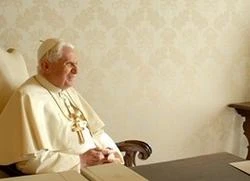
.- A joyful Pope Benedict spoke this morning with academics gathered at the Vatican to study the human person. While applauding their efforts, he also told them that science is not capable of fully understanding the mystery of human beings.
The inter-academic conference entitled "The changeable identity of the individual", is the collaborative effort of the "Academie des Sciences de Paris" and by the Pontifical Academy of Science.
In our time, the Pope told the scholars, "the exact sciences, both natural and human, have made prodigious advances in their understanding of man and his universe". However at the same time "there is a strong temptation to circumscribe human identity and enclose it with the limits of what is known.”
“In order to avoid going down this path,” the Pontiff said, “it is important not to ignore anthropological, philosophical and theological research, which highlight and maintain the mystery of human beings, because no science can say who they are, where they come from and where they go. The knowledge of human beings is then, the most important of all forms of knowledge".
"Human beings always stand beyond what can be scientifically seen or perceived", the Pope affirmed. This failure manifests itself today in “an incapacity to recognize the foundation upon which human dignity rests, from the embryo until natural death," said the Pope.
"Starting from the question of the new being, who is produced by a fusion of cells and who bears a new and specific genetic heritage", the Holy Father told his audience, "you have highlighted certain essential elements in the mystery of man". Man, said the Pope is "characterized by his otherness. He is a being created by God, a being in the image of God, a being who is loved and is made to love. As a human he is never closed within himself. He is always a bearer of otherness and, from his origins, is in interaction with other human beings".
Contrary to the Darwinian concept of man, Pope Benedict said that “man is not the result of mere chance, of converging circumstances, of determinism, of chemical inter-reactions.”
Man is a being who enjoys a freedom which ... transcends his nature and is a sign of the mystery of otherness that dwells within him. ... This freedom, which is characteristic of human beings, means they can guide their lives to a goal" and "highlights how man's existence has a meaning. In the exercise of his authentic freedom, the individual realizes his vocation, he is fulfilled and gives form to his deepest identity".
Closing his talk, the Pope told the academics, "Human beings have the specific ability of discerning what is good". "In our own time, when the progress of the sciences attracts and seduces for the possibilities it offers, it is more necessary than ever to educate the consciences of our contemporaries to ensure that science does not become the criterion of good, that man is still respected as the centre of creation, and that he does not become the object of ideological manipulation, arbitrary decisions, or abuses".

Good. The whole pope thing remains a mystery to me. ;O)
Duh... Science cannot fully understand the mystery of a tomato plant.
These statements are profound and also profoundly important.
Hah, everybody knows the answer is 42.
That's OK. Both in the sense of "puzzlement" and in the sense of "Dang! This has layers I haven't uncovered yet!"
I always love these sessions but again I wish these writers would use the accurate term for the philosophy they name Darwinism. Darwinism has a scientific definition and it is not synonymous with Philosophical Materialism.
No mystery whatsoever. Christ said to go to the Church as It is the final authority in Christianity. In addition, St. Paul states that the Church, not Scripture is "THE pillar and ground of the truth." (1 Timothy 3:15) Since the Church alone is mentioned as the pillar of truth, then It alone has the right to discern the truth and interpret Scripture. For if individuals could correctly interpret Scripture, then all interpretations would be exactly the same as there can only be one Spiritual Truth for the plural of the word "truth" never appears in Scripture. The Church is Christ's bride (Ephesians 5:29) and has "no spot, wrinkle or blemish" (Ephesians 5:27). Christ also stated that the gates of Hell will not prevail against His Church (Matthew 16:18) so how can the Church commit error? Individual clergy may commit sins, even popes commit sins because in the Church there are both "weeds and wheat" (Matthew 13:30)
Indeed, as are all of his writings. If you missed them, take a few minutes to read the two encyclicals he has written on Faith and Love, at the following link. These are truly profound.
Others may also wish to read Pope John Paul II's Faith and Reason - another classic. Similar topic.
Love the Pope!
Disclaimer: Opinions posted on Free Republic are those of the individual posters and do not necessarily represent the opinion of Free Republic or its management. All materials posted herein are protected by copyright law and the exemption for fair use of copyrighted works.