Skip to comments.
On the Divine Maternity of Mary [Catholic/Orthodox caucus]
Papa Ratzinger Forum ^
| January 2, 2008
| Benedict XVI
Posted on 01/02/2008 1:59:48 PM PST by ELS
On the Divine Maternity of Mary
[Here is a translation of the reflection on the Divine Maternity of Mary delivered today at the general audience in Paul VI Hall.]
* * *
Dear brothers and sisters!
A very old formula of blessing, reported in the Book of Numbers, says: "The LORD bless you and keep you! The LORD let his face shine upon you, and be gracious to you! The LORD look upon you kindly and give you peace! (Nm 6,24–26). With these words which the liturgy offered to us yesterday, the first day of the year, I wish to extend my heartfelt wishes to you who are present today and to all those who have sent me expressions of spiritual closeness during this Christmas season.
Yesterday, we celebrated the solemn feast of Mary, Mother of God. "Mother of God," Theotokos, is the title that was officially given to Mary in the fifth century by the Council of Ephesus in 431, but something which had been affirmed in popular devotion since the third century in the context of the heated discussion at that time over the person of Christ. The title 'Mother of God' underscored that Christ is God and was really born as a man, of Mary - and thus, intended to preserve (the doctrine of) his unity as true God and true man. Indeed, whenever the debate seems to be about Mary, it is essentially about her Son. Wishing to protect the full humanity of Jesus, some of the early Fathers of the Church suggested a more attenuated term: instead of Theotokos, they proposed Christotokos, "Mother of Christ." But rightly, this proposal was seen to endanger the doctrine of the full unity of Christ's divinity and humanity. That is why, after much ample discussion, the Council of Ephesus solemnly confirmed, on the one hand, the unity of the two natures - divine and human - in the person of the Son of God (cfr DS, n. 250), and on the other, the legitimacy of attributing to the Virgin the title of Theotokos, Mother of God (ibid., n. 251).
After that Council, a veritable explosion of Marian devotion took place, and many churches were constructed which were dedicated to the Mother of God. In first rank among these is the Basilica of Saint Mary Major here in Rome. The doctrine on Mary, Mother of God, was reaffirmed by the Council of Chalcedon (451), during which Christ was declared "true God and true man...born as a human for us and for our salvation, from Mary, Virgin and Mother of God, in his humanity" (DS, n. 301). As we know, the Second Vatican Council summarized Catholic doctrine on Mary in Chapter 8 of its Dogmatic Constitution Lumen gentium, reaffirming her divine maternity. Chapter 8 is entitled "The Blessed Virgin Mary, Mother of God, in the mystery of Christ and the Church".
The attribute "Mother of God', so profoundly linked to the Christmas celebrations, is the fundamental appelative by which the community of believers continues to honor the Blessed Virgin and always will, we might say, because it expresses very well the mission of Mary in the history of salvation. All the other titles attributed to Our Lady find their basis in her vocation to be the Mother of the Redeemer, the human creature elected by God to carry out His plan for the salvation of mankind, centered on the great mystery of the Incarnation of the divine Word. In these days of celebration, we have paused to contemplate in the Christmas creche the mystery of the Nativity. In the center of the Nativity scene is the Virgin Mother who offers Baby Jesus to the contemplation of those who have come to adore the Savior: the shepherds, the poor folk of Bethlehem, the Magi from the East. Later, in the feast of the Presentation of the Lord, which we will celebrate on February 2, it will be the old Simeon and the prophetess Anna who will receive the Baby from his Mother and adore him. Christian popular devotion has always considered the birth of Jesus and the divine motherhood of Mary to be two aspects of the same mystery of the Incarnation and have therefore never considered the Nativity as a thing of the past. We are 'contemporaries' of the shepherds, of the Magi, of Simeon and Anna, as we join them full of joy because God wanted to be God-with-us and have a human mother, who is our mother.
All the other titles with which the Church honors Mary come from the title "Mother of God", but this is the fundamental one. Let us think of the privilege of her "Immaculate Conception", meaning that she was exempt from original sin from the moment she was conceived: Mary was preserved from every stain of sin because she was to be the Mother of the Redeemer. The same thing applies to her title of "Assunta" [the one who was assumed into heaven]. She who generated the Savior could not be subject to the (corporeal) corruption that derives from original sin. We know that all these privileges were not granted to distance her from us, but on the contrary, to make her closer to us. In fact, being totally with God, this Lady is very close to us, helping us as mother and sister. Even the unique and unrepeatable place that Mary has for the community of believers comes from her fundamental calling as the Mother of the Redeemer. As such, Mary is also the Mother of the Mystical Body of Christ, which is the Church. Rightly, then during the Second Vatican Council, on November 21, 1964, Paul VI solemnly gave Mary the title of "Mother of the Church".
Because she is the Mother of the Church, she is also Mother to each of us, who are members of the mystical Body of Christ. From the Cross, Jesus entrusted his Mother to every disciple of his, and at the same time, entrusted each disciple to the love of his Mother. The evangelist John ends his brief evocative narration of the event with the words: "And from that hour the disciple took her into his home" (Jn 19,27). That is how the Greek text "eis ta idia" is commonly translated, which actually says, "he welcomed her into his own being" - to become part of his life, so that their lives compenetrated each other. This 'eis ta idia', this acceptance into one's life, is the Lord's testament. At the supreme moment of the fulfillment of his Messianic mission, Jesus left to each of his disciples, as a precious legacy, his own Mother, the Virgin Mary.
Dear brothers and sisters, in these first days of the new year, we are invited to consider attentively the importance of Mary's presence in the life of the Church and in our own personal existence. Let us entrust ourselves to her so that she may guide our steps in this new period of time that the Lord gives us to live, and that she may help us to be authentic friends of her Son, and therefore, also courageous authors of his Kingdom in this world, a Kingdom of light and truth. A Happy New Year to all! This is the wish that I wish to address to all you present and to those dear to you in this first general audience of 2008. May the new year, which began under the sign of the Virgin Mary, make us feel more strongly her maternal presence so that, sustained and comforted by her protection, we may contemplate with new eyes the face of her son Jesus and more easily walk along the paths of goodness.
Once more, a Happy New Year to all!
[After praying the Angelus, the Holy Father greeted pilgrims in six languages. In English, he said:]
Dear Brothers and Sisters,
At the beginning of this New Year, I offer prayerful good wishes to all of you and to your families! Yesterday, the Church joyfully celebrated the solemnity of Mary, Mother of God. This ancient title of Our Lady – Theotokos – reflects the truth that Jesus, her Son, is true God and true man. The confirmation of this title at the Council of Ephesus in the fifth century led to ever greater devotion to Mary and the dedication of numerous churches in her honour, including the Basilica of Saint Mary Major here in Rome. During this Christmas season, we can sense the close relationship between the Incarnation and our Lady’s dignity as the Mother of God. Indeed, the title “Mother of God” expresses Mary’s special mission in the history of salvation and her particular role in the mystery of Christ and the Church. Our Lady’s divine motherhood is in fact the basis of every other title by which the Church honours her. Mother of God and Mother of the Church, Mary was also entrusted by Christ to be the Mother of each of his disciples (cf. Jn 19:27). In this New Year, may we turn to her with confidence and, through her protection and prayers, be strengthened in our love for Jesus her Son and our service to the coming of his Kingdom.
I greet the English-speaking visitors present at today’s Audience, especially those from Ireland and the United States. I especially greet the various pilgrimages of priests and seminarians, and the many student groups in our midst. I also thank the choirs for their praise of God in song. May the New Year bring God’s richest blessings to you and your families!
© Copyright 2008 - Libreria Editrice Vaticana
TOPICS: Catholic; Current Events; History; Theology
KEYWORDS: generalaudience; paulvihall; popebenedictxvi; stmary

A faithful bows her head as she listens to Pope Benedict XVI during a general audience in the Paul VI Hall at the Vatican January 2, 2008. REUTERS/Max Rossi (VATICAN)

Pope Benedict XVI leaves Paul VI Hall at the Vatican following a general audience January 2, 2008. REUTERS/Max Rossi (VATICAN)
1
posted on
01/02/2008 1:59:51 PM PST
by
ELS
To: ELS
He mentions Mary at the end of the encyclical he recently wrote.
To: SF Republican; clockwise; bornacatholic; Miss Marple; bboop; PandaRosaMishima; Carolina; ...
Weekly audience ping!
Please let me know if you want to be on or off this list.
3
posted on
01/02/2008 2:54:11 PM PST
by
ELS
(Vivat Benedictus XVI!)
To: ELS
Thanks for the ping, ELS!
4
posted on
01/02/2008 9:19:59 PM PST
by
Salvation
(†With God all things are possible.†)
To: ELS; Salvation; narses; SMEDLEYBUTLER; redhead; Notwithstanding; nickcarraway; Romulus; ...
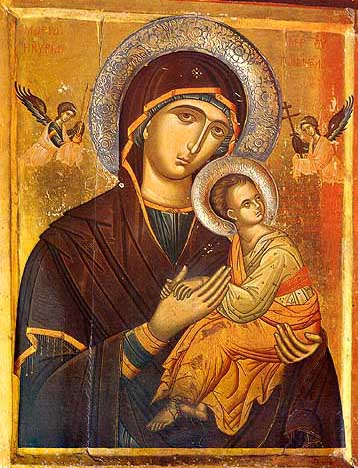
Theotokos
5
posted on
01/03/2008 7:34:37 AM PST
by
NYer
("Where the bishop is present, there is the Catholic Church" - Ignatius of Antioch)
To: phatus maximus
6
posted on
01/03/2008 7:36:47 AM PST
by
NYer
("Where the bishop is present, there is the Catholic Church" - Ignatius of Antioch)
Disclaimer:
Opinions posted on Free Republic are those of the individual
posters and do not necessarily represent the opinion of Free Republic or its
management. All materials posted herein are protected by copyright law and the
exemption for fair use of copyrighted works.
FreeRepublic.com is powered by software copyright 2000-2008 John Robinson