
Posted on 08/13/2006 11:55:24 AM PDT by HarleyD
In a newsletter published by a conservative Baptist denomination, a story is presented concerning one of its members. Deployed in Iraq , this middle aged soldier revealed that often, as he wrestles with problems of various types, “God just reveals the answer to me.” A leader from his church back home also claims to have heard from the Lord. “The Lord told me,” he says, “That this young man is going to be known as a builder, not a destroyer in Iraq .” So far his prophecy seems to have come true for, although the soldier has been involved in combat, his “day job” is to rebuild schools and water treatment plants. Just this week I received an e-mail from a gentleman who wrote, “Jesus has commanded me through the Holy Spirit to teach people how to pray, teach them the truth about their dreams, and guide them into the presence of God (utilizing the Scripture in an almost step-by-step methodology to do so).”
It seems the Lord has been quite busy lately speaking to His children. A few years ago Alistair Begg quoted a survey stating that one in three American adults say that God speaks to them directly. And hearing the voice of God is not isolated to the common person either. A slew of evangelical leaders claim to hear from the Lord, some of them quite regularly. Henry Blackaby, an avid proponent of extrabiblical revelation of this type, when asked how he knew he was hearing from God and not from some other source, gives this answer, “You come to know His voice as you experience Him in a love relationship. As God speaks and you respond, you will come to the point that you recognize His voice more and more clearly.”
Is God Speaking Today?
Of course, that leaves dangling the important question, “How does one know he is hearing the voice of the Lord in the first place?” Is it not possible that the voice many believe they are “hearing” is the voice of their own thoughts, imaginations, desires, or something more insidious?
In vogue in much of evangelicalism is the constant imploring of Christians to listen to God, experience God and feel God. D. A. Carson quoting a friend’s insightful critique of a book entitled Listening to God, wrote, “If anyone had written a book thirty years ago with that title, you would have expected it to be about Bible study, not about prayer…. Many [Christians] now rely far more on inward promptings than on their Bible knowledge to decide what they are going to do in a situation.” There seems to have been a powerful shift in thinking among conservative Christians during the last few decades.
What does the New Testament Teach?
The final court of appeals determining the identity of the voice of God, if it is such, must be the direct instructions or at least the examples found in Scripture. The Scriptures claim to be the Word of God (2 Timothy 3:16, 17; 2 Peter 1:20, 21). They are inspired, once for all, by the Holy Spirit, enabling prophets and apostles, using their own personalities, to write God’s words as He intended (Hebrews 1:1,2; 2:3,4; Acts 5:12; 2 Corinthians 12:12). I believe with the closure of Scripture, direct, infallible, authoritative revelation from God has ceased for this age (Revelation 22:18, 19; Ephesians 2:20; 3:5; Jude 3, 4; 2 Peter 3:2). It is instructive to note when Paul wrote his last epistle to pastor/friend Timothy about leading the church of God, he did not encourage Timothy to focus on new revelations, impressions, feelings or hunches. Rather, he continually turned him to the Word of God and the doctrines contained therein (2 Timothy 2:2-14, 15; 3:15-17; 4:2-4).
I find this to be the emphasis of the New Testament. As Donald S. Whitney reminds us,
Yet, this type of Divine encounter is considered insipid by many believers today. Many insist if God desires to relate to us in deep, personal, intimate ways, surely He must speak to us directly, individually, apart from Scripture. If we do not have such experiences, then we are nothing more than “practical deists.” What has led to this mindset that teaches the Scriptures are inadequate for our lives – that some additional revelation is needed? Let me list three competitors now challenging the Scriptures as final authority in our lives.
Subjective Experience
In relation to our subject we must thoroughly wrestle with the question of how we know who or what we have encountered in our subjective experiences. All the information we have about God and our relationship to Him is found in the Bible. Any “encounter” apart from Scripture must be verified by Scripture. If that is so, what does the Word tell us to expect in an encounter with God? I think you will search in vain for information on what God “feels” like; instead the biblical record speaks of transformation. When we encounter God at the moment of salvation we are born again (John 3). As Christians encounter God, through the indwelling presence of the Holy Spirit, the mark is changed lives (2 Peter 1).
D. Martin Lloyd-Jones was on to something when he wrote,
A New Kind of Revelation—New Testament Prophecy
In Colossians 2:18,19 Paul addresses a people confused by mystical experiences. The forerunners to the Gnostics taught that a few elite had received the gift of direct inspiration through the Holy Spirit. These moments of inspiration took place through visions, dreams and encounters with angels. This divided the church into two classes, the haves and the have-nots (those who imagined themselves as truly spiritual and those who had not had these experiences).
This kind of problem has not faded into the past and is almost identical to the teachings found within various elements of the charismatic movement today. For example, compare what Jack Deere, a leading Vineyard theologian writes:
At this point, Blackaby, Deere and Grudem would cry foul. They would claim that while they believe that God speaks to His people apart from the Bible today, these revelations are not on par with Scripture. That is, God speaks today but not with the same authority as He did in His Word. So do not accuse us of adding to Scripture, they would say. Interestingly enough, this brings up another issue. Does God ever speak in a nonauthoritative manner? In the biblical record we find that God did speak, either orally (including through His prophets) or through the written Word. But always, His Word was authoritative. It was nothing less than a word from God — one that could be understood and must be obeyed and heeded! But we are being told today that God is speaking in a different, less authoritative, even impure way.
This is how Wayne Grudem explains it:
A New Kind of Revelation—The “Inner” Voice
Noncharismatic evangelical Christianity has definitely taken on a mystical bent in recent days as well. While never denying the authority of Scripture as such, many, from people in the pew to key evangelical leaders, regularly point to mystical experiences as the basis for much of what they do and believe. We must be concerned that this weak view of the Scriptures will ultimately cause great harm in the body of Christ. We agree with David Well's assessment, "Granting the status of revelation to anything other than the Word of God inevitably has the effect of removing that status from the Word of God. What may start out as an additional authority alongside the Word of God will eventually supplant its authority altogether." John Armstrong concurs, “Direct communication from God, by definition, constitutes some form of new revelation. Such revelation would, at least in principle, indicate that the Scriptures were not sufficient or final.”
At issue is the subject of revelation. More to the point, is God speaking today, directly, infallibly, and independently of the Scriptures? Does He reveal Himself, His will, His truth, apart from the Bible? Critics of the position presented in this paper will tell us to look at the examples found in Scripture. God seemed to be speaking all the time to all sorts of people, apart from the written Word. This is a clear overstatement, although there is surely some truth to be found. Let’s make some observations. First, God did speak apart from the written Word occasionally. When we read the Bible we sometimes forget that what we are reading in a matter of minutes may have covered vast periods of time originally. Abraham, for example, definitely heard the voice of God at times. God speaks to him in Genesis 15 and again in Genesis 17. But there was at least a 14 year gap between the two utterances from God and possibly 20 years or more (compare 16:16 with 17:1). It seems to us that God was talking to Abraham all the time but the fact is that many years would go by with no communication from God at all – even to Abraham the friend of God and father of the Jewish race. This leads to the next observation: when God did speak it was almost always to prophets and key players in the biblical story, not to the common man or woman. There may have been a few exceptions to this, but if so, it was rare. Yet, many today act as if God speaks to everyone all the time, and they attempt to prop up this view through biblical accounts. But the Scriptures simply do not support this idea.
There is a third observation that I believe is often missed and is of great importance to this discussion. When God did speak in Scripture, whether directly or through His prophets, He did so with audible words. You will search in vain for some inner voice from God speaking to the heart of His people. Nor will you find God communicating through prompting or hunches. No one said, “I feel the Lord leading me to do such and such.” No one said, “I have the peace of God in this decision.” In other words, God’s people have created a means of communication from God not found in the Bible. God never spoke in this fashion in Scripture, but we now are to believe that this is the norm today. In an otherwise excellent chapter on this same subject, R. Fowler White, who takes a cessationist view (with the closure of the Scriptures, God is no longer giving revelation for this age) opens the door to this form of communication by writing, “God guides and directs His people by His Spirit in the application of His written word through promptings, impressions, insights, and the like.” Vineyard theologian Jack Deere, in one of his few on-target remarks, sees clearly the weakness in White’s statement,
It remains a mystery to me why people are attracted to this view of the Word of God. Surely it is not an improvement over, "Thus says the Lord." Surely the uncertainty of this system pales in comparison to the certainty of the Scriptures (2 Peter 1:19-21).
A rather interesting article for today's church.
I once knew someone who told me she surfed with Jesus.
Yeah, but Jesus doesn't need a board.
That's right, he surfs barefoot.
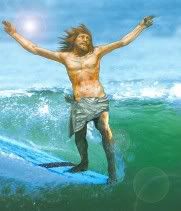


Interesting.
Sound, at a glance, like some of the teaching I hear in the PCS. Very rationalist and extremely biased against spiritual experience.
I'm in the middle of a house move - but I'm going to come back to this if I can... and nail it.
:)
Sorry - I meant PCA - Not PCS!
(and definitely not PCP!)
Just heard Dave Roever speak at the Assemblies of God church in G.J. CO. He showed us a picture of him sitting on
a throne that Saddam had claimed he would send to Jerusalem
after he killed off all the Jews. Dave Roevers vision is to prepared over three thousand veteran amputee evangelical preachers (one for every soul killed on 911)
to send to that region so Saddam and his kind will bow their knee to worship God.AWSOME vision- He's building a
school for it now here in Colorado.
I'm all ears.....
CC&E
Ping!
Very interesting. I'm listening to it now. Thanks for posting.
God spoke to me.
But I'm not a Christian.
That's a good point. The scriptures are clear that the Holy Spirit convicts one of sin but I don't think that is the same as God talking to us in the same way He talked to Abraham or Paul. I would say the reason you "feel" you grieve or quench the Holy Spirit is primarily though the scripture. For example, you know that you shouldn't lie because of the scripture and the Holy Spirit will bring God's word to your mind to cause you to repent.
Thr Pursuit of God
W.W.Tozer
Chapter 6
The Speaking Voice
In the beginning was the Word, and the Word was with God, and the Word was God.-John 1:1
An intelligent plain man, untaught in the truths of Christianity, coming upon this text, would likely conclude that John meant to teach that it is the nature of God to speak, to communicate His thoughts to others. And he would be right. A word is a medium by which thoughts are expressed, and the application of the term to the Eternal Son leads us to believe that selfexpression is inherent in the Godhead, that God is forever seeking to speak Himself out to His creation. The whole Bible supports the idea. God is speaking. Not God spoke, but God is speaking. He is by His nature continuously articulate. He fills the world with His speaking Voice.
One of the great realities with which we have to deal is the Voice of God in His world. The briefest and only satisfying cosmogony is this: "He spake and it was done." The why of natural law is the living Voice of God immanent in His creation. And this word of God which brought all worlds into being cannot be understood to mean the Bible, for it is not a written or printed word at all, but the expression of the will of God spoken into the structure of all things. This word of God is the breath of God filling the world with living potentiality. The Voice of God is the most powerful force in nature, indeed the only force in nature, for all energy is here only because the power-filled Word is being spoken.
The Bible is the written word of God, and because it is written it is confined and limited by the necessities of ink and paper and leather. The Voice of God, however, is alive and free as the sovereign God is free. "The words that I speak unto you, they are spirit, and they are life." The life is in the speaking words. God's word in the Bible can have power only because it corresponds to God's word in the universe. It is the present Voice which makes the written Word all-powerful. Otherwise it would lie locked in slumber within the covers of a book.
We take a low and primitive view of things when we conceive of God at the creation coming into physical contact with things, shaping and fitting and building like a carpenter. The Bible teaches otherwise: "By the word of the Lord were the heavens made; and all the host of them by the breath of his mouth .... For he spake, and it was done; he commanded, and it stood fast." "Through faith we understand that the worlds were framed by the word of God." Again we must remember that God is referring here not to His written Word, but to His speaking Voice. His world-filling Voice is meant, that Voice which antedates the Bible by uncounted centuries, that Voice which has not been silent since the dawn of creation, but is sounding still throughout the full far reaches of the universe.
The Word of God is quick and powerful. In the beginning He spoke to nothing, and it became something. Chaos heard it and became order, darkness heard it and became light. "And God said-and it was so." These twin phrases, as cause and effect, occur throughout the Genesis story of the creation. The said accounts for the so. The so is the said put into the continuous present.
That God is here and that He is speaking-these truths are back of all other Bible truths; without them there could be no revelation at all. God did not write a book and send it by messenger to be read at a distance by unaided minds. He spoke a Book and lives in His spoken words, constantly speaking His words and causing the power of them to persist across the years. God breathed on clay and it became a man; He breathes on men and they become clay. "Return ye children of men," was the word spoken at the Fall by which God decreed the death of every man, and no added word has He needed to speak. The sad procession of mankind across the face of the earth from birth to the grave is proof that His original Word was enough.
We have not given sufficient attention to that deep utterance in the Book of John, "That was the true Light, which lighteth every man that cometh into the world." Shift the punctuation around as we will and the truth is still there: the Word of God affects the hearts of all men as light in the soul. In the hearts of all men the light shines, the Word sounds, and there is no escaping them. Something like this would of necessity be so if God is alive and in His world. And John says that it is so. Even those persons who have never heard of the Bible have still been preached to with sufficient clarity to remove every excuse from their hearts forever. "Which show the work of the law written in their hearts, their conscience also bearing witness, and their thoughts the mean while either accusing or else excusing one another." "For the invisible things of him from the creation of the world are clearly seen, being understood by the things that are made, even his eternal power and Godhead; so that they are without excuse."
This universal Voice of God was by the ancient Hebrews often called Wisdom, and was said to be everywhere sounding and searching throughout the earth, seeking some response from the sons of men. The eighth chapter of the Book of Proverbs begins, "both not wisdom cry? and understanding put forth her voice?" The writer then pictures wisdom as a beautiful woman standing "in the top of the high places, by the way in the places of the paths." She sounds her voice from every quarter so that no one may miss hearing it. "Unto you, O men, I call; and my voice is to the sons of men." Then she pleads for the simple and the foolish to give ear to her words. It is spiritual response for which this Wisdom of God is pleading, a response which she has always sought and is but rarely able to secure. The tragedy is that our eternal welfare depends upon our hearing, and we have trained our ears not to hear.
This universal Voice has ever sounded, and it has often troubled men even when they did not understand the source of their fears. Could it be that this Voice distilling like a living mist upon the hearts of men has been the undiscovered cause of the troubled conscience and the longing for immortality confessed by millions since the dawn of recorded history? We need not fear to face up to this. The speaking Voice is a fact. How men have reacted to it is for any observer to note.
When God spoke out of heaven to our Lord, selfcentered men who heard it explained it by natural causes: they said, "It thundered." This habit of explaining the Voice by appeals to natural law is at the very root of modern science. In the living breathing cosmos there is a mysterious Something, too wonderful, too awful for any mind to understand. The believing man does not claim to understand. He falls to his knees and whispers, "God." The man of earth kneels also, but not to worship. He kneels to examine, to search, to find the cause and the how of things. Just now we happen to be living in a secular age. Our thought habits are those of the scientist, not those of the worshipper. We are more likely to explain than to adore. "It thundered," we exclaim, and go our earthly way. But still the Voice sounds and searches. The order and life of the world depend upon that Voice, but men are mostly too busy or too stubborn to give attention.
Everyone of us has had experiences which we have not been able to explain: a sudden sense of loneliness, or a feeling of wonder or awe in the face of the universal vastness. Or we have had a fleeting visitation of light like an illumination from some other sun, giving us in a quick flash an assurance that we are from another world, that our origins are divine. What we saw there, or felt, or heard, may have been contrary to all that we had been taught in the schools and at wide variance with all our former beliefs and opinions. We were forced to suspend our acquired doubts while, for a moment, the clouds were rolled back and we saw and heard for ourselves. Explain such things as we will, I think we have not been fair to the facts until we allow at least the possibility that such experiences may arise from the Presence of God in the world and His persistent effort to communicate with mankind. Let us not dismiss such an hypothesis too flippantly.
It is my own belief (and here I shall not feel bad if no one follows me) that every good and beautiful thing which man has produced in the world has been the result of his faulty and sin-blocked response to the creative Voice sounding over the earth. The moral philosophers who dreamed their high dreams of virtue, the religious thinkers who speculated about God and immortality, the poets and artists who created out of common stuff pure and lasting beauty: how can we explain them? It is not enough to say simply, "It was genius." What then is genius? Could it be that a genius is a man haunted by the speaking Voice, laboring and striving like one possessed to achieve ends which he only vaguely understands? That the great man may have missed God in his labors, that he may even have spoken or written against God does not destroy the idea I am advancing. God's redemptive revelation in the Holy Scriptures is necessary to saving faith and peace with God. Faith in a risen Saviour is necessary if the vague stirrings toward immortality are to bring us to restful and satisfying communion with God. To me this is a plausible explanation of all that is best out of Christ. But you can be a good Christian and not accept my thesis.
The Voice of God is a friendly Voice. No one need fear to listen to it unless he has already made up his mind to resist it. The blood of Jesus has covered not only the human race but all creation as well. "And having made peace through the blood of his cross, by him to reconcile all things unto himself; by him, I say, whether they be things in earth, or things in heaven." We may safely preach a friendly Heaven. The heavens as well as the earth are filled with the good will of Him that dwelt in the bush. The perfect blood of atonement secures this forever.
Whoever will listen will hear the speaking Heaven. This is definitely not the hour when men take kindly to an exhortation to listen, for listening is not today a part of popular religion. We are at the opposite end of the pole from there. Religion has accepted the monstrous heresy that noise, size, activity and bluster make a man dear to God. But we may take heart. To a people caught in the tempest of the last great conflict God says, "Be still, and know that I am God," and still He says it, as if He means to tell us that our strength and safety lie not in noise but in silence.
It is important that we get still to wait on God. And it is best that we get alone, preferably with our Bible outspread before us. Then if we will we may draw near to God and begin to hear Him speak to us in our hearts. I think for the average person the progression will be something like this: First a sound as of a Presence walking in the garden. Then a voice, more intelligible, but still far from clear. Then the happy moment when the Spirit begins to illuminate the Scriptures, and that which had been only a sound, or at best a voice, now becomes an intelligible word, warm and intimate and clear as the word of a dear friend. Then will come life and light, and best of all, ability to see and rest in and embrace Jesus Christ as Saviour and Lord and All.
The Bible will never be a living Book to us until we are convinced that God is articulate in His universe. To jump from a dead, impersonal world to a dogmatic Bible is too much for most people. They may admit that they should accept the Bible as the Word of God, and they may try to think of it as such, but they find it impossible to believe that the words there on the page are actually for them. A man may say, "These words are addressed to me," and yet in his heart not feel and know that they are. He is the victim of a divided psychology. He tries to think of God as mute everywhere else and vocal only in a book.
I believe that much of our religious unbelief is due to a wrong conception of and a wrong feeling for the Scriptures of Truth. A silent God suddenly began to speak in a book and when the book was finished lapsed back into silence again forever. Now we read the book as the record of what God said when He was for a brief time in a speaking mood. With notions like that in our heads how can we believe? The facts are that God is not silent, has never been silent. It is the nature of God to speak. The second Person of the Holy Trinity is called the Word. The Bible is the inevitable outcome of God's continuous speech. It is the infallible declaration of His mind for us put into our familiar human words.
I think a new world will arise out of the religious mists when we approach our Bible with the idea that it is not only a book which was once spoken, but a book which is now speaking. The prophets habitually said, "Thus saith the Lord." They meant their hearers to understand that God's speaking is in the continuous present. We may use the past tense properly to indicate that at a certain time a certain word of God was spoken, but a word of God once spoken continues to be spoken, as a child once born continues to be alive, or a world once created continues to exist. And those are but imperfect illustrations, for children die and worlds burn out, but the Word of our God endureth forever.
If you would follow on to know the Lord, come at once to the open Bible expecting it to speak to you. Do not come with the notion that it is a thing which you may push around at your convenience. It is more than a thing, it is a voice, a word, the very Word of the living God.
Lord, teach me to listen. The times are noisy and my ears are weary with the thousand raucous sounds which continuously assault them. Give me the spirit of the boy Samuel when he said to Thee, "Speak, for thy servant heareth." Let me hear Thee speaking in my heart. Let me get used to the sound of Thy Voice, that its tones may be familiar when the sounds of earth die away and the only sound will be the music of Thy speaking Voice. Amen.
That's alright...As long as she didn't say she went diving with Jesus...Cuz we know He don't sink...
Disclaimer: Opinions posted on Free Republic are those of the individual posters and do not necessarily represent the opinion of Free Republic or its management. All materials posted herein are protected by copyright law and the exemption for fair use of copyrighted works.