Posted on 03/13/2006 7:16:18 AM PST by Pyro7480
From Diocese of Mans:
Le 21 décembre 2005, Mgr Faivre a procédé à l'introduction officielle de la Cause de béatification de Dom Prosper Guéranger. En présence du Très Révérend Père Dom Philippe Dupont, Abbé de Solesmes, il a répondu à la supplique présentée par le postulateur de la Cause, Dom Jacques de Préville, en ordonnant l'ouverture de l'enquête sur la vie, les vertus et la renommée de sainteté du Serviteur de Dieu. A cet effet, il a constitué un tribunal en nommant le chanoine Olivier Le Jariel juge instructeur, le chanoine Jean Lusseau promoteur de justice, l'abbé Camille Moulin notaire, et l'abbé Yves Thorin notaire adjoint. Mgr Faivre a montré ensuite que l'introduction de cette Cause était une grâce pour le diocèse. Son issue heureuse le sera encore bien davantage. Espérons qu'elle ne sera pas trop éloignée.
Translation (from Pope to Beatify Dom Prosper Guéranger?): "On December 21, 2005, Msgr. Faivre proceeded with the official introduction of the cause of beatification of Dom Prosper Gueranger. In the presence of the Very Reverend Father Dom Phillippe Dupong, Abbot of Solesmes, he responded to the petition presented by the postulator of the Cause, Dom Jacque de Preville, in order to open the inquiry on the life, virtues and reputation of holiness of the Servant of God. To this end, he established a tribunal with canon Olibier le Jariel as judge, canon Jean Lusseau promoter of justice, Father Camille Moulin notary, and Father Yves Thorin notary assistant. Msgr. Faivre then demonstrated that the introduction of this Cause was a grace for the diocese; its happy outcome would be well received. Expect that it will not be too drawn out."
From Pope to Beatify Dom Prosper Guéranger?
The Diocese du Mans website in France recently announced that the great Dom Prosper Guéranger’s cause for beatification has been officially opened. The holy Benedictine abbot is best known for his master work: L'Année liturgique—The Liturgical Year—a fifteen-volume set designed to familiarize the faithful with the official prayer of the Church by introducing them to various aspects of the Eastern and Western liturgies, with interpretations and commentaries.
Some have called Dom Guéranger's Liturgical Year the "Summa" of the liturgy of the Holy Roman Catholic Church. Not only did this giant of the Benedictine Order almost single-handedly restore the ancient regime of his order's monastic tradition, he was also a preferred theologian of his friend, Blessed Pius IX, due to his energetic support for the soon-to-be defined doctrines of papal infallibility and the Immaculate Conception of the Mother of God.
If Dom Guéranger is an example of the kind of Catholic heroes Pope Benedict XVI is to raise to the altars, then, indeed, there is reason to rejoice.
Catholic ping!
Of course it is to his abbey that we owe the preservation of Gregorian Chant . . .
Amen. Woo hoo! ;-)
BTTT
"Hatred for the Latin language is inborn in the hearts of all the enemies of Rome. They recognize it as the bond among Catholics throughout the universe, as the arsenal of orthodoxy against all the subtleties of the sectarian spirit. . . . The spirit of rebellion which drives them to confide the universal prayer to the idiom of each people, of each province, of each century, has for the rest produced its fruits, and the reformed themselves constantly perceive that the Catholic people, in spite of their Latin prayers, relish better and accomplish with more zeal the duties of the cult than most do the Protestant people. At every hour of the day, divine worship takes place in Catholic churches. The faithful Catholic, who assists, leaves his mother tongue at the door. Apart form the sermons, he hears nothing but mysterious words which, even so, are not heard in the most solemn moment of the Canon of the Mass. Nevertheless, this mystery charms him in such a way that he is not jealous of the lot of the Protestant, even though the ear of the latter doesn't hear a single sound without perceiving its meaning .… . . . We must admit it is a master blow of Protestantism to have declared war on the sacred language. If it should ever succeed in ever destroying it, it would be well on the way to victory. Exposed to profane gaze, like a virgin who has been violated, from that moment on the Liturgy has lost much of its sacred character, and very soon people find that it is not worthwhile putting aside one's work or pleasure in order to go and listen to what is being said in the way one speaks on the marketplace. . . ."SOURCE
Thanks murphE. :-) I've seen that passage before. I think I read it in one of Michael Davies' works.
;-D
It's about time, already! At least Padre Pio didn't have to wait this long.
But did they tie Dom Guéranger's cause to some other guy like they tied Pio's to Pope Paul VI? Note: Paul VI had to be dropped before Pio's cause could move ahead.
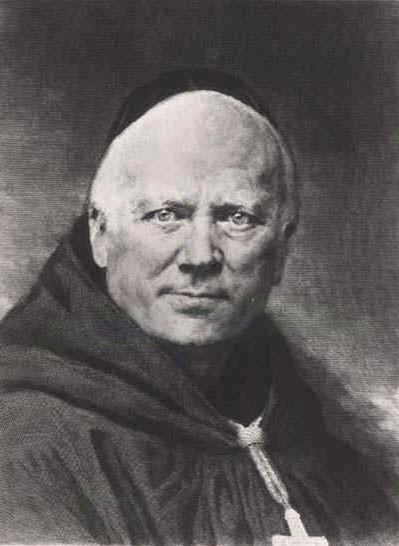
What he looks like is what JPII would have LIKED to look like in his DREAMS! The fire of foresight and zeal for the one, true Faith is obvious in his eyes. He looks right into your soul. No image of JPII ever looked like that.
Interesting "SOURCE." Thanks.
Ordained a priest in 1827 (Guéranger was only 22 years old at the time, so that his bishop had to obtain a canonical dispensation), he pursued his work as the bishop's secretary in Paris and in Le Mans. In 1831, learning that the priory at Solesmes was destined to destruction for lack of a buyer, the idea came to him to find the means to acquire it and to take up the Benedictine life again. With the help of a few friends and encouraged by his bishop, he gathered together - with considerable difficulty - enough money to rent the monastery property, and subsequently moved in with three companions on July 11, 1833.
No one doubted that a very great undertaking had begun, but it was judged to be barely viable, as the buildings were dilapidated, the tiny community without money or means to attract vocations, and certainly there was no one with experience in the monastic life. Its twenty-something superior possessed only a theoretical knowledge of how monks ought to live; the whole enterprise seemed to many to be more an act of folly than of faith.
The fledgling community encountered, of course, difficult times. But its young prior, borne up by his confidence in absolute Providence, by his humility and by his natural mirth and optimism, proved to possess a calm tenacity. Without copying the past in a servile way, he took inspiration from solid monastic traditions pursuing above all the true spirit of St Benedict while accepting several very necessary material adaptations to modern times. As a result, by his uncommon intuition of the benedictine charism, liturgy and spiritual life, he became a living example to his monks. As for temporal matters, Solesmes' first friends saw to the most urgent needs. They inaugurated a second and long list of the monastery's benefactors : the Cosnards, the Landeaus, the Gazeaus, Mme Swetchine, Montalembert, the Marquis of Juigné, and so many offers who thought constantly of the monks.
After a four-year tryout Dom Guéranger went to Rome, in 1837, to ask the Vatican for official recognition of Solesmes as a benedictine community. Rome not only granted Dom Guéranger's request, but on its own initiative raised Solesmes from the status of priory to that of an abbey making it the head of a new Benedictine Congregation de France, successor to the Congregations of St. Maurus and St. Vanne as well as the more venerable and ancient family of monasteries belonging to Cluny. On July 26, Dom Guéranger made his solemn profession in the presence of the abbot of St. Paul Outside the Walls in Rome.
From then on began a new period in the history of Solesmes. The trials and tribulations did not end, but they could no longer inhibit the newfound vitality of the young abbey.
Wishing to restore "a center of prayer and studies in service to the Church", Dom Guéranger underscored the primacy of the Divine Office from the very beginning, putting aside the notion of the benedictine monk as mere scholar. Nevertheless, the new abbot knew that for monks a persistant search for the truth is a prerequisite of an authentic spiritual life, and he seriously organised studies making huge sacrifices in order to build up the Solesmes library. A remarkable teacher with a lively and pleasant way of speaking, he encouraged his monks in intellectual pursuits, leading the way by his own example, and helped by his remarkable capacity for work. It is by the sheer number and authority of his publications that Solesmes acquired its first real influence, in France, and later in the universal Church.
Dom Guéranger is known above all for the part he played in the restoration of the liturgy. The meaning and value of the ceremonies having long been forgotten, the abbot of Solesmes explained them to the faithful in his most famous work, The Liturgical Year, which saw numerous translations and reprints. He taught them to live by and in the Church, to pray with Her and as She does . The return of the dioceses of France to the Roman Liturgy is owed in large measure to him, as well as the great current of piety, at once ancient and modern, known as "the liturgical life", which was to result in the present day liturgical movement.
Holding the Church's chant to be the perfect expression of her liturgical prayer, the abbot of Solesmes undertook, with his monks, the restoration of the Gregorian melodies which centuries of neglect and changes in taste had left unrecognizable. The workshop of the Paléographie musicale would be born of this research one day.
Ordained a priest in 1827 (Guéranger was only 22 years old at the time, so that his bishop had to obtain a canonical dispensation), he pursued his work as the bishop's secretary in Paris and in Le Mans. In 1831, learning that the priory at Solesmes was destined to destruction for lack of a buyer, the idea came to him to find the means to acquire it and to take up the Benedictine life again. With the help of a few friends and encouraged by his bishop, he gathered together - with considerable difficulty - enough money to rent the monastery property, and subsequently moved in with three companions on July 11, 1833.
No one doubted that a very great undertaking had begun, but it was judged to be barely viable, as the buildings were dilapidated, the tiny community without money or means to attract vocations, and certainly there was no one with experience in the monastic life. Its twenty-something superior possessed only a theoretical knowledge of how monks ought to live; the whole enterprise seemed to many to be more an act of folly than of faith.
The fledgling community encountered, of course, difficult times. But its young prior, borne up by his confidence in absolute Providence, by his humility and by his natural mirth and optimism, proved to possess a calm tenacity. Without copying the past in a servile way, he took inspiration from solid monastic traditions pursuing above all the true spirit of St Benedict while accepting several very necessary material adaptations to modern times. As a result, by his uncommon intuition of the benedictine charism, liturgy and spiritual life, he became a living example to his monks. As for temporal matters, Solesmes' first friends saw to the most urgent needs. They inaugurated a second and long list of the monastery's benefactors : the Cosnards, the Landeaus, the Gazeaus, Mme Swetchine, Montalembert, the Marquis of Juigné, and so many offers who thought constantly of the monks.
After a four-year tryout Dom Guéranger went to Rome, in 1837, to ask the Vatican for official recognition of Solesmes as a benedictine community. Rome not only granted Dom Guéranger's request, but on its own initiative raised Solesmes from the status of priory to that of an abbey making it the head of a new Benedictine Congregation de France, successor to the Congregations of St. Maurus and St. Vanne as well as the more venerable and ancient family of monasteries belonging to Cluny. On July 26, Dom Guéranger made his solemn profession in the presence of the abbot of St. Paul Outside the Walls in Rome.
From then on began a new period in the history of Solesmes. The trials and tribulations did not end, but they could no longer inhibit the newfound vitality of the young abbey.
Wishing to restore "a center of prayer and studies in service to the Church", Dom Guéranger underscored the primacy of the Divine Office from the very beginning, putting aside the notion of the benedictine monk as mere scholar. Nevertheless, the new abbot knew that for monks a persistant search for the truth is a prerequisite of an authentic spiritual life, and he seriously organised studies making huge sacrifices in order to build up the Solesmes library. A remarkable teacher with a lively and pleasant way of speaking, he encouraged his monks in intellectual pursuits, leading the way by his own example, and helped by his remarkable capacity for work. It is by the sheer number and authority of his publications that Solesmes acquired its first real influence, in France, and later in the universal Church.
Dom Guéranger is known above all for the part he played in the restoration of the liturgy. The meaning and value of the ceremonies having long been forgotten, the abbot of Solesmes explained them to the faithful in his most famous work, The Liturgical Year, which saw numerous translations and reprints. He taught them to live by and in the Church, to pray with Her and as She does . The return of the dioceses of France to the Roman Liturgy is owed in large measure to him, as well as the great current of piety, at once ancient and modern, known as "the liturgical life", which was to result in the present day liturgical movement.
Holding the Church's chant to be the perfect expression of her liturgical prayer, the abbot of Solesmes undertook, with his monks, the restoration of the Gregorian melodies which centuries of neglect and changes in taste had left unrecognizable. The workshop of the Paléographie musicale would be born of this research one day.
Thanks for a good quote from Dom Gueranger! He was certainly on target with this observation.
BTW, I'm reading an excellent book right now, The Mass and Modernity, by Fr. Jonathan Robinson, a priest (and the founder) of the Toronto Oratory. It connects the failed liturgical "reform" with its philosophical underpinnings and does a lot to explain why everything collapsed so quickly. In his view, it was basically because the understanding of believers had already been undermined by the acceptance of certain post-Enlightenment (or "modern") philosophical positions. It's available at Ignatius Press and Amazon.
Great!!!!!
Disclaimer: Opinions posted on Free Republic are those of the individual posters and do not necessarily represent the opinion of Free Republic or its management. All materials posted herein are protected by copyright law and the exemption for fair use of copyrighted works.