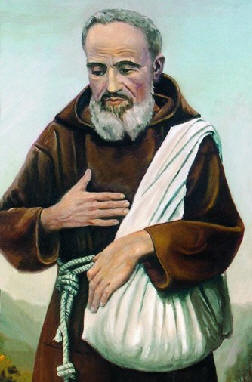
Felice da Nicosia (1715-1787)
Posted on 10/19/2005 7:31:13 PM PDT by NYer
VATICAN CITY, OCT. 19, 2005 (Zenit.org).- Here is the biography issued by the Holy See of Felix of Nicosia (1715-1787), who will be canonized with four other blessed this Sunday by Benedict XVI.
* * *
Felix of Nicosia was born of the marriage between Filippo Amoroso and Carmela Pirro, in Nicosia, Sicily, on Nov. 5, 1715. He was baptized on the same day, and was given the names Philip James. His father, a shoemaker by trade, died Oct. 12, 1715, leaving his widow with three children.
The family was poor but very religious. As a young boy, Felix worked in the workshop of the shoemaker Giovanni Cavarelli, close to the Capuchin friary, and so he often had opportunities to visit the community, get to know the friars and admire their way of life. Like most Sicilian boys in those days, he never attended school. The more time he spent with the friars, the more strongly he felt drawn to their life: their joyful austerity, their liberating poverty, their penance and prayer, their charity and missionary spirit.
Vocation tested
At age 20 he asked the superior of the friary in Nicosia to speak for him to the father provincial of Messina so that he could be admitted to the order as a lay brother. Being illiterate, he could not be admitted as a cleric; the lay vocation was more suited to his humble, simple nature. His request was repeated for eight successive years, and each time was met with the answer no, but his desire was as strong as ever.
His was a mature vocation, well weighed and ardently longed for. Certainly it is surprising that, after so many refusals, he never tried to join another similar order. For him, being a man of God and being a Capuchin were one and the same.
In 1743, hearing that the provincial of Messina was visiting in Nicosia, Felix asked to see him. He then explained his cherished wish. At last, the provincial admitted him to the order and sent him to the friary at Mistretta for his novitiate year.
A Capuchin friar
On Oct. 10, 1743, he began his novitiate, taking the name of Brother Felix. For him, the novitiate was a particularly intense year, spent in the practice of the virtues.
All his biographers tell us that Brother Felix was distinguished for his flair for obedience, his angelic purity, his love of mortification and his truly seraphic patience. It was with these virtues that he made his profession on Oct. 10, 1744.
Streets of Nicosia
Immediately after profession his superiors, contrary to the custom, sent him to the friary of Nicosia. In fact it was not common practice to assign a young religious to his own home town, in case he might be distracted by relatives and acquaintances. But Brother Felix's detachment from earthly affections was such that the superiors considered that no harm would come to his spiritual growth.
He had already made his own the maxim of St. Francis, that a friar should live in the world as a pilgrim and a stranger, calling nothing on earth his own, neither house, nor place, nor anything at all.
He was given the job of collecting alms. Every day he would walk through the streets, knocking on the doors of the rich, inviting them to share their prosperity, and of the humble dwellings of the poor, offering them comfort in their daily necessities.
There was a tranquil serenity and discretion about him as he moved through the streets, going from house to house. He would always say "thank you" whenever he received something, and even when he was sent away roughly he would answer: "Let it be for the love of God."
Thirsting for Scripture
Brother Felix was unable to read and write, yet full of Christian doctrine. Whatever he could not learn by reading Scripture, he learned by heart. He made every effort to absorb the passages of Scripture and the edifying books that were read at table in the friary, and lost no opportunity to listen to the sermons in the churches of Nicosia.
Devotions and penances
He was devoted to the crucified Christ. Every Friday he used to contemplate the passion and death of Jesus. Each Friday in March he fasted on bread and water and knelt in choir with his arms outstretched in the form of a cross, meditating before the crucifix.
He had a particular veneration for the Eucharist, spending hours in front of the tabernacle even after having endured the trials of every-day life. He showed tender devotion to the Mother of God.
Last days
Now relieved of all duties, and physically ill on account of his extreme penances and mortifications, he was always ready for any kind of service, especially for the sick brothers in the friary infirmary. The more his strength declined, the more intense was his concentration on God and his joyful, simple obedience.
At the end of May 1787 he was overtaken by a sudden, raging fever while working in the garden. His superior, Father Macario, ordered him under obedience to lie down. Brother Felix told the doctor who prescribed medicines for him that they were useless, because this was his "final illness." His earthly life ended at 2 a.m. on May 31, 1787.
He was beatified by Pope Leo XIII on Feb. 12, 1888.
A personal story. When I was 5, my mother took me to Rome. We were supposed to have a private audience with Pope Pius XII but he was ill. The private audience was opened up to a general one. It was held in St. Peter's Basilica.
As you can imagine, the Basilica was packed. When the audience ended, my mother and I became separated in the throng. I was frightened. Suddenly, two arms draped in brown fabric, swooped down and lifted me up. Just as quickly, I was sitting squarely on the shoulders of a Franciscan monk. He grabbed my mother's hand and led us out of the Basilica to St. Peter's Square. To this day, I recall that audience as though it were yesterday. I have always held a special place in my heart for the Franciscans.
BUMP
Great story!
CLOSING MASS OF THE OF THE SYNOD OF BISHOPS AND CONCLUSION OF THE YEAR OF THE EUCHARIST ~ CANONIZATION OF BLESSEDS JOZEF BILCZEWSKI, GAETANO CATANOSO, ZYGMUNT GORAZDOWSKI, ALBERTO HURTADO CRUCHAGA AND FELICE DA NICOSIA (2 ½ HOURS)
Sunday
October 23, 2005
3:30 AM
Thank you to whoever added the Keywords! Bless you!
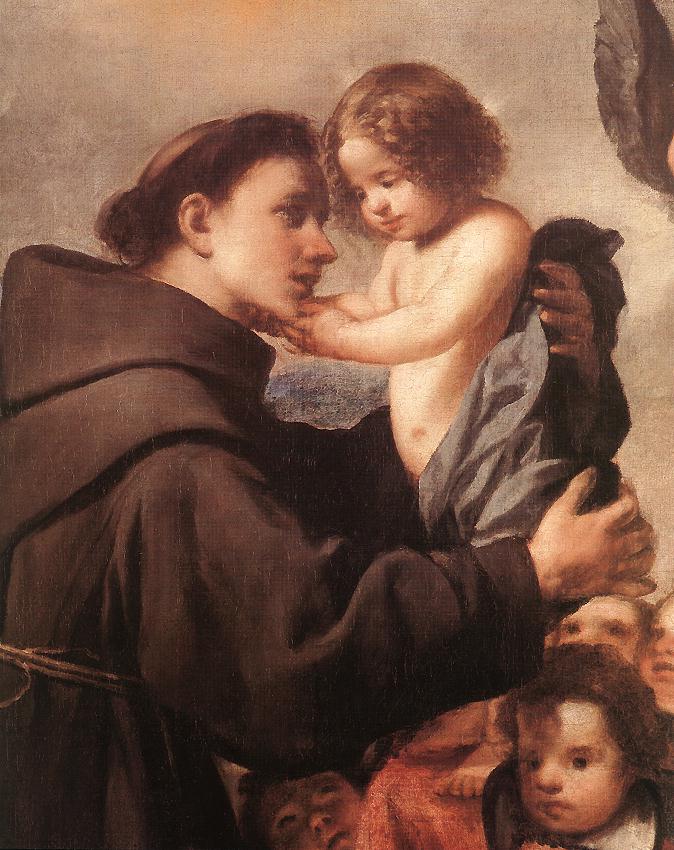
Just as St. Francis preached to the animals, St. Anthony preached to the fish. There is a church in Termoli, Italy, dedicated to St. Anthony. Franciscan artisans were brought in to decorate the interior with tiles depicting scenes of St. Anthony preaching to all types of fish. A bit too contemporary for my taste but mind blowing when you examine the size of the tiles used to construct these huge panels.
What a lovely story! And a great soon to be saint that I was not familiar with. Thanks!

A Veronese I had not seen before, of St. Anthony preaching to the fishes.


Disclaimer: Opinions posted on Free Republic are those of the individual posters and do not necessarily represent the opinion of Free Republic or its management. All materials posted herein are protected by copyright law and the exemption for fair use of copyrighted works.