Posted on 09/13/2004 12:31:44 PM PDT by Pyro7480
Icon of St. Edmund Campion
by T. Renee Kozinski
English Martyr, 1 December 1581
St. Edmund Campion is probably the most well-known of the English Martyrs; but his fame does not stand out alone; rather it draws attention to the many other Catholic martyrs of those years at Tyburn. The blood of the torn bodies of these lovers of Our Lord soaked the English soil upon which the darkness of heresy was growing. The dead tree of Tyburn, paralleling the dead wood of the cross at Calvary, became a tree of life for England; it is a true daughter of the Cross.
England is now a secular, neo-pagan land. The dead kings and queens who lie in Westminster, especially the mortal remains of Elizabeth I and Mary Tudor in their twin chapels, would never have imagined what would have become of their once fervently religious nation. Perhaps St. Thomas More would not be so surprised, and neither would St. Edmund Campion. Both brilliant scholars, they would have been far-seeing enough to know that the advent of "Cranmer's Lord's Table" signaled, not the Holy Sacrifice of the Mass, but a deeper and greater downfall for the life of England. Where there is no Sacrifice, there is no life; but there is still hope because of the martyrs of Tyburn.
In the middle of a traffic island, near Hyde Park and the Marble Arch, today's Catholic stands, forlornly staring at a small plaque set unceremoniously in the cement: "The Site of Tyburn Tree" is all it says, with a small cross — the only, and perhaps best, indication of what Tyburn Tree was to England. With cars whizzing by on all sides, it is truly an island in the middle of a world self-shorn of its true purpose: to love and serve the Lord, to become Little Christs. Yet this is what the martyrs of Tyburn Tree did; they gave their hearts, quite literally, and their blood (probably most of the blood in their bodies) rained quietly down into the dirt below the gallows as the darkness of death slowly clouded their eyes. The shouting, the cursing, the cries and the many Catholic eyes that glimmered in both rapture and grief faded, and the shabby curtain on this world tore in two.
They gave everything, except what they could not give, and that was returned to God. But I can't believe that St. Edmund and the other martyrs have forgotten their earthly patria. The evidence of this is the existence of a convent dedicated to them, and its dedication to being a light in England. More evidence is the miraculous conversions of the likes of Cardinal Newman, Chesterton, Tolkien (through his mother's conversion), and many others, famous and anonymous alike, who joyously faced opposition and ostracization, persecution and ridicule, all for the love of Our Lord.
The Icon
The general artistic theme of the work is inspired by the amazing and prayerful work of the monks who created the Book of Kells. The intricacies and apparently labyrinthine designs belie a wondrously ordered web of connections. Picturing the faithful monks of early Catholic Ireland, painstakingly painting the knots and various illuminations of faith, is to understand the work of prayer, especially intercessory prayer. Celtic design is, to me, symbolic of the prayer of a martyred saint for his earthly patria.
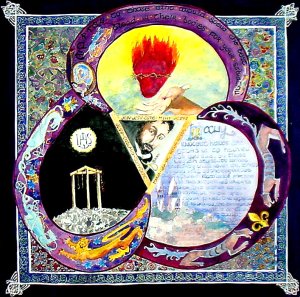
In the center, St. Edmund Campion is pictured with the tools of martyrdom, the noose and the blade. He was drawn by hurdle through the dirty streets of London. At Tyburn, he was hung until partially dead, then brought down and sliced open. His beating heart was torn from his body, and his entrails drawn out. He died. His body was then chopped into pieces, and scattered to different places all over the city. One could say his blood watered all of that sad city. The martyr directly after him, St. Ralph Sherwin, kissed St. Edmund's blood still on the hands of the executioner and then went to his own torture.
The play on darkness and light behind and in front of St. Edmund are symbolic of his being a light in the darkness which was oppressed Catholic England at that time. St. Edmund is surrounded by the planks of Tyburn tree. Upon the planks are the words in Latin: "Jesu, Jesu, be to me a Jesus"; "Jesus, convert England"; and "Mary, pray for our country." Some of these sentiments are taken from quotes of the different Tyburn martyrs.
Out from the ends of the beams come rings, dressed in the purple of kingship (Christ our King), and the red of blood (martyrdom). The topmost ring surrounds the Sacred Heart of Jesus. The martyrs had their hearts ripped from their bodies, and the "best blood," that is, the blood of the heart, was given to the glory of God. Providentially, the nuns of the Tyburn Convent are the "Adorers of the Sacred Heart." The quote, "Hearken to those who would spend the best blood in their bodies for your salvation" is taken from Campion's Brag (see below), the speech so derisively named by his enemies; the speech which was given to the Queen's Council, the members of which condemned him at the farcical trial.
The second ring on the lower left surrounds a painting of Montmartre, crowned by the magnificent Sacre Coeur, or Basilica of the Sacred Heart in Paris, France. Here is another strange twist of Providence. Montmartre was the place where St. Ignatius and his small band of followers took their first vows of poverty, chastity and obedience. Montmartre is the birthplace of the Jesuits, of which St. Edmund was a golden flower. Montmartre was also the birthplace of The Benedictine Adorers of the Sacred Heart of Jesus of Montmartre, or the nuns of Tyburn Convent. Also, during St. Edmund's time, many of the young English Catholic men who wished to give their lives to succor the suffering Catholics in England found themselves succor, education, and holy orders in France. In the sky behind Montmartre are more of the words from Campion's Brag, pertaining to those young men and to the Adorers of the Sacred Heart (some of their posterity). The ring around this picture portrays two grey wolves, rampant, and a fleur de lis. The fleur de lis is for France, and the wolves rampant (in heraldic terms) is from the family crest of Loyola, in honor of Loyola's glorious fruit, St. Ignatius.
The third and last ring is of sadness, hope, and conflict. Pictured within the confines of the ring is Tyburn Tree. There are the nooses and the garland of red roses. In some accounts, it is described that the martyr's tree would be adorned as for a wedding feast, a celebration of the martyr's impending meeting with the Bridegroom of Souls. The English people watch and wait in expectation, while the sky is black, symbolic of the darkness of heresy and injustice covering the land. St. Edmund's coat of arms is as the sun in the sky. The coat of arms is a sun with the IHS, the name of Jesus as witnessed to by the martyrs as the only hope for England to escape the darkness. The lion in the ring surrounding the picture is the great lion of England, part of the heraldry of English kings for centuries. During the time of Elizabeth, the royal coat of arms had a lion and a dragon, instead of the more familiar unicorn of later days. The dragon probably referred to the Welsh dragon, as Henry VI was related to the Lancasters from the Welsh side of the family. The dragons in this icon, facing inward upon themselves and tied in knots, are symbolic of heresy, as dragons are traditionally deceitful and bloodthirsty (the great dragon in the early Saxon Beowulf comes to mind). The lion, symbolic of real, Catholic England, Isle of Saints, and the Lion of Judah (Christ) is extending his claws, rampant, ready to strike down the dragons.
But he is only one—they have two. Will he win? Again, in our Christian faith we know that God gives strength to the lonely, the humble, the bruised, and to the victim; but for a time, He allows the enemy to seem to have the upper hand. Who now would have hope for a Catholic England? But we are a people of hope, and so the blue cinque-foils represent loyalty and truth; and the flower symbolizes hope. The wheat sheaves symbolize that the harvest of one's hopes has been secured. The gold of the wheat is for generosity. All of these relate to the gifts given us by the Martyrs of Tyburn Tree.
The icon of St. Edmund Campion is dedicated to the Sacred Heart of Jesus, to the Tyburn Convent (the Benedictine Adorers of the Sacred Heart of Jesus of Montmartre) and its foundress, Mother Mary of St. Peter, in the hope of the conversion of England back to her Catholic roots, and to the restoration of the Jesuits.
St. Edmund Campion, pray for us!
Catholic ping!
Another item on my long list of Must Sees for London. Sam Johnson was right - "A man who is tired of London, sir, is tired of life!"
Thank you very much for posting that! I knew of St. Edmund, but not of the more girsley aspects of his - and the other deaths - of the English marytrs.
How much Satan fills the hearts of the enemies of God with hatred for those who are truly in love with God!
They need to raise several hundred thousand pounds to upgrade their facilities so the handicapped can enter the crypt (they are required to by a recent British law), so they need our help!
You've been there too??
in my dreams. no, i admire the benedictines from afar. they were at the top of my vocations list, before i became more carmelite-inclined. still in the top ten. yup.
bump
Hope you enjoyed your trip.
Disclaimer: Opinions posted on Free Republic are those of the individual posters and do not necessarily represent the opinion of Free Republic or its management. All materials posted herein are protected by copyright law and the exemption for fair use of copyrighted works.