Free Republic
Browse · Search
News/Activism
Topics · Post Article

Skip to comments.

Study Predicts Boeing Downsizing
University of Buffalo ^ | Ellen Goldbaum

Posted on 09/01/2003 8:07:59 AM PDT by Paul Ross

University at Buffalo - Reporter

Volume 34, Number 21

Thursday, April 17, 2003

Study predicts Boeing downsizing

Geographers say airplane manufacturer will exit from passenger jet manufacturing

By ELLEN GOLDBAUM
Contributing Editor

The red ink flowing from the airline industry in recent months has consistently grabbed headlines, but during the next decade the U.S. economy will be affected by an even more significant loss with the nation's eventual exit from the building of passenger aircraft, a market the U.S. has led for more than half a century, according to a research paper by two UB geographers.

The paper, which was published last month in the journal Futures, provides a detailed look at the decline and eventual demise of an industry it describes as "the single most important sector of the U.S. economy in terms of skilled production jobs, value added and exports."

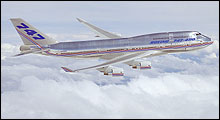
photo

UB geographers expect Boeing to cease manufacturing passenger planes like this 747-400 Jet Aircraft.

In the first in-depth analysis of the commercial aircraft industry since Sept. 11, 2001, the authors stress that the loss of this sector will have severe consequences for tens of thousands of U.S. workers, as well as for the nation's economy.

The authors focus on Boeing Corp., the only remaining U.S. manufacturer of large commercial aircraft—those with more than 100 seats.

"Ten years from now, Boeing, the last remaining U.S. firm in the business, will be making military and special aircraft, but its days of manufacturing large passenger jets will probably have come to an end," said Alan MacPherson, professor and chair of the Department of Geography in the College of Arts and Sciences, and co-author.

"This is the first analysis that documents the entire shifting of commercial aircraft manufacturing away from the U.S.," said David J. Pritchard, co-author of the paper, who wrote it as part of his doctoral work in geography at UB and who runs a consulting firm specializing in aerospace.

Pritchard worked for 20 years in commercial airframe manufacturing for suppliers servicing global aircraft manufacturers. He has visited every major aircraft plant in the world.

The dramatic shift in the geography of aircraft production overseas to Airbus and other government-financed firms in Japan, Italy and China, the researchers note, is in large part a result of subcontracting agreements in which foreign governments require that in order for them to buy planes, key technologies for aircraft production must be transferred to their companies from the U.S. or a certain percentage of the planes they buy must contain locally produced parts.

The recently published Final Report of the Commission on the Future of the United States Aerospace Industry http://www.aerospacecommission.gov cites Pritchard discussing this issue.

The authors note that although Boeing officials have not stated officially that the company is ceasing commercial aircraft production, there is overwhelming evidence that it will.

"Boeing has a lot of aircraft just sitting in the desert," said MacPherson, who adds that those planes have been purchased by airlines, but since Sept. 11, 2001, none of them is in any condition to take delivery.

In the paper, the authors cite the loss of more than 30,000 Boeing workers following Sept. 11, 2001 and subsequent announcements of future cuts, shifts in its emphasis into telecommunications and air-traffic control, and symbolic changes, such as the recent move of its headquarters to Chicago from Seattle, which is geographically closer to the emerging markets for new passenger jets in Asia.

As further evidence, Pritchard and MacPherson note:

  • Boeing's sale or closure of approximately 10 million square feet of space devoted to commercial and military aircraft production in the past decade

  • a 60 percent decline in Boeing's commercial aircraft production, with less than 50 aircraft in backlogs of four of its six commercial aircraft models, when most viable, mature aircraft programs have backlogs in excess of 100

  • the lack of new aircraft programs—Boeing's most recent aircraft is the 777, designed in the early 1990s

  • Boeing's announcement on Dec. 20 that it would shelve its futuristic, high-speed, sonic-cruiser design in favor of a cheaper alternative, its second cancellation of a proposed commercial jetliner program

"Our paper traces the transformation of Boeing from a manufacturing corporation to a global service corporation," MacPherson said.

That strategy probably will be positive for the corporation and its stock price, he explained, because traditionally aviation services and high-tech military aircraft manufacturing have had higher profit margins than the commercial side.

But, said MacPherson, there is a downside.

"The real cost will be to Boeing's workforce, which has already taken a major hit, and its subcontractor base in the U.S., sending a ripple effect throughout the sector and beyond," MacPherson said.

"The biggest loser in all this is the membership of the International Association of Machinists, the traditional aerospace workers who mainly do riveting and aircraft assembly," explained Pritchard. "These were well-paying positions and there will no longer be a need for them as Boeing aircraft programs are downsized and eventually closed. Now these people will need new sets of skills.

"My belief is that by the time Boeing comes out of this current 'downsizing,' the job losses will have reached between 45,000 and 50,000," he said.

At the same time, the authors document a major decrease in the number of scientist and engineer positions in the U.S. aerospace industry, which plummeted by 800 per cent from 1970 to 2000. More cuts are anticipated, they say.

The paper also documents the strengths of Boeing's new competitors, most significantly Airbus, whose market share has grown from zero in 1970 to 50 percent, as well as other firms—all of whom have benefited from the subcontracting offset agreements.

The paper forecasts a similar fate for other sectors of strategic importance to the U.S. economy, such as machine tools, where offset arrangements are becoming common.

MacPherson and Pritchard write that U.S. government policies have only been concerned with preventing the delivery of sensitive technologies to potentially hostile nations, rather than the potential economic consequences of such offset agreements, such as major job losses for American workers.

The UB authors characterize these agreements as prevalent in markets where "unit costs are high…and sellers are desperate to make a sale…"

"Direct offset agreements between airlines and aircraft producers are designed to transfer a segment of the manufacturing work to the buyer," they write.

In one striking example they cite from 1995, South Korean producer Hyundai obtained the engineering and technical specifications required to build wings for a Boeing/McDonnell jet.

Within two years, Hyundai had purchased state-of-the-art equipment and had successfully built wings for the Boeing 717. Meanwhile, the authors point out, Boeing's own equipment for building the same parts was around 30 years old.

"The competitors have the leverage to turn these deals very much to their advantage," said Pritchard.

The authors also note that Russian firms now are advancing technologically and are in the process of receiving FAA/JAA (Federal Aviation Administration/Joint Aviation Authorities, the European equivalent) certifications for several aircraft programs.

The Chinese aerospace industry is not far behind, they add, and currently is embarking on manufacturing a 70-seat regional jet featuring Western engines and avionics.

"We're foreseeing a radical shift in production of commercial aircraft from the U.S. to overseas," said Pritchard, "and it's not going to come back."


TOPICS: Business/Economy; Constitution/Conservatism; Foreign Affairs; Miscellaneous; News/Current Events; US: Washington
KEYWORDS: aerospace; boeing; deindustrialization; downsizing; implosion; manufacturing; outsourcing
Navigation: use the links below to view more comments.
first 1-2021-4041-6061-75 next last
The economic implosion that the Cato 'Fellows' will never, ever discuss.
1 posted on 09/01/2003 8:07:59 AM PDT by Paul Ross
[ Post Reply | Private Reply | View Replies]

To: Alamo-Girl; ALOHA RONNIE; maui_hawaii; chimera; Cacophonous; belmont_mark; harpseal; RogueIsland; ..
Ping. Never posted here. A key warning.
2 posted on 09/01/2003 8:11:13 AM PDT by Paul Ross (A nation which can prefer disgrace to danger is prepared for a master, and deserves one!-A. Hamilton)
[ Post Reply | Private Reply | To 1 | View Replies]

To: Paul Ross
At the same time, the authors document a major decrease in the number of scientist and engineer positions in the U.S. aerospace industry, which plummeted by 800 per cent from 1970 to 2000. More cuts are anticipated, they say.

What does that mean? I can't figure out how, if you started with 100 employees in 1970, you get to -700 employees in 2000. Is this a typo -- 80%?

3 posted on 09/01/2003 8:16:22 AM PDT by Eala
[ Post Reply | Private Reply | To 1 | View Replies]

To: Paul Ross
It's a sad state of affairs when its more attractive to do business in a communist country than in the USA.
4 posted on 09/01/2003 8:18:24 AM PDT by Voltage
[ Post Reply | Private Reply | To 1 | View Replies]

To: Eala
If Boeing wants to survive, it will have to develop a competitive advantage (faster airplane, lower fuel cost). Industry structure (where airlines automatically buy from this manufacturer) will not be enough to sustain it.
5 posted on 09/01/2003 8:22:12 AM PDT by Eric in the Ozarks
[ Post Reply | Private Reply | To 3 | View Replies]

To: Eala
It means that if you have 100 today you had 800 in 1970.
6 posted on 09/01/2003 8:30:38 AM PDT by jpsb
[ Post Reply | Private Reply | To 3 | View Replies]

To: Light Speed; Cannoneer No. 4
Ping.
7 posted on 09/01/2003 8:35:02 AM PDT by Paul Ross (A nation which can prefer disgrace to danger is prepared for a master, and deserves one!-A. Hamilton)
[ Post Reply | Private Reply | To 1 | View Replies]

To: Paul Ross
Nice, well we don't need to make airplanes. And the money saved will be put to better use in the "new" service economy. Maybe boeing can start up some kinda fast food chain.
8 posted on 09/01/2003 8:35:18 AM PDT by jpsb
[ Post Reply | Private Reply | To 2 | View Replies]

To: jpsb
Nice, well we don't need to make airplanes. And the money saved will be put to better use in the "new" service economy. Maybe boeing can start up some kinda fast food chain.

Nope..too dangerous, would get sued by a trial attorny for making people fat. Better just to move overseas outside their reach.

9 posted on 09/01/2003 8:38:29 AM PDT by Voltage
[ Post Reply | Private Reply | To 8 | View Replies]

To: Paul Ross
The dramatic shift in the geography of aircraft production overseas to Airbus and other government-financed firms in Japan, Italy and China, the researchers note, is in large part a result of subcontracting agreements in which foreign governments require that in order for them to buy planes, key technologies for aircraft production must be transferred to their companies from the U.S. or a certain percentage of the planes they buy must contain locally produced parts

Free market ideology is just that - an idealistic ideology, a goal, a direction. Nobody plays by those rules and noone ever has. Pragmatism rules the day - which means all sorts of anti-competitive coalitions exist and must be dealt with in a realistic way. Which means we can't be a free-trade nation in a world of protectionists. Which means we shouldn't criticize unions while exalting the NAM. And so on.

10 posted on 09/01/2003 8:50:27 AM PDT by liberallarry
[ Post Reply | Private Reply | To 1 | View Replies]

To: liberallarry
Free market ideology is just that - an idealistic ideology, a goal, a direction. Nobody plays by those rules and noone ever has. Pragmatism rules the day - which means all sorts of anti-competitive coalitions exist and must be dealt with in a realistic way. Which means we can't be a free-trade nation in a world of protectionists.


11 posted on 09/01/2003 8:59:59 AM PDT by Paul Ross (A nation which can prefer disgrace to danger is prepared for a master, and deserves one!-A. Hamilton)
[ Post Reply | Private Reply | To 10 | View Replies]

To: jpsb; Starwind
Nice, well we don't need to make airplanes. And the money saved will be put to better use in the "new" service economy. Maybe boeing can start up some kinda fast food chain.

Boeing Burgers, possibly? Or how about McDonnell-Douglas Fries?

12 posted on 09/01/2003 9:27:12 AM PDT by Paul Ross (A nation which can prefer disgrace to danger is prepared for a master, and deserves one!-A. Hamilton)
[ Post Reply | Private Reply | To 8 | View Replies]

To: Paul Ross
We are definitely selling them the rope they will try to use to hang us---we should make the same demands of those selling products here
13 posted on 09/01/2003 9:38:57 AM PDT by y2k_free_radical (ESSE QUAM VIDERA-to be rather than to seem)
[ Post Reply | Private Reply | To 1 | View Replies]

To: liberallarry
this is neither free market nor fair trade
14 posted on 09/01/2003 9:41:09 AM PDT by y2k_free_radical (ESSE QUAM VIDERA-to be rather than to seem)
[ Post Reply | Private Reply | To 10 | View Replies]

To: liberallarry
.."subcontracting agreements in which foreign governments require that in order for them to buy planes, key technologies for aircraft production must be transferred to their companies from the U.S. or a certain percentage of the planes they buy must contain locally produced parts..."

This is exactly the point that global free trade is anything but. In free trade, China could make a product and sell it in America, without restriction as to its own Chinese citizens building it. At the same time Boeing could use all Americans to build its jets for sale to China. China will not allow that as with so many products. China is a ruthless, dishonest trading partner trying to destroy the manufacturing base of the United States.

We are cooperating fully with the complete destruction of our own manufacturing.

Our government should simply tell the Chinese they MUST allow access to their markets for products built by Americans or LOSE THEIR ACCESS TO OUR MARKETS.

That's FREE TRADE.

15 posted on 09/01/2003 10:04:42 AM PDT by NoControllingLegalAuthority
[ Post Reply | Private Reply | To 10 | View Replies]

To: Paul Ross
Reminds me of a big billboard from the 70's...


"Will the Last Person Leaving Seattle Please Turn Out the Lights?"
16 posted on 09/01/2003 10:12:37 AM PDT by M0sby (Proud Marine Corp's Wife!)
[ Post Reply | Private Reply | To 1 | View Replies]

To: Paul Ross
There is a Boeing plant right up the road from where I live, drive past it every day. Used to have more people, and a second facility on the other side of the airport, but they contracted out that facility, then they had a strike, then a year later they laid everybody off at the contractor facility and closed it down. The main plant is still in operation, but there are a lot of empty spaces in the parking lot.

I have never worked in the aerospace industry, but I am surrounded by people who do, and their paychecks drive the economy around here. Lots of skilled tradesmen involved in building and rebuilding aircraft. Americans used to build more stuff, and build it better than anybody else. Now you can't tell what is built where or by whom.

The Wright brothers were Americans. We put men on the moon. Aerospace preeminence is ours to lose, and if we lose that we stand to lose our super power status, continuing the downward spiral to the end of the Republic.

17 posted on 09/01/2003 10:31:10 AM PDT by Cannoneer No. 4 ("Fahr na hole!")
[ Post Reply | Private Reply | To 7 | View Replies]

To: NoControllingLegalAuthority
I don't think it's just China. It's everyone who can get away with it.

There's also the question of unequal standards of living (pay, etc) and unequal levels of development, and unequal regulations (environment, health, etc) - which are normally adjusted by tariffs.

I don't understand our government's attitude. I've seen explanations to the effect that we are the world's greatest trading nation and would be most hurt by a trade war...but I don't believe it. I'd like to see a detailed breakdown of who benefits from the status quo and how they do it.

18 posted on 09/01/2003 10:35:50 AM PDT by liberallarry
[ Post Reply | Private Reply | To 15 | View Replies]

To: Paul Ross
March into Captivity

Pat Buchanan...assailed for his perspective.

Yet Pat..Like the Ancient Hebrew Prophets of old..forwarns of what is too come.

More headlines: Pat Buchanan on Free Trade

Warn Europeans: we’ll defend Boeing from Airbus subsidies Last week, the British government announced it would grant a $837 million loan to develop a superjumbo ‘Airbus,’ a plane whose mission is to sweep the Boeing 747 from the skies.
The loan is a first installment of an estimated $12 billion package, whose costs will be underwritten by European governments and taxpayers. These socialist subsidies allow Airbus to undercut Boeing on the world market. Airbus executives once boasted of their readiness to ‘give the planes away,’ if necessary, to seize market share from American rivals.
The strategy can succeed not because the European planes are better designed or better built, but only because they have the backing of a continental cartel.
[We should] warn the Europeans that America will not tolerate their targeting our aerospace industry for destruction. In a Buchanan Administration, America’s crucial industries will be defended by the White House from unfair and cutthroat competition from ungrateful nations we protected for 50 years.
Source: Press Release Mar 22, 2000

More import tariffs: 10% on Japan; 20% on China [Buchanan] favors a massive tax increase on consumer imports. He has called for a 10% tariff on Japanese imports, a 20% tariff on Chinese imports, and a “social tariff on Third World manufactured goods.” These tariffs would mean billions in new federal revenues, all of it siphoned from the pockets of American consumers. Source: Jeff Jacoby editorial, Boston Globe Sep 20, 1999

Replace welfare with National Guard against illegal aliens Illegal immigration must be halted, and no illegal alien given welfare. We need a nationwide Proposition 187, a closing of the Southwest border to illegals (with the National Guard, if necessary) and a new immigration law where we Americans decide who comes, and when. Our first concern must be the peace, stability and unity of our own country.

Tariffs on wheat imports to equalize costs & protect farms “Slapping a tariff on imported wheat would help deter foreign sales in the United States at a time when American farmers are not covering their own costs,” Buchanan said. He advocates a tariff on imported farm commodities to equalize the price with US production costs. The revenue could be used to cut taxes, he said. “When the price of wheat falls below the cost of production, why are you importing wheat? That simply kills your family farms.”
Source: Associated Press Jun 18, 1999

Supports banning Mexican trucks for US deliveries [I support the] Teamsters in stopping the use of Mexican trucks and drivers to deliver American cars. The 3.3 million Mexican trucks entering the US each year [are rarely inspected & are unsafe]. Deliberately imperiling American families by increasing US highway access for these rolling time bombs is unconscionable. The US has no shortage of reliable trucks and qualified American drivers, but under NAFTA, our workers are forced to compete with Mexican truckers earning one-tenth their wages.
Source: www.GoPatGo.org/ “Press Release: Hoffa Hailed” Jun 4, 1999

Support Steel Recovery Act to stop dumping [I support] the Steel Recovery Act (HR975), which is crafted to save the US steel industry from being destroyed by illegal foreign dumping of devalued steel. Last year, the industry was ravaged by imports from Japan, Brazil, Indonesia, Russia, Korea. Those nations were in recession, could not consume their own production, and so decided to dump steel on the US-to destroy our companies and save their own. US steelworkers do not ask for subsidies; they ask only that foreign regimes stop illicit dumping
Source: www.GoPatGo.org/ “Press Release: Save Steel” Mar 16, 1999

End trade deficits; stop exporting jobs; leave WTO Since 1992, the US has run a trillion-dollar trade deficit, $200 billion with Communist China, which now uses our currency to expand its military, steal our technology and buy weapons. We will reclaim our sovereignty over national economic policy, end these trade deficits, rebuild our manufacturing base, create, not export, good industrial jobs, and demand that products made in Japan and China pay the same taxes as products “Made in the U.S.A.” If the WTO objects, we will stand up and walk out.
Source: www.gopatgo2000.com/000-c-tradepolicy.html 5/28/99 May 28, 1999

Battle against globalization is a coming issue This whole battle against globalization is a coming issue. It’s going to unite a lot of people in a lot of countries. The economy is good for most people now, and most people focus on other issues. But if people care like this [referring to the large number of protestors at the Seattle WTO meeting] when the wood is green, what’s going to happen when the wood is dry? I think it’s THE coming issue.
Source: The Howie Carr Show, WRKO Boston 680 AM Dec 2, 1999

WTO is first step toward world government The WTO is more than a trade organization. It is an embryonic institution of world government, which asserts the right to veto laws democratically passed by the US. For example, if we Americans want to defend sea turtles and porpoises, that is our business. Who are these international bureaucrats to tell us we can’t do it? This is the beginning of world government, and people are resisting it to maintain their own national identity.
Source: Good Morning America with Diane Sawyer Dec 1, 1999

Supporting WTO is a march into captivity Buchanan has called support for the WTO part of a “march into captivity” by supporters of a single worldwide government.
Source: Boston Globe, p. A14 Oct 5, 1999

19 posted on 09/01/2003 1:56:48 PM PDT by Light Speed
[ Post Reply | Private Reply | To 7 | View Replies]

To: Paul Ross
I'll bet Boeing is betting that the airlines of the future (US-based mostly) will focus on mid-sized jets, not big jumbos because market trends and surveys show the passengers prefer more direct routes, not the hub-and-spoke approach. I know I do.

This is in contrast with the European approach towards bigger jets (500 + people). Who wants to ride on THAT cattle car.

Business decision.
20 posted on 09/01/2003 2:44:04 PM PDT by Gunrunner2
[ Post Reply | Private Reply | To 1 | View Replies]


Navigation: use the links below to view more comments.
first 1-2021-4041-6061-75 next last

Disclaimer: Opinions posted on Free Republic are those of the individual posters and do not necessarily represent the opinion of Free Republic or its management. All materials posted herein are protected by copyright law and the exemption for fair use of copyrighted works.
Free Republic
Browse · Search
News/Activism
Topics · Post Article

FreeRepublic, LLC, PO BOX 9771, FRESNO, CA 93794
FreeRepublic.com is powered by software copyright 2000-2008 John Robinson