Skip to comments.
Contraceptives: Make no bones about them
Health Center News ^
| 07/24/03
| Colette Bouchez
Posted on 07/24/2003 10:38:15 AM PDT by bedolido
If new studies are right, some birth control pills may do more than just prevent pregnancy. They could stop new bone from being made.
Reporting in the October 2001 issue of the Canadian Medical Association Journal, doctors said women who take birth control pills have a slightly lower bone density than non-users.
"At this point we don't know why we found these differences," said lead study author Dr. Jerilynn Prior, professor of endocrinology and metabolism at the University of British Columbia. She said earlier studies have shown some similar results.
"Some suggest early use of OC [oral contraceptives] cause less bone gain than is normal in women in their late teens and early 20s," said Prior.
From the time you are born, usually until you die, the cells in your bones are constantly being replaced. As old bone cells die, new bone is constantly being made, so bone density, a measure of the strength of our bones, should in theory stay fairly constant.
Doctors said one of two factors usually interrupt the process.
"Either something is causing bone to break down faster than it can be made, or the rate of bone loss is normal, but something is preventing normal bone gain from occurring," said Dr. Loren Wissner Greene, co-director of the bone mineral density unit at New York University Medical Center.
Since estrogen is intimately tied to bone production in women, the researchers theorize that the estrogen content of birth control pills may affect new bone formation.
"The high-dose estrogen and progestin [a hormone in even low-dose pills] suppress a woman's own estrogen. We don't know if the bone responds differently when high doses are given for three weeks, and there is none for one week," said Prior, referring to the average dosing schedule for most birth control pills.
Greene agreed: "It's possible that the natural ebb and flow of estrogen that occurs during the month is what helps trigger the production of new bone. The movement may be the 'switch' that turns on the whole process, and you don't get that kind of action when you take birth control pills." For the most part, oral contraceptives provide a constant and regular dose of estrogen through a month.
While the new research is far from conclusive, it examined the birth control use and bone density of some 500 premenopausal women. All were part of the nine-center Canadian Multicentre Osteoporosis Study, a research project looking at factors related to osteoporosis, a serious bone-thinning disorder that primarily affects women.
Participants in this leg of the study fell into one of two groups: those who had used birth control pills less than three months total in their lives (considered non-users) and those who had taken the pill for at least three months or longer at any time in their lives.
The researchers also questioned each woman about weight, height and bone mineral density.
Factors that could affect bone density in all the women were similar, including age, age at their first period, whether or not they had children, current calcium intake, alcohol consumption, smoking, exercise, body mass index, past irregular cycles and amenorrhea (absence of a menstrual cycle).
Although the group that used birth control pills showed a slight increase in smoking and alcohol consumption, Prior said that made little difference in the study results.
The results, based on bone density measurements of the spine and hip, showed women who used oral contraceptives had a bone density just below normal, at 1.03 grams per centimeter. Women who did not take birth control pills averaged 1.07 grams per centimeter. Greene said the average bone mass density for healthy women aged 20 to 40 is between 1.04 and 1.26.
"This places the women who used birth control pills in a category we call 'osteopenia:' the stage prior to osteoporosis," and just marginally under "low normal" in terms of bone density, said Greene.
She said the difference between the two groups is way too small to draw any major conclusions.
"The study also lumps together too many people without enough specific information about factors that could also affect estrogen levels or bone production," said Greene.
Prior also said you should not jump to conclusions based on her study. "We cannot say at this point that use of OC caused a lower bone density." She said the finding represents only "an association."
One month before the release of this study, researchers at University of Texas Medical Branch reported finding a similar association between the use of progesterone-only contraceptives known as Depo-Provera and reduced bone density in premenopausal women. However, a spokeswoman for Pharmacia Corp., which makes Depo-Provera, said the Texas study only lasted one year and therefore couldn't predict the long-term effect of contraceptive use.
TOPICS: Culture/Society; Extended News; Miscellaneous; News/Current Events
KEYWORDS: boneloss; bones; catholiclist; contraceptives; health
1
posted on
07/24/2003 10:38:15 AM PDT
by
bedolido
To: nickcarraway; Polycarp; Canticle_of_Deborah; maryz
ping
2
posted on
07/24/2003 10:40:31 AM PDT
by
Desdemona
To: bedolido
They could stop new bone from being made Maybe the condom is too tight :)
To: bedolido
Where are all the naturalists, anyway, when it comes to condemning unnatural birth control strategies, anyway?
I guess more folks oppose nature than they want others to realize. Has somethin' to do with maintaining this pseudosovereignty they've been in pursuit of...
To: Living Free in NH
They could stop new bone from being made Maybe the condom is too tight :)Different bone (have never had found one that was to tight... I thought they were all large)
5
posted on
07/24/2003 10:49:52 AM PDT
by
bedolido
(please let my post be on an even number... small even/odd phobia here)
To: Desdemona; .45MAN; AKA Elena; al_c; american colleen; Angelus Errare; Antoninus; aposiopetic; ...
Oral contraceptives are now revealed to cause osteoporosis. Should this come as any surprise?
Oral contraceptives are associated with an increased risk of other conditions, including blood clots, stroke, liver cancer, heart attack in women over 35 who smoke, and cervical cancer in women infected with the human papillomavirus.
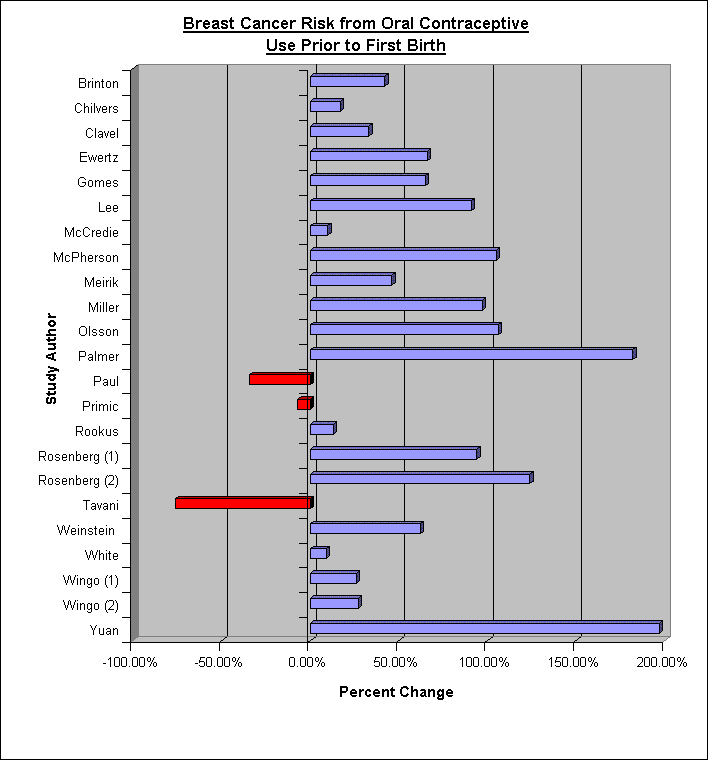
As of 2003, 18 out of 21 retrospective studies show that women who take oral contraceptives prior to their first-term birth incur an increased risk in developing breast cancer as noted in the bar graph below:
6
posted on
07/24/2003 10:50:21 AM PDT
by
Polycarp
(Life's not like a box o choclates...it's like eatin jalapenos. What ya do now might burn ya tomorrow)
To: bedolido
You said bone....hhuh huh huh huh
7
posted on
07/24/2003 10:51:27 AM PDT
by
GSWarrior
To: bedolido
Dr. Jerilynn Prior was married to my cousin. Smart cookie.
8
posted on
07/24/2003 10:52:50 AM PDT
by
happygrl
To: Polycarp
Informative chart. You might be interested to know that the Vedic/Hindu prohibition against illicit sex I told you about includes forbidding the use of contraceptives. In fact, the Bhagavad Gita has a verse that states (my own words) the sex that is performed in accordance with scripture represents God - in other words, is holy, if performed by a wedded husband and wife, ideally for children and at least doing nothing to prevent them.
To: bedolido
have never had found one that was to tight... I thought they were all largeYeah, me too.
To: bedolido
"Make no bones about them"
Too easy. Did you hear the one about the conceited couple?
"Tight, huh?"
"No, just full."
11
posted on
07/24/2003 11:06:33 AM PDT
by
talleyman
(Land of the freep and home of the brave)
To: talleyman
no jokes about getting boned...
12
posted on
07/24/2003 11:09:05 AM PDT
by
Mr. K
(VEY series about everything)
To: Canticle_of_Deborah
ping
Comment #14 Removed by Moderator
To: Desdemona
Very interesting.
To: bedolido
Bump for reference!
16
posted on
07/24/2003 3:58:30 PM PDT
by
Flying Circus
(Orthodoxy requires Orthopraxy)
Disclaimer:
Opinions posted on Free Republic are those of the individual
posters and do not necessarily represent the opinion of Free Republic or its
management. All materials posted herein are protected by copyright law and the
exemption for fair use of copyrighted works.
FreeRepublic.com is powered by software copyright 2000-2008 John Robinson