Posted on 09/08/2026 11:47:40 AM PDT by SeekAndFind
Inflation can make an investment account look far healthier than it really is. Once taxes are added, investors may discover that a significant portion of their apparent profit never increased their purchasing power at all.
Consider an investor who puts $10,000 into a stock, earns 10% annually and sells after 20 years.
The investment grows to approximately $67,275, producing a taxable capital gain of $57,275.
That sounds like an exceptional result. Yet if inflation averaged 3% during those two decades, nearly half of the gain would reflect rising prices rather than a true increase in purchasing power.
Compounding $10,000 at roughly 7%, the approximate return after subtracting inflation, produces about $38,700. The real gain is closer to $28,700.
Under current federal tax rules, however, the investor generally owes capital gains tax on the full $57,275 nominal profit.
At a 20% federal long-term capital gains rate, that could mean a tax bill of approximately $11,455 before accounting for the net investment income tax or state taxes. If the cost basis were adjusted for inflation, the federal bill in this simplified example would fall to roughly $5,740.
The difference represents a tax on wealth that exists on paper but delivered no additional purchasing power.
That is the argument behind renewed calls to index capital gains to inflation.
When an investor sells an asset, the taxable gain is generally calculated by subtracting the original cost basis from the sale price.
Capital gains indexing would increase that cost basis to reflect inflation during the holding period.
If a stock purchased for $10,000 was held through a period in which consumer prices doubled, its inflation-adjusted basis might become $20,000. Taxes would then apply only to appreciation above that adjusted amount.
The proposal has intuitive appeal. The federal tax code already adjusts income-tax brackets, the standard deduction and retirement contribution limits for inflation. Supporters argue that the same principle should apply to investment gains.
Yet indexing capital gains in isolation could create major distortions across financial markets and the tax system.
Stocks and other appreciating assets would be the primary beneficiaries of capital gains indexing. A portion of their future appreciation would become exempt from taxation based on the inflation rate.
Bonds would receive no comparable protection under a narrowly written proposal.
Bond interest is generally taxed as nominal income, even when inflation consumes much of the yield. A bond paying 5% during a period of 3% inflation produces a real return of only about 2% before taxes, yet the investor may owe tax on the entire 5%.
If stocks received inflation protection while bonds did not, investors could demand higher yields to own fixed-income securities. That would raise borrowing costs for the federal government, corporations, home buyers and other borrowers.
This matters because long-term interest rates are already elevated compared with much of the post-financial-crisis period. Any policy that reduces demand for bonds could place additional upward pressure on yields.
Capital gains indexing could also change the math behind traditional 401(k)s and IRAs.
Money contributed to a traditional retirement account can grow without annual taxation. In exchange, most distributions are included in taxable income when withdrawn. Those withdrawals include decades of nominal growth, including the portion caused by inflation.
Taxable brokerage accounts already benefit from lower long-term capital gains rates and the ability to defer taxes until an asset is sold. If those gains were also indexed for inflation, the relative tax advantage of a traditional retirement account could narrow for some savers.
Employer matching contributions would remain extremely valuable. Upfront deductions could also continue to benefit workers who expect to retire in a lower tax bracket.
Still, the balance between taxable accounts, Roth accounts and tax-deferred accounts could shift. Investors would need to evaluate where each new dollar of savings receives the best lifetime tax treatment.
The policy would also produce an uneven distribution of tax savings.
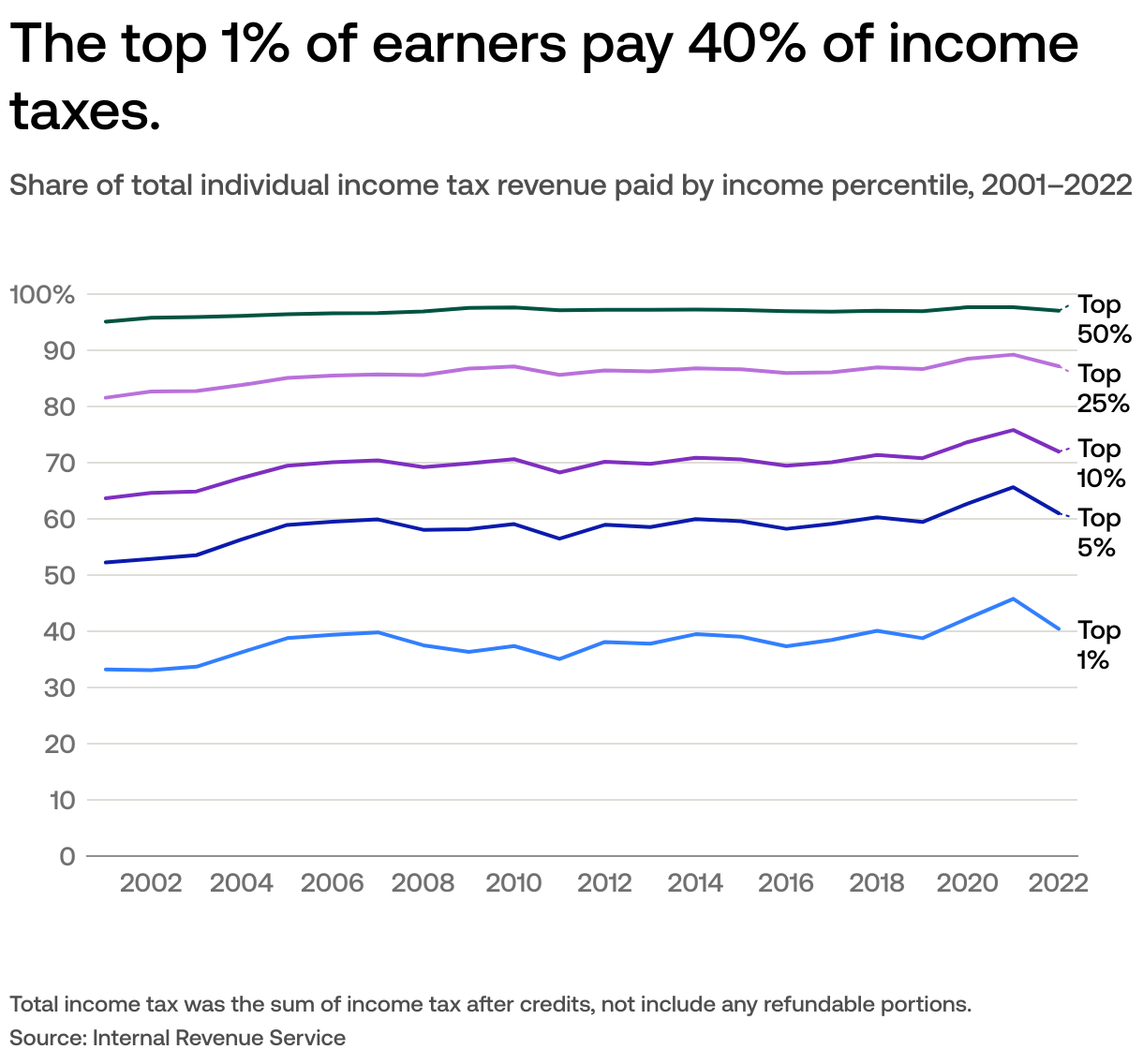
Capital assets held in taxable accounts are heavily concentrated among affluent households. Many lower-income and middle-income Americans own stocks primarily through retirement plans, where capital gains taxes do not apply when assets are sold inside the account.
The Yale Budget Lab estimates that retroactively indexing existing capital gains could cost the federal government almost $1 trillion over 10 years. The top 0.1% of households by income would receive an average tax cut of approximately $350,000 in 2027, while the bottom two income quintiles would receive essentially no benefit.
A prospective policy applying only to newly purchased assets would have a much smaller initial cost, estimated at approximately $170 billion over the same period.
That gap will be central to any serious policy debate. Retroactive indexing would deliver immediate tax relief to owners of assets that have already appreciated. Prospective indexing would reduce the fiscal cost while delaying much of the benefit.
The strongest argument for capital gains indexing is straightforward: taxing inflationary appreciation can produce extremely high effective tax rates on real gains.
Suppose an asset rises 4% during a year when inflation runs at 3%. Its real return is roughly 1%. A tax applied to the entire 4% nominal gain can consume a surprisingly large share of the investor’s actual increase in wealth.
Still, capital gains already receive several important advantages.
Taxes are usually deferred until an asset is sold, allowing money that would otherwise go to the government to remain invested. Long-term gains can receive lower rates than wage income. Appreciated assets transferred at death may also qualify for a step-up in cost basis under current law.
Indexing gains without addressing interest income, depreciation, borrowing costs and other inflation-sensitive provisions could create tax-planning opportunities. An investor might deduct nominal interest expenses while receiving inflation protection on the appreciation of assets purchased with borrowed money.
The result could favor leverage and certain asset classes instead of producing a neutral tax system.
Investors should avoid waiting for Congress to solve the inflation problem.
The likelihood of a sweeping capital gains tax break faces a major obstacle: the federal government would have to replace the lost revenue, borrow more money or accept larger deficits.
Higher government borrowing could push interest costs upward. That would create an ironic result in which a policy intended to protect investors from inflation contributes to the fiscal pressures that can keep inflation and bond yields elevated.
The practical lesson is that investors should build inflation awareness into their portfolio decisions today.
That means evaluating returns after inflation, considering the tax characteristics of each account and paying attention to asset location. Investments producing frequent taxable income may be better suited to tax-advantaged accounts, while tax-efficient stock strategies may fit more naturally in taxable accounts, depending on the investor’s circumstances.
Tax-loss harvesting, charitable donations of appreciated securities and careful management of realized gains can also reduce tax drag under current law. These strategies require attention to individual tax circumstances and applicable rules.
Capital gains indexing sounds like a narrow tax proposal, but its effects could extend across stocks, bonds, retirement accounts and federal borrowing costs.
The proposal also highlights a problem investors already face. Nominal portfolio gains can create an exaggerated impression of wealth, especially after several years of elevated inflation.
An account balance is only the opening number. The result that matters is what remains after inflation and taxes.
Whether Washington changes the law or leaves it untouched, investors should judge performance in purchasing-power terms. A smaller nominal return earned during stable inflation can build more real wealth than a spectacular market gain accompanied by rapidly rising prices.
If it’s adjusted for inflation, it should be taxed as ordinary income rather than at the more favorable capital gains rate. Inflation is one of the risks of investment. Favorable tax treatment is one of the benefits.
The lower capital gain rate was originally from a 50% exclusion for capital gains, to the reduced rate they use now.
One purpose of the reduced rate was to take into account the loss from inflation by using a general rule, rather than the nightmare of indexing.
Yet another very bad consequence of a fiat currency that almost automatically leads to inflation, destruction of wealth and devaluation
And yet we’ll get any number of cranks (or propagandists) here coming to tell us taking money production out of the hands of politicians and monetary central planners and linking money to something “hard” is a bad idea
Oh well, then - just stay on the present path....
You will NOT get indexing without an increase in the rate. This is a fool’s errand.
The article didn’t mention borrowing against the appreciated assets, which will pass through tax-free to inheritors at the value on the owner’s death. This only works if the estate is less than the tax-free inheritance, which I recall as being around $15 million.
duh ... High-Income households pay most of the cost.
Using the article’s assumptions, the investor would not automatically have been better off spending the $10,000. Even after the 20% federal capital-gains tax and 3% annual inflation, the investment would leave about $30,900 of today’s purchasing power—roughly three times the original $10,000. However, the investor’s real gain is far smaller than the impressive-looking $57,275 nominal gain.globalmarketnews
And yet we’ll get any number of cranks (or propagandists) here coming to tell us taking money production out of the hands of politicians and monetary central planners and linking money to something “hard” is a bad idea
- - - - - - -
Many people understand that competition leads to better products. Money is another product. If private companies compete and produce it, it will be of better quality.
“Capital gains indexing would increase that cost basis to reflect inflation during the holding period.”
Everybody experiences a different Inflation Rate.
Hold inflated items until you die.
Your heirs will get a step-up in basis and then they can sell w/o taxes on the Inflation.
A 2% Inflation Target is theft and a joke.
Shhhh...you’re not supposed to reveal the facts. Otherwise the lemmings might get irritated and do nothing.
-Roth IRA
-Index Funds
-Dividend Reinvestment option
Personally, I do high-beta (price fluctuation) oil stocks.
When we bomb -I buy
When they bomb -I sell
I am a man of patience, always wishing for peace.
later
instead, let’s say 30 years ago you bought $10,000 worth of SPY (S&P 500 ETF).
you’d get 149.66 shares.
by 2016, your portfolio would be worth $31,350
if you then borrow $25,000 at 6% and buy more SPY (119.34 shares),
you’d have a total of 269 shares and a monthly payment of $277.55 for 10 years.
As of today, you’d have 269 shares having paid $33,300 over the last 10 years.
your portfolio would be worth $206,000.
And none of it owed any taxes. so do it again... borrow $100,000 over 10 yrs and buy more SPY. repeat.
As long as you’re making more than 6% on SPY, you’re ahead of the game.
Those are the same thing. Folks who write about things economic should take some courses in the subject
The "Where's My Amended Tax Return" site said they had received my return on May 4th, and that my return should be completed within 16 weeks. As of August 24th, it was 16 weeks. On August 25th, when I checked their site, a new message was added, saying that they had received my return, but that there was now a delay in their processing it. They also recommended not calling their office over the delay. It's now been 18 weeks.
I wasn't the only person that experienced the IRS error. Another Freeper wrote me that they'd had the same problem. H&R Block told me they believed there was a glitch in the IRS software that caused the original calculation errors.
I always deduct inflation from my taxes. lol
Look up margin requirements and margin calls.
Disclaimer: Opinions posted on Free Republic are those of the individual posters and do not necessarily represent the opinion of Free Republic or its management. All materials posted herein are protected by copyright law and the exemption for fair use of copyrighted works.