
Click here: to donate by Credit Card
Or here: to donate by PayPal
Or by mail to: Free Republic, LLC - PO Box 9771 - Fresno, CA 93794
Thank you very much and God bless you.
Posted on 08/16/2026 7:45:07 AM PDT by SeekAndFind
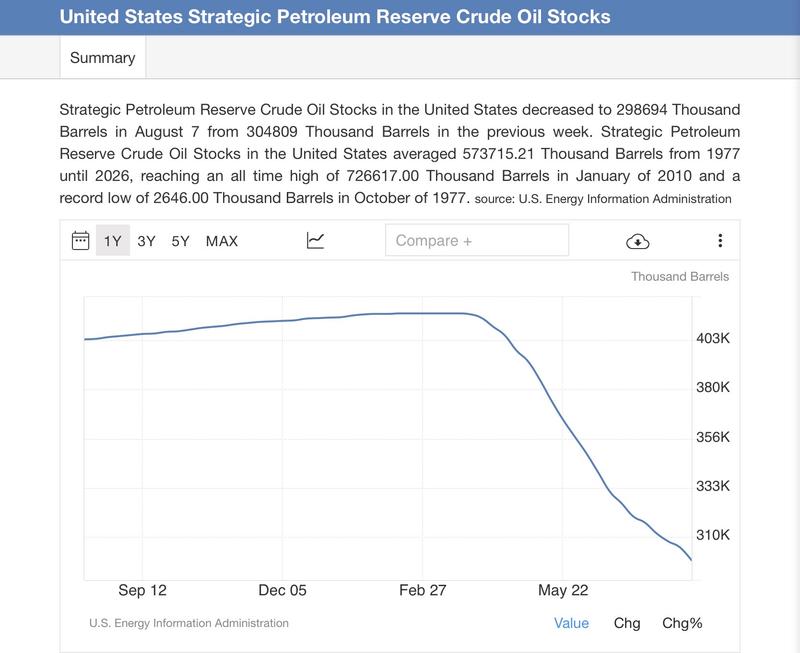
America’s emergency oil stockpile has fallen below 300 million barrels for the first time since the Strategic Petroleum Reserve was filled in the early 1980s. Now, some energy experts are warning that the problem may go far beyond simply having less oil available during the next crisis.
The rapid drawdown could threaten the underground salt caverns that hold the crude, potentially reducing how quickly the United States can respond to another major supply disruption. The warnings come as the U.S. releases 172 million barrels from the Strategic Petroleum Reserve, or SPR, in response to supply disruptions caused by the Iran war. When the current drawdown is complete, the reserve is expected to contain only about 243 million barrels.Geographic Reference
That would put the SPR below what some experts consider its practical operating floor and raise new questions about the long-term viability of one of the country’s most important energy-security assets.
The Strategic Petroleum Reserve was created after the oil shocks of the 1970s to give the United States a massive emergency supply of crude that could be released when wars, natural disasters or other disruptions threaten energy supplies. At its peak, the reserve held more than 700 million barrels.
Its oil isn’t stored in conventional above-ground tanks. Instead, crude is held thousands of feet underground inside roughly 60 enormous salt caverns at four major sites along the Gulf Coast in Texas and Louisiana.
Those caverns are now becoming a growing source of concern as inventories fall to levels not seen in more than four decades. The Department of Energy has said at least 70 million barrels must remain in the reserve to safely manage the caverns, but several energy experts argue that number represents a physical minimum rather than a realistic level at which the system could continue operating normally.
Former Biden administration energy adviser Amos Hochstein has been particularly critical of the 70-million-barrel figure.
“Don’t believe the people out of the government that are saying the SPR can go to 70 million barrels. It’s nonsense,” Hochstein told CNBC. He argued that taking the reserve that low could deplete it to the point where fully restoring its capabilities becomes extraordinarily difficult.
Hochstein had already warned in June that dropping below 300 million barrels could put the storage system itself at greater risk. “I don’t know anyone who believes we can go below 300,” he said at an Atlantic Council event, adding that some experts believe approaching that level could physically damage the caverns where the oil is stored.
The Department of Energy strongly disputes claims that the storage caverns face collapse as oil is withdrawn.
Energy Department spokesman Ben Dietderich said the caverns remain full because water replaces the oil removed from them. “The caverns are always full. All that changes is the ratio of oil and water that is filling them,” Dietderich told CNBC, adding that the Trump administration is “responsibly managing the SPR as the critical national security asset it was designed to be.”
But the mechanics of replacing that oil are precisely what concern some engineers. Extracting crude from the SPR involves pumping water into the bottom of a cavern, which pushes the oil upward and allows it to travel through wells into pipelines.
The problem is that fresh water dissolves salt. During repeated and rapid drawdowns, that process can gradually alter the shape and dimensions of the underground caverns, potentially creating problems that accumulate over decades of use.
The Government Accountability Office warned in a May report that repeated partial drawdowns followed by refilling can repeatedly leach the same portions of a cavern, potentially creating “undesirable shapes.”
The GAO found that most SPR caverns remained in “very good condition” following the massive 2022 drawdown. However, the watchdog also highlighted a longer-term structural concern: every drawdown cycle expands cavern volume and reduces the spacing between neighboring caverns inside the salt dome, which ultimately reduces their long-term viability.
That matters because the SPR has been used far more frequently than originally envisioned. Siddharth Misra, a petroleum engineering professor at Texas A&M University, said the reserve was originally designed around approximately five full drawdowns but has instead experienced dozens of large and small releases during its roughly four decades of operation.
According to Misra, repeated injections of water and extractions of oil have contributed to cavern deformation and salt falls from cavern ceilings while weakening the aging storage system over time. Rapid withdrawals can be particularly problematic because large quantities of fresh water must be injected to push the crude toward the surface.
Misra warned that the process can create flatter, less stable cavern roofs while thinning the salt pillars separating neighboring caverns. In a worst-case scenario, those changes could increase the geological risk of structural problems.
Misra estimates that the practical operational floor for the SPR is somewhere between 250 million and 300 million barrels. At current inventory levels, he said cavern integrity and the reserve’s overall operational capabilities face elevated risks.
That makes the projected post-drawdown level especially significant. Once the current 172-million-barrel release is completed, the SPR is expected to contain approximately 243 million barrels, putting it below the lower end of Misra’s estimated practical operating range.
Other analysts believe the reserve has more room before reaching a critical threshold. Rapidan Energy has estimated that the SPR has a “soft-ish floor” of roughly 170 million barrels, below which cavern integrity and pumping infrastructure limitations would increasingly argue against further withdrawals.
The disagreement illustrates an important distinction. There may not be a single number at which the Strategic Petroleum Reserve suddenly becomes unusable. Instead, its ability to operate efficiently could gradually deteriorate as inventories fall.
One of the SPR’s biggest advantages isn’t simply the amount of crude it contains. It is the ability to move huge quantities of oil into the market quickly when a major supply emergency occurs.
That capability may decline as inventories fall. Misra said that once the reserve drops below 300 million barrels, its ability to pump oil at the rapid speeds needed during an emergency can become constrained.
As the oil layer near the top of a cavern becomes thinner, sludge can move closer to extraction equipment. Pipes and pumps may face greater risk of damage, while operators could have less flexibility to move crude through the system at maximum capacity.
Seventy million barrels may therefore represent a strict physical minimum needed to keep extraction pipes safely submerged in oil rather than water. But that doesn’t mean the United States could efficiently release those remaining barrels at the speed required during a major crisis.
For an emergency reserve, that distinction is critical. Hundreds of millions of barrels underground provide much less protection if infrastructure limitations prevent them from reaching the market quickly enough.
The reserve’s infrastructure challenges aren’t entirely theoretical. Energy Department officials told the GAO that they were holding portions of the SPR infrastructure together with “Band-Aids” and that it was uncertain how long those fixes would last.
As of December 2025, more than one-quarter of the SPR inventory was unavailable for drawdown because of construction and cavern outages, according to the GAO. Those limitations could become increasingly important if another major supply crisis emerges while the reserve is still recovering from the Iran-related release.
The SPR stood at roughly 415 million barrels before the Iran war. The planned 172-million-barrel release will ultimately reduce it to approximately 243 million barrels, a dramatic decline from the more than 700 million barrels the reserve held near its historical peak.
The United States is therefore approaching potential future emergencies with a much smaller strategic cushion than it possessed during much of the SPR’s history, while simultaneously dealing with infrastructure that has undergone decades of drawdowns and refilling cycles.
Warnings about the physical condition of the SPR aren’t confined to one political party. Republican lawmakers raised similar concerns when the Biden administration released a record 180 million barrels in 2022 following Russia’s invasion of Ukraine and the resulting surge in global energy prices.
The SPR subsequently fell below 350 million barrels in 2023 before inventories were rebuilt to approximately 415 million barrels ahead of the Iran war. The latest crisis has now reversed much of that rebuilding effort and pushed the reserve below 300 million barrels.
That cycle illustrates the increasingly difficult balancing act facing Washington. Releasing oil from the SPR can soften the economic damage from a severe global supply disruption, helping stabilize crude supplies and potentially limiting increases in gasoline and other energy prices.
But repeatedly drawing down and refilling the caverns can impose physical costs on infrastructure that wasn’t designed for unlimited cycles. Policymakers must therefore balance the immediate economic benefits of releasing crude against preserving the reserve’s ability to function during future emergencies.
The timing creates an additional concern as the United States moves through Gulf Coast hurricane season. Major hurricanes can disrupt offshore oil production, refineries, pipelines and ports across Texas and Louisiana, precisely the region where much of America’s energy infrastructure and the SPR itself are concentrated.
Hochstein warned that a major hurricane striking Florida or Louisiana while inventories remain depressed could put the United States in a difficult position. “Below 300 million, which is where we are now, it is not that we can’t do it, but it slows the flow and puts us in danger,” he said.Geographic Reference
A severe hurricane occurring alongside continued disruptions from the Iran war could force Washington to confront two energy emergencies simultaneously. With the reserve already heading toward roughly 243 million barrels, the government’s ability to respond as aggressively as it has in previous crises could become increasingly constrained.
The United States still has hundreds of millions of barrels of emergency crude underground, and the Department of Energy maintains that the reserve can continue operating safely. The immediate question isn’t whether the SPR suddenly stops functioning when inventories cross an arbitrary threshold.
The bigger concern is whether continued depletion gradually reduces the reserve’s ability to do the job it was created to perform. With inventories at their lowest level since 1983, aging infrastructure already limiting access to portions of the stockpile and experts disagreeing over how much further the reserve can safely be drawn down, the margin for error is shrinking.
The current release is intended to help America weather today’s energy disruption. But if inventories ultimately fall to approximately 243 million barrels, Washington could face a much harder question the next time war, a hurricane or another major supply shock hits:
How much emergency oil can the United States afford to use today without weakening its ability to respond tomorrow?
|
|
Click here: to donate by Credit Card Or here: to donate by PayPal Or by mail to: Free Republic, LLC - PO Box 9771 - Fresno, CA 93794 Thank you very much and God bless you. |
Pedo Joe Biden brought in 20 million foreign illegal aliens to burn the American oil supply up. They need to be forbidden to buy American gasoline. They go back and forth across the border every day in their new luxury pickups and SUVs. They can buy it on their side of the border. We don’t have enough for those maggots here illegally.
More anti-Trump proaganda, that is irrelevant That defeicti has been the reality since the Biden Administration that used the pertoreum reserve for political purposes, that failed.
If a Democrat is in the WH and the SPR is low, the Dem voters shrug it off and the Rep voters run about like Chicken Little.
If a Republican is in the WH and the SPR is low, the Rep voters shrug it off and the Dem voters run about like Chicken Little.
(It's all part of the intellectual dishonesty that comes with our two-party system.)
Oh noooooooooooooooo. They got him now. POTUS Trump will refill it when he wants. POTUS Trump does what he wants. Once Strait is renamed and oil drops to $35 a barrel, POTUS Trump will fill them back up.
Blah, blah, blah... The oil is being used for the purpose it was designed for : war. Now as for winning that war, that is another matter for debate.
No one is saying anything about communist China’s reserves, which sit at 1 billion barrels. But China has more than 15 times the US population.
Do the math. China should be at 4.5 billion barrels, don’t ya think?
The biggest threat to America, perhaps even worse than creeping Communism and Islam, is our massive debt. America now spends over a trillion dollars each year for interest on that debt alone! If all the money from Elon Musk was seized it would only pay for interest on that massive debt and not enough to finish the yearly payment!
The publication covers a multi-asset perspective including equity markets, commodities, economic policy (such as Federal Reserve decisions), and global economics. Its mission is to translate complex financial topics into clear, actionable insights without providing personalized investment advice or financial planning services.
Key Details
Owner: Global Market News LLC
Contact: info@globalmarketnews.com or (888) 354-9644
Address: 1178 Broadway, 3rd Floor #3170, New York, NY 10001
Scope: Stocks, crypto, commodities, retirement, and macroeconomic policy.
Now for the true Key Point, who owns: Global Market News LLC
Bloomberg appears to be the owner of Global Market News LLC
POLITIFACT
Louis Jacobson PolitiFact Critics, including conservative media outlets, attacked President Joe Biden for selling oil from the Strategic Petroleum Reserve to a Chinese-owned company. Some of the coverage implies a connection between the sales and Chinese investments linked to Biden’s son Hunter.
Experts in the international oil markets, however, told PolitiFact that the sales were governed by U.S. law and they see no way that the Biden family could have influenced or benefited from the sales.
“It’s a political talking point, and a ridiculous one,” said Patrick De Haan, a vice president with GasBuddy, which tracks gasoline prices.
What oil was sold?
The U.S. Strategic Petroleum Reserve dates from OPEC’s oil embargo in 1973 and 1974, when an oil price shock battered the U.S. economy. It was designed to diminish the vulnerability of the United States to energy supply interruptions, according to the Congressional Research Service.
The reserve has a capacity of more than 700 million barrels, stored in underground geological formations known as salt domes. The reserve encompasses four sites, two each in Louisiana and Texas.
Biden has authorized the sale of some of the reserve’s crude oil to counteract supply shortages, notably the West’s decision to cut back on Russian oilin the wake of its invasion of Ukraine. The process is done through a long-standing competitive bidding process and whoever pays the most gets the oil. (More on this in a bit.)
One batch of oil, totaling 950,000 barrels, was sold on April 21 to Unipec America, a Houston-based, Chineseowned company. Other batches of crude oil, amounting to about 4 million barrels, were sold to companies based in other countries.
What are critics saying?
More than two months later, critics of Biden pounced. Fox News’ Tucker Carlson said Biden should be impeached for making the sale.
“So as gas prices set records in this country, as American citizens who were born here and vote and pay taxes cannot afford to fuel their own cars, the Biden administration is selling off our emergency oil reserves to China,” Carlson said July 6. “That’s not an indictable offense? It’s certainly an impeachable one and they should impeach him for that.”
Rep. Drew Ferguson, R-Ga., tweeted on July 7 that “Biden sending oil from the United States Strategic Petroleum Reserve overseas smells to high heaven. While Americans are paying record high prices at the pump, this administration decides to give our oil to the EU and China.”
The conservative Washington Free Beacon quoted Daniel Turner — executive director of Power the Future, a proU.S. energy production group that targets “the radical environmental movement” — saying that the sale highlights the Biden family’s “relationship to China.” The article said that Hunter Bidenis tied to Unipec’s parent company, Sinopec. “In 2015, a private equity firm (Hunter Biden) co-founded bought a $17 billion stake in Sinopec Marketing,” the article said.
As far as any role for Hunter Biden, his lawyer, George Mesires, released a statement on Oct. 13, 2019, saying that Hunter Biden would be resigning from the board of BHR, the investment company with business in China, without receiving any return on his investment or shareholder distributions. This would suggest no stake for Hunter Biden in the 2022 sale to Unipec.
Why is the US selling oil from the reserve to overseas companies?
Experts said it’s reasonable to ask why, if the U.S. is trying to lower prices at the pump back home, it would sell oil to overseas companies. But these experts offered a straightforward answer: That’s the law, and that’s how the international oil market works.
De Haan compared the long-standing Strategic Petroleum Reserve process to an “eBay auction for crude oil.”
When an administration orders the release of oil from the Strategic Petroleum Reserve, “the Department of Energy puts out a notice of sale that alerts companies that oil will be made available for purchase,” said Hugh Daigle, a professor in the University of TexasAustin Department of Petroleum and Geosystems Engineering. “Companies then bid competitively on the oil andthe winning bidders receive the oil and the bid price.” The winning company works out with the Energy Department when and how it will take possession of the oil.
Sometimes the winning bidders may be U.S. refiners, Daigle said, in which case the oil quickly boosts U.S. gasoline supplies. But in other cases, he said, foreign companies win the bid. This increases the supply of global crude oil and, eventually, helps lower prices in the United States. The law does not bar foreign companies in good standing from competing in such auctions.
“Companies that wish to bid on the oil sale have to be registered with the Crude Oil Sales Offer Program through the Energy Department and any company authorized to do business with the U.S. government can register for this,” Daigle said. “In the case that a Chinese company submitted a winning bid, there is no restriction on the sale and delivery of oil to that company provided they are properly registered.”
Sales to overseas companies typically account for a minority of the oil sold at Strategic Petroleum Reserve auctions. Calculations made for Agence France-Presse found that of 30 million barrels released from the reserve in June, only about 5.35 million barrels were exported.
Why does US allow this to happen?
The oil market operates on a global level, especially since 2015, when the United States ended a ban on the export of U.S.-produced crude oil. This means that the main factors in lowering prices are changing global supply and global demand. Lower demand or greater supply reduces prices.
“The logic of allowing exports is that oil is largely fungible and globally priced,” said Robert McNally, president of the Rapidan Energy Group. “So whether a barrel is refined in Louisiana or China or Italy doesn’t really matter from the perspective of the impact on domestic pump prices.”
Requiring the oil to stay in the U.S. would be pointless and could be easily evaded, said Clark Williams-Derry, an energy finance analyst with the Institute for Energy Economics and Financial Analysis. An American company could buy oil at auction while selling the equivalent amount from its own reserves to a foreign country, he said.
“It's not the same physical molecules, but the effects on U.S. and global markets would be essentially identical,” Williams-Derry said.
It’s also worth noting that the company that buys oil from the reserve will need to have the ability to refine it. U.S. refiners are currently operating near capacity and they may have special shortages in capacity for certain types of crude oil being offered from the reserve.
The international oil system, as constructed, is not necessarily “natural, inevitable or morally commendable,” since it is “mostly designed to work to the benefit of oil companies and traders,” Williams-Derry said. But, he added, it’s the system we have. In that context, the auction of oil from the strategic reserve to the highest bidder accomplishes the policy goal of lowering oil prices.
“Pedo Joe Biden brought in 20 million foreign illegal aliens to burn the American oil supply up.”
He sold that Strategic oil to China.
“The oil is being used for the purpose it was designed for : war.”
Biden drew it down to ease prices for an election, and he also sold some of it to China.
Now we must refill it with higher priced oil.

The Biden Administration drew it down for two main reasons:
Contrast this with actions by Trump, who has tried repeatedly to put more oil into the SPR (especially when the prices were low) and who has had the levels drop during his term because he was contractually required by an international treaty to release oil, which he HAD to do, of 170 million barrels. Granted, that may have been triggered by actions against Iran, but if you believe as I do that the action is necessary, then this is an unavoidable cost of that.
If Biden had not drawn the SPR down for wholly ideological and electoral purposes, we would not be having this discussion.
If I may, sir, a repetition in bold characters.
Al Gore did it under Clinton. Reasons were political.
Can we really blame that moronic corrupt zombie? The bad guys coup installed him in power precisely because he would be easy to manipulate. To me Biden will forever be just the treasonous hyphen between 45-47.
Now if they would just worry as much about our financial cushion (40T debt).
Now that Trump's in office the world is ending.
Disclaimer: Opinions posted on Free Republic are those of the individual posters and do not necessarily represent the opinion of Free Republic or its management. All materials posted herein are protected by copyright law and the exemption for fair use of copyrighted works.