"Don't worry, LT. It's buff out and be good as new."
Posted on 04/12/2026 12:11:38 PM PDT by MeanWestTexan
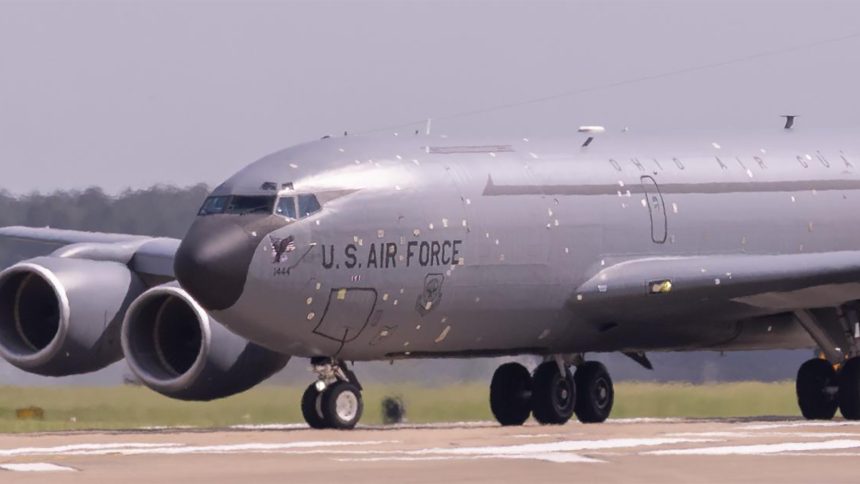
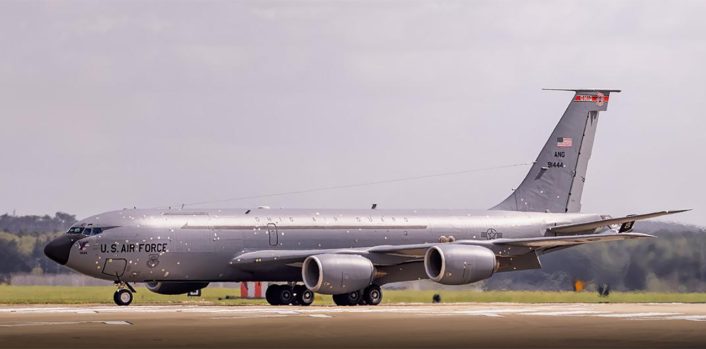
The visibly patched-up KC-135R Stratotanker that arrived at RAF Mildenhall on Apr. 12, 2026 was among the aircraft deployed to Prince Sultan Air Base when it was struck by Iran in March. After KC-135 Stratotanker 59-1444 arrived at RAF Mildenhall as REACH 717, spotters at the fenceline immediately noted its unusual appearance. Small unpainted patches of bodywork could be seen across the airframe, a telltale sign of battle damage repairs (BDR) made in the field. The spread of the small repairs is indicative of shrapnel damage from nearby explosions.
The aircraft had been noted deploying from the U.S. to the Middle East at the beginning of March. Specifically, its destination was noted as Prince Sultan Air Base in Saudi Arabia. In the weeks after the jet arrived in theatre, Prince Sultan Air Base was hit by several Iranian attacks.
The headline of these attacks was the total destruction of 81-0005, one of the U.S. Air Force’s precious few remaining E-3G Sentry AWACS aircraft. It came after the earlier attack in mid March reportedly left five KC-135s damaged – flight tracking data suggests that this attack may have been the one where this aircraft was damaged.
Few other details about the various attacks on the air base are confirmed at this stage, though unverified reports have said that U.S. Air Force EC-130H Compass Call and KC-46 Pegasus aircraft may also have suffered damage in the strike that destroyed the E-3 alongside other KC-135s.
The visibly patched-up KC-135R Stratotanker that arrived at RAF Mildenhall on Apr. 12, 2026 was among the aircraft deployed to Prince Sultan Air Base when it was struck by Iran in March. After KC-135 Stratotanker 59-1444 arrived at RAF Mildenhall as REACH 717, spotters at the fenceline immediately noted its unusual appearance. Small unpainted patches of bodywork could be seen across the airframe, a telltale sign of battle damage repairs (BDR) made in the field. The spread of the small repairs is indicative of shrapnel damage from nearby explosions.
The aircraft had been noted deploying from the U.S. to the Middle East at the beginning of March. Specifically, its destination was noted as Prince Sultan Air Base in Saudi Arabia. In the weeks after the jet arrived in theatre, Prince Sultan Air Base was hit by several Iranian attacks.
The headline of these attacks was the total destruction of 81-0005, one of the U.S. Air Force’s precious few remaining E-3G Sentry AWACS aircraft. It came after the earlier attack in mid March reportedly left five KC-135s damaged – flight tracking data suggests that this attack may have been the one where this aircraft was damaged.
I will remind folks that the WSJ reported that 5 tankers were damaged in a missile strike March 13th “in recent days”. Given that other Prince Sultan AB tankers had been seen since that report, my theory is that 59-1444 #AE0361 was one of those five tankers hit before 3/13. pic.twitter.com/ThsH5ReO6T
— Evergreen Intel (@vcdgf555) April 12, 2026
Few other details about the various attacks on the air base are confirmed at this stage, though unverified reports have said that U.S. Air Force EC-130H Compass Call and KC-46 Pegasus aircraft may also have suffered damage in the strike that destroyed the E-3 alongside other KC-135s.
KC-135R Stratotanker 59-1444 arriving at RAF Mildenhall with visible repair patches. (Image Credit: Mark Lynham) In the days following the second attack, the U.S. Air Force was noted to have mobilized a number of stored KC-135s from the ‘boneyard’ at Davis-Monthan Air Force Base for restoration to full service at Tinker AFB. This might indicate that some of the KC-135s damaged in theatre are not expected to return to service any time soon, if at all.
59-1444’s journey to Mildenhall was not without issue. On Apr. 10, as the jet was heading northwest over the Mediterranean, about to overfly Greece, it changed squawk code to 7700 – the worldwide general emergency code – and began an immediate turn and descent for Chania International Airport, a joint civilian-military airfield near Naval Support Activity Souda Bay.
The exact nature of this emergency is unconfirmed, though now we have images of the aircraft it would appear that a cabin pressurization issue could very well have been possible. Usually these types of faults are evident from a rapid descent and then levelling off at around 10,000 feet, where it is safe to fly without pressurization, though in this case the aircraft would already have needed to descend fairly quickly in order to successfully make the divert to Chania. If the diversion was indeed related to the temporary BDR, there may have been a need to make some further makeshift repairs at Chania before its onward journey.
Once the aircraft returns to the U.S. it will almost certainly head in to be assessed, and then, if feasible and economical, a major overhaul to rectify the damage and return it to full service.
Undertaking BDR is a fundamental skill for military aircraft engineers, and it is very common to see similar patchwork repairs made to retired aircraft relegated to ground training use. Some forces, including the U.S. Air Force, even hold competitions between maintainers for the best BDR efforts.
Aircraft that have flown in previous high intensity conflicts quite often still have BDR scars visible on the aircraft. On airframes maintained for heritage purposes, the BDR itself can often become a target of conservation efforts, the patch repairs being maintained to record that airframe’s historical provenance even when they could be completely repaired with modern techniques.

Looks as if a large SAM went off about 100 yards off the port side.
No, it was hit on the ground.
Ok. Thanks.
Duck tape.
It doesn’t look too bad to me.
I flew in several helicopters that I think the primary structural component was gorilla tape by the time we were done with them.
Of course, we weren’t a pressurized airframe and topped out at 120mph.
Reminds me of the Johnny Cash song about the survival of the American flag.
Ragged Old Flag (1974)
She waved from our ships upon the Briny foam
And now they’ve about quit waving her back here at home
In her own good land here she’s been abused
She’s been burned, dishonored, denied, and refused
And the government for which she stands
Is scandalized throughout the land
And she’s getting threadbare and wearing thin
But she’s in good shape for the shape she’s in
‘Cause she’s been through the fire before
And I believe she can take a whole lot more
So we raise her up every morning
We take her down every night
We don’t let her touch the ground and we fold her up right
On second thought, I do like to brag
‘Cause I’m mighty proud of that ragged old flag
https://www.youtube.com/watch?v=XfzJ8UBr-c0
Agreed as long as I wasn't inside the flying gas can.
That having been said, several posters here pointed out that the plane was sitting on the ground when struck.
Close. I think it is made by 3M
BRD tape is basically duct tape with aramid fibers and some sort of super glue that doesn’t stop being sticky when really cold or hot.
It will absolutely give you nasty splinters like handling fiberglass insulation.
BDR
Spicoli, “I can fix it!”

One of the few times that having an aircraft this old is a good thing - the 135 is basically an old Boeing 707 and is made of aluminum alloys. A recent aircraft would have been made out of composite and would not have been very repairable.
Believe it or not, the new tankers - KC-46 Pegasus also mainly aluminum -lithium alloys. They’re based on the 767.
They could have covered up the holes with LGBTQWERTY stickers and celebrated it’s landing with a parade.
I know about those, but the KC-46A is going to end up being just an interim solution - not least of which being because the 767 isn’t being manufactured any more. The NGAS proposal is out floating around and it is likely to be composite bodied.
We trained alongside the boomers at Altus.
Sad to see a wounded bird that is such a classic. They have been serving since I was 8 years old and saw my first one at Ramey AFB. That was a looong time ago now.
“Believe it or not, the new tankers - KC-46 Pegasus also mainly aluminum -lithium alloys. They’re based on the 767.”
____________________________________________________________
It’s true. You can go on the Boeing tour and see them being made and rolled out of the hanger. The Air Force planes have a special area for final assembly of their secret stuff.
It looks like it is plastered with Band aids!
*singing*
‘I am stuck on Band aids, ‘cause Band aids stuck on me!”
Disclaimer: Opinions posted on Free Republic are those of the individual posters and do not necessarily represent the opinion of Free Republic or its management. All materials posted herein are protected by copyright law and the exemption for fair use of copyrighted works.