Posted on 04/09/2026 12:30:05 PM PDT by UMCRevMom@aol.com
"The super-factory will alter everyday life. If it actually happens.
The announcement of Terafab was made at a decommissioned power plant, reflecting Elon Musk’s understanding of stagecraft: The ruined infrastructure of one era makes a convenient altar for the next. On March 21 and 22, 2026, at the Seaholm Power Plant in Austin, Musk presented Terafab. It is either the most ambitious semiconductor manufacturing project in history or a very expensive project that may not come to be.
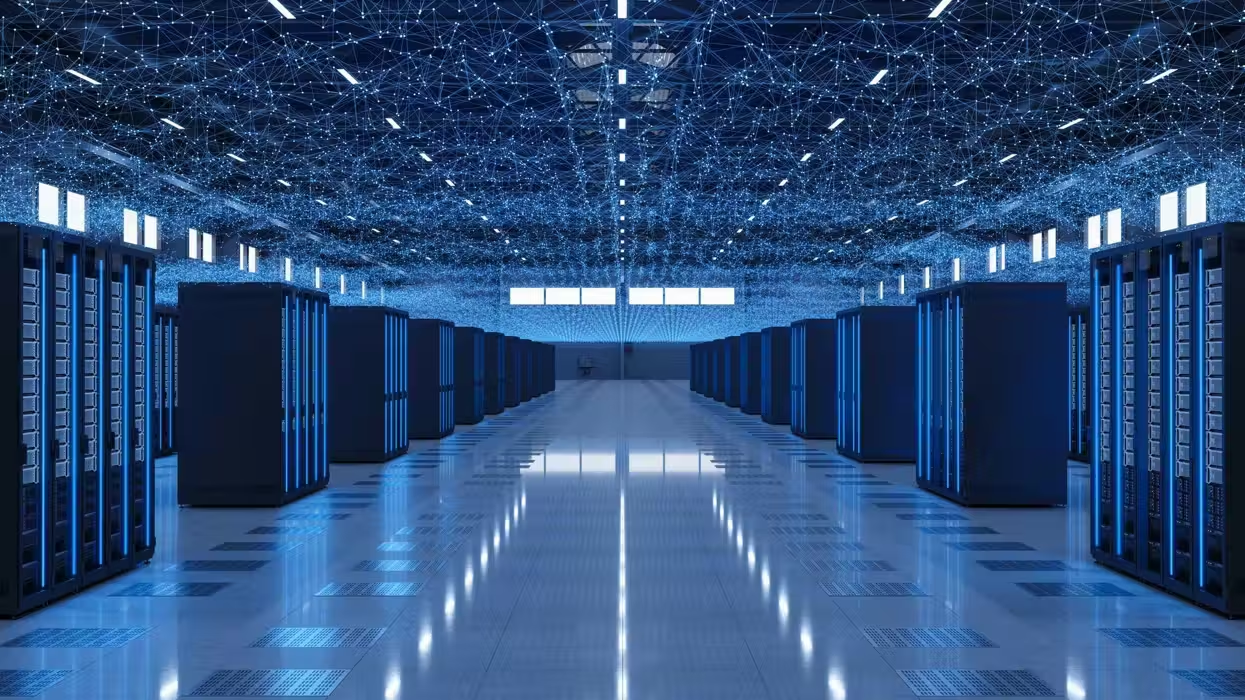
Terafab is a plan to build vertically integrated chip-manufacturing capacity in Austin, combining under one roof the design, fabrication, packaging, and testing of advanced semiconductors. Tesla, SpaceX, and xAI are the collaborating entities. The announced investment figure is $20 billion. The stated long-run target is one terawatt of compute capacity per year, a number that converts the language of performance into the language of power.
Terafab is a cultural event as much as a technical announcement.
Measuring compute in watts means that the limiting factor is energy throughput. The International Energy Agency has described data centers as a fast-growing fraction of global electricity demand; by 2030, in its base case, that demand could roughly double.
The technical core of Terafab is its most defensible part. The pitch is about iteration speed: If you can design a chip, fabricate it, package it, test it, and revise the mask, all inside one building, without shipping components between specialized facilities in different countries, you can improve faster than anyone who does not. In conventional semiconductor manufacturing, these functions are geographically and organizationally scattered. A mask set travels; a wafer ships; a packaged part crosses an ocean. Each journey is a delay, and delay is the enemy of the feedback loop. Terafab is a wager that learning velocity beats static node leadership.
Will this be an alternate to the data centers being built around the US (controversial in our neck of woods in NC)
Wouldn’t there be a terribly scary but ideal target for terrorists to wipe out so much with one missle?
Hi RevMom !!!! 👋
Betting against Musk is usually a bad bet.🤔
Look at all of the things a living creature does besides thinking. Those semiconductors are only brains. Our brains are only one part of our whole selves.
“ruined infrastructure of one era”
Idiot. It was shut down prematurely because of radical climanista lunatics, not because it was “ruined.”
Those data centers you see going up? They'll disappear like floppies.
yep. The data centers aren’t long for this world.
So Musk is inventing a River Rouge plant for chips. Could work. Could be state of the art. For awhile. The River Rouge plant was impressive. Until the whatevers shifted and now it’s a museum.
I like Musk but venturing into the Semiconductor world is much harder than space.
Even if you can afford EUV machines and steppers, you still need a solid set of design rules to play in the sub micron world.
I find it unlikely Intel, Samsung, TSMC or Global Foundry are going to license their design rules.
GF is way behind the curve so its remotely possible they might license as their fabs are pretty old.
Q: How do you make 50B in sub micron semiconductors?
A: Bring 100B to the table.
bookmark
Will this be an alternate to the data centers being built around the US (controversial in our neck of woods in NC)
Wouldn’t there be a terribly scary but ideal target for terrorists to wipe out so much with one missle?
Hi RevMom !!!! 👋
____________________________________________________________
No. It’s a self contained chip manufacturing facility.
“I like Musk but venturing into the Semiconductor world is much harder than space.
Even if you can afford EUV machines and steppers, you still need a solid set of design rules to play in the sub micron world.
I find it unlikely Intel, Samsung, TSMC or Global Foundry are going to license their design rules.
GF is way behind the curve so its remotely possible they might license as their fabs are pretty old.
Q: How do you make 50B in sub micron semiconductors?
A: Bring 100B to the table.”
__________________________________________________________
Musk is the kind of guy who’d buy Apple if that was what he needed.
Semiconductor design rules are commercially available for the most advanced chip designs from three companies in the world. The two American companies who offer them are Synopys and Cadence. The third is in Europe.
Waiting for the SpaceX IPO…….good book about Elon is Lift Off
Kindle
$11.49
Available instantly
Audiobook
$0.00
with membership trial
Hardcover
$9.91
Paperback
$15.19
Other Used, New, Collectible from $5.91
Buy New
$15.19 with 20 percent savings -20% $15.19
List Price: $18.99 List Price: $18.99
You Earn: 16 pts Learn more
Tomorrow
FREE delivery Tomorrow, April 10. Order within 31 mins
green leaf Shorter shipping distance
Deliver to Joyce - Venice 34293
In Stock
Quantity:
Quantity:1
Add to cart
Buy Now
Shipper / Seller
Amazon.com
Returns
FREE 30-day refund/replacement
Customer
service
Amazon.com
See more
Used - Like New
$9.49
You Earn: 10 pts
FREE delivery April 15 - 17
Ships from: BookOutlet USA
Sold by: BookOutlet USA
Save this item
Add to List
Other sellers on Amazon
New & Used (25) from $9.49 & FREE Shipping
Sponsored
Liftoff: Elon Musk and the Desperate Early Days That Launched SpaceX
Read sample
Play
Preview audio
Follow the author
Eric Berger
Eric BergerEric Berger
Follow
Liftoff: Elon Musk and the Desperate Early Days That Launched SpaceX Paperback – January 3, 2023
by Eric Berger (Author)
4.8 4.8 out of 5 stars (3,652) 4.5 on Goodreads 6,640 ratings
Editors’ pick
Best Biographies & Memoirs
See all languages and editions
“A colorful page-turner.” ―Walter Isaacson, New York Times Book Review
“As important a book on space as has ever been written.” ―Homer Hickam, #1 New York Times bestselling author of Rocket Boys
The dramatic inside story of the historic flights that launched SpaceX―and Elon Musk―from a shaky start-up into the world’s leading-edge rocket company.
SpaceX has enjoyed a miraculous decade. Less than 20 years after its founding, it boasts the largest constellation of commercial satellites in orbit, has pioneered reusable rockets, and in 2020 became the first private company to launch human beings into orbit, a landmark moment in the history of private spaceflight. Half a century after the space race it is private companies, led by SpaceX, standing alongside NASA, pushing forward into the cosmos, and laying the foundation for our exploration of other worlds.
But before it became one of the most powerful players in the aerospace industry, SpaceX was a fledgling start-up, scrambling to develop a single workable rocket before the money ran dry. The engineering challenge was immense; numerous other private companies had failed similar attempts. And even if SpaceX succeeded, they would then have to compete for government contracts with titans such as Lockheed Martin and Boeing, who had tens of thousands of employees and tens of billions of dollars in annual revenue. SpaceX had fewer than 200 employees and the relative pittance of $100 million in the bank.
In Liftoff, Eric Berger, senior space editor at Ars Technica, takes readers inside the wild early days that made SpaceX. Focusing on the company’s first four launches of the Falcon 1 rocket, he charts the bumpy journey from scrappy underdog to aerospace pioneer. We travel from company headquarters in El Segundo, to the isolated Texas ranchland where they performed engine tests, to Kwajalein, the tiny atoll in the Pacific where SpaceX launched the Falcon 1. Berger has reported on SpaceX for more than a decade, enjoying unparalleled journalistic access to the company’s inner workings. Liftoff is the culmination of these efforts, drawing upon exclusive interviews with dozens of former and current engineers, designers, mechanics, and executives, including Elon Musk. The enigmatic Musk, who founded the company with the dream of one day settling Mars, is the fuel that propels the book, with his daring vision for the future of space exploration.
Filled with never-before-told stories of SpaceX’s turbulent beginning, Liftoff is a tech startup saga of cosmic proportions.
This definitive history of SpaceX’s origins takes you inside the rocket factory to reveal:
A Definitive Tech Biography: Go behind the scenes with Elon Musk and the core team of engineers who willed a rocket company into existence, based on dozens of exclusive interviews.
High-Stakes Engineering: Witness the immense technical and logistical challenges of the first four Falcon 1 launches, from a Texas test ranch to a tiny, remote Pacific atoll.
Startup Against Goliaths: Understand the incredible risks and razor-thin margins of a company with just $100 million in the bank trying to compete with aerospace titans like Boeing.
The Birth of an Aerospace Giant: Discover the untold stories from the turbulent early days that laid the groundwork for SpaceX to pioneer reusable rockets and launch humans into orbit.
Read less
A
you still need a solid set of design rules to play in the sub micron world.
//////
I believe I read stories about Musk saying that he spent a considerable amount of time earlier in the year with the staff designing his chips to make sure it all worked.
You’re right it will be hard and harder than Rocket ships—even according to Musk himself. But the plant already has customers and capital and sufficient design know how plus and plus and plus the AI Recursive Self Improvement layer at all levels.
So its not just that the all the pieces of the stack are under one roof speeding up the iterative improvement cycle—but every piece itself is under a continuously improving iterative cycle.
Heck I’m building one of these right now. ... or anyhow I think I’m building one right now. Unlike Musk, I don’t know what I’m doing. I’m, how you say, vibe coding.
Sorry my response is so delayed.
My schedule is insanely overbooked.
Miss you guys!
Disclaimer: Opinions posted on Free Republic are those of the individual posters and do not necessarily represent the opinion of Free Republic or its management. All materials posted herein are protected by copyright law and the exemption for fair use of copyrighted works.