Posted on 01/21/2026 6:14:18 PM PST by Governor Dinwiddie
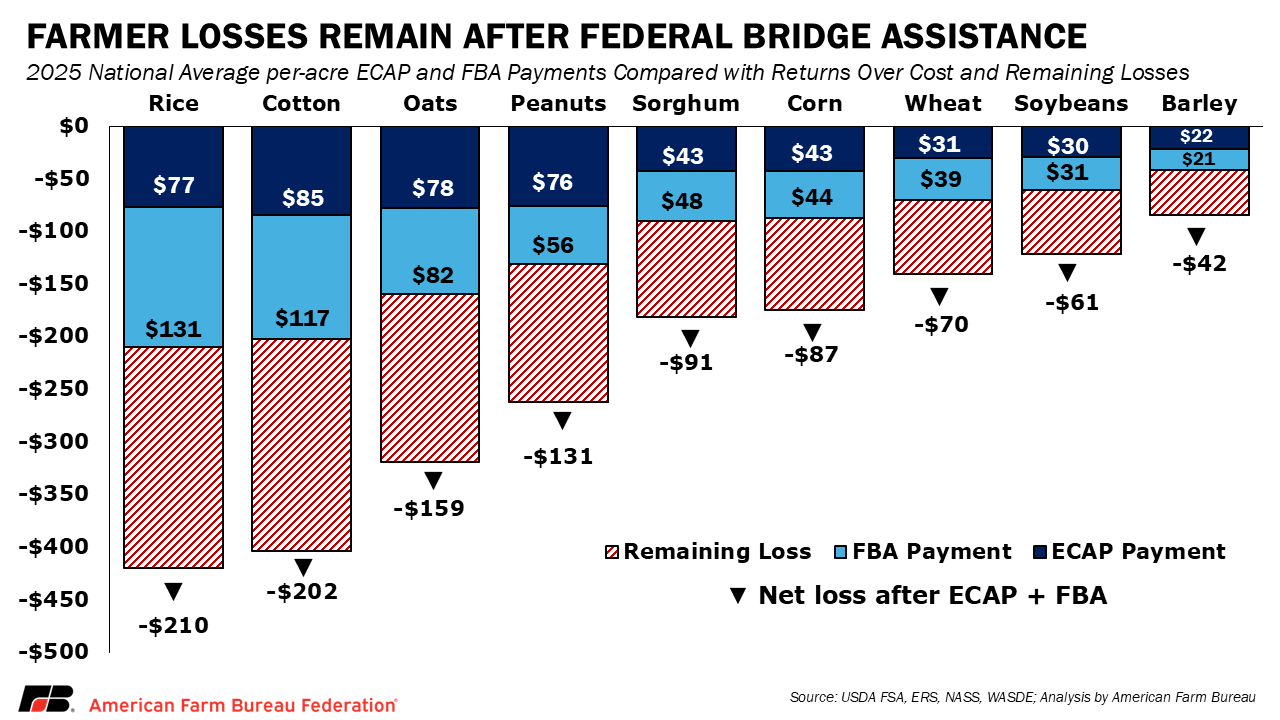
For many farms, aid helps slow the erosion of working capital but does not fully offset negative margins. As a result, producers continue to absorb multiyear losses that strain balance sheets, tighten cash flow and complicate access to operating credit. These loss estimates reflect national averages; actual costs of production and returns vary by region, management decisions and ownership structure. For example, producers who own their farmland may face lower total costs by avoiding cash rental expenses, resulting in higher returns.
Specialty Crops
Additionally, neither the FBA program nor the ECAP address losses in the specialty crops market. The 2024 Marketing Assistance for Specialty Crop Program (MASC) provided a first but limited relief step for growers and, for many, represented some of the first federal assistance tied to market challenges in the sector. Specialty crop growers continue to face deep and persistent economic losses driven by rising input costs, tightening margins, weather and disease disruptions, labor expenses and constraints, and global trade instability — challenges shared by field crop agriculture, including producers of crops beyond the nine principal crops, such as alfalfa and sugar beets. Strengthening support for all sectors of agriculture is an economic necessity. Doing so will help maintain a resilient, accessible and diverse U.S. food system.
Conclusion
ERS cost projections make clear that input costs for all of the nine principal row crops remain elevated and sticky. Continued increases in both operating and overhead expenses are pushing breakeven prices higher, while commodity prices remain insufficient to offset those costs for many producers.
While FBA and ECAP payments are an important and welcome step in addressing near-term financial stress, they do not fully close the gap between costs and returns. As farmers enter the 2026/27 marketing year, accumulated losses — estimated to exceed $50 billion across the sector over the past three crop years — continue to weigh on farm finances.
These estimates reflect national average conditions and are calculated ahead of the growing season, before producers make final planting, input and marketing decisions. In practice, farmers respond to market signals by adjusting crop mix, input use and risk management strategies as conditions evolve. While outcomes vary widely by region and operation, persistently elevated breakeven prices underscore the importance of market-driven solutions that strengthen domestic demand — such as year-round access to E15 — to help support commodity prices and improve farm margins.
Much-needed safety net enhancements through the One Big Beautiful Bill Act (OBBBA) are expected to take effect in October 2026, but those changes do not address the pressures farmers face today. In a recent letter to Congress organized by the American Farm Bureau Federation and signed by 56 agricultural organizations, farm groups warned of an economic crisis in rural America, citing multiyear losses driven by record-high input costs and historically low commodity prices. Congressional leaders from both parties have acknowledged the severity of these losses and the need for additional aid to stabilize farm finances. Until longer-term policy improvements take hold, many operations remain caught between high operating costs and low commodity prices, underscoring the ongoing financial strain facing U.S. agriculture as producers weigh whether they can afford to plant another crop.
The problem is we’re so darn good now...and farmers ain’t smart.
“Much-needed safety net enhancements”
Fancy phrase for welfare.
Most young farmers start off by leasing land.
There. Fixed it.
The big problem for the agriculture sector is other sectors of the economy have better and easier payouts.
That will change over the next 10-15 years.
Until the nonessential bloat in the global economy is eliminated, the essentials to our current level of civilization will be under valued & continue to recede.
People that grow crops will always be a backbone to our country.
From each worker according to their ability, to each farmer according to their need.
putting the smaller farmers out of business would seem to be the long term goal, same as it has always been
Ditto small businesses.
An article in the High Plains Journal this week pines for a process to level beef production with consumption. Remember The Grange? Yeah, that didn’t work either.
All commodities have the same problem.
They need to hire some Somali accountants.
Why don’t the farmers follow the Amish model.
**People like Bill Gates and his Banksters have been putting upward pressure on the cost of farmland. Dreams of owning your own farmland are disappearing over the horizon.
Most young farmers start off by leasing land.**
Very true. And heirs to farmland , that are not farmers, see $$, and want the $$. The farm may have been in their family for generations, but they don’t have a bond to the land; its just dirt to them.
**Why don’t the farmers follow the Amish model.**
Too much time and labor per acre is required. Modern farmers are addicted to gps and chemicals.
**putting the smaller farmers out of business would seem to be the long term goal, same as it has always been**
As my dad told me 45 years ago, when the Jimmuh Cawtuh guvmint embargoed grain to Ruzzia, which was a back breaker to an already strained high inflation-high interest rates farm economy:
“Its easier for the guvmint to control 20,000 farmers than 200,000.”
**Why don’t the farmers follow the Amish model.**
Too much time and labor per acre is required. Modern farmers are addicted to gps and chemicals.
**********
Well the Amish aren’t broke.
Disclaimer: Opinions posted on Free Republic are those of the individual posters and do not necessarily represent the opinion of Free Republic or its management. All materials posted herein are protected by copyright law and the exemption for fair use of copyrighted works.