Posted on 06/25/2023 5:54:48 AM PDT by Rummyfan
There is an overwhelming consensus that humanity is returning to a preference for absorbing information through pictures and video rather than text, and that the millennia and a half where the written word reigned is ending. This might sound apocalyptic to some minority of us, but it's hard to deny, and in any case it didn't become apparent with the rise of YouTube and TikTok influencers but decades ago, when a rumpled Englishman who looked like he emerged from the wood paneling of a university library told the story of western civilization with a TV series.
I feel like one of those people dismayed at the decline of text, but if I'm honest I'm like most of us and have always learned more, and faster, from the visual image – moving or still. I can name a half dozen TV documentary series that did more to form my worldview than almost any book I've read, back to the torpor of my TV junkie childhood. I want to use up a few dozen of what we once quaintly called "column inches" here talking about those shows, starting with the one that did more to make all the information I was getting from school, books, movies and pop culture cohere into a powerful narrative.
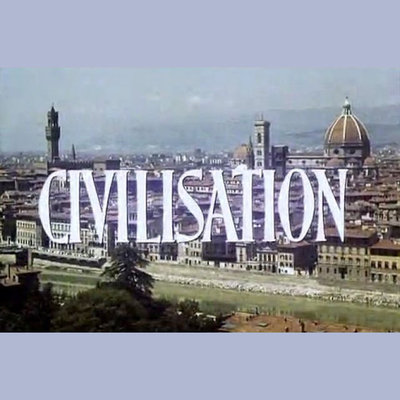
Civilisation – its official title, though it's always referred to as Kenneth Clark's Civilisation – debuted on February 23rd, 1969 on BBC2. It was not the first ambitious, comprehensive documentary series made by the BBC, but it was the first one broadcast in colour, which may account for its popularity and longevity. It cost £500,000 to produce and attracted unexpected numbers of viewers – 2.5 million in the UK, and 5 million in the US when it was aired on PBS a year later...
(Excerpt) Read more at steynonline.com ...
When the Insane takeover civilization collapses ,LOL
Interesting. But no one with critical judgment has ever doubted that “civilization” is a thin veneer, and easily compromised.
I started watching the series within the past year or so. I was VERY depressed by the first episode by the parallels I saw between our current time and the fall of Rome. I had to turn the episode off. I am now inspired to watch the remaining episodes.
“I said at the beginning that it is a lack of confidence, more than anything else, that kills a civilisation. We can destroy ourselves by cynicism and disillusion, just as effectively as by bombs. Fifty years ago W.B. Yeats, who was more like a man of genius than anyone I have ever known, wrote a famous prophetic poem:”
“Things fall apart; the centre cannot hold;
Mere anarchy is loosed upon this world,
The blood-dimmed tide is loosed, and everywhere
The ceremony of innocence is drowned;
The best lack all conviction, while the worst
Are full of passionate intensity.”
That last sentence says it all. That’s where we are!
Turning and turning in the widening gyre
The falcon cannot hear the falconer;
Things fall apart; the centre cannot hold;
Mere anarchy is loosed upon the world,
The blood-dimmed tide is loosed, and everywhere
The ceremony of innocence is drowned;
The best lack all conviction, while the worst
Are full of passionate intensity.
Surely some revelation is at hand;
Surely the Second Coming is at hand.
The Second Coming! Hardly are those words out
When a vast image out of Spiritus Mundi
Troubles my sight: somewhere in sands of the desert
A shape with lion body and the head of a man,
A gaze blank and pitiless as the sun,
Is moving its slow thighs, while all about it
Reel shadows of the indignant desert birds.
The darkness drops again; but now I know
That twenty centuries of stony sleep
Were vexed to nightmare by a rocking cradle,
And what rough beast, its hour come round at last,
Slouches towards Bethlehem to be born?
—William Butler Yeats, “The Second Coming”
True dat.
Excellent series. Well worth watching.
However,I somehow missed this one but I'll check it out at my local library.
The last time this statement could have been made with any intellectual honesty would have been at some point in the 1960s; we have been getting our news from television ever since. (Think of television as a high-tech painting on a cave wall.)
In Neil Postman's book, "Amusing Ourselves to Death", he points out the collapse in the public discourse that came about with the widespread use of television; reading forces one to comprehend a topic in a way television cannot. More importantly, a rebuttal to a point made in print requires an education in both dissecting a point and using logic to write out a rebuttal.
All of this is gone, so we're left with appeals to emotion.
I never thought of that angle. You make a critical point. “It is written” is much more significant than most of us realize.
Check it out. (Just prepare your family that you will be tossing the TV set into the garbage.)
It’s also a downside of the end of the Cold War.
The Cold War gave us something to rally around. It drove innovation, like sending a man to the moon.
Without the Cold War, we seem to have lost our definition of what we should be.
The episodes are available on Youtube.
I’ve recognized this for years following the initial surge of the internet. In essence we’ve become cave dwellers who can only express semi-coherent thoughts using what amounts to high-tech hieroglyphics. And you can’t create big revolutionary ideas typing with your thumbs.
Bkmk
The late Zbigniew Brzeziński said (some time in the last 20 years) that the United States had to sit down and ask itself what its purpose is.
(Because if it's just about money and entertainment, this is one society for certain that will never endure.)
There was a book version of it too.
Disclaimer: Opinions posted on Free Republic are those of the individual posters and do not necessarily represent the opinion of Free Republic or its management. All materials posted herein are protected by copyright law and the exemption for fair use of copyrighted works.