
Posted on 05/26/2023 8:18:25 PM PDT by SeekAndFind
With the X-date for potential US default now estimated at June 5, House GOP and White House negotiators appear to be settling on an agreement to raise the debt limit and cap federal spending for two years, Bloomberg reports, citing people familiar with the discussions.
That said, while the two sides have whittled down their differences over the past several days, the details are tentative, and a final agreement is not yet in sight. The two sides have yet to agree on the amount of the cap, however under the emerging agreement, defense spending would be allowed to rise 3% next year, which is in line with President Biden's budget request.
"We’re making progress and our goal is to make sure that we get a deal because default is unacceptable," said Deputy Treasury Secretary Wally Adeyemo, who warned CNN that payments to Social Security beneficiaries, veterans and others would be delayed in the event of a default. "The president has committed to making sure that we have good-faith negotiations with the Republicans to reach a deal because the alternative is catastrophic for all Americans."
The emerging deal would also include a measure to upgrade the nation's electric grid to be able to handle the massive requirements of renewable energy, a key goal for Democrats, while speeding up permits for pipelines and other fossil fuel projects demanded by Republicans.
The deal would also cut $10 billion from an $80 billion increase for the IRS that the Biden administration included in the Inflation Reduction Act, after Republicans warned of a 'wave' of audits led by new agents. Democrats say the increase will pay for itself via less tax cheating.
As Rabobank notes, the deal would cap just about everything aside from defense.
How exactly ‘close’ is defined is unknown – earlier in the evening it was reported that Republicans still required more spending cuts worth USD 70 billion – and a temporary suspension of the debt limit might still be necessary.
...
In a note last week, our US strategist Philip Marey stated that a suspension of the debt limit is likely, but he also underscored that the risk is substantial that the X-date will pass without an agreement on anything, and hence that some payments would be missed. According to the Wall Street Journal, the administration is preparing a contingency plan, but supposedly it does not yet mention any prioritization of payments. It rather discusses how to deal with a breach administratively.
As we noted earlier, putting this "deal" in context, the plan passed by the House GOP would reduce fiscal year ’24 spending by $130bn, or about 0.5% of GDP (setting aside the deficit saving from rescinding student debt forgiveness, which hasn’t been implemented yet and which may be struck down by the high court). At the other end, according to reports which indicate the White House may cap FY24 discretionary nondefense spending at FY23 levels would reduce spending by about 0.1% of GDP relative to a plausible baseline. So, the federal spending reduction for FY24 could range from 0.1% to 0.5% of GDP. The final "compromise" outcome - which may be announced as soon as Friday- will be a 0.2% spending cut.
Spoiler alert: spending will be cut by 0.2% of GDP. That's what all this drama is about - to make that seem like a giant sacrifice by both sides. https://t.co/Gb9vKWJr4e — zerohedge (@zerohedge) May 26, 2023
Today's daily update from Treasury showed that after a $25 billion benefits payment to Social Security, the Treasury's cash balance dropped by $27 billion to $49.5 billion, the lowest since 2021.
That means that net of roughly $80 billion in extraordinary measures (this number will have its weekly update Friday after the close), the Treasury now has approximately $140 billion in accessible cash. Which brings us to the good news: even net of the sizable cash drain on June 1 (just over $100 billion in scheduled payments) the Treasury is likely to retain a sufficient cash balance on Jun 1, the date which Janet Yellen has previously said was the X-Date, to extend operations for at least several days without a technical default.
Will the Freedom Caucus accept the deal?
Given that what's taking shape will be far less than Republicans' opening offer - which called for raising the debt ceiling through March in exchange for 10 years of spending caps, House conservatives appeared to already be balking at the current framework. On Thursday, the House Freedom Caucus sent a letter to Speaker Kevin McCarthy demanding that he stand his ground.
"We know where our differences lie," said McCarthy to reporters at the Capitol, adding that his team plans to work through the holiday weekend.
"We do not have an agreement yet. We knew this would not be easy. It’s hard, but we’re working. And we’re gonna continue to work till we get this done," he said.
Jan Hatzius and Alec Phillips of Goldman Sachs Group Inc. said in a note to investors that odds were highest for an accord to be reached on Friday. “Negotiators appear to be closing in on an agreement.”
Should a deal be reached soon, Tuesday is emerging as the likely day for a House vote. The Senate would then have to act quickly to send it to Biden’s desk before June 1, the date by which Treasury Secretary Janet Yellen has said her department could run out of cash.
The following day sees a payment due to millions of Social Security beneficiaries, putting pressure on politicians to resolve the impasse.
One of the negotiators, Rep. Garrett Graves (R-LA) described progress as "slow" on Thursday night, adding that the White House was holding firm against GOP demands to add work requirements to the eligibility for Medicaid and other social welfare programs.
"We have a lot of hangups," he said. "But that’s one of the bigger issues."
When Republican negotiator Rep. Patrick McHenry of North Carolina was asked Thursday evening what he would tell investors about the progress of talks, he shot back "Glad the market's closed."
On Wednesday, Fitch Ratings placed the US's AAA credit rating on watch for a potential downgrade - which hasn't happened since 2011, when Congress was at a similar impasse. According to the White House and the Treasury, Fitch's move demonstrates the urgency of reaching a speedy solution to the stalemate, however McCarthy said that negotiators don't need a ratings agency to convey the importance of getting this done.
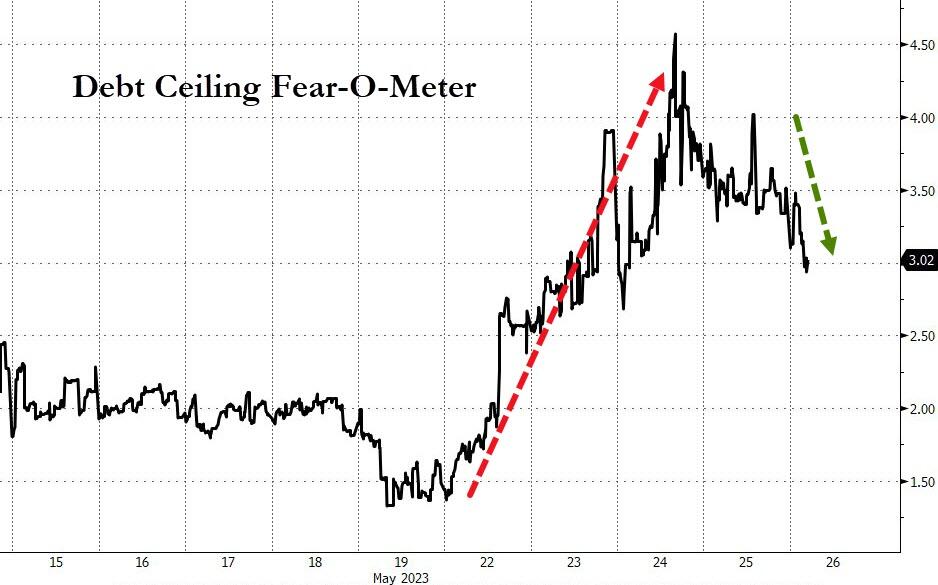
Meanwhile, it appears that the Treasury market feels a deal is nearly in hand.

Then again...
U.S Treasury bonds are junk, no matter what the rating agencies claim. That's because when it comes to sovereign debt the real risk is #inflation, not default. Anyone buying a 30-year U.S. Treasury is basically guaranteed to lose over 90% of their purchasing power. — Peter Schiff (@PeterSchiff) May 25, 2023
6 mo. at a time is the way to go until there is no need for increases anymore.
I’d rather see the demoncraps in hell before compromise.
10% for the Big Guy for Brandon's War.
I had an IT tech in Nigeria named Wally. Always lost as a ball in high weeds.
Comforting to know we have a Wally as deputy treasury secretary. Also a Nigerian. Good thing that since we don’t have any qualified people here.
https://en.wikipedia.org/wiki/Wally_Adeyemo
A whopping $10 to $70 billion in spending cuts.
Not a fart in a whirlwind.
WE are so fukt’d.
Can somebody tell McCarthy to stop negotiating please. The house has passed a plan. Until the Senate or the White House present a plan there is nothing to negotiate. When asked he should just say we’ve passed our bill where is their bill.
Looks like McCarthy has caved.
Anyone surprised?
“He was the first president of the Obama Foundation...”
Well, THAT’s a solid recommendation....
RE: A whopping $10 to $70 billion in spending cuts.
That is ONLY for the IRS that the Biden administration included in the Inflation Reduction Act. That is probably to prevent the hiring of 87,000 additional agents to snoop through your personal life.
The MEAT of proposal is this :
It would reduce fiscal year ’24 spending by $130bn, or about 0.5% of GDP (setting aside the deficit saving from rescinding student debt forgiveness, which hasn’t been implemented yet and which may be struck down by the high court). At the other end, according to reports which indicate the White House may cap FY24 discretionary nondefense spending at FY23 levels would reduce spending by about 0.1% of GDP relative to a plausible baseline. So, the federal spending reduction for FY24 could range from 0.1% to 0.5% of GDP.
RE: Looks like McCarthy has caved.
Exactly how did he cave, base on what was written in this article?
.
The GOP was trying to hold 2022 Spending Levels, not exactly Grapes of Wrath. If DC can’t do that with this Monster Budget, we’re in trouble.
They better plan for all negotiating to stop by Friday at 1:00pm, because no matter hell or high water, Biden is going for his Meds and Medical treatments at his Beach House.
.
We should be cutting Defense, especially the Army and the Marine Corps. But increase the Navy 3%. We need the ships (and the planes) to patrol the seas.
worthless
>>The final “compromise” outcome - which may be announced as soon as Friday- will be a 0.2% spending cut.
Ok, so to put that in perspective, if you SPEND $100,000/year, this would be spending $200 less. That’s an insulting reduction offer.
.
The plan in this article says that the IRS would get a $70 Billion increase, where Biden wants $80 Billion.
The question is more complicated, I think, but I don’t think that was the plan.
The Republicans are the only one with a Bill and it passed the House. There is no competing Bill. That Bill eliminates the $80 Billion increase Biden wants.
.
McCarthy is an unimaginative lying sack of chit. “It’s hard” … what an eff’n loser. McCarthy disgusts me.
It seems that everyone in DC has never had a real job in private sector during difficult times when a budget needs to be cut. Actually, it’s quite easy. I’ve survived a number of downsizings. One was particularly simple: every division had to cut 10%. It was so easy to do. Getting rid a dead weight lazy asses and waste is simple and enjoyable to do.
“defense spending would be allowed to rise 3% next year”
Take that Putin!!! Now we have a Wartime Economy!!! Oh Noes!!!
Yep, they are fighting “tooth & nail” over $130 billion in reduced spending when they are $1,375 billion in the red this year!! ($2,775 billion last year and $3,132 billion the year before that).
https://fred.stlouisfed.org/series/FYFSD
Of course he caved. The Pubbies always do. This was planned and expected long before today. Toss a few billion more into the initial budget and they can all congratulate themselves on the deal.
The biggest part of the cave is by pushing it out for 2 years, so the obscene scale of the federal government budget and deficit is off the table through the 24 election cycle.
Disclaimer: Opinions posted on Free Republic are those of the individual posters and do not necessarily represent the opinion of Free Republic or its management. All materials posted herein are protected by copyright law and the exemption for fair use of copyrighted works.