Posted on 04/02/2022 10:27:53 AM PDT by SeekAndFind
Viktor Orban has now served twelve years as prime minister of Hungary, emerging as one of the most exemplary conservative leaders of our time. On Sunday, he once again faces re-election as he seeks to lead Hungary for a fourth term as prime minister. Although this is a pivotal election for Hungary and for Europe, it is also vital for American conservatives to hope and pray for an Orban victory.
For one, Orban has shown what populist conservatives can do when given sufficient time and political capital to succeed. While it is true that the system of government in Hungary and its relative age has prevented the development of a U.S.-style "Deep State," Orban's refreshing willingness to use power for conservative ends has allowed him to deliver on ideological priorities and also benefit the Hungarian people.
His innovative family policies have seen birthrates rise, his independent foreign policy has allowed his country to wield outsized influence with regional and world powers, and his fortitude on immigration has helped preserve Hungarian national identity.
Over the last two years, I have had the pleasure of getting to know several leading officials within Orban's government, including now-president Katalin Novak, foreign minister Peter Szijjarto, and political director Balazs Orban. Like Prime Minister Orban, they are unashamedly patriotic, Christian, and anti-establishment, drawing the ire of globalists from Brussels to Washington. Nevertheless, Orban's government has stood strong, refusing to bow to globalist diktats and safeguarding the Hungarian nation's sovereignty and the Hungarian people's traditional values.
(Excerpt) Read more at americanthinker.com ...
THE REAL DANGER IN HUNGARY:
Now these very globalists are striking back. As 2020 showed, the number-one threat to U.S. national security is not any foreign adversary, but domestic subversion by an unaccountable elite that includes the permanent political class, the intelligence agencies, and the fake news media.
This enemy is currently at the forefront of the effort to remove Viktor Orban. There, it seeks to oust a democratically elected leader simply for prioritizing his national interest over the latest “current thing.”
Carlson had a good segment on this last night.
In many ways Orbán is Hungary’s Donald Trump.
The following groups are against Orbán:
EU bureaucrats
US bureaucrats
Globalists
The gay mafia
The US mainstream media
The EU mainstream media
Based on that list alone, it’s pretty easy to be for Orbán.
Really afraid they will steal this one too.
Jair Bolsonaro and Narendra Modi are the next targets after Orban.
Best leader in the world right now.
Great comment!
Recently they have seemed to have left nothing to chance when it comes to dislodging the elected official they disfavor and making sure their favored candidates either get re-elected or replace the designated incumbent baddies.
Let’s hope he wins.
For Hungary’s sake, and Europe he BETTER win!!!!!
What is the U.S. doing for this election? Last election (2017) “US State Department puts $700,000 into Hungarian media, demands “programming” against Orban, patriots” Foreign power interfering in other country’s elections?
Having lived in Budapest twice and learned the language, I am so glad Viktor Orban has kept Hungary as Hungary rather than just another small country to be gobbled up and destroyed by the globalists until it reached the point when it was no longer recognizably Hungarian.
Hungary is a beautiful Christian European country with extremely friendly people and over 1,000 years of distinct history. The world is a better place when distinct countries and cultures like this are preserved - which is what Orban has done and why globalists hate him so much.
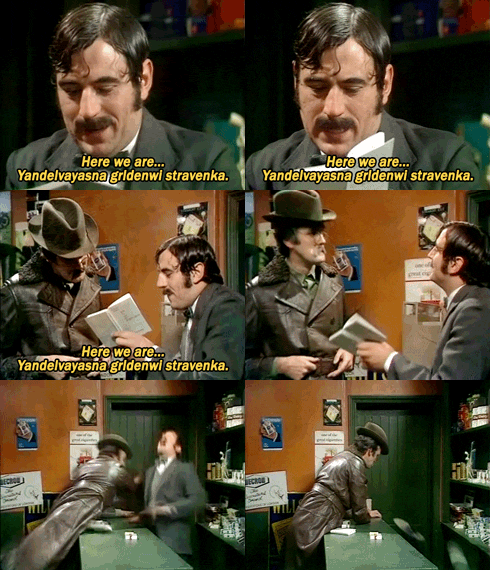
I hear that Hungarian is very difficult to learn. My Pop came to the US from Hungary around 1956ish. He would not teach us any Hungarian. He said in America, you speak American.
It is INCREDIBLY difficult to learn. It has some really weird concepts/structure I haven’t seen or heard of anywhere else.
A couple examples.....
Most languages have 6 verb conjugations. 1st, 2nd and 3rd person singular and plural. Easy enough. I, We, You (singular), You (plural), he/she/it, They.
Hungarian has 12. “How could it have 12???” you say? It has definite and indefinite.
Vasarolok egy auto = I buy a car. Its indefinite. It could be any car. Vasarolni = buy. The “ok” on the end means “I”.
Vasarolom az auto = I buy the car. See how the conjugation for “I” changed? Its definite. Its THE car. You know which specific car. Its like that for all 12 personal pronouns and in past tense, present tense and future tense.
More fun
plurals. In English except for about a dozen exceptions (child/children, man/men, woman/women, deer/deer, goose/geese etc) you can just add an “s” or “es” to the end of the word to make it plural.
In Hungarian if the word ends in a vowel you can just add a “k”. for example auto/autok. But if the word ends in a consonant the plural can be “ek”, “ak”, “ok” and there’s “e” with a slash above it as well as “o” with a slash above it or “o” with two dots above it....(Hungarian has 43 letters instead of 26 like in English).
So how do you know which one? You have to be able to tell if the vowels in the word are “deep” or “shallow”. Its difficult to explain....you just have to listen to it and get a feel for it.
Szek/Szekek = chair/chairs
Asztal/Asztalok = table/tables
hal/halak = fish/fishes
The same principle applies to possessives
for plurals, if you say the number of the thing, then you use the singular form of the word. for example
szek = chair
szekek = chairs
tiz szek = ten chairs Notice we did not say tiz szekek. That would be wrong. The literal translation would be “ten chair”.
As I said, its really got some wild structure and concepts you don’t see in other languages.
I tried the Duolingo Hungarian course, that lasted about two days, LOL!
Headed to Hungary this summer and I hope this man is still in charge
Oh yes, it is.
It’s a Uralic language, after all, and its closest relatives are the Mansi and Khanty languages of Western Siberia. It is - as a Uralic language - distantly related to Finnish, Estonian and Karelian, too; but Hungarian and Finnish are about as different as English and Persian.
Some things are easier, however,in Hungarian than in English- or so I’ve read: there is only one past tense, there is no grammatical gender (unlike in most Indo-European languages, though not in modern English), it is spoken just as it is written down, and its stress is always on the first syllable. Furthermore, there are practically no irregular forms in grammar and word-formation.
One wag once said that the Hungarian language could have been developed by a mathematician, its grammar and structure were that logical :-)
I know. I learned it when living in Budapest twice.
Yes there are only 3 tenses - past, present and future. There is also no gender.
BUT
There is definite and indefinite - which means 12 conjugations for each verb in each tense instead of 6.
There are 43 letters instead of 26.
To make plurals or possessives you have to be able to tell if a noun is “deep” or “shallow”.
It is one of the 2 or 3 most difficult languages to learn. The words are totally different from any info-European language and the grammar is both weird and wild.
Disclaimer: Opinions posted on Free Republic are those of the individual posters and do not necessarily represent the opinion of Free Republic or its management. All materials posted herein are protected by copyright law and the exemption for fair use of copyrighted works.