Posted on 06/24/2021 7:31:20 AM PDT by Red Badger
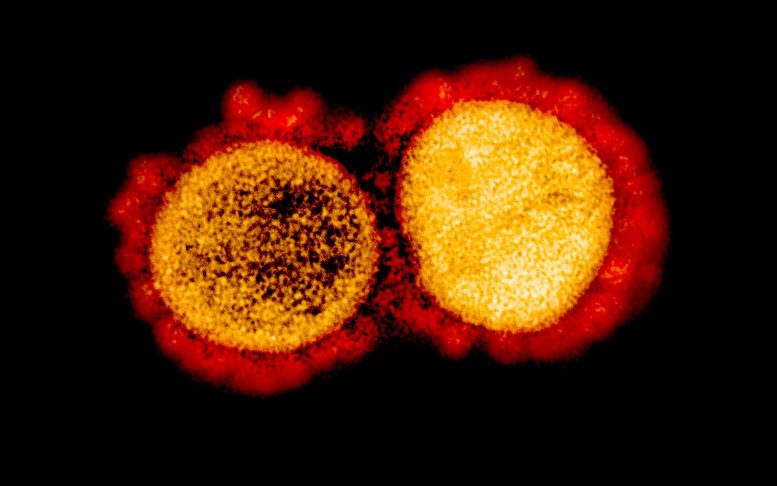
Transmission electron micrograph of SARS-CoV-2 virus particles, isolated from a patient. Image captured and color-enhanced at the NIAID Integrated Research Facility (IRF) in Fort Detrick, Maryland. Credit: NIAID ======================================================================================
Nanodecoys made from human lung spheroid cells (LSCs) can bind to and neutralize SARS-CoV-2, promoting viral clearance and reducing lung injury in a macaque model of COVID-19. By mimicking the receptor that the virus binds to rather than targeting the virus itself, nanodecoy therapy could remain effective against emerging variants of the virus.
SARS-CoV-2 enters a cell when its spike protein binds to the angiotensin-converting enzyme 2 (ACE2) receptor on the cell’s surface. LSCs – a natural mixture of lung epithelial stem cells and mesenchymal cells – also express ACE2, making them a perfect vehicle for tricking the virus.
“If you think of the spike protein as a key and the cell’s ACE2 receptor as a lock, then what we are doing with the nanodecoys is overwhelming the virus with fake locks so that it cannot find the ones that let it enter lung cells,” says Ke Cheng, corresponding author of the research. “The fake locks bind and trap the virus, preventing it from infecting cells and replicating, and the body’s immune system takes care of the rest.”
VIDEO AT LINK..........................
“Nanodecoys” made from human lung spheroid cells (LSCs) can bind to and neutralize SARS-CoV-2, promoting viral clearance and reducing lung injury in a macaque model. Credit: Ke Cheng, NC State University
Cheng is the Randall B. Terry Jr. Distinguished Professor in Regenerative Medicine at North Carolina State University and a professor in the NC State/UNC-Chapel Hill Joint Department of Biomedical Engineering.
Cheng and colleagues from NC State and UNC-CH converted individual LSCs into nanovesicles, or tiny cell membrane bubbles with ACE2 receptors and other lung cell-specific proteins on the surface.
They confirmed that the spike protein did bind to the ACE2 receptors on the decoys in vitro, then used a fabricated SARS-Co-V-2 mimic virus for in vivo testing in a mouse model. The decoys were delivered via inhalation therapy. In mice, the nanodecoys remained in the lungs for 72 hours after one dose and accelerated clearance of the mimic virus.
Finally, a contract research organization conducted a pilot study in a macaque model and found that inhalation therapy with the nanodecoys accelerated viral clearance, and reduced inflammation and fibrosis in the lungs. Although no toxicity was noted in either the mouse or macaque study, further study will be necessary to translate this therapy for human testing and determine exactly how the nanodecoys are cleared by the body.
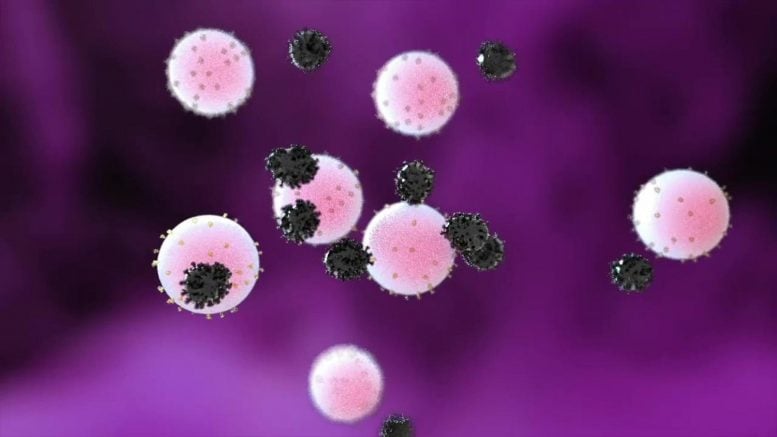
Nanodecoys bind with SARS-CoV-2 virus. Credit: North Carolina State University =====================================================================================
“These nanodecoys are essentially cell ‘ghosts,’ and one LSC can generate around 11,000 of them,” Cheng says. “Deploying millions of these decoys exponentially increases the surface area of fake binding sites for trapping the virus, and their small size basically turns them into little bite-sized snacks for macrophages, so they are cleared very efficiently.”
The researchers point out three other benefits of the LSC nanodecoys. First, they can be delivered non-invasively to the lungs via inhalation therapy. Second, since the nanodecoys are acellular – there’s nothing living inside – they can be easily preserved and remain stable longer, enabling off-the-shelf use. Finally, LSCs are already in use in other clinical trials, so there is an increased likelihood of being able to use them in the near future.
“By focusing on the body’s defenses rather than a virus that will keep mutating we have the potential to create a therapy that will be useful long-term,” Cheng says. “As long as the virus needs to enter the lung cell, we can keep tricking it.”
Reference: “Cell-mimicking nanodecoys neutralize SARS-CoV-2 and mitigate lung injury in a non-human primate model of COVID-19” by Zhenhua Li, Zhenzhen Wang, Phuong-Uyen C. Dinh, Dashuai Zhu, Kristen D. Popowski, Halle Lutz, Shiqi Hu, Mark G. Lewis, Anthony Cook, Hanne Andersen, Jack Greenhouse, Laurent Pessaint, Leonard J. Lobo and Ke Cheng, 17 June 2021, Nature Nanotechnology. DOI: 10.1038/s41565-021-00923-2
The research appears in Nature Nanotechnology and was supported by the National Institutes of Health and the American Heart Association. Dr. Jason Lobo, pulmonologist at UNC-CH, is co-author of the paper.
Authors: Zhenhua Li, Zhenzhen Wang, Phuong-Uyen C. Dinh, Dashuai Zhu, Kristen D. Popowski, Halle Lutz, Shiqi Hu, Ke Cheng, North Carolina State University; Leonard J. Lobo, University of North Carolina at Chapel Hill; Mark G. Lewis, Anthony Cook, Hanne Andersen, Jack Greenhouse, Laurent Pessaint, Bioqual, Inc.
Abstract: Coronavirus disease 2019 (COVID-19), caused by severe acute respiratory syndrome coronavirus 2 (SARS-CoV-2), has grown into a global pandemic, and no specific antiviral treatments have been approved to date. The angiotensin-converting enzyme 2 (ACE2) plays a fundamental role in SARS-CoV-2 pathogenesis as it allows viral entry into host cells. Here we show that ACE2 nanodecoys derived from human lung spheroid cells (LSCs) can bind and neutralize SARS-CoV-2 and protect the host lung cells from infection. In mice, the nanodecoys were delivered via inhalation therapy and resided in the lungs for over 72 hours post-delivery. Furthermore, inhalation of nanodecoys accelerated clearance of SARS-CoV-2 mimics from the lungs, with no observed toxicity. In cynomolgus macaques challenged with live SARS-CoV-2, four doses of nanodecoys delivered by inhalation promoted viral clearance and reduced lung injury. Our results suggest that LSC-nanodecoys can serve as a potential therapeutic agent for treating COVID-19.
I like the way these guys think!
Very interesting approach.
If successful, I suspect the same approach could be used for most respiratory viral infections. And maybe some non-respiratory ones as well.
I see such a report being an Excel file that's at least 10GB (meaning it contains a *lot* of data).
That group,if they felt particularly ambitious,could compile a similar report for Canada,Britain and other "civilized" countries. Of course nobody should believe anything coming from China so there's no need to waste the effort there.
Nasopharyngeal shedding of severe acute respiratory syndrome-associated coronavirus is associated with genetic polymorphisms. -- People with your genotype may have a lower chance of developing a corona virus infection.
Interleukin-10 (anti-inflammatory cytokine) - Risk of respiratory infection. -- People with your genotype have a lower risk of infection, if taking vitamin E supplements.
Association of SARS susceptibility with single nucleic acid polymorphisms of OAS1 and MxA genes. -- People with your genotype carry one marker that may increase your chance of developing a corona virus infection.
Association between mannose-binding lectin gene polymorphisms and susceptibility to severe acute respiratory syndrome coronavirus infection -- People with your genotype may have a lower chance of developing a corona virus infection.
Just a plain old TIMELINE would tell us a bunch.......................
Good news on the treatment front and I am all in favor of treatments over vaccines, because when treatments work they resolve life killing symptoms. help keep the body strong against a virus and provide the time and strength for the body’s defenses to work against the virus. With successful defense against how a virus kills, the patient obtains the antibodies that will successfully fight the virus for some time after that.
Not to throw cold water on this but I suggest everyone read a book called “Rigor Mortis” by Richard Harris (not the actor).
It is a thorough review of not only all the flawed studies-—far, far more than you think-—but WHY they are so bad.
*Mouse studies: Did you know that mice, even when “perfectly kept,” are susceptible to changes in height (mice stored in crates higher at Stanford’s labs responded differently in tests than mice stored on the floor); that mice respond differently to FEMALE scientists & techs than males, and even so much as a man’s sweaty t-shirt in the room produces anxiety in mice?
*Equipment: A major cancer study proved bogus because they ran the control group on the mass spectrometer on one day and the test group on the next. The equipment subtly changed overnight (barometer, temperature, age, whatever).
*Assuming all cancer cells were the same: hundreds (over 400) breast cancer papers were published using a cell line that was not breast cancer at all but melanoma.
*Virtually NONE of the flawed studies, even when acknowledged, are retracted. Thousands of papers remain in print AND CITED by doctors as fact when in fact they are baseless.
*The HeLa turns up everywhere. No, I don’t pretend to understand this except that it mimics many of the effects they think they are studying. This got so bad that independent “Cell Verification” insitutes were set up to guarantee that cell lines under study were not corrupted and were not HeLa.
*Sample size matters: one ovarian cancer study in mice looked incredibly successful. They tried it with 1500 humans-—looked good. Then they increased the sample to 3,300 and it flopped badly.
Now scientists are arguing that perhaps they ought to NOT closely control the “control groups” by age or whatever, and that it may be better-—more natural, and yield more accurate results-—just to go with random mixes.
Much much more in the book. If you’re taking the vax based on less than one year’s worth of highly questionable “research?” Good luck.
” If you’re taking the vax based on less than one year’s worth of highly questionable “research?””
There is decades of research behind this vaccine!
That's true.But an analysis like the one I propose would tell us,among other things "75% of fatalities in New York were nursing home residents"...35% of fatalities in Florida were nursing home residents". Or "0.12% of partially vaccinated people died after receiving the first shot...0.007% of fully vaccinated people died after receiving the second shot".
Try reading “Rigor Mortis.”
Chances are all of this previous research is corrupted and tainted.
They didn’t even know mice responded differently in tests to men and women!
No thanks. You take an untested vax. Not me.
You ignored the fact that I caught you spreading disinformation.
Try reading “Rigor Mortis” & get back to me on “disinformation.”
These were likely already corrupted series. All sorts of vaxes and “treatments” have been “in the works” for “years.” Not these.
Disclaimer: Opinions posted on Free Republic are those of the individual posters and do not necessarily represent the opinion of Free Republic or its management. All materials posted herein are protected by copyright law and the exemption for fair use of copyrighted works.