Posted on 05/24/2021 1:27:27 PM PDT by blam
Submitted by Nicholas Colas of DataTrek Research
The inflation of the 1970s/early 1980s is a big topic just now, but a deep dive into the historical CPI data shows the world was very different then. The CPI peak in 1974 felt awful because food/clothing was 33 pct of the index and prices were up 8-12 pct. Those items are just 14 pct of CPI now. May 1980’s 13-14 pct CPI inflation was driven by high mortgage rates, no longer even used in CPI. Bottom line: look forward, not backwards, and consider energy stocks, gold, “B”, and even US stocks as inflation hedges.
“You don’t know how to think about inflation unless you lived through the 1970s.” We see that comment a lot these days and can’t help but smile. I (Nick) do vividly remember inflation in the 1970s, mostly from going to the supermarket with my parents. I remember drinking powdered milk for years (cheaper than fresh, but not tasty) and only seeing beef for Sunday dinner. It’s certainly appealing to think that this experience somehow gives me an understanding other, younger market watchers may lack.
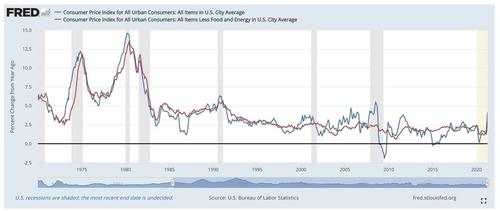
After all, just look at this chart of annualized changes in the Consumer Price Index, headline (blue line) and core (red line), back to 1968. If you weren’t watching your parents rummaging for every last penny to pay for food shopping or gasoline in the 1970s, do you even know what inflation means?
Dig into the historical CPI numbers, however, and one can reasonably question if the 1970s experience is really all that useful to understanding today’s world. Just because the CPI has been around since 1967 and those lines above tell an intuitively appealing story doesn’t mean the left side of the graph can tell us anything about the right side. Or, more importantly, about the future.
To show you what we mean, let’s zero in on those peaks in December 1974 (11-12 pct inflation) and May 1980 (13-14) and compare these to today (April 2021 data):
1974 vs. 2021 data:
• In December 1974, food and clothing were a combined 33.4 percent of the CPI. Inflation for these items was running 12.2 and 8.3 percent respectively.
• Now (April 2021), food and clothing are half the 1974 weightings (16.7 pct) and their respective inflation rates are 2.4 and 1.9 percent.
• In December 1974, rent and “household services less rent” were a combined 20.3 percent of CPI. Rent inflation then was only 5.2 pct (well below headline) but “household services less rent” (a measure of house prices) inflation was 15.0 percent since mortgage rates had gone from 7 to 10 percent over the prior 2 years.
• Now, rent and OER add up to a 33.0 percent CPI weighting, 62 percent higher than the 1974 weight. Inflation here is 1.8 and 2.0 percent, respectively.
• Interestingly, the 1974 weighting for gasoline (3.2 pct) is modestly lower than today’s (3.5 pct). Inflation rates are different, though: 20.2 percent in 1974, 49.6 percent in 2021.
Takeaway: December 1974’s inflation was about the stress to household budgets caused by higher prices for food and clothing – that’s why it lives on in so many people’s minds. Combined, these necessities were fully one third of consumers’ expenditures. Could the same thing happen now? Maybe, but whatever inflation rate these items see would have to be double their 1974 levels just to have a similar impact on headline inflation numbers. With global supply chains, even those temporarily stressed by logistical challenges, this seems unlikely.
And here’s how things developed by 1980:
• Food and apparel CPI weightings dropped to 23.1 percent, and both had inflation rates well below the headline number (6-7 percent vs. 13-14 pct).
• It was that “household services less rent” home price category, with a 21.7 percent weighting, that really pushed headline inflation higher. In December 1980 it was 22.8 percent above year-before levels. On its own, this category contributed fully one third (5.0 points) of May 1980’s 14.4 percent headline inflation.
• Gasoline prices were another important contributor to May 1980 inflation, adding 2.9 points to the 14.4 percent increase in prices (5.6 pct weight, +51.6 pct year-on-year change in price).
Takeaway: measured inflation in 1980 was all about housing prices and, to a lesser extent, gasoline. Take away these 2 items and headline inflation would have been less than half (6.5 percent) of the reported number (14.4 percent).
The overall point here is that those scary inflation spikes are rooted in specific categories that either struck very close to home (1970s food and clothing) or were actually “the home” (early 1980s house price inflation, measured with a pre-OER calculation). The cynical reader might wonder if those big early 1980s inflation prints, caused in large part by the Bureau of Labor Statistic’s methodology around measuring house prices, maybe caused the BLS to change their approach. The cynical reader has a point: Owners’ Equivalent Rent went into the CPI calculation in January 1983 and has never seen higher than a 7 percent inflation rate. Quite a difference from December 1980’s 23 percent, that.
Pivoting now to a final point, we want to give our answers to the question of “what’s the best inflation hedge right now?” Our thoughts:
• Oil stocks. If you’re looking for the fundamental root cause of 1970s/1980s inflation, consider energy prices. They went from $3/barrel pre-1973 to $43 in 1980. Paul Volcker was a brilliant man, but oil not getting back to $40/barrel until 2004 certainly helped his fight with inflation. The easiest path to sustainable inflation is at the well head, and energy equities should benefit. They are also a good geopolitical hedge against any sort of Middle East conflict, often a source of inflation on their own.
• Gold and maybe the online virtual currency that starts with “B”. Money flows into gold ETFs have been a primary driver of the yellow metal’s price over the last year; incremental inflation fears among investors should help it rally. If you want “digital gold”, “B” is a logical version of that but without gold’s 5,000-year track record. Also, we were looking at the Jan 2023 call options on GLD for a client today, and those are a capital-efficient approach to a gold position if one thinks inflation is coming sooner rather than later.
• US equities, if inflation climbs slowly but persistently. What economists call “inflation” corporations call “pricing power”. Decades of investment in IT should give US businesses an edge in managing rising prices within their supply chains and knowing where/how to pass those along to preserve and even enhance operating margins. And, inflation hits all producers relatively equally, so even the most fragmented industry should be able to move prices higher.
David Rosenberg: "A Whole Bunch Of People Are Really, Really Wrong" About Inflation
"Rosenberg essentially agrees with Fed Chairman Jerome Powell that the recent acceleration in inflation seen in April will be temporary."

I recall the 1970’s recession well. I had a small retail business and was locked into a 10 yr lease (pre inflation) and a 6% mtg taken out in 1968 so also preinflation. In fact I received several offers around 1973 for me to pay off the mtg at a discount which I refused. Mtgs at the time were about 15 to as high as 17%. Treasury Bonds at 30 yrs were paying 15%.
I got a call from a friend of mine at the bank who informed me that International Harvester was selling Commercial paper and offering 21% per annum. Here’s the best part. At that time and at least with this bank (Citizens 1st National Bank, NJ) the money was collected from investors and combined to make the purchases of the CP. Upon redemption, usually 90 days the invested amount plus interest (21% annually prorated) was returned. No tax info was ever taken by the bank from the investors and I never paid a cent in Fed or State tax.
The 70’s were not all bad...except for Disco.
In before the weeping, wailing, screaming and suicides begin.
I remember the 1970s inflation, horrible. Everything going up in price weekly. We were saving up for the down payment on getting a house, any house. House prices dramatically going up every week, and saving for a down payment was being outpaced by the price increases. We had to settle for a lesser house than the ones we looked at a few months prior, and were pinching pennies after getting the house, in order to buy groceries and gas (which dramatically increased in price). Had a few years of being broke until I was able to get a better paying job.
in 1970, if you made minwage a Z/28 was a little less than a years pay
2021?
Right. The way the current CPI is computed, it does not measure inflation. It considers that technological progress and improvements in production efficiency don’t make things cheaper, they make money more valuable. So, working smarter and harder is “deflationary” and offsets the effect of printing more dollars.
Prices of cars were insanely low compared to now, but so were wages. In 1973 my wife bought her brand-new Datsun/Nissan coupe fully loaded with options, out the door for $2500 including tax and registration. Kept using it until the mid-1990s when she sold it to a friend, good return on the money.
nice
Disclaimer: Opinions posted on Free Republic are those of the individual posters and do not necessarily represent the opinion of Free Republic or its management. All materials posted herein are protected by copyright law and the exemption for fair use of copyrighted works.