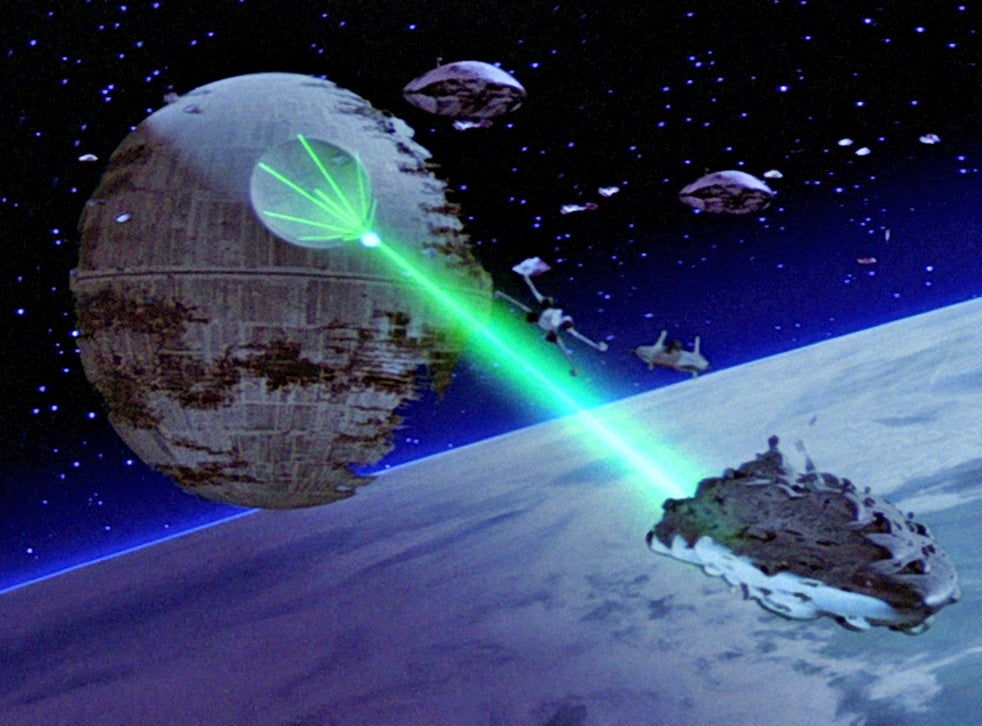

"I would like a Phased plasma rifle in the 40-watt range."
Posted on 11/26/2020 10:01:21 PM PST by texas booster
After decades of toiling and dead-ends, the dream of operational laser weaponry is about to become a reality. So, what changed that made what had been bulky systems go from clumsy pipe dreams to hardened, miniaturized, and reliable weapons that will be able to be deployed even in the harshest of conditions?
We recently had an in-depth interview with Dr. Rob Afzal, Lockheed Martin Senior Fellow, Laser and Sensor Systems, where I pressed him on everything related to laser weaponry and the emerging military applications that go along with it. In the course of answering my maelstrom of queries, Dr. Afzal eloquently conveyed how we have suddenly arrived in an era where laser weapons will become widespread across the battlefield. In this first piece in our two-part series with Lockheed's directed energy guru, I wanted to share his explanation with you, as it is fascinating in its own right.
Here ... is what technological developments have made the dawn of laser warfare possible according to Dr. Afzal:
"If you think back, that the laser is actually invented in roughly 1960. So, it begs the question, that's 50 years—why aren't there laser weapons all over the place today? There are really two reasons for that.
So, the threat landscape is evolved. And then in the technology space, there were two revolutions that really started to take place. The first was fiber-optic telecommunication, so I'll get to why that's relevant to directed energy.
All of a sudden, in the '90s, billions and billions of dollars started to pour into the development of fiber-optic communications equipment—how to make the optical fiber, how to pull kilometers and kilometers of it with high purity, how to make high-speed electronics to be able to do communications, semiconductor diode lasers to send the data down the fibers.
(Excerpt) Read more at thedrive.com ...
All the microelectronics and iPhones and so forth, were starting to be drilled and the touch screens were being scribed, and all this whole industrial space opened up, and the reason was that these fiber lasers were very efficient at converting electrical power to optical power. The beam quality that came out of the fiber-laser, meaning the ability for that beam to be focusable, to provide a high-intensity spot to do things, like melt metal and drill holes, the beam quality was very high. So, all of a sudden, the industrial space really opened up and the development of high-power fiber-lasers really, really took off.
That was particularly interesting, except for the fact that the power out of a fiber-laser doesn't scale to a weapons class, right? It's one thing to cut metal that's centimeters away, it's another thing to take out a mortar at two kilometers. So, the innovation that changed the game in the last five years or so, Lockheed Martin was a real leader or the leader in this innovation, and the innovation involved bringing together the technologies from fiber-optic communications and the technologies of high-power lasers for industrial applications to figure out a way to scale fiber-lasers to weapons class power... (con't)
Fundamentally, what we did was we took something, if you're familiar with wavelength division multiplexing in telecommunication—how to break up the spectrum that's available to you into many different laser-lines and send all that light down a fiber to increase your communications bandwidth. So, all of a sudden, we took a large number of fiber-laser channels, all closely spaced in wavelength or in frequency, and then by reflecting those beams off an object. We could call it a grating, or you can think in your mind of it like a prism, the beams all combine into a single output beam. Patty always loves this analogy I use, which is Pink Floyd's Dark Side Of The Moon record cover.
So, if you look at that prism, there's a white light beam that comes into the prism and it breaks up into the colors of the rainbow, you could run that in reverse, you could have a whole bunch of beams that cover the different spectrums, and if you put it through the prism, they all combine and output a single beam. We call it kinda the ‘reverse prism effect.’ So what all of a sudden we were able to do was to scale laser power in a modular way. Instead of just trying to build a bigger and bigger laser, we're actually scaling by adding lasers up.
Think of it as a mainframe computer breaking up into a supercomputing cluster. So, instead of just building a bigger device, we're combining in parallel. And so, what that enabled us to do is build a high-power laser that's scalable by adding modules that delivered a weapons class beam, but with very high beam qualities.
The fiber-laser technology is also, as I mentioned, the most efficient at converting electric power to laser light. So, all of a sudden that meant that the platform demands, whether you're on a ship, a truck, or an airplane, of being able to provide power and then cooling is minimized; it's certainly not zero, and we're talking about 30% to 35% efficiency at converting electric power into a usable laser beam. That may not sound that great to you, but compared to old solid-state laser technology, it was more like 10%.
It's a big, big deal.
What that meant was that the system demands, the platform demands were greatly reduced, and it meant that the laser weapon, not just the laser, the whole laser weapon, could now start being made small enough, powerful enough, to now be deployed on Army vehicles, Navy ships, and even on aircraft. So, that's really what changed the game. And as you can see, there's a lot of activity in this domain from our customers, all the services are now advancing capability in laser weapon systems for land, sea, and air. Lockheed Martin is a premier provider of this technology in all these domains, and we are working in all these domains.
So, the kind of the key message is the final piece of the puzzle to enable the fielding of laser weapons was solved using the fiber, the beam combined—spectrally beam combined fiber laser technology. Now what we're looking at is we're moving beyond S&T, Science and Technology demos... Is this even possible? We are now seeing those initial systems being built and ready to be deployed on platforms. For example, we have the program, the HELIOS [High Energy Laser and Integrated Optical-dazzler and Surveillance] program, which is to build, integrate, and install a laser weapon system on a DDG Arleigh Burke class destroyer.
One would imagine that if you have a large number of low-cost threats, you don't want to use high-cost, highly capable kinetic missiles against low-cost UAVs, right? You want to use your laser that has a low operating cost after the install and then you can hold your kinetics for more hardened threats that maybe the laser is inappropriate for. So, being able to provide choices, capabilities, to take on the evolving threat landscape, I think really is the value proposition that we are trying to provide our customers. So, that's kind of it in a nutshell.
Lockheed Martin, we've been in this business for about 40 years, really starting with the Airborne Laser program, where Lockheed Martin was the lead on the beam control system, and it's evolved over time, where we have built capabilities in beam control, tracking, line of sight stabilization, and then platform system integration, which is really a key core competency of Lockheed Martin, right? We also build a lot of the platforms, so how you install and interface these systems with the combat systems or the control stations, and providing that interface to the user is really important.”
Where did you do this? I worked at Corning’s science center when they were creating a green laser.
Just a matter of time and we will have this.
https://static.independent.co.uk/s3fs-public/thumbnails/image/2014/02/18/17/pg-28-star-wars-lucas-fox.jpg?width=982&height=726
A nice discussion of military technology under Trump.
This article is from a discussion with Dr. Rob Azfal of Lockheed Martin.
“fiber-laser technology”
Fascinating., I didn’t even know that was a “thing”!
BttT
Why isn’t anyone posting screencaps from Real Genius?
also how soon it will be turned against people by big tech, big business, big govt.
unnfortunately this is true for almost every innovation so far.
"invented in roughly 1960. So, it begs the question, that's 50 years"
I had an offer from Corning around 1990 to work in fiber marketing, but there was an April blizzard when I visited. I said “No thanks.”
Everything you put on FR is zooming along tiny strands of glass fiber and is put there by laser diodes.
That does tend to raise some basic questions about Dr. Afzal.
20 yr tecb writer telecomm. Fiber optic and power-line carrier. Excellent proofreader too. Need work.
Ps. Hate using phones to msg. 20 year tech writer.
“Phased plasma rifle in the 40-watt range.”
“Hey, just what you see, pal.”
“You can’t do that!”
“Wrong!”
Not only do laws not stop criminals, they also don’t stop mission-committed, time-traveling robot assassins (from the future).
Probably not from the past either. If there were any such robots in the past. Heh
Disclaimer: Opinions posted on Free Republic are those of the individual posters and do not necessarily represent the opinion of Free Republic or its management. All materials posted herein are protected by copyright law and the exemption for fair use of copyrighted works.